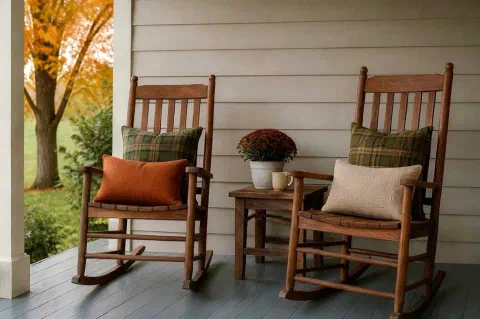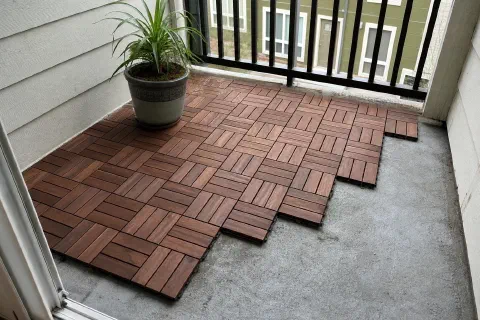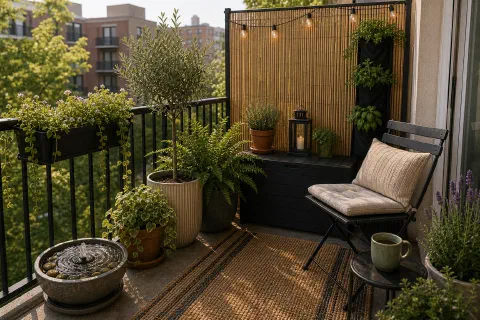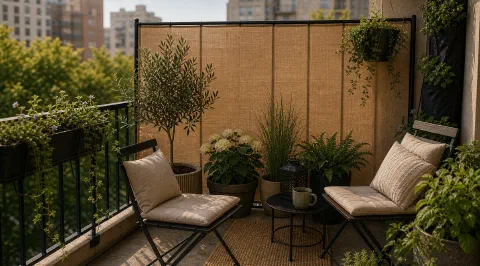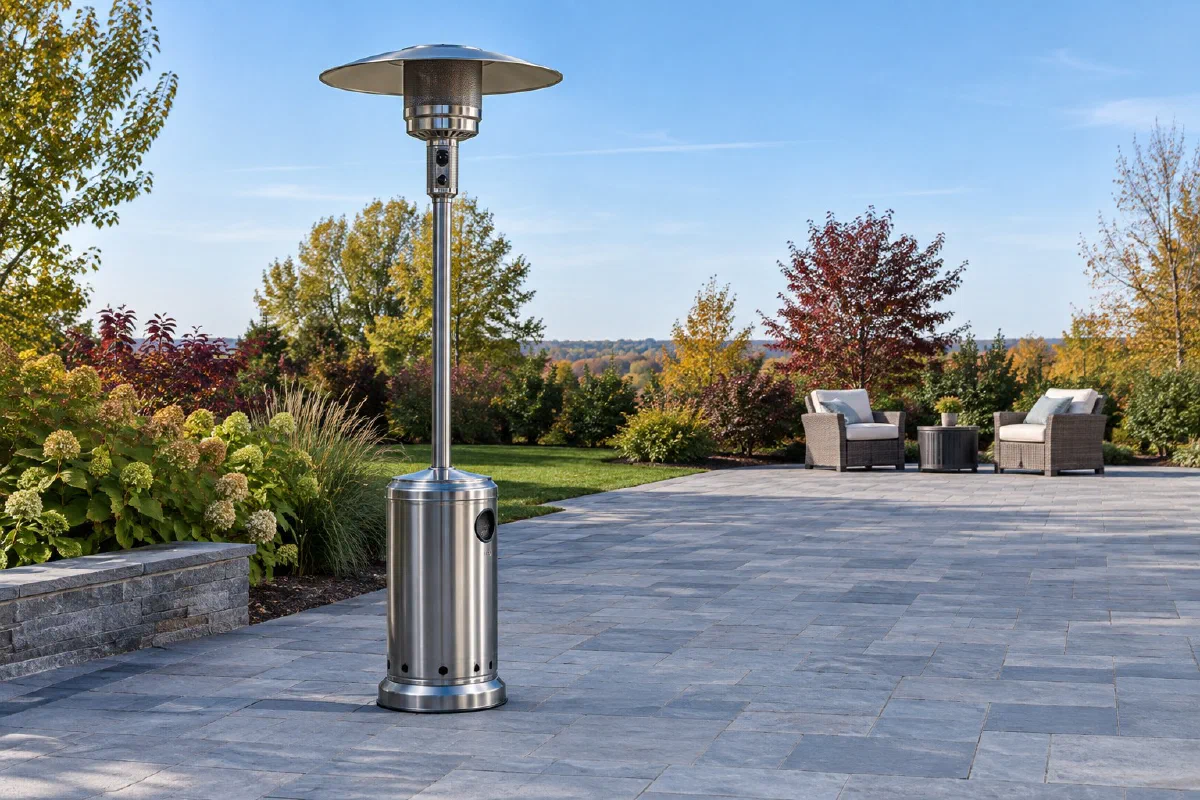
The patio does not stop being usable in October. It stops being comfortable, which is a different problem and a much cheaper one to fix.
Here is the part that trips people up. A patio heater does not warm your patio. It warms a specific piece of it, and the size of that piece is set by the fuel and the output, not by the price tag or how good the thing looks. Buy the wrong type and you get a handsome object that makes one chair warm and leaves the other one cold.
So this guide runs in the order the decision actually gets made. Fuel first, because it eliminates most of the catalog. Then the numbers in plain terms. Then clearance and safety, which is the part that genuinely matters. Then the picks.
I checked every listing below on August 24, 2026. Ratings and review counts are what showed that day, and the tradeoffs come from the published specs rather than from anything I am guessing at. Ratings move, so treat them as a snapshot.
If neither installation fits, keep the seats in the usable area you already have. If you are considering a fire pit instead, use the budget fire pit buying guide to compare fuel, required space, and the complete setup before switching products. A roof does not make a propane heater safe; never use an outdoor-only heater in an enclosed space.
Which Patio Heater Is Most Effective?
Propane is the most effective choice for a large, uncovered patio because a standing model can produce 40,000 to 50,000 BTU. Electric infrared is more effective for two to four seats under a roof because it aims heat at people instead of trying to warm moving air. Natural gas makes sense when a permanent gas line is already part of the patio plan.
| Your space | Best heater type | Why it works there | What to avoid |
|---|---|---|---|
| Open patio with four to six seats | Standing propane | High output and a broad circle of heat | A 1,500-watt plug-in heater trying to warm the whole patio |
| Covered porch | Electric infrared | Directed heat, no tank, and no open flame | A mushroom-style propane heater below a low roof |
| Apartment balcony | Electric infrared, if the lease allows it | Compact, quiet, and available in wall or ceiling mounts | Propane tanks where the lease or fire code bans them |
| Large permanent patio | Natural gas | Continuous fuel and high output | Installing a fixed line before the seating layout is settled |
Propane is the right answer for an open patio or a deck with nothing overhead. It needs no outlet, it goes wherever you roll it, and it makes far more heat than anything you can plug in. The costs are real: you are managing a 20 pound tank, refilling it, and storing it outside. It also cannot go indoors or into an enclosed space, which rules out a sunroom and most screened porches with the panels in.
Electric infrared is the right answer for a covered porch, a small balcony, or anywhere with a roof and an outlet. It warms objects instead of air, so it works in a breeze where a warm-air heater would not, and there is no tank and no flame. The ceiling is the limit: a standard 120 volt outlet caps you at 1,500 watts, and no brand gets around that.
Natural gas is the best of the three if you already have a gas line near the patio. It never runs out mid-evening and there is no tank to refill. It also needs a plumber, a permit in most places, and a fixed location forever. If you are not already planning outdoor work, this is a next-project answer rather than a this-weekend one.
A rough test: if there is a roof over the seats, buy electric. If there is open sky, buy propane.
BTU and Watts, Translated
The numbers on these listings are not comparable until you convert them, and once you do the gap is enormous.
Any plug-in electric patio heater tops out at 1,500 watts, which works out to roughly 5,100 BTU per hour. That is not a brand limitation. It is what a standard household circuit will carry. A standing propane heater runs 40,000 to 50,000 BTU. So propane makes something like eight to ten times the raw heat.
That sounds like propane wins outright. It does not, because raw output is not what you feel.
Infrared heat travels in a line and warms whatever it lands on, the way sun through a window warms your arm on a cold day. Point a 1,500 watt infrared heater at two chairs eight feet away and those two chairs are genuinely warm. Point it at an open lawn and you have heated the lawn. A propane heater does the same thing in a circle around the post, then loses most of it upward.
Translated into real spaces:
- Two chairs on a covered porch or a balcony. One 1,500 watt infrared unit aimed at the seats. Anything bigger is wasted.
- A four to six seat open patio. A standing propane heater at 40,000 BTU or more. Expect a warm circle roughly nine or ten feet across, not a warm patio.
- A long deck or two separate seating areas. Two heaters, both run lower, beats one heater run high. Same as with light and with speakers: two moderate sources always cover better than one loud one.
The honest version of the whole category is that these things buy you a comfortable pocket. If you want the whole yard warmer, that is a fire pit conversation, and fire pit seating size is where the geometry gets worked out.
Clearance and the Rules That Are Not Optional
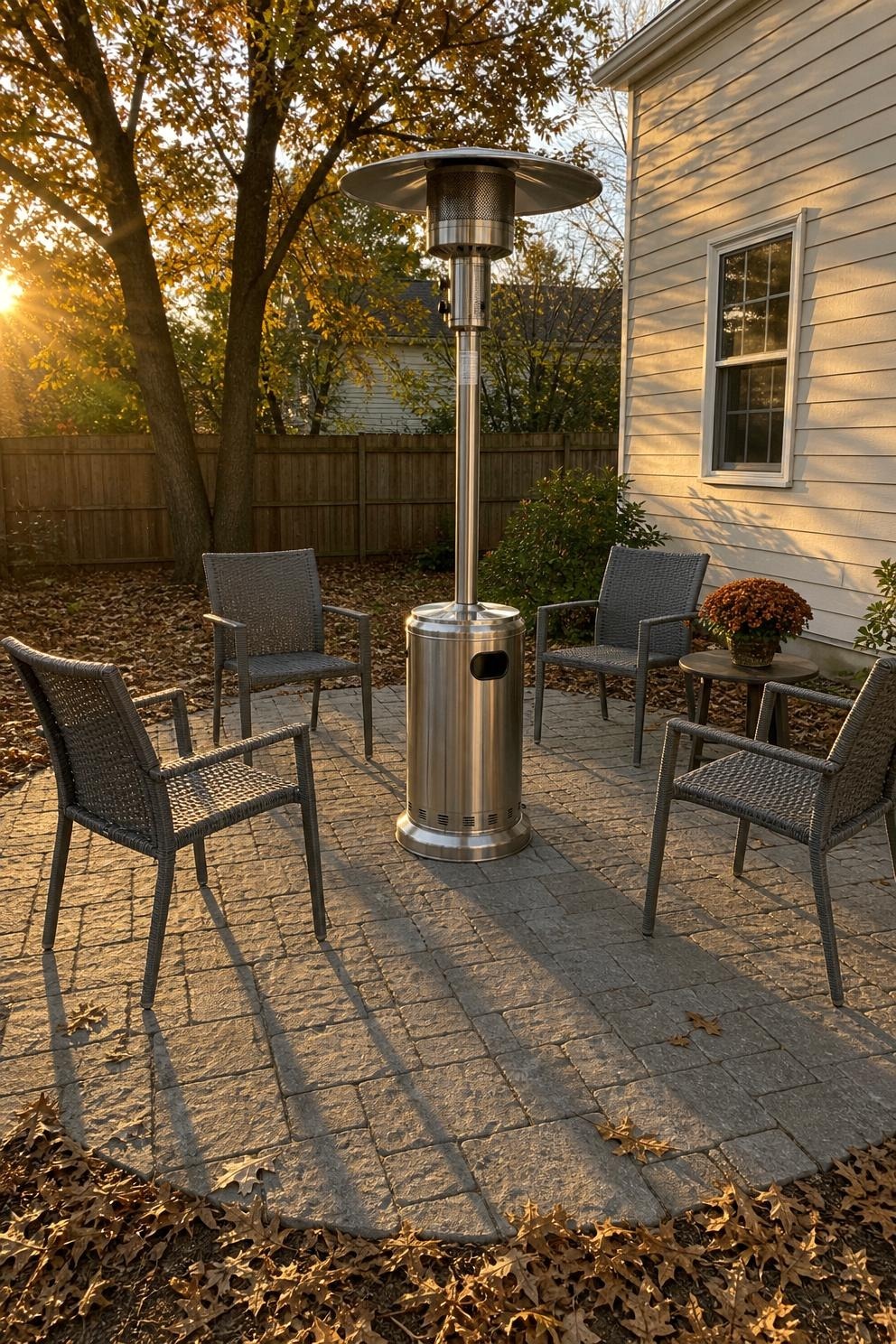
This is the section worth reading twice, because the failure modes here are burns and carbon monoxide rather than a wasted evening.
Never run a propane patio heater indoors or in an enclosed space. Not in a garage with the door cracked, not in a gazebo with the sides zipped shut, not on a porch that has been closed in for the season. Propane combustion produces carbon monoxide, which you cannot smell and which accumulates. The tall mushroom-style heaters are outdoor-only, full stop. The U.S. Fire Administration keeps a plain-language summary of outdoor fire safety at usfa.fema.gov worth five minutes before the first cold evening.
There is one real exception, and it is a category rather than a loophole. Mr. Heater’s Buddy line is certified as indoor safe and carries an oxygen depletion sensor that shuts the unit off if oxygen in the room drops. That is a genuinely different product from a standing patio heater. Even then, read the manual for that specific model before using it anywhere partly enclosed, and do not extend the exception to a heater that does not carry it.
Give it the clearance the manual asks for. Every heater publishes a minimum overhead and side clearance, and the number is model specific, so check yours rather than eyeballing it. What this rules out in practice is predictable: a standing propane heater does not belong under a low awning, a fabric market umbrella, a canvas-topped pergola, or a vinyl porch ceiling. The heat goes straight up.
Fill the base and use the tip-over shutoff. A standing heater is around seven and a half feet tall with a tank at the bottom, and a gust catches it like a sail. Most models have either a water-fillable base or a weighted one, plus an anti-tilt valve that cuts the gas if it goes over. Fill the base the day you assemble it. Skipping that step is the single most common way this goes wrong.
Electric needs its own outlet. A 1,500 watt heater draws about 12.5 amps, which is most of a 15 amp circuit. Give it a dedicated outdoor GFCI outlet and do not put string lights, a radio, and a heater on the same one. If the breaker keeps tripping, that is the reason.
What Renters and Small Balconies Can Actually Use
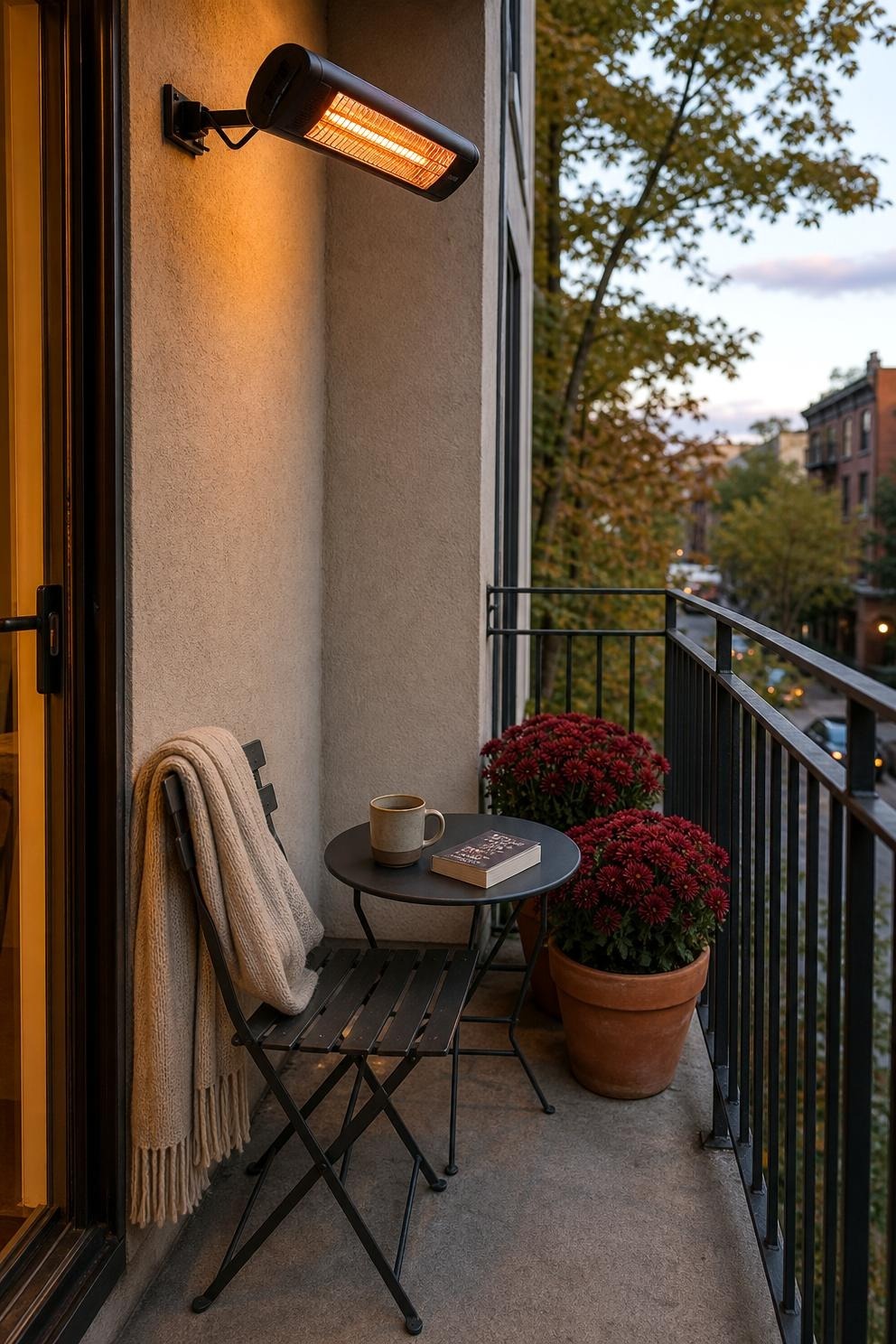
Check the lease before you check the reviews.
A lot of apartment buildings ban propane tanks and open-flame heaters on balconies outright, and many local fire codes back that up. Some go further and prohibit storing a tank anywhere on the property. This is the most common wasted purchase in the whole category: a heater bought in September, assembled on a balcony, and quietly returned in October.
Electric infrared is almost always the allowed answer, and it happens to suit a balcony anyway. It is silent, there is nothing to refill, and a wall or ceiling mount keeps the floor clear, which matters when the whole space is six feet deep.
Two things to check on the listing before you buy:
- An IP rating. IP55 or IP65 means it can live under an overhang through a rainy autumn. “Weather resistant” with no number is marketing.
- How it mounts. If drilling is not allowed, you need a model that ships with a freestanding pole base rather than brackets only. Many are mount-only and the listing will say so.
Once the heat is sorted, the rest of a cold-weather balcony is light and texture. Cozy patio lighting ideas for tiny backyards covers the part that makes a small space feel like somewhere you want to sit.
The Picks
Five heaters, covering the jobs people actually buy for: a big open patio, a covered porch, a balcony with an outlet, and something small and portable.
| Pick | Type | Best for | Power | Heat coverage | The real catch |
|---|---|---|---|---|---|
| Hampton Bay 48,000 BTU Standing | Standing propane | An open patio or deck | 20 lb propane tank | Radius up to 215 sq ft | Needs real overhead clearance, and somewhere to store it |
| Amazon Basics 46,000 BTUAs an Amazon Associate, we earn from qualifying purchases. Full disclosure. | Standing propane | An open patio with four or more seats | 20 lb propane tank | About a 9 foot radius | Step outside the circle and you feel nothing |
| Mr. Heater Big Buddy PRO (opens Amazon in a new tab)As an Amazon Associate, we earn from qualifying purchases. Full disclosure. | Portable radiant propane | A covered porch or a garage bay | 1 lb cylinders or a 20 lb tank | Up to 450 sq ft | Sits low, so it warms legs before faces |
| Mr. Heater Portable Buddy (opens Amazon in a new tab)As an Amazon Associate, we earn from qualifying purchases. Full disclosure. | Portable radiant propane | Two chairs, occasional use | 1 lb propane cylinder | Up to 225 sq ft | 2.4 hours on high from one cylinder |
| Dr. Infrared DR-238 (opens Amazon in a new tab)As an Amazon Associate, we earn from qualifying purchases. Full disclosure. | Electric infrared | Balconies and covered porches | Standard 120V outlet | Roughly 5,100 BTU, aimed | 1,500 watts is the hard ceiling |
Best for an open patio: Hampton Bay 48,000 BTU Standing
Home Depot’s own best seller in gas patio heaters, at 4.4 stars across 1,359 reviews. Model NCZH-G-SS.
The spec that matters is the heat radius, listed at up to 215 square feet, which is the largest claimed coverage of anything here. It runs on a standard 20 pound tank, lists up to ten hours of use per tank, and has stainless steel burners, an electronic ignitor, a weighted base, and built-in tip-over protection. Wheels are attached, which sounds trivial until you try to move seven and a half feet of steel with a full tank on it.
The honest catch is size, in both directions. It needs open sky above it and clearance around it, so a covered porch is out. It also has to go somewhere in the spring, and that somewhere is roughly the footprint of a bar stool and the height of a doorway.
Pick it if: the patio is open, the seating is spread out, and this is the main outdoor room from September through November.
Most-reviewed standing propane: Amazon Basics 46,000 BTU
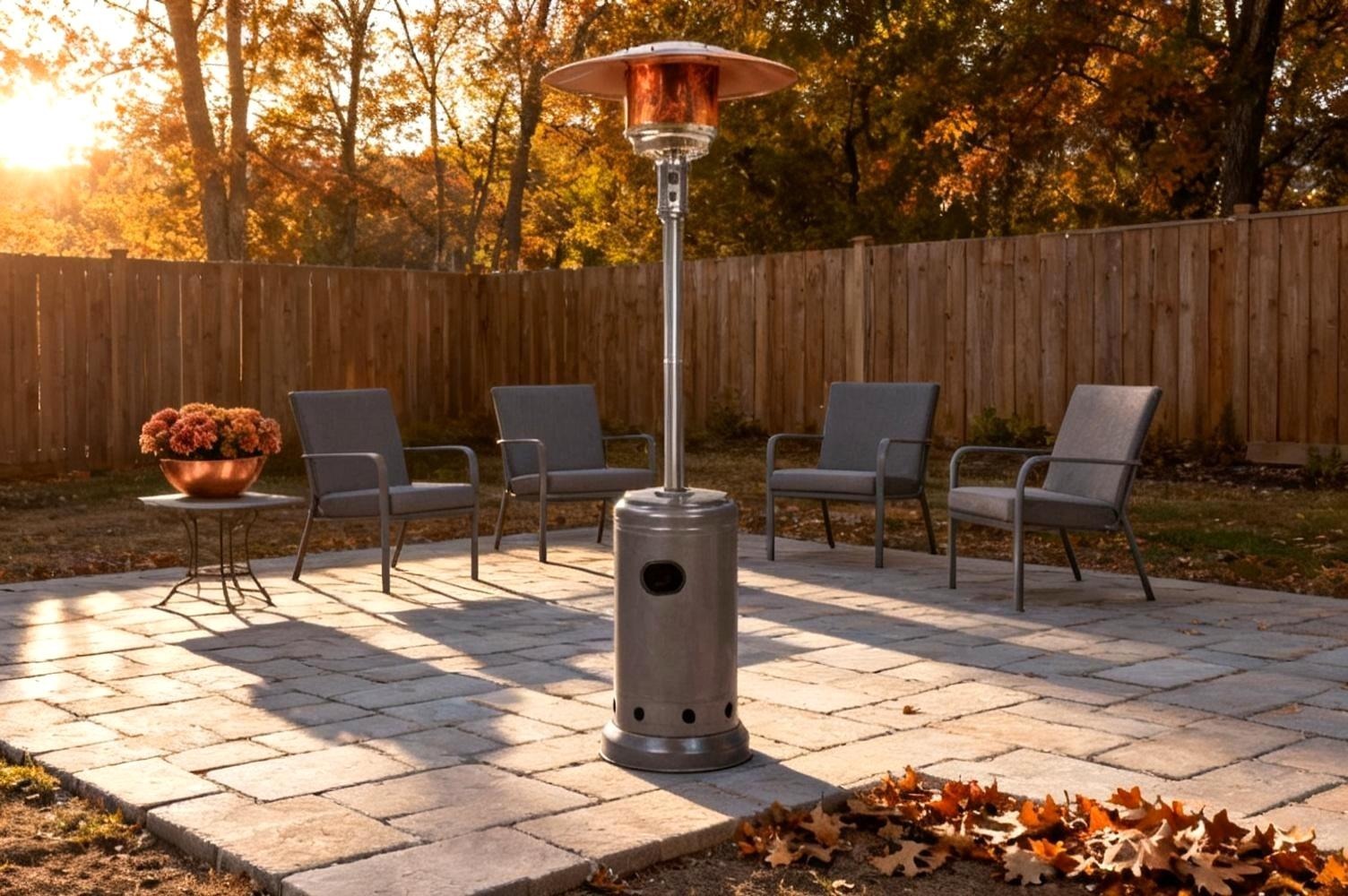
4.4 stars across more than 11,000 ratings and an Amazon’s Choice badge, which in this category is the closest thing to a track record. Model 62108.
The listing is specific in a way that is genuinely useful: 46,000 BTU heating up to a nine foot radius, one-touch ignition, an adjustable output knob, a tilt safety auto-shutoff valve, a water box for weighting the base, and a chain to secure the tank. It stands 91.3 inches tall.
The honest catch is that nine foot radius. It is a real number and it is smaller than people picture. Chairs need to be inside it. A heater at one end of a long deck warms one end of a long deck.
Pick it if: you want the standing propane format with the most owner feedback behind it, and you can arrange the seating around the post rather than the other way round.
Best for a covered porch: Mr. Heater Big Buddy PRO
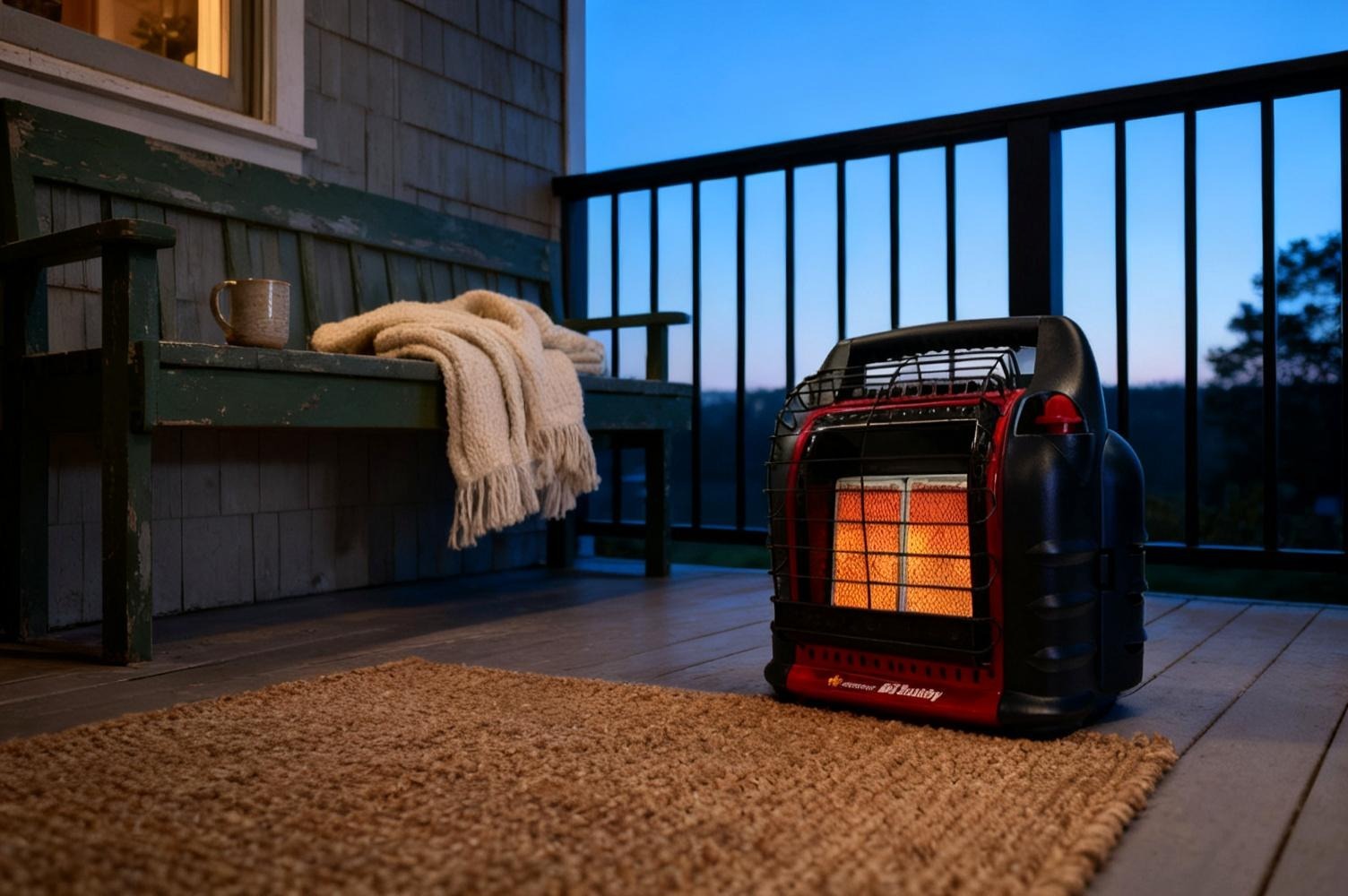
4.6 stars across 3,606 ratings. Model F274800.
This is a different shape of product from the tall ones and it solves a different problem. Three settings at 4,000, 9,000, and 18,000 BTU, coverage listed up to 450 square feet, and a dual system that pairs radiant heat with a built-in fan pushing warm air. It runs off 1 pound cylinders or, with the optional hose, a 20 pound tank, where the listing quotes up to 216 hours on the low setting.
It belongs on a covered porch, in an open garage bay, or beside a workbench, which is exactly where the tall heaters cannot go.
The honest catch is height. It sits on the ground, so the heat arrives at shin and knee level first. That is fine and even pleasant when you are sitting down with a blanket. It does less for you standing up.
Pick it if: the porch has a roof, the seating is fixed, and you want serious output without a seven foot post in the middle of it.
Best small and occasional: Mr. Heater Portable Buddy
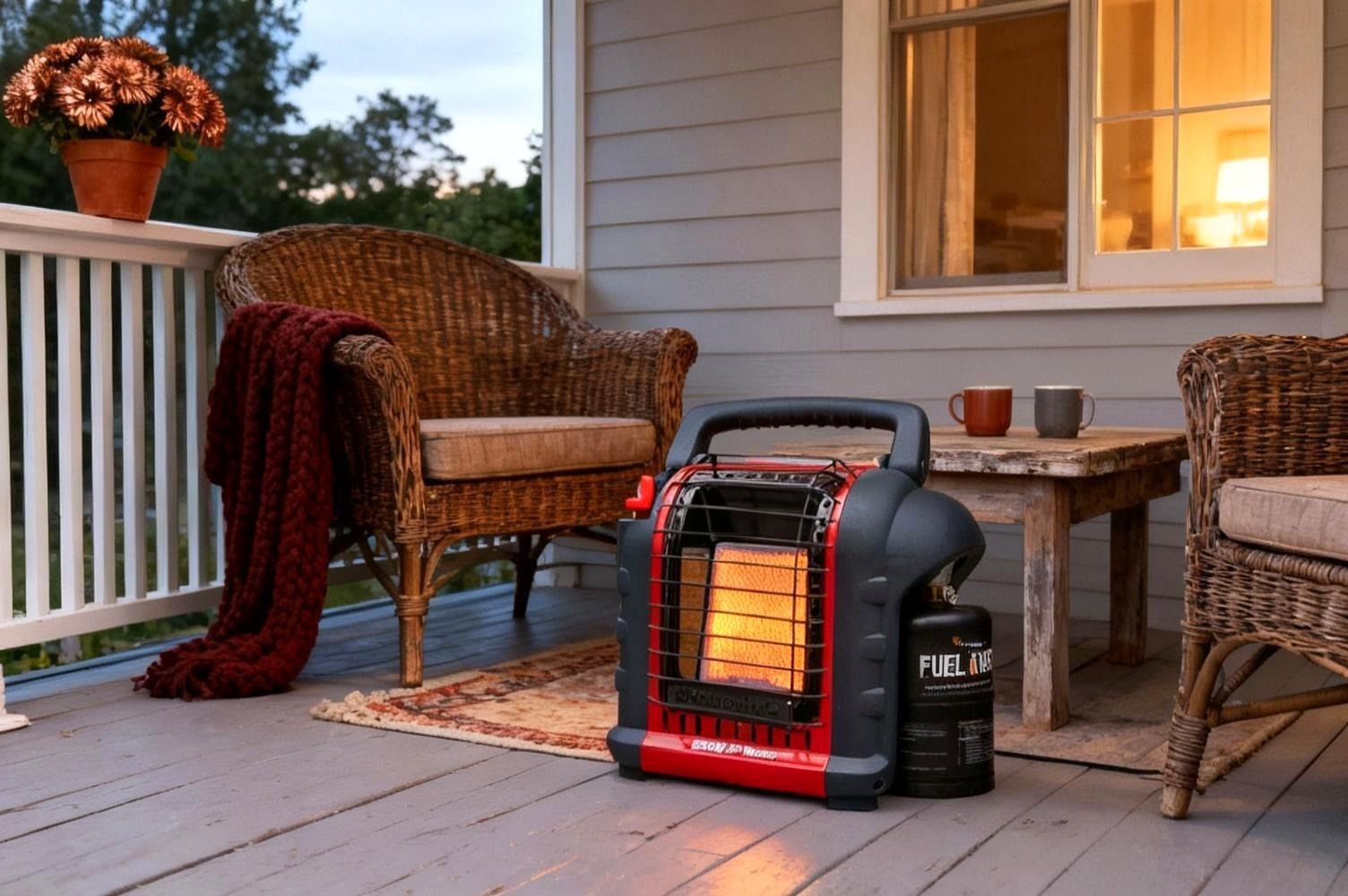
4.7 stars across more than 29,000 ratings, the highest rating and by far the most reviews of anything in this guide. Model F232000, sold as the MH9BX.
It is small, it takes a single 1 pound cylinder, and it puts out 4,000 or 9,000 BTU with coverage listed up to 225 square feet. Mr. Heater rates it indoor safe, with an oxygen depletion sensor and an accidental tip-over shutoff. That combination is why it turns up on porches, in ice-fishing shacks, and in emergency kits.
The honest catch is runtime. One cylinder gives 5.4 hours on low and 2.4 hours on high. For two people sitting out after dinner, that is fine. For hosting on a Saturday, you are buying cylinders by the case or adding the hose kit.
Pick it if: you want warmth for an hour or two at a time, in a space you can move it around, without owning a 20 pound tank.
Best for a balcony: Dr. Infrared DR-238
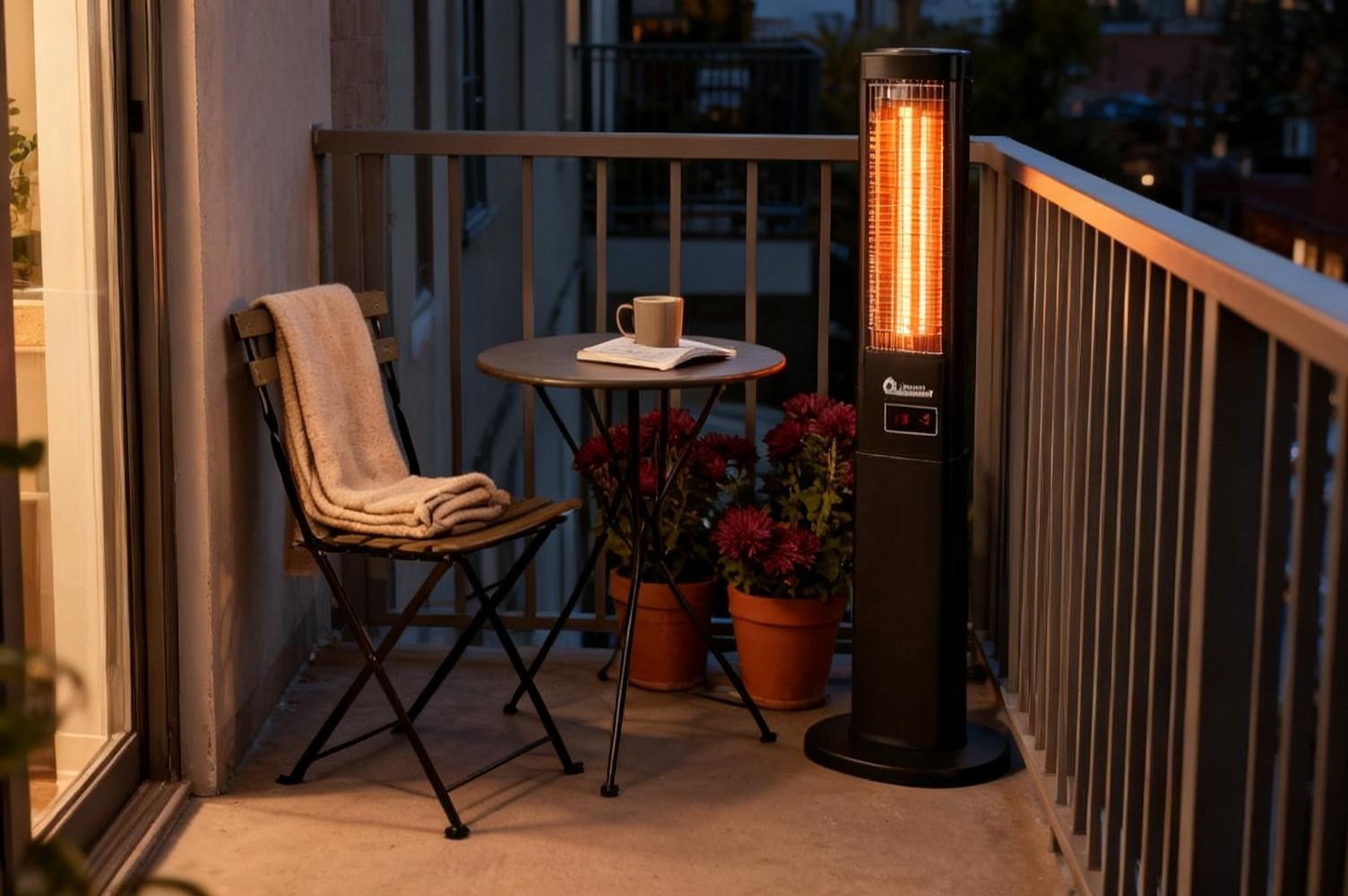
4.3 stars across more than 6,000 ratings, and the one on this list a renter can most likely use.
It is a 1,500 watt carbon infrared unit rated IP55 for indoor and outdoor use, with three power settings at 900, 1,200, and 1,500 watts, a remote, and both wall and ceiling mounting brackets included. It runs on a standard 120 volt outlet. Mounted on a ceiling under a balcony overhang it stays completely out of the way, which on a narrow balcony is worth as much as the heat.
The honest catch is the ceiling on output. 1,500 watts is 1,500 watts. Aimed at two chairs six or eight feet away it is genuinely warm. It will not do anything for an open lawn, and running it in an unroofed spot on a windy night wastes a good heater.
Pick it if: there is a roof, an outlet, and a lease that says no propane.
Placement, Which Fixes Most Complaints
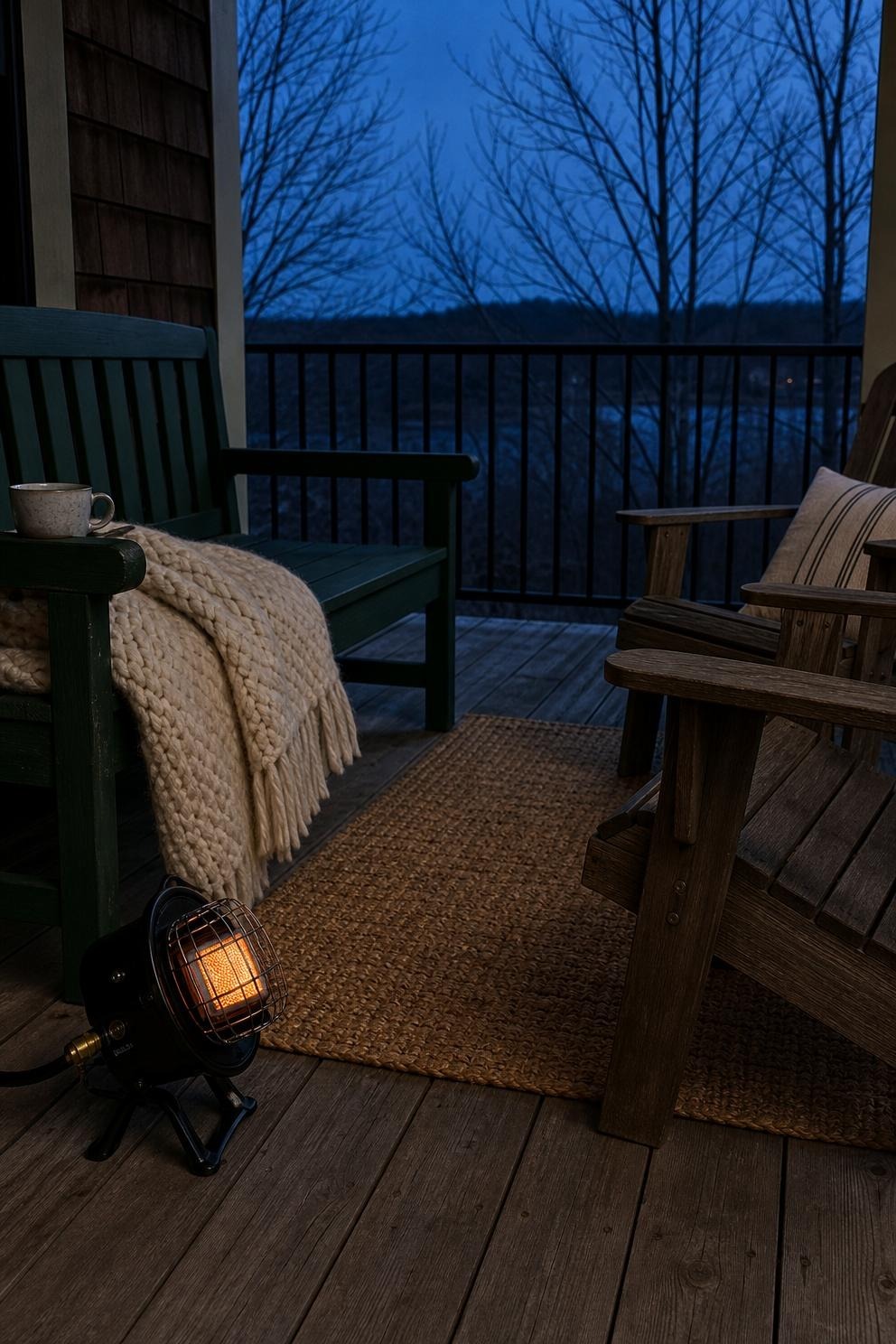
Most people who say their patio heater does not work have a placement problem, not a heater problem.
- Put it upwind, not downwind. Heat blows away from the source. A heater on the wrong side of the seating warms the fence.
- Keep seating inside the stated radius. For a nine foot radius that means chairs within about four feet of the post, not scattered across the patio.
- Aim infrared at people, not at the floor. Mounted units usually tilt. Angle it toward chest height where you actually sit.
- Two heaters run low beat one run high. A single unit at full output makes one hot spot and one cold corner.
- Block the wind first. A screen, a hedge, or a run of outdoor curtain does more for comfort than another 10,000 BTU. The same principle that makes string lights work without a pergola applies here: define the edges of the space and it holds warmth.
Getting Through the First Cold Weeks
A few things worth doing before the weather turns rather than during it.
- Buy the second tank now. Exchange cages empty out in October, and the first genuinely cold Saturday is when everyone remembers. A 20 pound tank on a 46,000 BTU heater is an evening or two, not a season.
- Store the tank outside and upright. Never a basement, never a closed garage, never on its side.
- Cover the heater between uses. Water sitting in the burner assembly through a wet autumn is how these fail before they are two years old.
- Test the ignitor in September. A dead ignitor battery is a small problem in daylight and a ruined evening in the dark.
- Layer instead of upsizing. A heavier throw over the chairs, a rug underfoot, and something at the edge to slow the wind changes the felt temperature more than the next model up does.
Cleaning and Storing a Patio Heater
A heater that goes away dirty comes back working badly, and most of the spring complaints start here.
- Let it cool completely before you touch the burner or the reflector. Both hold heat long after the flame is out.
- Wipe the housing and the reflector with a damp cloth. A dusty reflector sends less heat at the chairs, which is the whole point of the unit.
- Look over the burner and the air openings. Debris and insect nests in the burner are one of the reasons a heater that worked last year starts weak.
- Disconnect the tank and store it outside, upright, with the valve closed. The same rule as mid-season, and the one people bend when the tank is heavy and the garage is close.
- Bring the electric unit inside if you can. If it stays out, check the housing for cracks. An IP rating covers rain, not a cracked case.
- Store the cover dry. Folding a wet cover onto the unit for the summer is the fastest way to find rust in September.
Patio Heater Questions to Answer Before You Buy
What type of patio heater gives off the most heat?
A standing propane heater gives off the most raw heat in this group, usually 40,000 to 50,000 BTU. A standard 1,500-watt electric heater produces roughly 5,100 BTU, but infrared can feel more useful in a covered seating area because it directs that smaller output at the chairs.
How long does an outdoor patio heater last?
For fuel runtime, the 48,000 BTU Hampton Bay listing quotes up to 10 hours from a standard 20-pound propane tank. The Portable Buddy listing quotes 2.4 hours on high or 5.4 hours on low from a one-pound cylinder. Wind, the heat setting, and cold tank pressure can shorten those figures. The heater itself does not have one dependable lifespan number; burner condition, weather exposure, replacement parts, and whether water sits in the burner assembly matter more than the price tag.
What are the drawbacks of electric patio heaters?
Output and placement. A 1,500-watt unit warms a small aimed zone, not an open yard, and it uses most of a 15-amp circuit by itself. It also needs an outdoor GFCI outlet close enough to avoid running an extension cord through the walking path. Electric infrared is a strong small-space choice, but it is not a plug-in substitute for a 46,000 BTU propane heater.
How do you choose an outdoor patio heater?
Choose the permitted fuel first, then the seating footprint, overhead clearance, weather rating, and power source. Only compare models after those five checks. A heater with the best rating is still the wrong heater if the lease bans its tank or the manual requires more clearance than the porch provides.
What I’d Actually Buy
For an open patio with four or more seats, the Hampton Bay 48,000 BTU. It claims the widest radius here and it is the best seller in its own category at Home Depot. If you would rather buy where the review count is deeper, the Amazon Basics 46,000 BTUAs an Amazon Associate, we earn from qualifying purchases. Full disclosure. is the same shape with four times the reviews.
For a covered porch, the Mr. Heater Big Buddy PRO (opens Amazon in a new tab)As an Amazon Associate, we earn from qualifying purchases. Full disclosure.. It goes where the tall heaters legally cannot, and 18,000 BTU under a roof is more useful than 46,000 BTU under open sky.
For a balcony or a rental, the Dr. Infrared DR-238 (opens Amazon in a new tab)As an Amazon Associate, we earn from qualifying purchases. Full disclosure.. Plug it in, mount it overhead, forget it exists.
And if you are only heating two chairs for an hour after dinner, the Mr. Heater Portable Buddy (opens Amazon in a new tab)As an Amazon Associate, we earn from qualifying purchases. Full disclosure. is the smallest honest answer in the category. Nearly thirty thousand people rate it 4.7 for a reason.
If none of that fits, the alternative is not a bigger heater. It is a fire pit, which does a different job for a different kind of evening, and it comes with a different clearance rule. NFPA’s fire pit guidance puts a fire pit at least 10 feet from anything that can burn, on a level surface that will not catch, with children and pets kept three feet back. Budget fire pit ideas for a cozy backyard is the place to start on that.
What to Read Next
- Small fall patio after dark for the lighting half of a cold-weather patio once the heat is handled.
- Budget fire pit ideas for a cozy backyard because a fire pit suits a different kind of evening than a heater does.
- 10 cozy patio lighting ideas for tiny backyards if the space is small and the light is doing most of the work.
- Fire pit seating area size for the same geometry question a heater circle raises.
- String light patio ideas without a pergola when you want the space to keep working after the heater is off.