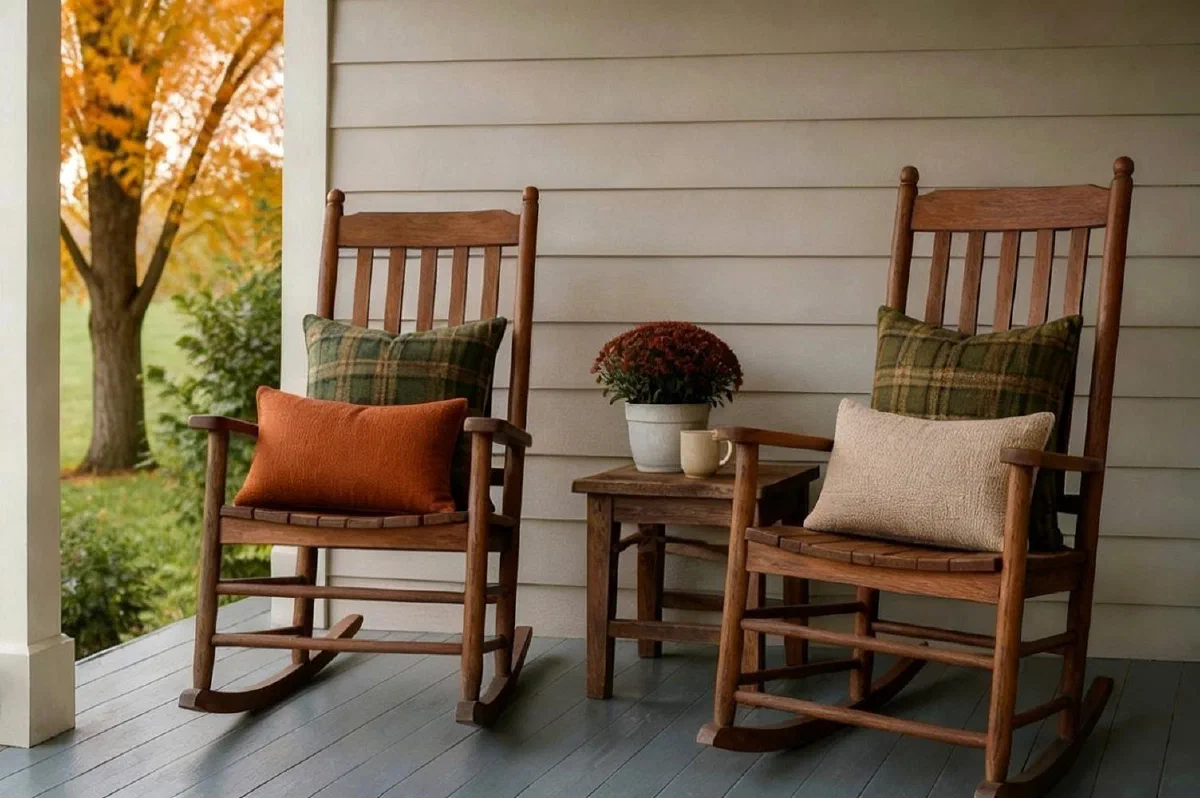
Sort Amazon’s outdoor throw pillow results by best sellers and the first thing you see is an indoor pillow insert. The listing says so in its own title. Not weather rated, not water resistant, just a white polyester square that soaks up rain like a dish sponge.
That is most of what goes wrong with fall outdoor pillows. The cover gets all the attention because the cover is the part you look at. The insert decides whether the pillow lasts one season or four, and it usually gets picked on price.
Two things decide whether a pillow lasts, and neither one is the pattern: what the fabric is, and what is inside it.
This article contains affiliate links. If you buy through them, Etheric Echoes may earn a commission at no extra cost to you. As an Amazon Associate I earn from qualifying purchases. Read the full disclosure.
The fabric decision is most of the game
Three fabrics, and the price gaps make sense once you know what you are paying for.
Solution-dyed acrylic
This is the Sunbrella category, and the whole thing hinges on when the color goes in. Pigment is mixed into the liquid polymer before the fiber is extruded, so the color is integrated during fiber extrusion rather than applied as surface coatings . The fiber is that color, straight through.
That matters because of how sun damage works. UV penetrates a textile and attacks both the pigments and the fibers. Surface dye sits in the top layer where the UV lands first, so it goes first. Solution-dyed fiber has no outer layer of color to lose, which is why these fabrics carry multi-year fade warranties and cheap ones do not.
Polyester
Almost everything on the outdoor pillow best-seller lists is polyester with a water-repellent finish. The top-selling outdoor cover set I found is 100% polyester in a faux linen weave (opens Amazon in a new tab) , which is honest labeling and a reasonable buy for a covered porch.
Polyester holds up in sun better than any natural fiber. It just fades sooner, and unevenly, which is the part that looks bad. After one season, compare the top edge facing the yard against the seam behind the chair arm. You will see it there first. Two or three seasons under a roof is realistic. So is one hard season in full afternoon sun.
Cotton canvas and cotton-linen
Every buffalo check and pumpkin print you love in September is probably this. On a porch with a roof, brought in when it rains, cotton is fine and it feels better than polyester.
Left out, it is the worst of the three, and not only because it fades. Missouri Extension’s list of fibers that resist mildew is a list of synthetics: acetate, acrylic, polyester and nylon . Cotton is not on it. Cotton is cellulose, and cellulose is food.
| Fabric | Where the color lives | How it fails | Where it belongs |
|---|---|---|---|
| Solution-dyed acrylic | Mixed into the fiber before extrusion | Slowly and evenly, over years | Uncovered porch, full sun, all season |
| Polyester with a repellent finish | Applied to finished yarn or cloth | Unevenly, sun-facing edges first | Covered porch, part shade, 1 to 3 seasons |
| Cotton canvas or cotton-linen | Applied to finished cloth | Fades, then mildews the fiber itself | Under a roof, brought in for rain |
On a porch with real sun, the cheap cover is not cheaper. It is annual.
“Water resistant” is not “waterproof”
Both words get used loosely, so start with what the sellers themselves mean. Here is the care note on an insert with the word waterproof in its title twice: “Please keep the pillow core in a dry state … if the pillowcase encounters water … please take out the pillow core.”
The maker of a waterproof outdoor pillow insert (opens Amazon in a new tab) is telling you to pull it out of the cover if the cover gets wet. That is not dishonest. It is what waterproof means on a sewn product: a coating that shrugs off a shower and a spilled drink. Seams are still holes, and a zipper is a long row of holes.
So plan around it. Weather-rated pillows handle dew, drizzle, and the sprinkler drifting, not a night of driving rain. The fix on a small porch is a lidded box within arm’s reach of the chairs. If putting them away takes three seconds, it happens. If it means a walk to the shed, they stay out.
The insert is why your old pillows smell
Polyester fiberfill is thousands of loose fibers with air between them, which is exactly the structure that holds water. Rain gets through a cover in minutes. Getting back out of a dense pile of fill takes days, and on a shaded porch in October it may not happen at all.
Now put that against what mildew needs. Molds that cause mildew “flourish wherever it is damp, warm, poorly lighted and/or where air is not circulated,” according to Missouri Extension . A wet pillow on a chair under a porch roof is all four.
The surprising part is that clean synthetic fabric is not the problem. Missouri is blunt: “Because most synthetic fibers, such as acetate, acrylic, polyester and nylon, are resistant to mildew, clean fabrics of these fibers will not support mold growth.” The catch is the word clean. Soil on a dirty article supplies enough food for mildew once moisture and temperature are right.
So the smell is pollen, dust, tree drip, and dog hair sitting wet on a fabric that would have been fine bare. You are not fighting the fabric. You are keeping the food off it.
Down and feather are wrong outdoors. They are protein, they mat when wet, they hold moisture longer than polyester, and they smell worse doing it. Feather inserts show up high in outdoor search results anyway. They belong on a sofa.
What about quick-dry foam? Open-cell reticulated foam is the real answer here. It is a foam skeleton with the cell walls burned out, so water runs through instead of being held, and marine upholstery has used it for decades. And I could not find it in a single best-selling outdoor throw pillow insert. Sorted by best sellers, they are polyester fill in a coated shell, top to bottom. Quick-dry foam lives in seat cushions and custom marine work, not the throw pillow aisle.
Which leaves two fine choices: a coated insert brought in for storms, or a plain one you treat as consumable and replace when it flattens.
How many, and what size, for a small porch
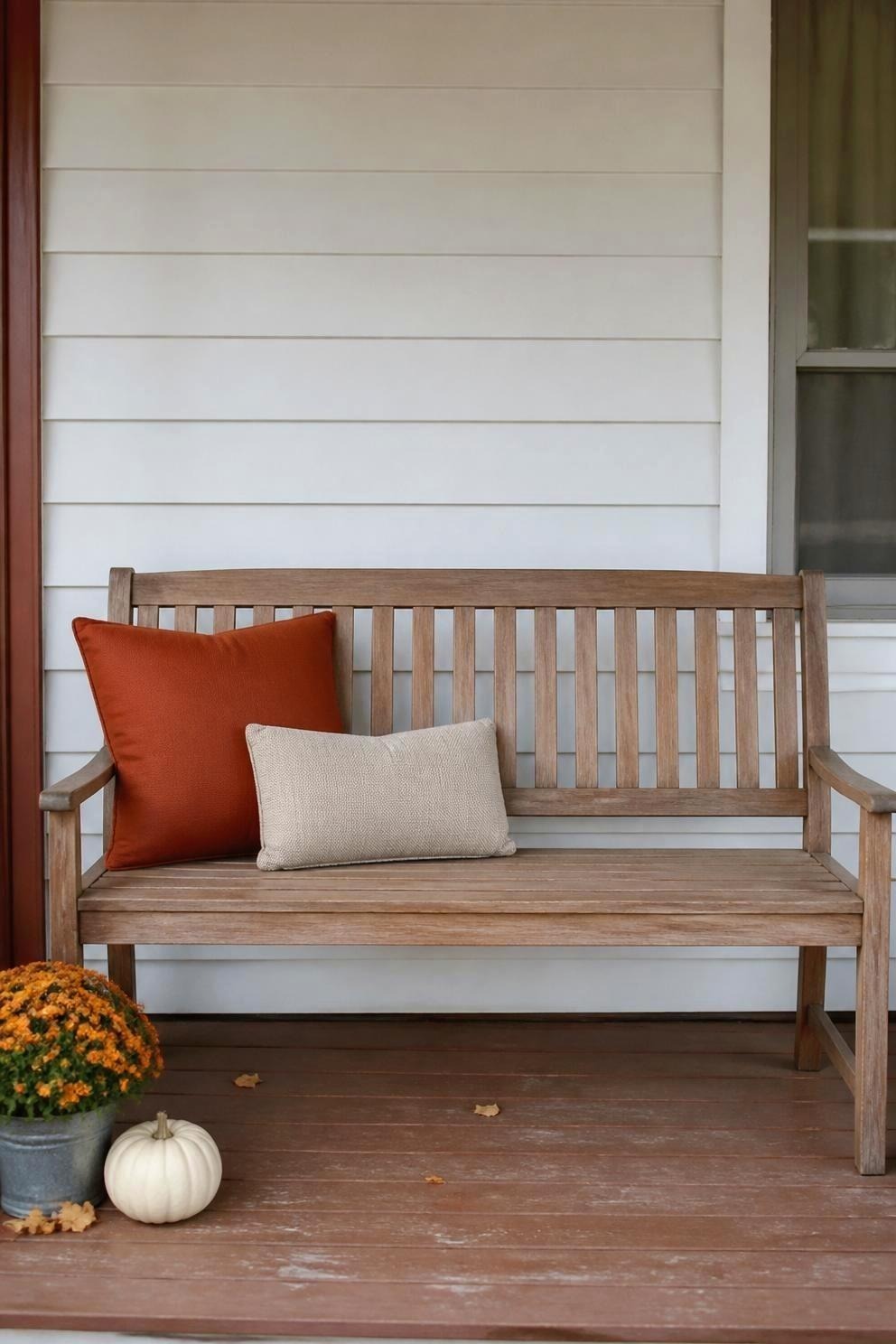
Small porches usually get this wrong by over-buying. Six pillows on two chairs and a bench is not generous, it is a pile you move every time you sit down. Start from the seat, not from the set: one pillow per sitting position, plus one odd piece for the longest seat.
| What you have | Pillow size | How many |
|---|---|---|
| One rocker or armchair | One 18 inch square | 1 |
| Two bistro chairs | One 16 or 18 inch square each | 2 |
| A 4 foot bench or loveseat | One 20 inch square plus one 12 by 20 lumbar | 2 |
| A 4 to 5 foot porch swing | Two 18 inch squares plus one lumbar | 3 |
| A narrow balcony, two chairs | Two, one of them a lumbar | 2 |
- Odd numbers across the whole porch, not per chair. Three on two chairs and a bench reads better than four.
- The lumbar is the odd one. A 12 by 20 keeps a symmetrical arrangement from looking like a showroom, and on a shallow bench it is the only pillow that supports your back.
- One pattern, two solids. Everything except the pattern is a solid pulled from a color inside it.
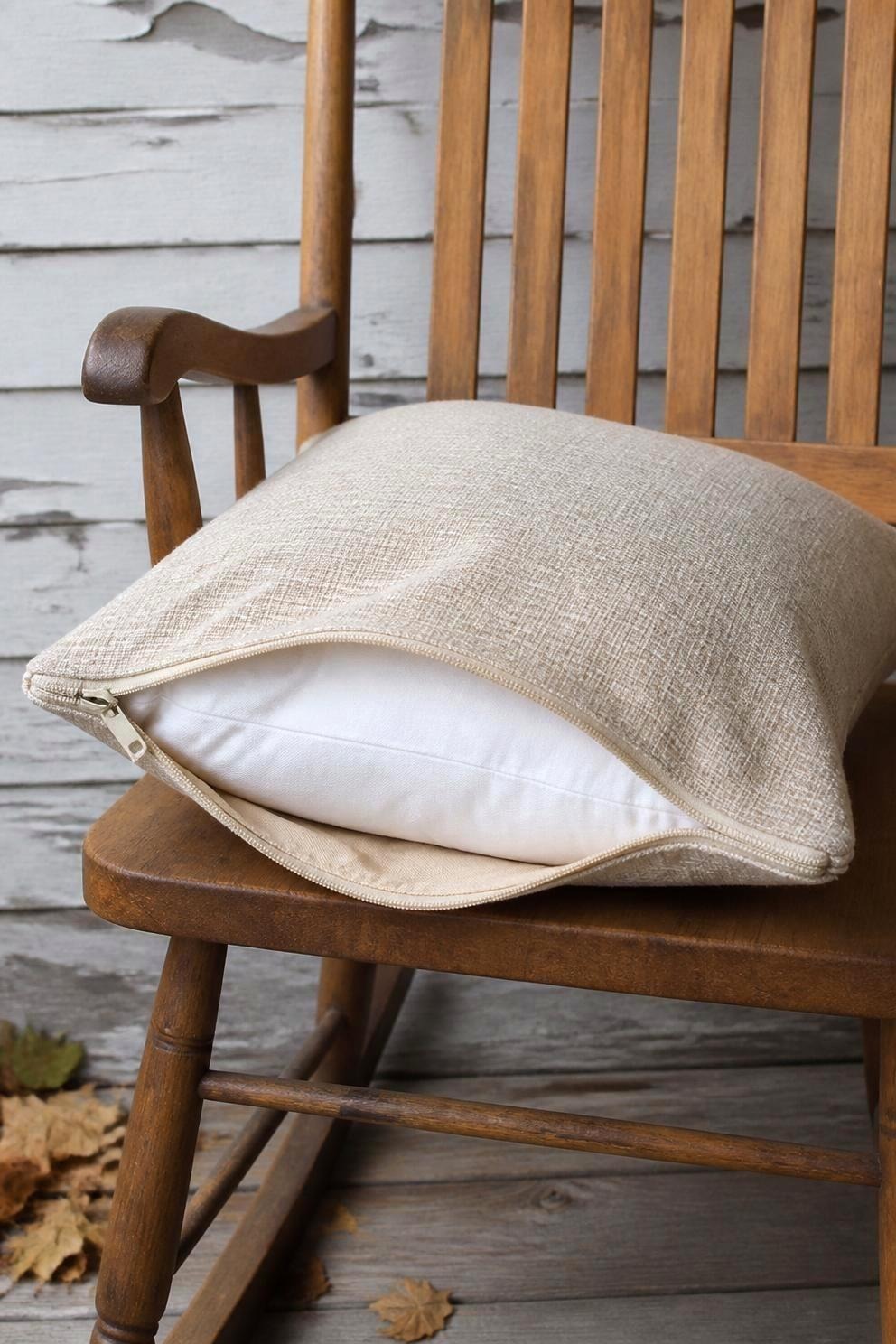
- Size the insert up, not the cover. An 18 inch insert in an 18 inch cover looks limp. A 20 inch insert in an 18 inch cover fills the corners. Cheapest upgrade here, and free if you are buying both anyway.
Buy covers, keep the inserts
Inserts are the bulky, durable half. Covers are the half that goes out of season, gets a stain, or stops matching a chair you repainted. Buying outdoor covers on their own (opens Amazon in a new tab) means one set of inserts serves spring, summer, and fall. Four 18 inch pillows are a hamper’s worth of volume. Four covers are a stack the thickness of a paperback.
Three things to check before you order:
- Hidden zipper, not an envelope back. Envelope closures gap outdoors and let rain in at the overlap.
- Take the care tag literally. Cold gentle wash, no bleach, low tumble. Hot water and a hot dryer strip a water-repellent finish faster than a year of weather does.
- Solids mix easier than prints. A solid green outdoor cover set (opens Amazon in a new tab) still works next spring. A print with pumpkins on it has a six-week life.
If you would rather keep whole pillows, the honest weather-rated squares are the water-resistant 18 inch outdoor pillows (opens Amazon in a new tab) and the matching 12 by 20 outdoor lumbar inserts (opens Amazon in a new tab) .
The fall palette that still looks right in November
Costume orange is the trap. It peaks the week you buy it and looks wrong the moment the leaves turn, because real fall outside your door is duller and browner than the plastic version.
Build on neutral, then add one accent.
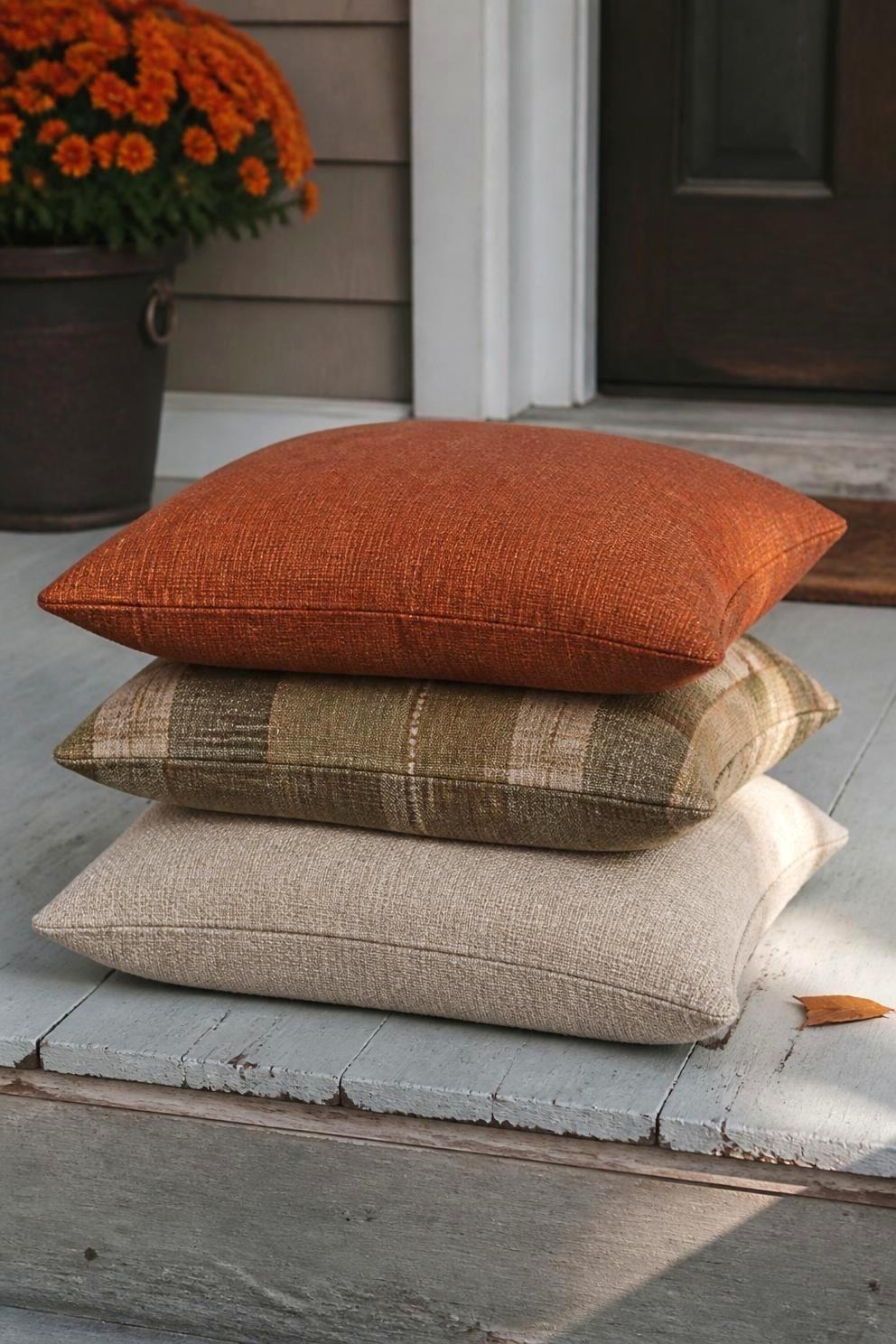
- Base: oatmeal, warm cream, flax, mushroom. Two of your three pillows.
- Accent: rust, terracotta, ochre, muted olive, deep burgundy. One pillow.
- Pattern: one, and let it be quiet. A soft rust tartan (opens Amazon in a new tab) or a black and white check (opens Amazon in a new tab) both read as fall without a single pumpkin.
- Skip: bright pumpkin orange, glitter, printed words, and faux fur, which mats in the first rain.
The reason to lean neutral is calendar, not taste. Rust, olive, and oatmeal carry from September into a bare winter porch. Orange pumpkins come in on November 1st, and on a small porch that leaves the seating looking unfinished for two months.
For renters and shared entries: pillows are the fastest fall change that leaves nothing behind. No hooks, no adhesive, no paint.
How to clean and store them, in the order that works
Do this in September before the fall covers go on, in November before they go away, and after any storm that soaks them.
- Brush the dry dirt off first, outdoors. Missouri Extension says to “brush off any surface growth outdoors to prevent scattering the mildew spores in the house,” and the same goes for plain pollen and dust. A stiff dry brush removes most of the food supply in a minute. Do not start with water, which turns dust into a stain you then have to work out of the weave.
- Vacuum the seams. Run a brush attachment along the piping and the zipper, where dirt collects and mildew starts.
- Wash with mild detergent in cool water. UGA Extension’s mildew procedure is short: brush off mildew out of doors, apply detergent to the stain, and launder . Pretest any cleaner on a hidden corner and read the care tag first. Bleach is safe on some outdoor fabrics and destroys others.
- Rinse until the water runs clear. Leftover detergent is itself a food source, the same reason Missouri warns against storing starched fabric.
- Dry completely, standing on edge. Upright on a railing or a rack, so air moves through both faces at once. Flat on a table, only one side dries. A box fan aimed at a row of pillows on a rail is the fastest method there is.
- Re-treat if water has stopped beading. The repellent finish wears off. 303 Fabric Guard (opens Amazon in a new tab) is what the marine canvas world uses to restore it. The fabric has to be clean and fully dry first, or you seal dirt under the coating, and it has to cure in dry weather, so spray on a clear afternoon.
- Store dry, in something that breathes. A sealed bag traps whatever moisture is left in the fill. A bin with the lid cracked, or a fabric bag, beats a vacuum pouch. Never put away a pillow that feels cool in the middle.
Repellency is a coating and can be replaced. Faded color cannot. It is either in the fiber or it is gone.
If the pillows live outside year round, a lidded resin box that doubles as a side table is what makes it work, because it gets them off the chairs at night without asking anything of you. More on picking one in the small patio storage fix .
Common mistakes that shorten their life
- Buying an indoor insert for an outdoor cover. Common, because indoor inserts dominate the search results and cost less.
- Leaving them out through a real storm. A soaked insert takes days to dry and often never smells right again.
- Storing them damp, or sealed in plastic. The two most reliable ways to ruin good covers.
- Six pillows on two chairs. Pillows you move to sit down end up on the floor and stay there.
What I’d Actually Buy
For a small covered porch, the whole project is three covers and three inserts, and the inserts carry over to next year.
- MIULEE outdoor pillow covers, 18x18, beige, set of 2 (opens Amazon in a new tab) (4.3 stars, 8,700+ ratings). Solid faux linen, 100% polyester, hidden zipper, no inserts. The neutral base, and the same family runs other colors including navy (opens Amazon in a new tab) .
- VAKADO outdoor waterproof covers, 18x18, green, set of 2 (opens Amazon in a new tab) (4.7 stars, 1,300+ ratings). The muted olive accent, and a solid that still works in April.
- VAKADO outdoor plaid covers, 18x18, black and white, set of 2 (opens Amazon in a new tab) (4.8 stars, 5,800+ ratings). One pattern that does not expire on November 1st.
- RABUSOFA rust tartan fall covers, 18x18 (opens Amazon in a new tab) (4.7 stars, 121 ratings). Warmer and more seasonal. Small review count, so treat it as new rather than proven.
- Utopia Bedding 18x18 water-resistant outdoor pillows, 2-pack (opens Amazon in a new tab) (4.7 stars, 1,300+ ratings). The straightforward insert. Go up to 20 inch to fill an 18 inch cover.
- MIULEE 12x20 outdoor lumbar inserts, 2-pack (opens Amazon in a new tab) (4.4 stars, 7,300+ ratings). The odd piece for a bench or a swing.
- Oubonun 20x20 waterproof inserts with a TPU layer, set of 2 (opens Amazon in a new tab) (4.6 stars, 757 ratings). The most weather-serious insert in the best sellers, and the one whose care note tells you to pull it out of a wet cover.
- 303 Fabric Guard, 32 oz (opens Amazon in a new tab) (4.4 stars, 10,400+ ratings). Restores repellency on clean, dry fabric. One bottle covers several seasons.
- Keter City 30 gallon storage box and side table (opens Amazon in a new tab) (4.5 stars, 11,400+ ratings). Resin, narrow enough for a small porch, holds a porch’s worth of pillows, and a table the rest of the time. The reason they get put away.
Worth saying plainly: I found no solution-dyed acrylic throw pillow anywhere on Amazon’s outdoor pillow best-seller lists. Every top result is polyester. For Sunbrella-class fade resistance you are shopping fabric retailers or a furniture brand’s own cushion line.
Check each product page for current sizes, colors, and options before ordering.
What to Read Next
- Fall Front Porch Decor for a Small Porch , for everything around the seating.
- Porch Cushions, Old Chairs, and the Stuff That Makes an Entry Feel Used , if the chairs need help too.
- Fall Balcony Ideas for Small Apartments , the same ideas scaled to four feet.
- Rainy Porch Ideas for Days You Still Want to Sit Outside , for wet-weather porch setups.
- Tiny Balcony Storage Ideas for Cushions, Soil, and Plant Stuff , where to put it all in winter.