
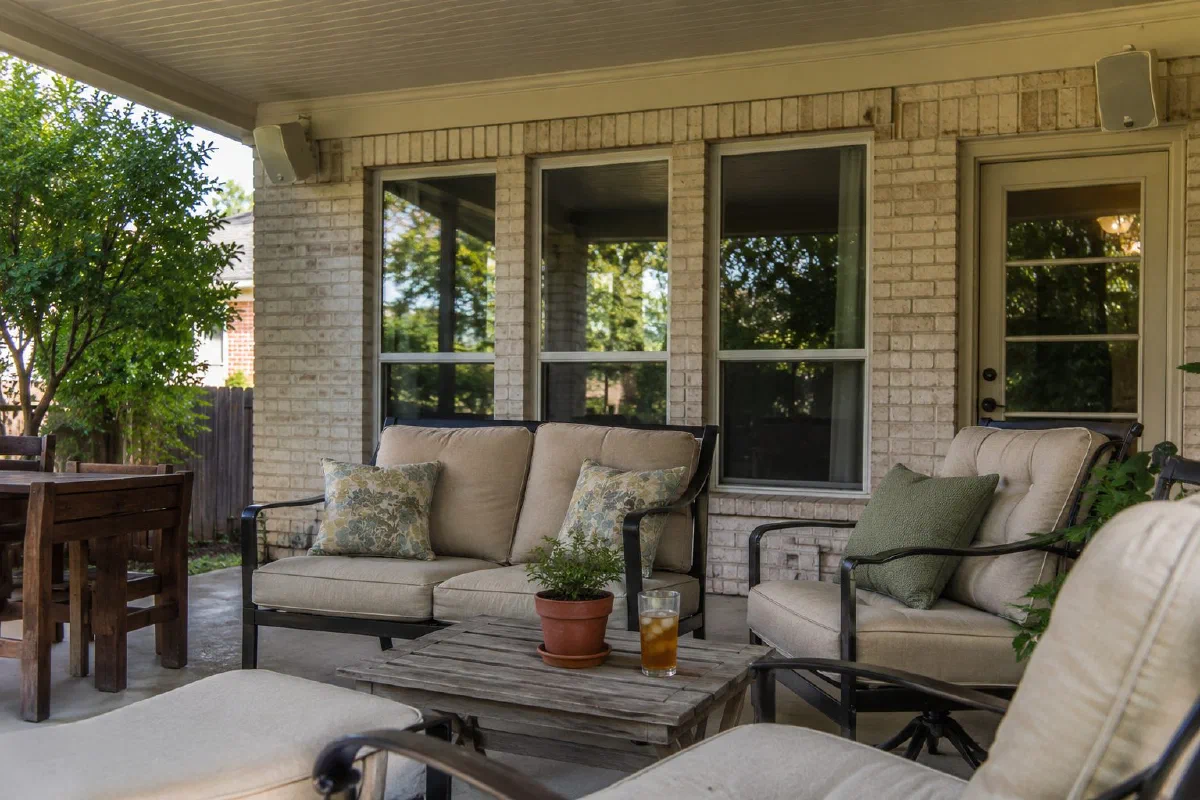
The best outdoor speakers depend on where the sound needs to go. For one patio, the strongest long-term setup is usually a passive, weather-rated pair mounted under an eave with the amplifier kept indoors. Choose outdoor landscape speakers when even coverage across a large yard matters more than price. Choose a portable Bluetooth speaker when you rent, need to move the sound, or do not want to run wire.
An indoor speaker left outside is a poor substitute. Outdoor models use sealed or weather-resistant enclosures and hardware designed for moisture and temperature swings, but the label alone is not enough. The product manual, exposure, mounting, and cable connections still decide whether it fits the spot.
This guide is organized the way the decision actually gets made: first the wiring question, then the weather rating, then the picks. Availability, ratings, and review counts for every linked product were refreshed from its Amazon page on September 10, 2026. Each one also appeared in a separately checked search for its exact product type. Ratings move, so treat them as a snapshot rather than a permanent score.
Fast answer: use a passive wall-mount pair for one patio, a wired landscape system for even sound across a large yard, and a portable speaker when the setup has to move.
| Your space | Best starting point | Why it fits | Main tradeoff |
|---|---|---|---|
| Small deck or patio | Two passive wall-mount speakers | Simple stereo coverage from the house | Needs an indoor amp and speaker wire |
| Covered porch with an open ceiling | Outdoor-rated in-ceiling pair | No wall or floor clutter | Hardest option to retrofit |
| Large yard or pool area | Wired landscape satellites plus a subwoofer | More even sound at a lower volume | Highest installed cost |
| Rental or occasional use | Portable Bluetooth speaker | No permanent installation | Battery, storage, and less stereo separation |
| Patio with no practical wire route | Powered outdoor Bluetooth pair | Permanent placement without an indoor amp | Electronics remain outdoors |
Start Here: Wired or Wireless
This one question eliminates most of the catalog, and almost nobody asks it first.
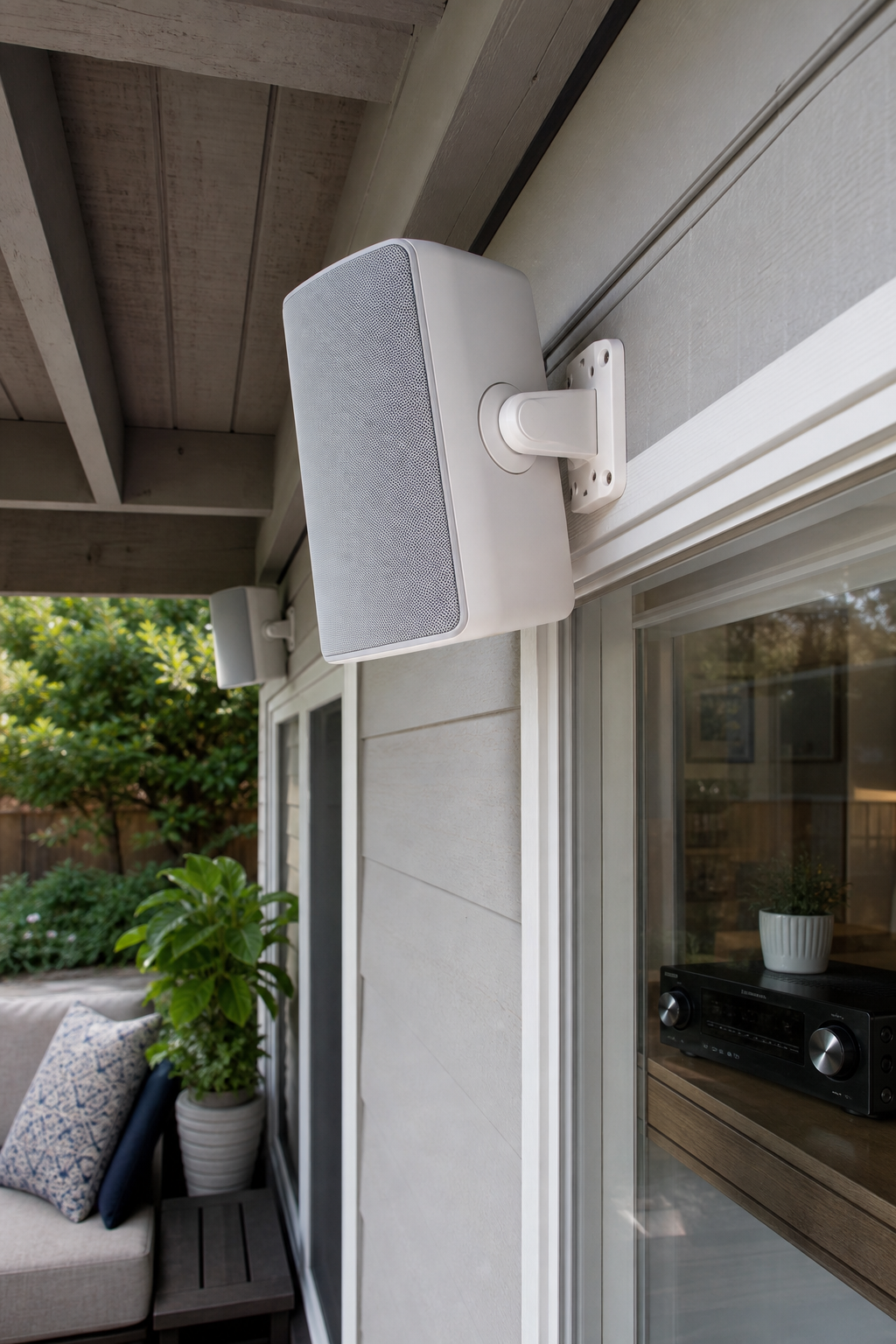
Wired (passive) speakers have no battery or built-in amplifier at the speaker. They need speaker wire run back to an amplifier or receiver, usually indoors. Choose wired if the speakers will live in one place and you can route outdoor-rated cable safely.
Wireless speakers and powered speakers need either a battery or an outdoor power outlet. They avoid a speaker-wire run, but a battery or amplifier remains part of the outdoor setup. Choose one if you rent, if a permanent cable route makes no sense, or if the speaker needs to move.
A rough test: if you would be annoyed to replace the speaker in three years, buy wired.
What “Weatherproof” and “Outdoor-Rated” Actually Mean
The IP code comes from IEC 60529, the international standard for enclosure protection . The two digits describe tested protection against solids and water:
| Digit | Meaning |
|---|---|
| First (dust) | 5 = dust-protected, 6 = dust-tight |
| Second (water) | 4 = splashes, 5 = jets, 6 = powerful jets, 7 = immersion to 1 meter |
“Weatherproof” is not enough information by itself. An IP rating does not promise that a speaker will tolerate every climate, either. It does not cover UV exposure, freeze-thaw cycles, an uncovered charging port, or a cable connection installed against the manual. Match the published rating and operating-temperature range to the exact location. Passive speakers sometimes use a manufacturer weather-resistance standard instead of an IP code, so read the installation guide before treating that as a flaw.
This article contains affiliate links. If you buy through them, Etheric Echoes may earn a commission at no extra cost to you. As an Amazon Associate I earn from qualifying purchases. Read the full disclosure.
Best Outdoor Patio Speakers by Setup
Ratings, review counts, and review text all verified from Amazon on August 7, 2026, including the one-, two-, and three-star reviews. The tradeoffs below come from what buyers actually complained about, not from the spec sheet.
| Pick | Type | Rating | Reviews | Price band | The real catch |
|---|---|---|---|---|---|
| Polk Audio Atrium 4 (opens Amazon in a new tab) | Wired, wall-mount pair | 4.6 | 6,000+ | Mid-price | Light on bass |
| Dual Electronics LU43PB (opens Amazon in a new tab) | Wired, wall-mount pair | 4.3 | 10,000+ | Budget | Can warp in direct heat |
| Pyle 6.5" Dual Marine Speakers (opens Amazon in a new tab) | Wired, wall-mount pair | 4.4 | 2,400+ | Budget | Basic sound, strong weather margin |
| Turtlebox Ranger (opens Amazon in a new tab) | Portable | 4.5 | 1,800+ | Premium portable | Expensive for one speaker |
| OontZ Angle 3 Gen 4 (opens Amazon in a new tab) | Portable, budget | 4.5 | 164,000+ | Entry-level | Small, limited bass |
| Large party speaker | Portable, large | Varies | Varies | Premium | Too much for background listening |
| Pyle 6.5" Wall Mount Bluetooth (opens Amazon in a new tab) | Powered, wall-mount | 4.2 | 2,400+ | Mid-price | See the warning below |
| uuffoo Solar Rock Speakers (opens Amazon in a new tab) | Wireless, landscape | 3.9 | 200+ | Mid-price | Not recommended |
Best overall wired pair: Polk Audio Atrium 4
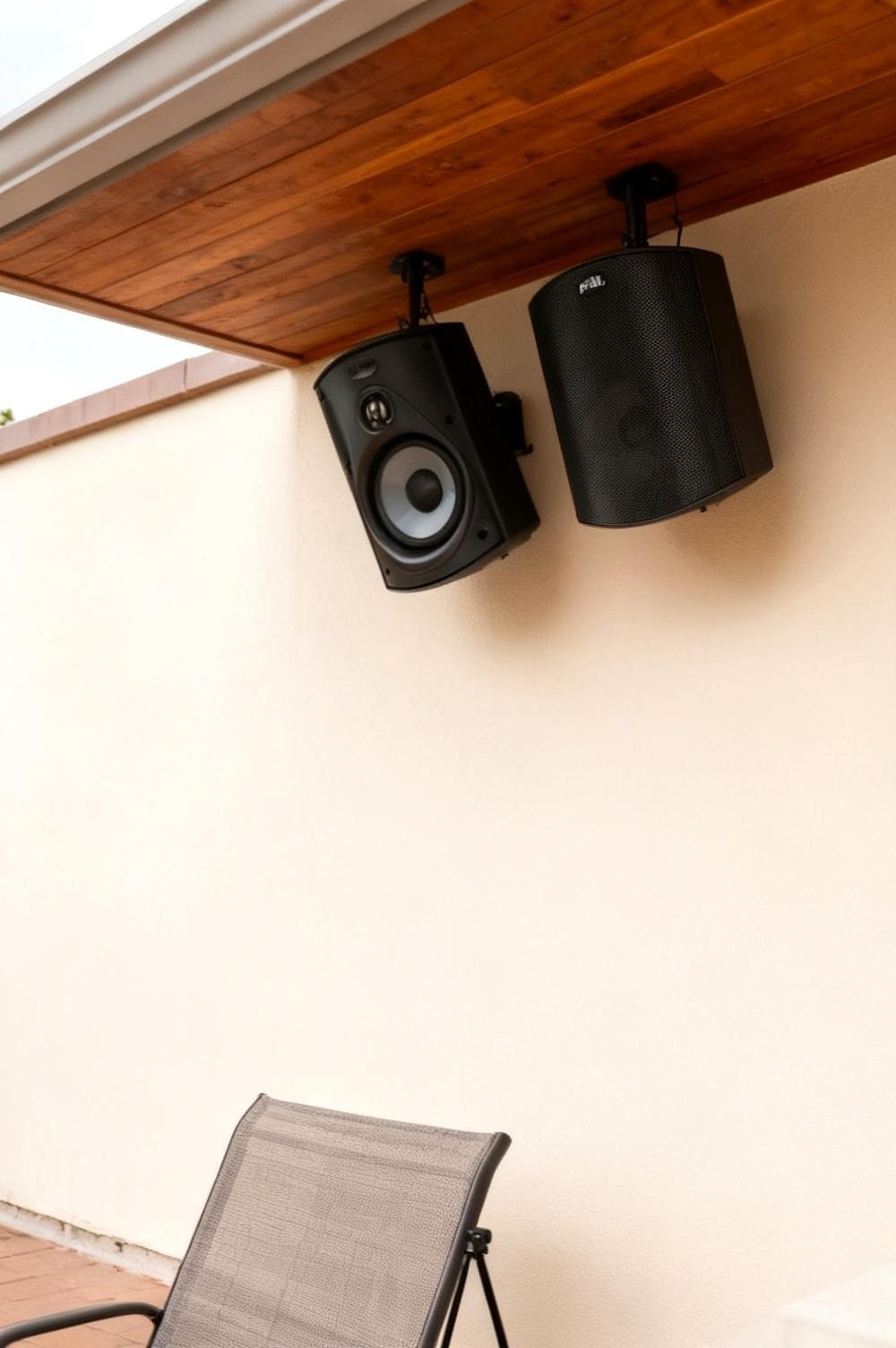
Polk’s Atrium 4 specifications list an 8-ohm nominal impedance, recommended amplifier power of 10 to 80 watts per channel, a five-year cabinet and driver warranty for the original purchaser, and the company’s all-weather certification. Those details matter more than the word “outdoor” on a retailer page.
The weather performance is the part buyers keep confirming. One owner reports them mounted under a deck year-round with no issue and enough output to cover a half-acre yard. Another opened a pair up after twelve years of patio use before the driver membrane finally gave out. Installation comes up repeatedly as easy.
The honest catch is bass. This shows up in review after review, and it is the single most common complaint: the product listing says “powerful bass,” and multiple owners say there is almost none. One describes great highs and mids at real volume with nearly zero low end. Another, after four years, calls the sound flat and notably directional, loud in front of the speakers and much weaker elsewhere in the yard. Several people solved it by adding a subwoofer or moving up to the larger Atrium 5.
Worth knowing: these are passive. At least one buyer read “powered” in the listing and was surprised they needed an amplifier. They do. A small Class-D amp indoors is enough, and as one reviewer put it, the speaker is only as good as the unit pushing it.
Pick it if: the patio is your main outdoor room, you want to install once, and you care more about clear conversation-level music than thump.
Best cheap wired pair: Dual Electronics LU43PB
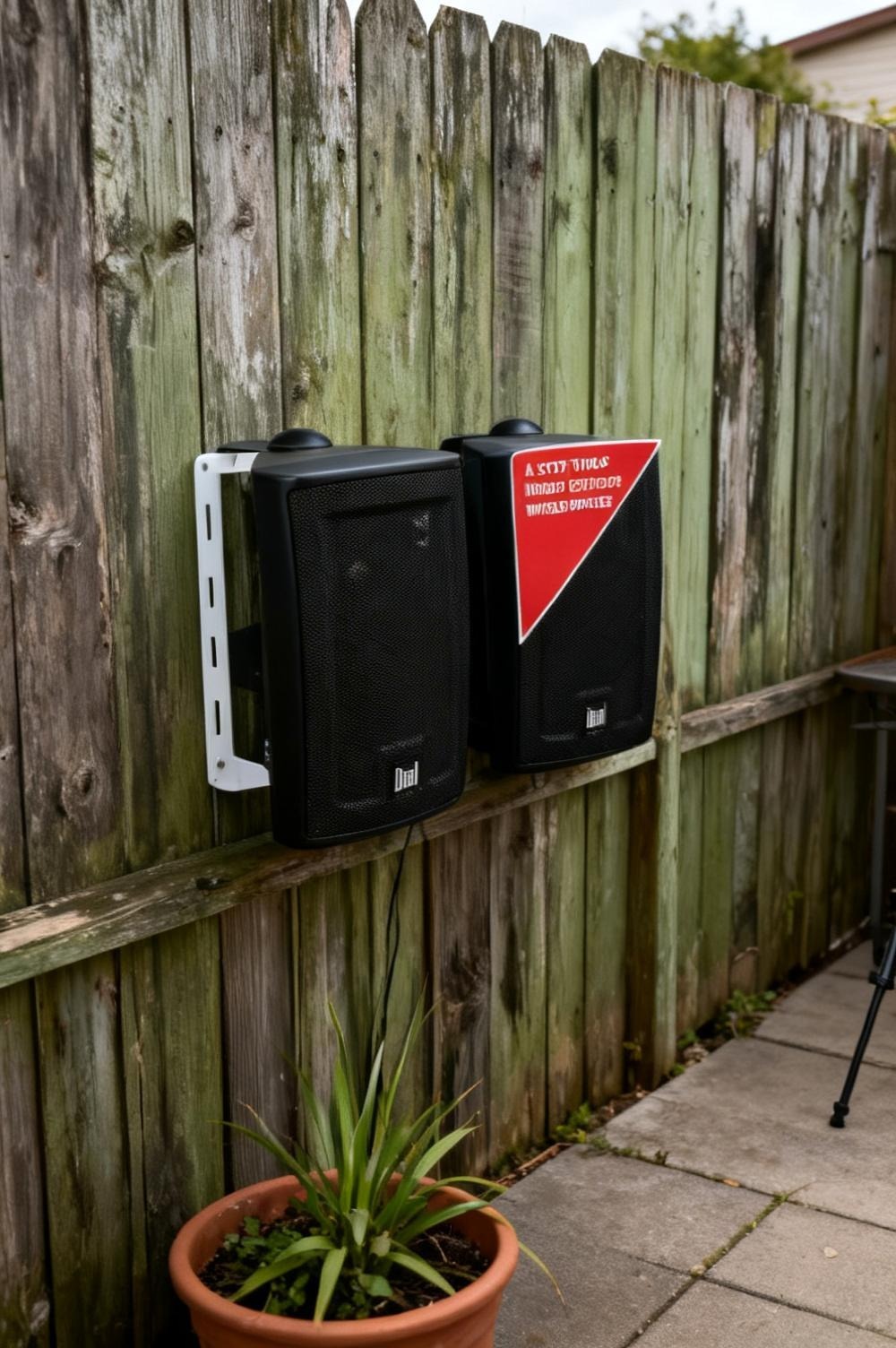
The catch is heat, and it is worth taking seriously. One owner had a speaker physically melt out of shape after about a month outdoors under cover. Another had the housing warp along the top within a year, breaking the weather seal and distorting the sound. There are also scattered quality-control complaints about loose internal screws and mounting inserts that do not line up.
That pattern points somewhere specific: these are fine in shade and moderate climates, and risky in direct sun or a hot region. Bass is thin, which nobody at this price should be surprised by.
Pick it if: you want wired reliability on a shaded covered porch and you are not asking much of them.
Best weather margin for the money: Pyle 6.5" Dual Marine Speakers
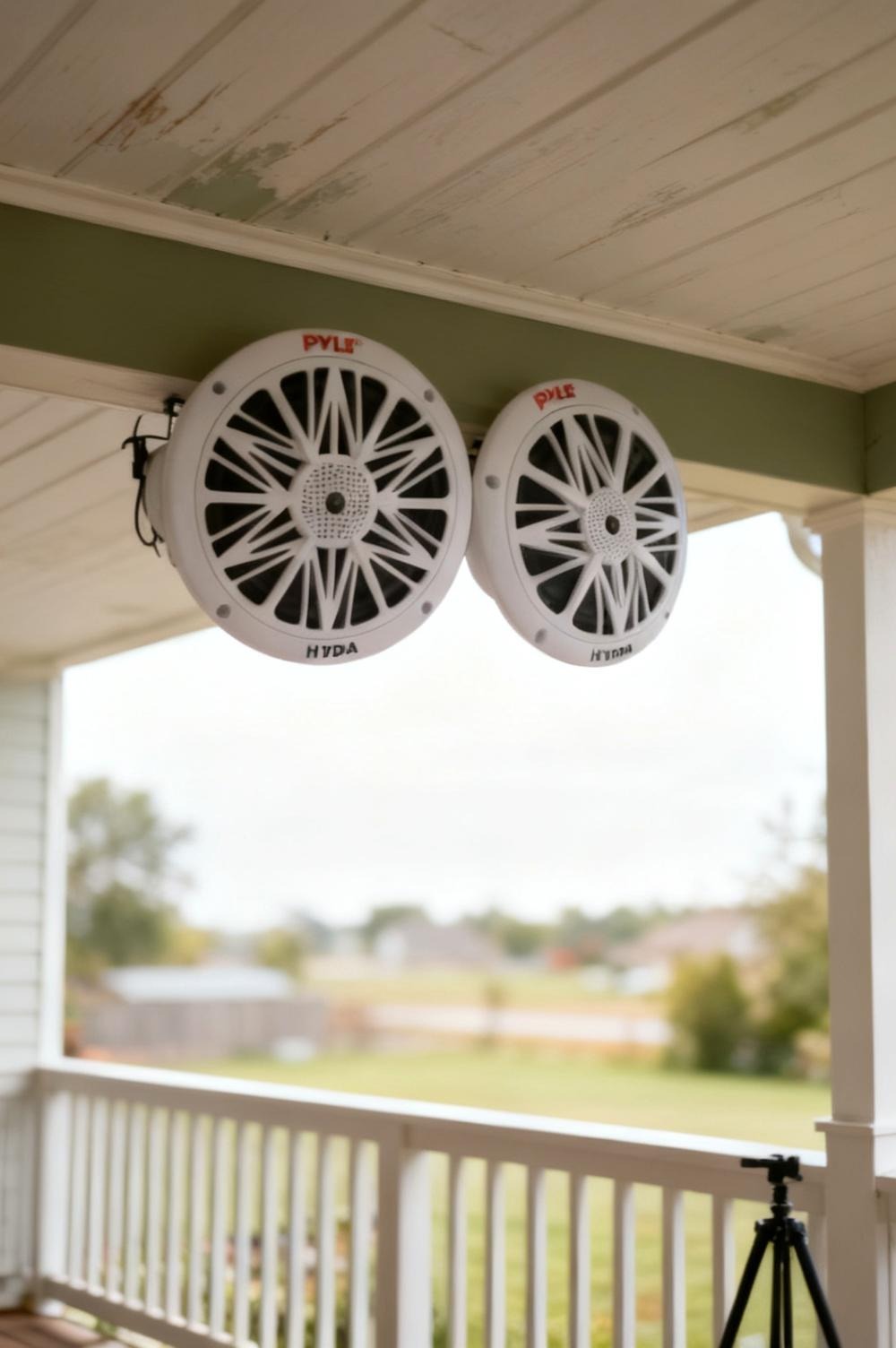
Poly carbon cones and butyl rubber surrounds are the materials that matter. Both resist UV and humidity far better than paper cones, which is exactly the failure mode that warps cheaper plastic-housing speakers.
Pick it if: the patio is fully exposed and you want weather margin over sound quality.
Read the reviews before you buy: Pyle 6.5" Wall Mount Bluetooth System
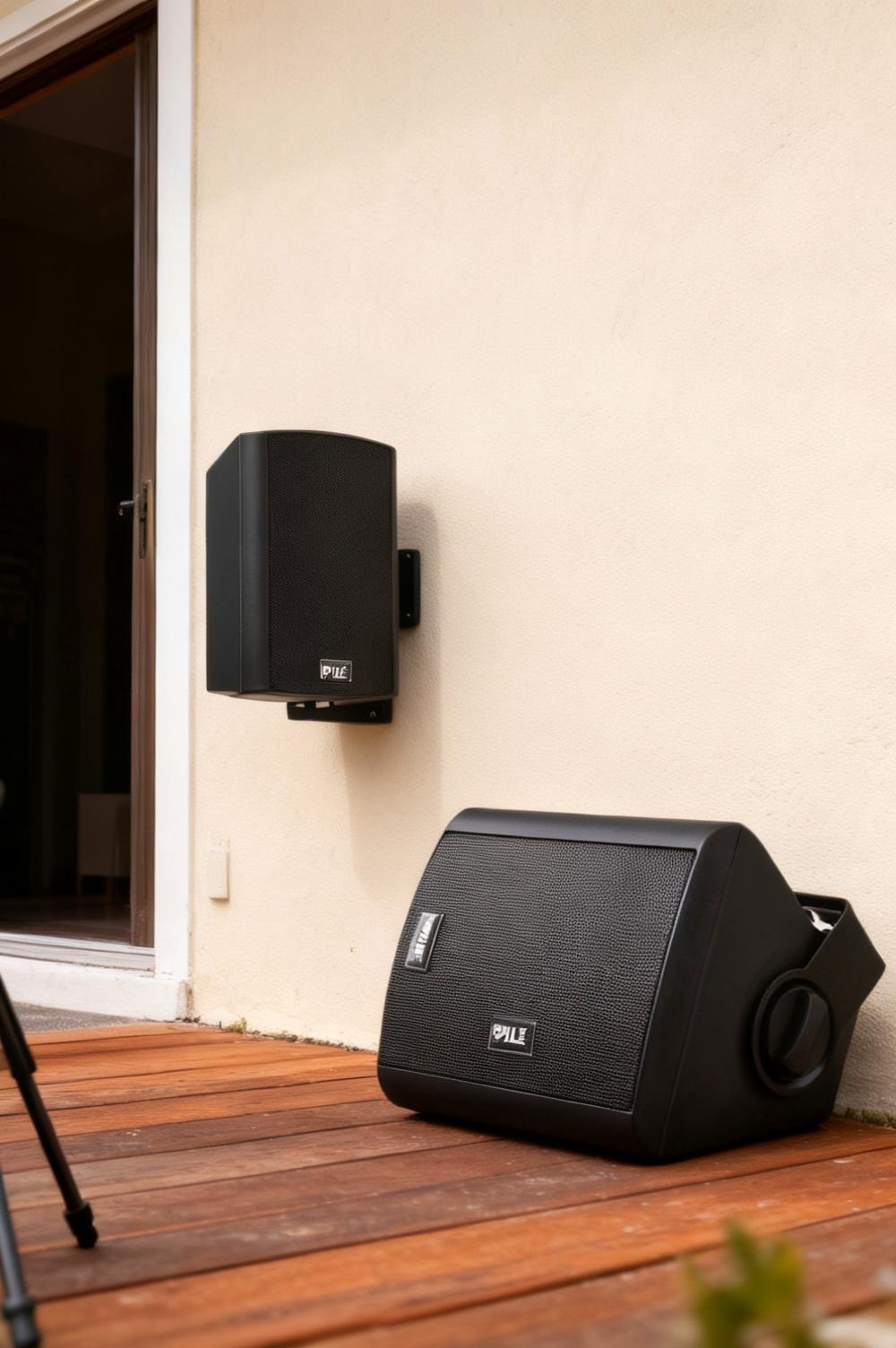
This one looked like the obvious compromise pick, a wall-mount pair with the amplifier built in so there is no wire run indoors. The review text talked me out of recommending it, and it is a clean illustration of the wired-versus-wireless point above.
What owners report: the built-in amplifier delivers around 30 watts per channel rather than the much larger number implied by the listing, and several describe the result as muffled and quieter than expected. Service life is the bigger problem. One buyer is on their third pair in ten years, getting only a few years each. Another had a pair fail at three and a half years, another at eighteen months. There are also Bluetooth pairing failures, and the on/off switch sits on the back of the housing, which is behind the wall once it is mounted.
None of that is unusual for outdoor electronics. It is the predictable cost of putting the amplifier outside. If you genuinely cannot run speaker wire, this category still exists, just go in expecting to replace it.
Skip: solar rock speakers
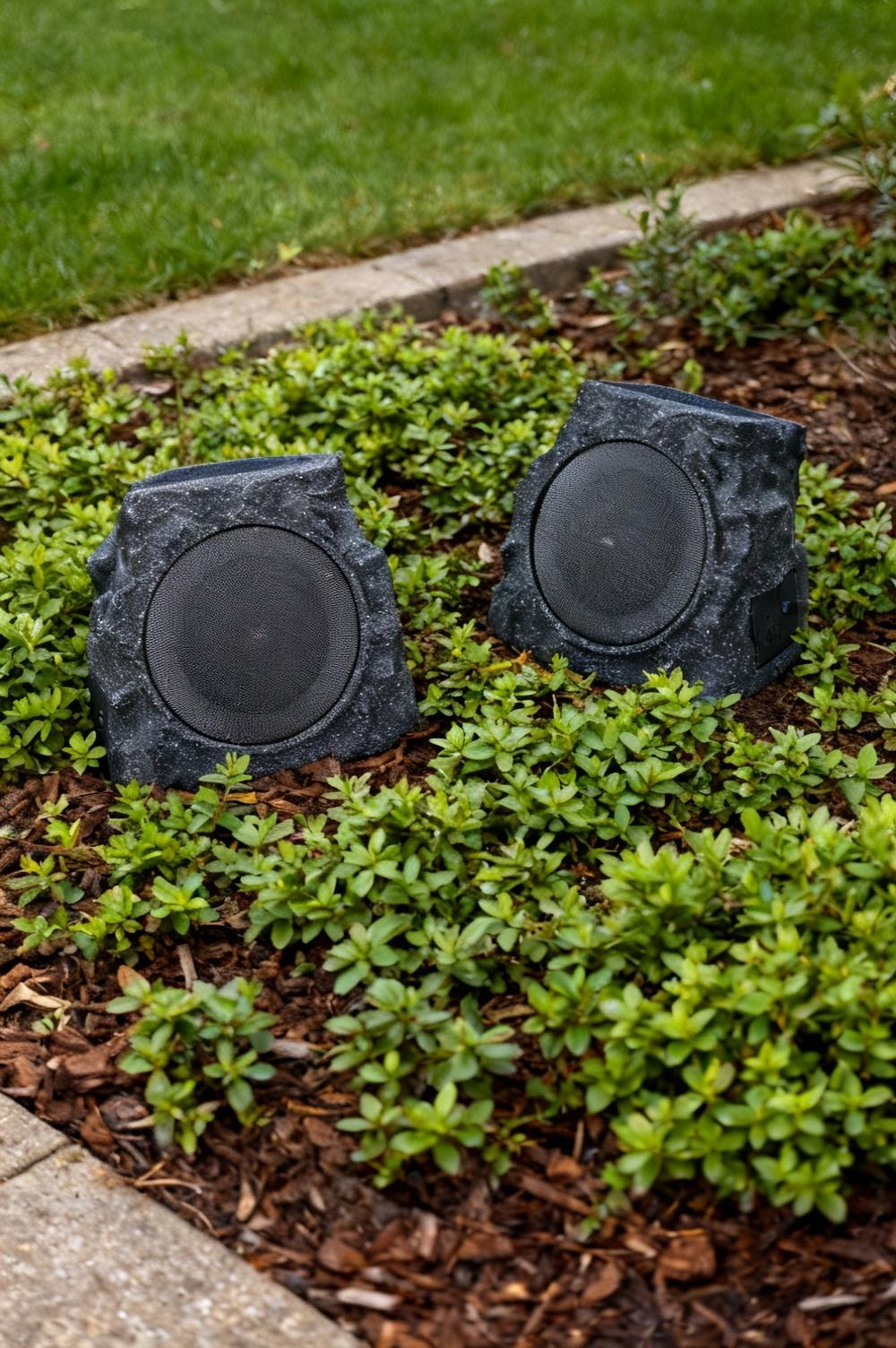
Solar rock speakers are a poor shortcut when the battery and pairing become part of every evening. A passive wired rock pair is a different option for one garden seating area; a matched satellite system is the larger-yard choice. Both need a real wiring and amplifier plan, covered below.
Portable picks
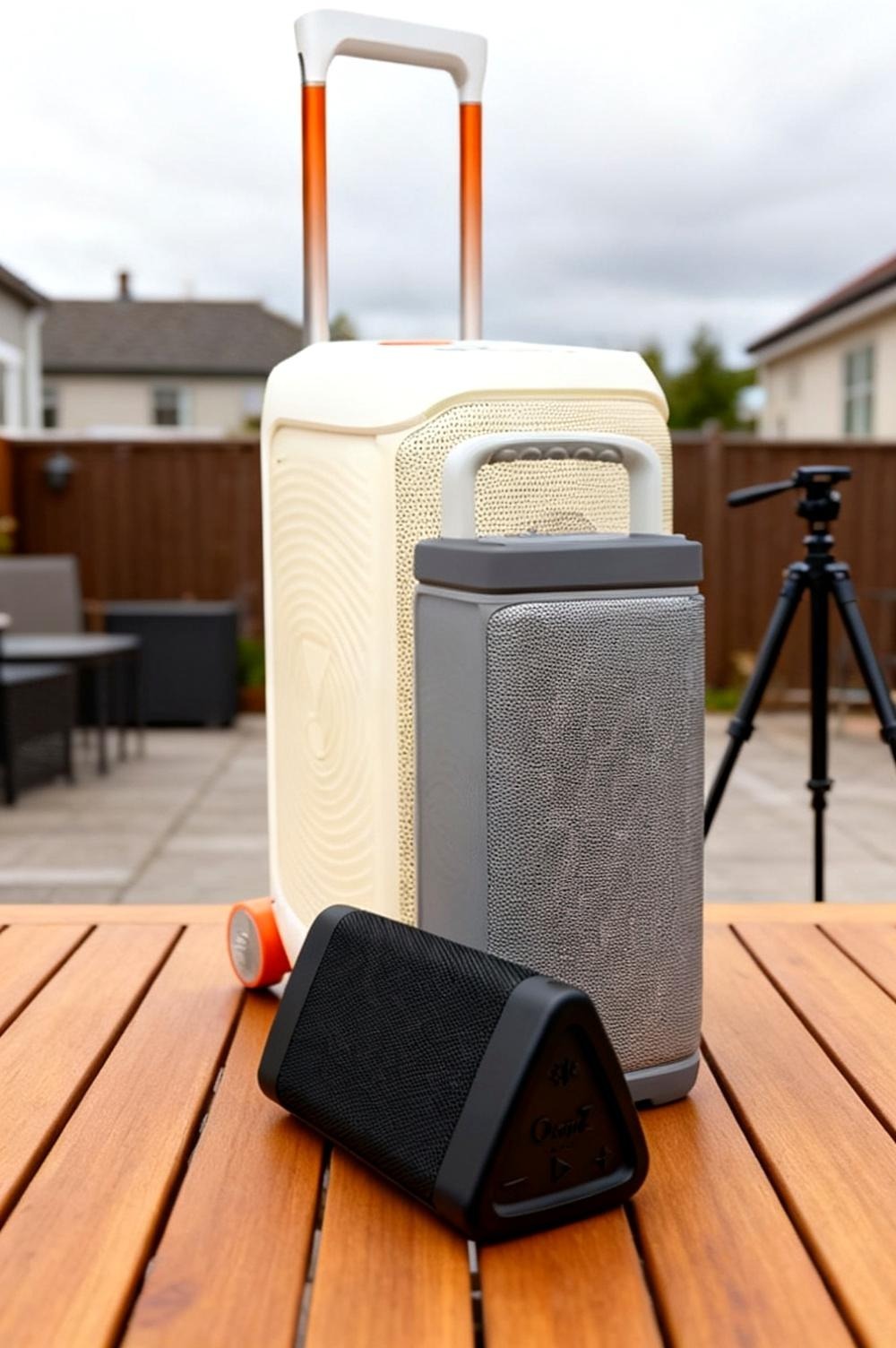
- OontZ Angle 3 Gen 4 carries an extraordinary 164,000+ ratings at 4.5, for about twenty dollars. IPX5, 24-hour battery. The one to buy first if you have never owned an outdoor speaker.
- Turtlebox Ranger is the durability pick at 4.6 across 1,700+ ratings with 3,000+ bought in the past month. IP67, magnetic mounts, and loud enough to be genuinely obnoxious, which is the point for open yards.
- A large party speaker with wheels fits the host who needs high output and easy moving. It is too bulky and expensive for ordinary background music, and it still needs storage that matches the manual.
Outdoor Ceiling Speakers for a Covered Porch
The category most people forget, and the best answer if your porch has a roof.
Outdoor-rated ceiling speakers mount flush into the porch ceiling or soffit, which puts the driver above the seating and out of the weather entirely. Rain never hits them, sun never fades them, and nothing takes up wall or floor space. In a covered porch they typically outlast wall-mount pairs by years for exactly that reason.
The tradeoffs are real. You need a cavity to recess into and access to run wire, which usually means a soffit or an unfinished ceiling. Sound projects straight down, so they work for a defined seating area and poorly for a large open yard. They are also the hardest to retrofit, which is why they make most sense during a porch build or a ceiling replacement rather than as a weekend upgrade.
If your porch is covered and you are already opening the ceiling for any reason, this is the option to price out before buying a wall-mount pair.
Landscape Speakers, and Why the Cheap Ones Disappoint
Landscape speakers are the ones you are not supposed to notice. Small satellite speakers sit on short stakes down in the planting beds, a subwoofer gets buried or tucked behind shrubs, and the sound arrives from the garden instead of from a box bolted to the house.
The reason to want them is coverage, not concealment. Several small sources running quietly can cover a yard more evenly than two loud ones on a wall. You get music at the far end of the patio without a hot spot by the back door, conversation stays possible everywhere, and the neighbors are not getting a concert. Anyone searching for even sound across a whole yard is really searching for this.
Klipsch’s commercial speaker-placement guide makes the useful principle clear: space speakers by their coverage patterns, with overlap giving more consistent sound at a higher system cost. A landscape installer should apply the same idea to the chosen satellites and the yard, not reuse one fixed spacing number for every system.
That is the version worth wanting. It is also the version that is hard to buy.
Search results for landscape speakers are dominated by solar rock speakers, and the category best sellers do not hold up. The uuffoo solar rock pair (opens Amazon in a new tab) sits at 4.0 stars across fewer than 200 ratings, and the recurring complaints are the ones that make the whole format pointless: satellites that drop their pairing, and batteries that run about an hour on a full charge. A speaker hidden in a flower bed is only worth having if you can forget it is there. One that needs re-pairing every evening is a chore with a rock around it.
There is a middle step between a solar rock and a full buried-satellite system: a passive, wired rock-speaker pair in a planting bed. These speakers still need an amplifier and a route for outdoor-rated wire; the rock shape does not make them wireless. TIC’s published specifications for one passive rock model show why the details matter: amplifier load, power handling, and weather-protected connections all belong in the buying decision. Check the exact pair and amplifier manuals together before ordering. If the cable has to cross a lawn, include the cable route and any installation work in the price.
| What you want to cover | Compare first | What the speaker price leaves out |
|---|---|---|
| One sitting area beside the house | A passive wall-mount pair | Indoor amplifier, mounts, and cable route |
| One garden sitting area away from the wall | A passive rock pair | Compatible amplifier, outdoor-rated cable, protected connections |
| Several parts of a large yard | A planned landscape satellite system | System design, amplification, cable runs, and installation |
For one patio, wall-mount speakers aimed toward the chairs are usually simpler to install. A wired rock pair earns its place when the seating is away from the house and a cable route is practical. For even sound across a large yard, price a matched landscape system with an installer. Multiple satellites and a subwoofer need a plan for coverage and amplification, not a cart full of unrelated rocks. Sonance’s landscape range illustrates that system approach; its 70V/100V models require amplification matched to the selected system settings, rather than an assumed fit with a two-channel patio amplifier.
Another way to cover two seating spots is to use wired wall-mount pairs on separate walls, aimed into each area at moderate volume. That leaves the speakers visible but may avoid trenching. Check the amplifier’s supported load before connecting two pairs.
Cold Climates and Year-Round Use
This comes up constantly and the answer splits by type:
- Passive wired speakers can stay outside only when the maker rates the model and installation for year-round exposure. Protect the cable connections exactly as the manual specifies.
- Powered wall-mount speakers depend on the maker’s operating and storage temperature ranges, along with the outlet and connection requirements.
- Portable battery speakers should follow the maker’s charging, storage, and temperature instructions. Bring them in when the manual does not allow cold-weather storage.
Care and Storage Between Seasons
A weather rating covers the speaker, not the way it was installed. Most outdoor failures show up at a mount, a connection, or a seal, and all three are visible on a five-minute walk around the patio.
- Clean the grille with a hose on low pressure. Follow the maker’s cleaning instructions, and skip the pressure washer, which is the fastest way to push water where the enclosure does not want it.
- Check every bracket, bolt, and strap. Vibration works fasteners loose over a season, and a speaker that has shifted may no longer be aimed where you set it.
- Look at the cable jacket and the terminals. Replace a cracked or sun-stiff jacket instead of taping over it, and use the connector type the manual calls for.
- Keep drain paths and port covers working. If the model has a drain or a gasketed cover, leave it doing its job rather than sealing it shut.
- Store whatever the manual does not rate for winter. Batteries and portables are the easiest to bring in; a permanent install depends on its published temperature and exposure limits.
Wiring a Patio Without Digging Up the Yard
For a covered porch or a patio against the house, most runs never need to go underground:
- Use the protected route approved for the wall, eave, or fascia instead of leaving cable loose across a walking path.
- Choose cable gauge from the speaker maker’s chart for the run length and amplifier load.
- Any buried run needs cable rated for direct burial and a route that meets local electrical requirements.
- Keep the amplifier indoors. Outdoor-rated amps exist, cost more, and still degrade faster.
A Good Setup on a Modest Budget
The practical budget setup is a Dual LU43PB pair plus a small Class-D amplifier kept indoors. Add a Bluetooth receiver to the amplifier if you want to stream from a phone. Price the full chain before buying: speakers, amplifier, outdoor-rated cable, mounts, and any weather-protected connection hardware.
That setup is not audiophile sound. It is reliable background music at conversation volume across a covered porch, which is what most people actually want.
What to Skip
- Speakers labeled “weather-resistant” with no IP rating and no sealed-enclosure spec. Marketing language for an indoor speaker.
- Soundbars outdoors. They are designed for indoor wall reflection. Outside, the sound simply disappears.
- Flame-effect lantern speakers bought for sound. They are patio lighting with a speaker attached. Fine for atmosphere, poor as your main audio.
- A product chosen by star average alone. Read the recent low ratings for water entry, charging-port trouble, pairing failures, and cracked mounts before trusting the headline score.
Placement That Fixes Most Sound Complaints
- Start with the maker’s mounting height, aiming, and coverage guidance rather than one spacing rule copied across every patio. For a small deck, Crutchfield’s outdoor-system planning guide uses a pair about 10 feet apart as a planning example and warns against stretching the pair farther just to cover more space.
- Aim coverage toward the seating and away from neighboring windows where the bracket and manual allow it.
- For a wide yard, add coverage at moderate volume instead of asking one pair by the house to reach every corner.
- Two speakers at moderate volume always beat one speaker turned up.
Before adding a subwoofer, listen from the chair farthest from the speakers. Thin bass may be a placement problem, while harsh treble often means the speakers are aimed too directly at that seat.
Three-Step Buying Order
- Decide whether the sound stays in one place or needs to move.
- Match the speaker’s weather and temperature limits to the exact location.
- Price the complete setup, including amplifier, cable, mounting, and storage, before comparing the product rows.
FAQ
What are the best outdoor patio speakers for a normal backyard?
A passive, weather-rated pair on the wall or eave with the amplifier indoors is the simplest permanent setup for many patios. The Polk Atrium 4 is the mid-price pick here, and the Dual LU43PB is the budget pick for a shaded location. The installation still has to match the product manual.
What is the best outdoor speaker system for a deck?
For one deck beside the house, start with two passive wall-mount speakers aimed toward the seating area and powered by an amplifier indoors. A portable Bluetooth speaker is the better fit when you rent or cannot run wire. A landscape system is usually more equipment than one deck needs.
Which outdoor Bluetooth speaker has the best sound quality?
There is no honest universal winner because “Bluetooth speaker” covers portable battery models and powered wall-mount pairs. For a portable, compare sound at the volume you use, published water and temperature limits, battery runtime, and whether one speaker can pair in stereo. For a permanent patio, a passive wired pair usually gives you more choice and keeps the failure-prone electronics indoors.
When is a premium outdoor speaker system worth it?
Pay for a premium installed system when the job is even coverage across a large yard, not simply louder music beside the house. Multiple landscape satellites and an outdoor subwoofer can cover separate seating zones at moderate volume, but they also require compatible amplification, buried cable, careful placement, and a much larger budget.
Do outdoor speakers need to come inside for winter?
Leave a speaker outside only if its manual allows the temperature and exposure at that location. Portable battery models are the easiest to bring in; passive and powered installations still depend on their published limits and protected connections.
Can I connect Bluetooth speakers to my home stereo?
Not directly. A Bluetooth audio adapter plugged into the receiver lets the stereo broadcast to a Bluetooth speaker. The better long-term answer is a wired pair powered by the receiver you already own.
What IP rating do I actually need?
There is no single rating that fits every porch or yard. Match the maker’s stated rain, dust, temperature, and installation limits to the exact location. An IP code describes specific lab-tested protection; it does not promise that a speaker can stay outdoors through every climate or installation mistake.
What I’d Actually Buy
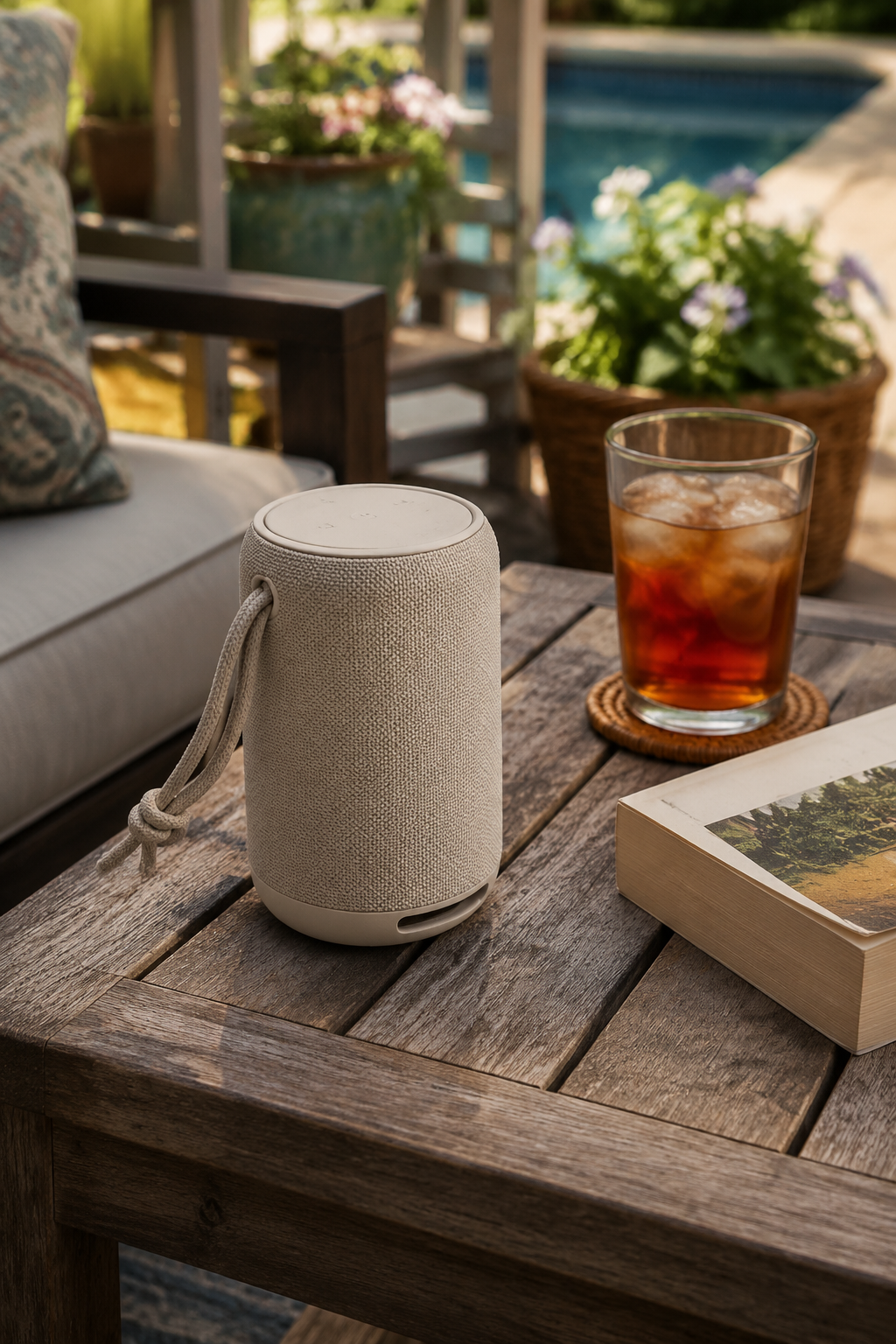
For a permanent mounted pair, I would start with the Polk Audio Atrium 4 (opens Amazon in a new tab) . Its large review history gives you more long-term complaints to inspect than a new listing does. The final choice still depends on the mounting location, amplifier, and installation instructions.
If you would rather not run wire, the OontZ Angle 3 (opens Amazon in a new tab) is the low-risk portable pick, and the Turtlebox Ranger (opens Amazon in a new tab) is the one to take if it will get rained on and dropped.
Skip a large party speaker unless you actually host. For two people on a patio, it is a large object you will end up storing indoors.
What to Read Next
- Small patio ideas helps protect the walking path before speakers take wall or floor space.
- Cozy patio layouts for small spaces helps place the seats that the speakers need to cover.
- Container garden ideas for small patios shows where plants can sit without blocking a speaker or cable route.
- String light patio ideas handles the other powered layer around the same seating zone.
- A weekend patio refresh is the next read when the whole setup needs work, not only the sound.