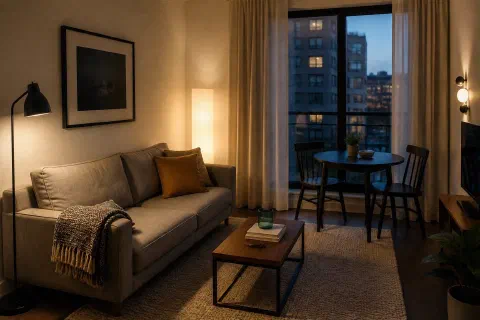
The tree comes down on a Saturday. By Saturday night the living room looks like a rental listing photo. Bare corner, empty mantel, a dented spot in the rug where the stand sat, and the whole place lit by whatever bulb is in the ceiling fixture.
Then you check the calendar and there are ten more weeks of this.
Almost nothing written about winter home decor answers that. Nobody tells you what to do with your bare corner on January 3rd, when the good decorations are in a bin and the stores have jumped to Valentine’s.
So here is the January version. What comes down, what earns another eight weeks, and why the answer is texture and light instead of color.
Start With What You Take Down, Not With What You Buy
Do the takedown all the way through first, then look at the room. Half the time it needs less than you think.
| What it is | December 26 | Why |
|---|---|---|
| Red and green anything | Goes in the bin | Reads as Christmas even sitting alone |
| Gold or silver glitter | Goes in the bin | Glitter is a party finish, not a winter one |
| Plain pine cones | Stays out | They belong to the season, not the holiday |
| Cream and white candles | Stays out | Carry them straight through to March |
| Wool throws and faux fur | Stays out | They do more work in January than in December |
| Warm white string lights | Stays out | The light is the point, not the association |
The test for a maybe: cover the item with your hand and ask whether the shelf still reads as Christmas. If it does, that item is not the problem. If it stops, it is.
Label the bins by room instead of by holiday, so next December you unpack the living room in one trip. If storage in a small place is the part that goes sideways, the small-home Christmas decor storage plan covers the system.
Choose a Winter Palette That Is Not Red and Green
Once the holiday color is gone, most rooms go beige and stay beige until spring. The fix is not adding color back. It is widening the neutrals and adding one quiet accent.
Four that hold up:
- Cream, oatmeal and pale gray, with raw wood and one black metal object. The most forgiving.
- Warm white and putty, with a single deep green: the flat green of boxwood, not the blue green of spruce.
- Ivory and mushroom, with dusty blue in one place only. Blue goes cold fast if you use it twice.
- Bone, camel and charcoal. Carries into February without looking like it is waiting for spring.
Three rules keep any of them from going flat:
- Pick two neutrals, not one. Cream alone is a hospital. Cream with oatmeal has depth.
- Put black somewhere. A lamp base, a frame, an iron candlestick. Without a dark note the scheme washes out under low winter light.
- Keep warm and cool on the same side. Warm white with camel is fine. Warm white with icy blue gray reads as fluorescent.
Our warm color palettes for a cozy living room work the same way in January as they do in October.

Texture Is the Whole Strategy, and the Wool Throw Does Most of It
What separates a January room that feels good from one that feels like a waiting area is that the second one is smooth everywhere. Painted walls, laminate, glass, upholstery, rug. All flat.
So stack texture instead of color:
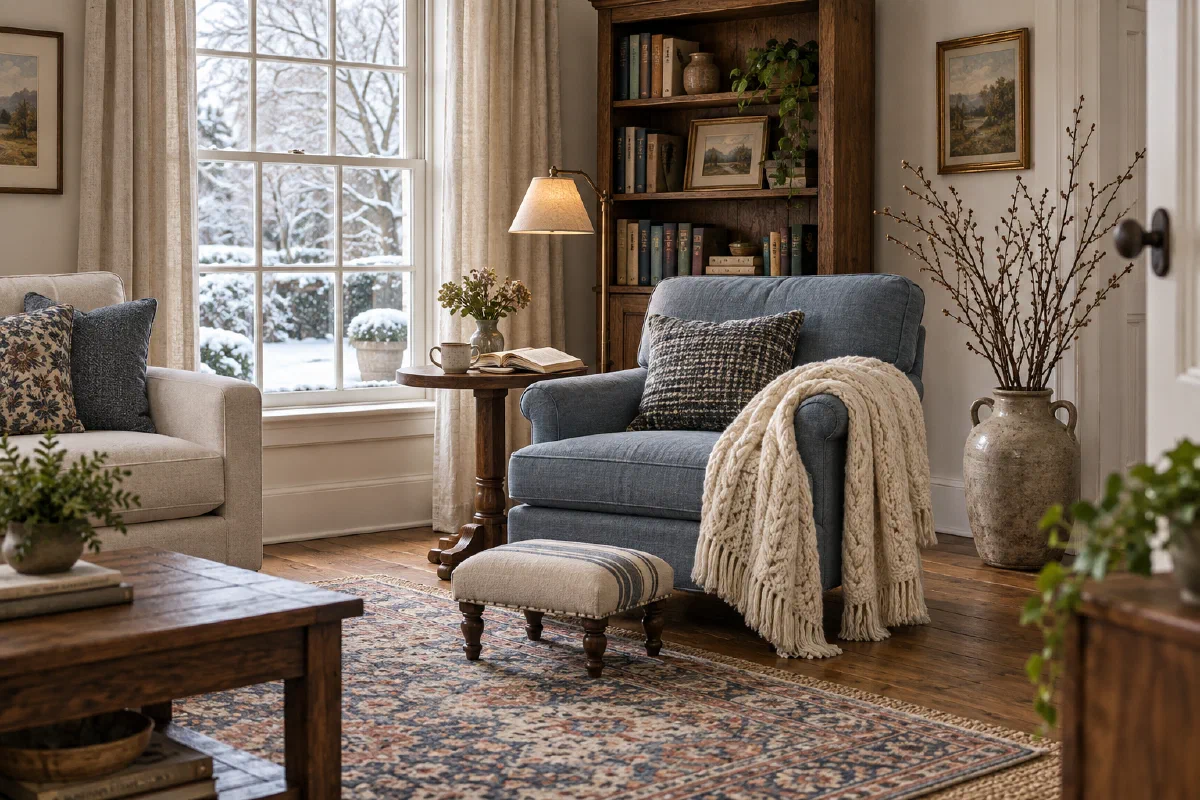
- Wool. A chunky wool throw over the arm of a chair does more than any object on a shelf. Cable or waffle weave, not fleece, which goes flat and shiny under lamplight.
- Sheepskin or faux fur. One piece, on a dining chair or a stool. Two looks like a set.
- Linen. Cushion covers, a runner, a curtain. Linen wrinkles, and the wrinkle is the texture.
- Stone and raw wood. A pottery jug, a marble board, a cutting board leaned on the counter. Weight for the eye to land on.
Three textures within touching distance is the target. A sofa arm with a wool throw, a linen cushion and a wood side table is three. Three cushions in three colors is one texture in three colors, which is why it never quite works.
Start with the seat you actually use. Cozying up a living room without a new sofa is the same move with a heavier hand.
Why a January Room Feels Cold by the Window, and What Lined Curtains Really Do
You are not imagining the cold spot, and it is not only drafts.
Cornell Cooperative Extension’s Energy Saving Window Treatments puts the mechanism plainly: heat moves from warm to cool, so sitting near a cold window means your own body heat radiates toward the glass. You feel cold three feet from a window while the thermometer says the room is fine. That fact sheet puts window losses at 25% to 35% of the heat in a typical single family home.
The decorating part is the opposite of what everyone assumes. Heavy fabric is not the lever. Installation is.
Unsealed draperies cut window heat loss by no more than 10 percent, because warm air slips in over the top, cools against the glass, falls, and pushes back into the room in a loop. Seal that loop and the same curtains reach up to 25 percent. Sealing means four things: close the top above the rod, seal both sides against the wall, let the panels touch the sill or floor, and overlap them about four inches in the middle. Cornell says outright that installation matters more than the fabric.
In a rental where you cannot build a cornice:
- Hang the rod high and wide so the panels close over wall, not over trim.
- Use floor-length panels. One that stops above the sill leaves the loop open at the bottom.
- Choose lined curtains over a thicker unlined pair. The separate lining traps its own layer of air.
- Open them on a sunny window by day, close them at dusk. A north window can stay closed.
- A rolled draft stopper along the sill closes the last gap.
Lamps at Three Heights Fix the Overhead Light Problem
The ceiling fixture is what makes a living room feel like an office at 4 p.m. One source, high up, pointing down, every shadow running the same direction.
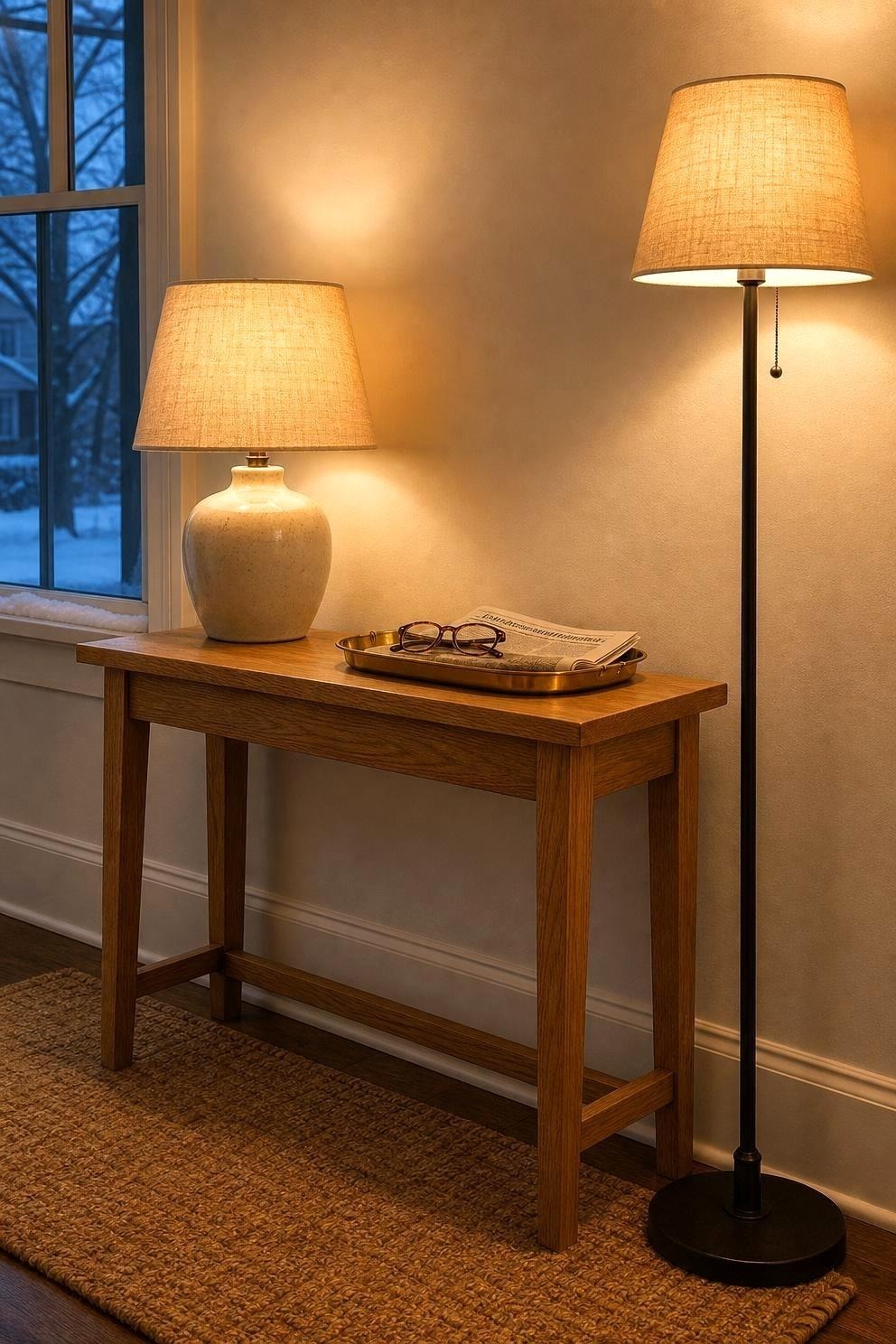
The fix is lamps at three heights, all on at once, ceiling light off.
- Floor level. A small lamp behind a plant, or a lantern with a battery candle. People skip this one, and it is the one that changes the room, because light coming from below eye level is what a fire does.
- Table height. A table lamp on an end table or console, roughly 24 to 30 inches to the top of the shade. Your reading light.
- Above eye level. A floor lamp beside a chair, a plug-in sconce, or a clip lamp on a shelf. It lifts the ceiling and stops the room feeling like a low box.
Then three small things. Match the bulbs, looking for warm white on the box, usually printed as 2700K, because daylight and cool white make a room read as an office. Put the lamps on an outlet timer set for 3:30 p.m. And light one real candle for an hour, not a grouping of nine, with nothing within a foot of curtains or a throw.
A reading nook layout that fits a small space is mostly a lighting problem, and January is when it pays off. If the mantel is bare because the firebox sits unused, a plug-in insert under an empty mantel puts a low warm light back there without a wood fire to tend.
Bare Branches, Evergreen Cuttings and Paperwhites: How to Keep Them Going
January is the one month where cut nature costs almost nothing, because most of it is on the ground outside.
Bare branches are the best value in winter decorating. Cut three or five stems at different lengths, never four, and stand them in a heavy stoneware jug. Birch, red-stemmed dogwood, curly willow, or whatever fell on your street. They need no water and last until you tire of them. In a small apartment, a tall jug of bare branches is the closest thing to furniture you can make for free.
Evergreen cuttings carry the smell of the season without the holiday. Purdue Extension’s guide to harvesting holiday greenery names the ones that hold up indoors: balsam and Douglas fir, yew, holly, boxwood and juniper. It warns off hemlock and spruce, whose needles drop easily. Keep the cut ends in water at all times, away from fireplaces, heat ducts and candles.
Paperwhites are the January flower, and simple enough to be worth doing even if nothing you plant ever lives. Iowa State University Extension’s forcing instructions run short: a clear shallow bowl with no drainage hole, part filled with washed gravel, bulbs set on top with the tips left exposed, then water added only until it touches the bottom of the bulbs. Two to three weeks somewhere dark at 45 to 50 degrees, then a sunny window at 60 to 70 once the shoots hit 3 inches. Discard them after flowering, because paperwhites cannot be forced again and are not winter hardy outdoors.
Amaryllis carries a shelf on its own. University of Minnesota Extension’s amaryllis guide gives the numbers: a pot about an inch wider than the widest part of the bulb and twice as tall, one third to one half of the bulb visible above the soil, water when the top 2 inches feel dry. Flowers develop in about 4 to 6 weeks from a dormant bulb, the exact length of the January dead zone.

The Empty Spot Where the Tree Was
Nobody answers this one, and it is the question you actually have.
First, be honest about what that corner was in November. If it was empty then, it can be empty now. Move the furniture back where it lived and the corner stops reading as a hole. If it really is a gap:
- A tall jug of bare branches on the floor. Height is what the tree was giving you.
- A floor lamp. If you were adding the third light height anyway, put it here. A lit corner never reads as empty.
- A basket of blankets. It absorbs the pile that builds on the sofa, and blanket storage that holds its shape is the version still looking good in March.
- Something leaned. A framed print, a mirror, an old shutter against the wall. No drilling, and it fills vertical space the way the tree did.
The one thing not to do is buy furniture in the first week of January to fill a corner that will be a different room by March. Live with it bare for a week first.
Renter Rules: No Drilling, No Paint, and the Bins You Just Filled
- Nothing that needs an anchor. Leaning and propping beat hanging. A mirror behind a console reads as intentional, not as a compromise.
- Plug-in over hardwired. Sconces and clip lamps give the third light height with no electrician and no holes.
- Adhesive strips have a weight limit printed on the packet. Believe it, and pull the tab straight down and slow.
- Storage is the renter tax. Flat bins under the bed, tall bins in the top of a closet, labeled by room. Cozy apartment ideas for making a rental feel like home treat storage as decorating rather than as the thing that ruins it.
Relative Humidity Is the Number Nobody Mentions
There is one more reason a January room feels worse than it looks, and it is not visual. Running heat dries the air out. The EPA’s guidance in Mold Course Chapter 2 is to keep indoor relative humidity below 60 percent, ideally between 30 and 50. The upper number is about mold. The lower one is what matters in January, because a heated home in a cold climate can sit well under it.
Your wood furniture notices. Purdue Extension’s sheet on the shrinking and swelling of wood explains that wood comes into equilibrium with the relative humidity around it: at 30 percent it settles near 6 percent moisture content, at 75 percent near 14. That swing is why a solid wood table that was fine in September opens a hairline gap in February.
- Put a cheap hygrometer in the main room and look at it once.
- If it reads low, run a humidifier where you spend your evenings. One room, not the whole place.
- Stand plants on a saucer of pebbles, keep the paperwhite bowl topped up, dry laundry on a rack.
- Keep wood furniture out of the path of a heating vent.
Questions People Actually Ask
How do you decorate in January after Christmas?
Take everything down first, then look at the room before you add anything. Keep what belongs to winter rather than to the holiday: plain pine cones, cream candles, wool throws, warm string lights, lanterns. Swap red and green for two neutrals plus one quiet accent. Then spend your effort on texture and lighting instead of new objects. Those are what make a January room feel finished once the color is gone.
How do you decorate for winter but not Christmas?
The dividing line is color and glitter. Red, green, gold sparkle and ornaments read as Christmas even sitting alone on a shelf. Cream, oatmeal, gray, deep green, bone and charcoal read as winter. Wool, linen, sheepskin, stoneware, bare wood and evergreen belong to the season rather than to December 25th.
What do you replace Christmas decor with?
Mostly with texture and light, not objects. A chunky wool throw, a linen cushion, a sheepskin on a stool and lined curtains fill a room more than a shelf of small things does. Then one or two living pieces: bare branches in a heavy jug, evergreen cuttings while they last, paperwhites or an amaryllis on the windowsill.
What decorations should you put up in January?
Cream and white candles, lanterns, a wool blanket over the chair you use, floor-length curtains, and one large mirror or framed print leaned against the wall. Add a table lamp and a floor lamp so the ceiling fixture can stay off. For anything living, branches and forced bulbs suit January best.
What are some easy winter decor ideas?
The five that take under an hour each: cut branches and stand them in a jug; move a plant you already own into the corner where the tree was; put your lamps on a timer set for 3:30 p.m.; swap every bulb in the room to warm white; and drape a wool throw over the arm of the chair you actually sit in. None of them need a purchase, a drill, or the landlord’s permission.
What to Read Next
- Warm Color Palettes for a Cozy Living Room is the reasoning behind the palette rules above.
- Cozy Up a Living Room Without a New Sofa is the same texture stacking, with no new furniture.
- Dried Flower Shelf Ideas is the no-water version of the branches idea.
- Small-Home Christmas Decor Storage Plan is what to do with the bins you just filled.
- Cozy Apartment Ideas to Make a Rental Feel Like Home is the no-drilling, no-paint version of all this.