
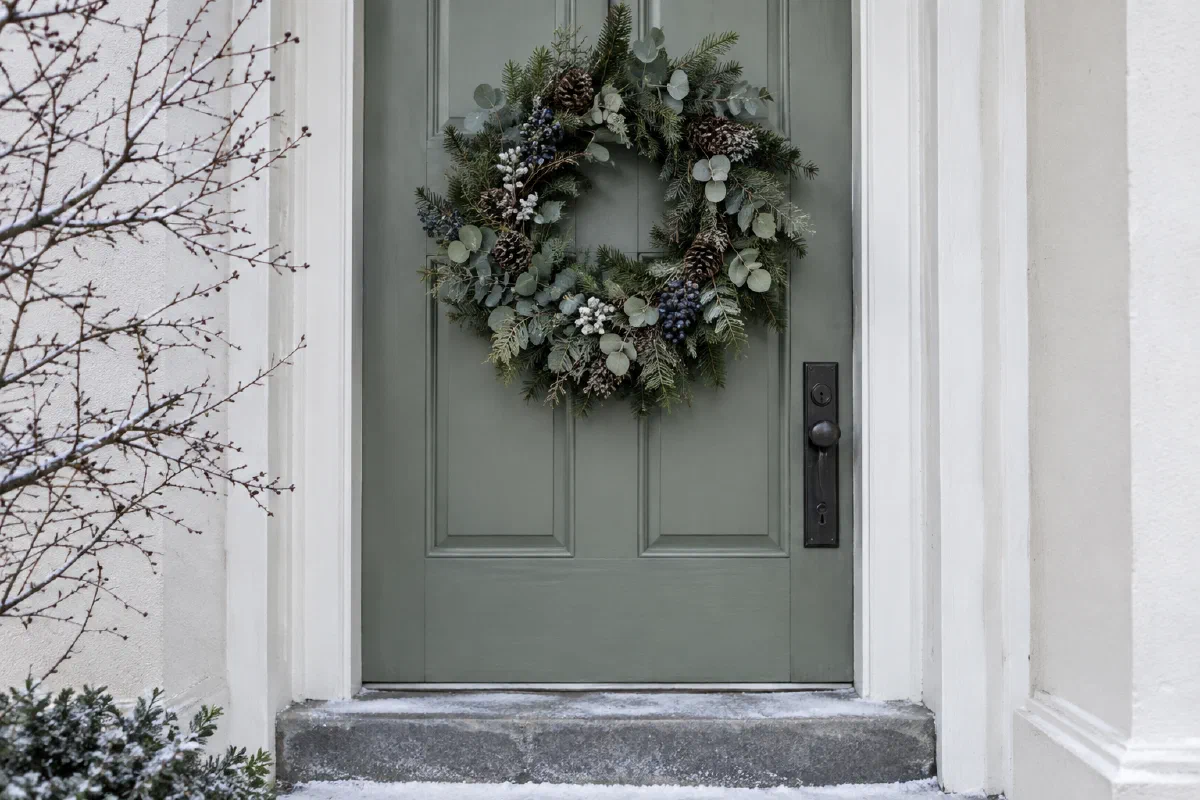
The wreath has no deadline. Its accessories do. That is why so many doors sit bare from January to March, and it is fixable in about ten minutes with no crafting skills at all.
The pinecones, the birch, the dried orange slices, the juniper, the winterberry: all of it reads as winter through February. The red and green plaid ribbon, the Santa pick, and the gold glitter spray are the only parts that expire on the 26th. Swap those and leave the rest standing.
A winter wreath is two layers. The base decides how long it lasts. The bow and the picks decide how long it is allowed to stay. Judge those two layers separately and most of the advice below sorts itself out.
Noble fir and magnolia or spruce and hemlock: what holds on a winter wreath
Needle retention is a species trait, not a brand, and the split is sharper than most listings admit.
Firs are the strong group. Clemson Cooperative Extension rates all firs as having good tolerance of hot, dry indoor conditions with “excellent color and needle retention,” and names Fraser fir wreaths as the commercial standard. The New York Botanical Garden plant information service lists the best needle retention in the trade by botanical name: balsam fir, Fraser fir, noble fir, white fir, Douglas fir, Scotch pine, and white pine. Noble fir earns its place on a winter wreath for a second reason, since its stiff branches hold a pinecone without sagging the way soft cedar does.
Spruce and hemlock sit at the other end. Clemson puts spruce needle retention below every other conifer, and NYBG calls both “notorious” for dropping needles. That is a reason to hang them outside a heated entry, where cold air does the retaining for them, not a reason to avoid them.
Magnolia and boxwood are the two broadleaf exceptions. Clemson describes magnolia leaves as holding up “very well, even without water,” and boxwood wreaths as long lasting, with the honest caveat that the scent divides people. Both dry in place instead of shattering.
| Green | Hold | Best spot on the wreath | The catch |
|---|---|---|---|
| Noble fir | Excellent | The body, under pinecones | Stiff and prickly to wire |
| Fraser fir | Excellent | Body and swags | Quality varies a lot by lot |
| White pine | Good | Soft filler between fir | Needles crease easily |
| Magnolia | Very good | Structure and backing | Heavy, needs room |
| Boxwood | Good | Compact wreaths | Scent divides people |
| Juniper or eastern red cedar | Moderate | Fragrant accents | Short life in a heated entry |
| Spruce and hemlock | Poor indoors | Cold outdoor doors only | Drops needles once warm |
Two things decide the real number of weeks, and neither is on the label.
The first is cutting date. A wreath made from boughs cut in late November keeps going well past one made from October-cut material, and the gap widens in a warm room. The second is position, because the threat on a door is not only drying out but winter burn. University of Minnesota Extension explains that winter sun and wind pull water from foliage faster than frozen roots can replace it, and that cold destroys chlorophyll while temperatures stay below 28 degrees, which bleaches the foliage. Damage lands on south, southwest, and windward sides.
So the door that keeps a winter wreath longest is the one the fall material already prefers: a north or northeast face with an overhang. And because the internet says otherwise, keep this line: the same extension page states that anti-desiccant and anti-transpirant sprays are not effective for protecting evergreen foliage in winter. Do not buy a spray to hold a wreath together.
Fresh, faux, or dried: which winter wreath to choose
| Option | In February | Time per winter | What it costs you |
|---|---|---|---|
| Fresh greens on a reusable base | Tired | Soak, top up, pull dry sections | A rebuild every November |
| Faux evergreen or boxwood | Unchanged | A dust in spring | Cheap ones read as plastic up close |
| Dried stems and grasses | Fades, keeps shape | Almost none | Sheltered doors only |
| Picks and dried on any base | Consistent | Ten minutes in late December | Somewhere to keep the off-season pieces |
One constraint most winter wreath pages skip: fresh greens are a perishable good with a closing window. A wreath bought on December 20 is a different object from one bought on November 24, and by mid January the lot is picked over or gone. So the real decision is not which looks best. It is whether you want a wreath you replace every November or one that is still in the closet in five years. For the second, buy one good faux wreath or one grapevine base and spend the money on greens and picks you can change.
If you would rather build the base than buy it, the sizing, the wire method, and the hanging hardware are in how to make a fall wreath in one evening , and none of it changes for winter. Only the material list does.
How to swap the bow and picks in ten minutes
This is the entire job, and it is why a winter wreath can stay up.
- Sort every piece into three piles. Stays: pinecones, birch, lights, the base. Goes: Santa picks, plaid ribbon, glitter. Worn: brittle greenery, faded berries.
- Pull the picks, do not cut them. Floral picks have wire legs that slide out of a grapevine base. Pull from the base of the pick, not the decoration.
- Untie the bow instead of unpicking it. Tied on with a pipe cleaner or a wire loop, it comes off whole and goes back on next December.
- Reattach with the hardware you removed. Floral picks and greening pins hold in grapevine and pull out in spring. Skip the glue gun.
- Put new pieces where the old ones sat. The base wears in a pattern, so the same clock position keeps it balanced.
- Add dried and berry pieces last. They are fragile, so push them in at the outer edge, facing the same way as everything else.
| Comes off in late December | Goes on and stays through February |
|---|---|
| Red and green plaid ribbon | Wide cream, oatmeal, or pale grey ribbon |
| Poinsettia clips, Santa picks | Pinecones, birch slices, cinnamon sticks |
| Glitter and metallic sprays | Frosted eucalyptus, preserved greenery |
| Candy canes, peppermint picks | Dried orange slices, juniper, winterberry |
| Keep the lights and the hanger | Same height, same nail hole |
Winter wreath mistakes that shorten the season
- Waiting until January to strip the Christmas layer. It was hiding the greenery’s decline for a month. Swapping in late December keeps the fresh half of the season.
- Soaking a finished wreath. Clemson’s overnight soak is right for loose branches, because cut ends drink. A finished wreath on a wire or grapevine base has nothing to drink, and foam bases can mildew.
- Red and green anything. One plaid ribbon is enough to make a neutral wreath read as Christmas. Pull all of it at once.
- Expecting winterberry to hold on a busy door. NC State Extension describes winterberry as a food source for songbirds, because the fruit is real food. Keep the berries for a sheltered spot or indoors.
- Glue where a pin would do. You will want those picks back next year.
Winter wreath care: swap, dust, store
- Test one needle. Bend it. It should flex, not snap. A section that snaps comes off the same day.
- Dust, never wash. A soft brush handles faux and dried material.
- Skip misting. Dried material pulls moisture from the air, so the piece that lasts longest sits on an interior wall, not in a steamy bathroom.
- Take it down while it still looks fine. Waiting until it looks finished means it is already dropping.
- Store the base, bin the greens. By mid January the evergreen is compost. The base is the part that carries over.
For storage, work in this order. Strip every pick and pin, and sort them into the same three piles. Bin the fresh greens rather than storing them, since they mold in a closed box. Dust the faux parts and let everything dry indoors a day or two. Hang the wreath instead of boxing it flat, because weight crushes dried stems and flattens faux branches. Store it somewhere breathable, a cotton bag or loose cardboard box rather than a sealed tote, and a closet rather than a damp basement floor, a hot attic, or an unheated shed. The EPA’s indoor guidance is to hold relative humidity below 60 percent, and ideally between 30 and 50, which applies to whatever room the wreath spends ten months in. Label the pick box for next December, and check the base in October.
What to Read Next
- A dried fall wreath that lasts past October makes the same two-layer argument for dried material, and its shelter rules decide whether dried stems can go on your door at all.
- How to make a fall wreath in one evening has the base sizing, the wire method, and the storm door clearances this article assumes you already solved.
- Indoor Christmas greenery that lasts past week one covers conditioning stems in water, which is the one place a cut end still drinks.
- Christmas front door decor is the December layer this piece takes back off, useful if you want to plan the swap before you hang anything.
- Fall garland ideas applies the same neutral palette to a rail or mantel, which is where the pieces you pull off a wreath can go next.