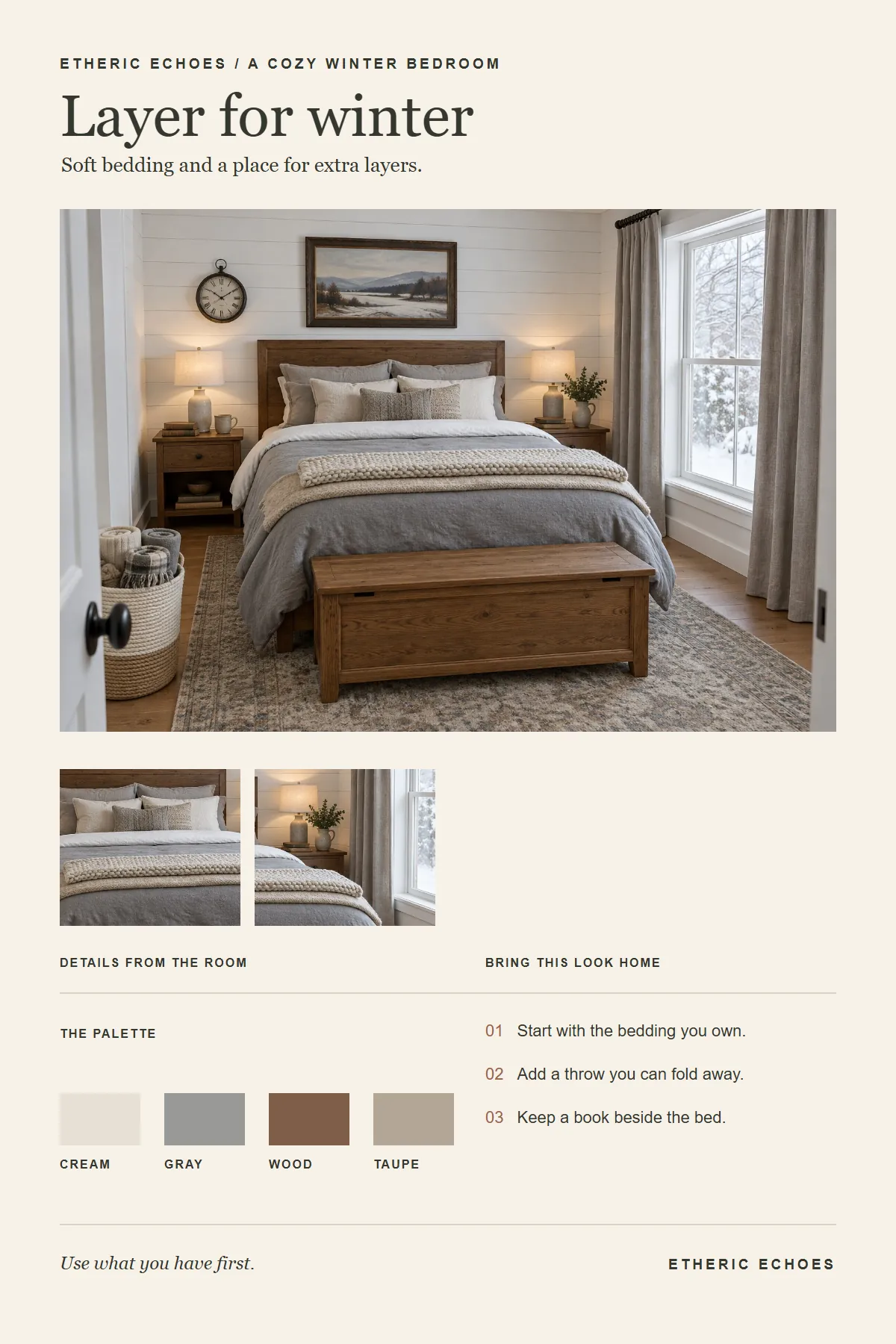
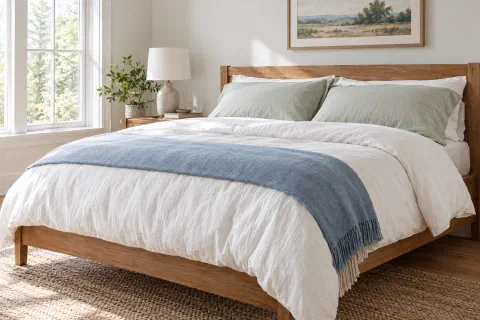
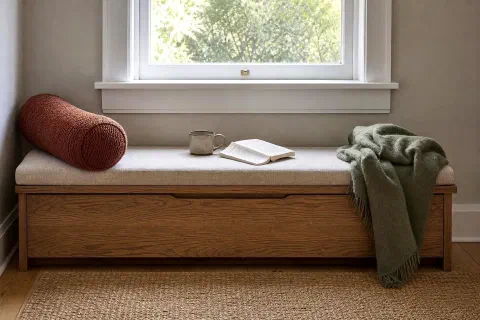
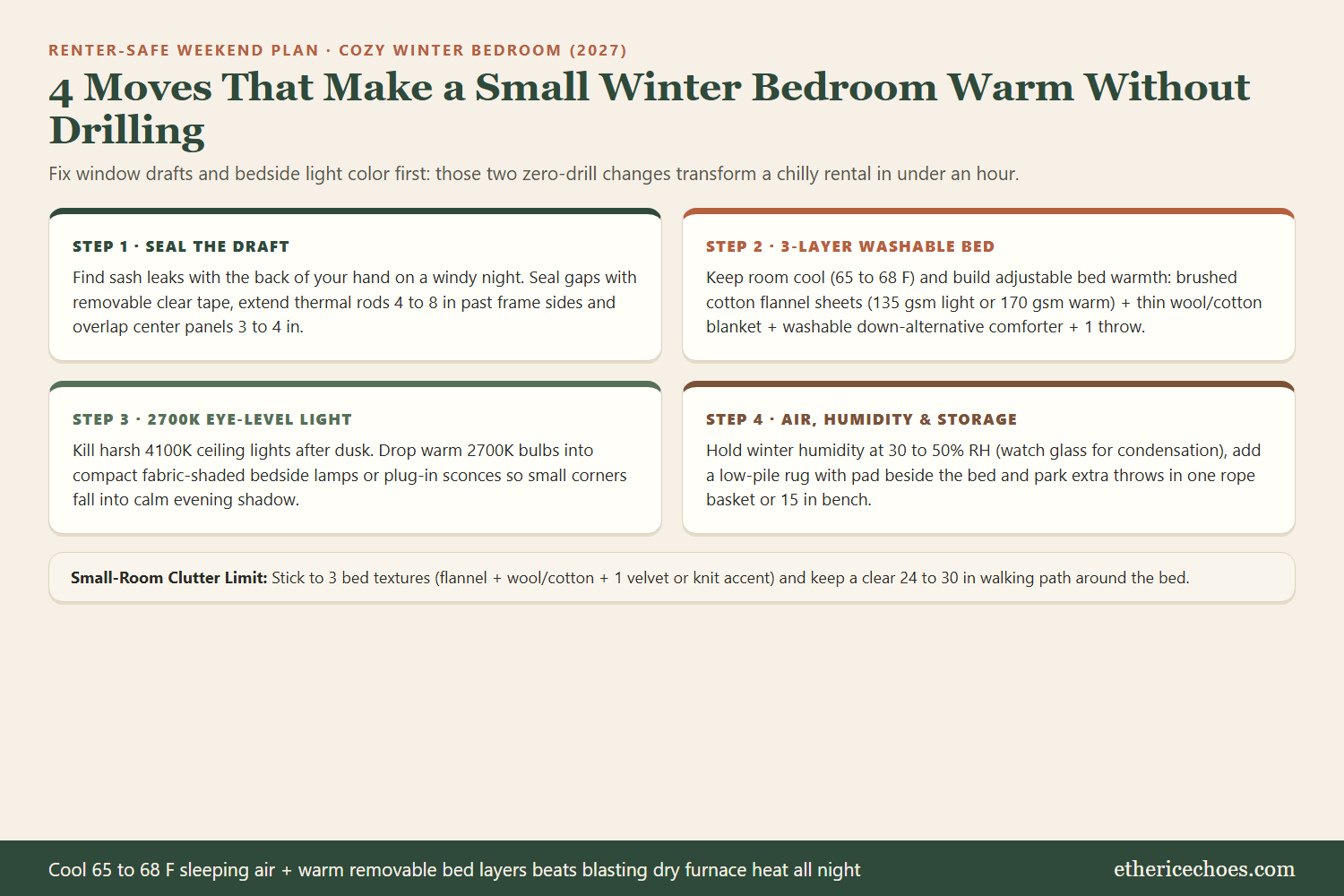
A cozy winter bedroom in a small room comes down to four moves in this exact order: stop the window draft, layer the bed for easy temperature control, switch to 2700K bedside light, and give your blankets and book a dedicated landing spot. When we refresh a tight bedroom or rental for cold weather, we start with the air leak and the lamp because those two fixes change how the room feels in under an hour, with zero drilling.
Cozy Winter Bedroom Ideas for a Small Room
Last updated:

Some links below are Amazon affiliate links. If you buy through them, Etheric Echoes earns a small commission at no extra cost to you.
15-Second Picker
Match your first winter bedroom upgrade to what feels coldest right now
Choose your biggest cold-weather annoyance in a small bedroom or rental for an instant weekend pick.
1. What bothers you most in your bedroom on cold winter nights?
2. What upkeep rule matters most in a small apartment?
Best First Cold-Bed Swap$
Double-brushed cotton traps warm air right beside your skin without trapping clammy synthetic heat, and washes cleanly at home.
Keep in mind: Heavy brushed flannel can feel too warm for naturally hot sleepers; check fabric weight on the listing.
Best Washable Rental Top Layer$
300 gsm breathable fill adds instant cloud-like warmth over cotton sheets while fitting easily into standard home washing machines.
Keep in mind: Down-alternative weighs slightly more per warmth level than premium 800-fill goose down.
Best Foot-of-Bed Layer$
Gives instant cozy texture in a small room, rolls into a bedside rope basket in seconds and washes effortlessly.
Keep in mind: Synthetic fleece runs warm, so drape it over the foot rather than under a heavy duvet.
Best Dry-Air Overnight Fix$$
Built-in Auto humidistat holds the 40 to 50% comfort zone automatically for up to 60 hours at a near-silent 26 dB without over-misting cold glass.
Keep in mind: Dial down to 40% RH if condensation beads behind closed thermal curtains on below-freezing nights.
Affiliate links: we may earn a commission if you purchase through Amazon at no extra cost to you. Cost tiers ($ to $$$) reflect relative spend; check Amazon for live pricing. Selections stay on your screen.
Featured small-room winter bedroom essentials (live product cards)
Affiliate disclosure: We earn a small commission if you buy through our Amazon links below, at no extra cost to you. Cost tiers ($ to $$$) reflect relative spend; check the live Amazon listing for current pricing and availability.
Best First Cold-Bed Swap$
Best for: Eliminating that icy first-minute shock when climbing into bed while keeping the room thermostat comfortably cool at 65 to 68 F.
Honest catch: Heavy brushed flannel can feel too warm for naturally hot sleepers; check fabric weight on the listing.
Best Washable Rental Top Layer$
Best for: Renters with small washers who want lofty winter insulation without dry-clean-only goose down care.
Honest catch: Down-alternative weighs slightly more per warmth level than premium 800-fill goose down.
Best Foot-of-Bed Layer$
Best for: Adding one dedicated warmth layer across the foot of the bed to pull up at 3 a.m. without piling five messy throws on a chair.
Honest catch: Synthetic fleece runs warm, so drape it over the foot rather than under a heavy duvet.
Best Dry-Air Overnight Fix$$
Best for: Dry winter bedrooms dropping below 30% humidity where furnace heat causes scratchy throats and static sheets.
Honest catch: Dial down to 40% RH if condensation beads behind closed thermal curtains on below-freezing nights.
If your room is still dressed for early autumn, our lighter seasonal setup works until frost hits. Once overnight temperatures drop, we swap out thin layers and focus on holding warmth right where you sleep.
What makes a small bedroom feel cozy?
Five practical details do the heavy lifting, and in a small room we keep each one tight so the floor stays open. Warm light low in the room. A bed built from adjustable layers. A window that does not dump cold air onto the pillows. One warm, calm color story. And a single spot to sit and read that is not the edge of a messy bed. If you only have an hour tonight, we always tell readers to spend it on the window leak and the bedside bulb before buying a single throw pillow.
| If your room… | Start here |
|---|---|
| Has cold air near the window or bed | Drafts and curtains |
| Feels cold when you climb in, then too warm by 2 a.m. | Bedding layers |
| Looks like an office after dark | Lamp color |
| Has blankets piled on a chair | A basket or bench |
How do you layer bedding for a cozy winter bedroom?
We build a winter bed from several thin layers instead of one bulky quilt. That way you can kick off one layer at 2 a.m. without freezing, and every piece fits in a standard apartment washer on its own. Most people sleep best in a cool room around 65 to 68°F, so our goal is a cool, breathable room paired with a bed that traps steady warmth right around your shoulders.
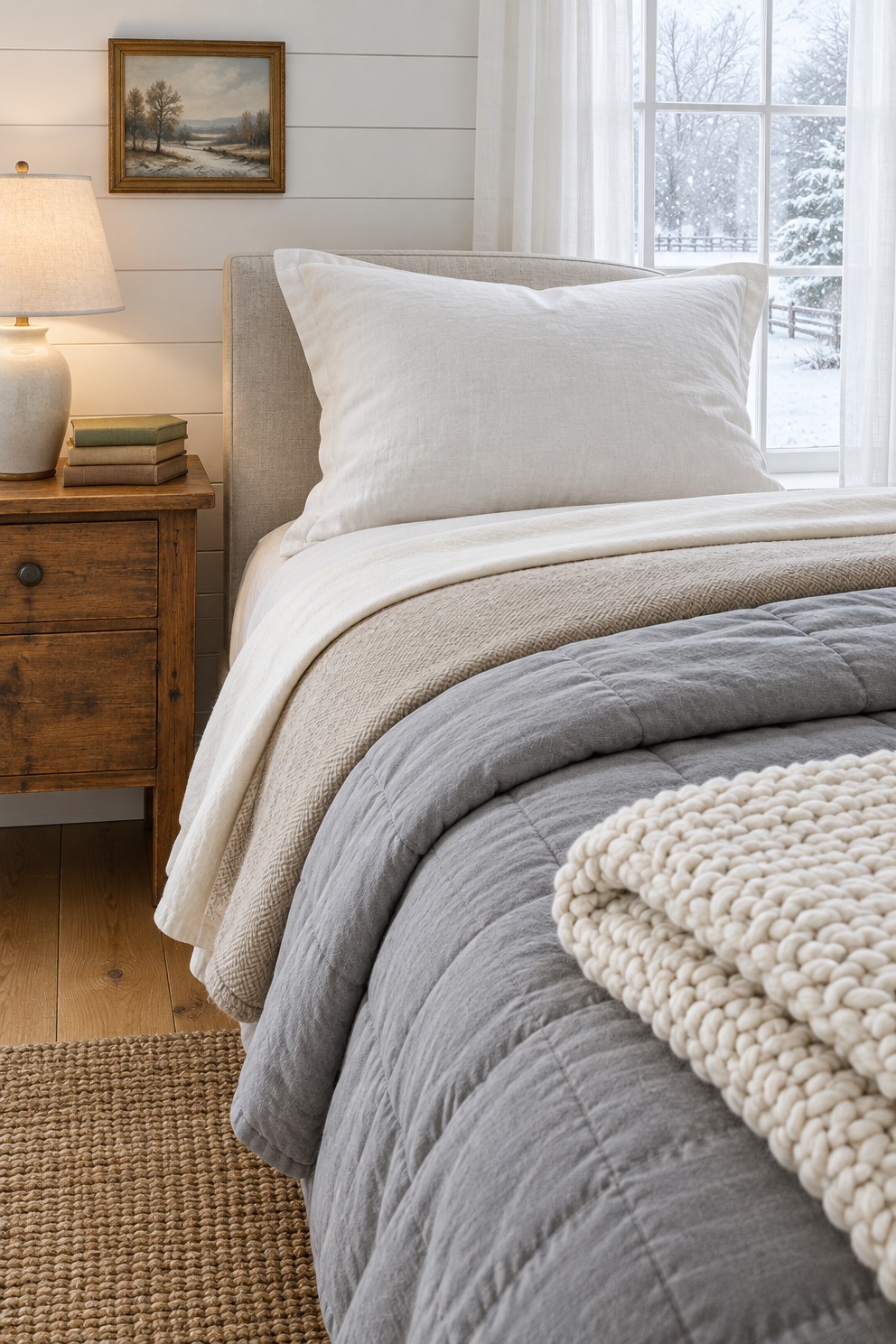
| Layer | What to use | What to know |
|---|---|---|
| Sheets | Cotton flannel | Flannel is brushed after it is woven, which raises fibers that trap warm air. Lighter flannel, near 135 gsm, sleeps cooler, and heavier flannel, near 170 gsm, holds more warmth. If you run hot, percale or linen sheets breathe better. |
| Middle | A thin quilt or cotton blanket | Easy to push off, easy to wash. Wool, per the same guide, is warm and wicks moisture, but it costs more. |
| Top | A down-alternative comforter | Real down insulates better, but down alternative costs less, is less likely to overheat you, and is usually machine washable. Real down often needs professional cleaning. |
| Foot of the bed | One knit or fleece throw | The layer you pull up in the coldest hour. Keep one here, not five. |
Flannel sheets are our favorite first swap because you feel the difference the second you climb in. This cotton flannel sheet set (opens Amazon in a new tab)As an Amazon Associate, we earn from qualifying purchases. Full disclosure. is listed as 100 percent cotton, double brushed and machine washable. Check the size and fabric weight on the listing before ordering. Heavier flannel near 170 gsm holds noticeably more warmth, while lighter flannel near 135 gsm is kinder if you wake up warm.
For the top layer, we sorted the real tradeoffs in the box below. In a rental with a small washer, a washable down-alternative comforter usually wins on upkeep. Real down gives lighter warmth per ounce, though it asks for gentler care and a bigger budget.
What is the difference between a duvet and a comforter?
A comforter is a filled, quilted blanket you put straight on the bed as it comes. A duvet is a plain filled insert tucked inside a removable duvet cover, so you wash the cover every week or two and wash the insert far less often. Either one works for the top layer in our table. If you already own a solid winter insert or comforter, we skip buying a second one and put the budget into better sheets or draft tape instead. Our 7 bedding ideas for a cozy bedroom covers color and pattern if you want a fresh cover.
Which fabrics feel warmest: flannel, sateen, wool or velvet?
Bedding guides do not always agree on warmth, so we separated what independent editorial guides recommend from claims that come only from a single brand.
| Fabric | Where it goes | What the sources say |
|---|---|---|
| Brushed cotton or flannel | Sheets | House & Garden recommends brushed cotton sheets for added warmth; the flannel weights are in the table above |
| Sateen | Sheets | Delara Home, a bedding brand, calls its sateen a slightly heavier, warmer alternative to its crisp percale. That is one brand’s description of its own sheets |
| Wool | Blanket | Bedable lists wool blankets for natural temperature regulation |
| Velvet, mohair, sheepskin | Pillows, cushions, a throw | Homes & Gardens lists them among the tactile fabrics that make a room feel relaxed; Bedable suggests velvet or velour pillowcases for a touch of luxury |
| Linen | Pillow cover, curtains | Pair it with a warmer fabric; a linen sheet alone is the cooler choice |
You do not need every fabric on this chart. In a small bedroom, we stick to three textures total: brushed flannel on the mattress, one wool or cotton middle blanket, and one velvet or chunky knit accent. Once you stack five or six heavy fabrics on a queen or full bed, the bed starts swallowing the room.
What color light makes a bedroom feel warm?
Check the bulb box for 2700K. That is warm white, the soft yellow-amber tone of classic lamplight. By contrast, cool white office and classroom bulbs sit around 4100K, which makes a winter bedroom look flat and chilly the moment the sun drops at 4:30 p.m.
After we swap the Kelvin rating, we move the light down to eye level. Keep the ceiling fixture off after dusk and save it for changing sheets or hunting for a missing sock. A low bedside lamp lights the pillows and lets the corners fall into soft shadow, which makes a tight room feel calm instead of boxy. We look for a fabric drum shade that hides the bare bulb from bed height. The Brightech Carter lamp (opens Amazon in a new tab)As an Amazon Associate, we earn from qualifying purchases. Full disclosure., a walnut stem under a linen drum shade, is the compact footprint we like on a narrow nightstand.
Pair that main ambient lamp with one smaller accent light across the room so no single corner feels cave-dark. When a nightstand is too tight for a lamp base, a plug-in wall sconce frees the whole top surface; our lamp placement guide breaks down warm bulbs and compatible plug-in dimmers. If your room has a ceiling pendant, put a dimmable 2700K bulb in it and keep it dimmed low rather than bright.
These soft white bulbs (opens Amazon in a new tab)As an Amazon Associate, we earn from qualifying purchases. Full disclosure. are listed at 2700K and 800 lumens. They are listed as non-dimmable, so if your lamp runs on a dimmer switch, grab a bulb clearly labeled dimmable instead. On the nightstand, a single unscented or mild-scent candle gives a similar low evening glow while you wind down.
How do you stop window drafts in a small bedroom?
Find the leak before you hang a single curtain. On a cold, windy evening, run the back of your hand slowly around the window frame, along the meeting rail where the sashes lock, and across the bottom sill. Wherever your knuckles feel a sharp drop in temperature is where warm air is slipping out.
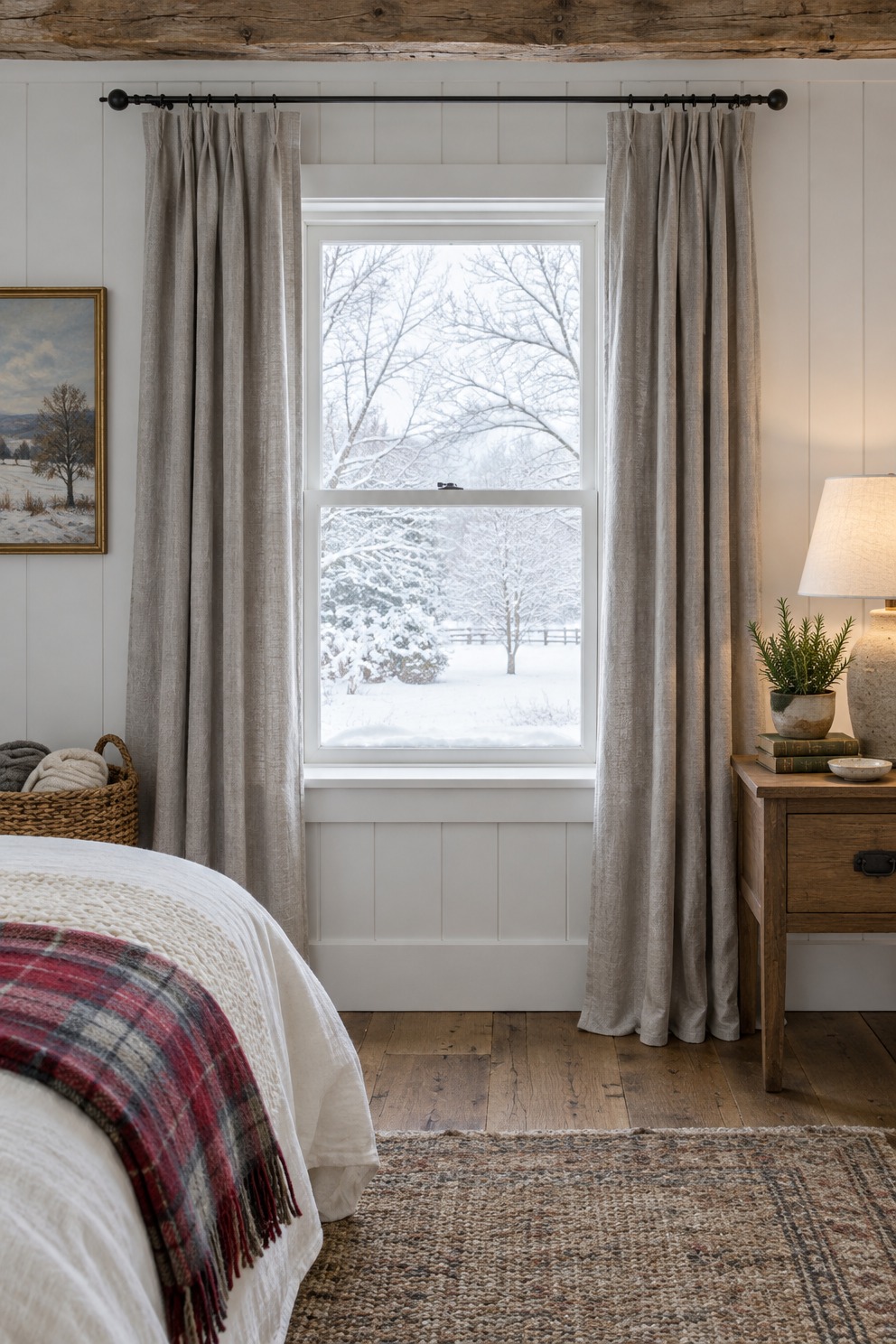
In our experience, most thermal curtains underperform because air still loops around the top, sides, and center seam. Once you close those gaps and watch your indoor humidity, a drafty bedroom feels noticeably warmer without touching the thermostat.
| Cold-window problem | What actually happens | Renter-safe fix and measurement |
|---|---|---|
| Sash or frame air leak | Cold outdoor wind blows straight through worn weatherstripping | Apply clear removable weather-sealing tape along the sash seam after wiping the frame dry |
| Side and bottom chimney draft | Warm room air cools against the glass and spills down onto the bed | Extend the curtain rod 4 to 8 inches past each side of the frame and let panels brush the floor |
| Top rod gap | Warm air rolls over the top of a standard rod and cools behind the fabric | Mount the rod close to the ceiling or use a wrap-around rod that curves back to the wall |
| Center panel gap | Two panels that barely kiss blow apart whenever the heat kicks on | Overlap the panels by 3 to 4 inches in the center or clip them shut at night |
| Morning window condensation | Humid winter air sneaks behind closed thermal curtains and hits freezing glass | Keep bedroom humidity at 30% to 50%, open curtains in the morning, and dial back a humidifier if water beads on the glass |
Work from the cheapest fix to the heaviest layer:
- Seal the gap. Clear adhesive weather-sealing tape along the sash stops drafts you can actually feel. This window sealing tape (opens Amazon in a new tab)As an Amazon Associate, we earn from qualifying purchases. Full disclosure. is listed as leaving no residue when removed. Test a hidden corner first and double-check your lease.
- Time your curtains with the sun. Close them right at dusk to hold indoor warmth in, and pull them wide open every morning so winter sunlight warms the room and dries any overnight moisture off the glass.
- Hang heavier thermal panels properly. Thermal insulated blackout panels (opens Amazon in a new tab)As an Amazon Associate, we earn from qualifying purchases. Full disclosure. come in a pair at 52 by 84 inches per panel, and the listing says they are machine washable. Mounting the rod high and 4 to 8 inches wider than the trim lets panels clear the glass by day so you never lose winter daylight. In a strict no-nail rental, a tension rod inside the frame or rated adhesive hooks will hold lighter insulated panels.
- Add insulating shades if the glass still radiates cold. Tight-fitting cellular shades sit inside the frame and trap a dead-air pocket right against the pane, making them the smartest next step for older single-pane windows.
If you run a humidifier during dry winter weeks, keep indoor relative humidity between 30% and 50%. Below 30% leaves you waking up with dry sinuses, while pushing past 50% behind heavy thermal curtains often causes water droplets to pool on the windowsill by morning. If you add a space heater, give it at least three feet of clear floor away from the bed and curtains, and switch it off before you go to sleep.
How do you make a reading spot in a small bedroom?
We skip the bulky accent armchair in small bedrooms because it steals floor space and usually turns into a laundry catch-all by Wednesday. All a real winter reading spot needs is a supported seat, warm light aimed over your shoulder, and a flat surface for a mug.
- In bed: use a dedicated clip-on light so you do not flood the whole room. This rechargeable clip-on book light (opens Amazon in a new tab)As an Amazon Associate, we earn from qualifying purchases. Full disclosure. is listed as warm 3000K with three brightness settings, which keeps the glow right on the page.
- At the foot of the bed: choose a slim storage bench. This folding ottoman bench (opens Amazon in a new tab)As an Amazon Associate, we earn from qualifying purchases. Full disclosure. is listed at 15 inches deep, 43 inches wide and 15 inches high, giving you a perch and 35 gallons of hidden blanket storage.
- By the window: pull in a lightweight desk or dining chair you already own, drape one throw over the arm, and set a small stool beside it for your tea. Aim the lamp from behind your shoulder on the side you hold the book.
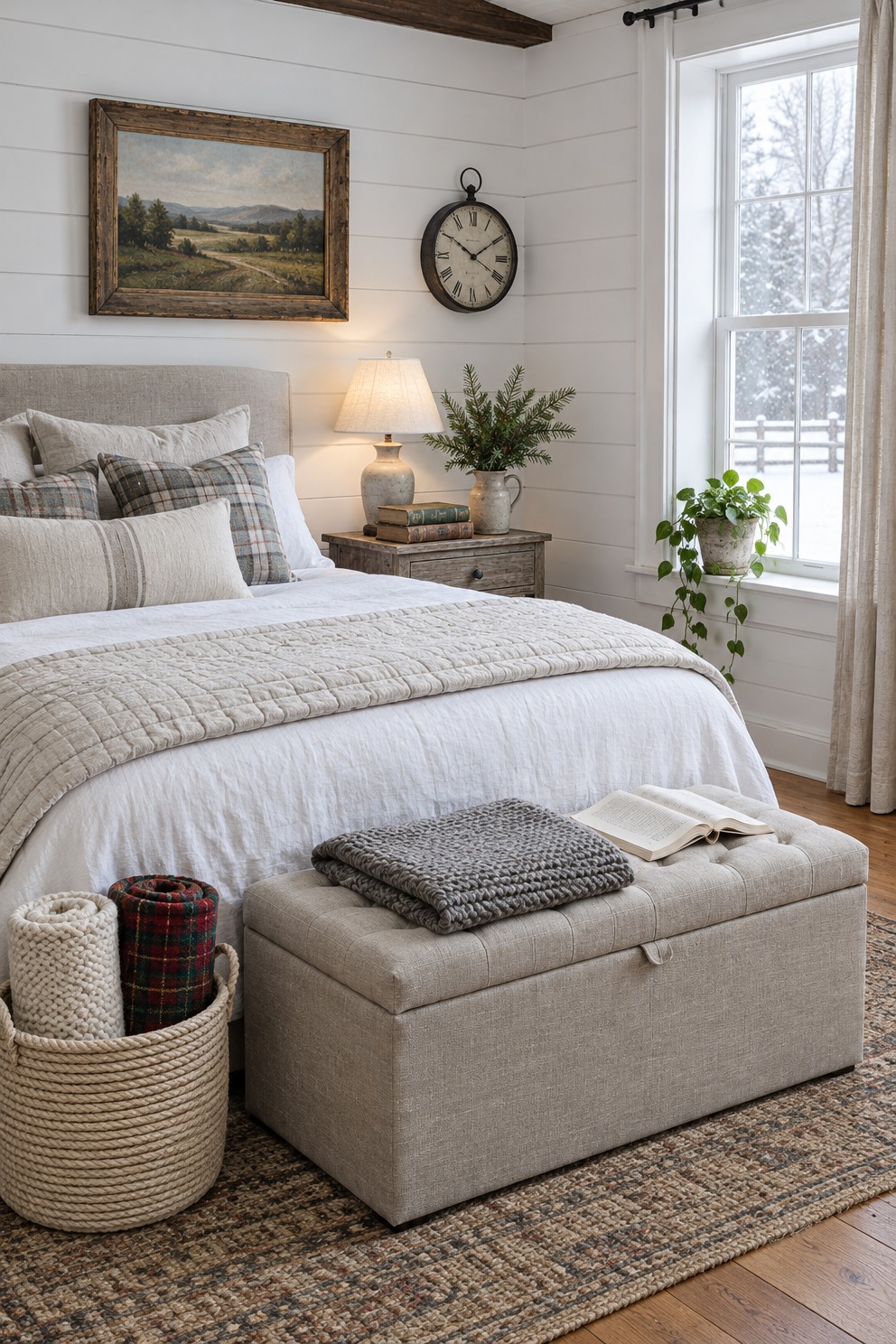
Before placing any bench or chair, we measure the walking lane between the bed edge and the wall or closet door. Aim to keep 24 to 30 inches of open floor along your main path so the room feels restful instead of pinched when you walk in with a laundry basket.
How do you keep a small bedroom cozy and not cramped?
Cozy and crowded can look almost identical in a photo and feel completely different at 7 a.m. when you are half awake. We lean on four small-room habits that let thicker winter bedding fit without crowding the walls:
- Use the space under the bed. Real Homes highlights under-bed storage, and it is our favorite spot for flat zippered bags holding summer cotton quilts and spare sheets.
- Let wall shelves act as bedside tables. Real Homes lists slim floating or ledge shelving as a nightstand swap, which opens up floor area so a small room reads wider.
- Hang one well-placed mirror. Cozy Bloom Decor includes mirrors for opening up a tight footprint. Place it across from a window or bedside lamp so it bounces soft glow rather than reflecting a bare bulb or closet clutter.
- Keep extra layers behind a lid. Cozy Bloom Decor emphasizes hidden storage. A lidded bench or structured basket holds heavy throws out of sight so your chair stays empty.
Always check the door swing and closet clearance before ordering a floor lamp or bench. Even a 15-inch ottoman feels huge if it clips the bedroom door every time you walk through.
Where do you keep extra blankets in a small bedroom?
Keep spare winter blankets within arm’s reach of the mattress, never buried on a high closet shelf. Our rule is simple: if you have to get out of bed in a cold room to fetch a blanket, you will not use it.
Two storage pieces work smoothly in tight rooms. A lidded storage bench at the foot of the bed keeps spare quilts dust-free and doubles as a spot to pull on warm socks. An open floor basket beside the bed makes grabbing a throw easy at midnight. This 65L cotton rope basket (opens Amazon in a new tab)As an Amazon Associate, we earn from qualifying purchases. Full disclosure. is listed at about 20 by 20 inches and 13 inches high, and the listing notes it can be hand washed or machine washed inside a laundry bag. Roll thick blankets tightly or fold them into neat rectangles so soft rope sides hold their upright shape instead of slumping into the walkway.
What colors and textures make a bedroom feel warm in winter?
Pick one color lane and let fabric texture carry the room. Across the winter bedroom guides we reviewed, two palettes work best in small spaces without making walls feel heavy.
| Route | Colors | Who says so | Best for |
|---|---|---|---|
| Warm neutral | Cream, oatmeal, taupe and warm gray, with warm white instead of stark white | Cozy Little House; Colorado Nest; Homes & Gardens says neutrals give a comforting, cocooning feel | A rental, and anything in this guide |
| Deep and earthy | Terracotta, rust, forest green, berry red, midnight blue | Bedstar, Bedable, Homes & Gardens | One wall you can paint, or one big textile |
Homes & Gardens notes that designers use warm earthy tones to bring walls visually closer, while cooler pale shades push walls outward. In a small bedroom, we keep deep terracotta, forest green, or berry on one large textile like the comforter or curtains rather than painting all four walls. Renters with plain beige or white drywall can skip paint completely and still get the warmth through bedding alone.
Texture supplies the second half of visual warmth. Flannel sheets on the bed, one chunky knit throw (such as the Battilo beige tassel throw (opens Amazon in a new tab)As an Amazon Associate, we earn from qualifying purchases. Full disclosure.), a single velvet pillow cover, and a soft washable rug beside the bed give you four distinct surfaces. We stop at three or four textures in a tight bedroom; piling seven different throws and cushions onto one bed reads as visual noise rather than comfort.
Do rugs and carpet warm a cold bedroom?
Yes, because bare wood or vinyl floors shock your feet at 6 a.m., making the whole bedroom feel colder than the thermostat says. Both Bedable and Homes & Gardens place a bedside rug near the top of their winter lists. Lay a runner or medium rug on the side where you step out, wide enough that both feet land squarely on it. We pick low-pile or flatweave weaves so bedroom and closet doors still glide over the edge, and we always slide a non-slip rug pad underneath on hard flooring.
Skip oversized holiday clutter bundles in a tight sleeping space. If you want festive warmth in December, our Christmas bedroom decor for small spaces keeps the room practical.
How do you decorate a small bedroom for Christmas?
Limit holiday touches to one dresser top and one warm light strand. Delara Home lists a small tree and string lights among its winter bedroom ideas; in a compact room, we translate that to a tabletop evergreen on the dresser and a warm white LED string draped along the headboard or window frame, using battery packs if the wall outlet is across the room. Keep the floor and door path clear, as shown in our Christmas bedroom decor for small spaces guide.
Once December wraps up, Levtex Home recommends transitioning from holiday reds to plain winter textures. Pack away the tabletop tree, leave up the warm white string lights and neutral knit throw, and let flannel sheets and 2700K lamplight carry the room calmly through January and February.
What should you change this weekend?
Work through this checklist in order so each step builds on the last and gives you the biggest warmth upgrade first:
- Saturday morning (20 minutes): Run the back of your hand around the window sash to find cold leaks, wipe the frame clean, and apply clear weather-sealing tape.
- Saturday afternoon (45 minutes): Mount curtains 4 to 8 inches wider than the trim (or switch to closing your current panels tightly at dusk with a 3-to-4-inch center overlap).
- Saturday evening (10 minutes): Swap bedside lamps to 2700K bulbs, turn off the overhead ceiling fixture after dark, and check bedroom humidity (aim for 30% to 50%).
- Sunday morning (30 minutes): Build the bed in thin layers: cotton flannel sheets, a breathable cotton or wool middle blanket, your comforter, and one throw at the foot.
- Sunday afternoon (30 minutes): Measure a 24-to-30-inch clear walking lane to the door, place a lidded bench or rope basket for spare blankets, and clip on a warm reading light.
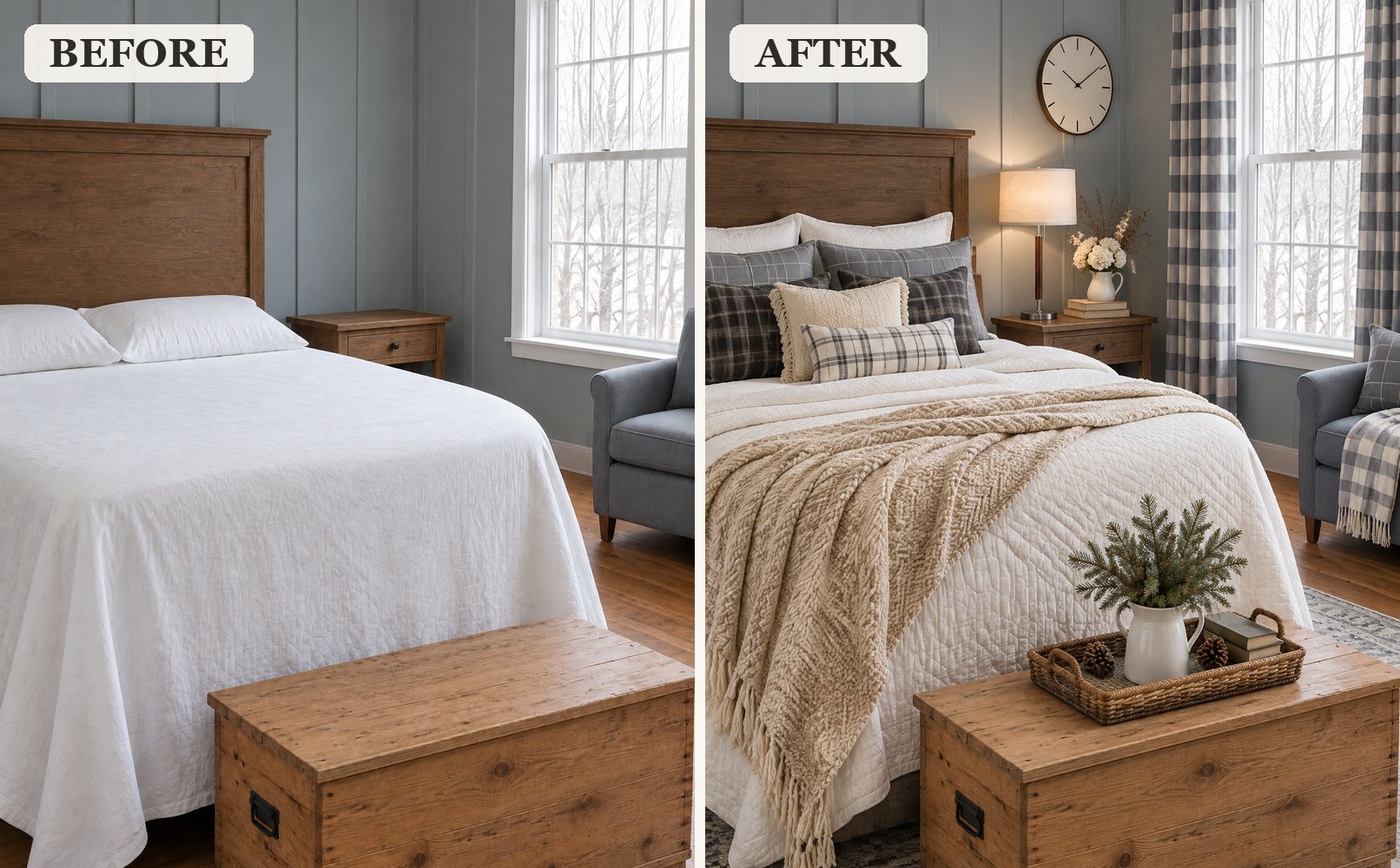
Shop a similar look
Start with the furniture and blankets you already own. These are options for a similar look, not exact products pictured in the AI scene.
- A walnut bedside lamp: for the low, warm bedside light this whole page leans on. The spec that matters: an LED lamp with a walnut wood stem and a linen drum shade that hides the bulb. The downside: it switches with a pull chain, so you reach up under the shade from bed. Cost: $$. Check the Brightech Carter lamp on AmazonAs an Amazon Associate, we earn from qualifying purchases. Full disclosure..
- A beige tassel throw: for the one throw at the foot of the bed. The spec that matters: 60 by 80 inches, big enough to pull over you in bed, in chenille of two thicknesses with tassels on both ends. The downside: it is all synthetic, 70 percent polyester and 30 percent acrylic, so pick wool if you want a natural fiber. Cost: $. Check the Battilo throw on AmazonAs an Amazon Associate, we earn from qualifying purchases. Full disclosure..
Other options for your space:
- A black swing-arm floor lamp for the reading chair: for the chair by the window. It is a dimmable LED with an adjustable arm and head, made to reach over a chair. The downside: it takes a patch of floor, so check the path to the door first. Cost: $$. Check the Brightech Leaf floor lamp on AmazonAs an Amazon Associate, we earn from qualifying purchases. Full disclosure..
- A red plaid sherpa throw for December: for the holiday version of the bed. A red tartan front with a sherpa back. The downside: at 50 by 60 inches it covers a lap, not the bed, and the plaid says Christmas, so it goes back in the basket in January. Cost: $. Check the Bedsure plaid throw on AmazonAs an Amazon Associate, we earn from qualifying purchases. Full disclosure..
What to buy
Every item below is linked from the sections above. Check the size and listing details before you order.
- Sheets: cotton flannel sheet set (opens Amazon in a new tab)As an Amazon Associate, we earn from qualifying purchases. Full disclosure.
- Top layer, budget: down-alternative comforter, 88 by 88 inches (opens Amazon in a new tab)As an Amazon Associate, we earn from qualifying purchases. Full disclosure.
- Top layer, mid-range: goose feather and down fiber comforter (opens Amazon in a new tab)As an Amazon Associate, we earn from qualifying purchases. Full disclosure.
- Top layer, splurge: 800 fill power goose down comforter (opens Amazon in a new tab)As an Amazon Associate, we earn from qualifying purchases. Full disclosure.
- Light: 2700K soft white bulbs, non-dimmable (opens Amazon in a new tab)As an Amazon Associate, we earn from qualifying purchases. Full disclosure.
- Bedside lamp: walnut table lamp with a linen drum shade (opens Amazon in a new tab)As an Amazon Associate, we earn from qualifying purchases. Full disclosure.
- Throw: beige chenille tassel throw, 60 by 80 inches (opens Amazon in a new tab)As an Amazon Associate, we earn from qualifying purchases. Full disclosure.
- Draft: clear window weather-sealing tape (opens Amazon in a new tab)As an Amazon Associate, we earn from qualifying purchases. Full disclosure.
- Curtains: thermal insulated blackout panels, 52 by 84 inches (opens Amazon in a new tab)As an Amazon Associate, we earn from qualifying purchases. Full disclosure.
- Reading: warm 3000K clip-on book light (opens Amazon in a new tab)As an Amazon Associate, we earn from qualifying purchases. Full disclosure.
- Seat and storage: folding storage ottoman bench (opens Amazon in a new tab)As an Amazon Associate, we earn from qualifying purchases. Full disclosure.
- Blankets: 65L cotton rope basket (opens Amazon in a new tab)As an Amazon Associate, we earn from qualifying purchases. Full disclosure.
Frequently Asked Questions
How warm should a bedroom be in winter?
Most people sleep best in a cool bedroom around 65 to 68 degrees Fahrenheit. Keep the thermostat near that range and build warmth on the bed with removable layers instead of overheating the room.
What humidity level is best for a winter bedroom?
Aim for 30% to 50% indoor relative humidity. Below 30% dries out skin and sinuses, while pushing near 50% behind closed thermal curtains can cause cold-glass condensation and damp sills.
Do thermal curtains help a cold bedroom?
Yes, when you seal window sash drafts first and close the air gaps around the panels. Extend the rod 4 to 8 inches past each side of the frame, mount it high, and overlap the center panels by 3 to 4 inches at dusk.
Is flannel too warm to sleep in?
Heavy flannel around 170 gsm can feel too warm for hot sleepers. Lighter brushed cotton flannel near 135 gsm sleeps cooler, or hot sleepers can keep crisp percale or linen sheets and rely on a removable wool or cotton blanket.
Can I do all of this in a rental?
Yes. Removable weather-sealing tape, tension rods, adhesive hooks, 2700K plug-in lamps, a clip-on book light, and a freestanding storage bench all work without drilling. Check your lease and test adhesives on a small hidden spot first.
Other guides we read
We read these before we revised this page. They agree on layers, warm light and a calm color, and they differ on color and fabric, which is why the sections above name them.
- 14 Cosy Winter Bedroom Ideas for Colder Nights from Bedable for rugs, wool blankets and velvet pillowcases.
- 15 Snug Winter Bedroom Ideas That Feel Extra Cosy in 2025 from Bedstar for deep earthy colors.
- Winter bedroom ideas: 10 ways to create a warm and cozy sanctuary from Homes & Gardens for warm neutrals, dark walls and tactile fabrics.
- Eight stylishly cosy bedroom ideas to steal this winter from Your Home and Garden for texture and cushions.
- Creating a cozy winter bedroom from Cozy Little House for a warm neutral palette.
- 20 small bedroom ideas: expert design tips from Real Homes for under-bed storage and shelves as bedside tables.
- 12 Cozy Bedroom Ideas for Small Rooms That Feel Bigger from Cozy Bloom Decor for mirrors and hidden storage.