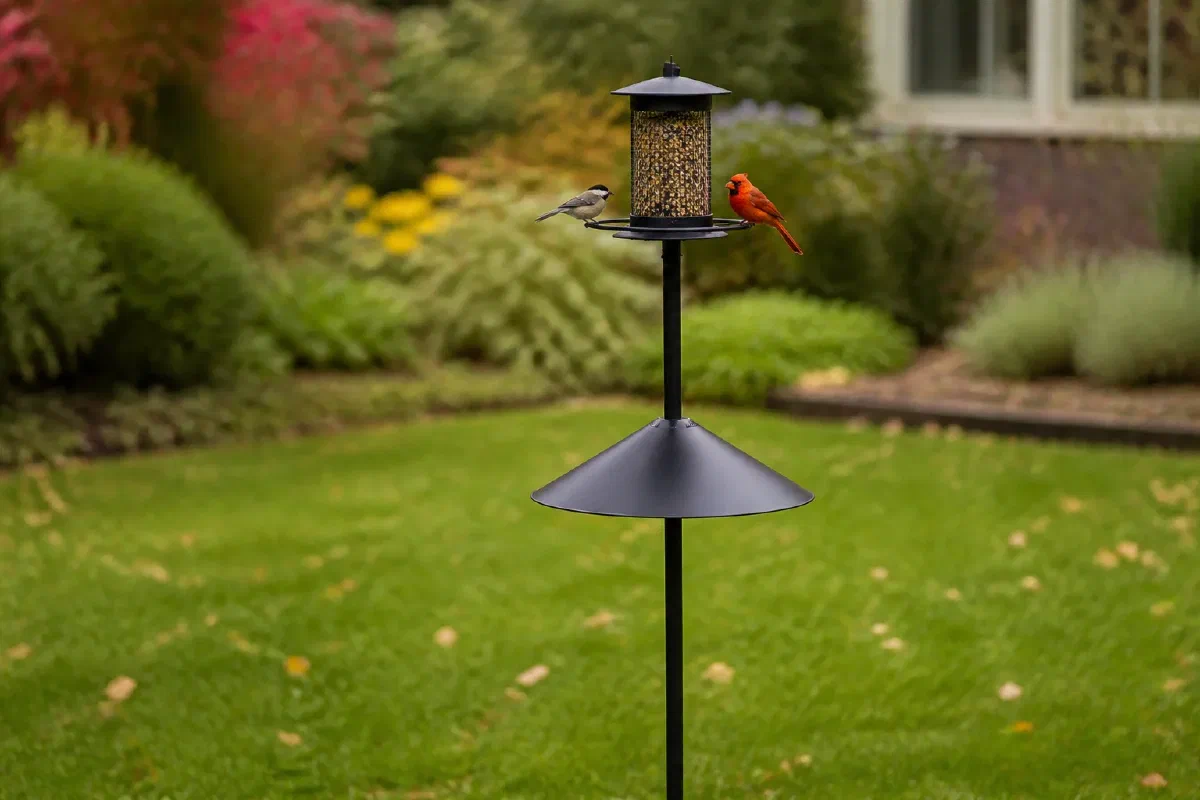
A feeding station that helps keep squirrels out needs three things working together: the right pole system, careful placement away from launch points, and feeders that match the job. When you plan the whole layout before you buy anything, you end up with a setup that works through winter and looks intentional in the garden, not like you kept adding pieces every time something failed.
The difference between a station that holds and one that doesn’t comes down to distances. Squirrels are athletic climbers and jumpers, and a single miscalculation can turn expensive feeders into squirrel buffets.
Why Most Setups Fail
Hanging a feeder from a tree branch or a shepherd’s hook pressed into the ground gives squirrels exactly what they need: a straight path from below or a short leap from the side. Penn State Extension notes that squirrels often defeat deterrents, and even well-planned setups may need adjustment as squirrels test them.
A metal pole with a baffle can help with the climbing problem, but only if the pole stands far enough from every structure a squirrel can use as a launching pad. That means measuring your yard before you shop, not after the feeder arrives.
Bird feeder parts: what each piece solves
| Part | Problem it addresses | Boundary to keep |
|---|---|---|
| Open pole | Climbing access from a trunk, fence, or deck | It still needs practical clearance from launch points |
| Baffle | Squirrels climbing up from below | Use the model’s mounting height and diameter instructions |
| Caged or weight-activated feeder | Direct access to seed | Treat it as resistant, not squirrel-proof |
| Locking seed bin | Moisture, spills, and easy refilling | Keep it dry, raised, and outside the walking path |
The parts only help when they match the site. Measure the yard first, then select compatible hardware.
Feeder pole, cone baffle, and weight-activated feeder
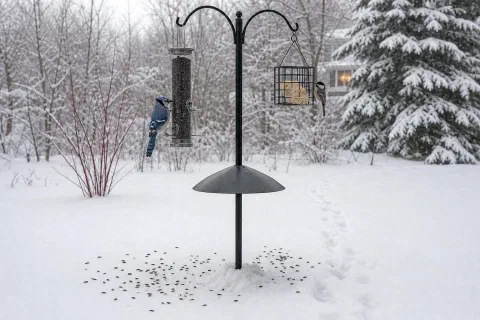
Squirrel-resistant bird feeder ideas still depend on the whole arrangement. A feeder pole reduces some climbing routes, a cone baffle addresses access from below, and a weight-activated feeder can close its ports when a heavier animal lands. Keep window collision safety in the same plan, because a squirrel-resistant setup is not useful if the feeder creates a glass hazard.
Birdseed storage and feeder cleaning steps
- Put the dry seed bin on a raised, stable surface near the service path.
- Fill only what the feeder can keep dry and fresh in the current weather.
- Remove and clean the feeder according to the manufacturer and Cornell guidance.
- Recheck the pole, baffle, and launch-point clearance after storms or snow.
Planning the Layout
Walk your yard with a tape measure and mark every tree trunk, fence line, deck edge, and shed wall near where you want the feeding station. Project FeederWatch, the Cornell Lab’s feeder-monitoring program, recommends placing feeders about 10 feet from natural cover as a compromise between giving birds escape routes from predators and keeping them visible. Squirrels will attempt jumps from nearby structures, so generous clearance helps, though determined animals may still find ways to reach feeders.
Pick a spot you can see from the window you use most, and check it against the mistakes that keep birds off a feeder before the pole goes in the ground. Early morning light from the east makes birds easier to identify, and a backdrop of evergreens or a fence shows off their colors better than open sky.
Build the station as one system
Before buying a feeder, sketch the pole, baffle, feeder arms, seed-storage spot, and walking path on one page. The pole needs clearance from launch points; the baffle needs to match the pole and its instructions; the storage bin needs to stay dry and reachable; and the ground below needs a surface you can clean. What to plant around a bird feeder covers the low-maintenance landing area and planted edges. This checklist keeps a squirrel-resistant station from solving one problem while creating another.
| Clearance Guideline | Distance | Why It Matters |
|---|---|---|
| Pole to tree, fence, or structure | As far as practical, ideally several feet | Reduces horizontal squirrel jumps |
| Baffle placement | Follow manufacturer instructions | Helps block squirrels climbing from below |
| Feeder to shrubs or cover | About 10 feet | Gives birds a safer escape path from predators |
| Feeder to window | Within 3 feet of the glass, or 30-plus feet out | The middle zone is where a bird can build collision speed |
Audubon’s winter feeding guide gives the window rule as 3 feet or 30-plus feet from the glass, so a near-window feeder belongs right against the house, not a few feet out. If your yard lacks an open pole site, a weight-activated feeder close to the house may fit better, provided the glass is also assessed and treated for collision risk.
Choosing the Pole System
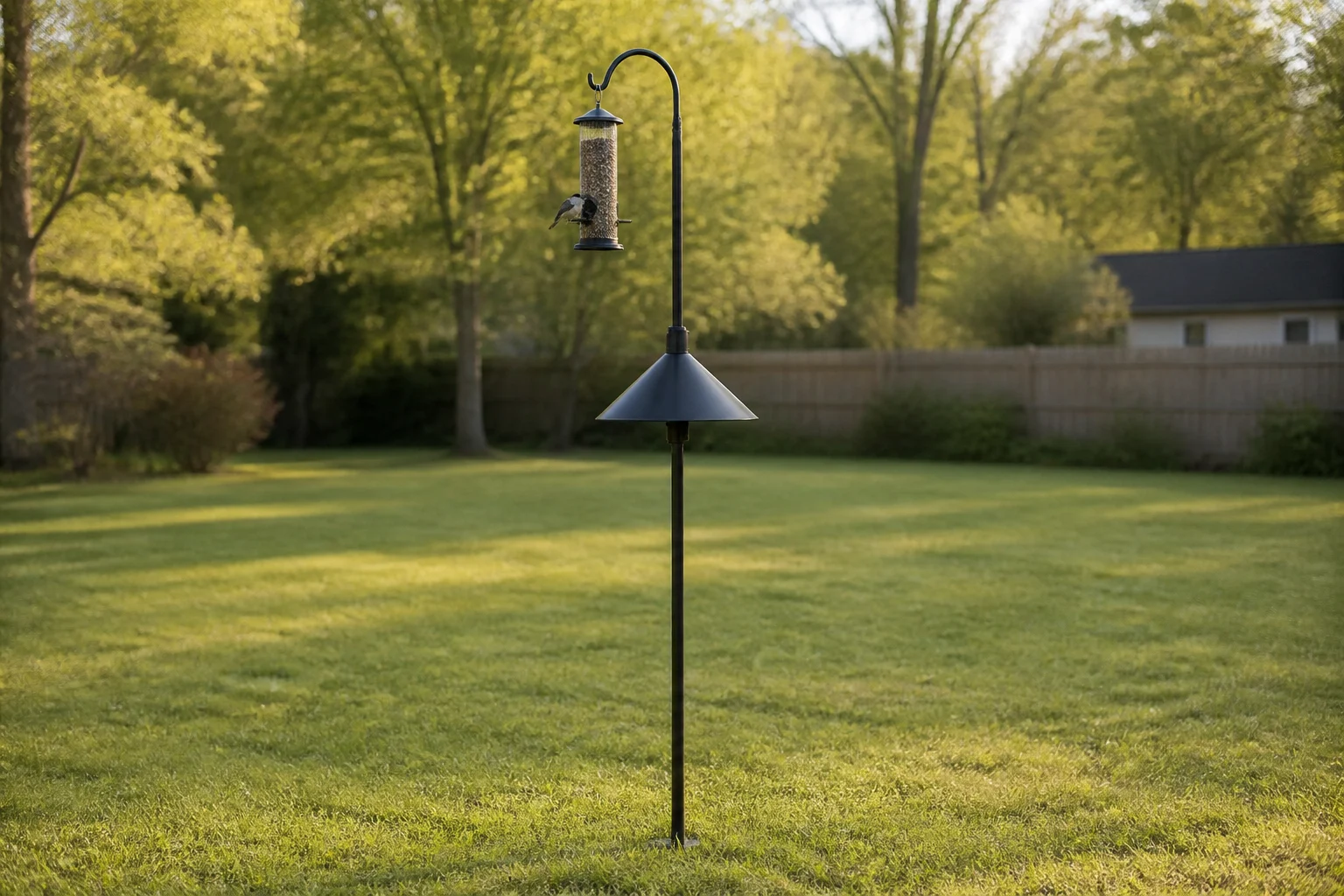
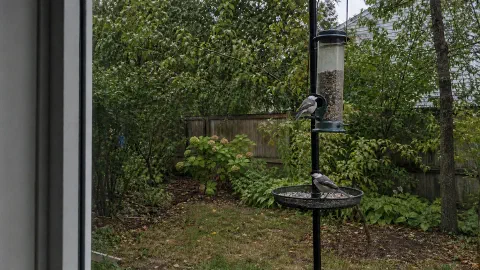
- Steel pole, appropriate height for your setup: Provides stability and a smooth surface that’s harder for squirrels to grip than wood or textured materials. Height depends on your baffle and feeder configuration.
- Multiple feeder arms: Poles that accept several arms let you offer tube feeders, suet cages, and platform trays without adding more poles to the lawn.
- In-ground installation for soft soil: Dig a hole of appropriate depth per the pole manufacturer’s instructions, drop in the pole, and pack the dirt tight for stability.
- Weighted base for decks or patios: A base filled with sand or gravel keeps the pole upright through wind without requiring ground installation. Follow the base manufacturer’s weight recommendations.
- Avoid shepherd’s hooks: They can tip under the weight of a full feeder and a determined squirrel, and the curved top may give squirrels a grip.
Baffle Placement
Penn State describes baffles as one option for discouraging squirrels, though not a perfect solution. Mount a cone or cylinder baffle according to the manufacturer’s instructions for your pole diameter and configuration. The baffle helps block squirrels climbing from below and sheds rain away from the feeders above it. Cone baffles work on poles; hanging baffles work on chains or wires suspended from a roof or pergola beam, but only if the beam itself is out of squirrel reach.
Selecting Feeders That Work on Poles
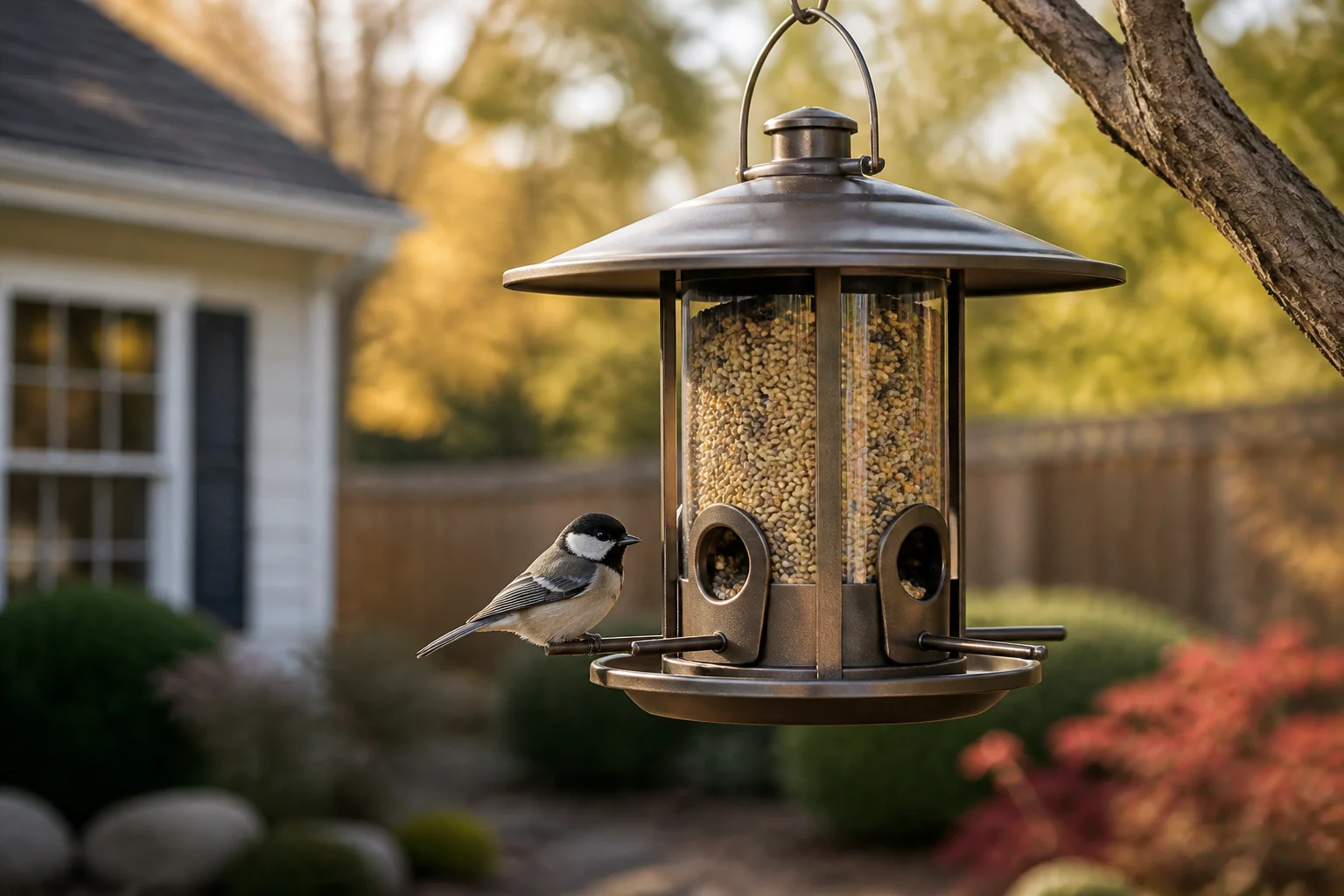
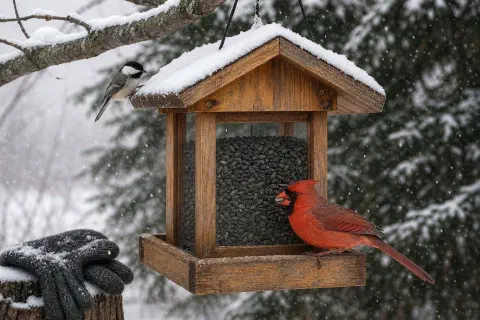
Audubon notes that a feeder surrounded by a cage keeps squirrels from reaching the food, and that weight-activated feeding ports work because birds weigh so much less, with the drawback that a cage also keeps out larger birds. Project FeederWatch adds that good feeders are weather-resistant, keep seed dry, and are easy to take apart and clean. Tube feeders with metal ports and weight-activated perches close the seed access when something heavier than a bird lands. Cage feeders surround a standard tube with wire spaced wide enough for small birds but too narrow for squirrels. Suet cages mounted upside down let woodpeckers and nuthatches feed while making it harder for squirrels to brace themselves.
Platform feeders attract ground-feeding species like juncos and towhees, but they need a roof to keep seed dry and a cage around the edge if squirrels are persistent. Choose feeders with UV-resistant plastic or powder-coated metal that won’t fade or rust quickly.
| Feeder Type | Best For | Squirrel Resistance |
|---|---|---|
| Weight-activated tube | Finches, chickadees, small songbirds | Ports close under heavier weight |
| Caged tube | Small birds in high-pressure yards | Wire spacing blocks squirrels and large birds |
| Upside-down suet cage | Woodpeckers, nuthatches | Squirrels may struggle to hold position |
| Covered platform with cage | Ground feeders, larger species | Cage helps keep squirrels out, roof keeps seed dry |
Seed Choices
Black oil sunflower seed attracts a wide variety of birds. Safflower seed may be less appealing to some squirrels, though it also appeals to fewer bird species. Suet cakes are available in various formulations; check the product label for what species they’re designed to attract.
Positioning Seed Storage
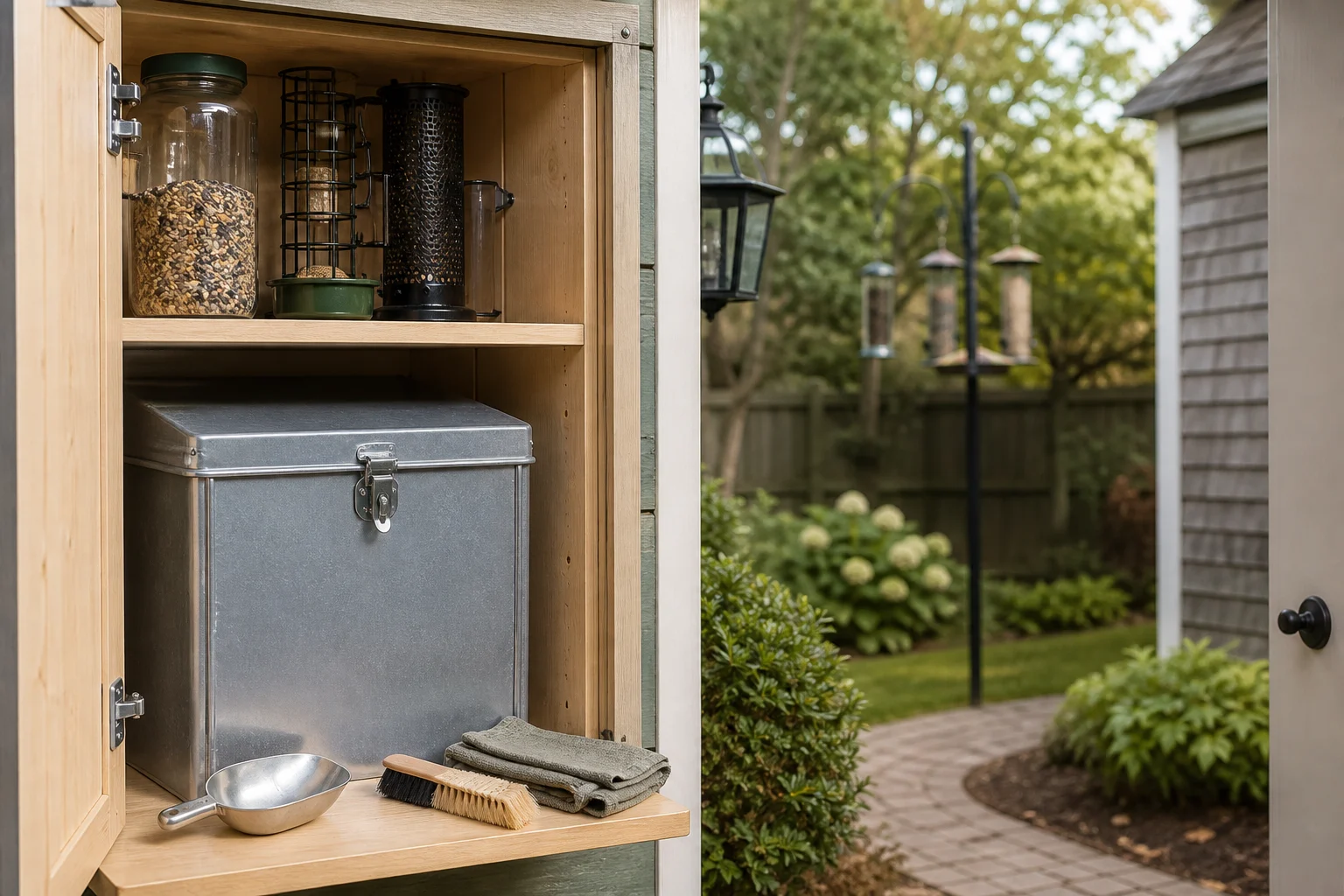
A weatherproof bin placed near the pole keeps seed fresh and refilling quick, but it should be positioned where squirrels can’t easily chew through the lid and where rain doesn’t pool around the base. Galvanized steel bins with locking lids tend to be more durable than plastic in various weather conditions.
Set the bin on a paver or a wooden platform so the bottom doesn’t rest in wet grass. If the bin sits on a deck or patio, position it where you won’t trip over it carrying a full scoop, and keep it out of direct afternoon sun, which can heat the seed.
Designing for Visual Appeal
A single black or bronze pole reads as garden furniture, not clutter, especially if you plant low perennials or ornamental grasses in a half-circle around the base. Avoid bright plastic feeders in red, yellow, or blue unless your garden already carries those colors; green, copper, and matte black disappear into the landscape better.
If you’re running multiple feeders on one pole, match the finish. Three different feeder styles in the same metal tone looks intentional; three random colors looks like you bought whatever was on sale.
Sightlines and Backdrop
Position the station so you’re looking at it with a fence, hedge, or building behind it, not open sky. The contrast makes birds easier to spot and photograph. If the backdrop is a fence, consider painting it a dark gray or deep green so the birds stand out.
Plant a small shrub or ornamental grass near the pole base to soften the look and give birds a perching spot before they commit to the feeder. Avoid anything that grows tall enough to create a potential squirrel ladder. The ground under the pole needs a plan too, since hulls and dropped seed sprout fast in bare soil.
Maintenance and Seasonal Adjustments
Project FeederWatch recommends cleaning seed and suet feeders every week or two with warm water and dish soap, or a soak in a solution of one part bleach to nine parts water, rinsing thoroughly, and letting them dry before refilling. Project FeederWatch’s disinfecting steps add the timing that matters if you are dealing with sickness in the yard: a 10-minute soak in one part bleach to nine parts water, a full rinse, and a complete dry before the feeder goes back up. Moldy seed can spread disease among birds, and a feeder that’s never cleaned may discourage visitors.
In winter, check that snow hasn’t piled high enough to give squirrels a boost over the baffle. In summer, consider moving feeders into partial shade if afternoon sun is heating the seed, which can turn oils rancid.
Refilling Access
If your pole system uses feeder arms that swing or lift off, refilling is quick. If feeders hang from fixed hooks, you may need a small stepladder or a pole with a pulley system. Plan for this before you buy; a feeder you can’t reach easily is a feeder you may stop filling by February.
Troubleshooting Common Failures
- Squirrels are still reaching the feeders: Measure again. A common mistake is underestimating the distance from a deck rail or a low tree branch. You may need to move the pole farther out, even if it means losing your preferred sightline. Remember that Penn State warns there is no perfect squirrel-proof answer, and persistent animals may eventually find a way.
- The pole tips in wind: The base may not be heavy enough or the hole may not be deep enough. Add more sand to a deck base per the manufacturer’s capacity, or dig the in-ground pole deeper and tamp the soil hard.
- Birds aren’t coming: Check that the feeders are positioned with appropriate clearance from dense shrubs and that you’re offering seed species in your area actually eat. A tube full of the wrong seed won’t get touched.
The Deterrents That Hurt the Squirrel
Several of the most-shared squirrel fixes are not deterrents. They are ways of harming an animal that will come back anyway, and they are worth naming so you can skip them.
Baking soda in the seed does not deter a squirrel, it poisons one. The American College of Veterinary Pharmacists lists baking soda as a poison at roughly 2 to 4 teaspoons per kilogram of body weight, with vomiting usually first and tremors, seizures and disorientation reported inside three hours. A grey squirrel weighs well under a kilogram, and the smallest dog on that same chart is about 0.45 kg. The margin for a squirrel is small, and the squirrel is not the only animal at risk. A feeder gets visited by birds and by whatever else passes through.
Vaseline or grease on the pole is the other one. It does not stop a determined squirrel, and what it does instead is coat fur the animal relies on for insulation and grooming. A greased pole also collects grit and seed husks, so you end up with a dirty pole and the same squirrel.
Poisoned bait is worse than either. It is not squirrel-specific, and anything that eats the bait, or eats the squirrel, carries the dose. That includes pets, hawks and owls.
The reason these keep circulating is that they feel like they should work. The reason they do not is that they treat the squirrel as the problem. The squirrel is not the problem. Access is the problem, and access is geometry, which is why every fix on this page is about height, distance and a physical barrier instead.
What actually works is the boring version: a baffle at the correct mounting height, a pole standing clear of launch points, and a weight-activated feeder that closes under a heavier animal. None of it hurts anything, and it keeps working after the squirrel has spent an afternoon on it.
Frequently Asked Questions
How far should a bird feeder pole be from trees or fences?
As far as practical in your yard. Squirrels are capable jumpers, and generous clearance helps reduce the chance they’ll reach feeders, though determined animals may still succeed. Measure your available space and position the pole to maximize distance from potential launch points.
What height should a baffle be mounted to help stop squirrels?
Follow the baffle manufacturer’s instructions for your specific pole and feeder configuration. Proper installation height depends on the baffle design, pole diameter, and your site conditions.
Can you hang a squirrel-resistant feeder from a tree?
It’s challenging. The branch would need to be far from the trunk and any other branch, and you’d need a baffle above the feeder to help block squirrels dropping from above. Most yards don’t have a branch that meets those conditions, so a pole system is often more practical.
How do you space multiple feeders to reduce crowding?
Mount feeders on separate arms with adequate spacing between them, or use two poles spaced apart. Crowding can cause conflicts among birds and may contribute to disease spread.
Do squirrel-resistant feeders actually work long-term?
Weight-activated and caged feeders can help as long as the mechanisms stay clean and the placement follows good practices. Penn State notes that squirrels often defeat deterrents, so treat these setups as resistant rather than proof. Squirrels will test the setup, and some may eventually find ways around defenses.
Where should you store birdseed to keep it fresh and accessible?
In a locking metal bin near the feeder pole, raised off the ground on a paver or platform, and out of direct sun. Seed stored in a garage or shed may stay fresher, but you’ll refill less often if the bin is outside near the station.
What Makes This Setup Last
A feeding station that works in January can still work in July because the layout doesn’t depend on a single clever feeder or a new deterrent trick. The pole stands where squirrels have difficulty reaching it, the baffle helps block the climb, and the feeders match the species you’re trying to attract.
When you plan the distances first and choose the equipment second, you end up with a setup that looks like part of the garden, not an experiment you’re still adjusting. Birds find it, squirrels are discouraged (though not always defeated), and you get to watch from the window with a setup that’s as thoughtfully designed as it is functional.
What to Read Next
- Bird Bath Placement Mistakes That Keep Songbirds From Landing: solve the window, cover, and approach problems before adding water.
- 7 Bird Bath Setups Songbirds Actually Use: compare bird-friendly water styles after the feeder station is stable.
- Heated Bird Baths for Winter: plan cold-weather water when the feeding station is already easy to maintain.