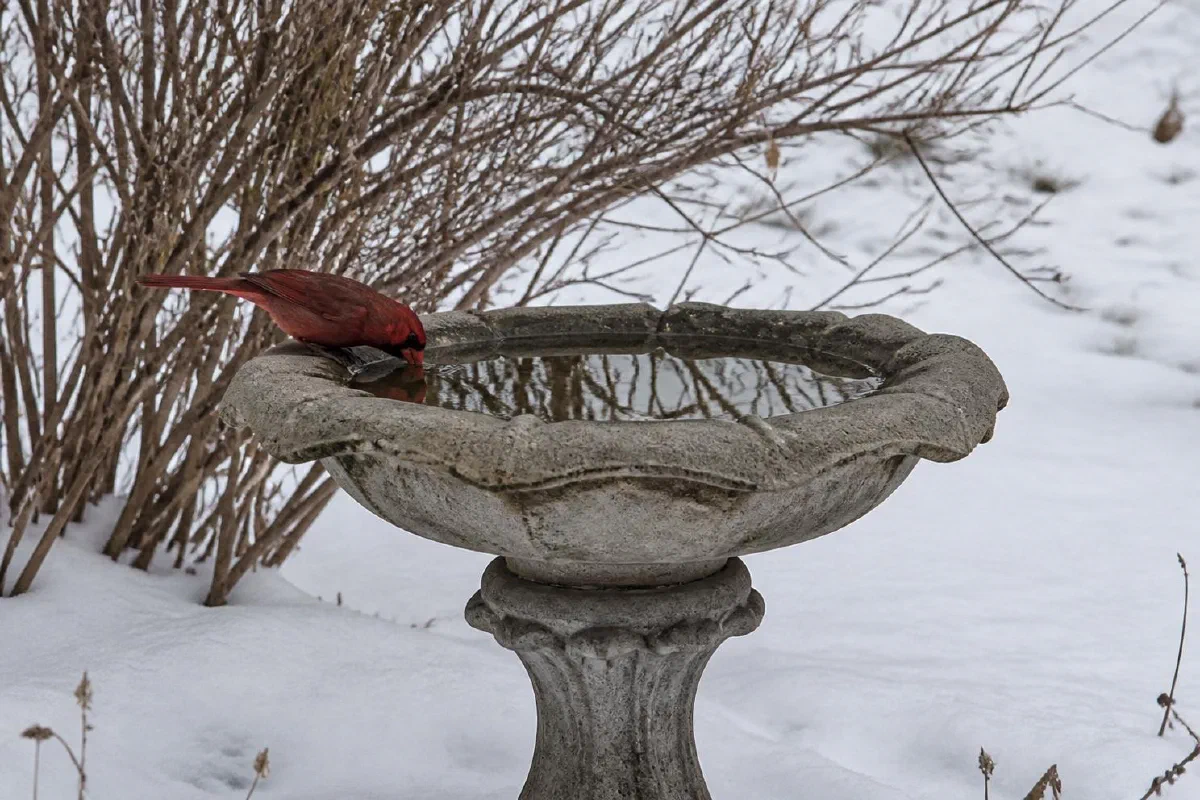
In January, the hardest thing to find in most backyards is not food. It is water.
Seed is everywhere, and the shrubs that hold berries into winter are still feeding. But every open surface freezes, and a bird that cannot drink has to eat snow, which costs body heat it is already struggling to hold overnight.
Put out open water in a hard freeze and you will see species at it that never touched your bath in July. If the bath is too far from an outlet, the companion guide explains how to keep a bird bath from freezing without electricity and where those unpowered methods stop helping.
Water Matters More Than Food in a Freeze
Birds need water year round for two things: drinking, and keeping their feathers in order. Audubon notes that many birds drink and bathe in open water during frigid weather .
The second one is what people miss. A bird stays warm by trapping air in clean, well-arranged feathers. Cornell’s Project FeederWatch guide warns that matted feathers are poor insulators , which is why glycerin in winter water creates a real risk. Feather maintenance in winter is not grooming, it is survival equipment.
Eating snow works, but it costs energy to melt, and energy is exactly what a small bird is short of on a long cold night.
Two Ways to Keep It Open
A de-icer in the bath you already own
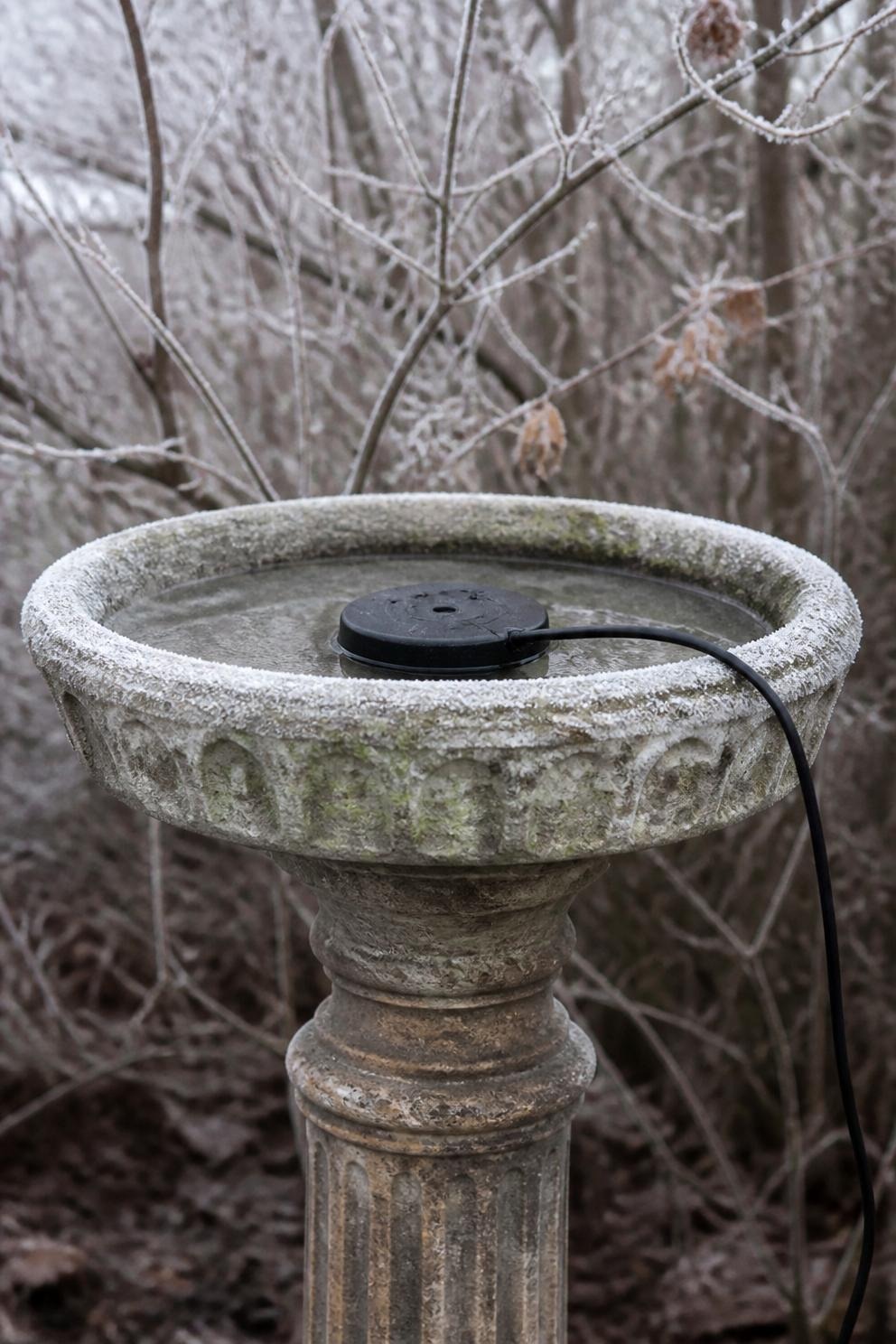
A de-icer is a submersible heating element that drops into an existing bath. It is the cheaper route and it usually makes more sense, because you already have the bath.
They are thermostatically controlled: the element only draws power when the water approaches freezing, and switches off once it is clear. It is not running all winter, only on the cold nights.
A bath with the heater built in
A heated bird bath has the element inside the basin. Fewer cords, nothing sitting in the water, and usually a shallower profile designed for winter use. Costs more up front and it becomes your winter bath rather than something you add to a bath you like.
If you already have a bath you are happy with, buy a de-icer. If you are starting from nothing and you want it simple, buy the heated bath.
Watts, and What It Costs to Run
De-icers run roughly 50 to 250 watts. Heated baths are usually 50 to 150.
Because the thermostat cycles them, actual consumption is much lower than the label suggests. A 150 watt unit cycling through a cold night might draw around 1 kWh a day in genuinely freezing weather, and nothing at all in a mild week. Multiply by your own electricity rate to see what that means for you; it is normally a small number, and it is the whole running cost.
Higher wattage is not better. Match it to your winter:
| Your winter | Wattage to look for | What it buys you |
|---|---|---|
| Brief overnight frosts, mild days | 50 to 80 watts | Enough to keep a thin skin of ice off a small basin |
| Regular hard freezes | 100 to 150 watts | The common middle. Thermostatic control matters more than the number |
| Weeks below freezing | 200 watts or more | Consider a bath with a smaller surface area so the heat is not fighting the whole basin |
Never Put These in the Water
This is the part that matters most, because all four of these show up in well-meaning advice and all four hurt birds.
- Antifreeze. Lethal, in any quantity, to birds and to every mammal that drinks it. There is no safe dilution.
- Glycerin. Circulates as a folk remedy and it is genuinely dangerous. It coats feathers, destroys the trapped-air insulation described above, and a bird that gets glycerin in its plumage in freezing weather can die of exposure.
- Salt. Toxic to birds in the quantity needed to lower the freezing point, and it dehydrates them.
- Anything oily. Same mechanism as glycerin. Feather structure is the thing keeping the bird alive.
The only safe way to keep a bath open is heat. Nothing added to the water is safe.
The Winter Depth Rule
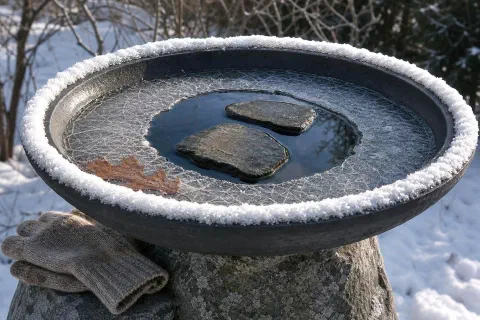
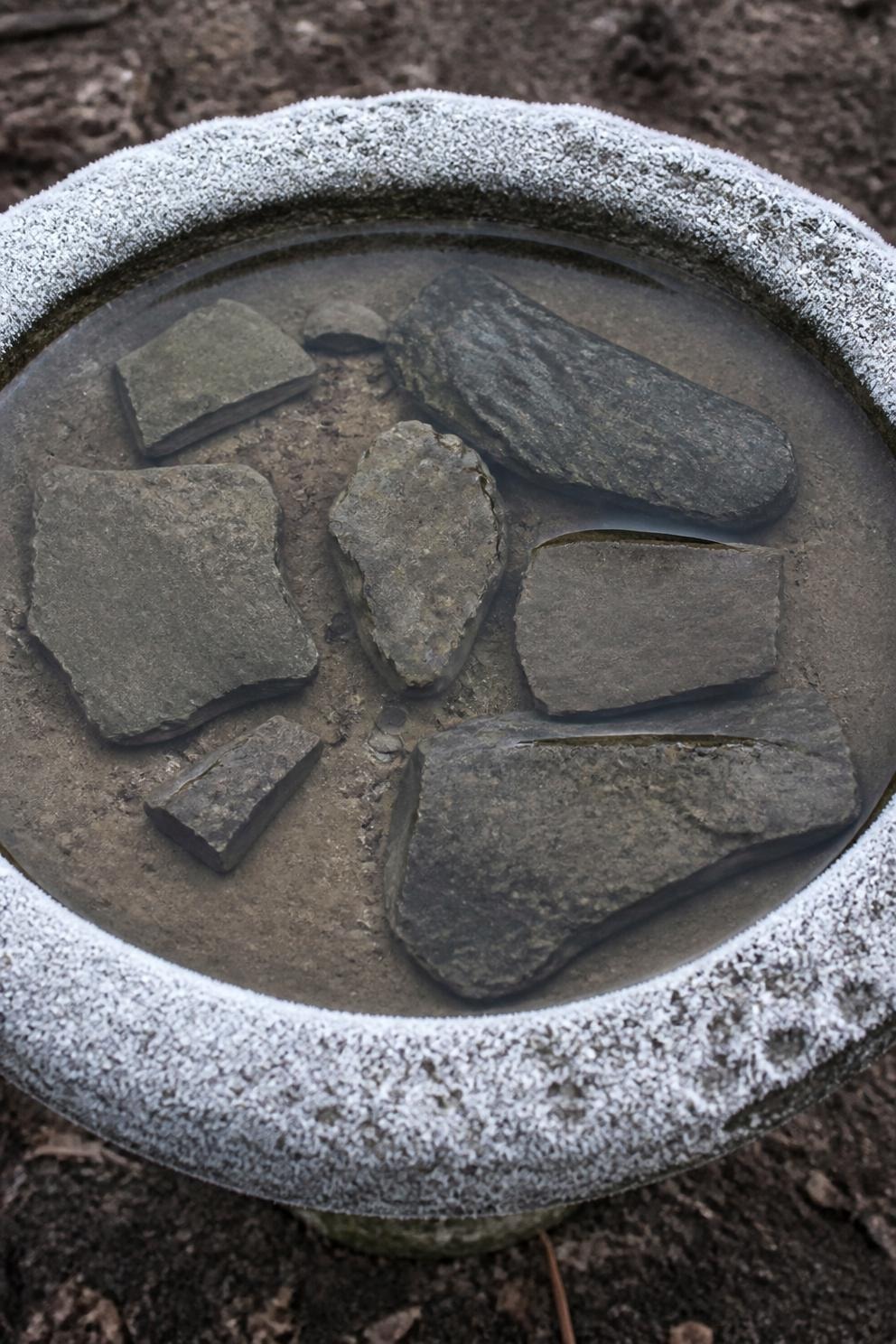
Winter water should be shallower than summer water: about one to two inches at the deepest point.
Birds still bathe in winter, and they need to be able to do it without getting fully soaked. A deep basin lets a small bird submerge, and a soaked bird in freezing air is in real trouble.
Put a few flat stones or a handful of pebbles in the basin. Project FeederWatch recommends exactly this in winter , so a bird can stand and drink without getting wet. They break up the surface too, so a nervous bird can approach the edge.
Where to Put It in Winter
Placement changes in the cold:
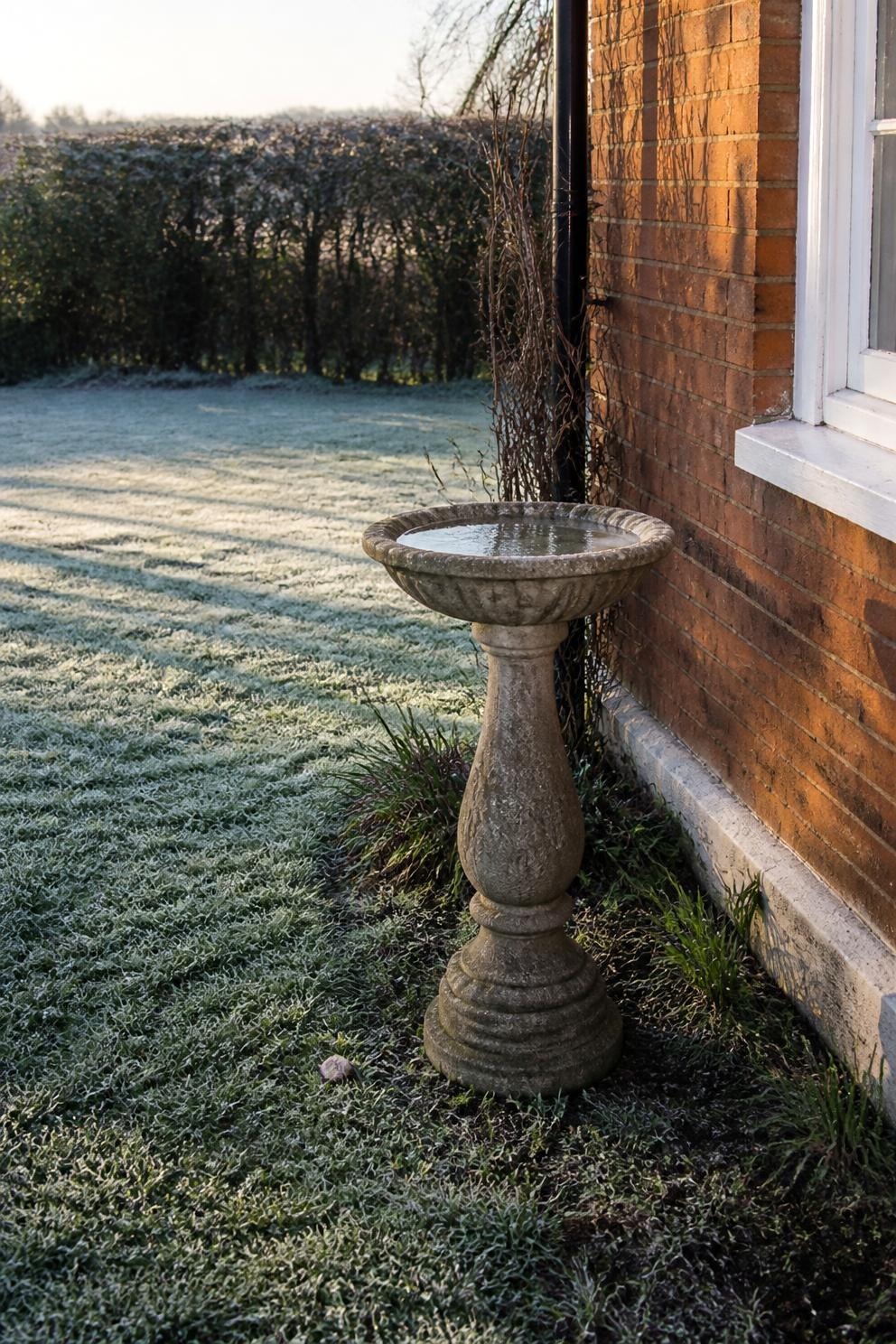
- Morning sun. Sun on the basin does part of the work for you and takes load off the heater.
- Out of the wind. A bath on an exposed corner loses heat fast and costs more to keep open. Tuck it on the sheltered side of the house or a hedge.
- Ten feet from cover, not two. Birds want an escape route nearby. But a bath pressed against dense shrubs is an ambush point for cats, and a wet bird is a slow bird.
- Somewhere you can reach. You will be topping it up in the cold and the dark. A bath at the bottom of the garden gets neglected by February.
Safety, Briefly but Properly
This is mains electricity in standing water outdoors, so it is worth doing correctly. The U.S. Consumer Product Safety Commission recommends GFCI protection and outdoor-rated extension cords for outdoor electrical use.
- Plug into a GFCI outlet. Not optional. If the outdoor outlet is not GFCI protected, use a GFCI adapter.
- Use an outdoor-rated extension cord if you need one, and keep the connection off the ground and out of puddles. Do not run an indoor cord out through a window.
- Never run a de-icer dry. They are cooled by the water around them. An empty basin with the element still powered will fail, and can be a fire risk. Check the level.
- Look at the cord each autumn before you plug it in. Squirrels chew, and UV makes old cable brittle.
Concrete Baths and Cracking
A concrete or stone bath is the one to be careful with. Water expands as it freezes and concrete is not flexible, so a full concrete basin that freezes solid can crack, and it usually cracks once and terminally. Audubon specifically recommends avoiding ceramic baths in cold weather and using a plastic heated basin instead.
Two workable options: use a de-icer that keeps it from ever freezing solid, or empty and flip the bath for winter and put out a cheap plastic or resin basin instead. What does not work is leaving a concrete bath full and hoping.
Check the de-icer’s own guidance too. Some are rated for plastic, some are not, and a bare element against a plastic basin can deform it. The ones with a guard or a flat base are the safer choice in a resin bath.
Keeping It Clean When It Is Freezing
Winter water gets dirty the same way summer water does, and a bath everything drinks from is a good way to move disease around a flock.
Tip it out and scrub it with a stiff brush every few days. Skip the bleach in winter, because rinsing thoroughly in the cold is awkward and residue is worse than a bit of algae. Hot water and a brush is enough at these temperatures, since algae barely grows anyway.
Top it up rather than letting it run low. A half inch of water over a heating element is doing nobody any good.
What I’d Actually Buy
Ratings and review counts checked 2026-08-15. I would keep the decision to the three choices above. The K&H is the small experiment for a mild winter, the BDT250 is the de-icer for real cold, and the Allied Precision 650 is the cleanest start-from-scratch setup. That is enough range without sending you through five nearly identical heaters.
FAQ
Do birds actually use a bird bath in winter?
Heavily, and more reliably than in summer, because open water is scarce and every bird in the area needs it. Expect species that ignored the bath in July.
Will a heated bird bath make birds bathe and then freeze?
No. Birds regulate this themselves and generally drink rather than fully bathe in hard cold. The thing that causes trouble is a basin deep enough to soak in, which is why the one to two inch rule matters.
Can I just pour hot water in every morning?
You can, and it works for an hour. In real cold it refreezes fast, and you are committing to doing it twice a day forever. A thermostatic de-icer is the version that still works in February when you are tired of it.
Is it safe to leave a de-icer running all winter?
Yes, on a GFCI outlet, in water, with the level kept up. They are built for it and the thermostat means they only draw power near freezing. The failure mode to avoid is running one in an empty basin.
Will it raise my electricity bill much?
Not usually. The thermostat means it only runs in freezing weather, so a mild winter costs almost nothing and a hard one costs roughly a kilowatt-hour a day while the freeze lasts.
What about solar heated bird baths?
Solar is fine for a fountain pump in summer and is not up to heating water through a winter night. A panel produces least exactly when you need most. If it must be heated, it needs mains power.
When should I put it out?
Before the first hard frost, so it is already running and the birds have found it. A bath they already know is a bath they come back to when the rest of the neighbourhood freezes.
What to Read Next
- Keep a Bird Bath From Freezing Without Electricity covers dark basins, wind shelter, and the point where a cord-free setup stops working.
- Bird Bath Placement Mistakes helps you balance morning sun, nearby cover, and cat safety.
- Bird Bath Ideas Songbirds Actually Use shows basin shapes and landing setups that feel safe to visiting birds.
- Plants That Feed Birds Through Fall and Winter adds the food half of a winter backyard plan.