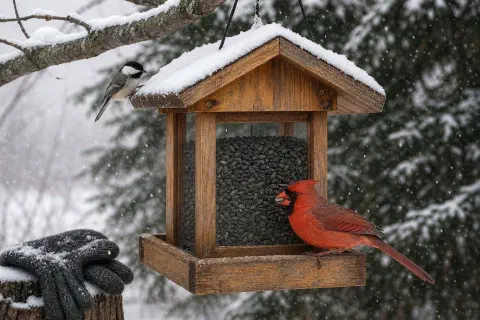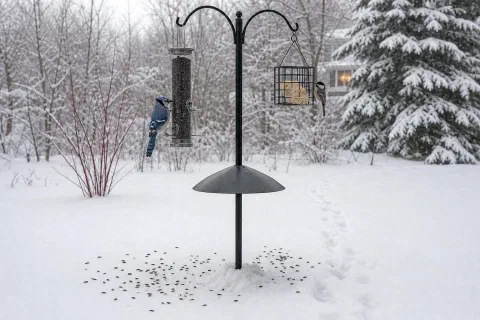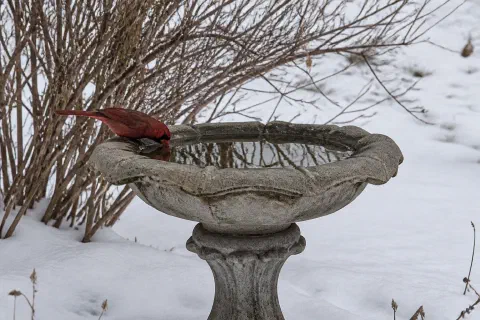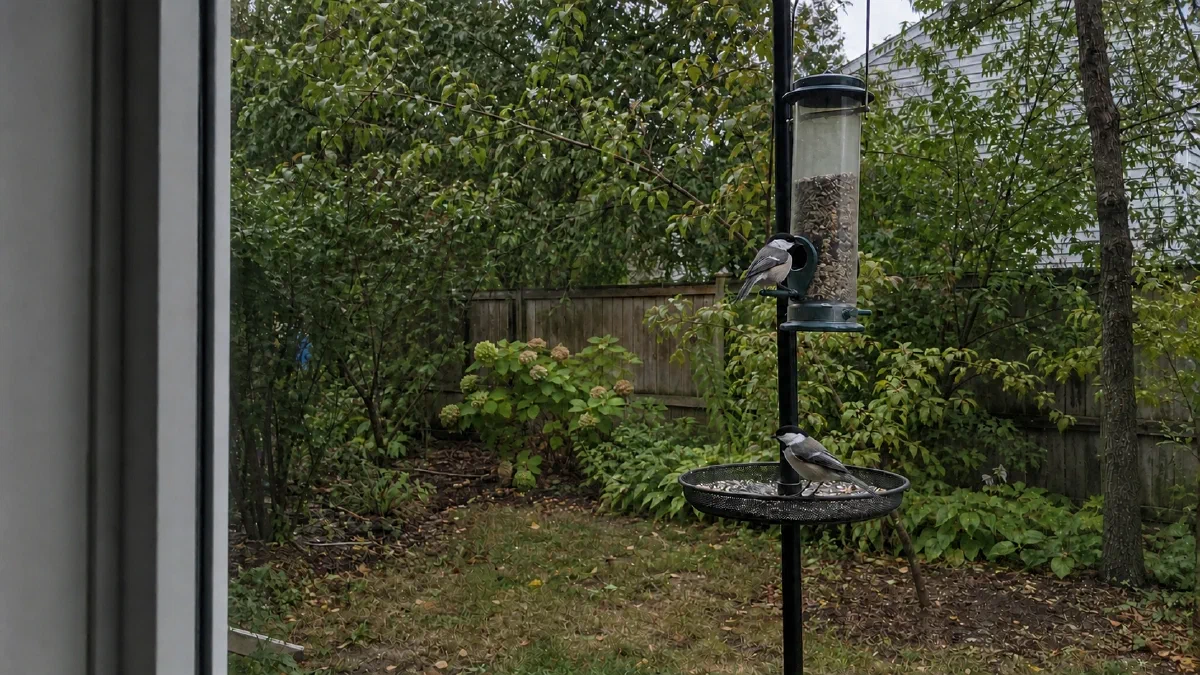
The feeder shape decides who can land and how they eat. A platform welcomes cardinals, jays, doves, and other birds that need room. A nyjer tube gives goldfinches and siskins a quieter station. A suet cage suits clinging birds such as woodpeckers and nuthatches. Start with the birds you hope to see, then choose a safe spot with useful cover, clear predator sightlines, and easy cleaning access.
The table below is the quick match. The rest of the guide shows where to put each feeder without creating a window-strike zone or a hiding place for cats.
Placing Feeders in the Window Strike Zone
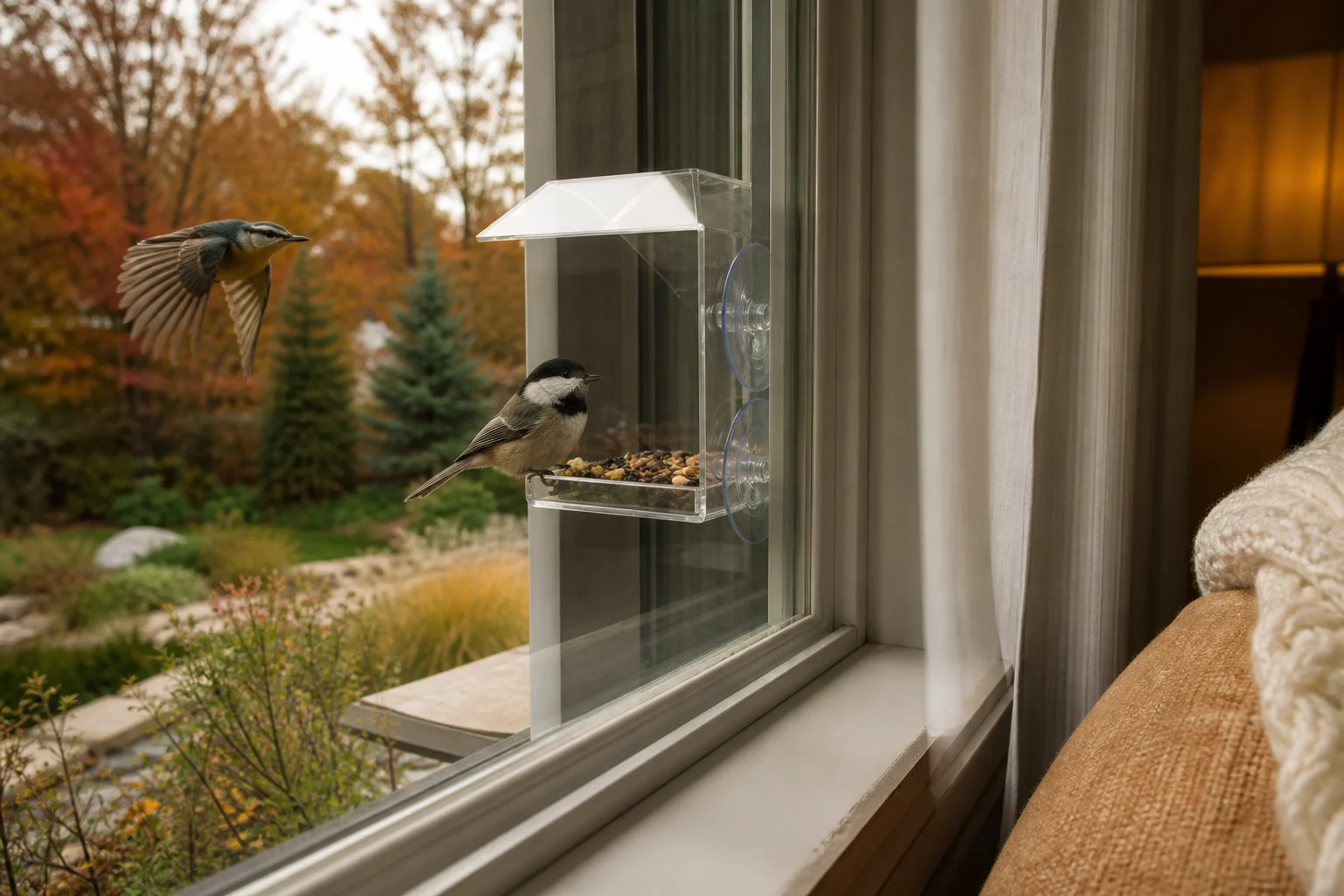
Window collisions are a serious hazard, so the distance between feeder and glass deserves a decision before the pole or hook goes in.
University of Arizona Cooperative Extension puts the safe window distance at either within three feet of the glass or at least 30 feet away . The space in between is the problem: close in, a bird leaving the feeder has no room to build momentum, and past 30 feet it no longer reads the glass as a route to the rest of the yard. A feeder mounted on the glass or frame sits inside the safe band by default.
If the glass reflects sky or trees, add an exterior collision treatment designed for birds and follow its coverage instructions. A few widely spaced decorative stickers may not cover enough of the pane, so use a tested pattern rather than guessing. Project FeederWatch’s guidance gives the spacing: marks on the outside of the glass no more than 2 inches apart, or an exterior screen. Either one breaks up the reflection of sky or foliage that a bird is reading as open air.
Positioning Feeders Too Far From Cover
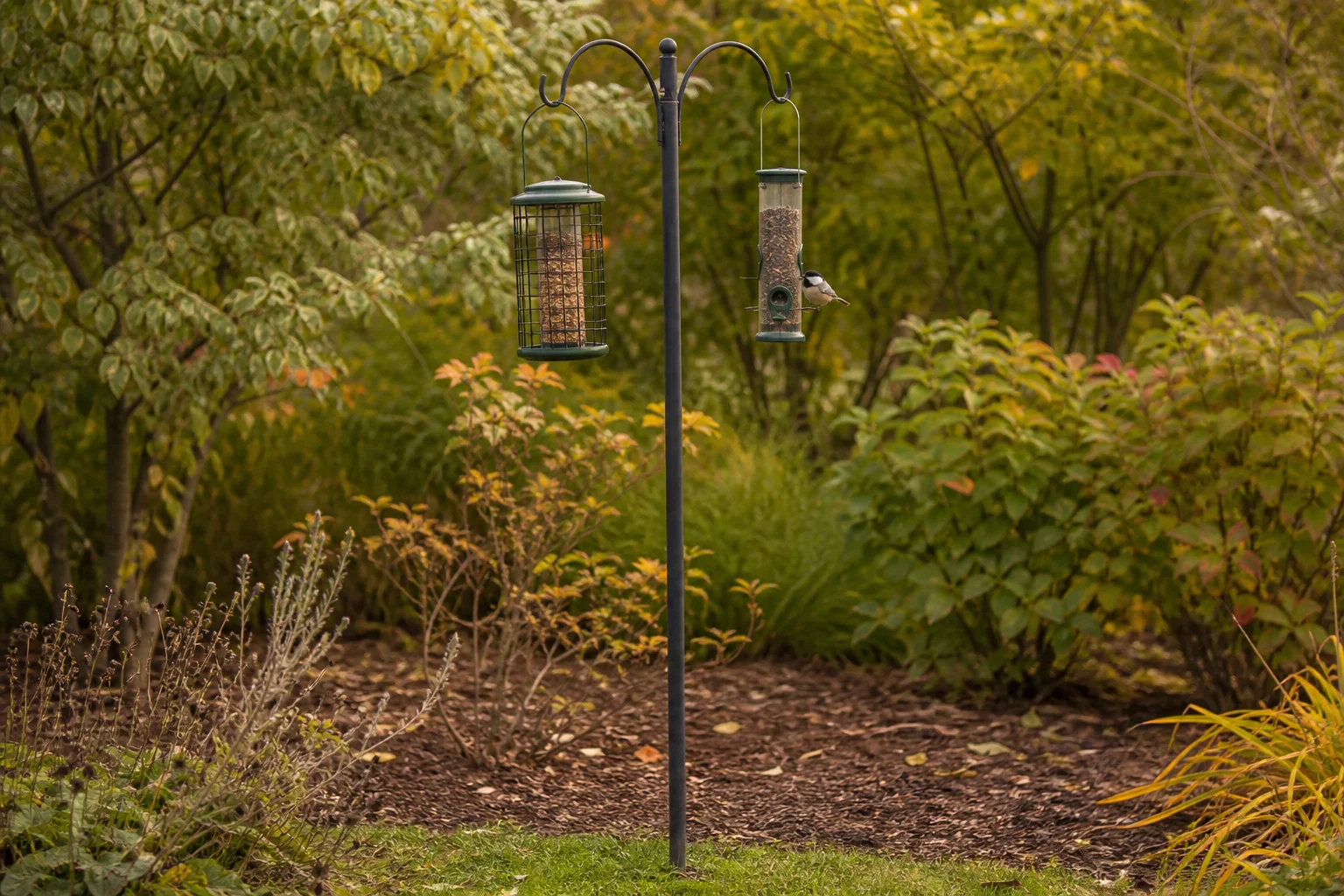
An exposed feeder may get fewer visits when birds have no nearby resting or escape cover.
FeederWatch’s placement guidance is to put feeders close to natural cover such as trees or shrubs, and evergreens are ideal because thick foliage hides birds from predators and buffers winter wind. Loosely stacked brush piles near the feeder give ground-dwelling birds like Song Sparrows somewhere to rest and escape to. Chickadees and titmice dart between the feeder and cover every few seconds, grabbing one seed and flying back to crack it in safety. Juncos and sparrows prefer feeders close enough that they can hop into the undergrowth without taking flight.
The cover itself matters. Look for dense branching or evergreen foliage rather than assuming any nearby plant offers the same shelter. Confirm that a shrub is appropriate and noninvasive in your region before adding it.
Hanging Feeders Too Close to Dense Cover
The opposite mistake is just as common. Feeders tucked directly against a hedge or under low tree branches become ambush sites for cats and Cooper’s hawks. Predators hide in the same cover birds rely on for escape, and birds know it.
Leave clear space between the feeder and the nearest dense shrub or ground-level hiding spot. This gives birds a sight line to scan before landing while keeping useful cover nearby.
Cornell’s Project FeederWatch calls about 10 feet a good compromise distance that balances access to cover with predator visibility. If your yard is small and you can’t manage both cover access and clearance, prioritize the clearance. A feeder in partial shade near a fence with adequate buffer will attract more birds than one pressed against a thick hedge.
Setting Ground Feeders Too Low
Platform feeders and ground trays need extra attention to sightlines and neighborhood cats. Tall grass, dense edging, and the space beneath steps can hide a stalking animal.
Use a stable mount when the feeder is designed to be raised, follow its installation instructions, and keep pet cats indoors. No mounting height makes outdoor predation impossible.
If you’re feeding birds that prefer to forage on the ground, scatter seed in a spot you can see clearly from a window and keep the grass mowed short in the surrounding area. Long grass and low groundcover give cats concealment. A bare patch of mulch or gravel under a feeder removes the hiding spots, and it settles what goes on the ground under a feeder before the area turns into a weed patch.
Choosing Spots You Can’t Reach for Cleaning
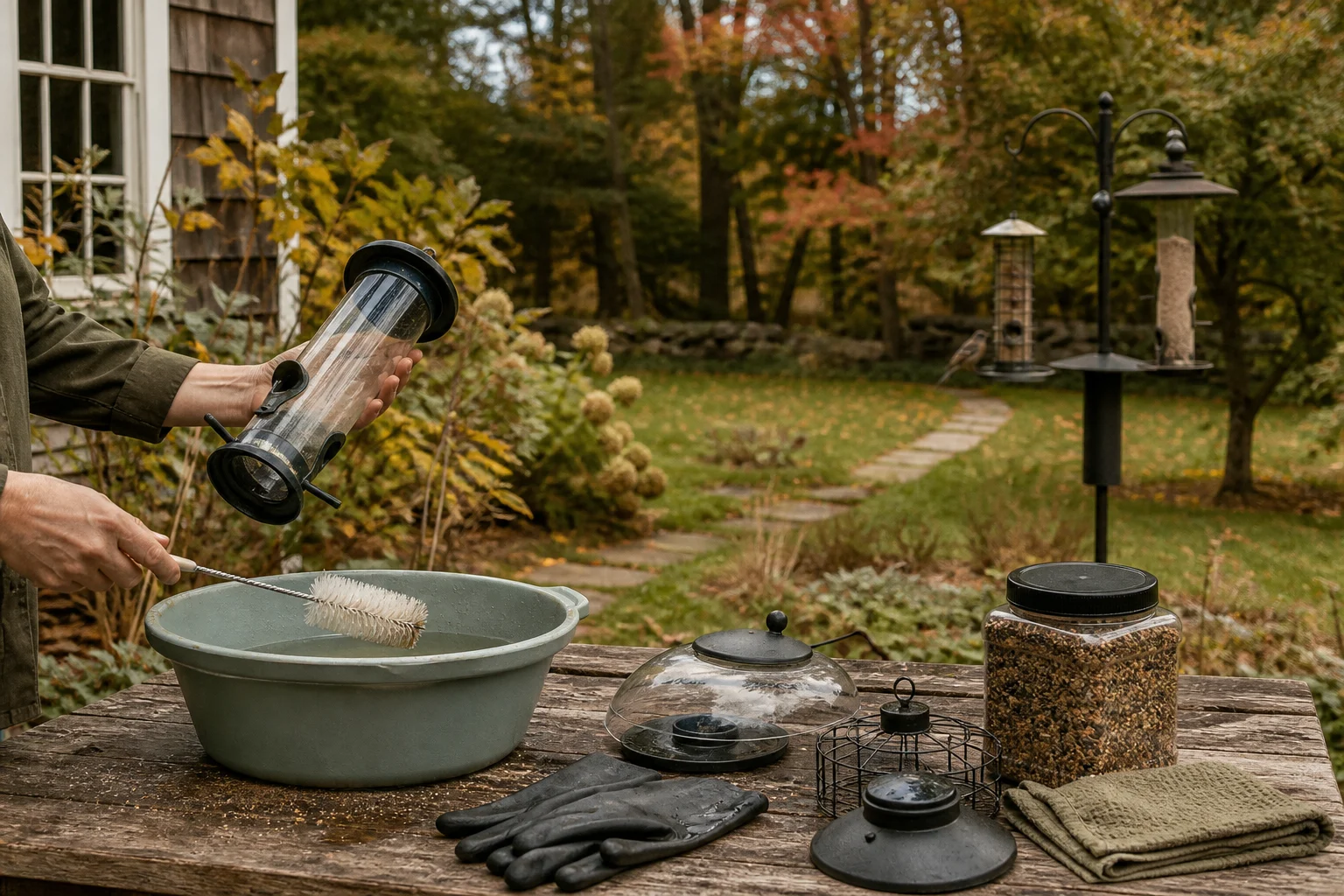
Feeders hung too high, too far into a flowerbed, or over a thorny shrub don’t get cleaned. Project FeederWatch recommends cleaning seed and suet feeders every week or two , and more often during heavy use or wet weather, to prevent disease transmission.
- A shepherd’s hook at the edge of a path works better than a tree branch you need a stepstool to access
- Tube feeders should hang at shoulder height so you can lift them off the hook with one hand
- Avoid placing feeders where you must step into muddy beds or reach through thorny shrubs
- Position feeders near cleared walkways or spots accessible from a deck in winter when snow piles up
- Skip locations that require a ladder for routine maintenance
Which Bird Feeders Attract Which Birds
FeederWatch’s own framing is that feeders are not one size fits all, and different species are attracted to different designs , but there is no single required mounting height for each type. The landing surface, port size, food, nearby cover, window distance, and your ability to clean the feeder matter more than a made-up height chart.
| Feeder type | Birds it often attracts | Food and fit | Where to put it |
|---|---|---|---|
| Platform or tray | Cardinals, grosbeaks, jays, sparrows, juncos, doves | Black-oil sunflower or a fresh seed mix; the open tray gives larger birds room to stand | Use an open sightline and a screened bottom for drainage; keep it reachable because trays soil quickly |
| Hopper or house | Cardinals, finches, grosbeaks, chickadees, titmice | Mixed seed or sunflower; the roof helps keep seed dry | Use a strong pole or hanger with a baffle and enough clearance for birds to approach from several directions |
| Tube | Chickadees, titmice, finches, buntings, nuthatches | Sunflower seed for a broad mix; smaller ports and perches favor smaller birds | Hang from a shepherd’s crook or stable branch where the ports stay visible and the feeder lifts off easily for cleaning |
| Nyjer tube or mesh feeder | Goldfinches, Pine Siskins, redpolls | Nyjer seed through tiny ports or mesh; a separate station reduces pressure from larger birds | Choose a dry, easy-refill spot and start with a small amount because wet nyjer spoils quickly |
| Suet cage | Woodpeckers, nuthatches, chickadees, titmice, wrens | Rendered suet in cool weather; upside-down designs favor agile clinging birds | Attach it firmly near a trunk or hang it with a clear approach; stop using soft suet in hot weather |
| Window feeder | Finches, chickadees, titmice, nuthatches, sparrows | Small tray or hopper fixed directly to glass or the frame | Mount it directly on the window so departing birds cannot build much collision speed, and keep the tray clean |
| Nectar feeder | Hummingbirds; orioles may also investigate | Plain hummingbird nectar in a feeder designed for frequent washing | Use a shaded, wind-protected spot where the feeder will not swing, spill, or heat up all afternoon |
Match the mounting hardware to the filled feeder’s weight and follow its instructions. A platform needs room for larger birds to land, while a tube or nyjer feeder needs unobstructed perches and ports. If squirrels already work your yard, plan the pole, baffle, and clearance distances before you buy the feeder. Black-oil sunflower is the most common seed offered in North America and a favorite of cardinals, chickadees, finches, and sparrows , so start there when you want the broadest mix, then add a specialized feeder only when you know which birds are visiting.
If you run multiple feeders, spread them enough that birds can approach and leave without crossing one crowded landing zone. Watch the first week and adjust if one feeder blocks another or the ground becomes hard to clean.
A simple mixed-species backyard station
Start with one sunflower tube and one platform on a pole you can reach from a path. The tube gives chickadees and finches a protected seed source; the platform makes room for cardinals and larger birds. Add a suet cage on a separate trunk or arm in cool weather if woodpeckers already work the trees nearby. Add nyjer only when goldfinches or siskins are present, since it serves a narrower group and costs more than sunflower seed.
Keep the station deliberate. Two feeders that do different jobs are more useful than five nearly identical feeders competing for the same birds.
How to Set Up a Bird Feeding Station
Use this short setup sequence before adding a second feeder:
- Choose the birds and feeder type you want to support.
- Mark the nearest window, dense cover, tree, fence, deck edge, and busy path.
- Place the feeder using the window and cover guidance above, with an open approach.
- Walk the refill route with a full scoop and confirm that you can remove the feeder for cleaning.
This sequence turns the species table into a station you can maintain, not a collection of feeders placed wherever a hook happens to fit.
Tube feeder and platform feeder placement
Give a tube feeder an unobstructed approach to its ports and give a platform feeder enough open room for larger birds to land. Keep both within the same reachable service path, but do not force them into one crowded landing zone.
Bird feeding station ideas: a layout you can service
Start with the path you will walk while carrying seed, then place the feeders around it. A useful station has three zones: a clear landing area under the feeders, nearby cover that does not hide a predator, and a refill and cleaning path that stays reachable in wet weather.
| Station zone | Practical choice | Article-backed reason |
|---|---|---|
| Feeding point | One pole with separate arms, or a small group with clear approaches | Different feeder types serve different birds without forcing one crowded landing |
| Window relationship | Either closer than 3 feet to the glass or at least 30 feet out | Extension guidance limits acceleration before a possible collision, and past 30 feet the glass stops reading as a route |
| Cover | Dense shrubs or evergreen branches nearby, with open sightlines around the feeder | Birds need an escape route without a hidden ambush spot |
| Service path | A firm, reachable route to the feeder and seed storage | Cleaning and refilling are easier to keep up when they do not require unsafe reaching |
For a narrow yard, one well-positioned pole is enough to begin. For a larger yard, separate feeder arms or two stations can spread traffic, but add a second location only after the first one is easy to clean and the birds use it consistently.
Placing Feeders Where Human Activity Scares Birds
Feeders next to a busy door, a dog run, or a play area may get fewer visits because footsteps, voices, and sudden movement repeatedly interrupt feeding. A more predictable spot is easier for birds to assess.
Choose a location away from high-traffic zones. A feeder visible from a kitchen window but set back from the patio door works better than one hung right outside the door you use ten times a day. Birds tolerate slow, quiet movement inside a house, but they flush when someone steps outside or a dog barks nearby.
If your yard is small and every spot is close to some activity, position the feeder where you can see it from inside but where outdoor movement is infrequent. A side yard that you walk through once a day is better than a deck you use for morning coffee. FeederWatch’s first placement rule is a quiet area that is easy to see and convenient to refill , and a calmer spot is one birds settle into faster.
Skipping Seasonal Placement Adjustments
A feeder location that works in summer might fail in winter when deciduous cover drops its leaves and snow changes sight lines. Birds that felt safe under a leafy maple in July are exposed in January when the branches are bare.
Check your feeders in late fall and move any that lost their cover when the leaves dropped. Add a temporary brush pile, lean evergreen boughs against a fence, or move the feeder closer to a conifer. In spring, prune back any branches that grew over the feeder and blocked the flight path.
Evergreens make the best cover because thick foliage hides birds from predators and buffers winter wind , which matters most for a feeder that already swings or stays wet. Recheck any feeder that swings, spills, or stays wet after seasonal weather changes, and avoid places where ice or roof runoff can fall onto it. A nectar feeder also needs the plain 4:1 sugar-water mix and a cleaning schedule that keeps up with the heat , because nectar left too long in the heat ferments.
Frequently Asked Questions
How close to a window can I safely place a bird feeder?
University of Arizona Cooperative Extension gives the safe range as within three feet of the glass or at least 30 feet out , because a bird leaving the feeder has less distance to accelerate. Add a tested exterior window treatment when reflections remain a hazard.
What’s the best feeder height to prevent cat attacks?
There is no universal height that prevents cat attacks. Use a stable mount, keep clear sightlines around the feeding area, keep pet cats indoors, and choose a height you can safely reach for cleaning.
How far from cover should a bird feeder be?
About 10 feet from dense shrubs or trees gives birds quick escape cover without creating ambush zones for predators. Leave clear space between the feeder and the nearest hiding spot so birds can scan for danger before they land.
Why do birds avoid my feeder even though it’s full of fresh seed?
Check the placement first. An exposed site, reflective glass, repeated door traffic, wet seed, or hidden approach routes can all reduce use. Tube feeders keep seed fairly dry and a platform with a roof helps too , so drying the seed out and adjusting one factor at a time makes the response easier to judge.
Do I need to move feeders in winter?
Yes, if deciduous trees and shrubs provided your summer cover. Once the leaves drop, feeders lose their shelter and birds feel exposed. Move feeders closer to evergreens, add a brush pile, or reposition them on the lee side of a building where wind is calmer.
Can I place multiple feeders in the same area?
Give each feeder an unobstructed approach and enough separation that birds are not forced through one crowded landing zone. Exact spacing depends on the yard and feeder types, so observe traffic and adjust.
How often should I clean my bird feeders?
Project FeederWatch recommends cleaning seed and suet feeders every week or two , more often in wet weather or heavy use, and advises against any feeder that cannot be thoroughly washed, such as one made of wood. When using bleach for disinfection, use no more than one part bleach to nine parts water .
Getting the Placement Right
Walk your yard in the morning when birds are most active and watch where they already perch, where they fly, and where they avoid. The spot that feels right to you might sit in a flight path birds won’t cross or lack the cover they need to feel safe.
Start with one feeder in a location that balances the key factors: close enough to useful cover without pressing into a hiding spot, deliberately positioned relative to glass, and easy for you to reach for cleaning. Add more only after you can see how birds use the first location.
What to Read Next
- Bird Bath Placement Mistakes That Keep Songbirds From Landing covers the water-side version of the same window, cover, and cleaning decisions.
- 7 Bird Bath Setups Songbirds Actually Use helps you add water without turning the backyard into a row of unrelated fixtures.
- Morning Coffee, a Bird Bath, and Nothing Else is the quieter next step if the goal is a watching spot rather than a bigger feeding station.