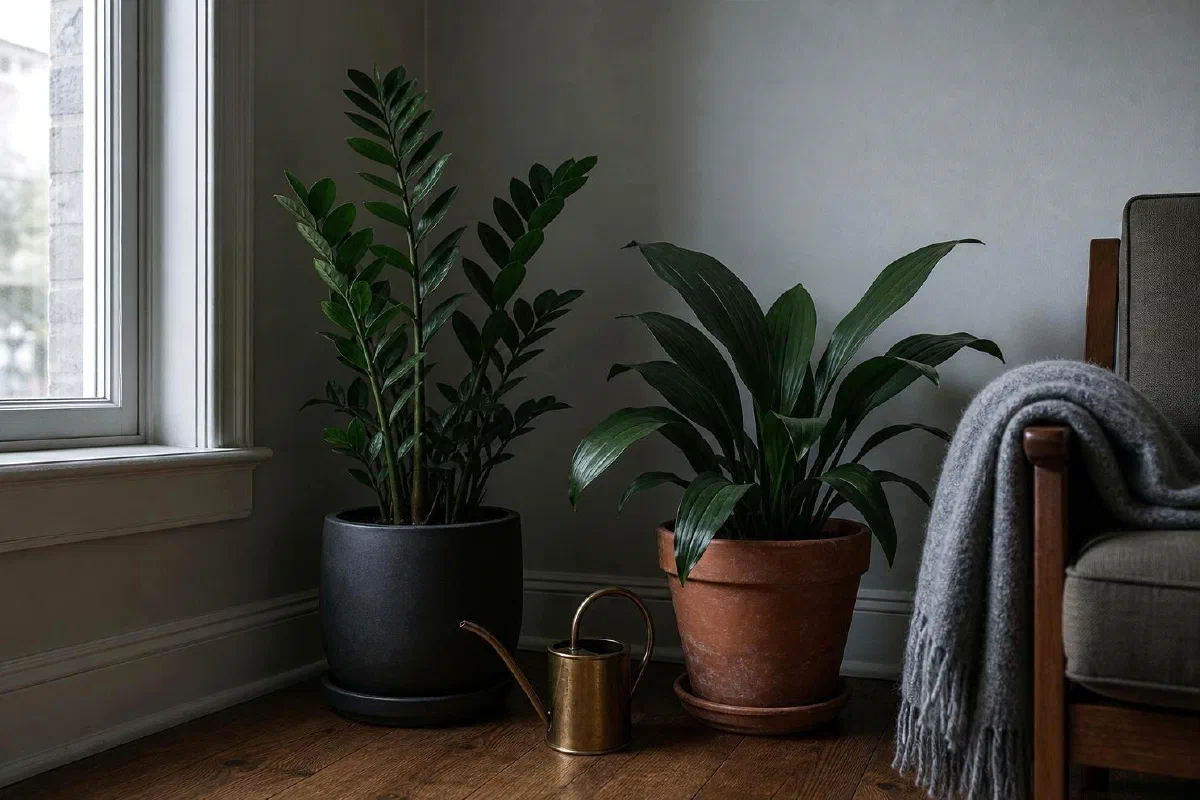
Most low light indoor plants lists are written by people who have never had a genuinely dark room. They put a fiddle leaf fig at number four and move on.
A real dark room is a north-facing bedroom, a hallway corner, a rental where the only window looks at the neighbor’s wall. The list of plants that live there is shorter than the internet suggests, and it is worth knowing which ones they are before you spend money finding out.
Fast answer: the ZZ plant, cast iron plant, and snake plant tolerate the least light of anything on this page, and the cast iron plant is the one that is also on the ASPCA non-toxic list. Water all three less often than you would by a bright window, because a dim plant drinks more slowly. Nothing on this list survives a room with no window at all.
Here is that list, ordered by how little light each one can tolerate, plus the boundary where low light stops and no light begins. Watering notes below are starting points for an average indoor room. Check the soil before you water; a dim plant usually uses water more slowly than the same plant beside a bright window.
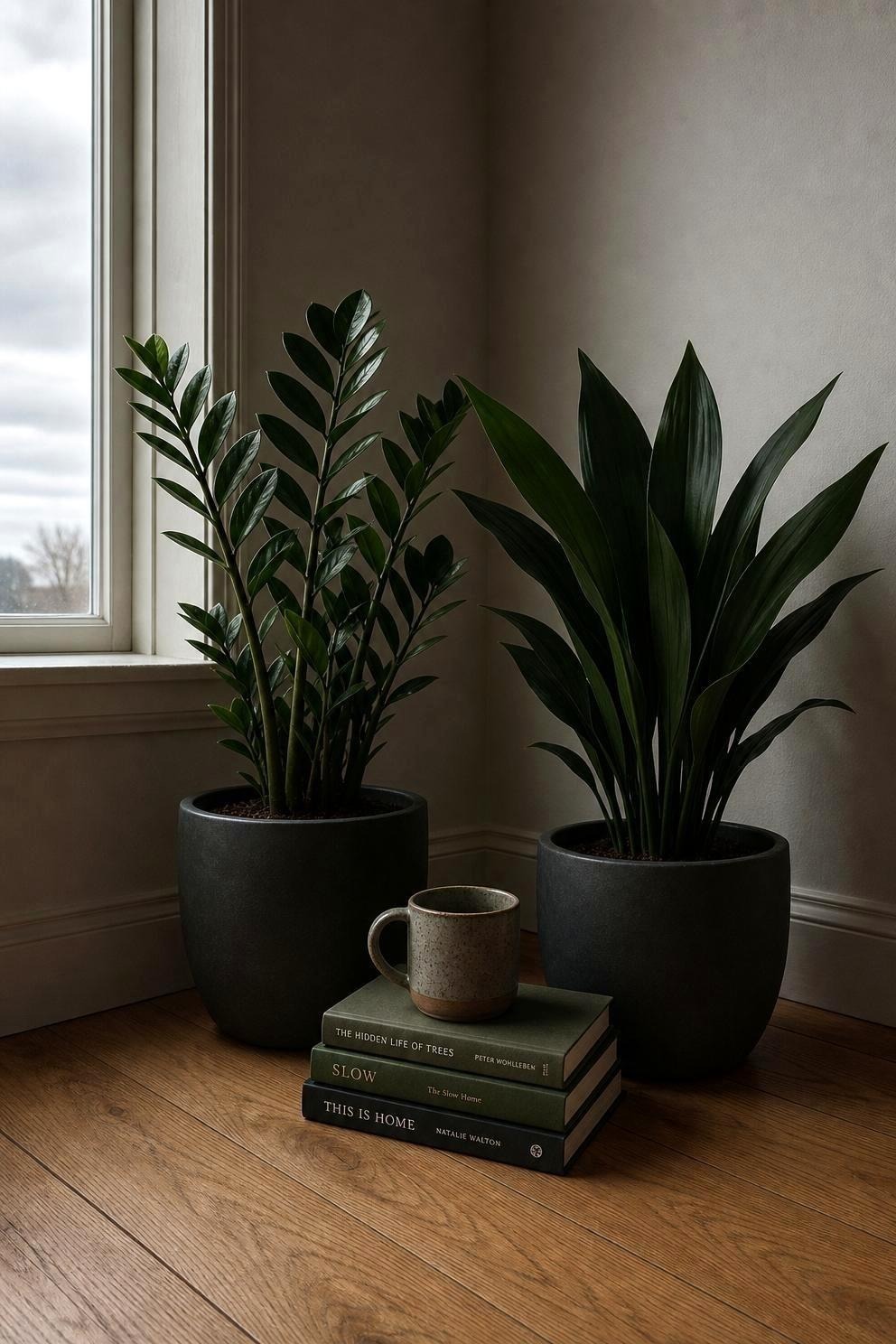
Best Plants for Dark Rooms: Four to Start With
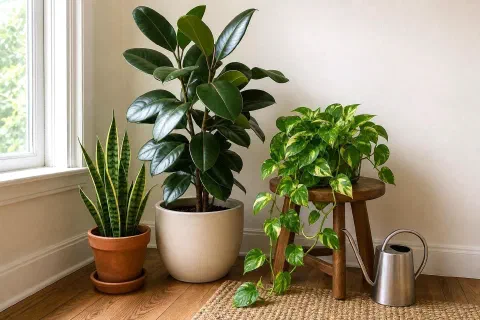
If the room is dim but still gets measurable daylight, start with a ZZ plant, cast iron plant, snake plant, or golden pothos. They cover four different needs without pretending that a plant can live in complete darkness.
| If you need… | Start with… | Why it fits |
|---|---|---|
| The most forgiving floor plant | ZZ plant | Stores water in thick rhizomes and tolerates the dimmest usable corner on this list |
| A pet-safe floor plant | Cast iron plant | Handles low light and appears on the ASPCA non-toxic list |
| Height in a narrow gap | Snake plant | Grows upright instead of spreading into the walkway |
| A trailing plant for a shelf | Golden pothos | Grows faster than the other three, though its variegation may fade in lower light |
“Dark room” still means a room with some daylight or a grow light. If you cannot make out a shadow at midday, measure the spot before buying; the windowless-room options below are more honest than promising that any houseplant will survive with no light.
University of Maryland Extension distinguishes a plant that tolerates its indoor conditions from one that thrives. In a dim room, slower growth and fewer new leaves are the tradeoff; a room without daylight needs a suitable grow light.
Buy for the Light You Have
A new pot or another plant will not solve a room with too little light. Decide which problem needs fixing before shopping.
| Your situation | Useful next step | Buying check |
|---|---|---|
| A dim spot with daylight | Choose a suitable plant from the list above | Pet safety, mature spread, and the light at the actual placement |
| A corner with no useful daylight | Compare living-room grow-light formats before buying a plant | Coverage at the stated light-to-leaf distance, glare, timer, and cord route |
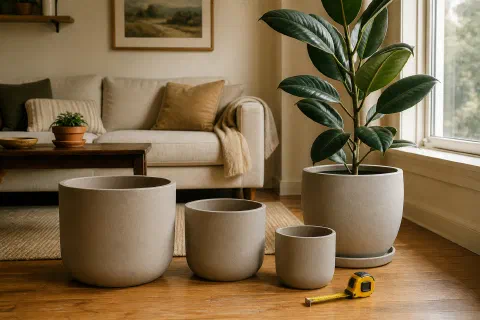
| A healthy plant that only needs a better-looking container | Use the planter sizing and drainage guide | Fit around the existing nursery pot, drainage, and access for watering |
Keep the nursery pot if the roots have enough room. Measure it before choosing an outer container, and check that you can lift it out to water. If a grow light cannot reach the leaves without blocking the walkway, choose another placement before spending on the fixture.
What Low Light Actually Means
Light gets measured in foot-candles, and one foot-candle is roughly the light a single candle throws on a surface a foot away.
| Category | Foot-candles | What it looks like |
|---|---|---|
| Low light | roughly 50 to 250 | North window, or several feet back from any window |
| Medium light | roughly 250 to 1,000 | Near an east or west window, out of the direct beam |
| High light | 1,000 and up | In the beam of a south or west window |
| Outdoor daylight | Thousands and up | For scale |
Treat those as a band rather than a threshold, because the people who publish them do not agree. University of Missouri Extension puts low light at 50 to 250 foot-candles and notes a few plants hold at about 10 under artificial light. Penn State Extension calls 100 foot candles a common baseline while acknowledging much lower figures get claimed for some species. Clemson’s Home and Garden Information Center sets a 100 foot-candle minimum with 75 to 200 preferred, and adds a number worth sitting with: the interior of a well-lighted home is often under 100 foot-candles before you place anything. Nobody is wrong; the boundary is genuinely soft and it moves by species.
What all three agree on is the part that matters. A “low light” plant still wants something in the tens-to-low-hundreds of foot-candles. That is not darkness. It is dim.
The second is the scale gap. Even a bright indoor spot is a fraction of what an overcast day outside delivers. Every houseplant in your home is living on a small fraction of what it evolved for, which is why the tolerant ones are almost all understory species from forest floors.
How to Test the Light in Your Room
The University of Missouri guidance explains why people get this wrong: the human eye adjusts automatically, so a room you call bright can still measure low at plant height.
Three ways to check, in order of accuracy:
- Use a light meter app on your phone. Free ones read in lux or foot-candles. Stand where the pot will go, hold the phone facing the ceiling, and take readings at three times: mid-morning, noon, and late afternoon. The lowest number is the one that matters, not the best.
- Run the shadow test. At midday, hold your hand about a foot above a sheet of white paper on the spot. A sharp-edged shadow means high light. A soft shadow with a recognizable outline is medium. A shadow you can barely make out is low. No shadow at all means you are choosing between a grow light and an artificial plant.
- Read the plant. Once something is in place, the plant tells you within a couple of months. Long bare stretches of stem between leaves, new leaves smaller than the old ones, pale stems, and lower leaves yellowing and dropping all mean it wants more light than it is getting.
Do the test before you buy. It takes a day and it is the difference between a plant that lives and a plant you replace in March.
10 Low Light Indoor Plants, Most Tolerant First
1. ZZ Plant (Zamioculcas zamiifolia)
The most tolerant plant on this list, and the one I would put in the darkest corner you have. Thick waxy leaflets on upright stems, and rhizomes under the soil that store water, so it handles an occasional missed watering. Let the mix dry well before watering, with longer gaps in winter. Not in the ASPCA plant database, so treat pet safety as unverified rather than safe.
2. Cast Iron Plant (Aspidistra elatior)
Named for exactly the reason you would hope. Broad dark green strap leaves, grows slowly, and tolerates dim light, drafts and irregular watering better than anything else here. The tradeoff is the slow growth: it will not fill a corner quickly. Water when the top inch dries and empty the saucer. Safe for cats and dogs.
3. Snake Plant (Dracaena trifasciata)
Upright, architectural, and nearly unkillable. It fits the narrow gap beside furniture where nothing else does. Let the mix dry well between waterings. More people kill this by watering it than by neglecting it. Toxic to cats and dogs; the ASPCA lists saponins as the toxic principle, with nausea, vomiting, and diarrhea.
4. Golden Pothos (Epipremnum aureum)
The quickest grower here for a dim spot. Vines can run several feet and can root in water, so one plant can become several. Variegated leaves may produce greener new growth when light is limited. Water when the top inch or two dries. Toxic to cats and dogs.
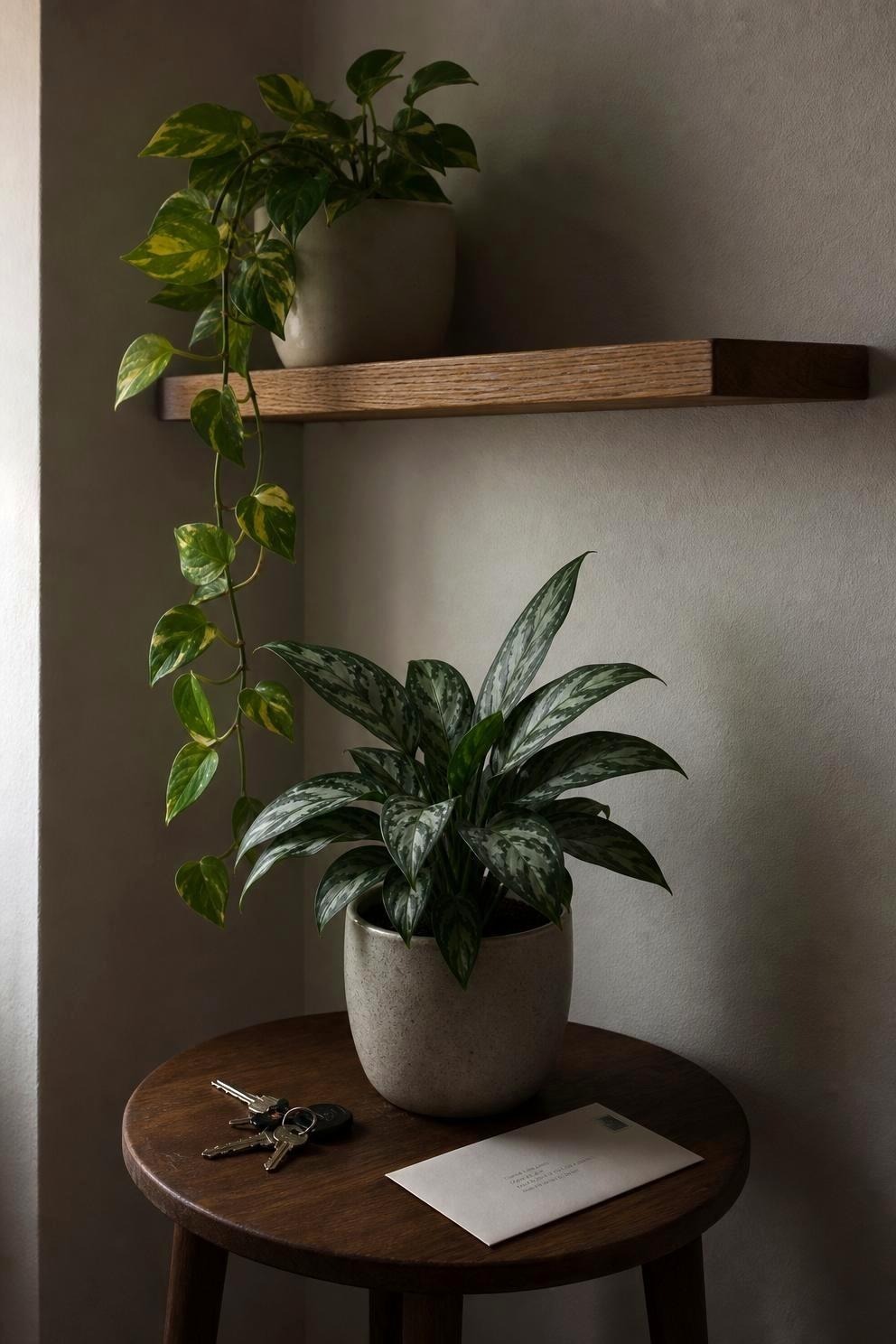
5. Chinese Evergreen (Aglaonema)
Broad leaves marked in silver, gray, or cream depending on the variety. Missouri Extension notes that some aglaonemas can be maintained at very low light, though growth and color still depend on the cultivar and conditions. Water when the top inch dries. Toxic to cats and dogs.
6. Heartleaf Philodendron (Philodendron hederaceum)
Trails like a pothos with softer, more matte leaves. Tolerates low light and forgives a missed week. Pinch the growing tips if you want it fuller rather than stringy. Water when the top inch or two dries. Toxic to cats and dogs.
7. Peace Lily (Spathiphyllum wallisii)
Peace lily can flower in lower indoor light, though flowering generally needs more light than leaf growth. It wilts when thirsty, which gives you a visible cue, but do not wait for repeated wilting. Water when the top inch dries. Toxic to cats and dogs.
8. Parlor Palm (Chamaedorea elegans)
A Victorian parlor plant for the obvious reason: it was one of the few things that survived a dim Victorian parlor. Stays around three to four feet. Water when the top inch dries. Safe for cats and dogs.
9. Spider Plant (Chlorophytum comosum)
Honest placement: Clemson and the University of Illinois both put the spider plant in the medium light group, not the low light group, so it belongs here with a caveat rather than a recommendation. It will hold its shape in a dim room without growing much. Baby plants on long stems can root in water, which makes this a useful choice for a shelf. Water when the top inch dries. Safe for cats and dogs.
10. Bird’s Nest Fern (Asplenium nidus)
The fern for a dim bathroom. Wide, glossy, undivided fronds suit a humid room better than a dry heated corner. Keep the potting mix evenly moist without leaving the pot in standing water. Not in the ASPCA plant database, so treat pet safety as unverified rather than safe.
Which One to Choose for Your Room
| Plant | Lowest light it takes | Watering cue | Mature size | Cats and dogs |
|---|---|---|---|---|
| ZZ plant | Very low | Let mix dry well | 2 to 3 ft | Unverified |
| Cast iron plant | Very low | Top inch dry | 2 to 3 ft | Safe |
| Snake plant | Very low | Let mix dry well | 2 to 4 ft | Toxic |
| Golden pothos | Low | Top inch or two dry | 6 to 10 ft trailing | Toxic |
| Chinese evergreen | Low | Top inch dry | 1 to 3 ft | Toxic |
| Heartleaf philodendron | Low | Top inch or two dry | 4 to 8 ft trailing | Toxic |
| Peace lily | Low to medium | Top inch dry | 1 to 3 ft | Toxic |
| Parlor palm | Low to medium | Top inch dry | 3 to 4 ft | Safe |
| Spider plant | Medium, holds in low | Top inch dry | 1 to 2 ft | Safe |
| Bird’s nest fern | Low to medium | Keep evenly moist | 1 to 2 ft | Unverified |
The water column is a starting point, not a schedule. Pot material, drainage, season, temperature, humidity, and the plant’s growth all change how quickly the mix dries. Check the top inch or two before watering and empty the saucer afterward. The mature size column is the usual indoor range for a potted plant rather than a promise, since light, pot size, and pruning all move it.
Narrow it with three questions:
- How dark, honestly? If your reading came in under 100 foot-candles, start with the top three and watch the plant’s new growth. Below 50, skip to the windowless section below or add a grow light.
- Does a pet reach it? The safe options here are the cast iron plant, parlor palm and spider plant, and those three are confirmed on the ASPCA list rather than assumed. The ZZ plant and the bird’s nest fern are not in that database at all, which is a gap in the list and not a clean bill of health. The ASPCA keeps a searchable list of toxic and non-toxic plants if you want to check something else.
- What shape is the gap? Floor corner takes a ZZ plant or a cast iron plant. Narrow slot beside a sofa takes a snake plant. Shelf or hanging takes a pothos or a heartleaf philodendron. Buy for the gap, not for the photograph.
If you want more detail on any species before you commit, the Missouri Botanical Garden plant finder carries a proper cultural sheet for every plant on this page.
Hanging and Trailing Plants That Tolerate Dim Rooms
A low light corner often has no floor left. Hanging and trailing plants solve that, and three of them are already on the list above: golden pothos, heartleaf philodendron, and spider plant. They do not have the same tolerance, so which one hangs where matters.
| Plant | How it grows | Cats and dogs | Where it fails |
|---|---|---|---|
| Golden pothos | Trails several feet, or climbs if given support | Toxic, calcium oxalates | Loses variegation in dim light and grows greener |
| Heartleaf philodendron | Trails with softer, matte leaves | Toxic, calcium oxalates | Stretches into long bare stems if light keeps dropping |
| Spider plant | Arching leaves with baby plants on runners | Safe | Wants medium light; it holds in a dim room without growing |
| Bird’s nest fern | Upright rosette, not trailing | Not in the ASPCA database | Needs the humidity of a bathroom rather than a dry heated room |
Two things go wrong with a hanging plant in a dim room, and neither is the plant’s fault.
The pot never dries. A hanging pot is out of the air movement at floor level, and in low light the mix holds water even longer than a floor plant. Check the weight of the pot before you water rather than the surface, and use a pot with drainage holes inside the hanger.
Water goes somewhere. Lifting a pot down to water it over a sink is the honest routine. If you water it in place, the overflow lands on the shelf or the floor below. A saucer that fits inside the hanger, or a cachepot you lift the nursery pot out of, handles both problems.
If you would rather not hang anything at all, a narrow stand beside furniture holds the same trailing plants in the same light with far less fuss.
The Mistakes That Kill Low Light Plants
Low light does not kill houseplants on its own. Low light plus a habit from a brighter room does.
- Watering on the same schedule as before. This is the one that does the damage. A plant in dim light uses far less water, and the soil stays wet for days longer. The identical routine that kept a pothos happy by a window will rot it in a hallway.
- Potting up too big. A large pot holds a large reservoir of wet soil around a small root ball. In a dark corner it never dries. Go up one pot size, not three.
- A cachepot with no drainage. Keep the plastic nursery pot inside the pretty one and lift it out to water, or drill the pretty one.
- Fertilizing through winter. A plant barely growing in a dim January is not asking to be fed. Feed at half strength, spring to early autumn only.
- Expecting the plant it was in the shop. Nurseries grow stock in bright greenhouses. Some leaf drop and slower growth after it comes home is the plant adjusting, not dying.
Care in a Room Without Much Light
Turn the pot a quarter every time you water. In a dim room the light is directional and the plant leans hard toward it. A quarter turn keeps it even.
Clean the leaves. A film of dust and grease dulls a plant, and in a dim room a dull leaf is the whole show. Clemson’s indoor plant guide calls clean leaves favorable to healthy growth and notes that leaf-shine products leave a residue that interferes with air exchange, so a damp soft cloth on the upper and lower surfaces is the whole method. Skip the wet cloth on hairy leaves; use a soft brush instead.
Move it seasonally. The same corner loses a lot of light between June and December. A plant that coasted through summer may need to shift two feet closer to the window for winter, and back again in spring.
Watch the top inch, not the calendar. Finger two inches into the soil. Damp means wait. In a dark room that will often mean waiting twice as long as the label says.
Rooms With No Window at All
Nothing photosynthesizes in the dark. A windowless bathroom, an interior hallway or a basement is not a low light room, it is a no light room, and no plant on this page survives there long term.
Two honest options:
Rotate them. Keep two plants and swap them every two weeks, one on duty in the dark room and one recovering somewhere brighter. This genuinely works and it is what commercial interior landscapers do.
Add a light. A supplemental light on a timer turns a dead corner into a low light spot, and the setup is less fussy than the equipment lists suggest. Iowa State Extension’s guide to supplemental lighting gives the numbers that matter:
- Run it 14 hours a day, and stay between 10 and 16 hours. Plants still need a dark period.
- Distance matters more than wattage. An LED fixture sits 12 to 24 inches from the foliage; a fluorescent fixture sits 6 to 12 inches away. Plants grow, so the light has to move up with them.
- A grow-light bulb in an ordinary lamp works for one small plant. Iowa State’s built-it-yourself option is a standard shop fixture with full-spectrum daylight bulbs, which is what makes a desk lamp and a floor lamp plausible instead of a rack in the corner.
- An ordinary incandescent bulb does not. Clemson’s indoor plant guide notes that plants under incandescent light stretch and go leggy, which is the same symptom the shadow test is meant to catch.
That last point is worth knowing before you spend anything. Clemson also puts a number on what fertilizer can and cannot do here: about 100 foot-candles for 12 hours a day is what it takes just to maintain a plant’s quality, and a foliage plant needs at least 200 foot-candles for 12 hours before fertilizer does anything measurable. A dim corner at the bottom of the low light band is below that line, so feeding a struggling plant in the dark mostly wastes fertilizer.
Questions People Actually Ask
What indoor plants need the least light?
The ZZ plant, the cast iron plant and the snake plant, in that order. All three hold at the bottom of the low light band, around 50 foot-candles, and the cast iron plant is the one that will also forgive a draft and an erratic watering can.
What is the best houseplant for a dark room?
If the room genuinely has a window and you want one plant, buy a ZZ plant. If a pet shares the room, buy a cast iron plant instead, because it is the one plant near the top of this list that the ASPCA lists as non-toxic. The ZZ plant is not in that database at all, so it comes with a question mark rather than a warning. Both are slow, which is a feature in a dim corner.
Can indoor plants live with no sunlight at all?
Not with no light at all. They can live with no direct sun, which is what most people mean, and every plant on this page does that happily. A room with no window needs either a grow light or a rotation with a brighter room.
Do low light plants grow more slowly?
Yes, and that is the honest tradeoff nobody mentions. A pothos by an east window puts out a new leaf every couple of weeks in summer. The same pothos in a hall corner might manage one a month. Buy the plant at the size you want the room to have.
What about plants for shade outdoors?
Different question with a different answer. Outdoor shade still delivers far more light than most indoor corners, so outdoor shade plants like hostas and ferns are not interchangeable with this list.
What plants work in a dark bedroom or a windowless bathroom?
A bedroom with one north window is a normal low light room, and the ZZ plant, cast iron plant, and snake plant all handle it. A bathroom is a different problem. If it has a window, the humidity suits the bird’s nest fern better than a dry heated living room. If it has no window, no plant on this page will live there on the bathroom light alone, because a light you switch on for twenty minutes is not a light source. Put a small grow light on a timer, or rotate a pothos in and out every two weeks.
Will variegated plants keep their pattern in low light?
Usually not entirely. Variegated leaves have less chlorophyll, so dim light can lead to greener new growth. How strongly that happens depends on the plant and cultivar. Chinese evergreen is worth trying when leaf pattern matters, but watch the new leaves after it settles in.
Sources
- University of Missouri Extension: Lighting indoor houseplants: low-light ranges, measurement limits, and plant responses.
- Penn State Extension: Low-light houseplants: practical low-light thresholds and caveats.
- Clemson HGIC: Indoor plants, cleaning, fertilizing, containers and light requirements: foot-candle bands by species, what fertilizer can and cannot do in low light, and the winter rest period.
- Iowa State University Extension: How to set up supplemental lights for indoor plants: daily light duration, fixture-to-foliage distance, and a shop-fixture alternative to a grow light.
- University of Minnesota Extension: Spring houseplant care: soil checks, drainage, and seasonal watering.
- ASPCA: Toxic and non-toxic plants: verify the exact plant before bringing it within a pet’s reach. The list is not all-inclusive, which is why two plants on this page read as unverified.
What to Read Next
- Air purifying plants and what they really do: read the evidence limits before choosing a plant for air quality.
- Living room plant ideas for empty corners: place one of these plants in the corner you keep walking past.
- How to style tall indoor plants in a living room: fit a larger plant to the room’s height and floor space.
- Narrow plant stands for apartment corners: check stand dimensions when the floor gap is measured in inches.
- Indoor house plants without the clutter: keep the room from filling up around the new plant.