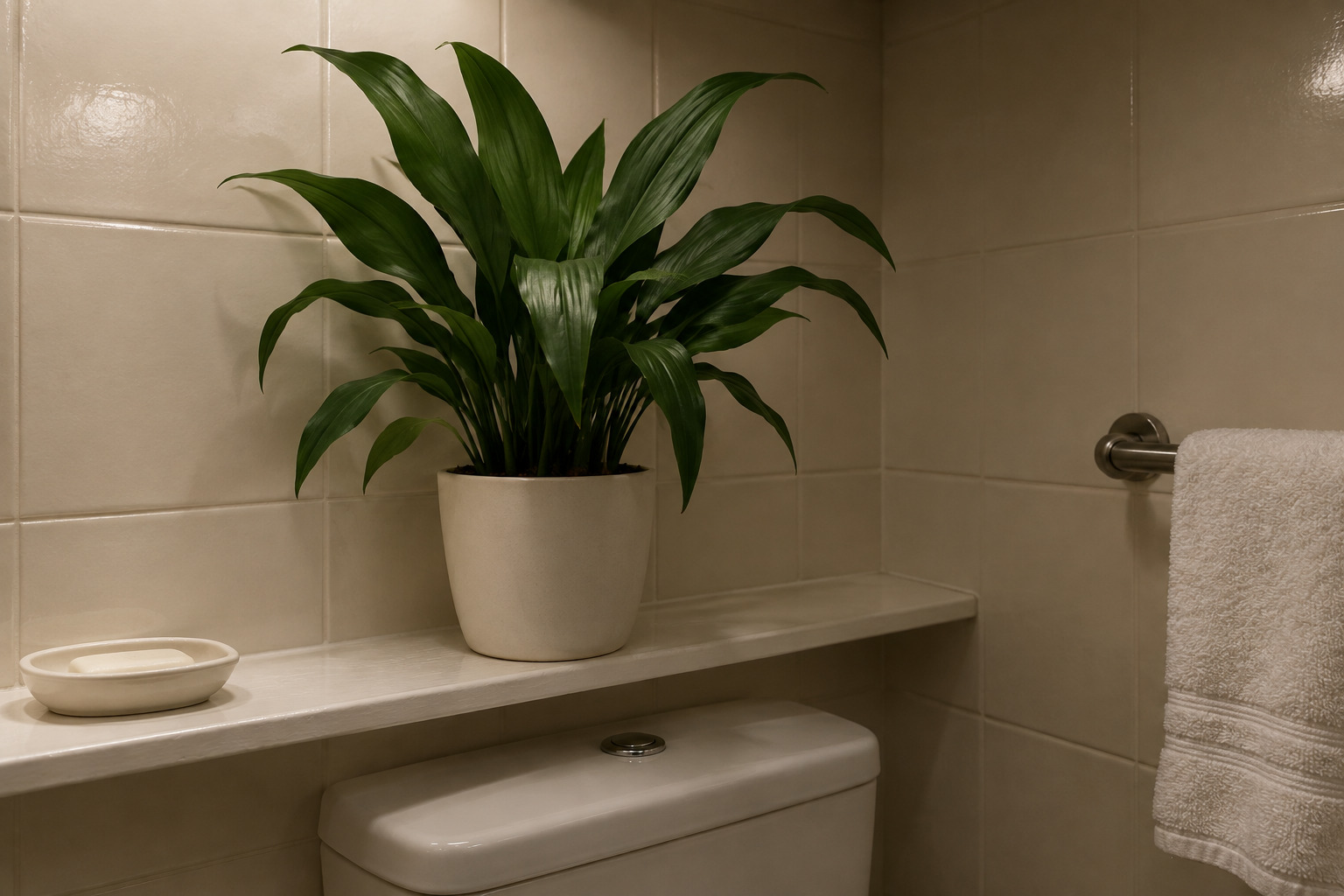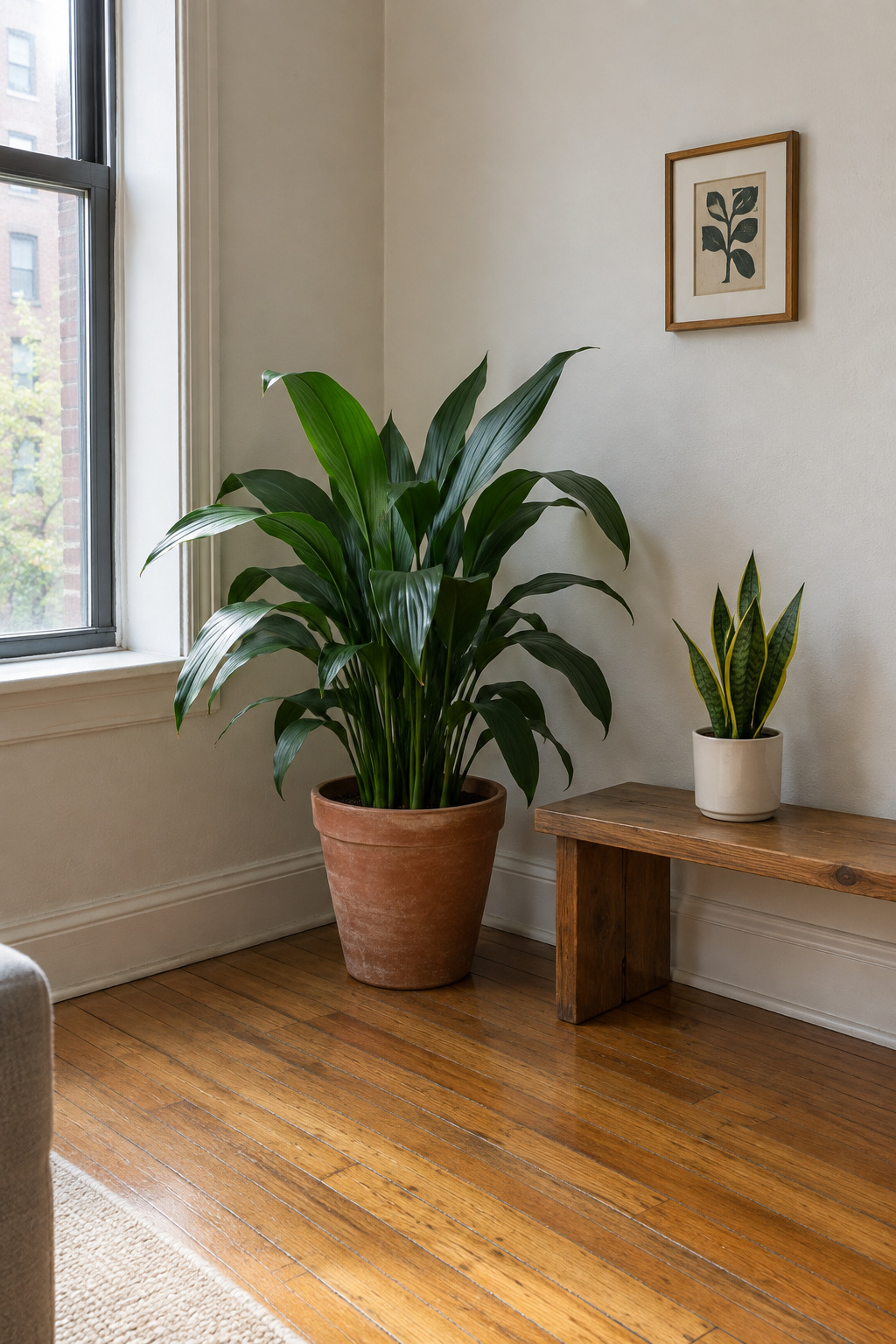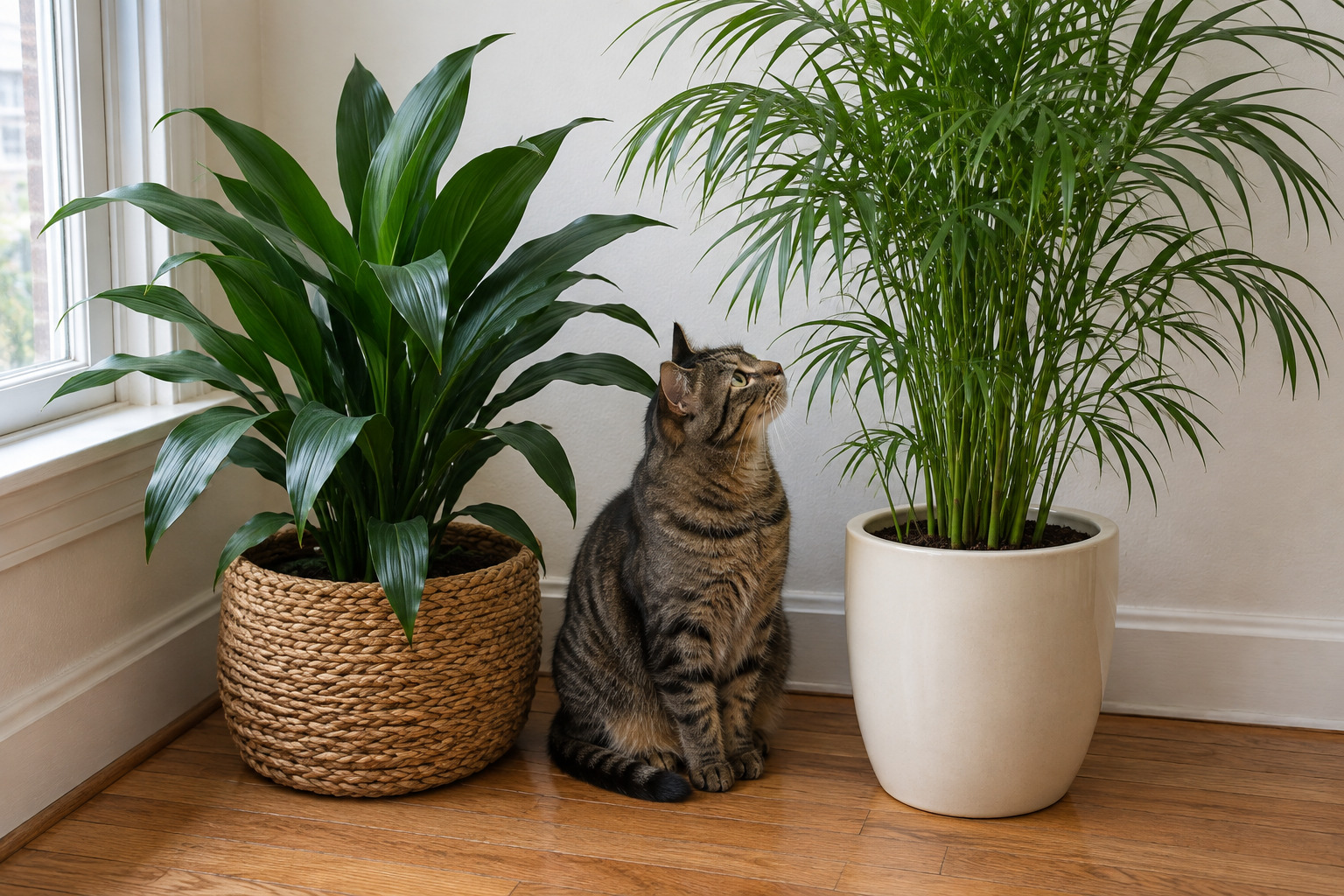
Nearly every pet friendly apartment plants list on the internet was written from another list. Somewhere back at the start of the chain, somebody guessed, and a rubber plant got handed the safety status of a different species.
Every plant below was checked by hand against the ASPCA toxic and non-toxic plant database , and the light needs come from university extension services. Every status is one of three words.
If the ASPCA has no entry for a plant, this article says Unverified, not safe. The ASPCA states on its
own list page that the information is “not meant to be all-inclusive, but rather a compilation of the
most frequently encountered plants.” Absence from the list is a gap in the list, not a clean bill of
health.
The short answer: the low light apartment plants verified as non-toxic are cast iron plant, parlor palm, kentia palm, areca palm, calathea, and prayer plant, with African violet and spider plant safe for medium light. The list is short because most popular low light houseplants are either toxic (they contain insoluble calcium oxalates, which burn a pet’s mouth) or they are so well known that everyone assumes they are listed, and they are not in the database at all.
Which Apartment Plants Are Verified ASPCA Non-Toxic
Here is the comparison table, sorted safe first. The toxic principle column is the exact wording the ASPCA page carries, and it is blank when the page lists no toxic principle because there is not one.
| ASPCA common name | Scientific name | Cats and dogs | Toxic principle | Light needs |
|---|---|---|---|---|
| Cast Iron Plant | Aspidistra elatior | Safe (ASPCA non-toxic) | none listed | Very low, the most tolerant here |
| Parlor Palm | Chamaedorea elegans | Safe (ASPCA non-toxic) | none listed | Low to medium |
| Kentia Palm | Howea forsteriana | Safe (ASPCA non-toxic) | non-toxic | Low to medium |
| Areca Palm | Dypsis lutescens | Safe (ASPCA non-toxic) | none listed | Medium, bright indirect |
| Calathea | Calathea spp. | Safe (ASPCA non-toxic) | none listed | Low to medium |
| Prayer Plant | Calathea insignis | Safe (ASPCA non-toxic) | non-toxic | Low to medium |
| African Violet | Saintpaulia spp. | Safe (ASPCA non-toxic) | none listed | Medium, bright indirect |
| Spider Plant | Chlorophytum comosum | Safe (ASPCA non-toxic) | none listed | Medium, holds in low light |
| Boston Fern | Nephrolepis exalta bostoniensis | Safe (ASPCA non-toxic) | none listed | Medium |
| Christmas Cactus | Schlumbergera bridgesii | Safe (ASPCA non-toxic) | none listed | Medium |
| Wax Plant | Hoya carnosa | Safe (ASPCA non-toxic) | non-toxic | Medium to bright |
| Polka Dot Plant | Hypoestes phyllostachya | Safe (ASPCA non-toxic) | Unknown | Medium |
| Golden Pothos | Epipremnum aureum | Toxic | Insoluble calcium oxalates | Low |
| Heartleaf Philodendron | Philodendron hederaceum | Toxic | Insoluble calcium oxalates | Low |
| Chinese Evergreen | Aglaonema modestum | Toxic | Insoluble calcium oxalates | Low |
| Peace Lily | Spathiphyllum | Toxic | Insoluble calcium oxalates | Low to medium |
| Snake Plant | Sansevieria trifasciata | Toxic | Saponins | Very low |
| Umbrella Tree | Brassaia actinophylla | Toxic | Terpenoids, saponins, insoluble oxalates | Medium |
| Aloe | Aloe vera | Toxic | Saponins, anthraquinones | Bright |
| Jade Plant | Crassula argentea | Toxic | Unknown | Bright |
| Kalanchoe | Kalanchoe spp. | Toxic | Bufodienolides | Bright |
| Begonia | Begonia spp. | Toxic | Soluble calcium oxalates | Medium |
| Dracaena, Red-Marginated | Dracaena marginata | Toxic | Unknown | Low to medium |
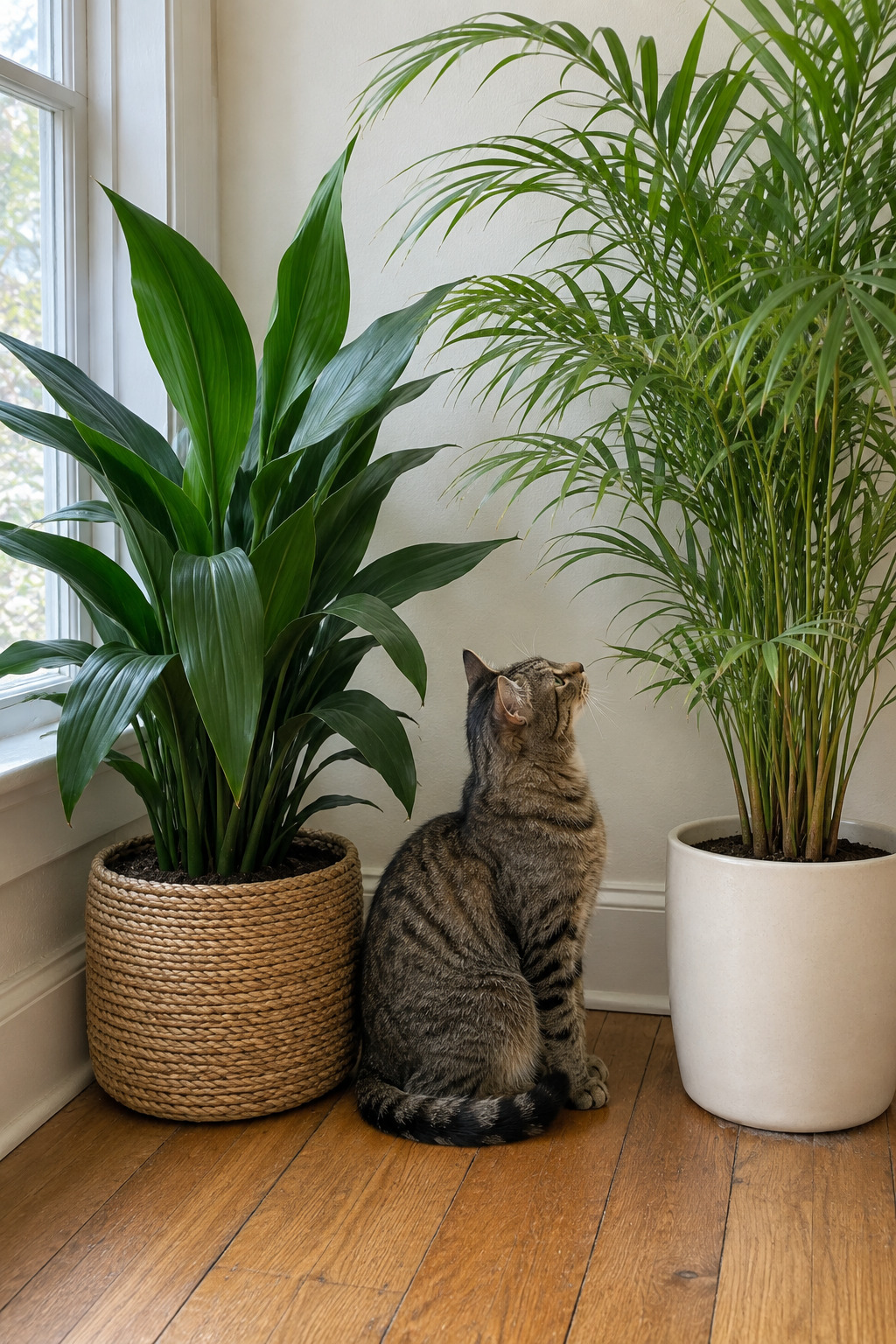
The toxic plants down the bottom of that table are among the most recognizable low light houseplants in the country, which is the awkward part. If your apartment is dim and your pet investigates everything, the cast iron plant and the palms carry the least risk.
Two rows need a footnote, because the ASPCA page is not tidy. Polka Dot Plant is listed as non-toxic
and the same page shows Toxic Principles: Unknown with mild vomiting and diarrhea under clinical
signs, so read it as a plant that is not expected to be dangerous and can still make a pet throw up.
Spider plant is non-toxic, and extension services put it in the medium light group rather than the
low light group.
What to Do When a Pet Chews a Plant
Most houseplant exposures are not emergencies, and a few are, and the difference is usually the species and the amount.
The first thing to know is the ASPCA’s own general point, which applies even to the safe list above. The list page states that consumption of any plant material may cause vomiting and gastrointestinal upset for dogs and cats, and it adds that plants listed as non-toxic, or as potentially toxic with mild GI upset, are not expected to be life-threatening. A chewed leaf and a vomited breakfast do not automatically mean poison. They mean a phone call is worth making.
- Identify the plant and the amount. Keep the tag or a photo. “Some kind of houseplant” is not useful to a veterinarian, and the toxic principle changes with the species. A calcium oxalate plant irritates the mouth. A saponin plant like snake plant or dracaena is more likely to upset the stomach.
- Treat a true lily as urgent. If a cat has chewed any part of a Lilium species, including Easter lily, that is a same-day veterinary problem. The ASPCA lists kidney failure among the possible outcomes.
- Call for advice. ASPCA Poison Control is (888) 426-4435, staffed 24 hours a day, and the ASPCA notes that a consultation fee may apply. Your own veterinarian is the other call, and for a cat with a lily it is the first one.
- Do not wait for symptoms to decide. The ASPCA’s instruction is to contact your veterinarian or the hotline if you believe your animal is ill or may have ingested a poisonous substance.
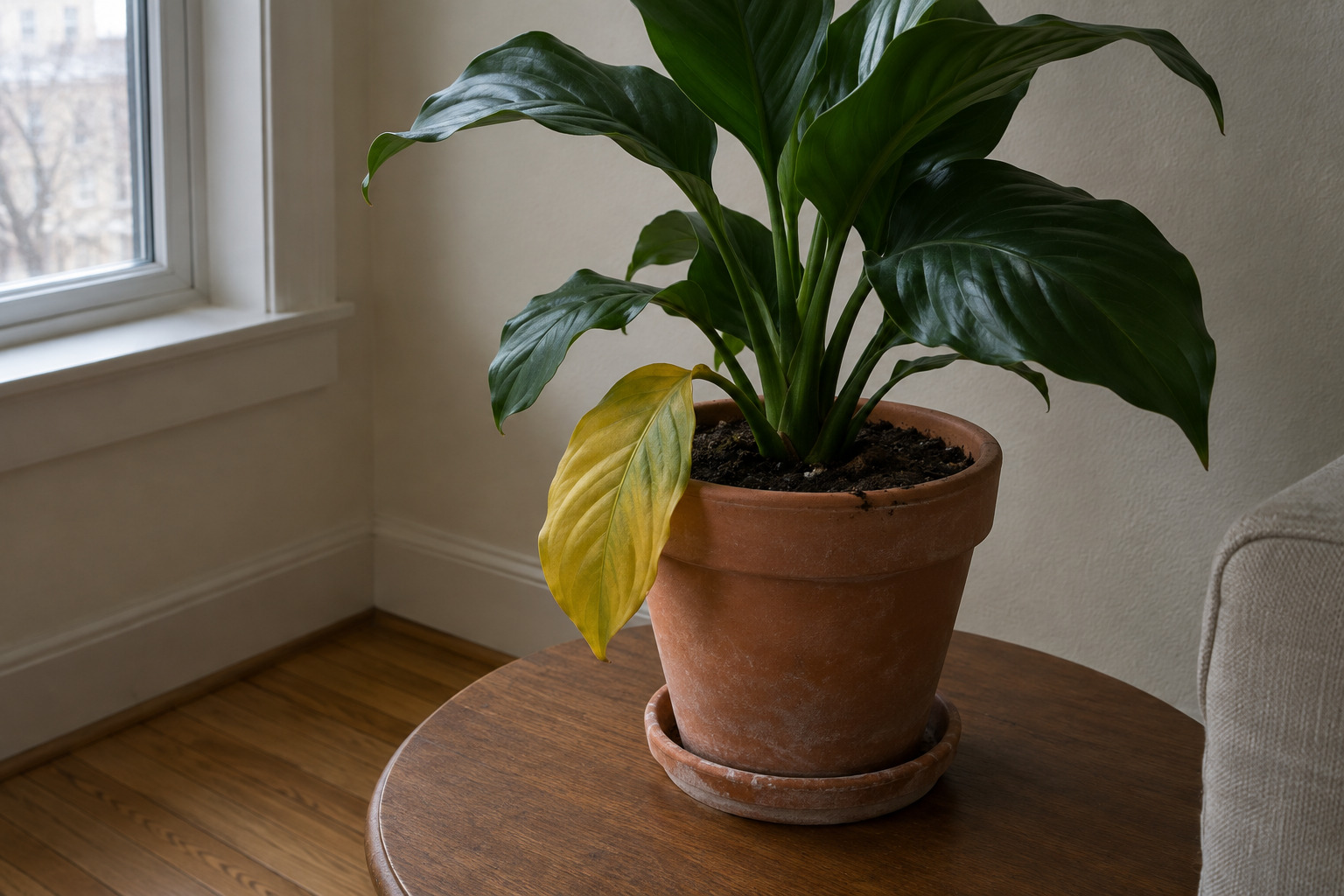
Height is the answer more often than a warning label is, which is why hanging a plant without drilling is often the better move than a shelf a cat can reach. And if a plant starts failing badly enough that you suspect the pet was not the cause, reading the symptoms sorts a watering problem from everything else.
Write the plant’s name on the bottom of the pot when it comes home, or keep the tag in the pot. At ten at night, the difference between a plant you can name and a plant you have to identify from a photograph is your evening.
Which Plants Are Toxic to Cats and Not to Dogs
Most of the ASPCA entries move cats and dogs together. Plenty of them do not, and the differences are real enough to matter if your apartment has both a cat and a dog.
The clearest case is the true lilies, and it runs the opposite way from the rest of this article. Easter Lily (Lilium longiflorum) is listed as toxic to cats with nothing about dogs. The page’s own note reads that cats are the only species known to be affected, and lists vomiting, inappetence, lethargy, and kidney failure, with death possible. A lily is not a placement problem. It is a plant that should not come into a home with a cat.
Going the other way, these are listed as toxic to cats and dogs but not horses:
- Golden Pothos, and Devils Ivy, which is the same plant under a second common name
- Marble Queen (Scindapsus aureus), listed as calcium oxalate crystals
- Satin Pothos (Scindapsus pictus), whose clinical signs note vomiting in animals other than horses
- Warneckei Dracaena and Corn Plant
- Asparagus Fern, listed with no toxic principle at all
Some entries flip within a single plant. Amaryllis is toxic to cats, dogs, and horses, and its listed signs include vomiting with the parenthetical “(not horses)”. Dieffenbachia and Schefflera are toxic to cats and dogs and say nothing about horses.
One more pair worth knowing, because the common names collide. Umbrella Tree is Brassaia actinophylla, toxic to cats and dogs. A separate entry called Umbrella Plant is Eriogonium umbellatum, non-toxic to all three. Searching a common name can land you on the wrong plant.
Check the entry for your animal, not just the plant. The ASPCA keeps a separate filtered list of plants toxic to cats for exactly this reason.
The Safety Mistake People Make About Plants That Are Not Listed
This is where other lists go wrong, and it is the reason the ASPCA tells you to check the plant’s name rather than trusting the label at the shop. Every plant below returned no database entry when checked. Not a toxic entry. Not a safe entry. Nothing.
| Plant | What people assume | What the ASPCA actually has |
|---|---|---|
| ZZ plant (Zamioculcas zamiifolia) | Safe, or toxic | Unverified (absent from the ASPCA list) |
| Bird’s nest fern (Asplenium nidus) | Safe | Unverified (absent from the ASPCA list) |
| Bird of paradise (Strelitzia spp.) | Safe | Unverified (absent from the ASPCA list) |
| Monstera deliciosa | Toxic | Unverified under that name, but listed as Swiss Cheese Plant (toxic) |
| Rubber tree (Ficus elastica) | Toxic, because the rubber plant is | Unverified (absent from the ASPCA list) |
| Peperomia | Safe | Unverified (absent from the ASPCA list) |
| Pilea, including Chinese money plant | Safe | Unverified (the related Friendship Plant and Aluminum Plant are listed) |
| Echeveria | Safe | Unverified (absent from the ASPCA list) |
| Air plant (Tillandsia) | Safe | Unverified (absent from the ASPCA list) |
| Philodendron Birkin | Toxic, because it is a philodendron | Unverified under that name (absent from the ASPCA list) |
| Orchid (Phalaenopsis) | Safe | Unverified (absent from the ASPCA list) |
That rubber tree row is the one worth reading twice, because it is the most common pet safety mistake on the internet for this plant.
Search the ASPCA for “rubber plant” and you get no entry. Search for “Indian Rubber Plant” and you get a real page, toxic to cats and dogs, with a toxic principle of proteolytic enzyme (ficin) and psoralen (ficusin). The scientific name on that page is not Ficus elastica. It is Ficus benjamina, the weeping fig.
So the rubber plant most people own, the thick-leaved Ficus elastica, has no listing of its own. Its status has been borrowed from a different species that shares a common name. Separate searches for Ficus elastica and for weeping fig return two more different results again, and neither one is an entry for the plant on the windowsill. That is how a wrong answer gets copied onto a hundred other lists.
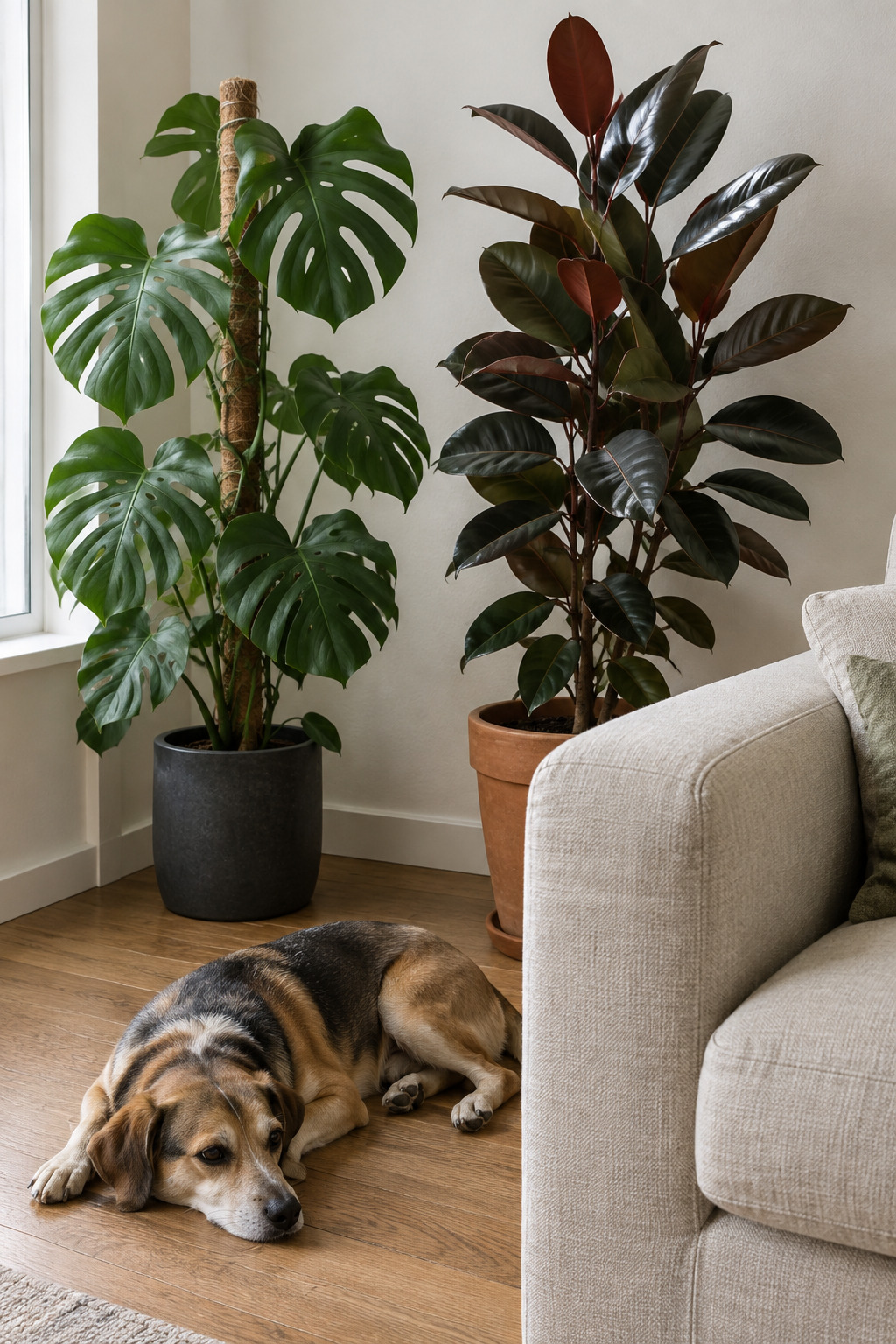
Monstera deserves its own note, because the check went the other way. The slug for Monstera deliciosa has no entry. But Monstera deliciosa is in the database under the common name Swiss Cheese Plant, and also under Cutleaf Philodendron, toxic to cats and dogs with insoluble calcium oxalates. The plant is listed. The name most people search is not.
So search the scientific name rather than the common name, read the scientific name on the entry you
find, and confirm it matches the plant in your hand. If the entry names a different species, you have
verified a different plant, not yours. If nothing comes back, write Unverified and decide on placement
instead of on a status.
How to Choose Between Two Plants You Like
Nine times out of ten the decision comes down to two plants on a shelf and three questions.
Which one can you verify? A plant with an ASPCA non-toxic entry for your animal beats a plant with a nicer leaf and no entry. Does the light suit it? A verified safe plant in the wrong light is a plant you replace, and the cast iron plant and its low light neighbors are ranked by how little light each one tolerates. What happens if it is chewed? Safe plants can still cause the general GI upset the ASPCA describes. Toxic plants can cause mouth pain, drooling, vomiting, and in the case of a lily in a cat, organ failure. If the answer is “nothing I want to handle on a Tuesday”, the plant goes on the high shelf or stays in the shop.
Be skeptical of the label. A tag that says “pet safe” is a marketing line unless it names a source, and the same nursery can sell you a plant under a common name that belongs to a different species.
How to Keep Safe Plants Out of Reach (African Violets and Friends)
You cannot put a toxic plant out of reach in a small apartment by walking it to another room. You have one room, and the cat is in it. So placement has to be deliberate rather than spacious.
Start with the honest fact: a determined cat reaches more than people expect. A fit cat can clear five to six times its own height from a standing jump, and it will use a sofa back or a chair as a step on the way to a shelf. A toxic plant two feet behind a chair is a plant the cat can reach.
What works, in rough order of reliability:
- Match the plant to the height. Safe plants go low, where the pet walks. Anything toxic goes up, and the height has to account for the launch pad, not just the floor.
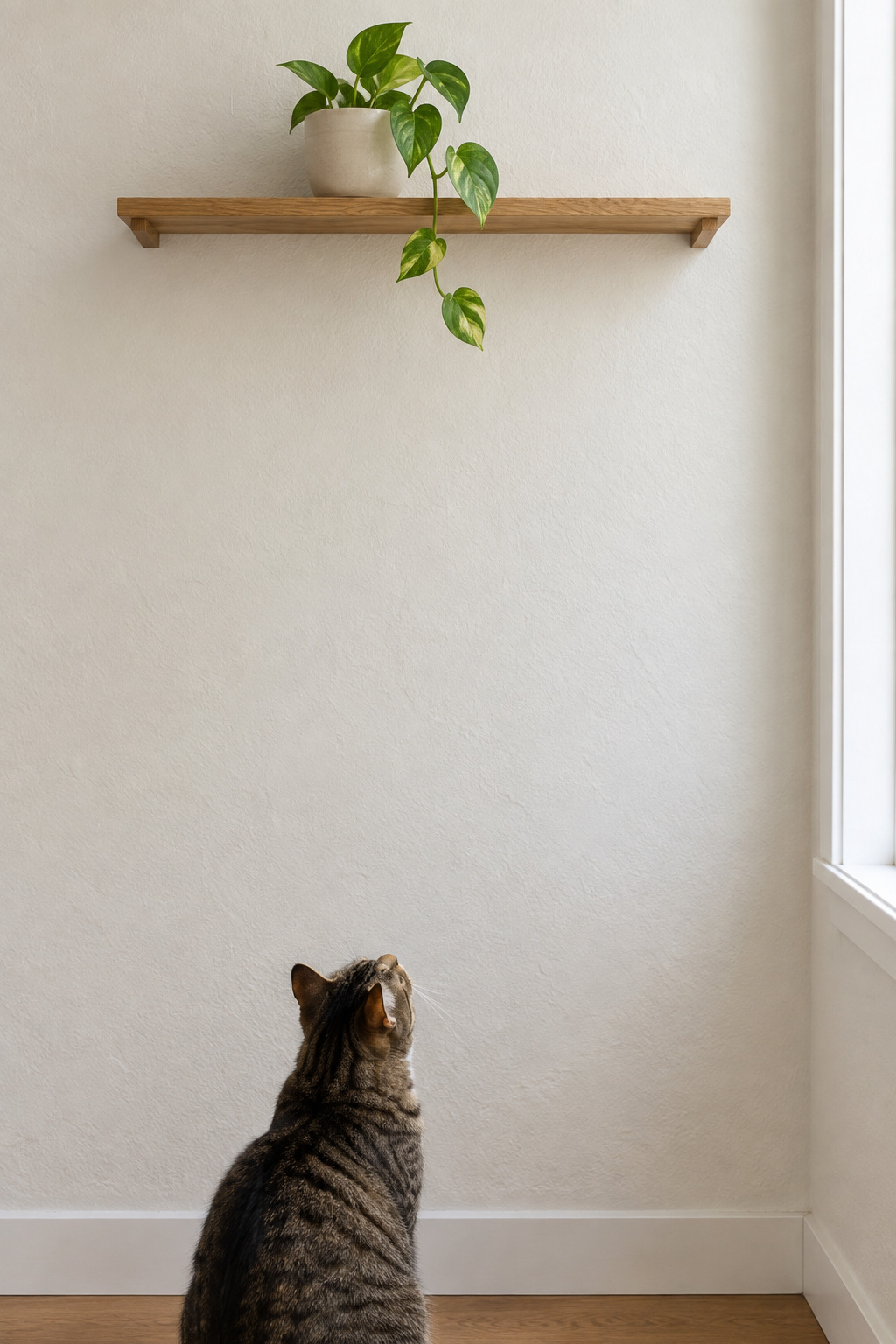
- Use a high, narrow wall shelf. Five feet and up is a reasonable working number. A narrow shelf gives the cat nothing to land on, and the bracket should be rated for the weight of the potted plant rather than the pot.
- Keep trailing vines short. A pothos trailing to the floor is a rope with leaves on it. Trim it so the lowest leaves stay above about thirty inches.
- Use the cabinet you already have. A glass-fronted cabinet is a display case with a door, which is the one barrier in a small apartment that a cat respects. It suits ferns, calathea, and African violets, which like humidity and hate a draft anyway.
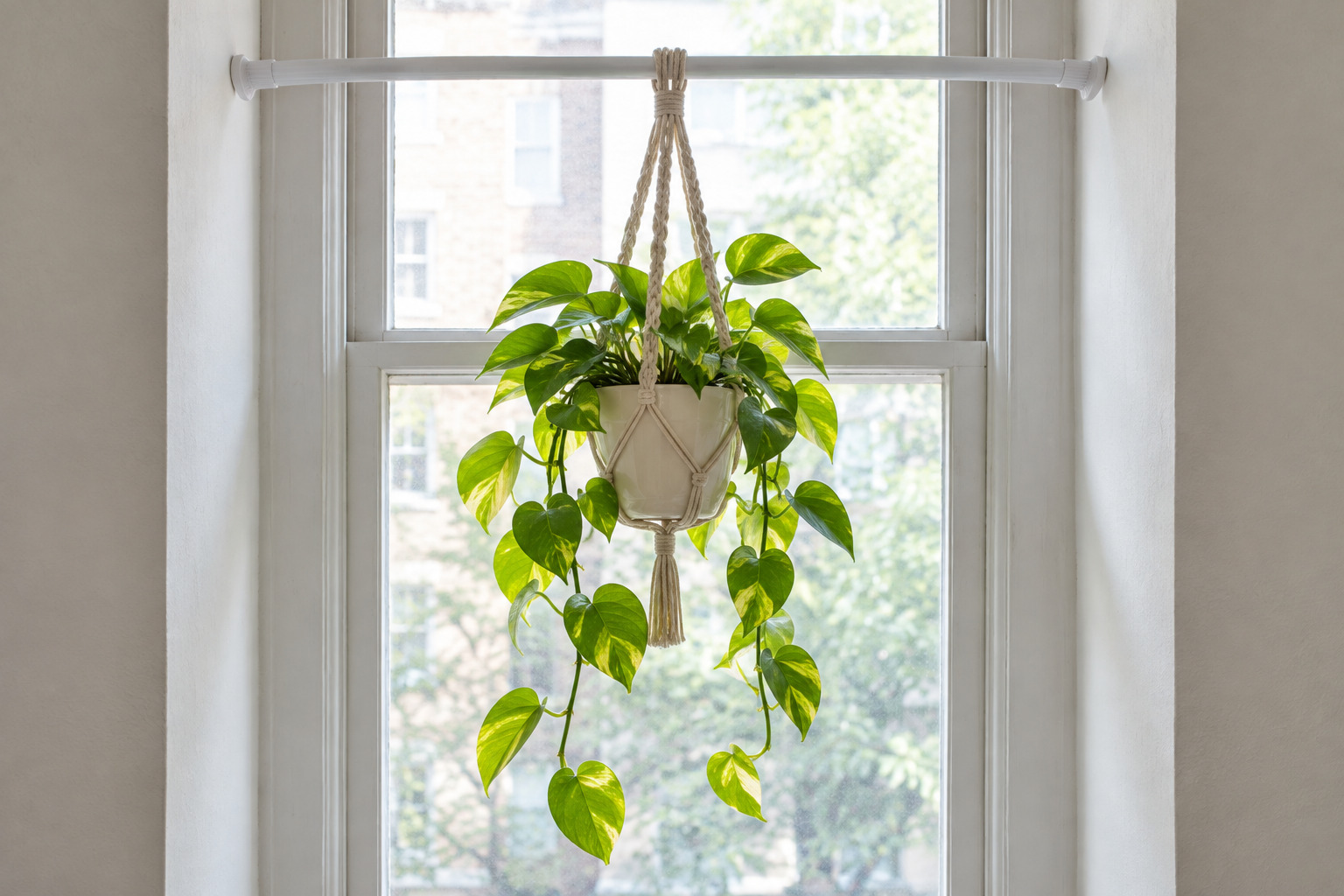
- Hang it, if the hardware is honest about its limit. Here is the arithmetic. Weigh the potted plant dry. Water it thoroughly over a sink until it drains. Weigh it again. The difference is the water it is holding, and water weighs a bit over eight pounds per gallon, so a quart is about two pounds. That wet weight is the number the hardware has to carry. Tension rods are a common renter-friendly answer for a window recess, and I am not aware of any published load rating or standard for them, so read the rating printed on the package. If there is none, treat it as decoration rather than support, and leave a margin, because a cat landing on a hanging pot is a moving load rather than a static one.
A bracket that holds a plant sitting still may not hold the same plant with a cat arriving on it, and the failure mode is your plant, your soil, and your security deposit on the floor at once. If the light in your chosen spot is the problem rather than the height, grow lights that look good in a living room solve it without turning the corner into a hardware rack.
Questions People Actually Ask
What plants are safe for cats and dogs?
From the table above, verified as non-toxic to both: cast iron plant, parlor palm, kentia palm, areca palm, calathea, prayer plant, African violet, spider plant, Boston fern, Christmas cactus, wax plant, and polka dot plant. If you want one plant and you have low light, buy the cast iron plant.
Are there pet-safe plants for low light?
Yes, and the honest list is short. Cast iron plant, parlor palm, kentia palm, calathea, and prayer plant all carry a non-toxic listing and all tolerate low to medium indoor light. A longer list of verified safe low light plants is either including unverified species or repeating an older list.
What plants are toxic to cats?
Among the common apartment plants above: golden pothos, heartleaf philodendron, Chinese evergreen, peace lily, snake plant, dracaena, aloe, jade plant, kalanchoe, begonia, and umbrella tree. The entries that matter most for cats are the true lilies, listed as toxic to cats alone. The ASPCA publishes a plant list filtered for cats as a starting point.
What is the safest houseplant for a small apartment?
The cast iron plant, if you have a pet and a dim room. It has an ASPCA non-toxic listing for cats and dogs, it takes the lowest light of anything on this page, it forgives a missed watering and a draft, and it grows slowly enough that it rarely needs repotting. The tradeoff is that slow growth, so buy it close to the size you want.
Why does the ASPCA list not have every plant?
It was never built to be complete. The ASPCA describes it as a compilation of the most frequently
encountered plants rather than an all-inclusive reference, which is why this article uses Unverified
for anything absent from it. A plant missing from a list of common plants has not been studied and
cleared. It has simply not been listed.
Sources
- ASPCA: Toxic and non-toxic plants : every safety status in this article, the exact scientific name and toxic principle for each plant, and the statement that the list is not all-inclusive and that eating any plant material may cause vomiting and GI upset.
- ASPCA: Plant list filtered for cats : the cat-only view, which is how the true lilies were separated from the plants listed for cats and dogs together.
- ASPCA Poison Control : the 24-hour hotline number (888) 426-4435 and the note that a consultation fee may apply.
- Missouri Botanical Garden Plant Finder : botanical names and cultural sheets used to confirm the species behind each ASPCA entry, including the two different plants sold as umbrella plant.
- Clemson HGIC: Indoor plants, cleaning, fertilizing, containers and light requirements : light requirement groups, which is why the spider plant is listed here as a medium light plant rather than a low light one.
- Penn State Extension: Low light houseplants : what low light actually means for a houseplant.
- University of Missouri Extension: Lighting indoor houseplants : low light ranges in foot-candles and how a room that looks bright can measure low at plant height.
- University of Minnesota Extension: Spring houseplant care : watering and drainage practice for the potted plants in this table.
What to Read Next
- Low light indoor plants that survive a dark room : the same plants ranked by how little light each one actually tolerates, for a north-facing corner.
- Narrow plant stands for apartment corners : check the dimensions when the only safe spot for a plant is a gap measured in inches.
- Plants that make an apartment feel less sterile : what to add when the room feels like a rental rather than a home.
- Grow lights that look good in a living room : if the only spot the pet cannot reach is the spot with no light.
- Indoor house plants without the clutter : keep the safe plants from taking over a small room.