
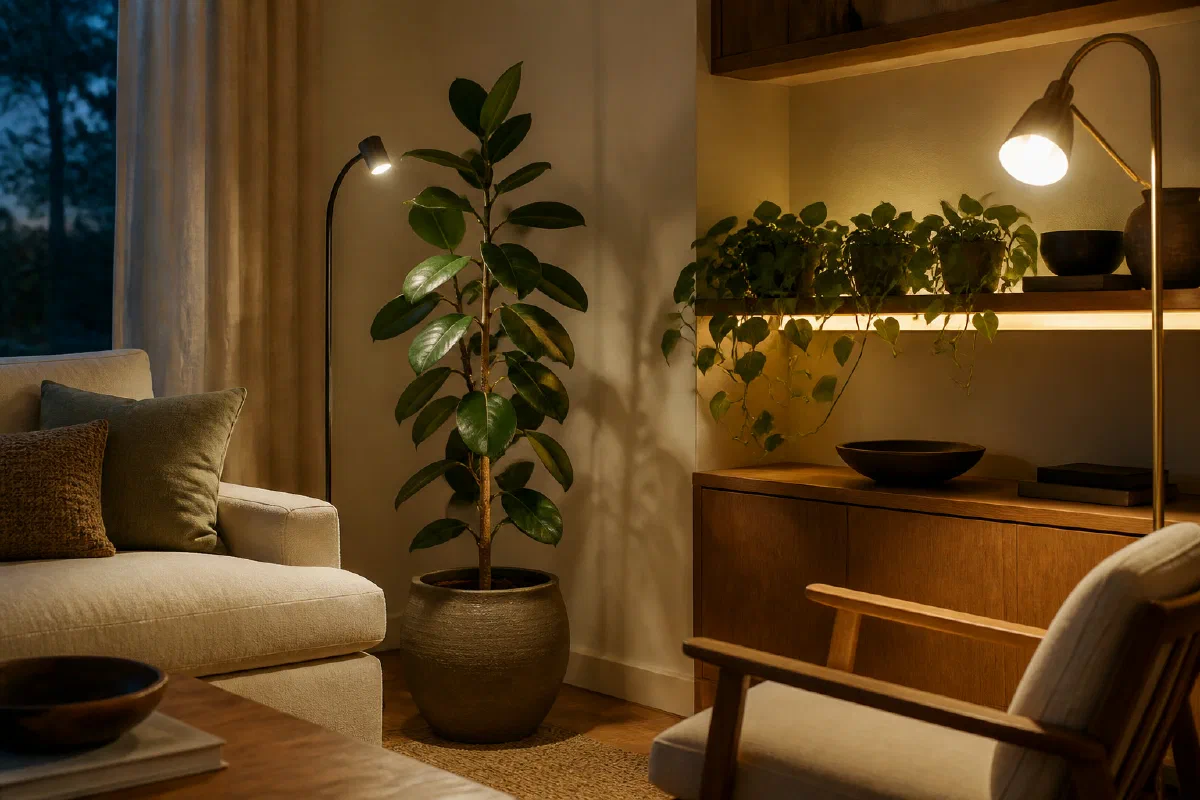
The grow light that looks best in a living room is the one whose shape fits the furniture and whose output reaches the leaves. A beautiful bulb twelve feet from a plant is room lighting. A slim lamp aimed at one rubber plant may be useful supplemental light.
Choose the fixture around the plant grouping, then check the light-to-leaf distance, coverage, heat, glare, and timer. Appearance matters because you have to live with the fixture, but the plant responds to light at the leaves.
Pick the fixture shape before the color
| Fixture type | Visual role | Best coverage | Best room use | Main compromise |
|---|---|---|---|---|
| Floor or stake lamp | Slim reading-lamp silhouette | One medium or tall plant | Empty corner beside a sofa | Visible cord and narrow beam |
| Balanced-white grow bulb | Ordinary bulb in a familiar lamp | One large plant or a small group | Open-shade floor lamp or pendant | Needs a compatible socket and shade |
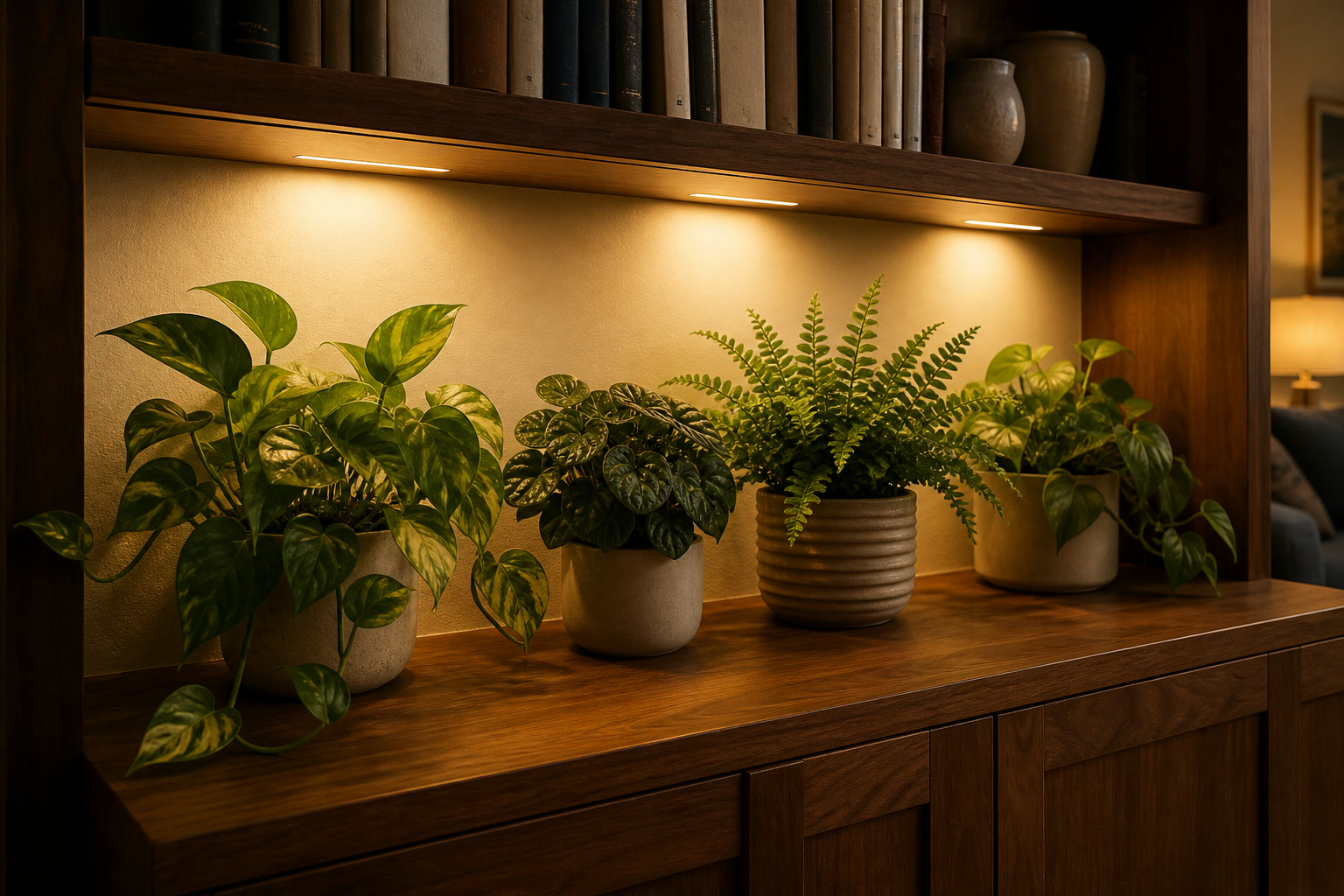
| Shelf light bars | Under-shelf task lighting | A row of small plants | Bookcase, console, or plant shelf | Installation and limited vertical clearance |
| Hanging or ceiling fixture | Broad overhead pool | A wider plant group | Dedicated plant zone | Harder to hide and aim in a rental |
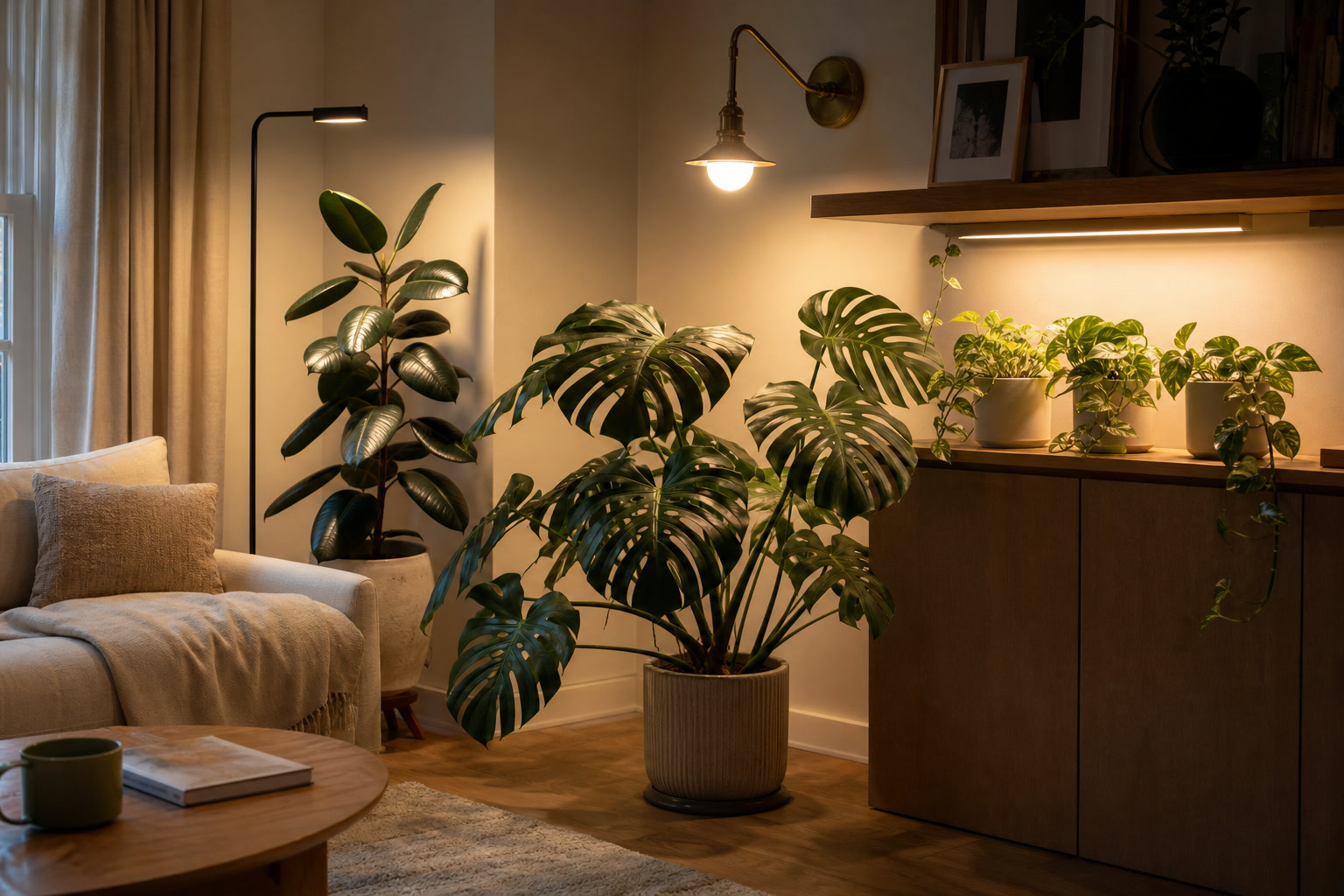
A shelf bar can work six inches above a row of small plants and miss the lower leaves of a tall bird of paradise. A flood-style bulb can cover more foliage from a floor lamp, but the bare emitter may create glare at eye level. There is no universal best format.
Check PPFD, coverage and light-to-leaf distance
The phrase “full spectrum” describes a quality of the light, not how much reaches a leaf. University of Minnesota Extension explains that light intensity changes with distance. Its general starting ranges place supplemental light about 12 to 24 inches from foliage houseplants and 6 to 12 inches from flowering houseplants. Those are starting points, not guarantees for every fixture.
Look for these details on a product page or package:
- PPF or PPFD: Prefer a measurement tied to a stated distance. PPFD describes the plant-usable light arriving at a surface; a number without distance tells you little.
- Beam shape: A narrow spot and a wide bar cover different leaf patterns. Look for a footprint or distribution map when one is provided.
- Physical clearance: Confirm the bulb fits the socket and shade, and that the fixture can sit at the needed distance without touching foliage.
- Heat and ventilation: A closed shade can trap heat or block the beam. Follow the fixture’s instructions.
- Cord and control: Place the cord away from watering, walkways, and chair legs. A timer should be accessible without moving the plant.
Watts describe energy use. Lumens describe brightness to human eyes. Neither number alone tells you whether the canopy is receiving enough plant-usable light.
Iowa State University Extension also notes that distance strongly affects daily light and that LED fixtures often need adjustment as plants grow. Narrow plant stands for apartment corners can help bring a shelf or pot into the fixture’s usable range without putting a plant in the wrong corner.
Make the light belong to the living room
Color temperature changes the room as much as the fixture. Use the plant’s needs first, then select the least distracting appearance that can do the job.
- 2700K to 3000K: warm beside table lamps and comfortable in an evening room, though foliage can look slightly golden.
- 3500K to 4000K: cleaner and more neutral, useful when the plant corner is also a reading corner.
- 5000K and above: closer to daylight or task lighting after dark and more noticeable in a soft living room.
- Red and blue fixtures: may support growth, but the purple cast can dominate the room and make foliage look unnatural.
White or balanced light is often the easiest visual match. If the lamp is in your line of sight, aim the emitter at the leaves and use a shade or shield designed for that fixture. Do not cover an LED with fabric or improvise a hot enclosure.
Match each format to a real room job
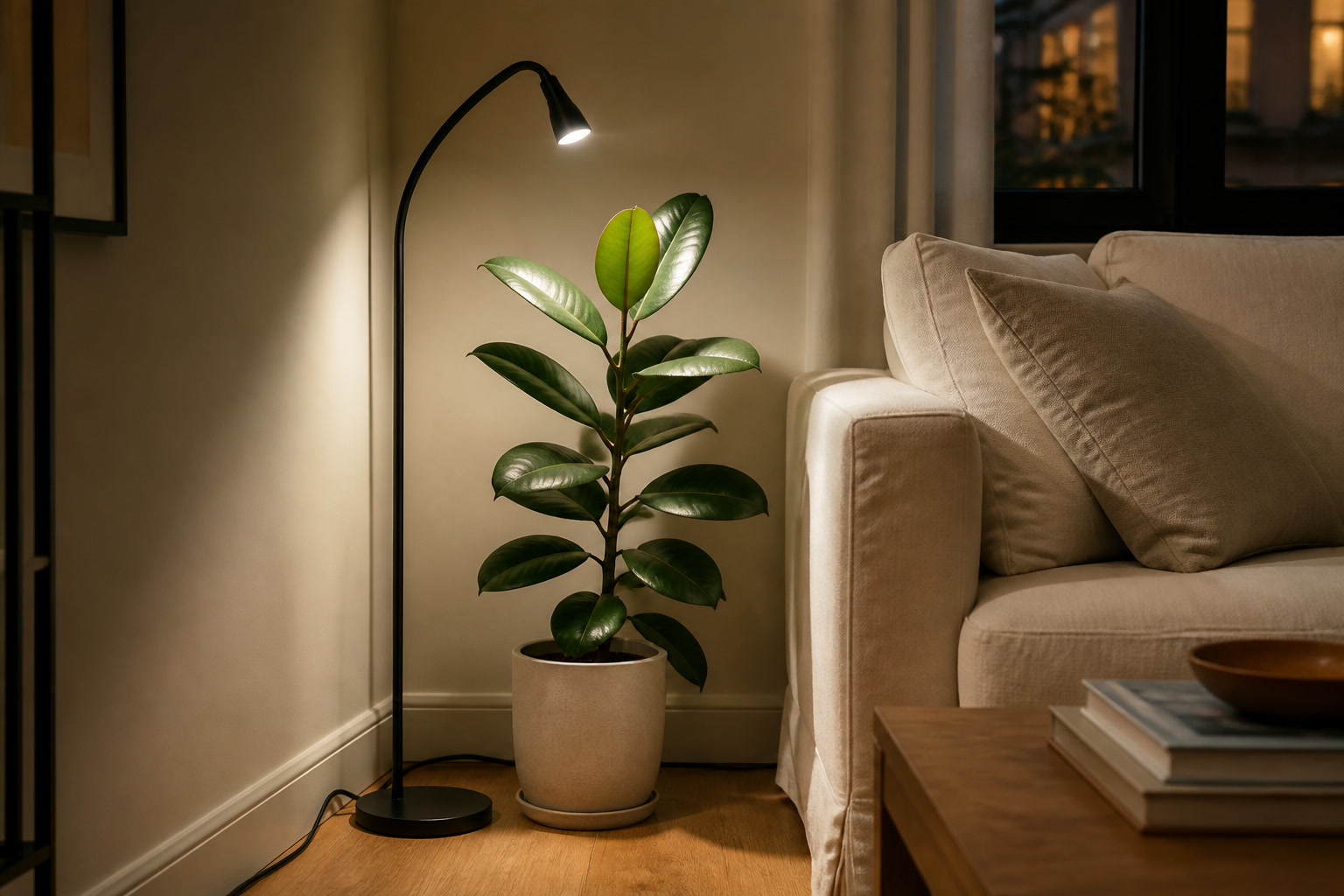
A floor or stake lamp for one tall plant
Use a floor or stake lamp when one plant occupies an open corner and needs a dedicated pool. The base still needs a clear, level spot outside the walking route. Aim the head down at the canopy rather than across the room, and measure from the emitter to the top leaves.
This format is a poor match for several plants spread across a console. The outer leaves may sit outside the beam even when the center looks bright. A flexible head is useful only when it stays in position after you adjust it.
A balanced-white bulb in a lamp you already own
This is the least conspicuous route when an existing floor lamp or pendant has the correct socket, physical clearance, and ventilation. Check the bulb shape against the shade. A large flood bulb can touch or crowd a decorative shade, and a closed shade may block useful output.
Keep the fixture where you can reach the switch or timer without leaning over wet soil. A lamp that looks ordinary still needs to point its output at the foliage, not the wall behind it.
Warm shelf bars for a row of small plants
Bars sit below a shelf and spread light across several small pots. Measure the entire leaf row, not only the center plant. Leave enough vertical space to lift each pot and to move the bars as growth reaches them.
Bars are not a substitute for a taller fixture below a floor plant. They can also create a bright line in the viewer’s eye if the shelf is beside the sofa. A front lip, shield, or a slightly recessed placement can reduce glare when the manufacturer’s instructions allow it.
Set up the timer and watch the plant
Use this placement test before attaching anything permanently:
- Put the light at the manufacturer’s starting distance and measure to the highest leaves.
- Sit in every seat you use at night. If the bare LEDs are at eye level, change the angle or location.
- Aim the beam at the canopy, not across the room or at a wall.
- Count the room’s natural light and supplemental light together. University of Minnesota Extension gives around 12 to 14 hours of total light as a winter starting point for many houseplants and recommends a dark period.
- Run the setup consistently for a week or two. Watch for continued stretching, pale new growth, scorched patches, or bleaching.
- Adjust one variable at a time: distance, angle, brightness, or schedule. Sudden large changes can stress a plant.
If a plant keeps stretching toward the window, the fixture may be too weak, too far away, too narrow for the canopy, or on for too few total hours. If leaves bleach or develop crisp patches, increase distance and check the fixture’s heat and intensity guidance. What size planter a tall indoor plant actually needs helps separate a light problem from a pot-stability problem.
Which format fits your living room?
Choose the floor or stake lamp for one medium or tall plant in an open corner.
Choose the balanced-white bulb when a lamp you already like has the right socket, angle, and ventilation.
Choose warm shelf bars for several small plants arranged on one shelf.
Choose an overhead fixture when a broad plant group needs even coverage and the installation is safe for the room.
If you cannot name the plant grouping and measure the light-to-leaf distance, pause before buying. A quiet-looking fixture in the wrong format is still the wrong grow light.
Keep the Lens and the Leaves Clean
Two surfaces stand between the fixture and the plant, and both collect dust.
The leaves are the easier half. Clemson HGIC’s indoor plant factsheet notes that dust and greasy films dull a plant’s appearance, that clean leaves are favorable to healthy growth, and that leaf-shine products are generally not recommended because the waxy residue may interfere with air exchange. Its method is a soft cloth dampened with water, wiped over the upper and lower surface of each leaf. Hairy leaves should be brushed rather than wiped, and should not get a shine product at all.
The fixture is the other half. Unplug it before you touch it, then clean the lens, diffuser, or bulb the way the manufacturer’s instructions describe. A dusty cover and a weak fixture look identical from the sofa, so wipe both surfaces before you decide a light is too dim and buy a stronger one.
FAQ
Can a normal lamp hold a grow bulb?
Only when the socket and fixture are rated for that bulb and the shade leaves the required clearance. Check the base type, physical bulb size, wattage limit, ventilation, and manufacturer’s instructions before installing it.
How far should a grow light be from a houseplant?
For many foliage houseplants, 12 to 24 inches is a useful general starting range. Flowering plants often begin closer, around 6 to 12 inches. Fixture output, plant species, acclimation, and the manufacturer’s data can change the result.
Do grow lights need to stay on all night?
No. Plants need a dark period. Use a timer and count natural and supplemental light toward the daily total. Some flowering plants respond to day length, so do not assume more evening light is always better.
Sources
- University of Minnesota Extension: lighting for indoor plants and starting seeds
- Iowa State University Extension: how to set up supplemental lights for indoor plants
- Penn State Extension: low-light houseplants
What to Read Next
- What Size Planter Does a Tall Indoor Plant Actually Need? separates root-space needs from a leaning or dimly lit canopy.
- Narrow Plant Stands for Apartment Corners helps you place a plant shelf without blocking a walkway or window.
- How to Style Tall Indoor Plants in a Living Room helps the finished light and plant setup sit naturally with the furniture.