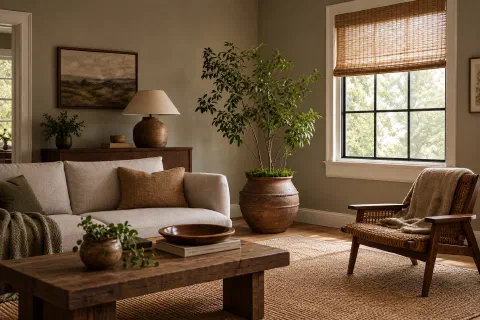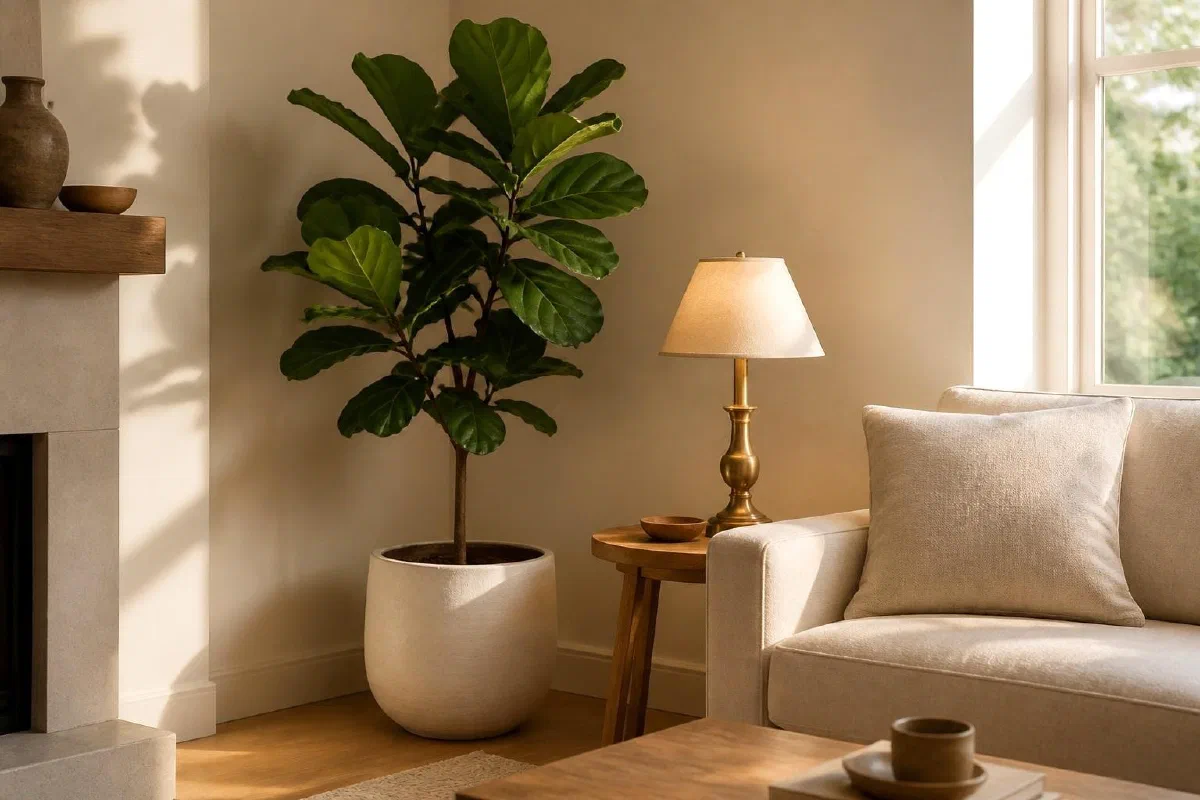
Tall indoor plants do one job in a living room better than anything you can buy: they put a vertical line in a corner that furniture cannot fix. A single six-foot plant changes the scale of the room. Three small plants spread around the same floor do not.
The plant earns that by replacing the line a piece of wall art would otherwise have to provide, and it does it with living material. The eye reads a six-foot plant differently than a six-foot canvas. The plant moves with the light. It changes through the seasons. It softens the corner.
These five rules cover where to put a tall plant, what to pair it with, how to pick the right pot, what to plant, and what maintenance to expect. Skip any one of them and the plant becomes a problem.
Fast answer: a dragon tree is the easiest narrow choice for height, a kentia palm is the softer choice for medium or lower indirect light, and a bird of paradise is the broad statement plant for a genuinely bright room. Measure the empty floor width and check the light at the leaves before buying.
| If the room has… | Start with… | Why |
|---|---|---|
| A narrow corner | Dragon tree or snake plant | Height without a wide leaf spread |
| Medium or lower indirect light | Kentia palm | Softer, taller shape than most low-light choices |
| Bright indirect light and open floor space | Bird of paradise or rubber tree | Broad leaves that can fill a large corner |
| A cat or dog that chews plants | Kentia palm or cast iron plant | Both appear on the ASPCA non-toxic list |
| Very little time for watering | ZZ plant or snake plant | The potting mix can dry well between waterings |
| A small apartment with almost no spare floor | Dragon tree, snake plant, or kentia palm | They add height without adding much footprint |
Rule 1: Pick the Corner, Not the Wall
A tall plant in a corner reads intentional. A tall plant against a wall reads stranded.
The reason is geometry. A corner has two walls supporting the plant visually. A flat wall has only one. The corner placement gives the plant a frame. The flat-wall placement makes the plant look like it is waiting for the rest of the furniture to arrive.
Look at the living room from the seated position on the sofa. Note which corner gets the least foot traffic, has the most light, and is currently empty or has a single dead piece of decor. That is the plant corner. Most living rooms have exactly one of these. A few have two.
If the room genuinely has no usable corner, the second-best placement is beside a piece of low furniture: an oak side table, a low bookshelf, or a sofa arm. The low furniture provides the visual frame that a corner would have provided.
Rule 2: Pair With One Low Piece
A tall plant needs one low piece of furniture in conversation with it.
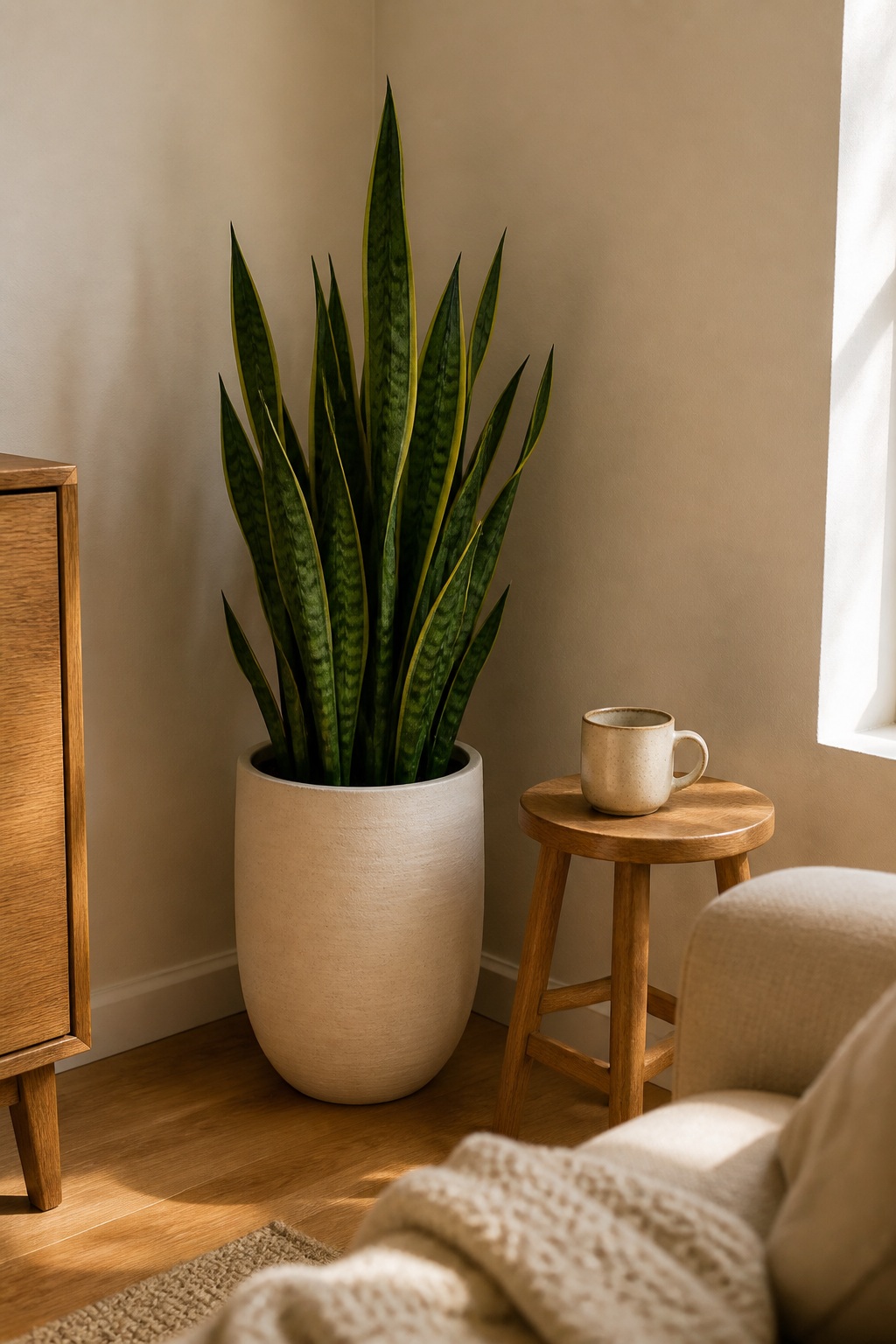
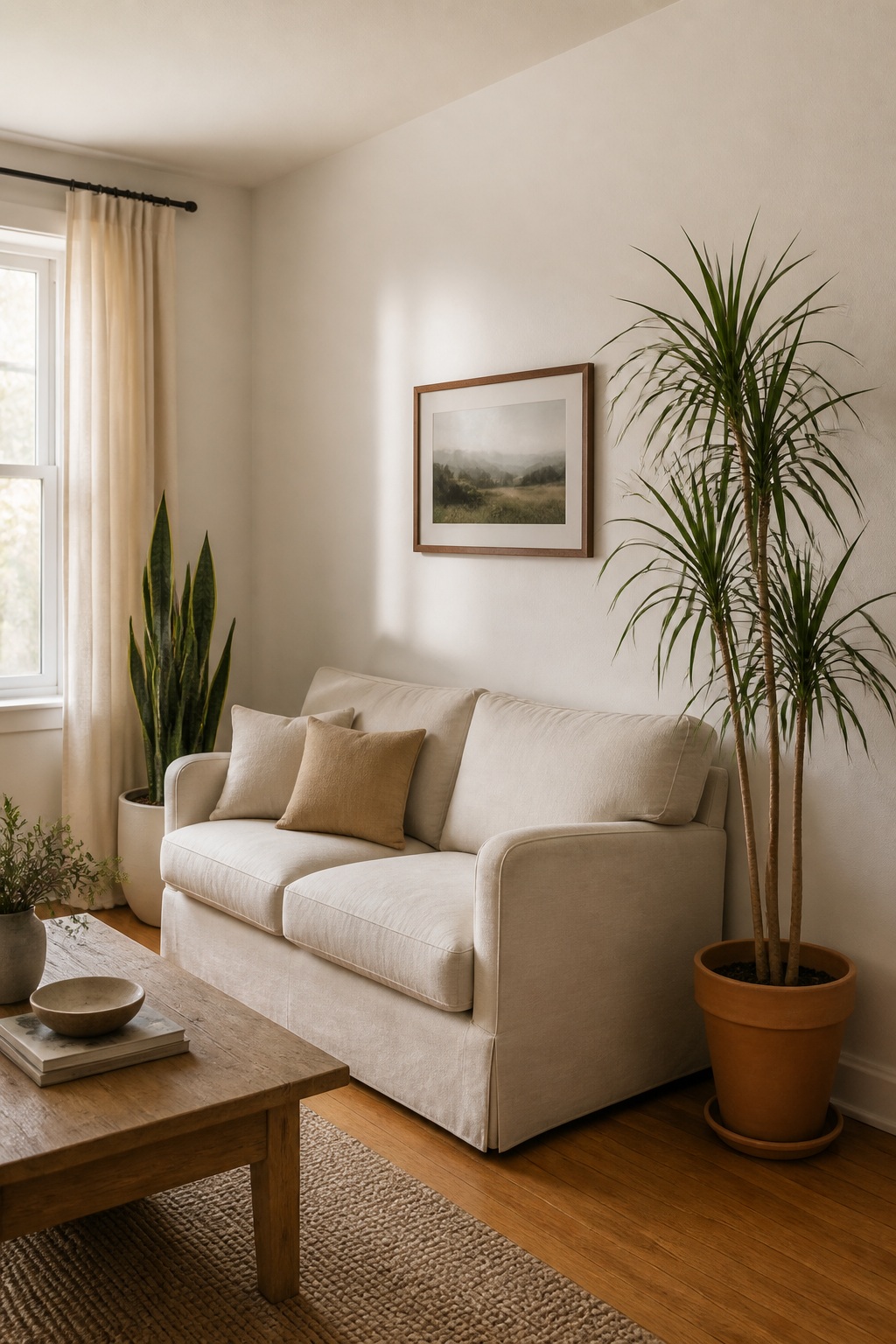
A six-foot dragon tree standing alone in a corner reads like a tree in a room. The same dragon tree beside a 24-inch oak side table reads like a styled corner. The low piece grounds the plant. It also gives the eye a place to land before going up.
The low piece should be no taller than the bottom third of the plant. For a six-foot plant, that means furniture under 24 inches. An oak stool, a small side table, a low bookshelf, or a planter base all work. Avoid anything taller, a tall console behind a tall plant flattens both.
If the corner already has a sofa arm or an armchair beside it, the low piece is already there. Skip the extra furniture and let the chair do the work.
Rule 3: Leave Breathing Room
Start with enough clearance for the leaves to spread, for you to lift the nursery pot out, and for a person to walk past without brushing the plant. Eighteen inches is a useful planning mark for a large floor plant, not a plant-health rule. A narrow snake plant may need less; a broad bird of paradise needs more.
Push the pot into the corner and the plant looks squeezed. Pull it too far into the room and it looks adrift. Set it in place, walk the route you use every day, and adjust until the plant has room without stealing the walkway.
Rule 4: Choose the Right Pot
The pot is half the design. A tall plant in a bad pot looks rented. A tall plant in the right pot looks rooted.
For warm-palette living rooms, three pot materials work:
- Cream or bone ceramic. The most versatile. Reads sophisticated, works with any warm palette, and does not fight the green of the plant.
- Terracotta clay. The most lived-in. Best for warm-toned rooms with oak floors. Develops a patina over years that ceramic never does.
- Natural rattan or seagrass basket. Best for casual cottage-style rooms. The texture adds warmth. Hide the plastic nursery pot inside the basket, do not transplant.
Avoid: black plastic, gloss white plastic, anything described as “modern minimalist concrete,” and any pot smaller in diameter than the plant’s nursery pot.
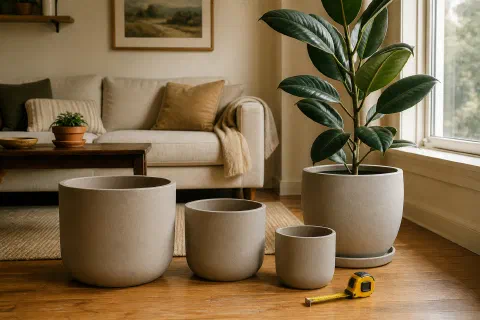
Choose the inner growing pot by the root ball, not by the height of the leaves. If the plant is root-bound, move up only one pot size and keep drainage holes; Penn State Extension advises a slightly larger container rather than an oversized one . For a fuller look, place that correctly sized nursery pot inside a larger decorative basket or cachepot. Take it out to water and empty any collected water before returning it.
Rule 5: Match Light and Maintenance to the Plant
The most carefully placed tall plant will struggle if its light and watering needs do not match the room. The University of Minnesota Extension recommends letting the plant and soil guide watering rather than following a fixed calendar. Brighter spots often dry faster; dim spots stay wet longer.
Use the table below as a comparison, not a promise. The watering intervals are starting points for an average heated room. Check the soil before watering, then adjust for pot size, season, light, and the plant’s growth.
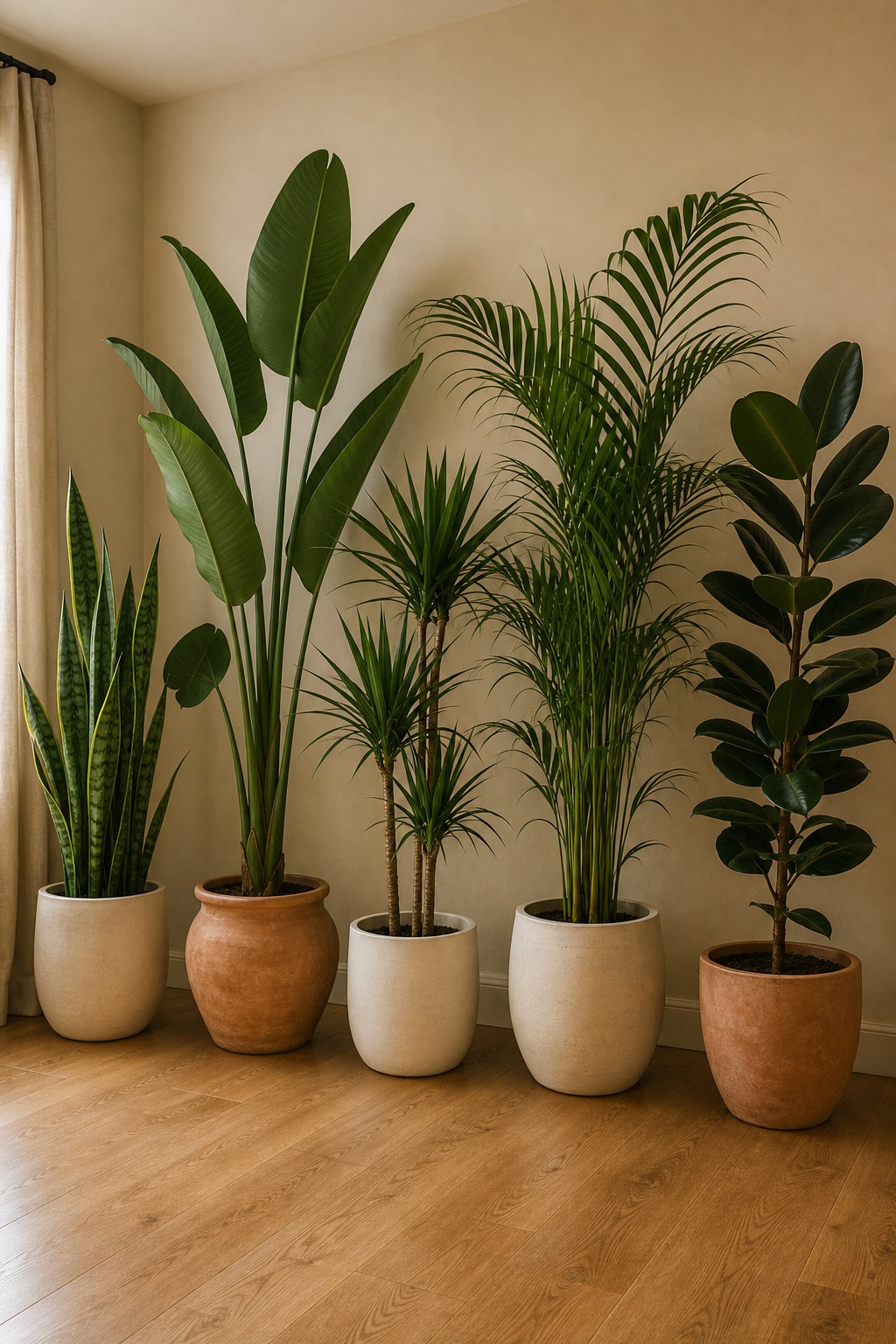
The five practical starting points for a living room are:
- Snake plant (Dracaena trifasciata, formerly Sansevieria trifasciata) for a narrow corner and a missed watering now and then.
- Bird of paradise (Strelitzia nicolai) when the room has bright indirect light and space for broad leaves.
- Dragon tree (Dracaena marginata) when you need height without much floor spread.
- Kentia palm (Howea forsteriana) when you want soft fronds in medium or lower indirect light.
- Rubber tree (Ficus elastica) when a bright room can support broad, glossy leaves.
The fiddle leaf fig (Ficus lyrata) needs a steadier position than many beginners expect. If the room has changing light, drafts, or a difficult watering routine, the table offers less demanding choices.
Best Tall Indoor Plants for a Living Room, Compared
Those five are the safe bets. Here is the wider field, including the four people ask about most, with the numbers that decide whether a plant fits your room instead of someone else’s.
| Plant | Mature indoor height | Light | Watering cue | Pet-safe | Difficulty |
|---|---|---|---|---|---|
| Snake plant, or mother-in-law’s tongue (Dracaena trifasciata) | 3 to 4 ft | Low to bright indirect | Let mix dry well | No | Easiest |
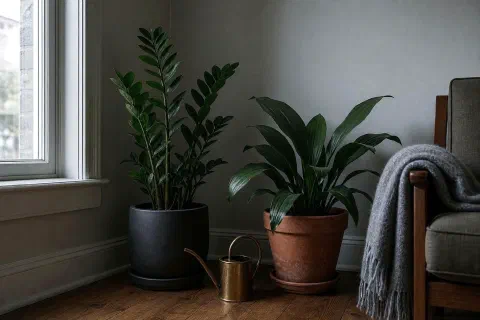
| ZZ plant (Zamioculcas zamiifolia) | 2 to 4 ft | Low to bright indirect | Let mix dry well | Unverified | Easiest |
| Kentia palm (Howea forsteriana) | 6 to 10 ft, slowly | Low to medium indirect | Top inch dry | Yes | Easy |
| Dragon tree (Dracaena marginata) | About 6 ft | Low to bright indirect | Top inch or two dry | No | Easy |
| Rubber tree (Ficus elastica) | 2 to 10 ft, by training | Medium to bright indirect | Top inch or two dry | Unverified | Easy |
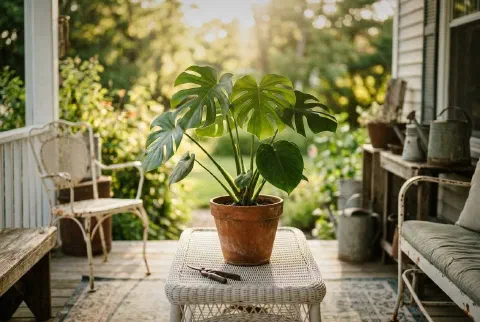
| Monstera (Monstera deliciosa) | 6 to 8 ft on a pole | Bright indirect | Top two inches dry | No | Moderate |
| Bird of paradise (Strelitzia nicolai) | 6 to 8 ft | Bright, an hour or two of direct sun | Check soil before watering | Unverified | Moderate |
| Fiddle leaf fig (Ficus lyrata) | 2 to 10 ft | Bright, with direct morning sun | Check soil before watering | Unverified | Hard |
| Olive tree (Olea europaea) | 5 to 6 ft in a pot | Six or more hours of direct sun | Check soil before watering | Unverified | Hard indoors |
Those heights are planning ranges for a potted plant in a home, not a guarantee. Nursery stock can be smaller, and light, pruning, pot size, and growing conditions change the result. Where a plant has a reliable published indoor figure, that is the one used here. The rubber tree and the fiddle leaf fig are the clearest examples: both are trees that reach 50 feet or more in the ground in a tropical climate, and both are usually kept between two and ten feet indoors depending on how they are pruned and trained. Lists that print the outdoor number are describing a different plant than the one in your living room.
A snake plant sold as a floor plant is usually three feet and stays there for years. If the corner needs a true six-foot vertical line, the honest choices are a dragon tree, a kentia palm, a rubber tree, or a bird of paradise.
The watering column assumes an average heated room and is a starting point, not a calendar. Check the soil before watering, especially in winter or in a dim corner. Pet safety follows the ASPCA toxic and non-toxic plant list , which is worth checking yourself before anything new comes through the door. A plant that is not on that list reads as unverified here rather than safe.
What Actually Works in a Living Room Corner
Corners are darker than the rest of the room, which is the part most plant lists skip. Stand in the corner at midday and look back toward the window. If you cannot see sky from there, you are choosing from the low-light group whatever the tag on the pot says. The dark-room plant guide compares that shorter list by measured light, mature size, watering cue, and pet safety.
- A dim corner, more than eight feet from the window. Kentia palm, ZZ plant, snake plant, or a dragon tree. The kentia is the one that still reads as a statement plant in that light.
- A bright corner, within six feet of a south or west window. Rubber tree, bird of paradise, or a monstera on a pole. This is the only kind of corner where a fiddle leaf fig has a chance.
- A tight corner with a walking path beside it. Snake plant or dragon tree, both of which go up without going out.
- A small apartment where the floor is already spoken for. Dragon tree or snake plant narrow enough to sit beside a sofa arm, or a kentia palm when the only window is a dim one.
Measure the floor before you buy, not the ceiling. Rule 3 asks for 18 inches of clearance on the corner sides, and Rule 4 puts a six-foot plant in a pot around 20 inches across. That is closer to a yard of floor than the nursery pot suggests. In a studio or a small one-bedroom, that yard is the whole reason the planter size question matters before the plant comes home rather than after.
How Many Tall Plants Belong in One Room
For most living rooms, the answer is one.
A single tall plant in a corner does the job. A second tall plant in the opposite corner can work in larger rooms, but only if the two plants are visually different, one upright and narrow (snake plant, dragon tree), the other broad and spreading (bird of paradise, kentia palm). Two plants of the same shape in the same room read repetitive.
A third tall plant is almost always too many. The room starts to read as a plant store.
If the room can support multiple plants, the better move is one tall plant plus one trailing plant on a shelf and one small plant on the coffee table. Three plants of different heights and habits feel layered. Three plants all six feet tall feel cluttered.
Narrow Tall Indoor Plants for a Small Apartment
A small apartment changes the question from “how tall” to “how wide.” A bird of paradise is a beautiful answer to a bare corner in a house and a poor one in a 500 square foot studio, because its leaves reach out at the same height a person walks past.
The plants below add height without claiming much floor. They are the ones that pass the walkway test in Rule 3.
| Plant | Footprint | Why it fits a small room |
|---|---|---|
| Snake plant | A single narrow footprint, roughly a foot across | Leaves go straight up, so nothing overhangs the path |
| Dragon tree | A slim trunk with a crown near the top | Height with almost nothing at floor level |
| ZZ plant | Compact and upright, wider than a snake plant, far narrower than a ficus | Slow, so it stays the size you bought |
| Kentia palm | A frond spread, but a single central trunk | The one that still reads as a statement in dim light |
| Rubber tree | Moderate, and it wants space to look right | Worth it only if the corner is genuinely open |
What to skip in a small room: fiddle leaf fig and olive tree, both of which need more light than an apartment corner gives and both of which end up as a plant you move every time you vacuum. A monstera also belongs only where the pole and the vine have somewhere to go, which is rarely the corner itself.
Two placement notes that matter more in a small room than a large one:
- Keep the pot narrower than the plant. A pot that is visually wider than the leaves makes the corner read as a container, and it eats floor you do not have. Rule 4’s one-third rule is a starting point; in a small room, err toward the smaller end of it.
- Put it where a chair would have gone. A corner that is too small for seating is often exactly the right size for one tall plant, which is the trade that makes a studio feel finished instead of crowded.
If the room cannot spare floor at all, the honest move is up rather than out. A plant on a stable stand beside a low piece gives you the same vertical line with a fraction of the footprint, and the narrow plant stands for apartment corners comparison covers the width that actually fits.
Which Tall Indoor Plants Are Pet-Safe for Cats and Dogs?
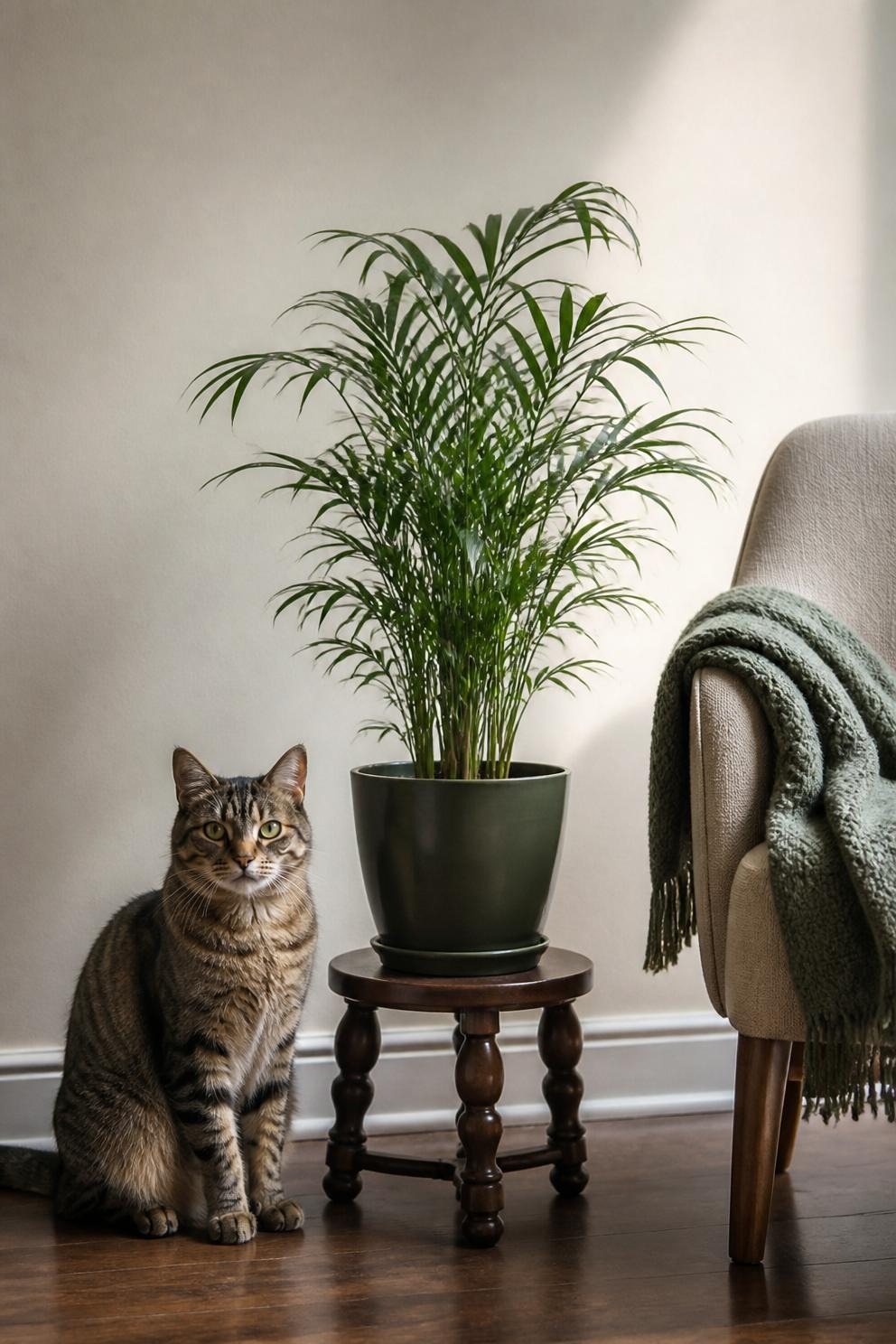
Four tall plants on this page are listed as non-toxic to cats and dogs by the ASPCA: kentia palm, parlor palm, areca palm, and cast iron plant. The rest are toxic or absent from the list, so a pet that chews narrows the shortlist fast.
Check the ASPCA toxic and non-toxic plant list before you choose the pot, not after the leaves are in reach. It is searchable by exact common and scientific name.
| Plant | Safe around pets |
|---|---|
| Kentia, parlor, and areca palm | Listed as non-toxic by ASPCA |
| Cast iron plant | Listed as non-toxic by ASPCA |
| Olive tree (Olea europaea) | Not in the ASPCA database, so treat it as unverified |
| Monstera (Monstera deliciosa) | No, toxic to cats and dogs |
| Bird of paradise (Strelitzia nicolai) | Not in the ASPCA database, so treat it as unverified |
| Rubber tree (Ficus elastica) | Not in the ASPCA database, so treat it as unverified |
| ZZ plant (Zamioculcas zamiifolia) | Not in the ASPCA database, so treat it as unverified |
| Snake plant (Dracaena trifasciata) | No, toxic to cats and dogs |
| Dragon tree (Dracaena marginata) | No, toxic to cats and dogs |
| Weeping fig (Ficus benjamina) | No, toxic to cats and dogs |
That table is narrower than most pet-safety tables, and the reason is worth knowing. The ASPCA list is not all-inclusive, so the correct answer for a plant that is absent from it is “unverified,” not “safe.” Four plants on this page fall into that gap, including two as common as the bird of paradise and the rubber tree. The rubber tree is the clearest trap: the ASPCA entry named “Indian Rubber Plant” is Ficus benjamina, a different species from the Ficus elastica most people mean, so the rubber tree’s status gets borrowed from a plant it is not.
The monstera is the opposite trap, and it catches people searching the database directly. There is no page filed under monstera deliciosa, so a quick lookup reads as “not listed.” But the ASPCA carries Monstera deliciosa under two other common names, Swiss Cheese Plant and Cutleaf Philodendron, and both list it as toxic to cats and dogs with insoluble calcium oxalates. Checking a scientific name alone is not enough to clear a plant.
ASPCA lists different toxic principles and symptoms by plant. Treat the table as a screening step, not a substitute for checking the exact cultivar or calling a veterinarian after an ingestion. A chewer narrows the shortlist quickly, which is why a verified non-toxic palm or cast iron plant may be the easier choice.
What to Do When the Plant Outgrows the Corner
Tall houseplants do grow. A six-foot bird of paradise can become a nine-foot bird of paradise in three years if it likes the room. The corner gets crowded. The leaves start hitting the ceiling.
Three options when the plant outgrows the corner:
- Prune only when the species supports it. A cane-forming dracaena and a branching rubber tree respond differently from a palm, so use instructions for the exact plant rather than cutting every tall houseplant back the same way.
- Divide or propagate when that plant allows it. Snake plants can be divided; a single-trunk indoor tree cannot simply be split. This is often safer than trying to force a large root ball into a smaller pot.
- Move and replace. Move the plant to a higher-ceiling room and replace it in the original corner with a smaller version of the same species. This is the cleanest answer when pruning would ruin the plant’s shape.
Where to Buy a Tall Indoor Plant
Buy the living plant where you can inspect it. A local nursery or garden center lets you check leaf undersides, stems, soil moisture, pot stability, and the actual width before committing. Online listings are useful for unusual varieties, but a stated height often includes the nursery pot and does not tell you whether the plant is narrow enough for the corner.
Take three numbers with you: the empty floor width, the distance from the corner to the nearest window, and the tallest plant height the ceiling allows after adding the decorative pot. That turns “where to buy tall indoor plants” into a fit decision instead of a search for the biggest listing.
What to Buy After the Plant
Do not buy a styling bundle before the plant is in the room. These two accessories solve distinct problems. Check the current listing details and recent reviews before ordering, since availability and product specifications can change.
FAQ
What is the easiest tall houseplant for a beginner?
The ZZ plant, with the snake plant a close second. Both tolerate lower light and a missed watering when the soil is allowed to dry between waterings. The snake plant stays narrower, which makes it easier to fit into a tight corner. The snake plant is toxic to cats and dogs, and the ZZ plant is not in the ASPCA database at all, so keep both out of reach of a pet that chews.
How tall should an indoor plant be in a living room?
For most rooms with eight-foot ceilings, a five to six foot plant is the sweet spot. Taller than that starts to crowd standard ceilings. Shorter than that loses the vertical line that makes a tall plant work.
Do tall indoor plants need direct sunlight?
Most do not. Bird of paradise prefers bright indirect light, while snake plant, ZZ plant, kentia palm, and dragon tree tolerate lower indoor light. Among the plants in this article, fiddle leaf fig and olive tree have the strongest direct-light demand, so they are poor choices for a dim corner.
Can a tall indoor plant remove mold or clean the air?
Do not buy a houseplant as mold treatment or as a replacement for ventilation and filtration. A review of chamber studies found that ordinary potted plants remove volatile organic compounds far too slowly to compete with normal air exchange in a real building. The peer-reviewed review is available through the Journal of Exposure Science & Environmental Epidemiology . For mold, the EPA says to fix the moisture source and clean up the mold . A plant can make the room feel better; it is not an air-cleaning appliance.
The percentages you see quoted, like a plant removing most of a pollutant, come from sealed laboratory chambers. Scale that to a room and the numbers collapse: the same review calculated you would need close to ten plants per square foot before potted plants cleaned the air at anywhere near the rate ordinary ventilation already does. That is the part the roundups leave out, and it is why no tall plant in this article is recommended for air quality. Choose it because it fills the corner well.
Which tall indoor plants are easiest to keep alive?
Start with a ZZ plant, snake plant, or dragon tree when the goal is forgiving care. A kentia palm tolerates less light than many statement plants but still needs more consistent watering. Bird of paradise, fiddle leaf fig, and an indoor olive tree need brighter conditions and leave less room for guesswork.
Sources
- NC State Extension Plant Toolbox : published indoor height and cultural notes for the rubber tree, fiddle leaf fig, and dragon tree, plus the current Dracaena trifasciata name.
- University of Minnesota Extension: Spring houseplant care : use soil and plant conditions to guide watering.
- University of Missouri Extension: Lighting indoor houseplants : compare low, medium, and high indoor-light ranges.
- Clemson HGIC: Indoor plants, cleaning, fertilizing, containers and light requirements : species-level foot-candle bands and container guidance.
- ASPCA: Toxic and non-toxic plants : verify pet safety by exact plant name. Plants absent from the list read as unverified here, not safe.
- Harvard University, Sustainability: House plants don’t really clean indoor air : explains why sealed-chamber plant studies do not scale to a room, and gives the ten-plants-per-square-foot figure used above.
What to Read Next
- Living Room Plants for a Calmer Home helps you mix one floor plant with smaller plants without crowding the room.
- What Size Planter Does a Tall Indoor Plant Need? settles the pot decision before the plant comes home.
- Living Room Plant Ideas for Empty Corners works through the corner decision when the room has more than one blank spot.
- Indoor House Plants Without the Clutter keeps a small room from filling up around the tall plant.
- Narrow Plant Stands for Apartment Corners covers the stand that gives you height without spending floor space.