Pick up a bag of winter bird food and turn it over. The ingredient list on a lot of the cheap mixes reads like a grain elevator inventory: sorghum, wheat, hulled oats, cracked corn, and somewhere near the bottom, sunflower.
Most of that is not food, at least not to the birds standing on your feeder. They flick it onto the snow hunting for the sunflower, and you spend February sweeping up grain nothing ate.
The practice side of winter feeding, cleaning, placement, dependence, is its own subject. This one is about the bag: what each seed is, which species take it, and how to tell food from padding at the shelf.
The Short Answer: Which Winter Bird Seed to Buy First
If you buy one bag, buy black oil sunflower.
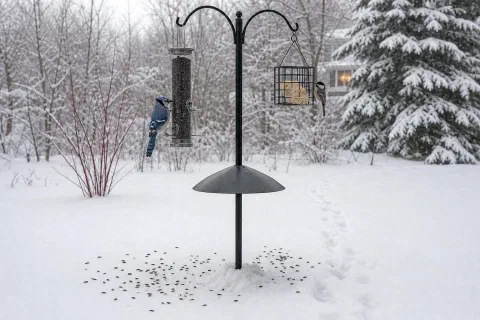
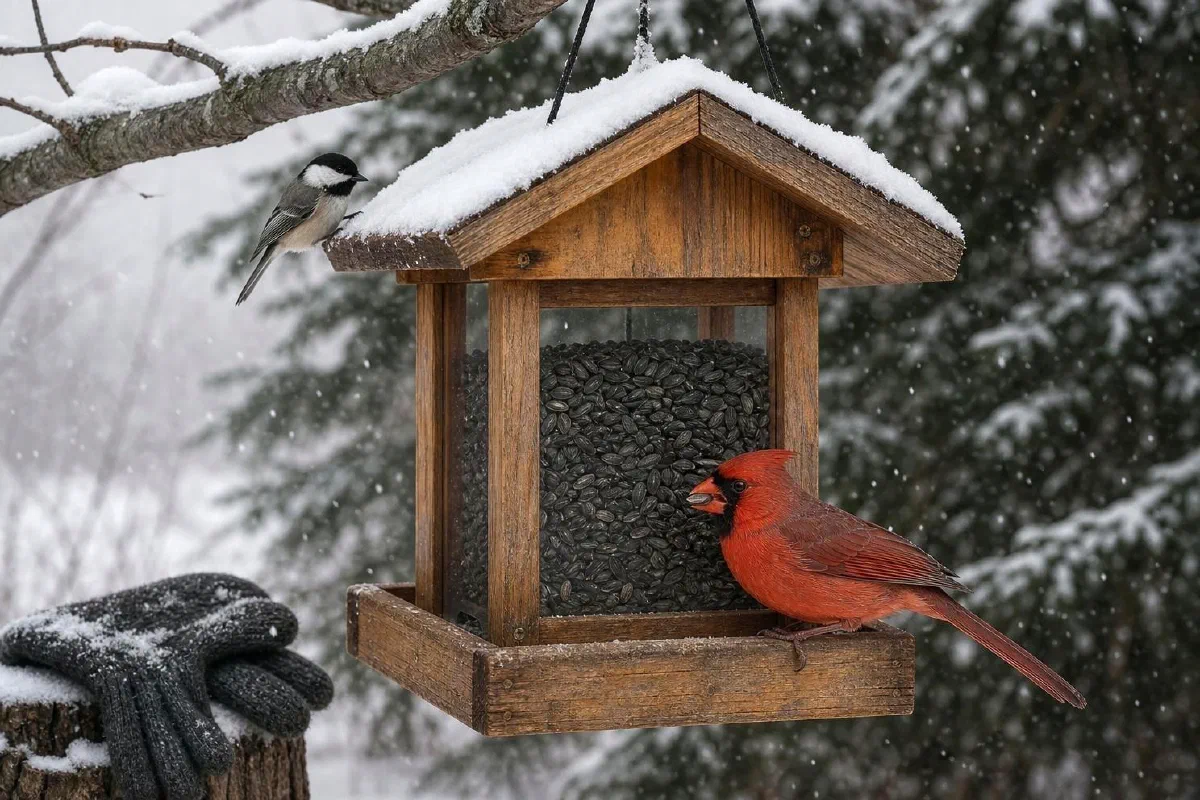
Cornell Lab’s Project FeederWatch calls it the most common seed offered at feeders in North America and puts cardinals, chickadees, finches and sparrows on it, with woodpeckers turning up on occasion. Nebraska Extension is blunter: small black oil-type sunflower seeds are the most widely preferred bird seed, with high energy content and thin shells that smaller birds can open.
The whole starter kit, in order:
- One bag. Black oil sunflower, in a tube or hopper feeder.
- Two bags. Add suet in a wire cage. In a hard freeze it does more per ounce than anything else you can hang.
- Three. Add white proso millet on a low tray, for the birds that will not use a hanging feeder at all.
Everything below is how to spend past that without wasting money.
| Seed | Who takes it in winter | Where it works | What to watch |
|---|---|---|---|
| Black oil sunflower | Northern cardinal, black-capped chickadee, tufted titmouse, finches, sparrows | Tube or hopper | Shells pile up underneath |
| Striped sunflower | Blue jays, northern cardinal, grosbeaks | Hopper or platform | Shell too thick for small birds |
| Hulled sunflower chips | Anything that eats sunflower, and faster | Covered tube or tray | Spoils quicker than seed in the shell |
| Safflower | Northern cardinal, chickadees, finches, nuthatches, doves | Hopper or tray | Most birds still prefer sunflower |
| Nyjer | American goldfinch, pine siskin, common redpoll | Fine-port finch feeder, on its own | Goes stale in a few months |
| White proso millet | Dark-eyed junco, sparrows, mourning doves | Ground or low tray | Also draws house sparrows and cowbirds |
| Cracked corn | Mourning doves, quail, sparrows | Ground or platform, small scoops | Molds fast once wet |
| Milo (sorghum) | Very few birds in the East | Not worth paying for | The main padding in cheap mixes |
| Shelled peanuts | Black-capped chickadee, nuthatches, tufted titmouse, blue jays | Mesh peanut feeder | Never salted or flavored |
| Suet | Downy woodpecker, nuthatches, wrens, titmice, cardinals | Wire cage | Cold season food, not summer |
Sunflower Comparison: Black Oil, Striped Sunflower, and Chips
Three things sold under one word, and the difference is the shell.
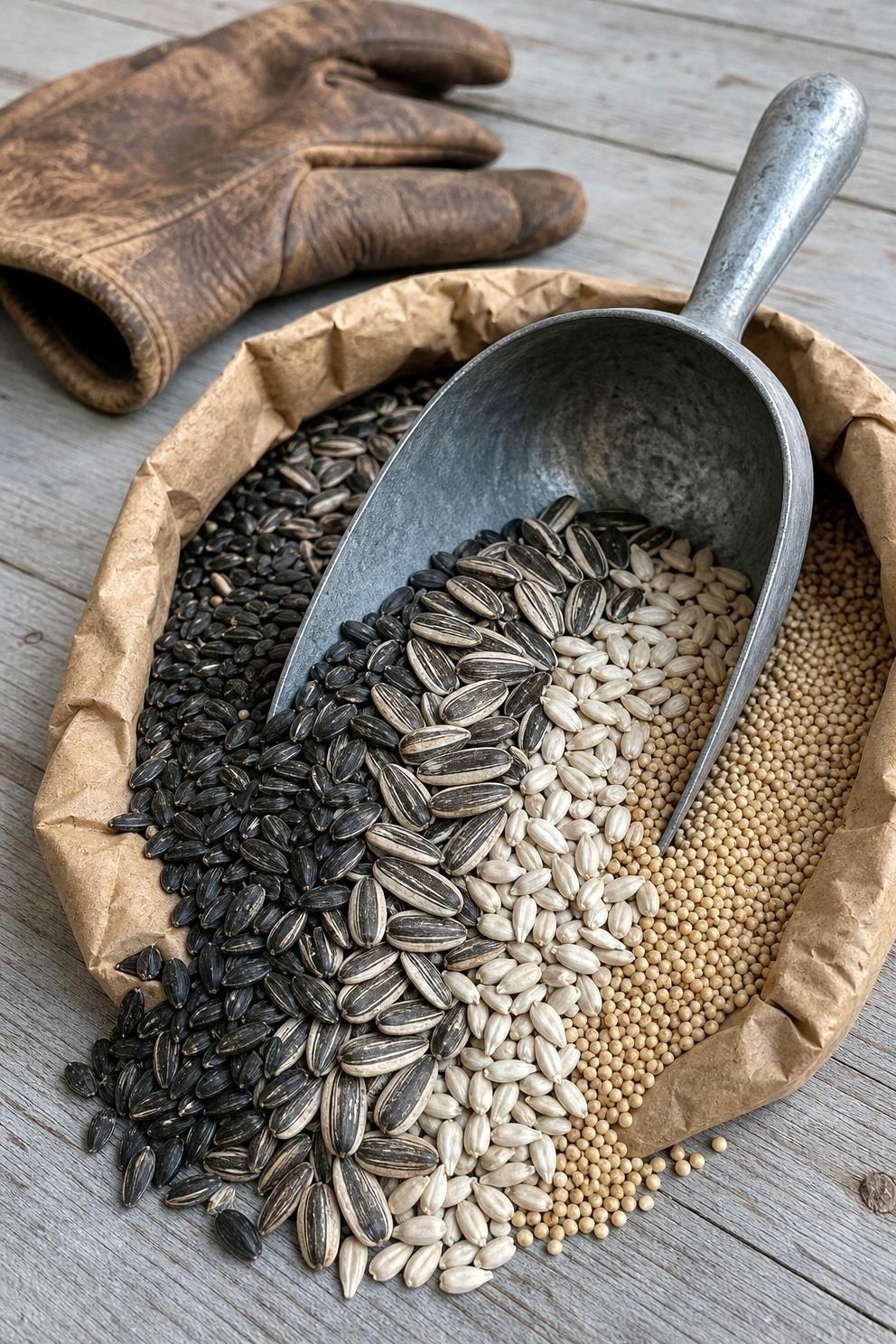
Black oil sunflower is the small black one. Penn State Extension calls it the best all-round choice, preferred by chickadees, nuthatches and titmice for its high oil content and thin seed coats. Thin is the operative word. A black-capped chickadee carries one seed to a branch, pins it under a foot and hammers it, and a bird that light can only do that if the shell gives.
Striped sunflower is the bigger gray-and-white striped seed. Same page: very popular with blue jays and cardinals, but difficult for many smaller species to crack open. Fine on a second feeder, poor as a default, because in a cold snap it locks out the birds with the least reserve.
Hulled sunflower, sold as chips or hearts, is the kernel with the shell already off. FeederWatch notes that anything eating regular sunflower will take it and many species prefer it. No shell means no mess under the feeder, and no armor: FeederWatch warns to keep chips dry because they spoil faster than seed in the shell. Buy small amounts, use a feeder with a real roof.
Safflower, and Whether Squirrels Really Avoid It
Safflower looks like a small white sunflower seed. Project FeederWatch says it draws cardinals and other big-billed birds, then adds the honest part: in their experience, most birds prefer sunflower to safflower.
People buy it anyway for the pest claim. Nebraska Extension words it carefully, and the wording is worth reading exactly. Safflower is used increasingly, with reports that cardinals, chickadees, finches, nuthatches and doves consume it, but that it is less attractive to grackles, starlings, house sparrows and squirrels.
Less attractive. Not a wall. Safflower is a preference nudge, and preferences bend when an animal is hungry enough. Run it on a second feeder and see whether it holds in your yard. If squirrels are the real trouble, hardware beats groceries, and a baffle plus honest distance in a squirrel-resistant feeder setup beats any bag of seed.
Nyjer Goes Dead Before It Looks Old
Nyjer is the tiny black seed sold for finches, often labeled thistle even though it is not a thistle. Audubon identifies the plant as Guizotia abyssinica, grown mostly in India and Ethiopia, and puts the seed at 30 to 40 percent oil, on par with black oil sunflower. Imported seed is heat sterilized under a USDA rule dating to the 1980s, and only four facilities worldwide are licensed to do it.
That oil is the point, and it is also the problem. Nebraska Extension notes nyjer is highly attractive to finches when fresh but may be rejected when the seed is several months old. Nothing visible changes. The bag looks the same, the birds stop coming, and people blame the feeder.
Two habits fix it:
- Buy the smallest bag you will finish in a few weeks, not the value sack.
- Feed nyjer by itself in a fine-port finch feeder rather than in a mix, which is what FeederWatch recommends. In a general mix it pours through the ports and lands in the mud.
Your customers are American goldfinches, drab olive-brown in winter, plus pine siskins and common redpolls in irruption years.
White Proso Millet and the Birds That Feed on the Ground
Millet is not a lesser sunflower. It is a different feeder entirely, aimed at birds that will not use your tube.
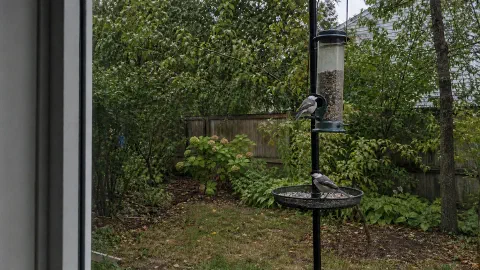
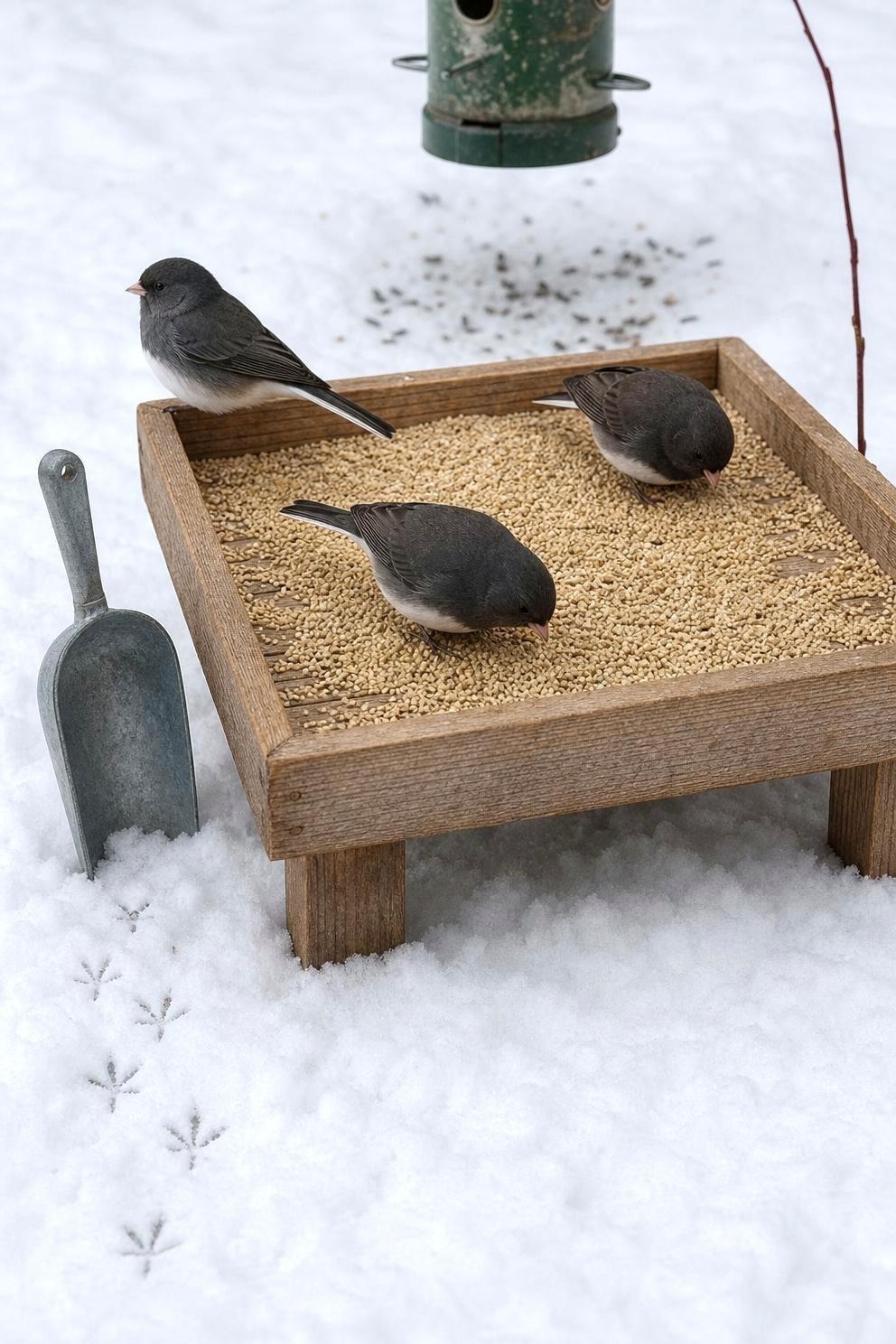
Project FeederWatch describes millet as a favored food of many smaller ground-foraging birds, and says a handful sprinkled on the ground keeps juncos and sparrows happy. The same guide is direct that many species, including sparrows and doves, prefer large flat surfaces and may not visit an elevated feeder at all. Song sparrows, fox sparrows and towhees work the ground beneath rather than the feeder itself. The dark-eyed junco is the one most people meet first: slate gray above, white belly, white outer tail feathers that flash when it flushes, and it wants seed at boot level.
Two cautions. Penn State notes white proso millet is cheap and attracts many species, but also less desirable ones such as house sparrows and brown-headed cowbirds. And seed on bare ground gets wet, so use a low tray with drainage or a paver you can sweep. If you want more of that ground crowd, what you plant around the feeder does more than another scoop.
Milo, Wheat, and the Filler Problem in Cheap Mixes
Here is where the money goes.
Project FeederWatch describes milo as a reddish round grain that is often a major component of inexpensive seed mixes, notes it is not a favorite of most birds and often goes to waste, and advises avoiding mixes with large amounts of milo in the East. Penn State lists the rest of the padding by name: wheat, milo, hulled oats, rice and rye seed, all of which it calls not attractive to birds. Nebraska Extension adds that packaged mixes often contain large amounts of filler seeds birds do not prefer, and that the seed may not be as fresh as you would like either.
None of this is new. Audubon traces it to Aelred Geis, whose 1970s work for the Fish and Wildlife Service tested what birds actually chose, and to David Horn’s later Project Wildbird study of 1.2 million feeder visits. Milo, wheat, hulled oats and rice come out as the losers. Fifty years of data, and the same grains are still in the bag.
Rejected grain also hits the ground and turns the patch under your feeder to mush, which is one of the quiet reasons a station stops working, alongside the more familiar feeder placement mistakes. And one label trap: a mix may simply say millet. White proso is the type the research names. If the bag will not say which, treat the ingredient list as unverified.
Cracked Corn: The Mistake That Molds Fastest
Cracked corn has real users. FeederWatch pairs it with doves, quail and sparrows, and suggests mixing it with millet for the ground or a platform feeder.
It also has the shortest fuse of anything you can put out. University of Minnesota Extension advises avoiding cracked corn and milo because they tend to attract house sparrows and starlings that crowd out other species. And corn is the grain most associated with aflatoxin, a mold toxin from Aspergillus flavus and A. parasiticus. Missouri Extension notes that most aflatoxin problems on corn in the United States come from A. flavus, that the mold grows best around 80 to 100 degrees Fahrenheit at high humidity and roughly 18 percent grain moisture, and that seeing mold does not by itself prove aflatoxin is present.
Those are summer conditions, not January ones. The winter risk is corn that got soaked in a thaw and sat, or a bag that spent August in a hot garage. Penn State’s rule covers both: store seed cool and dry, and if it molds, do not use it. For ground food, millet is the safer default, and corn belongs in small scoops eaten the same day.
Suet Is Not Seed, and in a Freeze It Does the Most Work
Suet belongs in a seed article because it is what most people are missing when they ask what to buy. FeederWatch describes it as a good choice for insect-eating birds and notes most of it is beef kidney fat. Georgia’s Department of Natural Resources is more specific: the best suet comes from around the kidneys and loins of cattle, and when rendered, that fat will not go rancid or melt in warm weather as quickly as other fats. The same page gives the number people ask for: suet melts and spoils rapidly once temperatures climb above about 70 degrees Fahrenheit. Rendering raises that line, it does not erase it, which is why FeederWatch warns that suet may turn rancid in hot weather if it has not been specially processed.
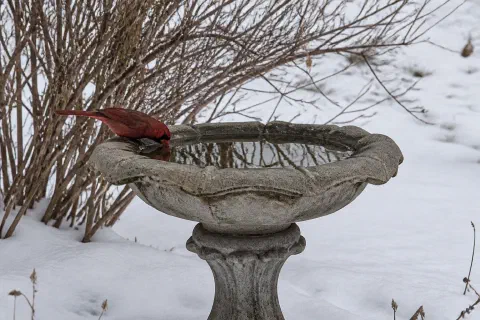
In winter none of that applies. Illinois Extension puts the job plainly: winter bird food supplies the calories birds burn holding their body temperature up. Downy woodpeckers, nuthatches, chickadees, titmice, wrens and even cardinals work a suet cage.
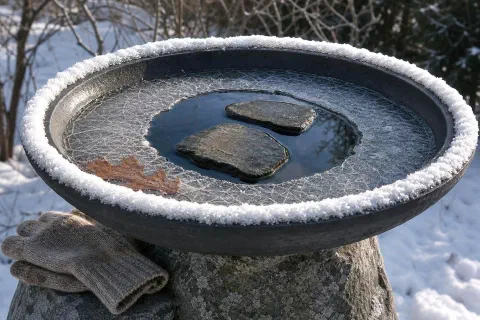
So: buy plain rendered suet or a seed-studded cake, hang it in a wire cage on its own hardware, and stop buying it in April. Fat is not the only thing worth putting out in a freeze, since open water gets scarcer than food, which is what a heated bird bath is for.
How to Read a Seed Label Before You Buy
Thirty seconds in the aisle settles most of this.
- Read the ingredient list, not the front. Ingredients run heaviest first. If sorghum, wheat or cracked corn sits in the top two lines, that is what you are buying.
- Count the useful ingredients in the top three. Black oil sunflower, safflower, white proso millet, peanuts and nyjer are the ones with research behind them. If two of your top three are missing, put it back.
- Buy straight seed rather than a blend. Separate bags of sunflower and millet waste less, and you control the ratio.
- Buy the size you will actually use. Nyjer and hulled chips both go off. A bag you finish in three weeks beats the sack that sits until March.
- Look at the seed. Sunflower should look full rather than shriveled, nyjer glossy black rather than dull, and nothing should smell sour or show webbing in the seams.
How to Store Bird Seed So It Keeps
Storage is where good seed quietly turns into bad. Three things go wrong: damp, age, moths.
- Damp. Penn State’s line is the whole rule: cool, dry place, and discard it if it molds. FeederWatch is blunt about why, telling people to throw out moldy food because some molds produce toxins harmful to birds.
- Age. Nyjer fades fastest, and hulled sunflower is close behind since it has no shell protecting the oil. Both are worth buying small.
- Moths. The Indian meal moth rides in on birdseed. UGA describes the larvae as small white worms with black heads, up to about two thirds of an inch, in silk or silken tubes. Their fix works on seed: freeze it at zero degrees Fahrenheit for at least seven days, and store it in strong plastic, glass or metal, since larvae cannot chew through a solid container but will walk in through a seam.
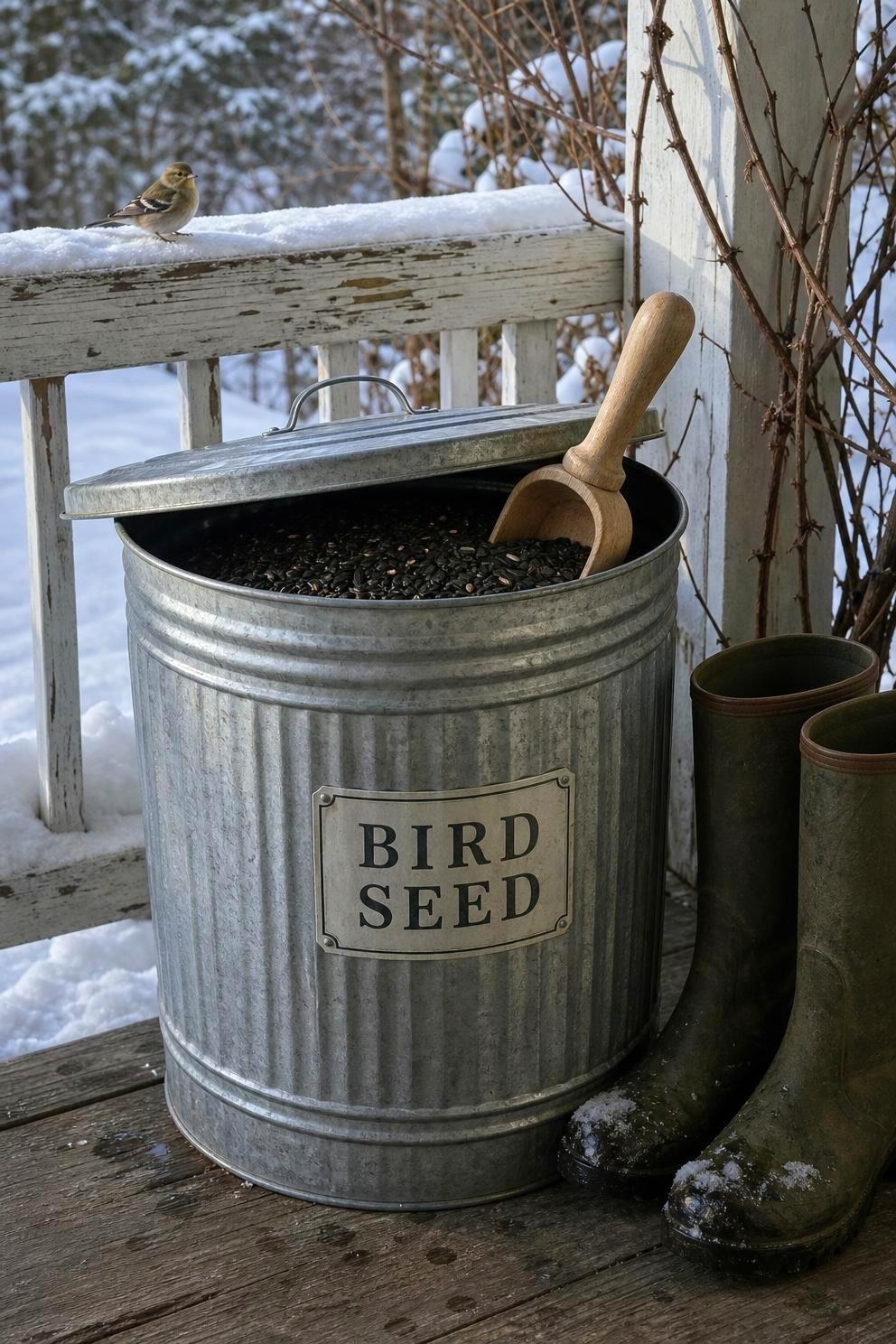
A lidded metal can in an unheated garage handles all three. Keep the scoop inside it. Feeder hygiene runs on its own schedule, covered in the winter feeding practice guide.
Questions People Actually Ask
What Is the Best Thing to Feed Birds in the Winter?
Suet and black oil sunflower, in that order once it is properly cold. Sunflower brings the widest range of species, suet delivers the most energy per bite, and white proso millet on the ground covers the birds that never touch a hanging feeder.
What Bird Seed Attracts the Most Birds?
Black oil sunflower, and it is not close. FeederWatch calls it the most commonly offered seed in North America and Nebraska Extension the most widely preferred, because the thin shell puts it in reach of small birds while the oil still makes it worth a big bird’s time.
Is It Good to Put Out Bird Seed in the Winter?
Yes, and winter is when it does the most good, because natural food is at its lowest and the nights are longest. The fears about creating dependence do not hold up, and that argument with its research is in the winter bird feeding guide. What deserves care is what you put out and how long it sits. Fresh seed in a dry feeder helps. A wet cake of rejected sorghum does not.
What Do You Put on the Ground Under a Bird Feeder?
Two answers, and you want both.
Put food there on purpose: white proso millet, or millet with a little cracked corn, on a low tray with drainage rather than loose in the snow. That is what juncos, sparrows and mourning doves are hunting for, and FeederWatch is clear that many of them will not use an elevated feeder.
Then put something under it you can clean, like a paver or a tray you can lift and tip. Hulls build up all season, and a surface you can sweep is the difference between a feeding spot and a sour patch of ground come thaw.
What Is the 5-7-9 Rule for Bird Feeders?
It is internet folklore, not guidance from any ornithological body.
As it circulates, it says to hang a feeder five feet up, seven feet from any structure and nine feet below an overhanging branch, on the theory that those are a squirrel’s jumping limits. Every source repeating it is a retailer blog or a lifestyle aggregator. Cornell Lab, Project FeederWatch, Audubon and university extension material do not mention it anywhere. The idea underneath, distance plus a baffle, is sound, but the sourced numbers differ, and they are worked through in the squirrel-resistant setup guide. It also has nothing to do with what is in your bag, which is the part that decides which birds show up.
What I’d Actually Buy
Checked on Amazon on August 25, 2026, sorted by best sellers. Ratings and availability move, so check the listing before ordering.
Buy single seeds rather than a mix. That is the whole argument of this page, and it is also the cheaper route once you stop paying for grain that ends up on the ground.
- Wagner’s black oil sunflower seed (opens Amazon in a new tab)As an Amazon Associate, we earn from qualifying purchases. Full disclosure. at 4.7 stars. If you buy one bag and nothing else, buy this one. Thin shells, high oil, and it is the seed the widest range of feeder birds will actually take.
- Kaytee nyjer seed (opens Amazon in a new tab)As an Amazon Associate, we earn from qualifying purchases. Full disclosure. at 4.5 stars across roughly 14,000 ratings, for goldfinches, siskins and redpolls. Buy the smallest bag that makes sense for your yard. Nyjer goes stale invisibly, and stale nyjer is the usual reason a finch feeder sits untouched.
- C&S no-melt suet dough (opens Amazon in a new tab)As an Amazon Associate, we earn from qualifying purchases. Full disclosure. at 4.6 stars. A dough formulation is the one to reach for through a warm spell, since plain rendered suet spoils once temperatures climb past about 70 degrees.
- Heath all-season high energy suet cakes (opens Amazon in a new tab)As an Amazon Associate, we earn from qualifying purchases. Full disclosure. at 4.4 stars across about 6,500 ratings, for the deep cold when woodpeckers, chickadees and nuthatches want the fat most.
What to Read Next
- Winter Bird Feeding: What Helps Birds Through the Cold covers the practice side: cleaning schedules, window distance, and whether birds get dependent.
- Squirrel-Resistant Bird Feeder Setup is the hardware answer that safflower alone will not give you.
- Plants That Feed Birds Through Fall and Winter is the food source you never have to refill or store.
- Heated Bird Baths and De-Icers That Keep Water Open explains why open water pulls in species your seed never will.