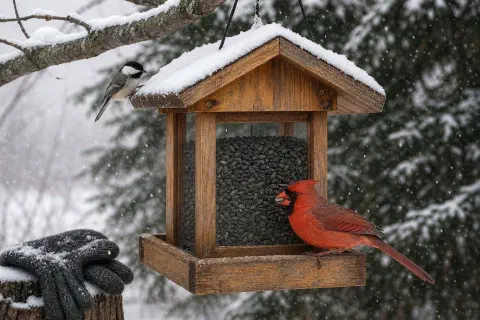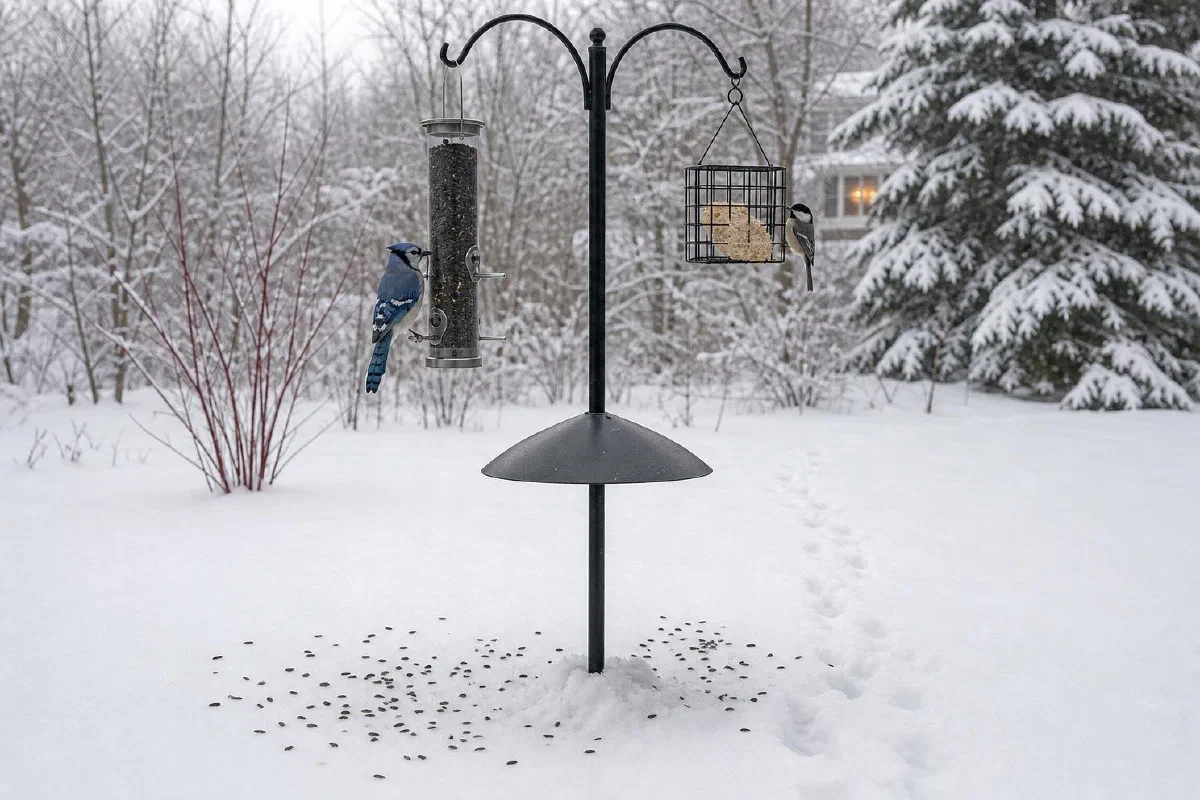
A black-capped chickadee can lose more than ten percent of its body weight on one cold January night. It burns that weight just holding its temperature until sunrise, and a short winter day gives it fewer hours of light to put the weight back on.
That’s the honest case for winter bird feeding. Not that the birds in your yard would starve without you, because decades of banding data say most of them wouldn’t. It’s that on the handful of truly brutal mornings each year, a full feeder shortens a search that has gotten very expensive.
What follows is mechanical: what to put out, how far it sits from the glass, how often you scrub it. The interesting part is how much of the popular advice has nothing underneath it.
Do Birds Get Dependent on Feeders?
This is the worry that keeps people from starting, and the research answers it clearly.
Margaret Brittingham and Stanley Temple studied wintering black-capped chickadees in Wisconsin for years. In one study, a chickadee population that had been fed for 25 years showed survivorship identical to an unfed population nearby once the feeders came out. Removing the food did not cost those birds anything measurable.
The reason is that a feeder is a supplement, not a diet. A review of the feeding research looked at the studies where dependency was actually tested, and the feared outcome did not turn up. So you can go on vacation, and you can quit in March without guilt.
There is one exception, and it’s the reason to keep the feeder stocked. In the same Wisconsin work, 69 percent of chickadees with feeder access survived October through April, against 37 percent without. That advantage showed up in the hardest weather, when natural food is locked under ice and a full feeder shortens a search that has gotten very expensive.
So the benefit is real but narrow. Your feeder matters most during the cold snap, which is exactly when nobody wants to go outside and fill it.
Why Fat and Calories Matter Below Freezing
A small bird in winter runs an energy budget with almost no reserve.
The National Wildlife Federation describes how a chickadee gets through a long night: it lowers its body temperature in a controlled way, roughly 12 to 15 degrees below its normal daytime temperature of 108 degrees Fahrenheit. That’s not a system failing. It’s a deliberate move to spend less fuel overnight, and it only works if the bird roosted with fat on board. So its whole day goes to laying that fat down again, more than ten percent of its body weight, before dark.
Fat carries about twice the energy per gram that carbohydrate or protein does, so the foods that help most in a freeze are the greasy ones:
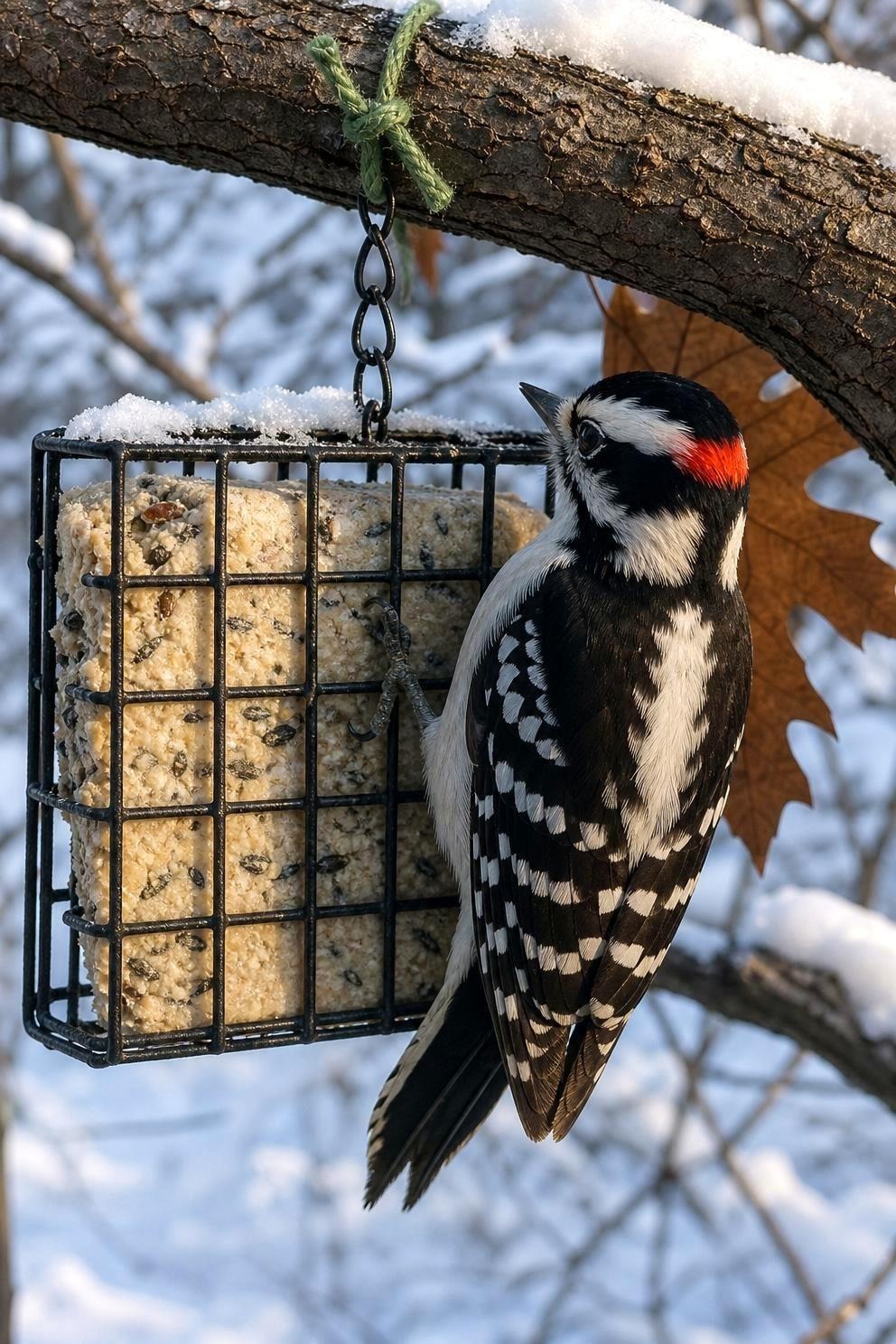
- Suet. Rendered beef fat, plain or mixed with seed. The single most useful thing to add when the temperature drops.
- Black oil sunflower. Thin shells, high oil content, and nearly every feeder bird can open it.
- Peanuts. Shelled pieces for chickadees, nuthatches, and the tufted titmouse; whole ones in a wire feeder for blue jays.
- Peanut butter. Fine to smear into a log or a pinecone. Birds are in no danger of choking on it.
Two cautions on suet. FeederWatch warns to keep suet out of hot weather, because it can turn rancid unless it has been specially processed, so this is a cold-season food. And hang it at least five feet off the ground, out of reach of dogs. For a fat source that isn’t yours to maintain, the shrubs and seed heads that hold food into winter do the same job without a scoop.
Which Seeds Bring Which Birds
You don’t need six feeders. You need to know what each food is for, so you stop paying for seed that ends up on the ground.
| Food | Birds it brings | Worth knowing |
|---|---|---|
| Black oil sunflower | Northern cardinal, black-capped chickadee, finches, sparrows | The most common seed at North American feeders, and the best single bag |
| Safflower | Northern cardinal and other big-billed birds | Squirrels leave it alone; most birds still prefer sunflower |
| Nyjer | American goldfinch, pine siskin, common redpoll | Needs a feeder with small ports or it pours straight through |
| White proso millet | Dark-eyed junco, sparrows | A ground-forager food, so scatter it low or use a tray |
| Peanuts | Blue jays, chickadees, nuthatches, titmice | Jays take several at a time; shelled pieces suit the small birds |
| Cracked corn | Mourning doves, quail, sparrows | Ground food, and it molds fast once wet |
| Suet | Downy woodpecker, nuthatches, wrens, titmice | The fat lane, and the first thing to add in a freeze |
Those pairings come from Project FeederWatch’s guide to feeding birds, run by the Cornell Lab of Ornithology and built on counts from tens of thousands of backyards.
Three things follow from that table:
- Millet and cracked corn are for birds that eat off the ground. A dark-eyed junco will never work a hanging tube the way a chickadee does, so give it a low tray or a cleared patch.
- Safflower is the quiet answer to a squirrel problem. You keep the cardinals and lose the squirrels, which beats most gadgets.
- Nyjer goes stale. Buy it in small amounts, and toss it once it looks dull and clumped instead of glossy black.
How to Set Up a Winter Feeding Station
Six steps, done once in late fall, and the rest of the season is refills.
- Pick a hopper or tube feeder with a roof. Covered seed stays dry, and dry seed doesn’t mold. A hopper holds enough to ride out a two-day storm.
- Add one suet cage. Separate hardware, separate crowd. Woodpeckers and nuthatches work it while finches take the seed.
- Put a tray or a cleared patch underneath. That’s where juncos and sparrows feed, and it keeps spilled seed from rotting into the snow.
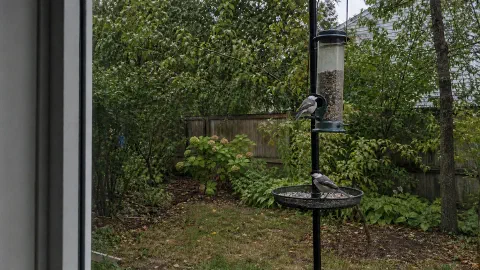
- Set it about 10 feet from cover. Project FeederWatch recommends feeders near natural cover but not against it, noting that “a distance of about 10 feet seems to be a good compromise.” Close enough to duck into a shrub when a hawk passes, far enough that a cat can’t ambush from it.
- Fix the window math before you hang anything. See the next section. That’s the one that kills birds when it’s wrong.
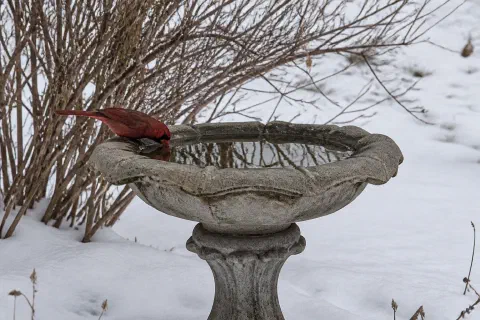
- Put out water. In a hard freeze, open water is scarcer than food. A heated bath or a de-icer pulls in species that ignore your seed entirely.
Do it in late fall, so the birds have found the feeder by the time they need it.
Feeder Placement: The Window Strikes Rule
This is the part of winter bird feeding most people get exactly backwards, and the stakes are high. Cornell’s Project FeederWatch notes that bird-glass collisions are common in residential areas, not just downtown, which is the whole problem: the glass doing the damage is usually your own window, not a tower.
The guidance is counterintuitive, so read it twice. Audubon’s winter feeding guide says to hang feeders “3 feet (or 30-plus feet) from a window to avoid bird collisions.”
The dangerous zone is the middle. Somewhere between three and thirty feet, a bird flushing off the feeder in a panic has just enough runway to hit the glass at full speed. Move the feeder in close and it can’t build the momentum to hurt itself. Move it far out and it’s less likely to read the reflected sky as a flight path at all.
So the fix for window strikes is almost never to move the feeder a little. It’s to move it a lot, one way or the other. Six feet from the kitchen window is the worst possible spot, and it’s exactly where most of us hang it.
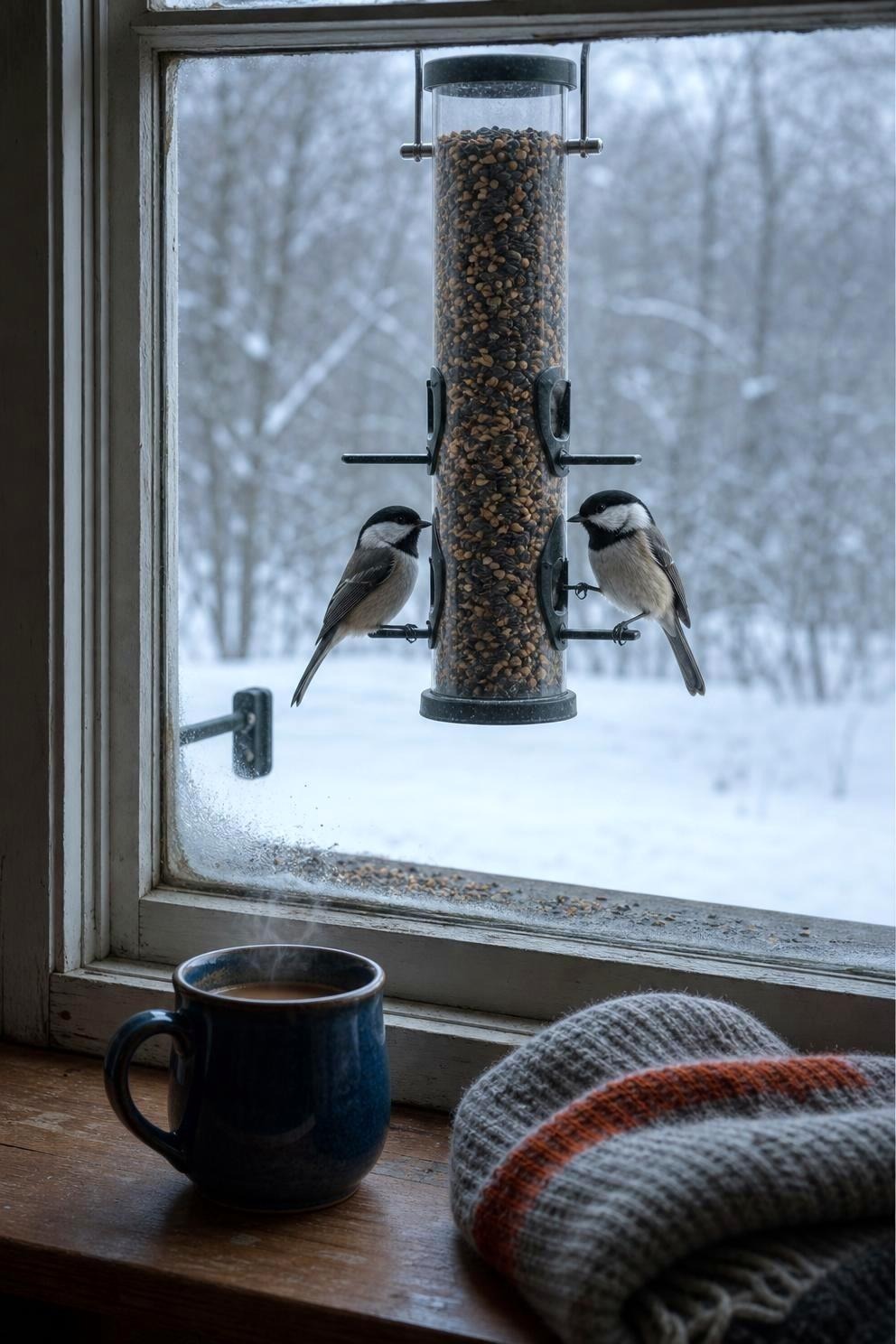
If you want the view, take the close option: suction-cupped to the glass or mounted a couple of feet out is the best seat in the house and the lowest collision risk at once. There are other placement mistakes worth checking while the shepherd’s hook is out of the ground.
How Often to Clean a Feeder, and With What
A feeder concentrates a lot of birds onto one small surface, which is how salmonella moves through a finch flock. Pine siskin die-offs at feeders are a regular winter event in some years. Utah State University Extension names five diseases that move through feeders, citing the National Wildlife Health Center: salmonellosis, aspergillosis, avian pox, trichomoniasis and mycoplasmosis. All five can kill a bird outright or leave it vulnerable enough for a predator to finish the job.
Project FeederWatch tested this directly, comparing three cleaning methods. Both methods involving a bleach soak beat scrubbing with soap and water alone at reducing salmonella on the feeder.
The routine:
- Clean seed and suet feeders every week or two, and more often during heavy use or wet weather.
- Scrub off the visible gunk with soap and water first.
- Soak the parts for 10 minutes in one part household bleach to nine parts water.
- Rinse thoroughly and let everything dry completely before you refill it.
- Rake up the spilled seed underneath. Wet hulls on the ground are their own disease surface.
Two judgment calls matter more than the schedule. If seed has clumped or smells sour, dump it rather than topping it off. And if a bird sits fluffed and lethargic at the feeder, or you find dead birds nearby, clean and disinfect more often and consider taking the feeders down for a while. FeederWatch is straight about the limits of that last step: pulling feeders disperses the crowd only where few neighbours feed birds, and in a busy feeding neighbourhood it can just push more birds onto the feeders that are still up.
What a Squirrel Baffle Does and Doesn’t Do
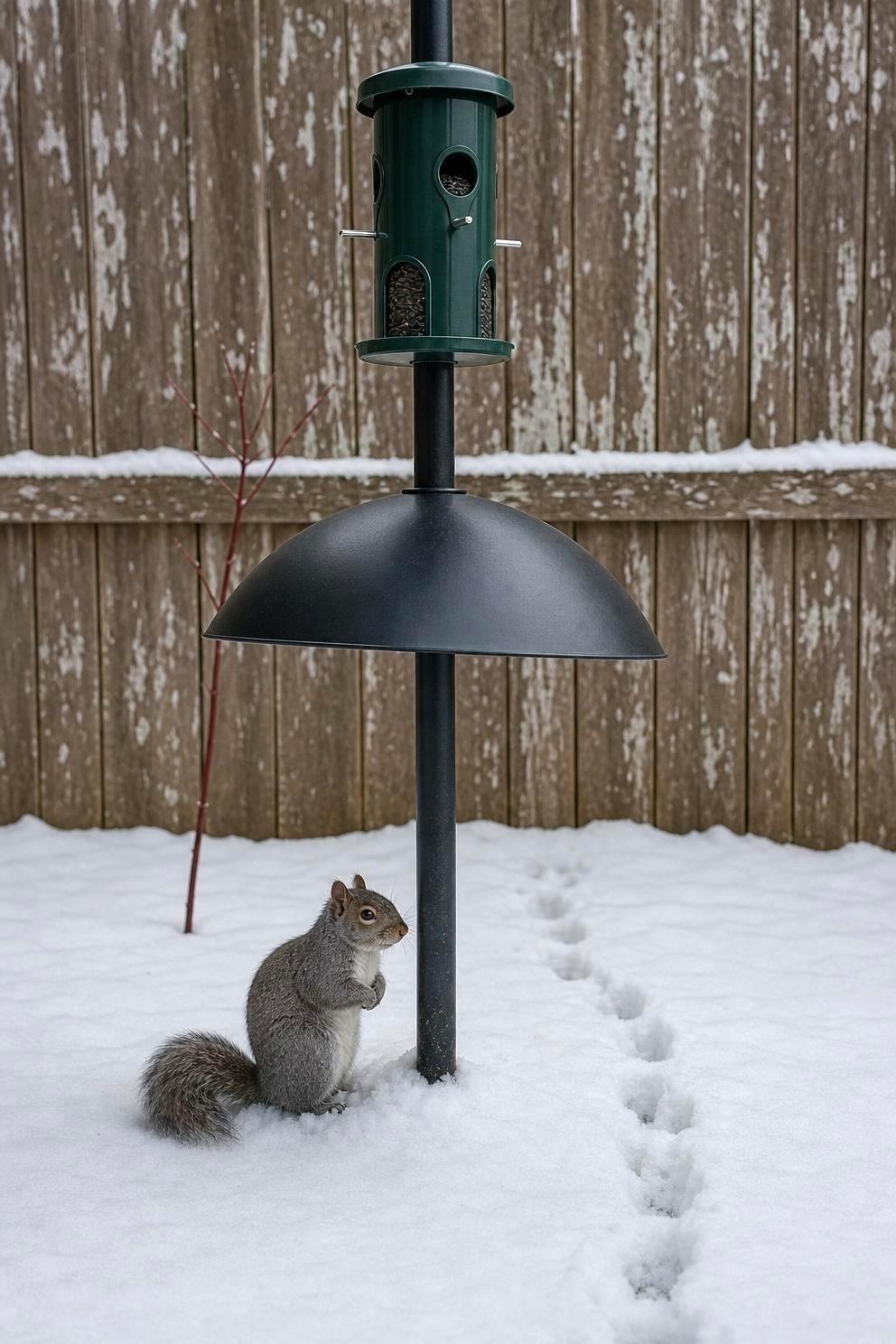
Squirrels are the reason half the winter feeding advice online exists, and most of it is wishful. The physical stuff works. Project FeederWatch notes that squirrels can jump to feeders placed less than ten feet from a tree or building, and recommends a tilting baffle at least 18 inches in diameter above a hanging feeder, or a baffle below to stop them climbing a pole.
Audubon adds the measurements that make a squirrel baffle work: put the feeder at least 8 to 10 feet from anything solid, and set the baffle four to five feet off the ground. Too low and the squirrel uses it as a launch pad. Too high and it jumps from the pole over the top.
Three things worth trying, in order of how well they hold up:
- Move the feeder. Distance from launch points beats every gadget, and it’s free.
- Add a baffle, sized and placed right. Both numbers have to be correct or it’s decorative.
- Switch to safflower. Cardinals keep coming; squirrels mostly lose interest.
A fourth option is to stop fighting: put peanuts or dried corn on the ground some distance away and let them have their own station. It beats buying a fifth squirrel-proof feeder. For the full build, here’s a setup that holds.
Questions People Actually Ask
Are You Supposed to Feed Birds in the Winter?
Yes, and winter is when feeding does the most good. Natural food is scarcest, the nights are longest, and the research on chickadee survival shows a real advantage during extended sub-zero stretches.
Two common fears are unfounded. Feeding doesn’t make birds dependent, as covered above. And it doesn’t keep them from migrating: migration runs on changing day length rather than on food supply, which is why birds leave in fall while natural food is still abundant.
What you owe them is consistency during a storm and a clean feeder the rest of the time.
Do Birds Need Water in Winter?
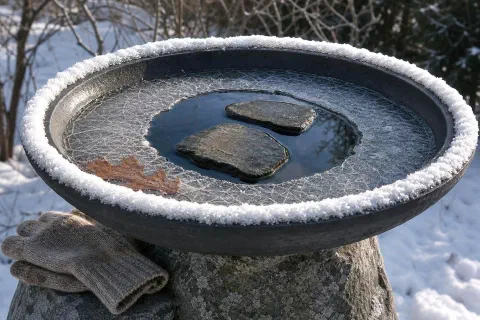
Yes, and in a hard freeze it is scarcer than food. Project FeederWatch’s guidance on water covers the two jobs water does for a bird, drinking and keeping its feathers in order, and it is specific about the winter version: arrange stones or branches in the basin so a bird can stand and drink without getting wet, and never add antifreeze, because it is poisonous to all animals, including birds.
A pan you can reach and refill does most of that. Where the overnight lows sit well below freezing, the heated bath or de-icer is the version that still works in February, and the cord-free options buy you a few hours when there is no outdoor outlet.
What Is the 5-7-9 Rule for Bird Feeders?
It’s internet folklore, not guidance from any ornithological body.
As it circulates, the rule says to hang a feeder five feet off the ground, seven feet from any structure, and nine feet below an overhanging branch, on the theory that those are a squirrel’s jumping limits. Every source repeating it is a retailer blog, a pest-control site, or a lifestyle aggregator. It doesn’t come from the bird-feeding organizations or from university extension material.
The underlying idea isn’t wrong, which is why it spreads. Squirrels jump, and distance is the real defense. But the sourced numbers are different: 10 feet of clearance from any solid launch point, not seven, and a baffle at four to five feet, not a feeder at five. Follow 5-7-9 literally and you build a seven-foot gap a squirrel can clear.
Use the measurements. Skip the rhyme.
Why Put a Potato in Your Bird Feeder?
There’s no good evidence for this one, and the version going around is a garbled import.
It surfaced in a wave of lifestyle articles calling cooked potato a high-calorie treat birds need. What’s underneath it is genuine but much narrower: RSPB feeding advice does suggest putting out some leftovers, such as dried fruit or cut apple and pear, as long as nothing you put out is mouldy or salty. That’s a note about using things up, not a reason to stock a feeder with potato. No North American bird-feeding authority recommends it, and FeederWatch’s standing advice is to avoid adding untested things to bird food at all.
Leftover plain baked potato on the ground for the robins won’t hurt anything, as long as it’s unseasoned and cooked. Raw is a different matter, since potatoes carry solanine, which is why we don’t eat green ones either. But potato does nothing a suet cake doesn’t do better, and it goes slimy in a day.
Do Coffee Grounds Keep Squirrels Away From Bird Feeders?
No. When this went to an extension wildlife specialist, Dr. Dana Sanchez answered in one line: “I know of no evidence that coffee grounds will deter squirrels.”
That’s the whole state of the evidence. No peer-reviewed work shows coffee grounds repel squirrels, and the theory behind it, that the smell is off-putting, runs into the fact that squirrels habituate to smells fast and are driven by hunger rather than preference. Grounds in the garden aren’t harmful, so nobody’s going to stop you. They just don’t do this job. A baffle does.
Do Birds Remember People Who Feed Them?
Some do, and the evidence for individual human recognition in wild birds is good.
The clearest case is Northern Mockingbirds. In a study on a university campus, one person approached the same nests for four days in a row, wearing different clothes each time and disturbing the rim briefly. The birds flushed from further away every day. On the fifth day a different person approached in exactly the same way, and the alarm level dropped straight back to what it had been on day one. The birds had recognised an individual, not a routine.
American Crows do the same and hold the memory for years. Work at the University of Washington using masks showed crows scolding the “dangerous” face long after the encounter, and passing the grudge to birds that were never there.
Whether the chickadee at your window knows you personally is less certain, since nobody has run that experiment on feeder songbirds. What’s clear is that they learn the feeder, the schedule, and the shape of a person walking toward it. That’s why the crowd shows up faster in February than in November.
What Do Squirrels Hate?
Less than the internet claims.
Holds up: open space. Squirrels dislike a jump they can’t make, which is why the 8-to-10-foot rule and a properly placed baffle are the only reliable tools. They also pass on safflower when sunflower is available elsewhere.
Doesn’t hold up: hot pepper, the most-repeated remedy going. The logic was that birds lack the receptor that responds to capsaicin while mammals have it. But research by Gabriel Colbeck at Maryville University found squirrels will eat even the spiciest seed when hungry, and that birds are not as indifferent to capsaicin as everyone assumed. Northern Cardinals, Carolina Chickadees, and House Finches tolerated heat to roughly 500,000 Scoville units and refused seed at ghost-pepper levels. Project FeederWatch is blunt about the category: it’s unaware of research on high doses of capsaicin in birds, and it discourages adding any untested product to bird food.
Also failing: coffee grounds, mothballs, human hair, and most spray repellents. None have evidence behind them, and mothballs are not meant to be used as animal repellents at all. Their vapour is the pesticide, it does little or nothing to repel a squirrel, and the open air is the worst possible place to release it.
The pattern is worth noticing. Every squirrel remedy built on a smell or a taste has failed. Every one built on a measurement has worked. Get the tape measure.
What to Read Next
- Heated Bird Baths and De-Icers That Keep Water Open because open water gets scarcer than seed in a hard freeze.
- Bird Feeder Placement Mistakes covers the hawk, cat, and cover problems this piece only touched.
- Squirrel-Resistant Bird Feeder Setup is the full build, pole and baffle numbers together.
- Plants That Feed Birds Through Fall and Winter is the food source you plant once and never refill.
- What to Cut and What to Leave in a Bird-Friendly Fall Garden keeps seed heads standing into January.