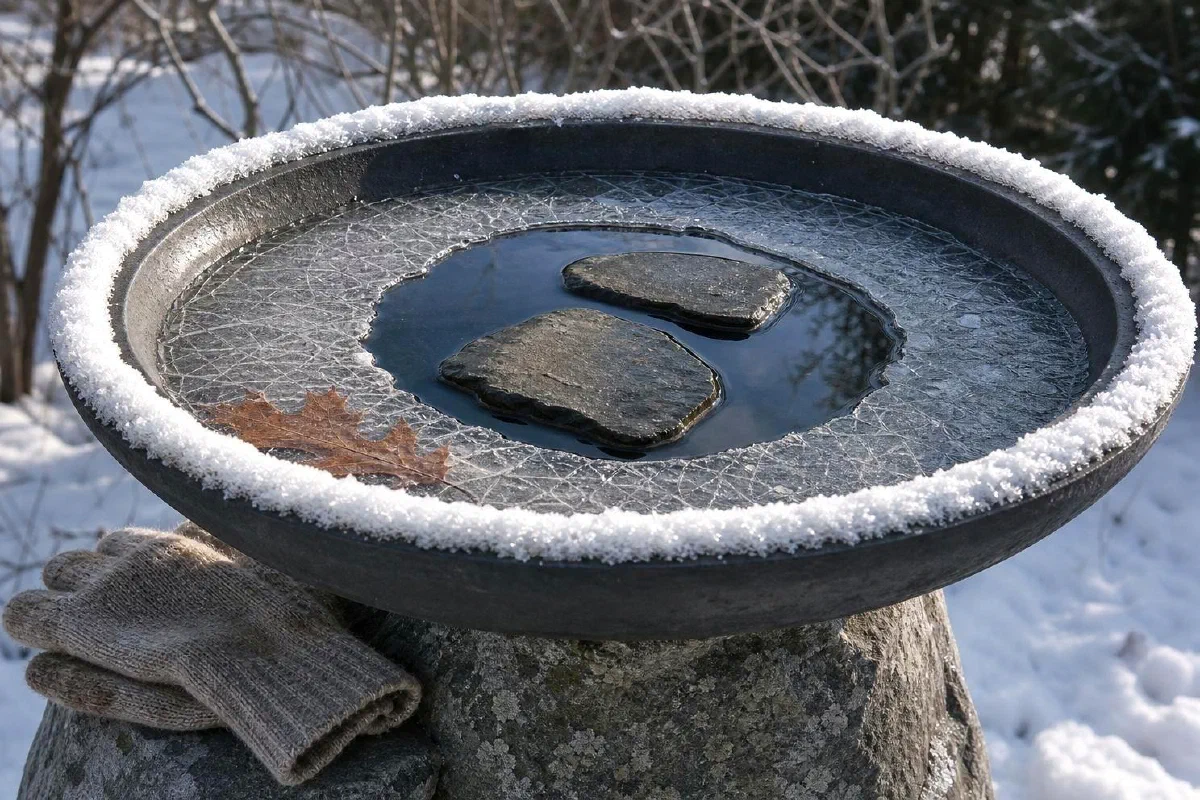
The outdoor outlet is on the wrong side of the house. That is the whole problem, and it is why most winter bird bath advice is no use to you.
Search “how to keep bird bath from freezing” and nearly every answer opens with a heater. Heaters work, and if you can run a safe cord I would rather you did. But plenty of us have a bath in the middle of a yard with no power near it, and the honest question is what is left once you rule electricity out.
Here is the short version. One piece of the folklore will poison a bird, and two unglamorous things buy you real hours of open water. Which is which, with the source for each.
Start With the One Number That Decides Everything
Before you try anything, look at your overnight low.
Nothing unpowered keeps water liquid through a night in the teens. Water freezes at 32°F, and no floating object, dark paint or coin changes that. What the unpowered tricks do is delay the ice and shorten the hours the bath is useless. Worth doing, because birds do most of their drinking in the first hour or two after sunrise.
Sort your winter into two kinds of day:
- Nights that dip to about 28°F and climb back above freezing by mid-morning. This is where an unpowered bath genuinely works. You can hold open water through most of the daylight.
- Nights in the teens, or days that never get above freezing at all. Nothing here beats going out with a kettle, or running power.
If your winter is mostly the second kind, read the heated bird bath and de-icer guide instead and skip the rest of this. There is no clever workaround for a week at 15°F, and anyone offering you one is selling something.
Why the Copper Penny Trick Does Nothing for Ice
The most-asked question about a winter bath, and the answer comes in two parts.
First, on ice: a copper penny sitting in a basin does not lower the freezing point of water. Nothing dissolves in any meaningful quantity, and a coin holds almost no heat. The folklore is not about freezing at all. It grew out of a summer claim, that copper slows green algae, and got carried into winter posts where it makes no sense.
Second, and this is the part that matters: the penny is a genuine hazard. A modern American penny is not a copper coin. Every US one-cent piece minted since 1982 is copper-plated zinc, and the Merck Veterinary Manual puts the figure at 97.5 percent zinc, roughly 2,440 mg of elemental zinc per coin, listing pennies as a leading source of zinc poisoning in animals.
Birds are not average animals here. The University of Illinois College of Veterinary Medicine states it plainly: birds are far more sensitive to the toxic effects of zinc than are humans. Zinc toxicosis shows up as lethargy, fluffed feathers and a bird that stops eating.
The trick that does nothing for ice also drops a zinc lozenge into the drinking water of every songbird in the yard. Leave the coins in the jar.
What a Ping Pong Ball Actually Does
This one is not a myth. It is just much smaller than the internet makes it sound.
The RSPB recommends it directly: “float a ping pong ball in it to keep the water moving and prevent freezing.” Notice the mechanism. It is not insulation or warmth. A light ball catches the breeze, drifts across the surface, and moving water takes longer to knit into a solid sheet.
The RSPB is honest about the size of the win. A light ball will keep just a small amount of water ice free. A small amount. Not the bath.
In practice:
- On a light frost, you get a hole in the skim ice by morning instead of a lid.
- On a dead still night, you get nothing. The ball needs wind to move.
- On a hard freeze, the ball gets frozen in place and you own a bird bath with a ball set into it.
A tennis ball is the same idea with worse execution: heavier, lower in the water, and the felt soaks through and holds grime. A ping pong ball or a wine cork is lighter and cleaner. Treat either as a bonus on a marginal night, never as the plan.
Which Basin Materials Crack, and Which Survive
Here is the failure that ends a season early, and it is not the freeze. It is the basin splitting.
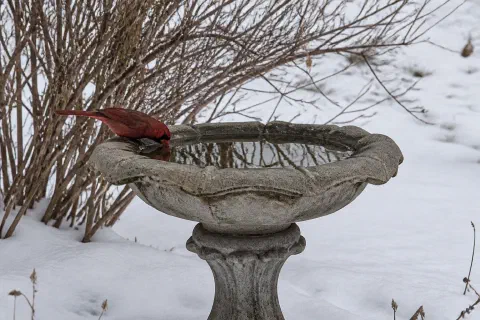
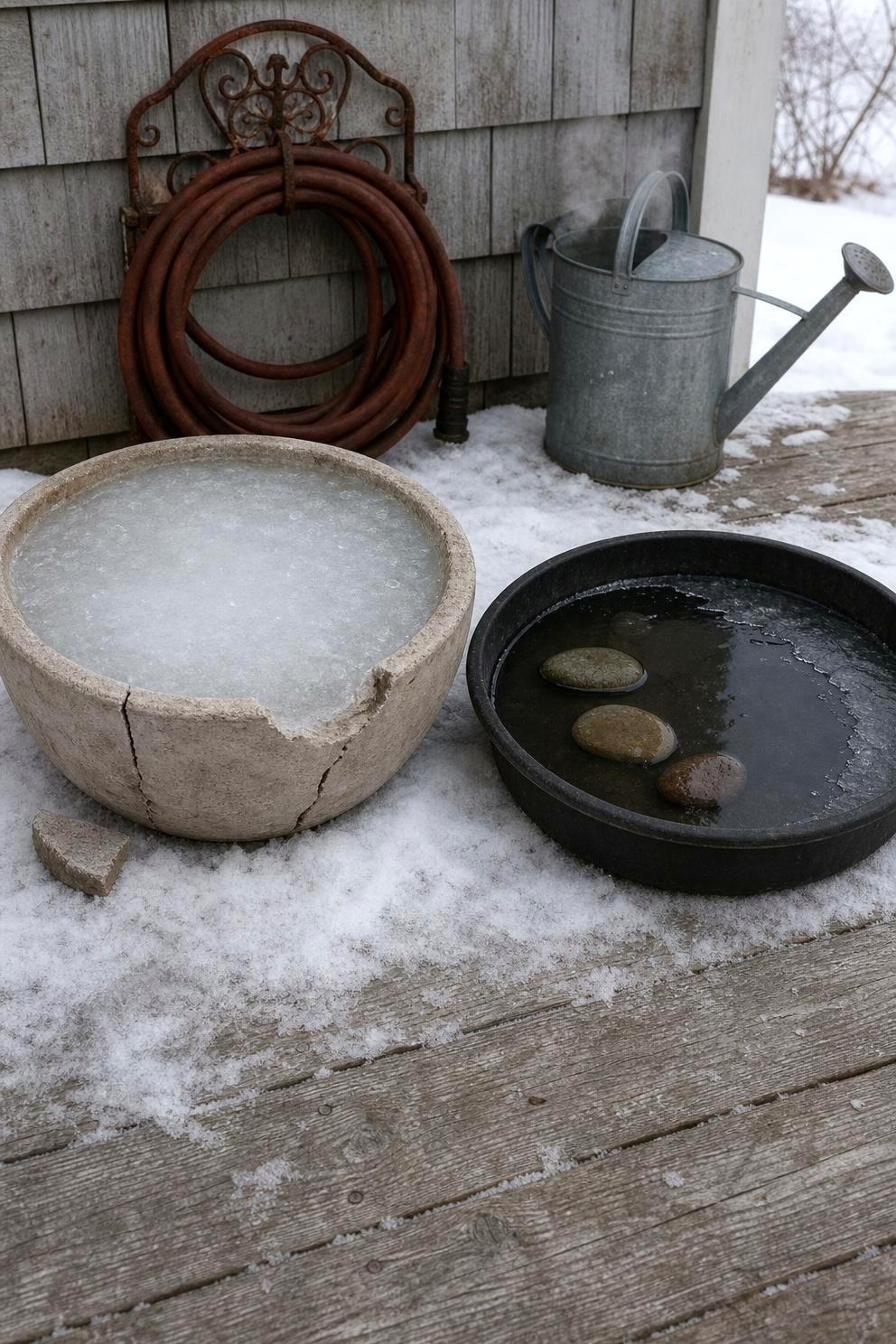
Water expands by about nine percent when it turns to ice, and in a rigid basin that expansion has nowhere to go. Porous materials are worse again, because they hold water inside the material itself, and every freeze-thaw cycle drives a wedge into the pores. Illinois Extension describes exactly this for clay: water within the pores of terra cotta and clay pots will expand when frozen, leading to cracked pots.
Cornell Lab of Ornithology is blunt about what that means for a concrete bird bath: concrete basins often crack if they freeze during winter. Audubon says the same of ceramic: avoid ceramic baths, they can crack in cold weather.
| Basin material | Left full through a hard freeze | Why |
|---|---|---|
| Concrete or cast stone | Cracks, usually once and terminally | Rigid and porous, so ice pushes and the pores split |
| Glazed ceramic | Cracks | Rigid body, and the glaze traps water inside it |
| Unglazed terracotta | Cracks soonest | The most porous of the common materials |
| Tough plastic or resin | Survives | Flexes as the ice expands |
| Flexible rubber | Survives best | Deforms and springs back, every time |
| Thin metal | Does not crack, but freezes soonest | Flexes at the seams, sheds heat quickly |
Cornell’s own recommendation for a bath that will freeze: tough plastic that will not break if the water freezes or the dog knocks it over.
That is the real answer for most people without power, and it is not a gadget. You do not need to save the handsome concrete bath. Retire it in November and put a shallow plastic or rubber pan in its place. A rubber tub never fails. It flexes, the ice pops out in a single disc when you flip it, and you refill it in ten seconds with cold hands.
Store the concrete basin upside down and empty, ideally under cover. Right side up it collects rain, and rain freezes.
Flat Stones Do More Than a Penny Ever Will
If you take one thing from this article, take this.
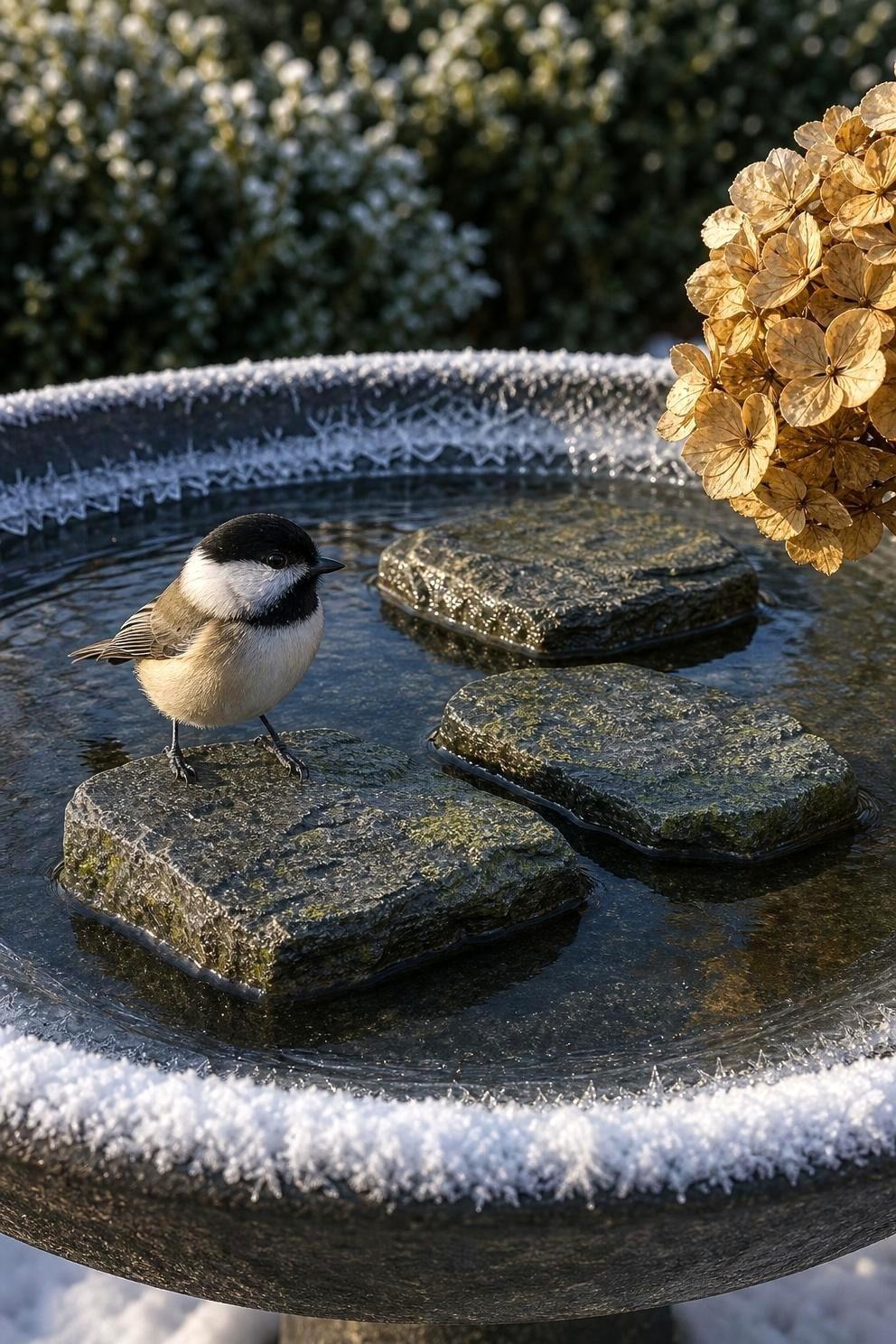
Set two or three flat stones in the basin so their tops sit above the water line. Project FeederWatch’s guidance on water is specific about why, and specific about the season: arrange a few branches or stones so that they emerge from the water, so birds can stand on them and drink without getting wet, and this is especially important in the winter.
That last clause is the point. A bird that soaks itself at 25°F is in real trouble. Bathing and preening are how a bird keeps the trapped-air layer in its feathers that holds heat through the night, and Cornell notes that birds cannot fly well when wet, which makes a soaked bird easy work for a cat. A stone gives a chickadee a dry perch, a drink and a way out.
Stones do a second job in a freeze. They break the surface, so ice forms as a ring rather than one solid lid, and there is usually a gap at the stone edge come morning.
For depth, Audubon’s build guide keeps the water about an inch to an inch and a half deep in a basin no more than two inches deep, and tells you to toss in a few large pebbles or a flat stone. Penn State Extension puts the ceiling at no more than two to three inches at the deepest.
Now the awkward part nobody mentions. Shallow water freezes faster. A wide inch of water has an enormous amount of surface for the volume underneath it, and it sheds heat quickly. Depth and open water pull against each other in winter, and safety wins. Do not deepen a winter bath to slow the ice down. Use stones, and accept the ice.
Four Moves Before the First Hard Freeze
None of these need power. Do them in October and you buy hours, not minutes.
- Move the bath into full winter sun. Summer siting says shade, to slow evaporation and algae. Winter says the opposite. The low sun is weak but free, and a basin catching sun from nine in the morning opens hours ahead of a shaded one.
- Get it out of the wind. Moving air strips heat off an open surface far faster than still air at the same temperature. The sheltered side of a fence, a garage wall or a thick hedge is worth several degrees on a cold night.
- Swap to a dark basin. A dark surface absorbs more of the sunlight landing on it than a pale one does; the EPA notes reflective roofing stays 50 to 60°F cooler than conventional material in peak summer sun. Winter sun is far weaker, so treat solar gain as a daytime effect. A black pan in the sun opens before a white concrete one every time, but it will not carry you overnight.
- Reduce the surface, not the depth. A smaller bath at the same depth loses less heat overall, because there is less surface for cold air to work on. Two small pans you rotate beat one wide basin.
Keeping Water Open on the Cold Mornings
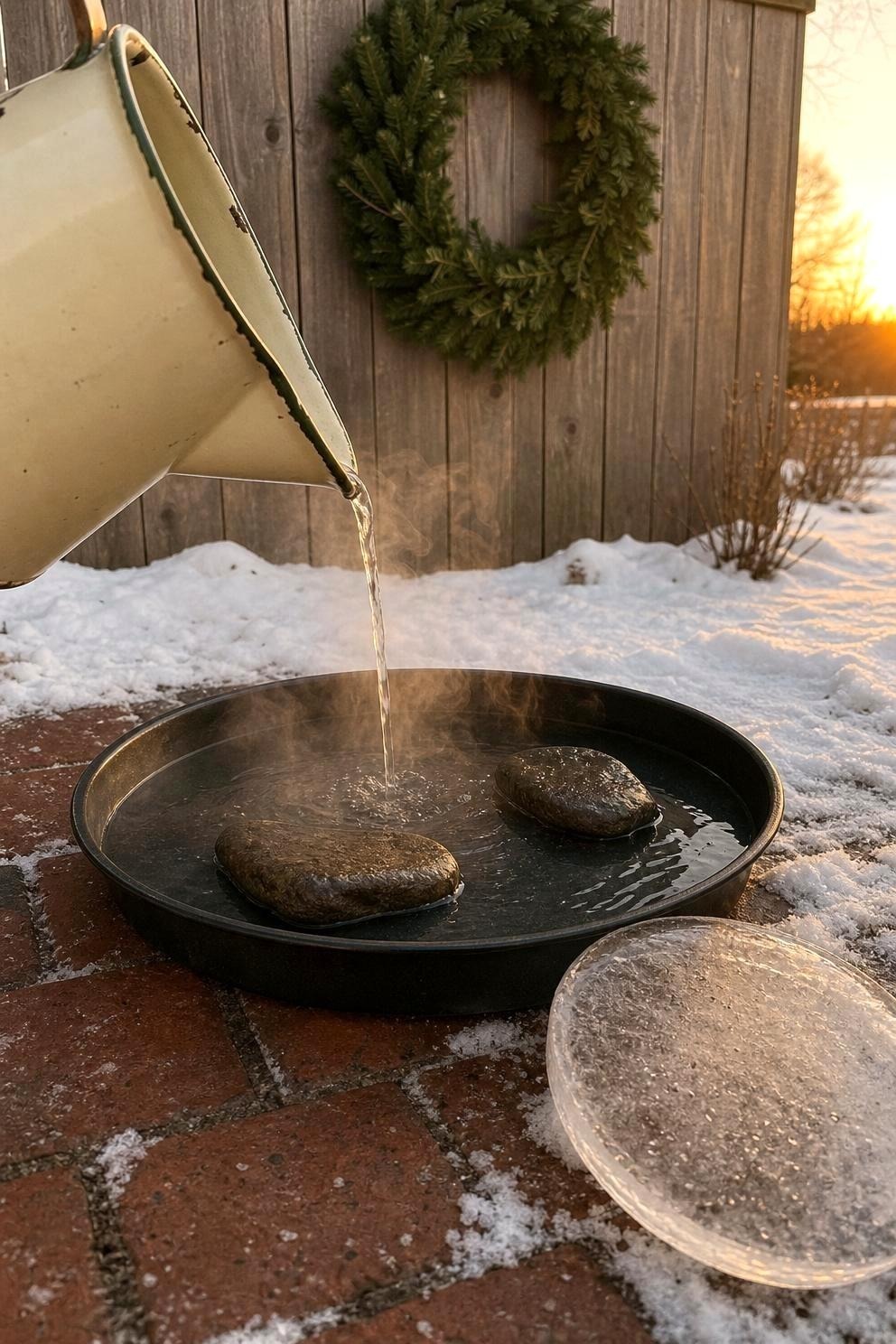
The unglamorous method is the one that works, and Audubon lists it first: keep the water thawed by adding warm or hot water, or by making a hole in the ice.
Done properly it takes a minute:
- Go out at first light. Birds arrive at dawn with a long night of fasting behind them, and that is the hour that counts.
- Pour warm water, not boiling. Boiling water against a cold rigid basin is a thermal shock and can crack it on its own.
- Tip the old ice out first if the bath is plastic or rubber. Flip it, flex the sides, and the disc drops out.
- Refill often. Cornell’s rule is to keep the bath full at all times, and Audubon notes that frequent refills are necessary in winter because water evaporates quickly in dry air.
- Skip the bleach. Rinsing thoroughly in freezing weather is awkward, and residue is worse than a little algae, which barely grows at these temperatures. A stiff brush and hot water every few days is enough.
One warning bears repeating, because it is the thing that actually kills birds. Never add anything to lower the freezing point. Cornell measured it: dropping the freezing point to 15°F takes a 30 percent glycerin solution, and a bird that bathes in that comes out with matted feathers which no longer insulate. The RSPB is blunter still, never use salt, soaps or chemicals like antifreeze. Every additive is broken down in the heated bird bath article.
When to Give Up and Run a Cord
I would rather tell you where the ceiling is than pretend there is not one.
If your overnight lows sit below about 20°F for more than a night at a time, every unpowered method here becomes ice management rather than ice prevention. The honest answer then is a thermostatically controlled immersion heater in the bath you already own, on a ground-fault interrupted circuit. Cornell calls them perfect for the job. They cycle on and off, so they cost pennies a day, and modern ones shut down if the bath runs dry.
If a cord is impossible, keep the rubber pan and the kettle, and put the rest of the effort into the habitat. Shrubs that hold berries into winter and feeders sited where birds will actually use them do more for a yard in January than a heroic bath routine.
Questions People Actually Ask
Most of these are folklore, and there is no shame in having believed them. I did.
Why put a penny in a birdbath?
The idea comes from copper’s mild algaecide effect in summer, not from freezing, and it does nothing at all to ice. A US penny minted since 1982 is 97.5 percent zinc under a thin copper plate, so you would be dropping a zinc source into drinking water for animals unusually sensitive to zinc. Skip it.
Why put a tennis ball in a bird bath?
Same reasoning as a ping pong ball. A floating object catches the breeze, keeps a patch of surface moving, and delays ice forming there. The effect is real, it is small, and it needs wind to happen at all. A ping pong ball does the job better because it is lighter and does not soak through.
What type of birdbath will not crack in winter?
Tough plastic, resin and flexible rubber, because they give as the ice expands. Concrete, cast stone, glazed ceramic and terracotta split, being rigid and porous at once.
Can I leave my bird bath out all winter?
The pedestal, yes. The basin, only if it is plastic, resin, rubber or metal. Empty a concrete or ceramic basin, turn it upside down so it cannot collect rain, and put out a cheap shallow pan for the season instead.
Should I put rocks in my birdbath?
Yes, and in winter more than any other season. Cornell’s guidance is to arrange stones so they emerge from the water, so birds can stand and drink without getting wet. Flat, with the tops above the waterline. They break the ice into a ring as a bonus, and they give a nervous bird somewhere to land.
Where not to put a bird bath?
Not tight against dense shrubs, and not marooned in the open. Penn State Extension suggests keeping a ground-level bath 10 to 15 feet from anything a cat can hide in, while Cornell wants cover close enough for a bird to escape quickly. Where cats are a problem, Cornell suggests raising the bath two or three feet off the ground. Winter adds two rules: out of the wind, and in the sun. More on siting in bird bath placement mistakes.
Is it safe to put copper pipe in your birdbath?
I cannot tell you that it is, and I went looking. Neither Cornell Lab nor Audubon publishes guidance on copper pipe in bird baths, and there is no de-icing mechanism to point at: copper does not lower the freezing point, and it moves heat out of water faster than plastic or concrete, so a copper insert cools the bath sooner rather than later. The anti-algae claim needs copper ions dissolving into the water, and no safe daily dose for a wild bird has been established. With no source I trust, I leave it out.
What color birdbath attracts the most birds?
Nobody has studied bird bath color properly. The nearest real evidence is a 2017 PLoS ONE study of eight feeder colors in UK gardens, which found that birds made significantly more visits to the silver feeder and significantly fewer visits to the red and yellow feeders. Those are feeders rather than baths, and UK species, so hold it loosely. Pick a dark basin for the winter solar gain and stop worrying about the rest. Moving water pulls in far more birds than any color does, and Cornell rates a slow drip as one of the best ways to make a bath more attractive.
What to Read Next
- Heated Bird Baths and De-Icers covers the powered options, wattage and electrical safety.
- Bird Bath Placement Mistakes is for when songbirds walk past a bath you already own.
- Bird Bath Ideas Songbirds Actually Use shows the shapes and setups worth copying.
- Plants That Feed Birds Through Fall and Winter handles the food half of a winter yard.
- Best bird seed for winter pairs the open water with food that keeps resident birds coming back.