The best outdoor garden mirror setup for a small backyard is an arched windowpane mirror with divided grid bars, mounted 24 to 36 inches above a shaded flower bed on an east-facing fence and framed by soft vines and ferns. When the glass reflects lush green foliage instead of open sky or a neighbor’s siding, it creates a convincing illusion of a doorway opening into a second yard while keeping birds and plants safe from glare.
Garden Mirror Ideas for a Small Backyard That Make It Feel Twice as Big
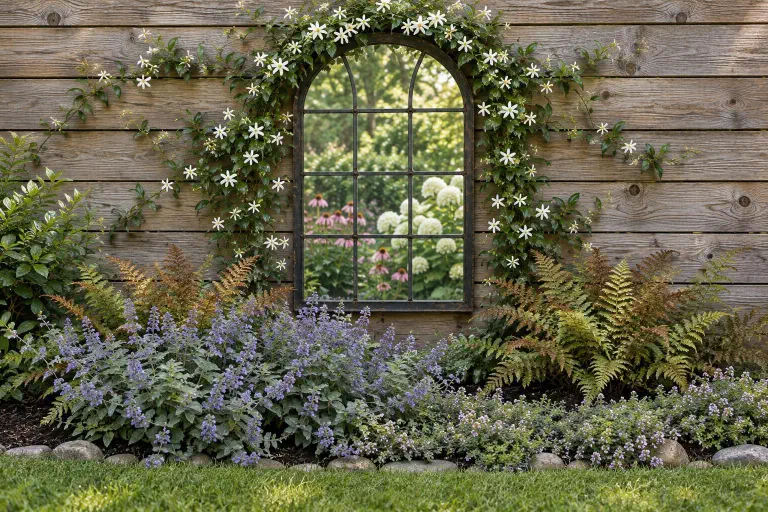
An arched windowpane garden mirror framed by star jasmine and catmint tricks the eye into seeing a doorway to a second yard.
Most backyard mirrors go wrong for one of three reasons: someone hangs a wide, frameless bathroom mirror on a blazing west-facing fence, forgets to seal the backing against rain, or leaves it floating bare on empty planks where it just mirrors the back door. Treating a garden mirror like an architectural doorway instead of wall art solves all three problems in a single afternoon.
6 outdoor garden mirror ideas that actually work in small yards
You do not need a grand brick courtyard to pull off a storybook reflection. In fact, a tight 12-by-15-foot patio or narrow side yard gets the biggest visual payoff because the eye immediately reads the reflection as extra square footage. These six layouts pair cleanly with our core whimsical garden ideas for a small backyard.
1. The secret-doorway arched fence mirror
Mounting a tall arched windowpane mirror flush against a weathered cedar or painted privacy fence is the classic small-yard illusion. Hang the bottom edge 24 to 36 inches above the planting bed, tuck a slim metal trellis beside it, and train star jasmine or clematis around the upper curve. Plant purple ‘Walker’s Low’ catmint and bronze autumn ferns right beneath the sill so the frame looks rooted in the garden instead of tacked to wood.
2. Renter-friendly leaning mirror behind potted ferns
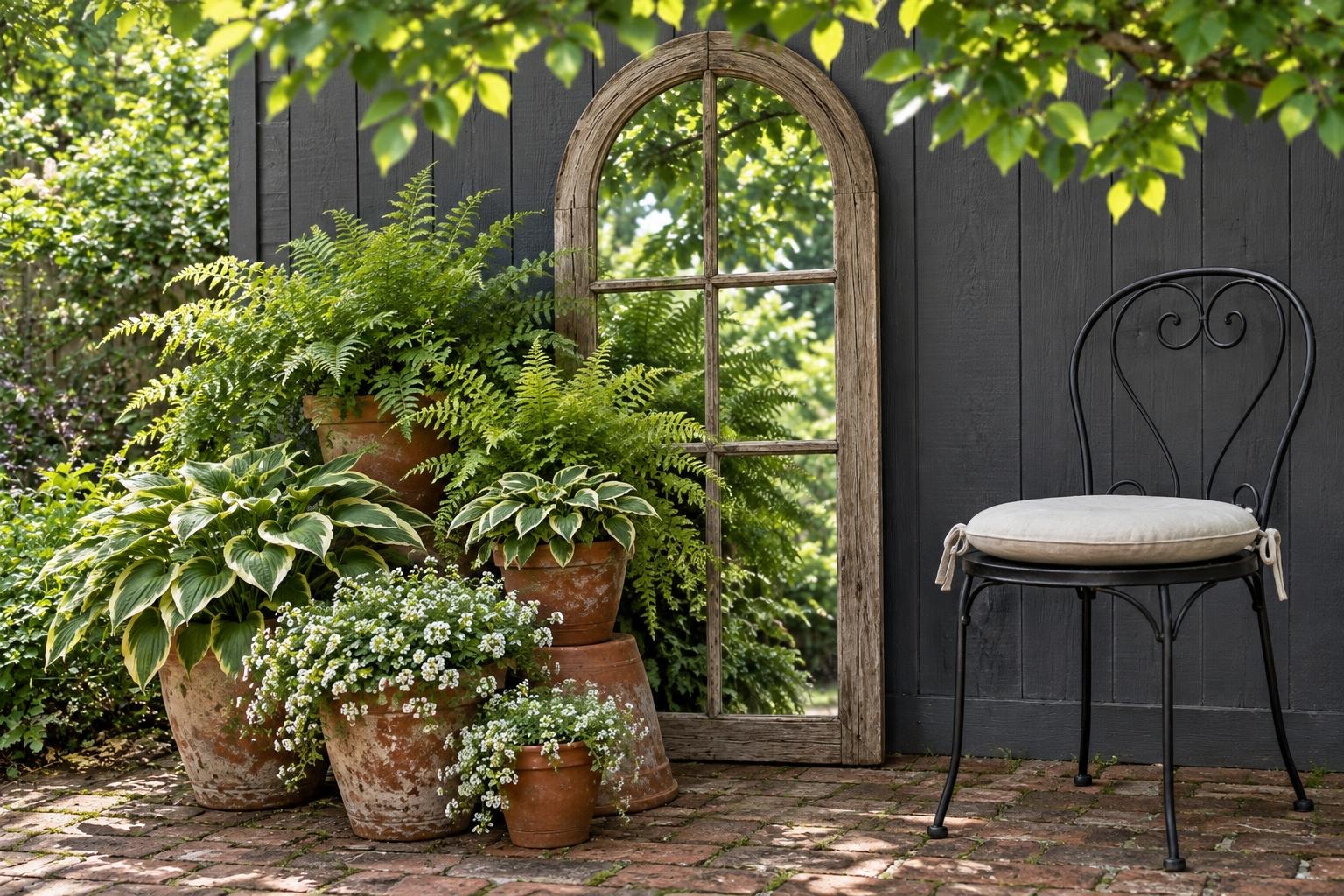
If you rent or do not want to drill into brick or vinyl siding, skip fence hooks altogether. Lean a 48 to 60 inch arched cedar or metal outdoor mirror against a shaded shed wall or porch corner, then lock the base safely in place behind a staggered cluster of heavy terracotta pots holding woodland ferns, variegated hostas, and spilling white sweet alyssum. Set one slim wrought-iron bistro chair beside the pots and the corner suddenly feels like a leafy garden room.
3. Gridded mirror behind a stone birdbath or water bowl
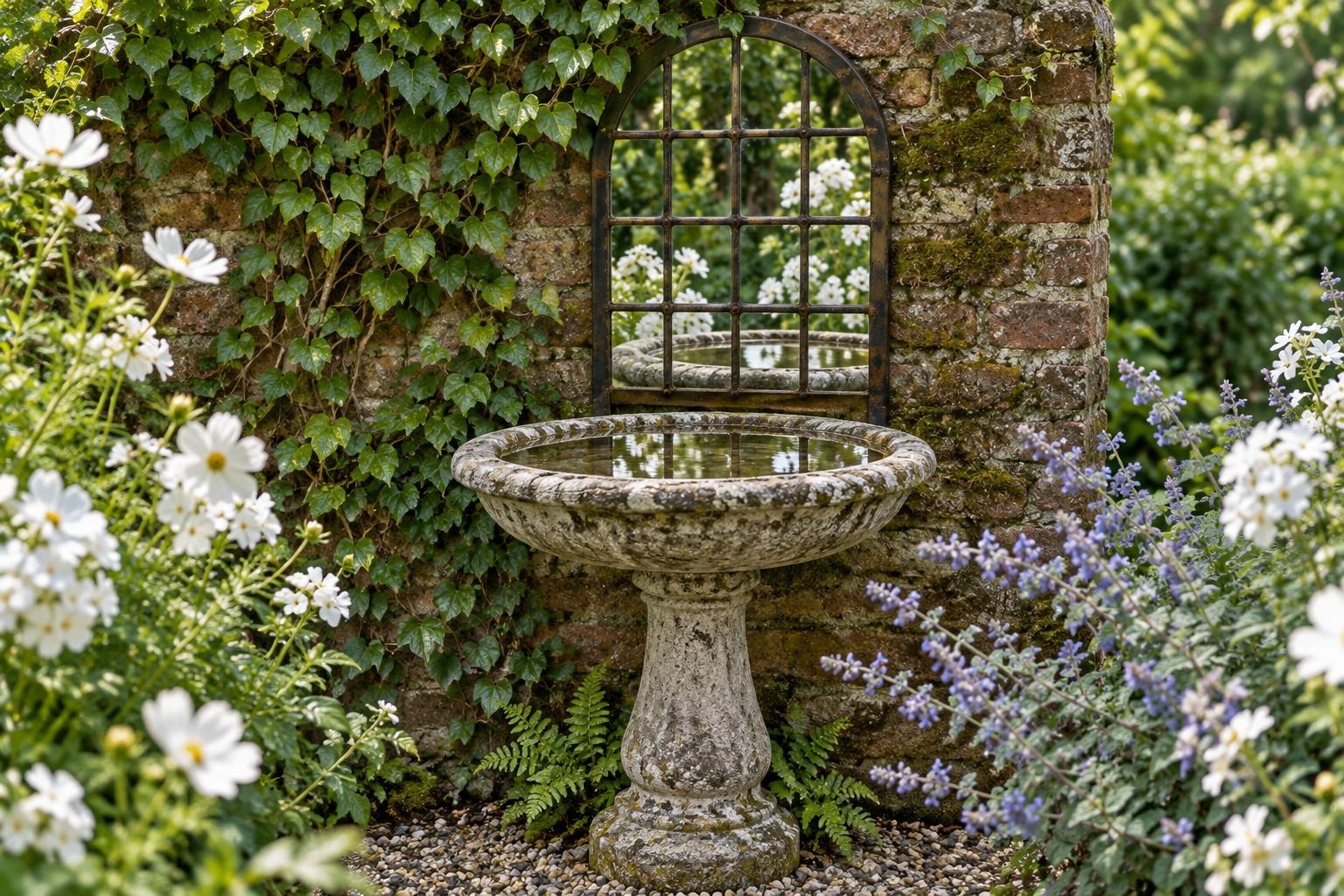
Setting an arched iron windowpane mirror directly behind a weathered stone pedestal birdbath or a small bubbling no-dig backyard water feature doubles both the sparkle and the foliage around it. The moving water breaks up the reflection gently, and even a compact 18-inch water bowl suddenly reads like a deep, shaded courtyard spring from across the patio.
4. Upcycled wooden window frame on a budget
Before buying a specialty outdoor mirror, check local Habitat ReStores, flea markets, or your own garage for an old six-pane or nine-pane wooden window sash. Have a local glass shop cut mirror glass (or shatter-resistant outdoor acrylic mirror sheet) to fit behind the muntins, seal the wood with two coats of exterior spar urethane, and bead clear exterior silicone along the rear edge. The real wooden dividers give you built-in bird safety at a fraction of retail cost.
5. Peek-a-boo mirror tucked inside a shade border
Not every garden mirror has to sit in full view. Nestle a narrow 16-by-36-inch gridded mirror low inside a deep shade bed so mature hosta leaves, lady ferns, and heuchera partially overlap the bottom corners. When you stroll down the path, you catch a quiet flash of greenery and dappled light between the fronds, which pairs naturally with a hidden secret garden corner.
6. Evening light multiplier under warm string lights
Hang a single strand of warm 2700K solar cafe lights across the fence or overhead tree branch two to three feet in front of your mirror. Once dusk settles, the mirror reflects every warm bulb back across the patio so one modest light strand does the work of two without extra cords or glare.
How to keep outdoor garden mirrors safe for birds
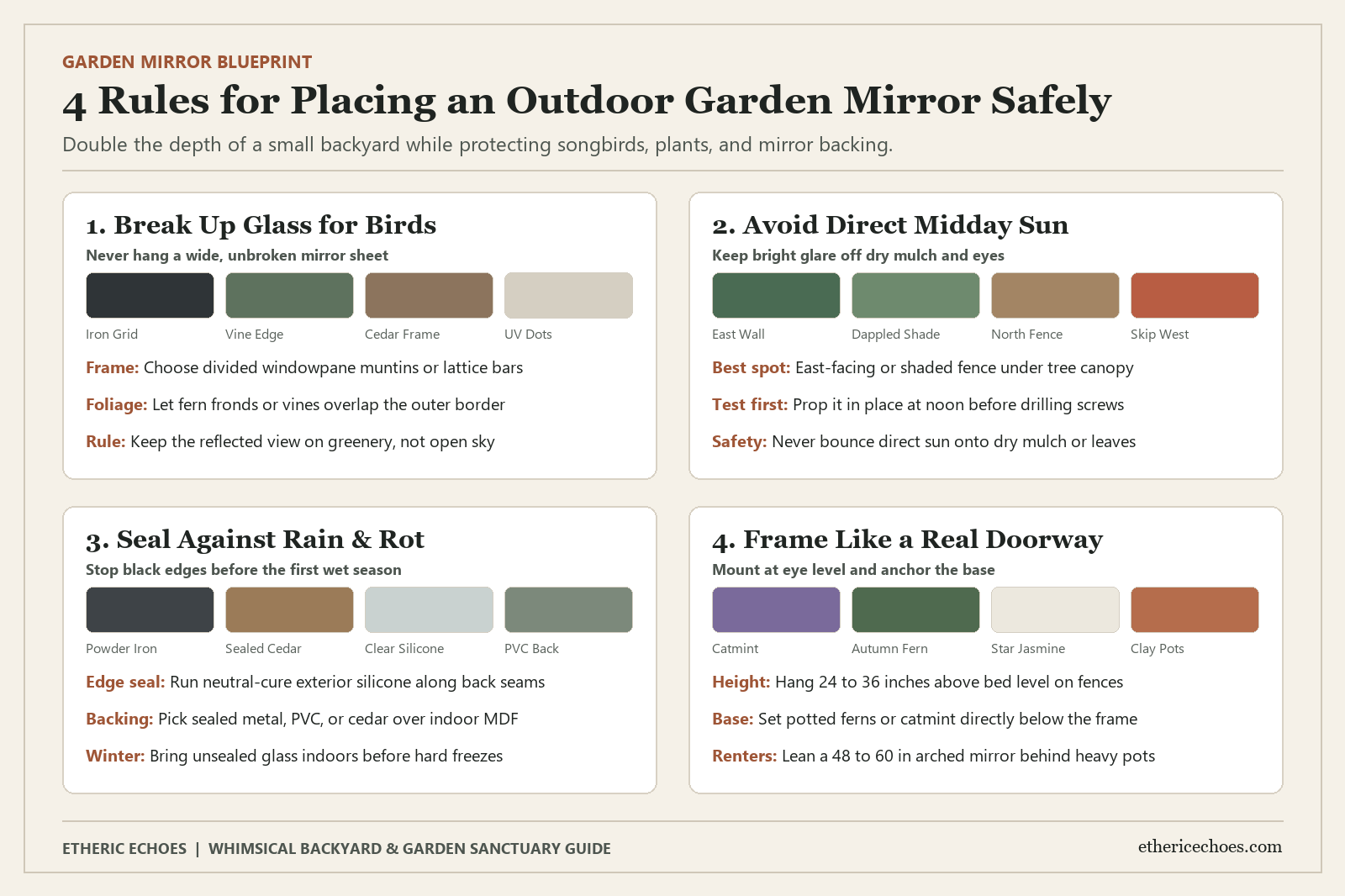
Backyard wildlife always comes before decor. Songbirds cannot tell the difference between real trees and a wide, unbroken reflection of trees or open sky, which is why plain sheet mirrors can cause painful strikes or make territorial robins and cardinals peck at their own reflection for hours.
Three simple choices prevent that problem right from day one:
- Pick divided panes every time. Windowpane muntins, iron lattice bars, or arched grid overlays spaced roughly 4 to 6 inches apart signal a solid surface to flying birds while giving the mirror its cottage doorway charm.
- Let real leaves touch the edges. Train climbing vines over the top arch and set taller ferns or catmint stems across the lower corners so the border feels irregular and broken up.
- Reflect greenery, never open sky. Tilt or angle the mirror slightly toward dense garden beds, a pergola post, or a shaded stone path instead of pointing straight up at bright clouds. If you ever notice a territorial bird fluttering near the glass during spring nesting season, temporarily drape soft garden netting or shift a potted fern in front of the lower panes for two weeks until nesting settles.
Sun angles, reflection tests, and avoiding scorch spots
A flat mirror reflects sunlight back at the same angle it hits, and a curved or decorative convex mirror can concentrate heat like a weak magnifying glass. Never guess the reflection angle from memory.
Carry the mirror out on a sunny afternoon between noon and 3 p.m., prop it safely against the fence where you plan to hang it, and walk around your yard for two minutes:
- Best orientations: East-facing walls (gentle morning light only), north-facing fences, and spots tucked under a mature tree canopy or deep porch overhang.
- Spots to skip: Unshaded south- and west-facing fences that take four or more hours of harsh afternoon sun, especially anywhere the bounce hits dry pine straw, cedar mulch, dead leaves, or your neighbor’s kitchen window.
- Check the sightline from your chair: Sit where you actually drink morning coffee and check what shows up inside the frame. Aim for blooming hydrangeas, ornamental grasses, or a shady path rather than trash cans, the AC unit, or the back of a shed.
Weatherproofing and mounting so your mirror lasts past one winter
Standard indoor mirrors use thin cardboard or MDF backing and unsealed silver edges. After one wet spring, moisture creeps behind the glass and turns the perimeter into dark, flaky black spots.
| Mirror feature | Holds up outdoors | Skip for backyard use |
|---|---|---|
| Frame material | Powder-coated iron, galvanized steel, or sealed western red cedar | Painted MDF, raw particleboard, or thin indoor plastic |
| Reflective surface | Exterior-grade sealed mirror glass or thick outdoor acrylic mirror | Unsealed bargain frameless wall mirrors |
| Rear backing | Weatherproof PVC board, sealed metal sheet, or treated marine plywood | Cardboard or raw fiberboard backing |
| Mounting hardware | Exterior-rated stainless screws, French cleats, or brick masonry anchors | Indoor drywall sawtooth hangers or adhesive strips |
Even on a mirror labeled for outdoor use, spend ten minutes sealing the rear perimeter seam with a continuous bead of clear neutral-cure exterior silicone (avoid standard acidic acetoxy caulk, which can corrode mirror silvering over time). Let it cure completely indoors for 24 hours before hanging.
If you live in USDA Zones 3 through 5 where wet autumn nights turn into hard sub-freezing snaps, either choose an exterior acrylic mirror or unhook glass mirrors in late November and store them dry in the garage until spring thaw.
Best framing plants for a garden mirror (by sun and zone)
The right plants blur the hard rectangle where the mirror meets the fence, turning a hanging object into a believable garden portal. Stick to restrained, tidy growers so you are not hacking vines off the glass every Sunday.
| Plant | Mature size | Light | USDA Zones | Why it works around a mirror |
|---|---|---|---|---|
| Climbing hydrangea (Hydrangea anomala subsp. petiolaris) | 15 to 30 ft (slow to start, easy to prune) | Part shade to shade | 4 to 8 | Lacy white summer clusters that light up shady north fences |
| Sweet autumn or spring clematis (Clematis spp.) | 8 to 12 ft | Sun to part shade | 4 to 9 | Twines lightly up slim iron trellises without heavy woody weight |
| Star jasmine (Trachelospermum jasminoides) | 10 to 15 ft | Sun to part shade | 8 to 10 | Evergreen glossy leaves and fragrant white blooms around arches |
| Autumn fern (Dryopteris erythrosora) | 18 to 24 in | Part to full shade | 5 to 8 | Copper-tinged fronds hide the bottom frame edge all year in mild zones |
| Catmint ‘Walker’s Low’ (Nepeta) | 2 to 2.5 ft | Full sun to part sun | 3 to 8 | Soft lavender spikes spill across the sill without blocking the reflection |
| Sweet alyssum (Lobularia maritima) | 4 to 8 in | Sun to part shade | Annual (Zones 9 to 11 perennial) | Foamy white mounds soften terracotta pots beneath a leaning mirror |
Use this table as a starting plan rather than a nursery guarantee. Mature size, bloom window, and winter hardiness vary by cultivar and local microclimate, so double-check the plant tag or your county extension list before planting.
Helpful pieces to frame and finish a garden mirror corner
You can build a lovely mirror nook with a salvaged window sash and pots you already own. If you need sturdy metal trellises to frame a fence mirror, warm evening light to reflect across the patio, or a shatterproof reflective accent for a breezy yard where glass feels risky, these verified pieces fit right into the layout.
Affiliate note: Etheric Echoes earns a small commission if you buy through the Amazon links below, at no extra cost to you. Our generated garden photos above illustrate the finished look; linked pieces below help you create a similar effect.
- Framing trellises (
$): Flanking a fence-mounted arched mirror with a pair of matte-black metal trellises gives clematis or star jasmine clean vertical rungs to climb while visually widening the “doorway” by two extra feet. - Warm solar string lights (
$): Draping one 27-foot warm-white solar strand above the mirror doubles your cozy patio glow after sunset with zero outdoor wiring. - Stainless-steel reflective alternative (
$): If kids, dogs, or gusty winds make wall-mounted glass a worry, a shatterproof 10-inch mirrored steel globe tucked among ferns delivers that same bright reflection safely. Pair it with our full gazing ball garden ideas or hang a gentle breeze accent from our whimsical wind chime ideas nearby.
Frequently Asked Questions
Are outdoor garden mirrors safe for backyard birds?
Solid, unbroken sheets of mirror glass can confuse songbirds into flying toward reflected trees or sky. Choose a mirror with divided windowpane grids or iron muntins, let vines or fern fronds overlap the outer edges, and angle the glass toward dense planting beds rather than open sky.
Where should you place a garden mirror so it does not cause sun glare or scorch plants?
Mount outdoor mirrors on an east-facing fence, a north-facing wall, or in dappled shade under a tree canopy. Always prop the mirror in place around midday before screwing it in to make sure it never bounces direct afternoon sun onto dry mulch, wooden fences, or seating.
How do you weatherproof a mirror for outdoor backyard use?
Start with a frame made of powder-coated iron, galvanized metal, or sealed cedar instead of indoor MDF, then run a continuous bead of clear neutral-cure exterior silicone around the rear perimeter seam so rain and humidity cannot creep behind the silver backing and cause black edges.
How high should you hang an outdoor garden mirror on a fence?
Hang an arched fence mirror 24 to 36 inches above the top of the flower bed so the bottom edge sits just behind mid-height foliage like catmint or ferns. That puts the reflection at natural eye level and makes the mirror read like a real garden gate or doorway.
Can renters use garden mirrors without drilling into a patio wall or fence?
Yes. Lean a tall 48 to 60 inch arched outdoor mirror securely against a shaded patio wall or shed behind a tight cluster of heavy clay or stone pots filled with ferns and hostas. The pots anchor the base against breezes while hiding the bottom frame edge.
What are the best climbing plants to frame an outdoor garden mirror?
Pick manageable climbers that soften the outline without swallowing the glass in one summer: spring clematis (USDA Zones 4 to 9), climbing hydrangea for shade (Zones 4 to 8), star jasmine in warmer climates (Zones 8 to 10), or trailing creeping fig on brick walls (Zones 8 to 11).