A string of lights along a porch rail looks like a five minute job. It is, right up until you need somewhere to plug it in.
That is the part almost every Christmas porch decor guide skips. They show you the finished photograph and leave the electricity to luck: nothing about the outlet, nothing about the cord you are about to run across a wet step, nothing about what a January wind does to a garland hung with staples.
So this starts there. The pretty part comes after, and it needs less than you think: a small porch looks better with three good things on it than with twelve.
Start With the Porch You Have, Not the Photo
Before you buy anything, answer two questions. They decide almost everything else.
Is it covered or open? A covered porch has a roof over it, so decorations sit out of direct rain and snow. An open stoop, a balcony, or a shared apartment landing does not. That changes how long fresh greenery lasts, and whether a ribbon stays a ribbon or turns into a wet rag by the second week.
How much surface do you actually have? Not how much you wish you had. Measure it:
- The width of the door, so a wreath is in proportion instead of swallowing it
- The length of usable porch railing, in feet, because that number is what you buy lights against
- The clear floor space left after the door swings open, which on a one step porch is often about two feet
- The distance from your decorations to the nearest outdoor outlet, the measurement people skip and the one that sends them back to the store
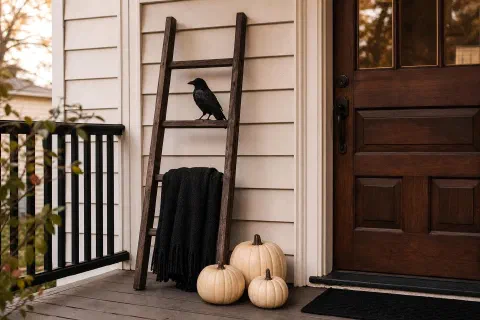
If your whole porch is one step and four feet of rail, you are decorating a doorway rather than a porch, and that is fine. The thinking that makes a small porch work in fall works in December: one vertical element, one thing at ground level, one thing on the door. Stop there.
If you own the home and are considering a permanent roofline system instead of seasonal strands, compare Govee Permanent Outdoor Lights 2 and Pro before choosing the run. That is a separate installation decision from decorating a porch rail.
The GFCI Rule Almost Nobody Mentions
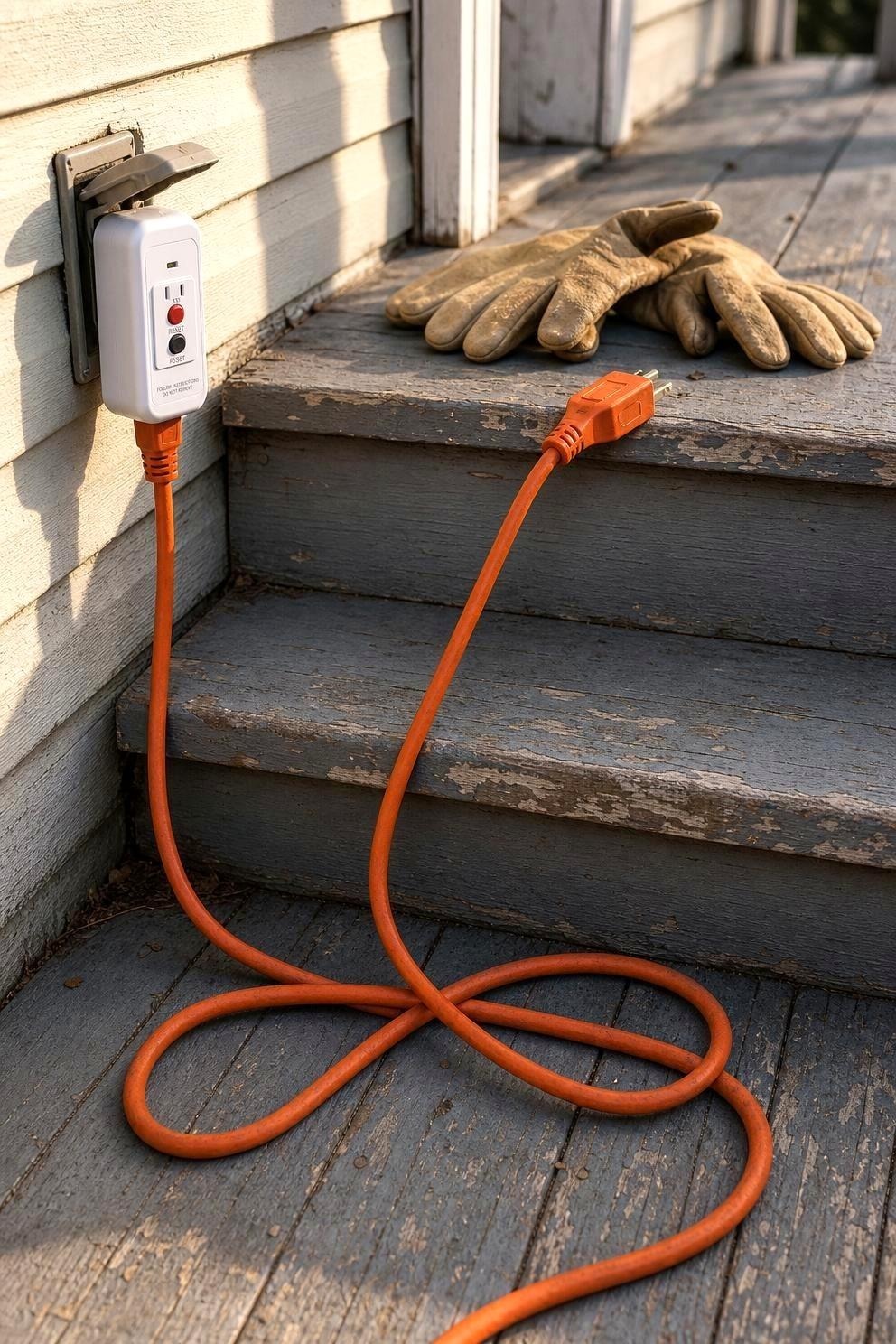
The single most useful thing on this page. Outdoor lights and decorations should be plugged into GFCI protected circuits. That is the direction in NFPA’s home safety messaging, which calls for GFCIs outdoors and anywhere else electricity is used near water. A GFCI is the outlet with the little TEST and RESET buttons on it. It watches for electricity going somewhere it should not, like through standing water or through you, and cuts power fast.
Outdoor receptacles at homes are required to have that protection under the National Electrical Code, section 210.8(A)(3), as explained by the International Association of Electrical Inspectors. The scope has changed between code editions and older houses were built to older rules, so “required” does not mean “definitely present at your address.” Go look at the outlet.
If yours has no test and reset buttons, the fix is easy. ESFI notes that portable outdoor GFCIs are sold at electrical supply stores and need no special knowledge or equipment to install. You plug it into the outlet, then plug your lights into it. That is the whole install, and for a renter it is the whole answer: you cannot rewire anything, but a portable GFCI is yours and it moves with you.
Two more habits from the same ESFI guidance, both easy to forget once you are cold and want to be done:
- Keep cords and light strings clear of snow and standing water. The low corner of a porch where meltwater collects is exactly where a plug should not sit.
- Fasten lights securely so wind cannot whip them around, but not in a way that damages the cord’s insulation. Cinching a zip tie down hard enough to bite into the jacket defeats the point.
Which Extension Cord Gauge to Choose
Most porches need a cord, and most people grab whichever one is in the garage. That cord is doing real work, and the wrong one runs warm.
Start with the letters printed on the jacket. W means the cord is rated for outdoor use. That is the letter to look for. The others describe the build: S is general use, J means 300 volt insulation, T is vinyl thermoplastic, P is parallel wire, O is oil resistant, and E is TPE.
Then match the cord to its length and the amperage you are drawing. A longer cord loses more along the way, so it needs thicker wire, and a lower gauge number means thicker wire:
| Cord length | 16 gauge | 14 gauge | 12 gauge | 10 gauge |
|---|---|---|---|---|
| 25 to 50 ft | 1 to 13 A | 14 to 15 A | 16 to 20 A | 16 to 20 A |
| 100 ft | 1 to 10 A | 11 to 13 A | 14 to 15 A | 16 to 20 A |
| 150 ft | not listed | 1 to 7 A | 8 to 10 A | 11 to 15 A |
Read it as a floor, not a target. At 100 feet and 12 amps, 16 gauge is not enough and 14 gauge is the honest minimum.
Four rules from the same source, and they are the ones broken every December:
- One cord, one appliance. Not one cord feeding a splitter feeding three things.
- Do not run cords through doorways or walls. A door closing on a cord all season is a slow injury to the insulation.
- Do not chain multiple plug outlets together. Power strips into power strips is the classic version.
- A cord is temporary, not permanent wiring. If the cord has lived in that spot since last Christmas, that is a sign you need an outlet there, not a longer cord.
How Many Light Strings Can Go End to End
You have seen the warning on the box and ignored it. Here is the arithmetic behind it.
Specialist lighting retailers publish working numbers, and I want to be straight about where these come from: this is trade guidance, not a published standard. The underlying safety standard is paywalled. The number that governs your lights is the maximum connectivity rating printed on your own box, and both trade sources say so.
According to Christmas Lights Etc, with Christmas Light Source in agreement:
| Mini light string | Watts per string | Strings end to end |
|---|---|---|
| Incandescent | about 41 W | roughly 5 |
| LED | about 5 W | up to roughly 43 |
That gap is the whole argument for LED on a porch, and it has nothing to do with bulb color. Five incandescent strings is your entire run. With LED you will run out of railing long before you run out of circuit.
Now the circuit those strings plug into. The same source gives the household figures:
- A 15 amp circuit supports 1,800 watts, with 80 percent working capacity at 1,440 watts
- A 20 amp circuit supports 2,400 watts, with 80 percent working capacity at 1,920 watts
Use the working capacity, not the maximum. That margin exists because a circuit run flat out for six hours a night is a circuit asking for trouble, and your porch outlet is very likely sharing it with something indoors.
Run your own numbers before you buy. Twelve LED strings at about 5 watts is roughly 60 watts, which is nothing. Twelve incandescent strings at about 41 watts is roughly 492 watts, a third of a 15 amp circuit’s working capacity for one porch railing.
This is where one major retailer’s guide falls down. It tells you to plan on 100 lights for every 6 to 8 feet of railing, cites nothing, and never converts that into watts or amps. So it cannot tell you the one thing you need to know, which is whether your outlet will carry it.
The UL Mark Is a Two Second Check
Holding two similar boxes in a store, this is the fastest way to tell them apart.
UL Standards & Engagement explains that decorative lighting strands, wreaths, light sculptures and motorized displays are covered by UL 588, and that lights certified to it are put through rain tests, water immersion tests and UV exposure tests. GFCI devices fall under UL 943, and automatic timers conform to UL 60730-2-7.
Then the part that saves you: read the wording on the tag, not the picture on the box. A strand rated for indoor and outdoor use says so on its label, and a strand marked indoor only is the quiet mistake behind a lot of dead displays in January. This is also the check that matters most for the box you bought last year and cannot remember the origin of. Find the tag.
Two habits worth adopting, and neither one shows up on a label. Use plastic hooks when hanging lights, because metal nails and staples can damage the wires. And keep the cord from being pinched where it passes a door, a rail, or a window sash, since a jacket that gets crushed all season is a jacket that fails in February.
ESFI says the same in different words: everything you put outside, cords and decorations both, must be marked for outdoor use, and you match the product’s amperage to the cord’s amperage rating.
Renter Safe Ways to Hang It Without Drilling
Nothing here needs a drill, and nothing here leaves a mark.
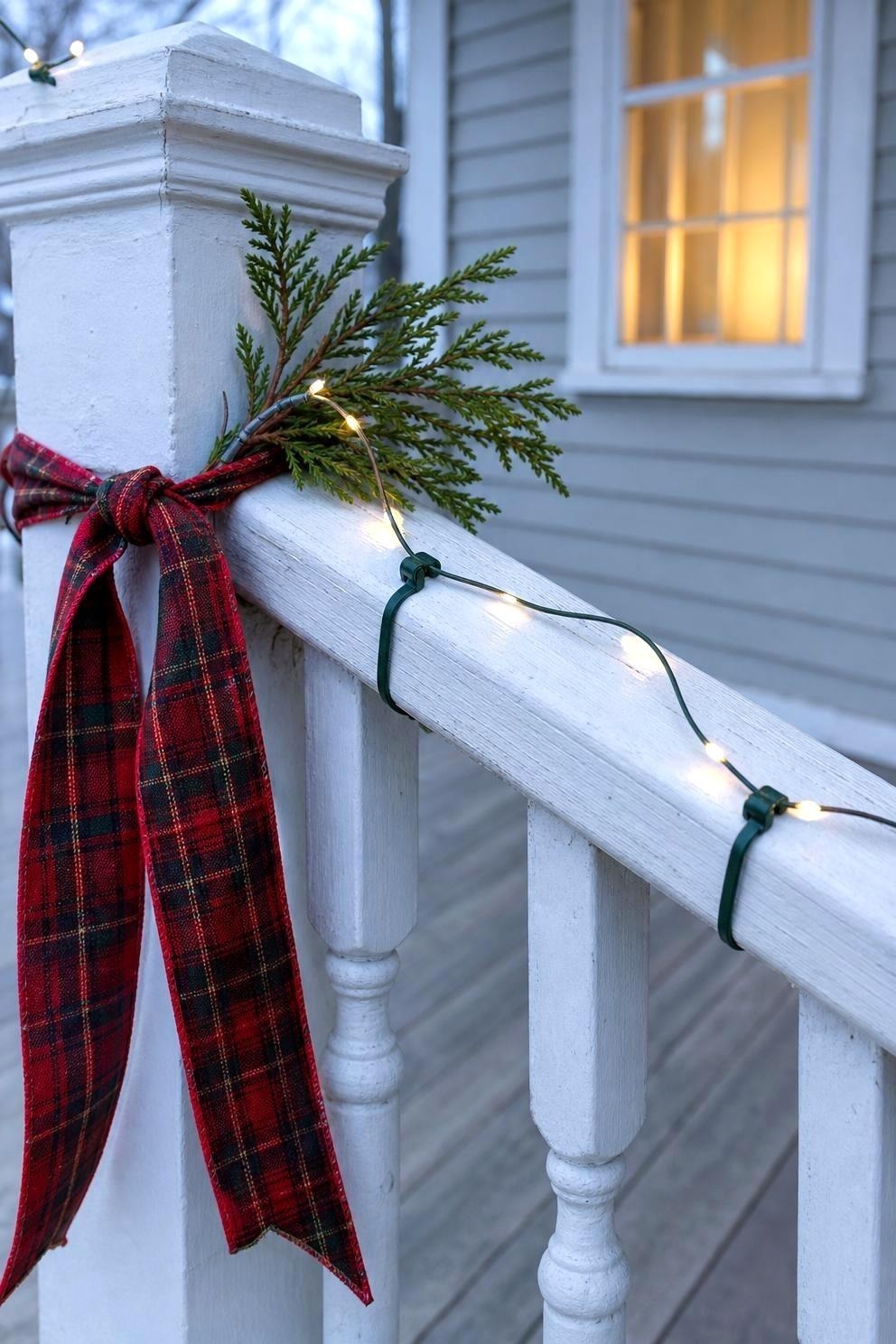
On the railing. Wrap the strand loosely around the porch railing rather than pulling it taut. A taut strand has nowhere to go when it contracts in the cold, and a loose spiral looks fuller anyway. Plastic clips made for the job hold it without a fastener touching the wire.
On the door. An over the door hanger carries a wreath with no hardware at all, and on a metal door a strong magnetic hook does the same. Check the weight rating, then hang something lighter than it, because a wreath soaks up rain and gains weight.
On the ceiling of a covered porch. Adhesive hooks rated for outdoor use, on a clean dry surface on a mild day. Cold is why adhesive hooks fail, so put them up before the temperature drops and let them cure before you load them.
On the floor. Two pots flanking the step is the cheapest strong move on a small porch. Nothing attaches to anything, and it reads as intentional from the sidewalk.
On the posts. Ribbon spiraled down a post, tied top and bottom, no hardware.
Same instinct as the no drill fixes that keep a balcony usable: if it does not attach to the building, your deposit is not part of the conversation.
Wind is what will undo all of it. A porch is a funnel, and a gust a garden shrugs off will take a bow off a railing. Tie both ends of anything long, not just the top. Weight the pots with gravel or sand. And keep to ESFI’s line about fastening securely without damaging the insulation: firm enough that nothing swings, gentle enough that nothing bites into a cord.
Ladders: the Boring Paragraph That Matters
Going above head height, ESFI’s outdoor guidance is short and specific.
- Use a wooden or fiberglass ladder, not metal.
- Keep yourself and your equipment at least 10 feet from power lines.
- A ladder should extend at least three feet past the roof edge.
On a small porch you can skip the ladder entirely, which is one more argument for keeping everything at railing height and below. What you can reach flat footed in December, you can also take down in the cold and the dark in January.
Fresh-Cut Greenery, and Keeping It From Turning Into Fuel
Real cedar and fir smell like the whole season, and I understand the pull. Just be clear about what you bought: fresh-cut greenery is a plant severed from its roots, and from the day you hang it, it is drying out.
That matters because of what usually goes with it. One competitor guide is built entirely around fresh-cut fir and pine and then tells you to run lights through it, without mentioning drying once. Dry needles and a heat source in the same wreath is worth ten seconds of thought.
So, practically:
- On a covered porch, out of rain and direct sun, cut greenery holds far longer than it does on an exposed stoop that swings between wet and freezing.
- Check it by hand every week or so. When needles come away at a touch and stems snap instead of bending, it is done being decoration. I am not going to hand you a number of days, because it depends entirely on your weather, and anyone who does is guessing.
- Dry greenery near a heat source is a fire question, not a decorating one. Clemson Cooperative Extension puts it plainly: dried evergreens can become flammable in close contact with a candle flame or a fireplace, and wreaths on a door behind a sun-facing glass storm door can scorch from reflected heat alone.
- If you are lighting greenery, LED is the sensible choice for the reason above and one more: it runs cool.
- Faux garland with real greenery tucked in gives you the smell for a few weeks and a shape that lasts all season. It is also what most of those photographs actually are.
- Citrus slices, pine cones and cinnamon sticks freeze and thaw without complaint, which is more than most decorations manage.
Frost decides the rest. Anything glued rather than mechanically fixed tends to let go after the first hard freeze and thaw, and anything hollow that can hold water will hold it, freeze, and split. Terracotta pots full of wet soil crack for that reason, which is why the porch pots that make it to New Year’s tend to be resin, metal, or wood.
Garland on a porch rail is its own set of problems, because wind and UV do more damage out there than cold does, and outdoor Christmas garland that survives winter covers how it is secured, how the cord reaches it, and how much length a rail actually takes.
The Small Porch Plan, Start to Finish
An afternoon, in order. Doing it in this sequence saves you the trip back to the store.
- Find the outlet first. Confirm it has TEST and RESET buttons. If it does not, buy a portable outdoor GFCI before you buy anything else.
- Measure the railing and the door. Feet of rail, width of door, distance from decorations to that outlet.
- Buy to those numbers, checking every tag for an indoor and outdoor rating and every cord jacket for a W. Match the amperage of what you are plugging in to the amperage rating of the cord.
- Do the floor first. Two pots flanking the step, weighted, before anything goes up. It sets the proportions for everything else.
- Then the door. Wreath on an over the door hanger or a magnetic hook.
- Then the lights. Loose wrap along the porch railing, plastic clips, tied off at both ends.
- Then the cord run. Route it where meltwater does not collect, off the step, not through a doorway, one cord to one thing.
- Plug in and watch it for ten minutes before you go inside. A warm plug or a flickering section is telling you something now rather than at 2 a.m.
A timer makes the whole thing hands off, and it gets the same treatment as everything else out there: marked for outdoor use, nothing else.
Questions People Actually Ask
How can I decorate my porch for Christmas?
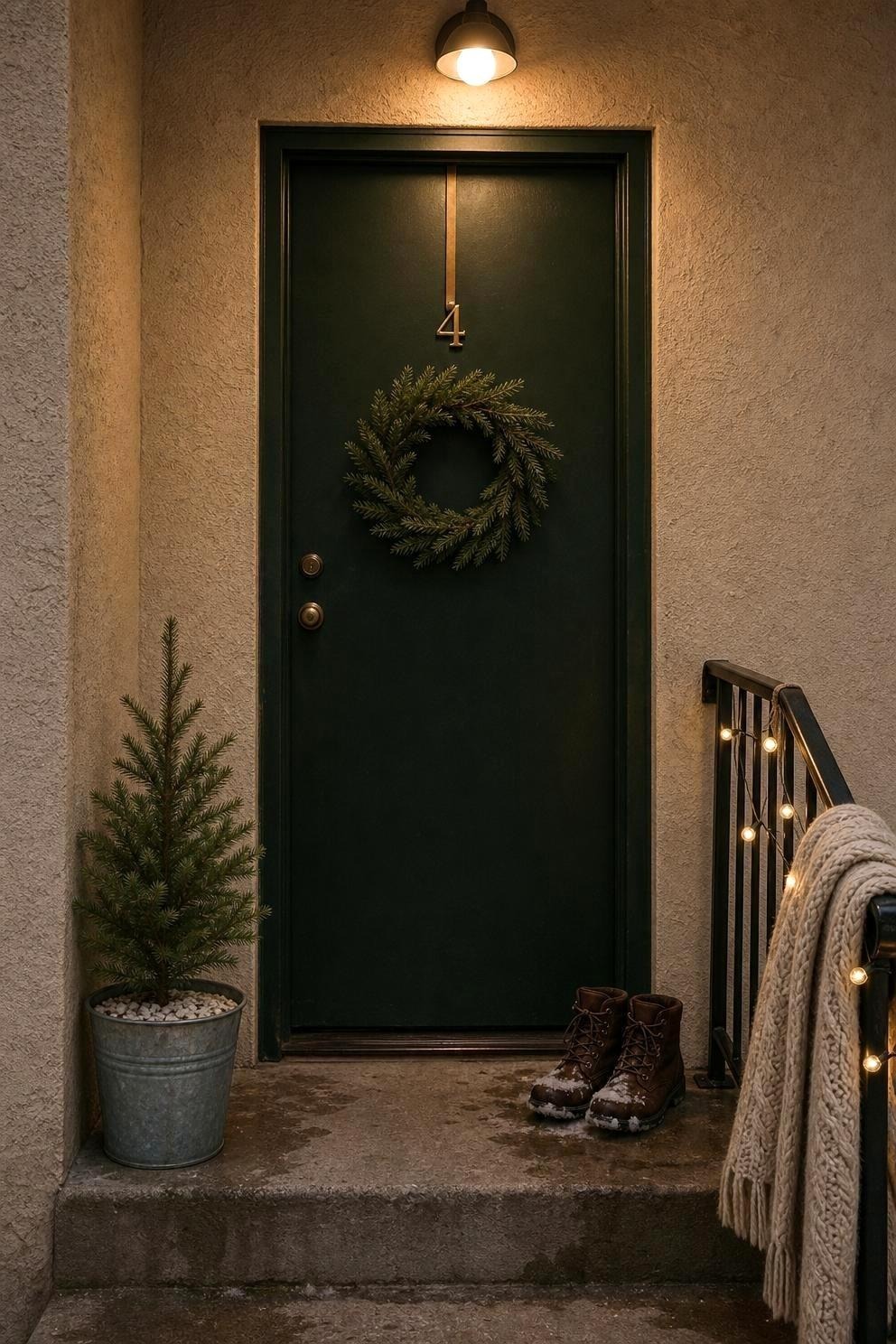
Work outward from the door in three layers. One thing on the door, usually a wreath sized to the door rather than the porch. One thing at ground level, usually a pair of pots flanking the step. One thing that carries light, usually a strand along the railing. Sort the outlet and the cord before you buy any of it, because that decides whether the light layer is possible where you are standing. On a small porch those three layers are the whole job, and a fourth is what tips it into cluttered.
How to elegantly decorate outside for Christmas?
Restraint and repetition. Pick one palette and hold it: deep green and warm white will carry a whole porch, with a single accent color at most. Repeat shapes rather than mixing them, so two matching pots beat two different ones, and one continuous run of light beats three strands doing different things. Keep things at consistent heights. Warm white reads quieter than multicolor, and anything inflatable or motorized is working against you. Then stop earlier than feels natural. The porches that look expensive are almost always the emptier ones.
What are some good Christmas decorations for outside?
The ones that survive weather. A wreath on the door, evergreen or faux, on hardware rated for more weight than it starts at. Potted evergreens beside the step in resin, metal or wood, weighted with gravel. Lights whose tag says indoor and outdoor, LED for the reason in the table above. Outdoor rated ribbon tied at both ends. Lanterns with flameless candles, on the floor rather than perched somewhere they can be knocked over. Pine cones and citrus slices, which freeze and thaw without caring. What does poorly: paper, real flames, a strand labelled indoor only, and anything glued together.
How can I make the outside of my house look Christmassy?
Light and a focal point, in that order. Light is what reads from the street after 4 p.m., which in December is most of the time anyone sees your house, and one well lit element beats decorations scattered over a dark facade. Then give the eye one place to land, which for most homes is the front door. Wreath, lit railing, pots at the step, done. If you want more, add it symmetrically rather than adding more kinds of thing. And check the numbers before you scale up, because every strand is watts on a circuit. The same instincts that work on a small patio apply here: warm and low beats bright and everywhere.
What I’d Actually Buy
Checked on Amazon on August 25, 2026, sorted by best sellers. Ratings and availability move, so check the listing before ordering.
Note what is missing from this list: string lights. That is deliberate. The label check matters more than the brand, and it is a check only you can do standing in the aisle. Buy whichever lights you like carrying the mark that says indoor and outdoor.
- Command outdoor light clips, 20 clips with weather-resistant strips (opens Amazon in a new tab)As an Amazon Associate, we earn from qualifying purchases. Full disclosure. at 4.4 stars across roughly 27,300 ratings. These are the plastic-hook answer to the metal nails and staples problem, and they come off in spring without taking paint with them.
- BN-LINK outdoor 24-hour mechanical timer (opens Amazon in a new tab)As an Amazon Associate, we earn from qualifying purchases. Full disclosure. at 4.5 stars across about 32,800 ratings. A timer is the habit that stops a display sitting energized overnight in the rain, and the mechanical one is the version that keeps working when the power blinks.
- BN-LINK outdoor 7-day programmable timer (opens Amazon in a new tab)As an Amazon Associate, we earn from qualifying purchases. Full disclosure. at 4.3 stars, if you want different hours at the weekend.
- Southwire Woods 50 ft outdoor extension cord (opens Amazon in a new tab)As an Amazon Associate, we earn from qualifying purchases. Full disclosure. at 4.6 stars across roughly 6,400 ratings. Check the jacket for the W before you buy any cord, and match the gauge to the length using the table above rather than grabbing whatever is nearest.
- Outdoor lanterns, set of 2 (opens Amazon in a new tab)As an Amazon Associate, we earn from qualifying purchases. Full disclosure. at 4.5 stars, for the part of the porch that wants light without another thing plugged in.
What to Read Next
- Christmas planter ideas for indoors and outside has the step-by-step porch-pot build, a narrow balcony version, and a design that stays up after Christmas.
- Fall front porch decor for a small porch uses the same three layer approach on a porch this size, one season earlier.
- Christmas mantel decor covers the garland math and the fixings for the room your porch leads into.
- Fall balcony ideas for small apartments is the no drill playbook if your outdoor space is a landing rather than a porch.
- Cozy front porch ideas for early spring is where to go in January when everything comes down and the porch looks bare.