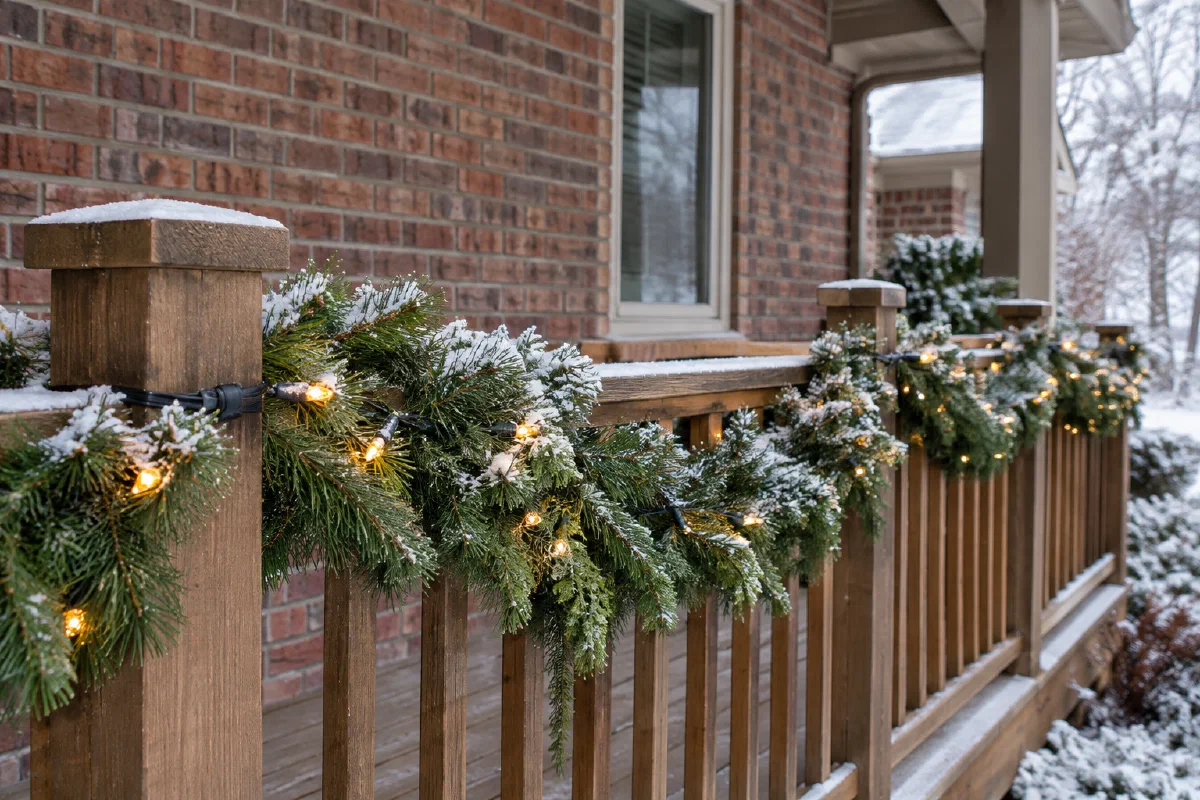
The garland looks fine on the day you hang it. Then the first real wind comes through, and by morning it is swinging off the rail, the plug is sitting in a puddle, and half the run has gone dark.
Most guides show the finished porch and skip week three: how wind pulls garland down, where the power comes from, and how much length to buy.
Outdoor Rated vs Indoor/Outdoor: What the Tag Actually Says
“Indoor/outdoor” is a phrase a marketing team can print on a box. A weather rating is tested, and it usually sits on the tag near the plug, not the front of the package.
- Dry location. Indoor only.
- Damp location. Covered outdoor areas, where weather reaches it but water does not sit on it.
- Wet location. Direct rain and standing water, which is what a fence line or an open balcony rail needs.
Utah State University Extension says to look for a UL or ETL mark when buying outdoor lights, because it means an independent lab tested the product to recognized safety standards (USU Extension ). The mark alone does not make something outdoor rated, though. A dry location string carries a mark too, so read the mark and the location rating together.
You will also see IP codes, like IP44 or IP65. Those are international protection ratings for dust and water, and the second digit is the water one. IP44 takes splashing water. IP65 takes water sprayed from a nozzle.
| Where it is going | Rating to look for | IP code you will see |
|---|---|---|
| Fence line or open balcony rail | Wet location | IP65 and up |
| Porch rail under a roof | Damp location | IP44 or IP65 |
| Door frame, recessed | Damp location | IP44 or IP65 |
Wind Is What Takes Garland Down, Not Rain
Rain gets the blame. Wind does the damage.
Any outdoor garland is a sail. A 20 foot run, six inches wide, presents about ten square feet of surface to the wind, so a day of 35 mph gusts pushes hard on something held by a few hooks.
The usual hanging method is the problem. Wrapping the light strand around the rail and looping the greenery over it puts the full weight of the garland on the strand, and a strand was engineered to carry bulbs, not load. A 20 foot fresh garland with lights runs 8 to 12 pounds. Add wind and that weight lands on the two or three points where the strand touches the rail. A socket cracks, a wire pulls out of a plug, and half the run goes dark.
Give the garland its own support line instead, so the lights carry nothing.
How to Hang Garland So Wind Cannot Move It
- Install a support line first. Run 1/8 inch galvanized cable along the rail or fence with an eye hook at each end, plus a turnbuckle so you can take up slack in December.
- Keep spans under 8 feet, anchored every 24 to 36 inches. Utah State University Extension notes that light strings are designed to span only a few feet, with lamp sockets pointed down so moisture cannot collect in them.
- Attach the garland to the wire, never to the lights. Zip ties every 18 inches around the stem bundle and the support wire. No staples.
- Let the light strand hang loose through the greenery. A strand carrying weight is the failure mode from the last section.
- Raise every plug at least six inches off the ground, out of snow and standing water.
A run that survives to January is not the one with the most clips. It is the one where the greenery hangs on a wire, the lights hang on nothing, and very little weight touches any single point.
On a door frame, rest the garland on two hooks at the top corners and one on each side instead of stretching it between them, and the swag will not pull straight by week two.## Extension Cord Routing Off the Walking Path
Start at the outlet. Outdoor outlets should be GFCI protected, meaning the outlet has test and reset buttons or sits on a circuit with a GFCI breaker. A GFCI cuts power when current leaves the circuit where it should not, which is the protection that matters when a cord end is sitting in meltwater. If it trips and the reset will not hold, something on the run is letting current escape, so do not work around it. An unprotected outlet just needs a plug-in GFCI adapter.
Choose the cord by length, not by price. A 16 gauge cord is fine for a short run of LED strings. At 50 to 100 feet, move up to 14 or 12 gauge, or the lights at the far end dim and quit. University of Kentucky Occupational Health and Safety recommends the shortest cord that works and keeping cords out of walkways and doorways where they get pinched or tripped over (UK OHS ). The cleanest way across a walkway is vertical:
- Plug in at the outlet and drop the cord straight down the wall.
- Cross behind the railing, not over the tread of the steps.
- Zip tie along the back edge of a stair stringer or the outside face of a porch post.
- Tape it down anywhere it has to cross a walking surface. Tape covers the last two feet, it does not fix a bad route.
Keep one outlet doing one job, and add up the amps of every string against the cord and the circuit. A 15 amp circuit is shared with whatever else the porch and the front room are already using.
Fresh Greenery Outdoors Lasts Longer Than Fresh Greenery Indoors
Cold air holds moisture in the needles, and a heated living room pulls it right back out. That is why a fresh indoor garland starts dropping needles in a week or two, while the same garland outside in December sits in cold, humid air and dries far more slowly (UMN Extension ).
Three outdoor catches:
- Sun is harder on greenery than cold. A fence line with full afternoon sun bleaches and dries. A shaded porch rail can look good into January.
- Faux is not immune. Faux greenery is molded plastic, and plastic fades under ultraviolet light. One season looks fine. Three seasons on an exposed fence line and the color has gone flat.
- Take it down after the season. Utah State University Extension notes that outdoor lights are not designed for prolonged sun and weather exposure.
Measure the Run, Then Add for the Dip
Garland length is the one measurement people guess at, and every sag in a swagged run eats extra material.
| Where it goes | How to measure it |
|---|---|
| Porch rail, straight run | Rail length, plus 10 percent |
| Porch rail, swagged | Rail length, plus about 15 percent. Each dip takes about a foot extra |
| Around a door frame | Twice the frame height, plus the width |
| Fence, swagged between posts | Fence length, plus about 15 percent |
A 20 foot porch rail with five swags is about 23 feet straight across and closer to 26 feet once each dip takes its extra foot. Round to 30 feet, in two 15 foot sections, because two pieces are easier on a ladder than one. A standard 36 inch door needs roughly 9 feet: 3 across the top and 3 down each side.
The Problems You Will Actually Hit
- Garland sags into the doorway. The run stretched or the hooks were spaced too far apart. Retighten the support wire and add an anchor at the midpoint.
- The lights trip a breaker. That is an overload, not a bad string. Add up the amps and move one run to another outlet.
- Greenery stains siding or paint. Fresh stems and sap leave marks that will not always wash out, so keep the run a half inch proud of the wall on the support line.
- Half the run is dark. On a pre lit garland you cannot replace one bulb. The strand is molded into the greenery and the plugs are sealed, so a dead section means the whole length is done.
Care Through the Season, and Storage That Survives to Next Year
Ten minutes every couple of weeks is enough.
- After the first hard wind, tighten the ties and the turnbuckle. The first two weeks are when garland settles most.
- Check the cord where it bends around a post corner. That spot cracks first.
- Look at the connections after a warm day. Meltwater is what finds its way into a plug.
Take it down on a dry day above freezing, because cold makes fresh greenery brittle.
- Unplug at the outlet first, then at the cord.
- Cut the zip ties and lift the garland off the wire. Do not pull it off the support line.
- Let the run dry indoors for a day so nothing gets packed wet.
- Coil single strings loosely on a cardboard tube. Wrapping a strand around your elbow kinks the wire.
- Fold fresh garland in a loop no tighter than a hula hoop, or lie it flat in a bin.
- Label the bin by location. “Porch rail 30 ft” saves twenty minutes next November.
What to Read Next
- Pre Lit Christmas Garland That Looks Real : how to judge a strand’s realism once the weather question is settled.
- Christmas Front Door Decor : doorway measurements and layout, since the door frame is the second hardest place to hang garland.
- Christmas Porch Decor : a full porch plan that keeps the entrance clear and the cords hidden.
- Christmas Garland Ideas for a Small Home : short, odd runs where one measured length has to do two jobs.
- Fall Garland Ideas : the same support-line trick on a lighter autumn run, a good way to practice before December.