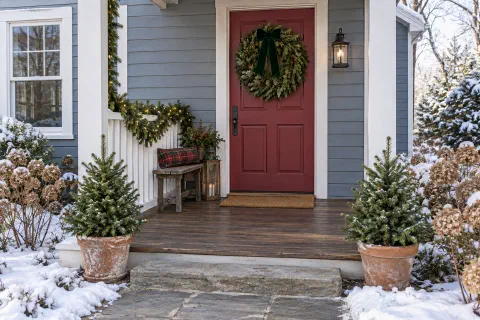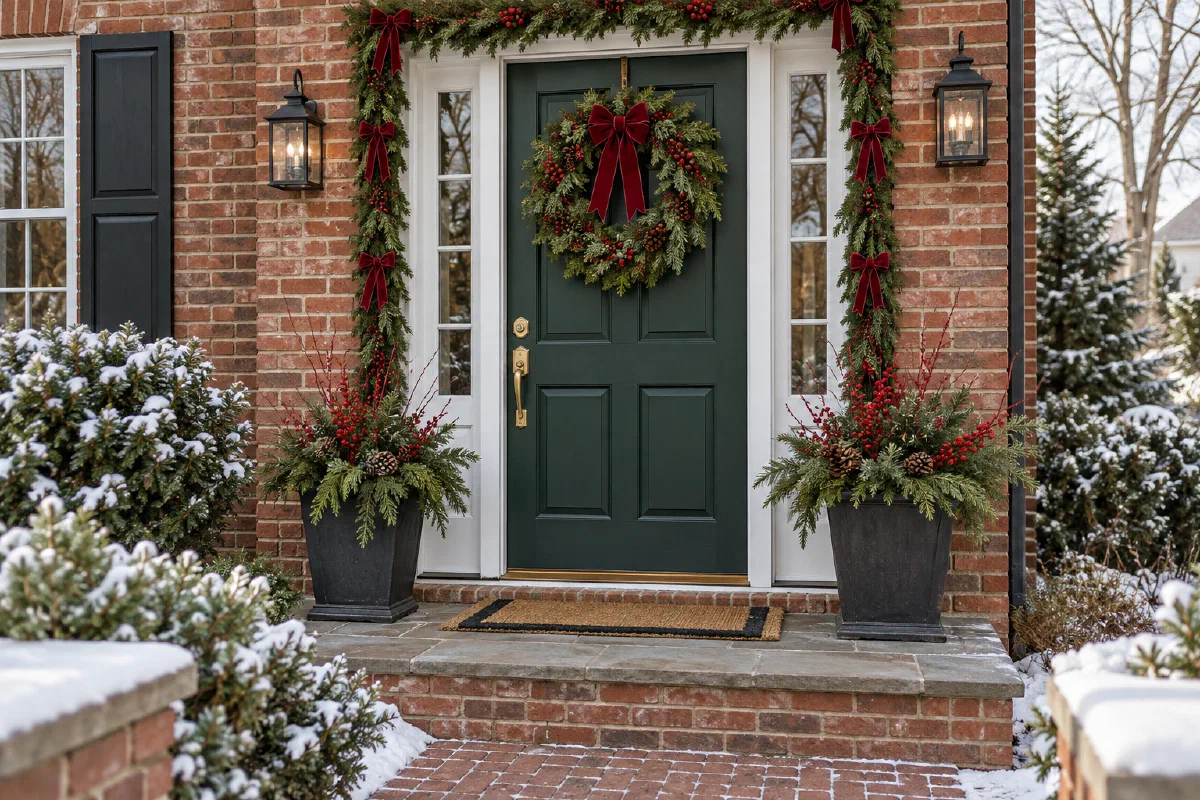
Most Christmas front door decor advice assumes a door that does not exist. A wide slab of bare wood, nothing in front of it, and a homeowner with a drill and permission to use it.
Real front doors are harder than that. Yours might have a storm door sitting two inches out from it. It might be a single sheet of glass. It might be fiberglass, which looks like steel and behaves nothing like it when you press a magnet against it. It might open onto a shared corridor where the door is part of the building’s fire rating.
So this starts with your actual door. Measure it, figure out what it is made of, buy hardware that matches. The decorating gets easy once the hanging problem is solved.
Before You Hang Anything, Check the Door Swing
Stand outside, open the door all the way, and close it. Watch what your hand and the door edge pass through. That is where holiday decor goes to die.
- The swing. A wreath on an inward-opening door meets the wall, the coat hooks, or whoever is behind it. On an outward-opening door it meets the storm door frame. Either way it takes the hit twenty times a day.
- The deadbolt and the knob. Anything hanging over either turns locking up into a two-hand operation. Keep the bottom of the decor above the lock line.
- The peephole. Ribbon tails and long picks drift. If you cannot see out, you will pull the whole thing down by New Year’s.
- The threshold. Anything below knee height gets dragged across the sweep every time the door moves. Trailing garland ends and long ribbon streamers are the usual casualties.
- The paint. A bare wire frame rubbing on every swing polishes a bright ring into the finish by January. Felt furniture pads on the back of the frame stop that.
Do this before you buy. It changes what shape you should be shopping for, and sometimes it decides that the door is not the right surface at all.
If you are dressing a porch, a railing or a fence as well as the door, the weather problem is a different one from the indoor problem, and outdoor Christmas garland that survives winter covers the wind, cord and UV side of it. For the door and stair garland itself, how much garland you actually need is the measurement that stops you buying twice.
Wreath Diameter, Door Width, and Hanging Height
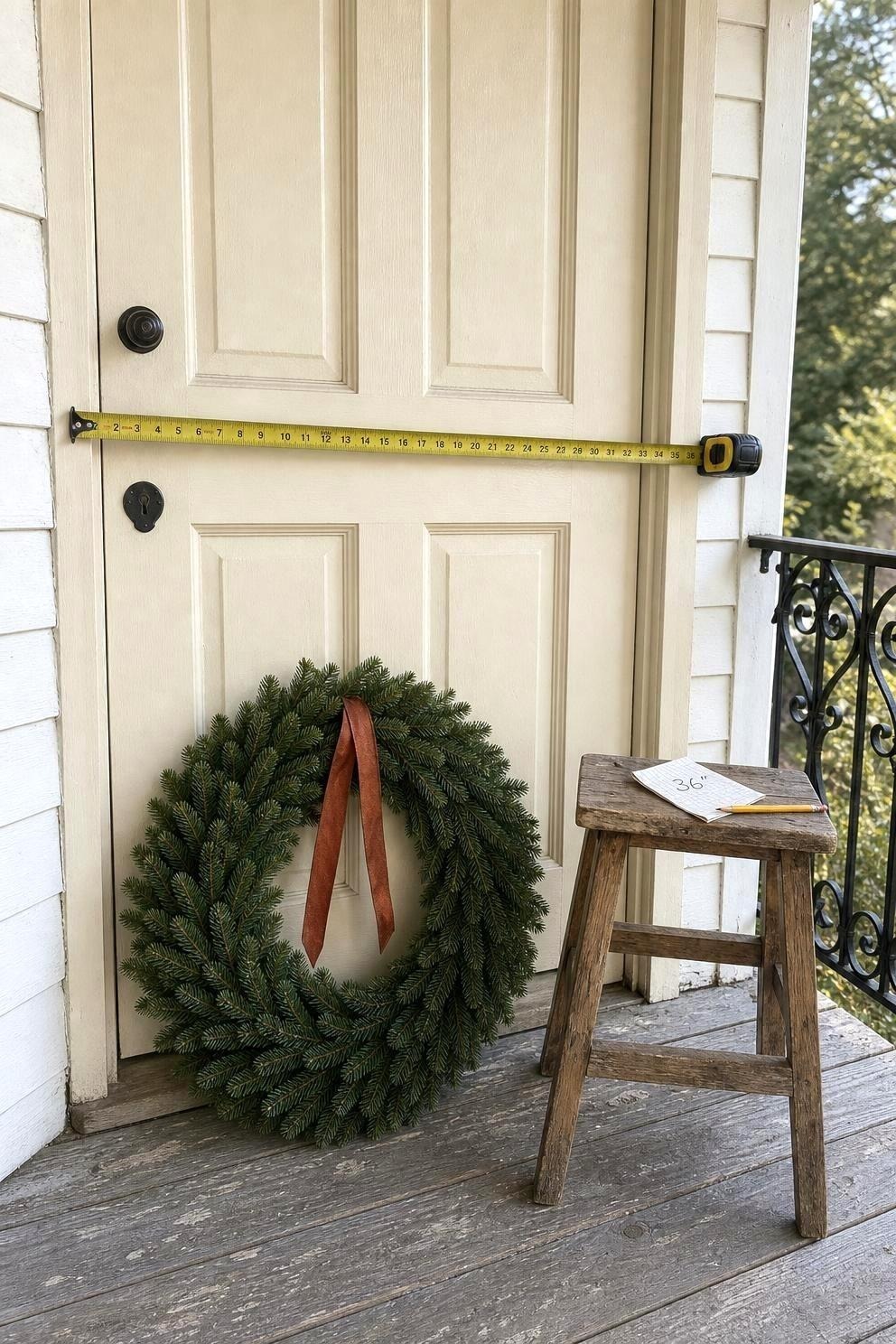
Exterior doors in the US are commonly 36 inches wide, 80 inches tall and 1-3/4 inches thick, with 30, 32 and 42 inch widths also standard. Measure yours anyway. Older houses and apartment conversions do their own thing, and the whole point of measuring is that the wreath has to fit the door you have rather than the average one.
Then use the sizing rule that works: door width minus 12 inches gives the ideal wreath diameter. A 24-inch wreath on a 36-inch door leaves about six inches of door showing on each side (howtomakewreaths.com). That margin is what makes it read as placed rather than parked. Run it on the common widths:
- 30-inch door, 18-inch wreath
- 32-inch door, 20-inch wreath
- 36-inch door, 24-inch wreath
- 42-inch door, 30-inch wreath
One correction, because it sits on a large retailer’s own advice page: some guides tell you to divide door width by three. On a standard 36-inch door that returns a 12-inch wreath, about the size of a dinner plate. Hang it and the door looks like it lost something. Use minus 12.
Height matters as much as diameter. Hang the wreath at eye level, center 57 to 60 inches from the floor (Christmas Designers). Higher reads as an afterthought from the sidewalk, lower collides with the knob. Measure to the center of the wreath, not the hanger, because the hook and the hanging loop add drop you did not plan for.
Which Wreath Hanger Matches Your Door Material
This is the part almost nobody covers, and it is why people end up with a wreath on the porch floor. Steel, fiberglass, wood and glass are four different problems. A magnetic hanger on a fiberglass door is wasted money, because there is no steel in the door for it to grip.
Figure out what you have first. Hold any refrigerator magnet against the center panel. It sticks on steel and slides off a fiberglass door. Wood shows real grain and a visible joint line where the stiles meet the rails.
| Door | What holds a wreath | Watch out for |
|---|---|---|
| Wood | Over-the-door hanger, or an outdoor-rated adhesive hook on a smooth painted area | Hanger hook thickness against the door stop; check the door still latches |
| Steel | Magnetic hanger, over-the-door hanger, adhesive hook | Magnets slide down slick paint on a windy day; place, then press hard |
| Fiberglass | Over-the-door hanger, or an outdoor-rated adhesive hook | Magnets do nothing here; molded grain reduces adhesive contact |
| Full-glass or storm door | Wreath magnets through the glass, or an adhesive hook on the metal frame | Most decorative wreaths are too thick for the gap; double-pane glass defeats most magnets |
| Corridor or fire-rated door | Over-the-door hanger, if the closer and latch still work with it in place | Drilling and adhesives are usually off limits; check the lease and the HOA rules |
Weight is the number that decides everything else, and almost no guide gives it to you. Over-the-door wreath hangers on the market carry stated capacities of 10, 12 and 20 pounds, with an adjustable drop of roughly 5 to 25 inches from the top of the door. A common outdoor-rated adhesive hook is commonly rated to 5 pounds and to a temperature range around minus 20F to 125F.
So weigh the wreath. A dense fir wreath with pinecones and ribbon is heavier than it looks, and it gains weight in rain. Over five pounds, adhesive hooks are the wrong tool no matter how nice the surface is. Over ten, check the hanger’s rating before you trust it. Bathroom scale, wreath on it, ten seconds.
Buy the adjustable-drop kind rather than a fixed one, because that range is what lets you hit the 57 to 60 inch center height. Check the hook arm is thin enough to sit in the gap at the top of the door and still let it close. On weatherstripped exterior doors that gap is tight.
Storm Doors and Glass Doors: The Gap Is the Problem
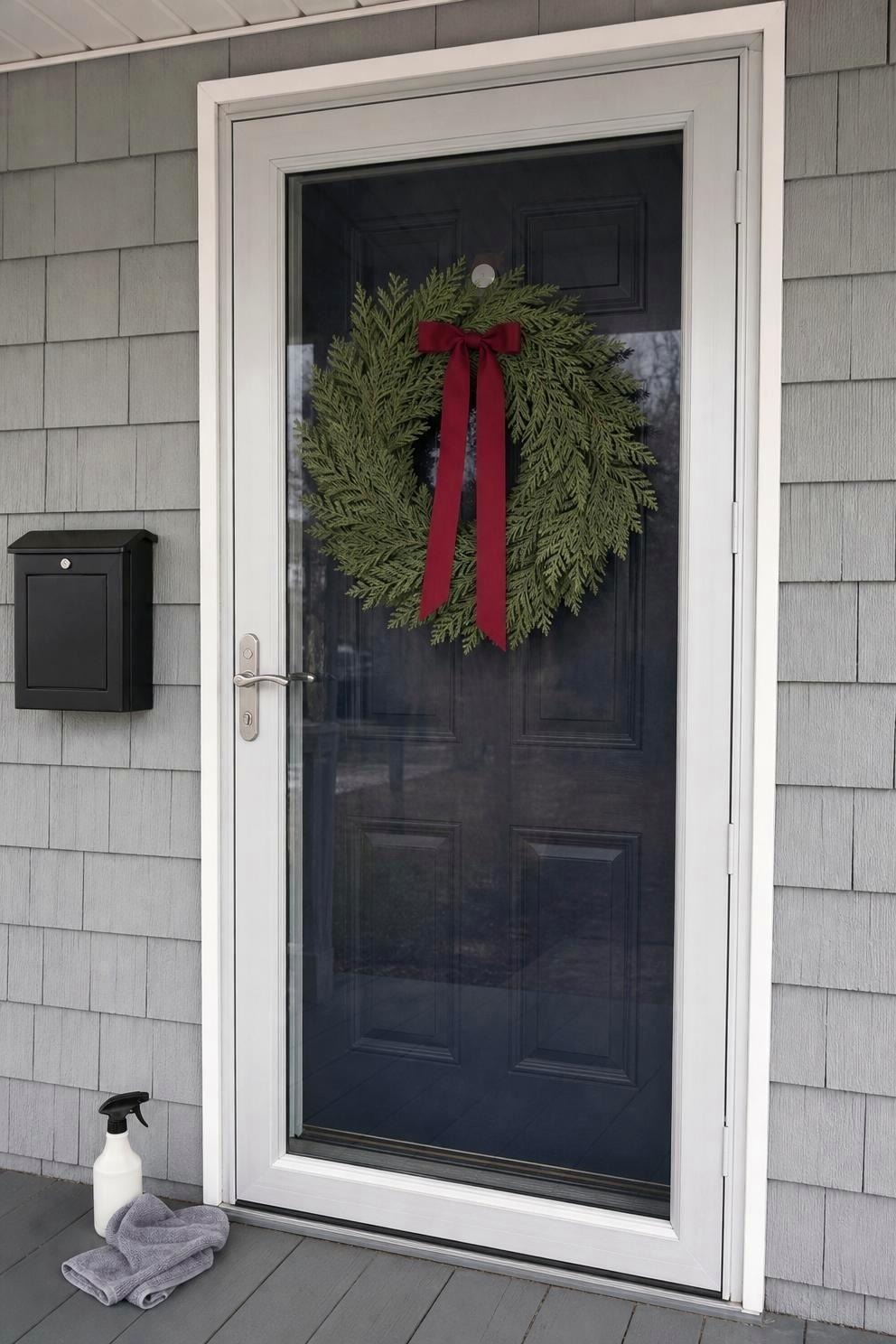
This is the failure almost every ranking article skips. If you have a storm door, the wreath does not go on the entry door, because it will not fit.
Storm door manufacturer Larson is direct about it: most decorative wreaths are too thick for the space between the main door and the storm door (larsondoors.com). You close the storm door, the wreath compresses against the glass, and either the door will not latch or the wreath comes out flat on one side.
Which leaves you decorating the storm door itself. Same source, worth reading before you buy:
- Wreath magnets work best on lightweight wreaths and on single-pane glass. Most are not strong enough to hold through double-pane glass, which is what a lot of newer storm doors have.
- The magnets work in pairs, one inside the glass and one outside, sandwiching the pane between them.
- Where you can, put outdoor-rated adhesive hooks on the storm door’s metal frame rather than on the glass itself.
- Clean and dry the surface before any adhesive goes on it. Cold weather affects how adhesive products behave, so mount them on a mild day rather than the first freezing one.
- If the back of your wreath is rough, add felt to it so it does not scratch the glass.
So buy a deliberately slim wreath for a storm door: flat cedar sprays, eucalyptus, or a wire frame wrapped with ribbon and a few tucked stems. If none of that appeals, move the decor off the door and beside it. There is a section on that below.
The Ten Minute Setup, In Order
Wrong order is how people end up with adhesive hooks stuck two inches off center.
- Weigh the wreath on a bathroom scale. Write the number down.
- Measure the door width and subtract 12 to confirm the wreath is the right size for it.
- Identify the door material with the refrigerator magnet test.
- Pick the hanger from the table above, matched to both the material and the weight.
- Measure 57 to 60 inches up from the porch floor and mark that height lightly with painter’s tape at the door edge. This is the wreath’s center, not the hook.
- Hang the hanger, then hang the wreath, then step back to the sidewalk and look. Adjust before anything is permanent.
- Open and close the door twice with the wreath on it. If it swings, catches, or blocks the lock, fix it now rather than in the dark on Christmas Eve.
Step six matters more than it sounds. A wreath that looks centered from three feet away often reads as low from the street, because you are looking up at it from a different angle.
Renters, Corridor Doors, and HOA Rules
If you rent, three questions decide what you can do. Ask them before you buy anything.
Can anything be attached to the door? Many leases say no fasteners of any kind in an exterior door. An over-the-door hanger attaches to nothing, which is why it is the renter’s default. It hooks over the top edge and comes off in one motion in January.
Is it a corridor door? An apartment door opening into a shared interior hallway is usually a rated fire door with a self-closing mechanism, and it has to latch fully on its own every time. Anything sitting in the gap at the top can stop that. Test it: hang the hanger, open the door wide, let the closer take it. If it does not click shut by itself, take the hanger off.
What does the HOA or the building allow? Many buildings limit corridor decor to the door face, cap how far it may project into the hallway, and set a takedown date. Ask the manager rather than guessing.
If all three go against you, decorate at ground level instead. A lantern beside the threshold, two small potted evergreens, a good doormat. None of it touches the door, which is the same logic behind apartment decor with no mantel needed.
How to Care for Fresh Greenery on an Exposed Door
Fresh greenery is the best-looking option and the one most likely to be a brown pile by mid December. How long it lasts depends on the species and on whether your door is covered.
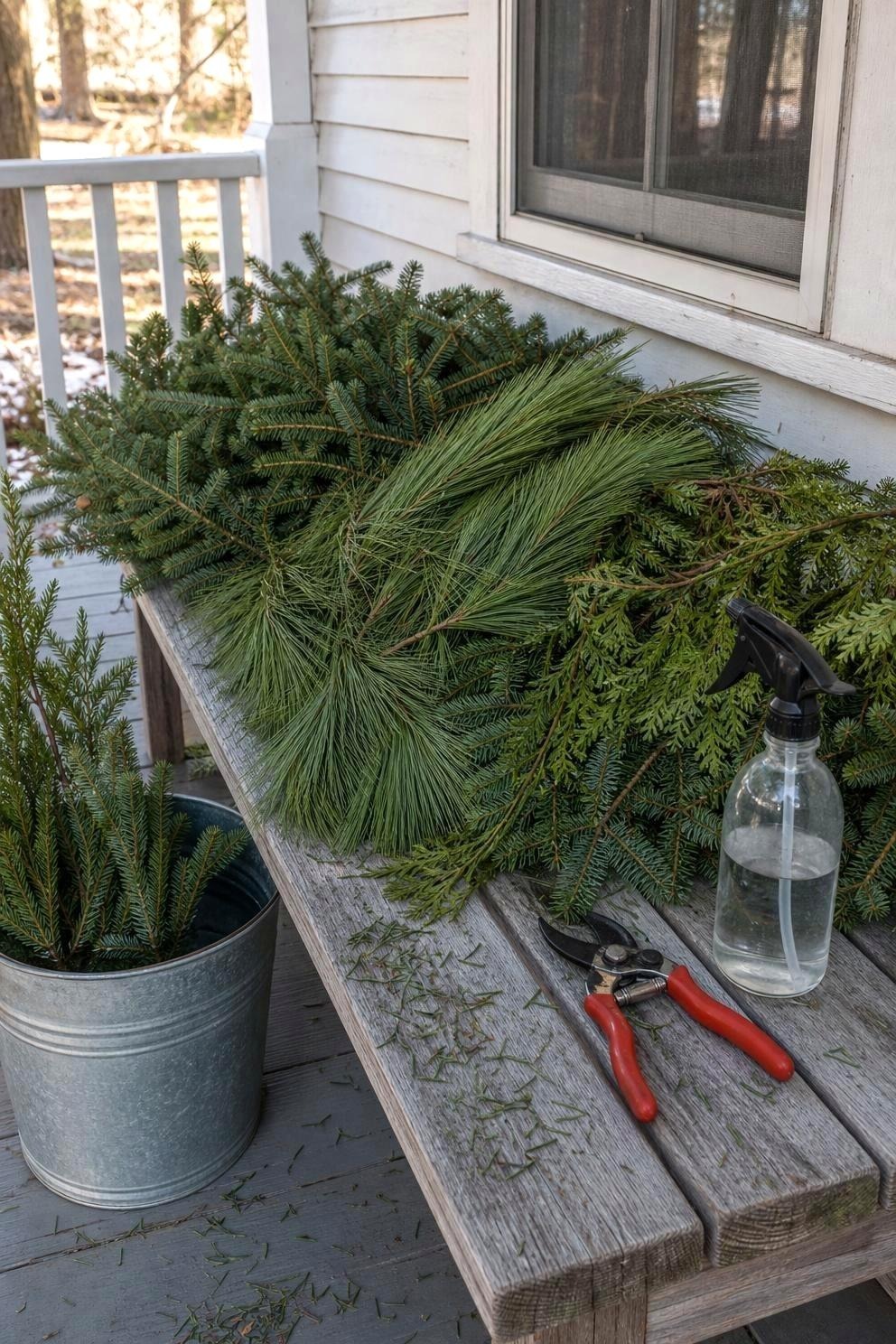
Clemson Cooperative Extension is the clearest source here. Pines, firs and cedars dry out slowly and hold their needles best at warm indoor temperatures, which makes them right for anything sitting inside. For outdoor work, the Extension notes: “Hemlock, spruces, and most broadleaf evergreens will last longer if used outdoors” (Clemson HGIC).
Two steps from the same source make a real difference to how long a fresh wreath holds:
- Soak the cut greenery in water overnight before you arrange it, so the cuttings take up as much moisture as they can hold.
- Let the foliage dry, then spray it with an anti-transpirant such as Wilt-Pruf to seal that moisture in. One exception the Extension is specific about: do not use anti-transpirants on juniper berries, cedar, or blue spruce.
Two safety notes that belong on every greenery article and appear on almost none. Dried evergreens become flammable near a heat source such as a candle flame or a fireplace, so a drying wreath and a real flame stay out of the same entryway. And poisonous berries grow on hollies, yews, mistletoe and Jerusalem cherry, with mistletoe’s pearly white berries particularly toxic. If small children or a dog pass under your door decor daily, pick something else to carry the red.
For how long the greenery itself will hold up, the commercial tree care company Davey publishes species-by-species figures worth planning around (Davey):
| Greenery | Indoors | Outdoors |
|---|---|---|
| Pine | About 2 weeks | 6 to 8 weeks |
| Spruce | 2 to 3 weeks | 4 to 8 weeks |
| Fir | About 3 weeks | 6 to 8 weeks |
| Cedar | 3 to 8 weeks, depending on location | 3 to 8 weeks, depending on location |
Davey also notes that boughs harvested after a hard frost hold their needles best, which is a good reason to skip the very first fresh wreath that appears in October.
Read the table this way: an exposed door in sun and wind runs at the short end of every range, a covered porch at the long end. If your door faces weather with nothing over it, either plan on replacing the greenery once, or use a faux base and add fresh stems you can swap out.
What to Hang When a Wreath Won’t Work
Sometimes the door says no. Glass with no frame to stick to, a lease with no exceptions, a wreath that will not fit the gap. These all read as intentional rather than as a compromise.
- A vertical swag. Three or four long boughs bound at the top with wire and finished with ribbon. Hangs from the same hook, sits flatter, suits a narrow door better.
- A ribbon-and-bell drop. One wide ribbon down the door with a cluster at the bottom. Almost no thickness, which is exactly what a storm door needs.
- A pair of lanterns on the floor. One each side of the threshold, battery candles inside. This is the move that works in corridors.
- Two small potted evergreens. Dwarf Alberta spruce or boxwood in matching pots, flanking the door. They keep earning long after the season, like the pieces in cozy front porch ideas for early spring.
- Garland along the railing. A longer, more visible line than the door face, and it leaves the door’s operation alone.
- A seasonal doormat and one good light. Least effort here, and from the sidewalk it does more work than a small wreath.
Questions People Actually Ask
What can I decorate my front door with for Christmas?
A wreath is the default, not the only option. Swags, ribbon drops, garland framing the doorway, and lanterns or potted evergreens flanking the threshold all work. Pick by how much depth your door will tolerate. A door with a storm door in front of it needs something flat.
What do people hang on their front door at Christmas?
Overwhelmingly a wreath of pine, fir or cedar, usually 20 to 24 inches across on a standard door, hung at eye level with a ribbon. After that: swags, bells on a ribbon, a monogram, and garland around the door frame rather than on the door itself.
What can I put on the front door instead of a wreath?
A vertical swag is the closest substitute and often looks better on a narrow door. Also a long ribbon drop with a cluster at the base, cinnamon sticks and eucalyptus tied with twine, or a small basket of greenery on the same hook. All of them solve the thickness problem.
What are some simple and beautiful ideas for front door decor?
The simplest version that looks finished: one correctly sized wreath at 57 to 60 inches, a clean doormat, one working light. Add potted evergreens if you have the floor space. Four elements beat eight mismatched ones, which is the same restraint that works on a small front porch.
How do I make my front door look nice?
Start with the door, not the decor. Wipe the door and the glass, wipe the hardware, sweep the threshold, replace the doormat if the old one has gone flat. Then hang one thing at the right size and height. A clean door with a well-proportioned wreath beats a dirty one with a lot going on.
What I’d Actually Buy
Checked on Amazon on August 25, 2026, sorted by best sellers. Ratings and availability move, so check the listing before ordering.
- Sattiyrch 15 inch over-the-door wreath hanger (opens Amazon in a new tab)As an Amazon Associate, we earn from qualifying purchases. Full disclosure. at 4.7 stars across roughly 30,400 ratings. This is the default answer for most doors, because it needs no adhesive, no magnet and no steel. It hangs over the top edge and it does not care what the door is made of.
- FYY single over-the-door hooks, 4 pack (opens Amazon in a new tab)As an Amazon Associate, we earn from qualifying purchases. Full disclosure. at 4.7 stars across about 11,500 ratings, for a door where the standard hanger sits too low or you want the drop adjustable.
- Mars-Rock over-door steel hooks sized for 1-3/8 inch doors (opens Amazon in a new tab)As an Amazon Associate, we earn from qualifying purchases. Full disclosure. at 4.6 stars. Worth knowing about because interior and older doors run thinner than the 1-3/4 inch exterior standard, and a hanger sized for the wrong thickness rattles or will not seat.
- DIYMAG magnetic hooks (opens Amazon in a new tab)As an Amazon Associate, we earn from qualifying purchases. Full disclosure. at 4.4 stars across roughly 26,200 ratings. These are the option for a STEEL door only. Run the refrigerator-magnet test first. On fiberglass or wood they will not hold, because there is nothing in the door for them to grip.
- Pinkpum 20 inch eucalyptus wreath (opens Amazon in a new tab)As an Amazon Associate, we earn from qualifying purchases. Full disclosure. at 4.4 stars across about 6,100 ratings. Twenty inches suits a 32 inch door on the minus-12 rule. On a standard 36 inch door size up to 24 inches.
What to Read Next
- A fall berry wreath for the front door uses the same hanging math one season earlier, with a lighter build.
- Fall front porch decor for a small porch covers what to put beside the door when the door itself is off limits.
- Christmas mantel decor for the shelf inside, including how much garland a given width really needs.
- Apartment decor with no mantel needed if you are working around a lease and a corridor door.
- Cozy front porch ideas for early spring so the pots and lanterns you buy now keep earning in March.