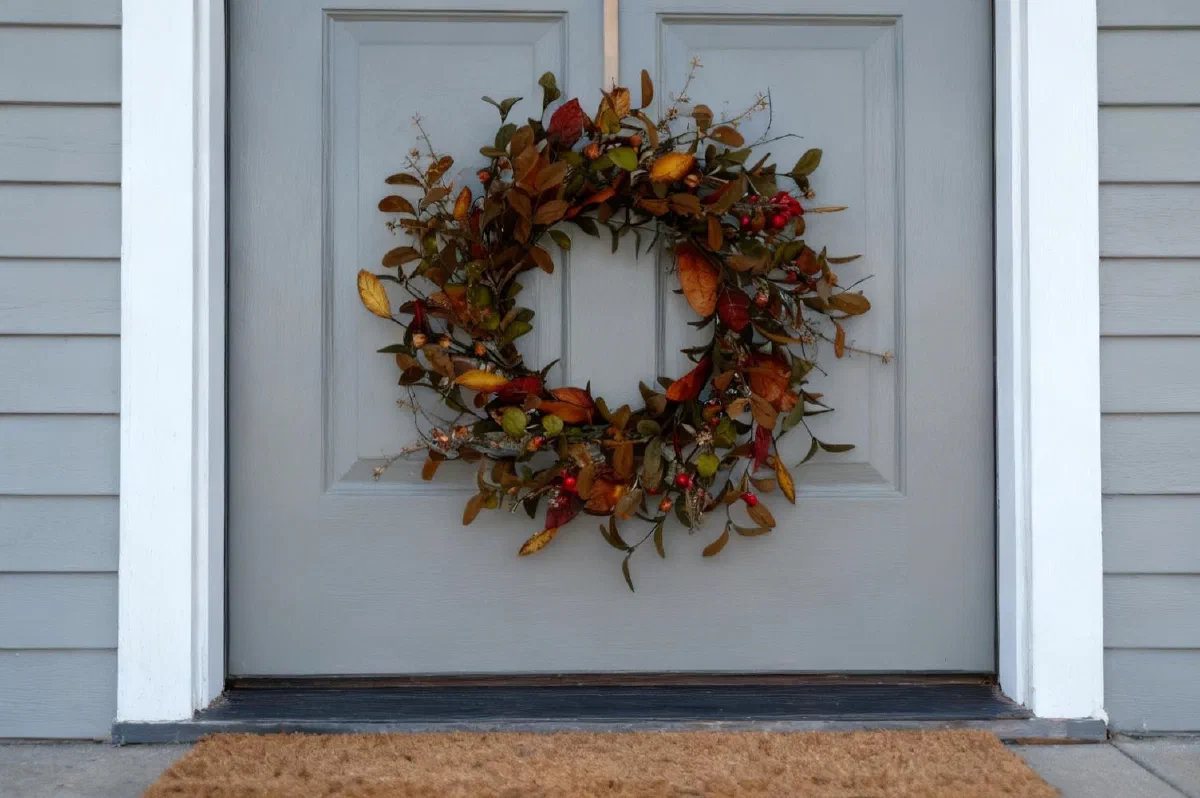
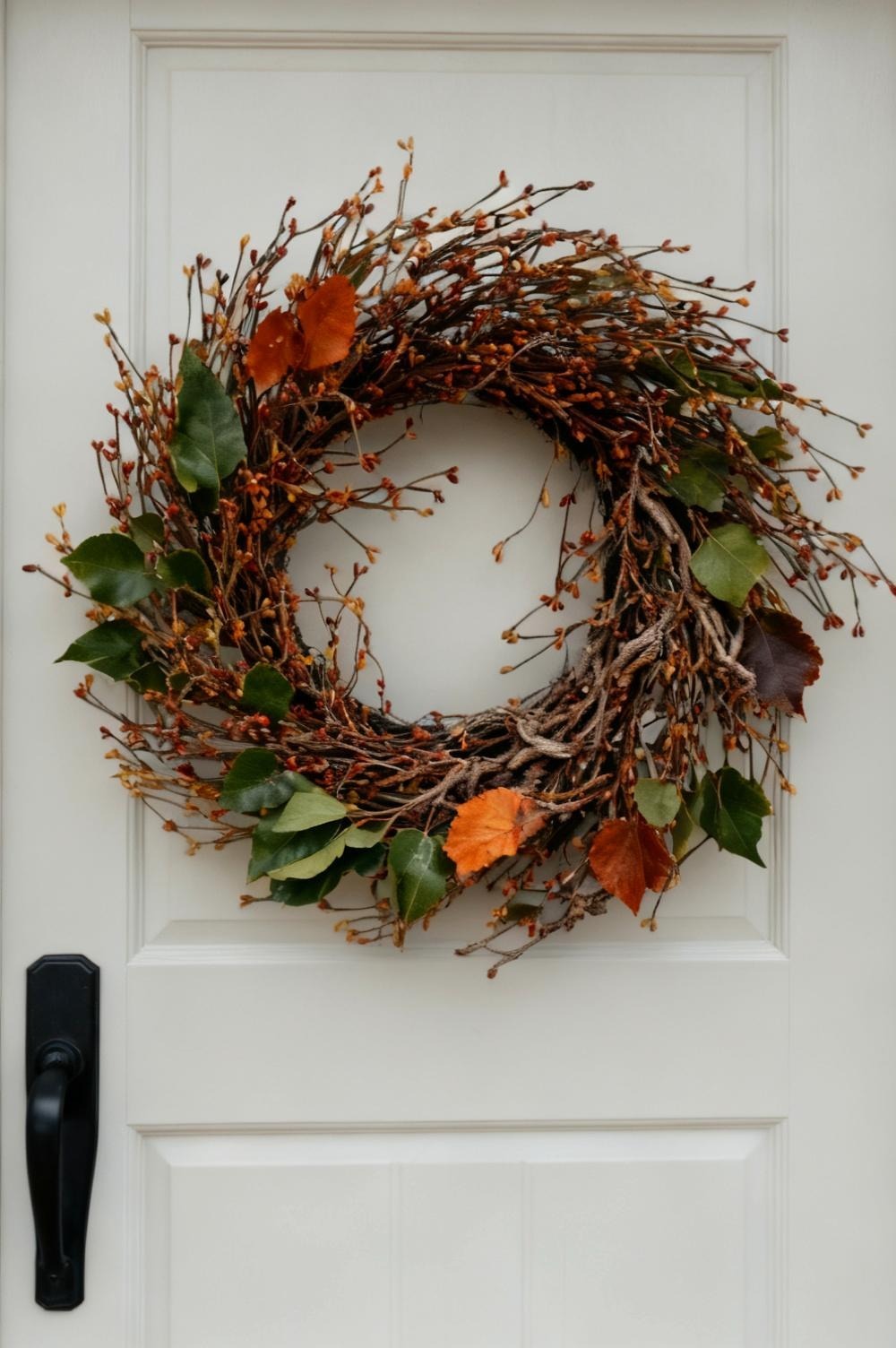
From the sidewalk, a wreath is a blurred ring. Nobody out there sees the leaf shapes, the ribbon tails, or the small pumpkin tucked in at four o’clock. What survives the distance is contrast, and on an autumn door the contrast is almost always the berries.
That is the whole case for a fall berry wreath. Berries are small, dense points of saturated color sitting against matte foliage, and points of color are the last thing to dissolve as detail drops away. A wreath built only from leaves goes quiet by the third step down the path. A berry wreath is still doing something from a car.
This is a buying guide. If you would rather build one, the DIY fall wreath guide handles bases, stem counts, wire against hot glue, and hanging without marking the paint. Everything here is about choosing a finished wreath from a listing photo, which is a different problem: judging something you cannot touch, shot in a light booth, against a door you have stopped really looking at.
Why a fall berry wreath reads from the street
Do this before you shop, because it settles most of the decisions. Stand where a visitor first sees your door, photograph it from there, then convert the photo to black and white on your phone.
Greyscale strips out hue and leaves value, which is the only thing distance preserves. If a berry color disappears against your door in that photo, it will disappear at thirty feet too. Red berries on a dark walnut door are the classic case: right on your screen in color, the same mid-grey as the door once the hue is gone.
Two other things carry from a distance:
- Spread beats size. Small clusters distributed evenly through the ring read as texture. Four or five oversized clusters read as spots, and spots look like a craft project.
- The foliage has to stay quiet. Berries only pop against something matte and plain. Glossy leaves plus gold glitter plus plaid ribbon plus berries is a wreath where nothing wins.
This article contains affiliate links. If you buy through them, Etheric Echoes may earn a commission at no extra cost to you. As an Amazon Associate I earn from qualifying purchases. Read the full disclosure.
Fall berry wreath buying guide: what makes one look expensive
Almost all of it is visible in the listing photo. Open the main image, pinch until the berries fill your screen, and check four things.
| Tell | The cheap version | What you want |
|---|---|---|
| Berry finish | Uniform high gloss, a hard white highlight dot on every berry | Matte or low sheen, slight variation between berries |
| Berry attachment | Berries glued flat onto a leaf face | Berries on their own short wired stems, standing off the foliage |
| Color count | Five or six competing colors | Two or three, plus a neutral |
| Depth | One flat layer with the base showing through | Foliage layered at different heights, visible in a side photo |
Berry attachment matters most, because it drives both the look and the life of the wreath. A berry cluster on its own stem sits proud of the leaves and casts a small shadow. Glued berries sit flush, read as a printed pattern, and are the first thing to pop off in wind.
Reading the full listing title matters just as much, since titles truncate in search results and the size and colorway sit at the very end. Two wreaths at the same diameter can look identical in the thumbnail and be completely different arrangements.
Two 20 inch wreaths show how much the mix decides. The 20 inch eucalyptus, berry and magnolia wreath (opens Amazon in a new tab) sets its berries against magnolia, at 4.5 stars on about 1,900 reviews. Magnolia leaves are broad and matte, so berries sit on a wide calm field, which is what the distance test rewards. The 20 inch eucalyptus, berry, pumpkin and lamb’s ear wreath (opens Amazon in a new tab) packs the same ring with more parts, at 4.4 stars on about 590 reviews. Up close that reads generous. From the street the berries compete with everything else on the ring.
The AMF0RESJ pair splits on content rather than size. One is a mixed harvest arrangement with bright oak leaves, a small pumpkin and berry branches (opens Amazon in a new tab) , at 4.4 stars on about 2,000 reviews. The other trades the pumpkin for golden eucalyptus and oak leaves (opens Amazon in a new tab) , at 4.6 stars on about 685 reviews. Neither states a diameter in its title, so check the size before you order.
None of these carries an Amazon’s Choice or Best Seller badge. Every one was checked on 2026-08-16 against Amazon’s best-seller order for its own product type, and every one ranked there.
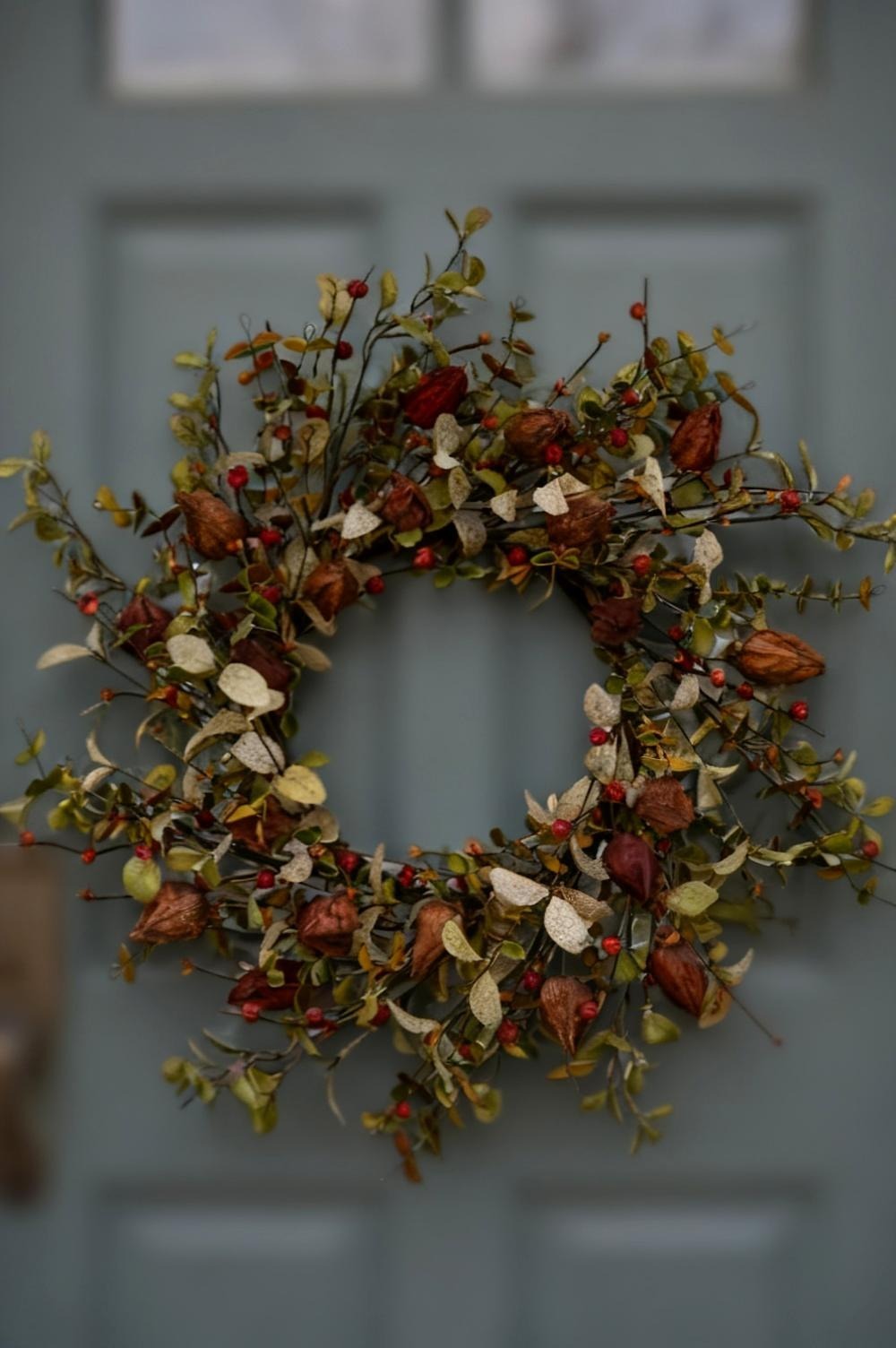
Best fall berry wreath colors for white, dark, and wood doors
Your door is not a neutral background. It is half of the finished picture, and it is already there.
| Door color | What happens to berries | What to pick |
|---|---|---|
| White or cream | Everything reads | Deep red, burgundy, orange, anything |
| Black or charcoal | Deep red and burgundy sink and go muddy | Orange, gold, or cream berries |
| Navy or deep green | Warm colors separate cleanly | Orange, rust, red |
| Natural or stained wood | Warm on warm cancels. The hardest door | Cream or white berries, or foliage much lighter than the wood |
| Red door or red brick surround | Red berries vanish into the surround | Cream, gold, or a green-forward wreath |
| Sage or grey-green | Almost everything works | Red, burgundy, orange |
Two of the picks show how this plays out on a bigger ring. The 22 inch orange daisy wreath with wildflowers and berries (opens Amazon in a new tab) runs orange the whole way around, at 4.4 stars on about 1,600 reviews, and orange holds its value against a dark door where red would not. The 24 inch wreath with red broad leaves and burgundy berries (opens Amazon in a new tab) is the opposite proposition, at 4.4 stars on about 555 reviews. Burgundy berries against red foliage have almost no separation, so the berries are not the contrast there. The broad red leaves are, which means that one wants a light door.
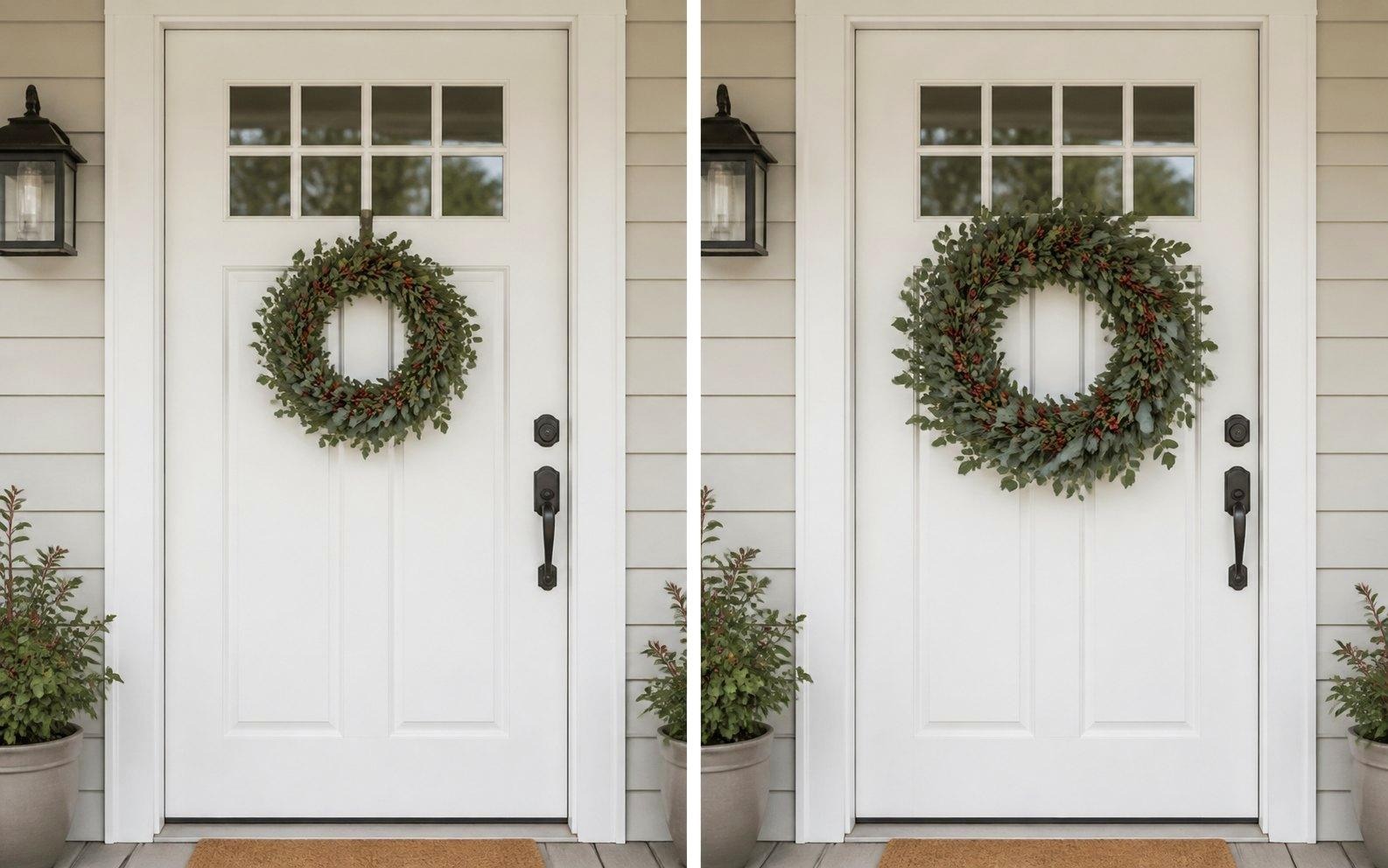
20-inch vs. 24-inch fall wreath on a 36-inch front door
One useful thing about buying instead of building: the number in the listing is the finished diameter. A base grows by roughly eight inches once stems go on, which is the sizing trap the DIY guide exists to keep you out of. A 24 inch bought wreath measures 24 inches on the door.
Most American entry doors are 36 inches wide, but measure yours, because side doors, older houses, and apartment entries all run narrower.
- On a 36 inch door, 24 inches leaves 6 inches of bare door each side. That is the proportion that looks deliberate.
- On the same door, 20 inches leaves 8 inches per side and reads a little small. Not wrong, just quieter.
- On a 30 to 32 inch side door, 20 inches is right and 24 will crowd the frame.
Depth is the measurement nobody checks and the one that causes returns. Berries standing off the foliage make a wreath thicker front to back, and with a storm door in front, that thickness is what hits the glass. The hanging section of the DIY guide covers that case, including hangers slim enough to let the outer door latch.
Real vs. faux berries for an outdoor fall wreath
There is an obvious question under all of this. Why not cut real berried branches and be done with it? Two reasons, both worth knowing even if you never make a wreath.
Winterberry is toxic. Winterberry holly, Ilex verticillata, is the native shrub behind most red berry decor. University of Minnesota Extension notes plainly that winterberry fruit can be poisonous to humans and pets, and berries drop. It also grows 3 to 15 feet and needs a male plant nearby to fruit at all, so it is a shrub project rather than something you walk out and cut.
Bittersweet is a bigger problem than it looks. That orange husk splitting open around a red center, the look those vine wreaths copy, belongs to Oriental bittersweet, Celastrus orbiculatus. Penn State Extension describes a woody vine introduced from East Asia in the 1860s that now smothers and strangles native plants, and that Pennsylvania has declared a noxious weed, meaning it can no longer be sold, propagated, or intentionally planted in the state. The fruit holds on the stem through winter, which is exactly why it became a decorating staple, and cutting it moves ripe seed to a new address. The native look-alike, American bittersweet, Celastrus scandens, is rare or vulnerable in several states, and Penn State warns that nurseries fairly commonly sell the invasive one mislabeled as the native.
Which makes the faux version the sensible route rather than the compromise. An orange-berry wreath like the 22 inch orange daisy and wildflower ring (opens Amazon in a new tab) gives you that same warm orange on the door for years without moving a single seed. Skip any listing that advertises real bittersweet vine.
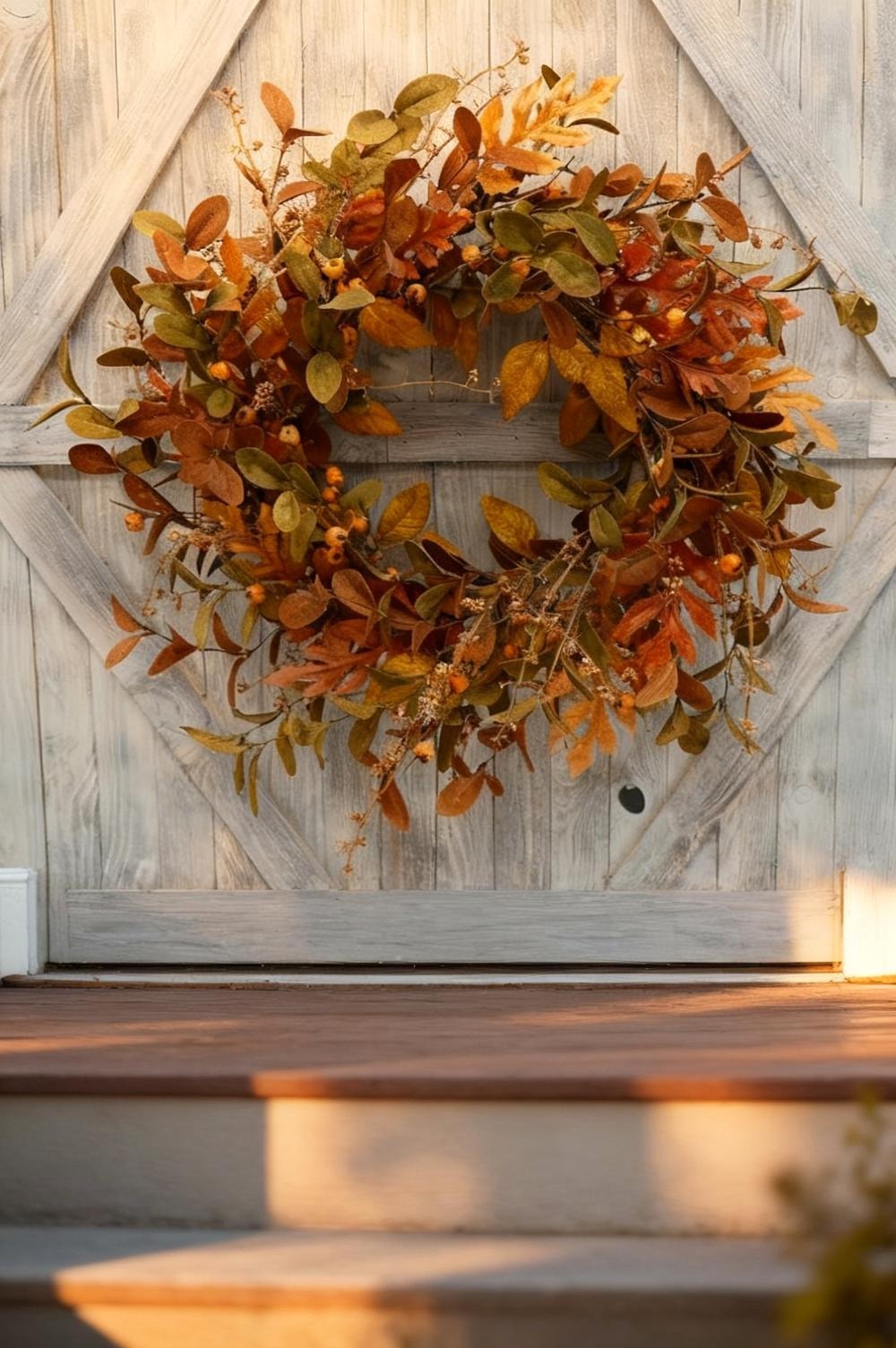
How to keep an outdoor berry wreath from fading
Berries are the part of the wreath most likely to show its age, because saturation is the entire point of them. When it goes, the wreath does not look faded so much as tired.
- Look for UV protection in the listing text. If a listing does not claim it, assume it is not there. Untreated color in full afternoon sun on a west-facing door is the fastest way to lose a wreath.
- Cover is worth more than any treatment. A recessed entry or a porch roof keeps direct sun off for most of the day, and a wreath in shade holds its color for seasons.
- Dust is the quiet killer. A film of dust turns saturated red into dull grey-red, which is exactly the contrast the street test depends on. Take the wreath down once mid-season, brush the clusters with a dry soft paintbrush, and hang it back up.
- Store it hanging or flat, never squashed. Crushed berry clusters do not spring back the way leaves do. A paper bag on a closet hook beats a bin with the Christmas decorations stacked on top.
Anything on your door made from dried natural material follows different rules, and the DIY guide covers what sun does to dried and dyed stems.
Fall berry wreath checklist before you buy
Six things, in this order. It takes about five minutes and prevents almost every return.
- Measure the door width and the clear space above the handle.
- Take the greyscale photo from the end of the walk and decide what the berries have to fight.
- Read the whole listing title. The diameter and the colorway sit at the end and truncate in list views, which is how people order 12 inch wreaths by accident.
- Zoom the main photo to the berries. Own stems, matte finish, clusters distributed rather than clumped.
- Sort reviews by newest and skim for the word small. Buyer photos also show the wreath in a hallway instead of a studio.
- Check for a storm door. If there is one, favor a flatter arrangement.
Six mistakes that make a fall berry wreath look cheap
- Buying off the thumbnail. The lifestyle photo is styled and lit. The zoomed detail is the truth.
- Matching the berry color to the door. Red on a red door, burgundy on stained wood. They cancel, and from the street nothing is left.
- Choosing by berry size. A few big clusters look like decorations stuck on. Small berries spread through the ring look like a plant.
- Ignoring depth with a storm door. Standing berries are what press against the glass.
- Sizing a bought wreath like a base. A 14 inch base becomes a 22 inch wreath. A 14 inch finished wreath stays 14 and looks lost on a full-size door.
- Leaving it up until it is grey. Dust and sun take the contrast first, and contrast was the reason you chose berries.
What I’d Actually Buy
Two 20 inch options, two mixed arrangements, and two larger rings for a wide door. None of them carries an Amazon’s Choice or Best Seller badge. Each was checked on 2026-08-16 against Amazon’s best-seller order for its own product type, and each ranked there.
- YNYLCHMX 20 inch fall wreath, eucalyptus, berry and magnolia (opens Amazon in a new tab) (4.5 stars, about 1,900 reviews). The one for a door seen from the street, since the broad matte magnolia leaves give the berries a calm field.
- 20 inch fall wreath, eucalyptus, berries, pumpkins and lamb’s ear (opens Amazon in a new tab) (4.4 stars, about 590 reviews). The busier 20 inch ring. Better on a covered porch you pass close to, where the lamb’s ear and small pumpkins actually register.
- AMF0RESJ artificial fall wreath, oak leaves, small pumpkin and berry branches (opens Amazon in a new tab) (4.4 stars, about 2,000 reviews). The literal harvest arrangement. Confirm the diameter on the listing, since the title does not state one.
- AMF0RESJ artificial fall wreath, golden eucalyptus and oak leaves (opens Amazon in a new tab) (4.6 stars, about 685 reviews). The quieter one from the same maker, gold rather than red. Diameter is not in this title either.
- 22 inch orange daisy wreath with wildflowers and berries (opens Amazon in a new tab) (4.4 stars, about 1,600 reviews). The one for a dark or stained door. Orange keeps its separation where red goes muddy.
- 24 inch fall wreath, red broad leaves and burgundy berries (opens Amazon in a new tab) (4.4 stars, about 555 reviews). Berries are the accent here rather than the contrast, so give it a light door.
Check each listing for current sizes and colorway options before ordering.
Related
- DIY fall wreath you can finish in one evening is the build route, with base sizing, stem counts, wire, and every hanging option including storm doors.
- Fall front porch decor for a small porch sorts out what goes on the floor once the door is handled and the porch is narrow.
- How to dry hydrangeas for fall arrangements is the indoor half of the same season, and dried heads pair well with berry stems.
- Fall flowers for pots that get better in the cold covers the containers beside the door, with planting windows by zone.