Most people buy Christmas garland by guessing, and the guess is almost always short.
Then they hang it, see gaps, and go back for more that does not match the first batch. The measurement takes two minutes and it is the difference between one good line and three mismatched ones.
How to Work Out How Much Garland You Need
Measure the run, then add the swag. Garland is not hung taut like a cable. It dips between attachment points, and that dip eats length.
Measure the actual path, not the object. For a banister, run a tape along the handrail, not along the staircase. For a mantel, measure the shelf edge, not the fireplace. For a door frame, measure up one side, across the top, and down the other.
Then apply the multiplier for how full you want it:
| Where | Measure | Add for the dip and the fullness |
|---|---|---|
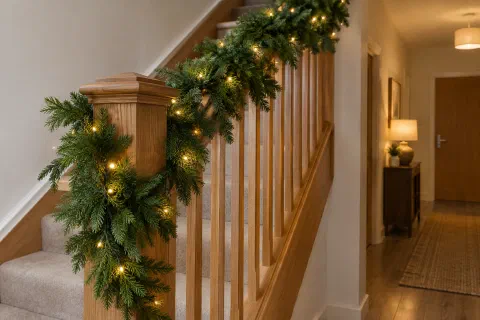
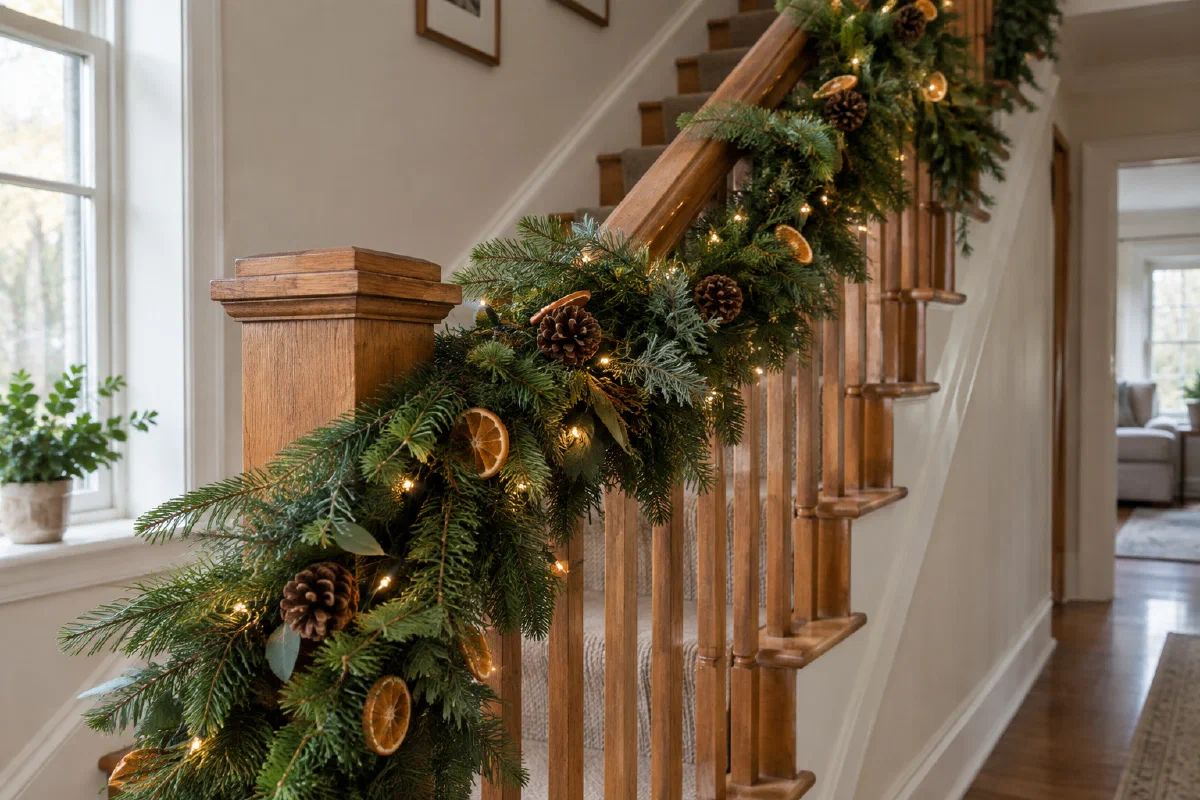
| Stair banister | Along the handrail | 1.5x, and 2x if you want it thick |
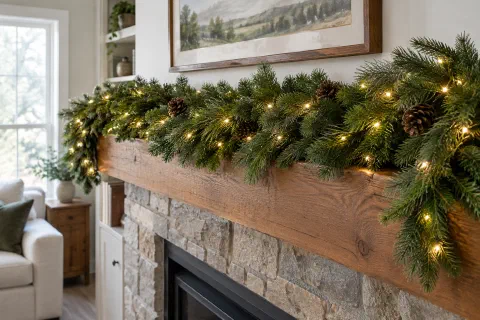
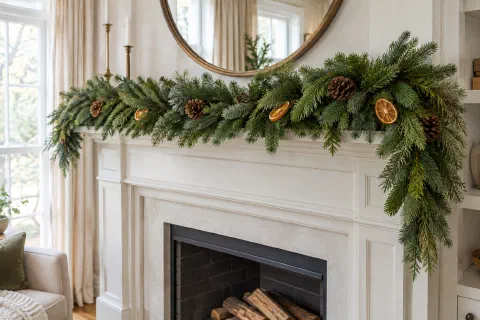
| Mantel | The shelf edge | 1.5x, plus extra if it drapes down both sides |
| Door frame | Up, across, down | 1.5x for a single line, 2x for a double |
| Table runner | The table length | 1.3x, because a runner dips less |
Two worked examples, because this is where people go wrong.
A banister with a 12-foot handrail wants about 18 feet for a single generous line, or 24 feet if you are doubling it. A standard front door at 36 inches wide and 80 inches tall has a frame run of about 16 feet, which wants 24 feet for one line, or 32 for two.
Buy the next size up if you are between sizes. Extra garland can be looped at the bottom of a banister or tucked into a pot. Being short means a visible gap in the most photographed part of the house.
A 9-foot pre-lit strand is the most common size sold, and it is short for almost every staircase. Check the stated length before you assume a “staircase garland” is sized for a staircase.
Real or Faux: How to Choose Christmas Garland
Neither is the right answer for everyone, and the honest trade-off is different from how it is usually sold.
Fresh greenery smells like Christmas and looks like nothing else, because the needles have irregular length and natural gaps where light passes through. It is also a perishable product with a fire risk attached, and it will be dropping needles indoors within two to three weeks.
Faux garland lasts for years, costs less per season after the first, and can be put up in October without dying. The downside is the tell: uniform needle length, a visible wire spine, and a flatness that reads as plastic from across the room.
The deciding questions are how early you decorate and how long you want it up. If the garland goes up the weekend after Thanksgiving and comes down in early January, fresh is realistic. If it goes up in November and you want it to still look good on New Year’s Day, buy faux and spend the difference on ribbon.
A practical middle path that most people land on: faux for the long runs like a staircase or a porch rail, and fresh for the small focal points like a mantel or a door, where it is close enough to smell and short enough to replace.
Fresh Greenery or Faux Garland: the Honest Trade-Off
| Fresh greenery | Faux garland | |
|---|---|---|
| Looks right up close | Yes | Only the good ones |
| Lasts | 2 to 3 weeks indoors | Years |
| Fire risk | Real, and it grows as it dries | Low, but the lights still get warm |
| Storage | None, it goes to the compost | Needs a box and dry space |
| Cost per season | Every year | Falls after year one |
| Can go up early | No | Yes |
If you buy faux, look at the needle tips rather than the photographs. Realistic garland has two or three different needle lengths mixed together, and a wire that is only partly visible. Garland where every tip is identical and the wire is fully wrapped will look like a garland from across a room and like plastic from a meter away.
The Styling Trick That Makes Cheap Garland Look Full
Cheap garland is thin, and thin garland is what makes a staircase look like it is wearing a necklace instead of a dressing.
The fix is not more garland. It is doubling the run and offsetting the two strands so the gaps in one are covered by the body of the other. Two cheap strands, twisted so the bunches alternate, read fuller than one expensive strand at the same total cost.
Then add volume in a second layer rather than a longer one: pinecones, dried orange slices, a length of wide ribbon, or a few sprigs of something with a different texture. A garland looks expensive when it has more than one texture, not when it has more length.
One more thing that separates a good garland from a bad one: lights should be woven, not draped over the top. Push the strand into the greenery so the bulbs sit among the needles. Garland with lights laid on the surface reads as an afterthought in every photograph.
Where to Hang It So It Reads as One Piece
Garland looks best when the eye can follow it without a break.
- Anchor both ends and let the middle sag. A garland pulled tight looks like a cable. The dip is what makes it look like greenery.
- Attach at the structure, not the decoration. Command hooks on painted trim, or ties around the banister itself. Never hang weight on a light strand.
- Keep one continuous line where possible. Two garlands butted end to end always show the join. Overlap them instead and hide the overlap behind a bunch of pinecones.
- Match the corners. Whatever you do at the top of a staircase, repeat at the bottom, or the eye notices one end looks finished and the other does not.
Fresh Garland Safety: What to Avoid
This is the part that matters more than styling, and it is why fresh garland is not simply a nicer version of faux.
Fresh cut evergreens will dry out in the heat of our homes and become very flammable, per University of Illinois Extension’s guidance on decorating safely for the holidays . That is the whole reason the care instructions exist.
Their practical advice, which is worth following exactly:
- Soak fresh wreaths, roping and garlands in water, then let them dry before decorating. This rehydrates the greens and extends their indoor life.
- Spray with an anti-transpirant to slow moisture loss through the leaves if you want it to last longer.
- Keep garland away from any heat source, light or candle. This is the one not to compromise on.
- Remember that a fresh wreath on a front door with a glass outer door dries out very quickly. The same applies to garland trapped between a door and a storm door.
So: fresh garland over a working fireplace is the single worst placement in the house. If you want garland on a mantel and you use the fire, use faux there or keep the garland well clear of the opening and never leave a burning fire unattended under it.
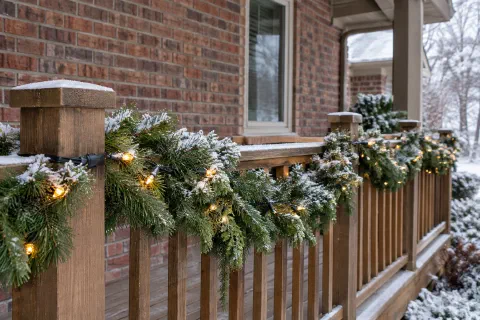
For the electrical side, keep to lights rated for where you are putting them, inspect the cord before the season starts, and plug outdoor garland into a protected outdoor outlet. The Electrical Safety Foundation’s outdoor decoration guidance covers cord inspection and outdoor ratings, and it is worth two minutes before you hang anything.
Getting It Up in One Afternoon
- Measure every run and write the numbers down before you buy anything.
- Soak or fluff. Fresh garland gets soaked and dried. Faux garland gets shaken out and the branches spread by hand, which takes ten minutes and is most of the difference between full and flat.
- Hang the support first, then the garland, then the lights woven into it, then the extras.
- Stand back and look at it from the doorway. Gaps you cannot see from standing right at it are the ones visitors see first.
- Check the distance to any heat source before you walk away, every time.
The garland that looks expensive is not the expensive one. It is the one that was measured, doubled and woven.
What to Read Next
- Fall garland ideas if you want the same treatment for the autumn months, where the palette and the greenery are completely different.
- Indoor Christmas greenery that actually lasts because keeping fresh greenery alive indoors is its own problem, and this covers what dies first.
- Christmas mantel decor for when the garland is only the bottom layer of the mantel and you need the rest of it.
- Christmas front door decor for the door itself, since a door and its frame want different treatment.