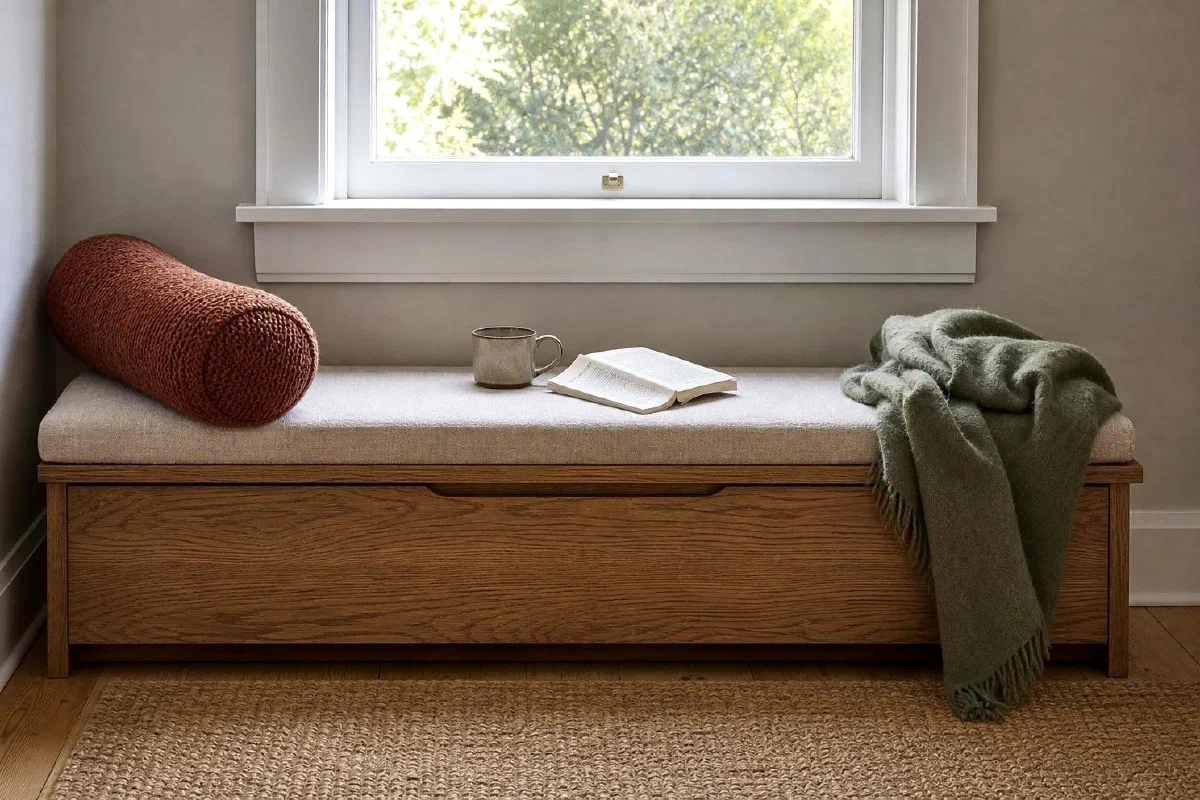
Search window seat ideas and you get the same photograph forty times. A deep bay window in a house with tall ceilings, a built-in bench with a hinged lid, joinery that took a carpenter a week.
Most of us have one flat window in one ordinary wall and a lease that says nothing permanent. That is fine, because almost everything that makes a window seat feel good is furniture, not carpentry. A seat at the right height, pushed against the wall the window sits in, with a cushion thick enough to sit on and light that is not shining straight into your book.
Everything below moves out on moving day.
What Is a Windowsill Seat?
A windowsill seat is a bench pushed flat against the wall directly under a window, sitting at 17 to 19 inches from the floor so you are at sill height rather than table height. Nothing about it has to be built in. A storage bench, or a cube shelf unit turned on its side, gives you the same windowsill seat for the price of a piece of furniture, and it leaves with you when the lease ends.
The Seat Height That Actually Works
Start with one number, because it decides whether the seat gets used or becomes a shelf for laundry. Federal accessibility standards put a bench seat between 17 and 19 inches above the finished floor, and set bench seat depth at 20 inches minimum and 24 inches maximum (U.S. Access Board, sections 903.3 and 903.5). Those are public bench rules rather than living room rules, but they are the closest measured comfortable range that exists, and they land where a dining chair already does.
Aim for 17 to 19 inches from the floor to the top of the finished cushion. Below about 15 inches your knees ride up and your back rounds within ten minutes. Above 20 inches your heels leave the floor.
Seat depth decides what the seat is for:
- 16 inches or less. A perch. Fine for putting on shoes or watching the rain.
- 18 to 20 inches. A real seat, knees over the front edge, feet flat.
- 22 to 24 inches. Deep enough to turn sideways and pull your feet up, which is what everyone actually wants at a window.
Measure the window sill before you buy anything
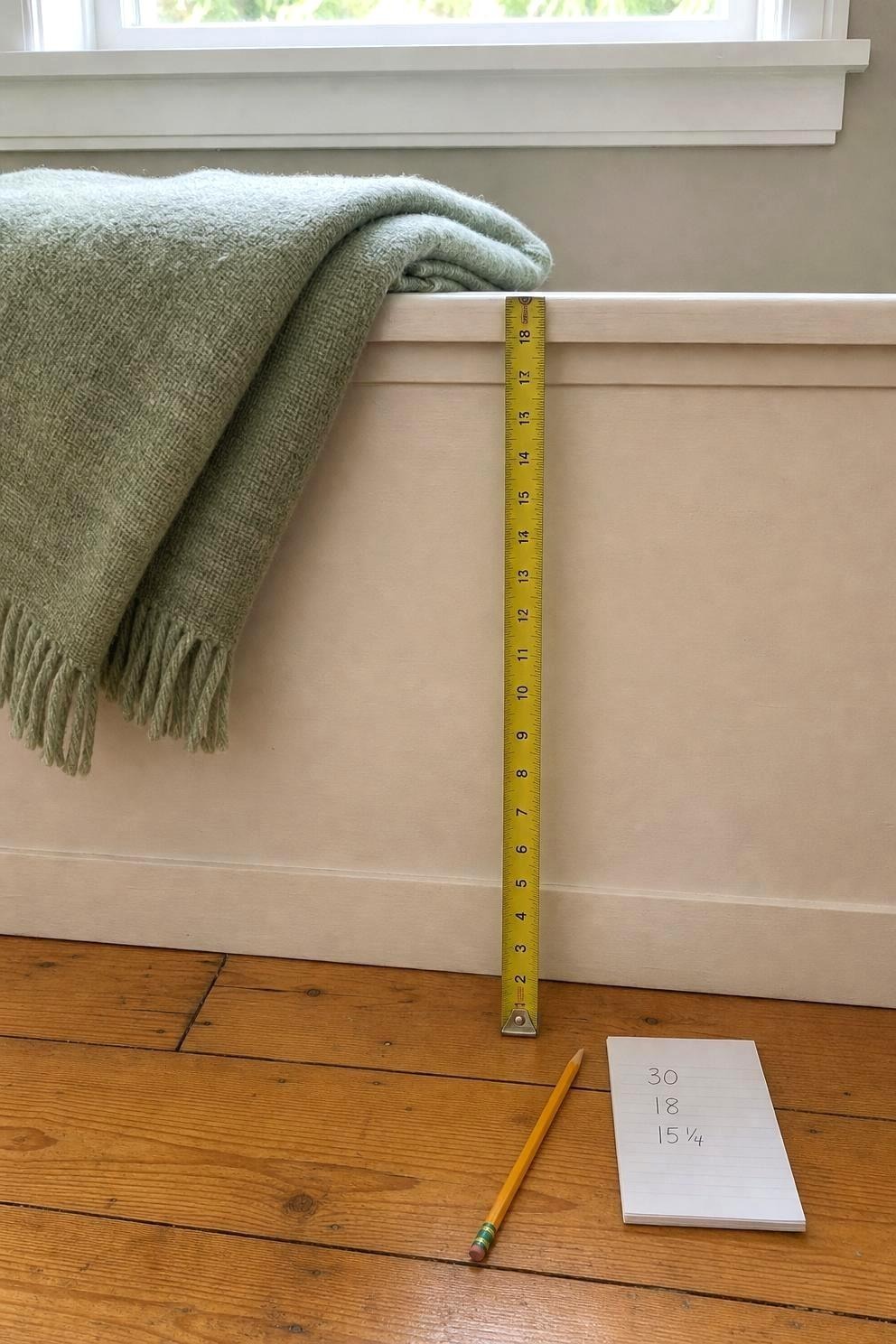
Three numbers, one tape measure. Floor to the bottom of the window sill, sill depth front to back, window width.
The floor-to-sill number decides the plan. A sill between 24 and 32 inches is the easy case: a bench at 18 inches leaves six to fourteen inches of wall above the cushion to lean against. Under 20 inches, your cushion top lands at or above the glass and you end up leaning on the window. Above 36 inches, the window is a light source rather than a view.
Keep the cushion top at least six inches below the sill where you can. That gap is what your shoulder blades rest against, and it lets the lower sash open.
Five No-Build Window Seat Options, Compared
Every one of these is furniture pushed against a wall.
| Option | Height out of the box | Storage | Renter safe | Best window |
|---|---|---|---|---|
| Storage bench | Usually right in the 17 to 19 inch range | Inside the lid | Freestanding | Any flat window |
| Low bookcase on its side | A little low, the cushion makes it up | Open cubbies facing the room | Freestanding, strap it if children climb | Wide windows |
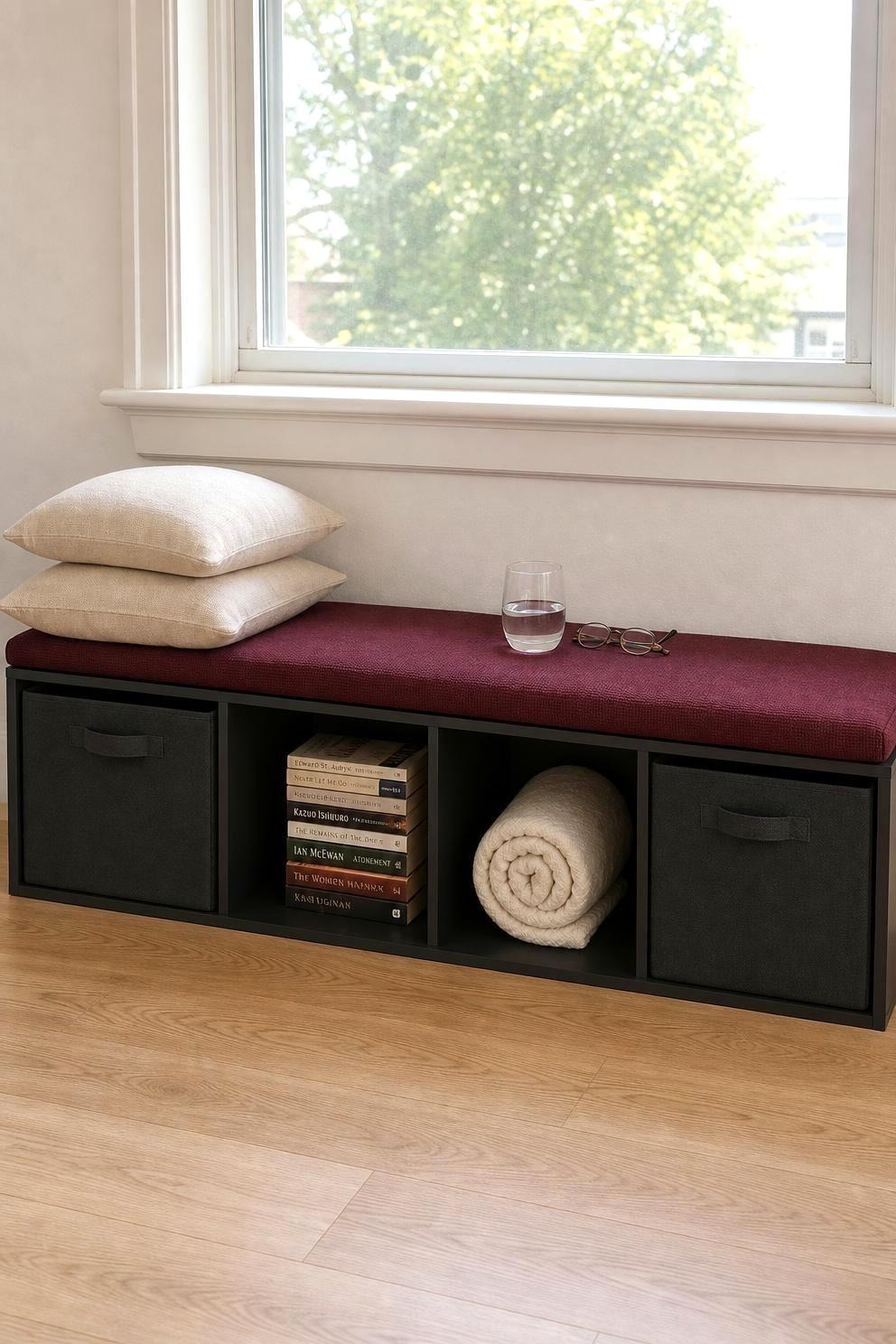
| Cube shelf unit | Low, wants a thicker seat cushion | Cubbies with fabric bins | Freestanding, strap it if children climb | Wide, low sill |
| Daybed | Higher, closer to sofa height | Rolling bins under the frame | Freestanding | Bedroom or home office |
| Deep window sill with a cushion | Whatever the sill already is | None | Nothing added at all | Old buildings, thick walls |
The storage bench
The shortest path. Entry benches, blanket boxes, and hall benches are built near seat height already, which is why they feel right the moment you sit down. Buy the longest one that fits between the window trim and whatever is beside it; a bench that stops short looks like it wandered in. If the lid is hinged, pick one that stays up on its own or lifts off completely, because a heavy lid that drops shut is not something to keep around small hands.
A low bookcase on its side
The cheapest window seat here, and usually already in the house. Lay a three-shelf bookcase on its long side, back panel to the wall, shelves running vertically. The openings become cubbies facing the room, and a slab cushion goes across the top.
One test first. Sit on it hard, in the middle, with no cushion. Particleboard built to hold books upright is not always built to hold a person sideways, and the panel that used to be the back is now carrying your weight. If it flexes, fill it with baskets instead.
The cube shelf unit
A four-cube unit turned on its side gives you a long, low, open-fronted bench. Fabric bins hide the mess, and one cubby left open for books keeps it from reading as storage furniture. Cube units land below the comfortable range, so make that up with a thicker seat cushion rather than risers. A bench on blocks wobbles.
The daybed under the window
In a bedroom or home office, a daybed is the most comfortable version of this idea. A twin mattress on a low frame, long side to the wall under the window, two or three firm bolsters along the back.
It sits higher and softer than a bench, rolling bins underneath replace a hinged lid, and it solves a guest bed too. If the room has to do three jobs, the layouts in our cozy reading nook guide for small spaces apply here too.
The deep window sill with a seat cushion
Old buildings and thick walls sometimes hand you a sill deep enough to sit on. If yours is ten inches or more, a foam slab cut to the sill turns it into a place to sit sideways with a mug. Be honest about what that is: under about twelve inches of depth it is a ten-minute seat, not an hour seat. Cut the cushion to the exact sill depth so nothing overhangs, and add rug gripper underneath.
How to Set Up a Window Seat in One Afternoon
- Measure the three numbers and write them on your phone before you shop.
- Clear the wall, including the radiator cover if it lifts off.
- Dry fit with no cushion. Sit on it. Check it clears the lower sash, the curtain, and any door swing.
- Do the height math. Target height minus furniture height equals cushion thickness. A 15-inch bench and an 18-inch target means three inches of foam, not two.
- Stop it sliding. Felt pads on hard floors, rug gripper on rugs. A bench that shifts an inch every time somebody sits will drift off the wall in a week.
- Put the lamp on the room side, angled over your shoulder.
- Live with it a week before buying the pretty cushion. You will change the depth, the pillow count, or the location.
When the Window Sill Sits Too High, Too Low, or Over a Radiator
Too high. Above roughly 36 inches you will not see out while seated, so stop trying. Treat it as a wall seat with good light: taller pillows against the wall, a side table at arm height, a lamp doing the reading work.
Too low. Below roughly 20 inches your back goes straight onto glass. Pull the seat three or four inches off the wall and drop a firm bolster into the gap.
A radiator underneath. The most common blocker in an older rental. A radiator cover built as a slatted or grille-fronted box, open at the back and vented across the top, gives you a flat surface at roughly bench height. Two cautions. Most decorative covers are made to hide metal rather than hold an adult, so check the maker’s weight rating before anyone sits down. And a radiator warms a room mostly by moving air, so a top sealed solid keeps the heat in the box instead of the room.
The simpler answer is usually better: stand a bench in front of the radiator with a hand’s width of air behind it, and call it a spring, summer, and fall seat.
Cushions and Covers: How to Keep It From Feeling Like a Board
Every option above is a hard box, and a hard box needs real foam over it.
- Three inches is the floor. Two inches over a wooden lid goes numb in about fifteen minutes. Four is better on a shelf unit, and four also makes up the height a cube unit is short.
- Ask for high-resilience foam and wrap it in batting. Bare foam gives sharp corners; batting rounds them so the cushion looks upholstered instead of cut.
- Get it cut to size. Any foam shop cuts a slab to exact measurements, which matters most on a sill.
- The cover has to come off. A zip along three sides, cotton canvas or a linen blend. This is the seat the dog will choose.
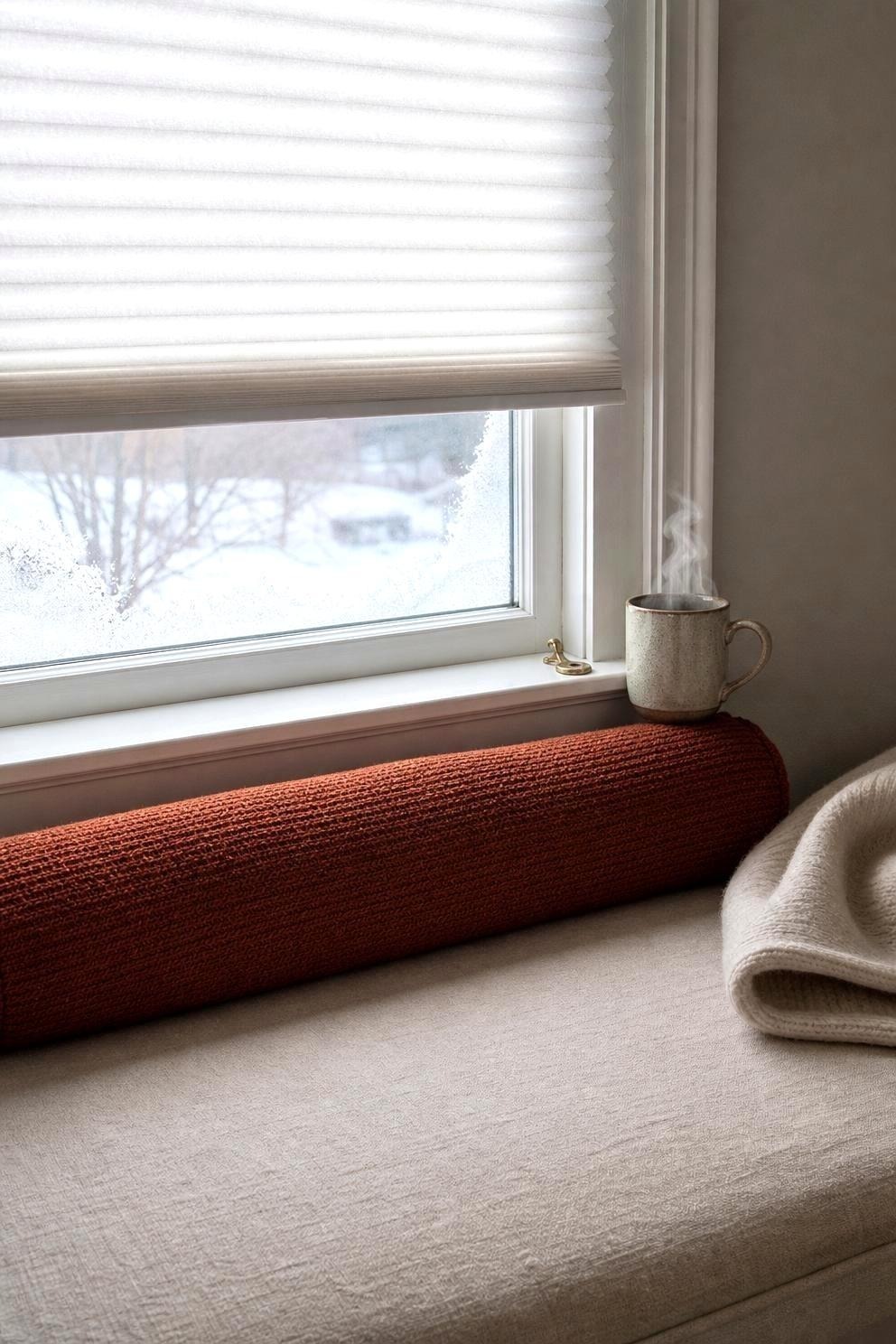
- Bolsters do double work. Along the glass they are back support in July and insulation in January.
Two or three pillows is the whole plan. For colors that hang together with the room, our warm living room color palettes give you combinations that already work.
Light, Glare, and the Cold Glass Problem
Glare. Reading with a bright window in front of you is tiring, and a tiring seat is an unused seat. Sit sideways, with the window at your shoulder, which the deeper seat depths make possible, and add a sheer or a light-filtering roller shade so midday reads as glow.
Cold. A seat against single-pane glass in January is genuinely cold, and styling does not change that. What helps: a cellular shade lowered at night, curtains long enough to reach the sill, a bolster along the glass, and a rug under the seat. Insulating film is the renter version of a storm window and peels off in spring.
Condensation. A cushion flat against a cold pane collects moisture. Leave a finger’s width of air between cushion and glass.
Safety Rules Before You Put a Seat Under a Window
This is the part the galleries skip.
The egress window rule
In a bedroom, one window has to work as a way out. Code requires every sleeping room to have an operable emergency escape and rescue opening, and requires it to be operational from the inside of the room without the use of keys, tools or special knowledge. Where a window serves that purpose, its sill can be no more than 44 inches above the floor.
So if that is the window you are decorating, the seat has to stay out of the way. A low bench you can step onto is fine. A chest whose lid must be cleared and lifted, bins stacked on the sill, or a unit taller than the opening are in the way at the worst moment. Keep the seat low and open the window from where you sit to prove it still works.
Small children, cords, and climbing
If a small child uses the room, read this first. The American Academy of Pediatrics is blunt: “Never put chairs, sofas, low tables or anything else a child might climb on in front of a window.” A window seat is exactly that piece of furniture. The same guidance says to open windows from the top where possible, and where you open from the bottom, to fit operable window guards that only an adult or older child can release, because a screen will not stop a fall.
Cords are the second hazard. The advice is to choose coverings with no cords at all, and where cords already exist, to hold them taut with floor mounts or wall brackets, fit safety stop devices, and cut any looped cord and finish it with safety tassels.
So a guarded window and cordless coverings come first, the cushion second. An anti-tip strap into the wall is worth two small screw holes and a dab of filler at move-out.
The glass itself
Codes treat a pane as a hazardous location, meaning it has to be safety glazing, when four things are true at once: the pane is larger than 9 square feet, its bottom edge is less than 18 inches above the floor, its top edge is more than 36 inches above the floor, and a walking surface sits within 36 inches of the glass. Older windows may predate any of it, so keep body weight off the pane with a bolster between cushion and glass.
Storage Underneath, Without Losing the Deposit
- Open cubbies with fabric bins. For what you reach for weekly: throws, board games, magazines.
- A lidded storage bench. For seasonal things you touch twice a year, like out-of-season bedding.
- Rolling bins under a daybed. For bulk. Shoes, wrapping paper, the suitcase.
One rule saves regret: nothing you need daily goes under a lid you have to clear first. Blankets are the exception, since a window seat is where they get used, and our blanket storage guide covers folds that survive a season in a box.
Questions People Actually Ask
What are some modern ideas for a window seat?
Modern here mostly means low and quiet. One long full-length cushion instead of a row of separate pads. Two or three colors total, so the seat reads as one object. A base with visible legs or a plinth on the floor, both of which look more built-in than a bench with a ruffle. Cordless shades inside the window frame, and a slim floor lamp beside the seat.
What are some modern ideas for window benches?
Three shapes are doing the work right now: a slatted wood bench with the slats running the length of the seat, an upholstered slab on thin metal legs, and a plain box in pale wood with no hardware showing. All three work under a window because none of them have a back, which is what lets a bench sit tight to the wall. Match the length to the window opening, and keep the finished height in the 17 to 19 inch range.
How can I make a DIY window seat?
The version that takes an afternoon and leaves no marks: set two cube storage units end to end under the window with the cubbies facing the room, lay one board across the top cut to the combined length, and rest a foam slab in a washable cover over it. Two bolsters go against the wall. To make it look built, run the seat wall to wall and paint the board the same color as the trim. Nothing is fastened to anything, which is the point in a rental, and more moves that leave no trace are in our renter-friendly cozy apartment guide.
What are some ways to dress up my windows without curtains?
Inside-mount shades are the cleanest answer: a cellular shade, a woven wood shade, or a plain roller sits inside the frame, never touching the wall. A cafe-height panel on a tension rod covers the bottom half for privacy and leaves the top open for light. Frosted window film peels off at move-out and does the job of a sheer, and plants on the sill dress a window with nothing but green.
What are the downsides of a window seat?
Four, and only the first one is unfixable.
It cannot move. You are committing that wall. In a small room that is the real price, because every other piece of furniture has to arrange itself around the seat, and in a rental it is one more thing to undo at move-out. If you are not sure the room’s layout has settled, start with the no-build version so you can change your mind.
The sill has to cooperate. A seat only works when the sill lands in roughly the 17 to 19 inch range, and plenty of windows miss it. Too high and you perch. Too low and it is a floor cushion with a view. Over a radiator you are warming a cushion all winter. The fix for each of those is in the sections above, but the honest summary is that some windows should get a chair instead.
The cushion lives in the sun. A window seat sits in the brightest spot in the house, which is exactly where fabric fades fastest and foam breaks down. A cordless shade you actually lower during the day does more for the cushion’s life than any fabric choice will.
Storage doors need swing room. Hinged lids need clearance above, and doors need clearance in front. On a narrow floor that decides whether the storage is usable or permanently shut with a basket parked against it.
If none of those put you off, a window seat is still one of the best square-feet-per-dollar moves in a small home.
How much does a window seat cost?
There is no single number, and anyone quoting one is guessing about your window. What you are actually choosing between is two very different projects.
A built-in is carpentry. You are paying for a frame, a lid or doors, a cushion cut to a size nobody stocks, and someone to fit it to a wall that is probably not square. The cushion is usually the part that surprises people, because foam is priced by size and density and a full-length seat takes a lot of it.
The no-build route is materials only, and it is three things you can carry home in one trip: two cube storage units, one board cut to length, and a foam slab in a washable cover. Nothing is fastened to the wall, and if you move or change your mind, it comes apart.
That gap is the reason the no-build version is worth doing first even if you intend to build later. It tells you whether anyone in the house actually sits there.
What to Read Next
- Cozy Reading Nook in a Small Space has seven layouts with real footprints, for when the window is not the right wall.
- Cozy Apartment Ideas for a Rental covers the rest of the room using the same nothing-permanent rule.
- Warm Living Room Color Palettes gives you cushion and throw combinations that already hang together.
- Quiet Reading Corner Pieces lists the lamp, table, and seating shapes that make a corner readable.