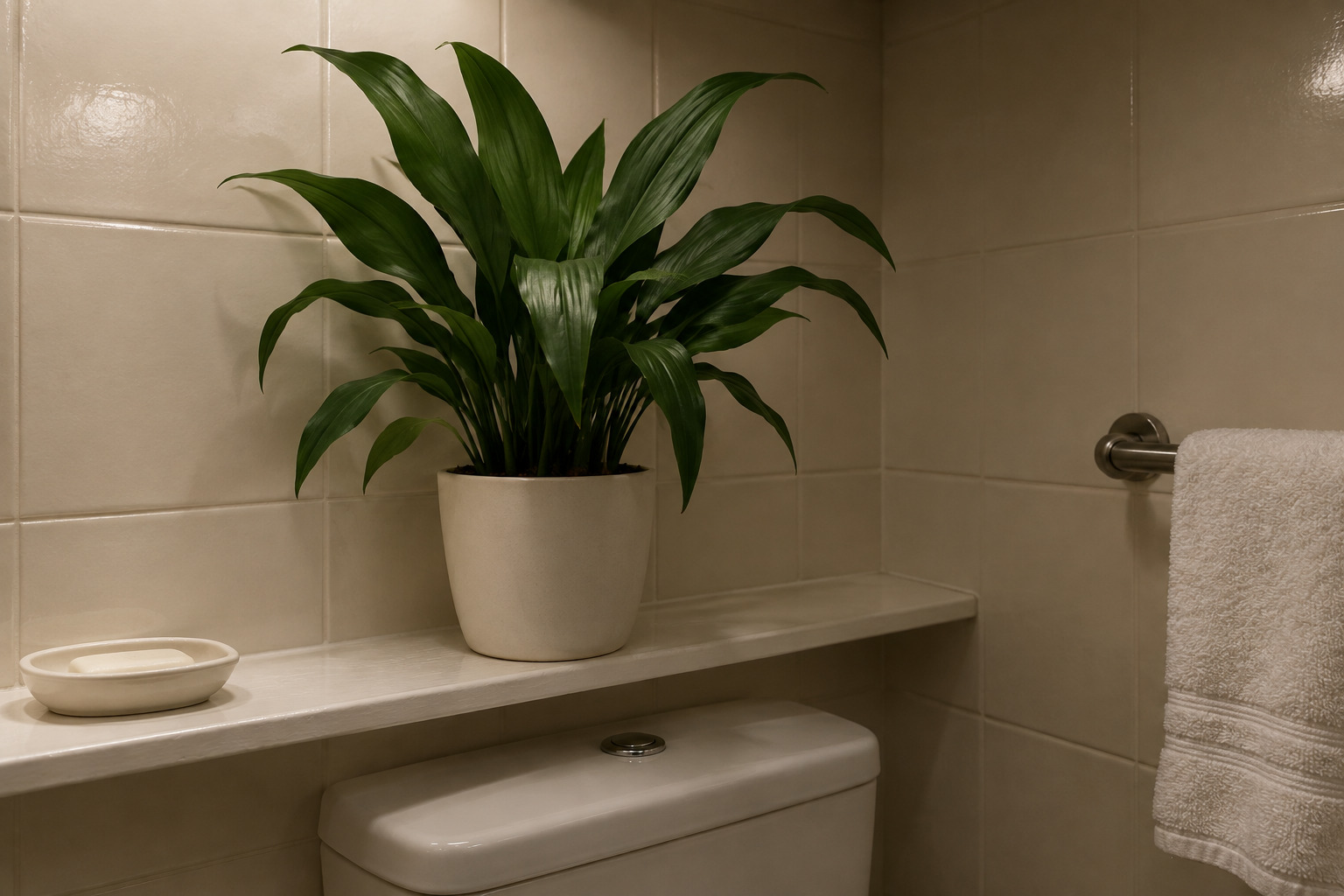
You killed a plant in that bathroom. It was supposed to be the easy one.
Plants for bathroom no window is a different search from low light bathroom plants, and the gap between the two is the whole article.
The honest answer: nothing photosynthesizes in the dark. A windowless bathroom is not a low light room, it is a no-light room. No houseplant lives there on the room’s own light. What works instead is a two-plant rotation, a supplemental light on a timer, or a plant that only visits.
Plants for Bathroom No Window: Start With the Light You Have
Low light is a measurement. Clemson’s Home and Garden Information Center puts low light at a minimum of 100 foot-candles with 75 to 200 preferred, medium at 100 to 150, and notes that the interior of a well-lighted home often sits below 100 before you put anything in it. Outdoor light on a clear day tops 10,000.
A windowless bathroom sits at zero of that. A switch you flip for twenty minutes twice a day is not a light source, because it adds up to almost nothing at leaf height.
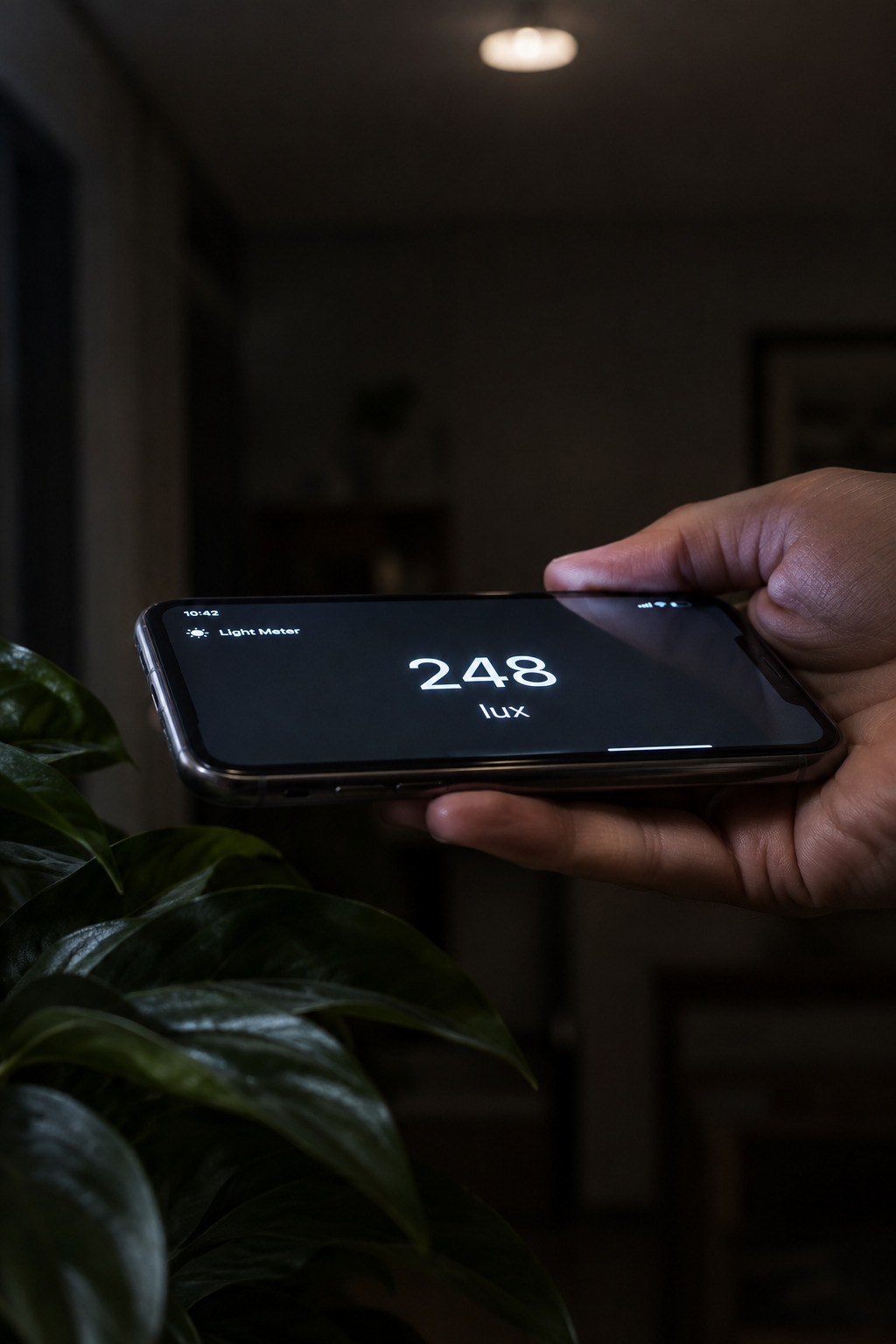
Measure the spot rather than guessing. A free phone app that reads foot-candles is enough:
- Stand where the pot will go, phone flat at leaf height, facing the ceiling.
- Read it mid-morning, at noon and late afternoon, and keep the lowest number.
Then the shadow test, with your hand a foot above white paper at that spot. A sharp-edged shadow is real light. A soft one with an outline is medium. One you can barely make out is low. None at all means the rotation or a timer light.
A frosted or undersized window changes the math rather than solving it, since Clemson lists curtains, outdoor shading and the location itself among the things that change what a spot gets.
| What you see at midday | What it means | What the spot can carry |
|---|---|---|
| No shadow | No usable daylight | Rotation or a timer light |
| A shadow you can barely make out | Bottom of the low light band | The most tolerant few only |
| A soft shadow with an outline | Genuine low light | The standard low light list |
| A sharp-edged shadow | Medium light or better | Most foliage houseplants |
The Rotation Method: Two Plants, One Job
The rotation method needs no wiring and no equipment. If you are choosing that pair and a pet shares the home, the pet-safe apartment plant shortlist narrows the candidates to ones with an ASPCA listing.
Buy two of the same plant in the same pot size. One is on duty in the dark room, the other recovers somewhere bright, and they swap every two weeks.
The reason is a number. Clemson states that about 100 foot-candles for 12 hours a day are necessary just to maintain a plant’s quality for one year, and that at least 200 foot-candles for 12 hours a day are needed before a foliage plant shows any benefit from fertilizer at all. A windowless room delivers neither, so the plant is not living in the dark. It is serving a two-week shift there.
I could not find an extension page that documents the commercial rotation practice itself, so treat that as trade talk. The daily light threshold is the sourced part, and it explains why the swap works.
- Buy two of the same species, same size, same pot.
- Keep one where it gets real light, near a bright window without a hard midday beam.
- Put the other in the windowless bathroom as a display rather than a growing plant.
- Swap on the same day every second week, and water the one in the dark room less.
- Check both for pests on swap day, since a dark bathroom hides scale and mites.
A plant on a two-week shift uses almost no water, so the schedule that worked by the window will drown it in the dark room. The no-schedule watering rule is the fix, and the apartment plants guide covers what survives one window in the first place.
Expect no new growth from the bathroom shift. The plant by the window does the growing, and that trade beats replacing the plant every few months.
How to Add Supplemental Light Without Guessing
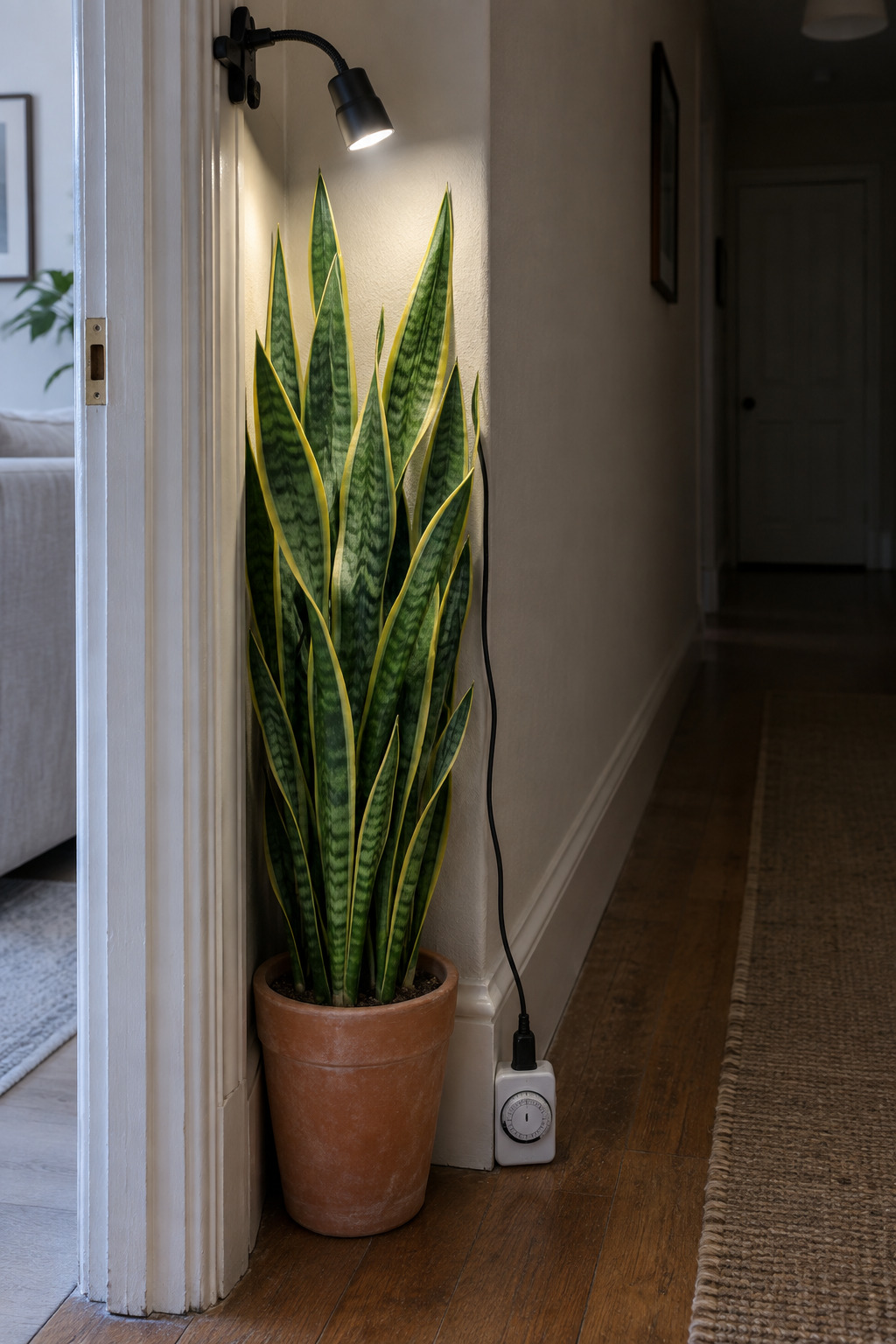
A light on a timer turns a dead corner into a low light corner. Iowa State University Extension gives the numbers that matter, and duration and distance matter more than wattage:
- Run it 14 hours a day. Iowa State’s range runs from 10 hours to no more than 16, because plants need a dark period.
- Distance is the part people get wrong. A fluorescent fixture sits 6 to 12 inches from the foliage, an LED fixture sits 12 to 24 inches away, and the light moves up as the plant grows.
- A shop fixture works. Iowa State’s recipe is a 4-foot plug-in shop fixture with full-spectrum bulbs: at least 3,000 lumens at 18 inches for the LED version, or a 2-bulb, 40-watt, T5 high-output fixture at 9 inches. Either way, 14 hours.
- One plant does not need a rack. Iowa State notes a homemade setup can be as small as an LED grow light in a desk lamp.
- Skip the incandescent bulb. Clemson states that plants under ordinary incandescent lamps stretch and become leggy.
- Use a timer. If the light goes on when you remember, the dark period shrinks.
Clemson also draws the line fertilizer cannot cross. About 100 foot-candles for 12 hours a day maintains a plant’s quality, and at least 200 is where a foliage plant responds to feeding at all. Below that, feeding mostly wastes fertilizer. Fertilizer is not light.
The grow lights that look good in a living room guide handles the fixture you have to look at.
Which Plants Handle Bathroom Humidity
Humidity is the one real advantage a bathroom has. Clemson’s indoor fern guide says a very humid area such as a bathroom suits delicate, fine-leafed ferns well, and that home humidity is usually too low for them anywhere else.
Read that the right way around. The fern wants humidity. It does not remove it.
- The humidity is intermittent. It spikes during a shower and drops afterward, and a heated home in winter is dry.
- Temperature swings with it. Clemson gives most ferns 60 to 70 degrees Fahrenheit by day and about 10 degrees cooler at night.
- The room is still dark. A humid windowless bathroom is a dark room that also stays wet, and the wet part is the risk.
Among the plants below, the ferns are the ones that actually use the humidity. Everything else on the list tolerates it at best.
That last point decides more plants than the humidity does. In a dark, still, humid room the potting mix dries far more slowly, and root rot is what usually kills the plant people describe as having died from the dark.
| Plant | Light it wants | Cats and dogs |
|---|---|---|
| Boston fern | Medium; Clemson groups it with medium light plants | Safe |
| Bird’s nest fern | Low to medium, no direct sun | Unverified |
| Peace lily | Low to medium | Toxic |
| Golden pothos | Low | Toxic |
| Chinese evergreen | Low | Toxic |
| Spider plant | Medium, holds in lower light | Safe |
| Parlor palm | Low | Safe |
| Cast iron plant | Low | Safe |
| Snake plant | Very low light, but rots in a wet bathroom | Toxic |
| ZZ plant | Very low light, poor in a wet bathroom | Unverified |
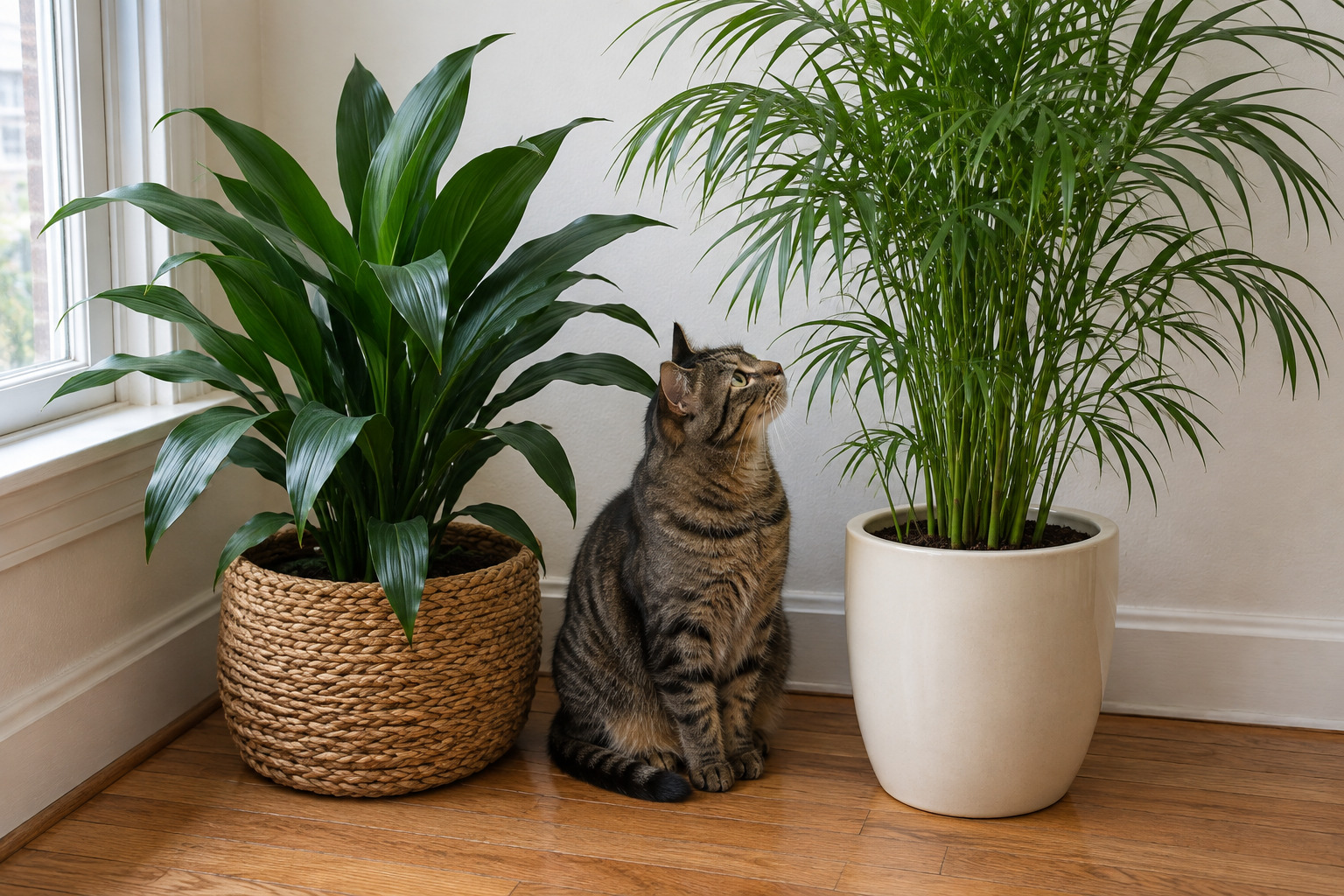
That column is not a guess. The ASPCA toxic and non-toxic plant database lists the Boston fern, spider plant, parlor palm and cast iron plant as non-toxic to cats and dogs, and the peace lily, golden pothos, Chinese evergreen and snake plant as toxic. The bird’s nest fern and the ZZ plant are not in the database at all, which is a gap in the list rather than a clean bill of health.
How to Keep Plants Alive in a Hallway With No Daylight
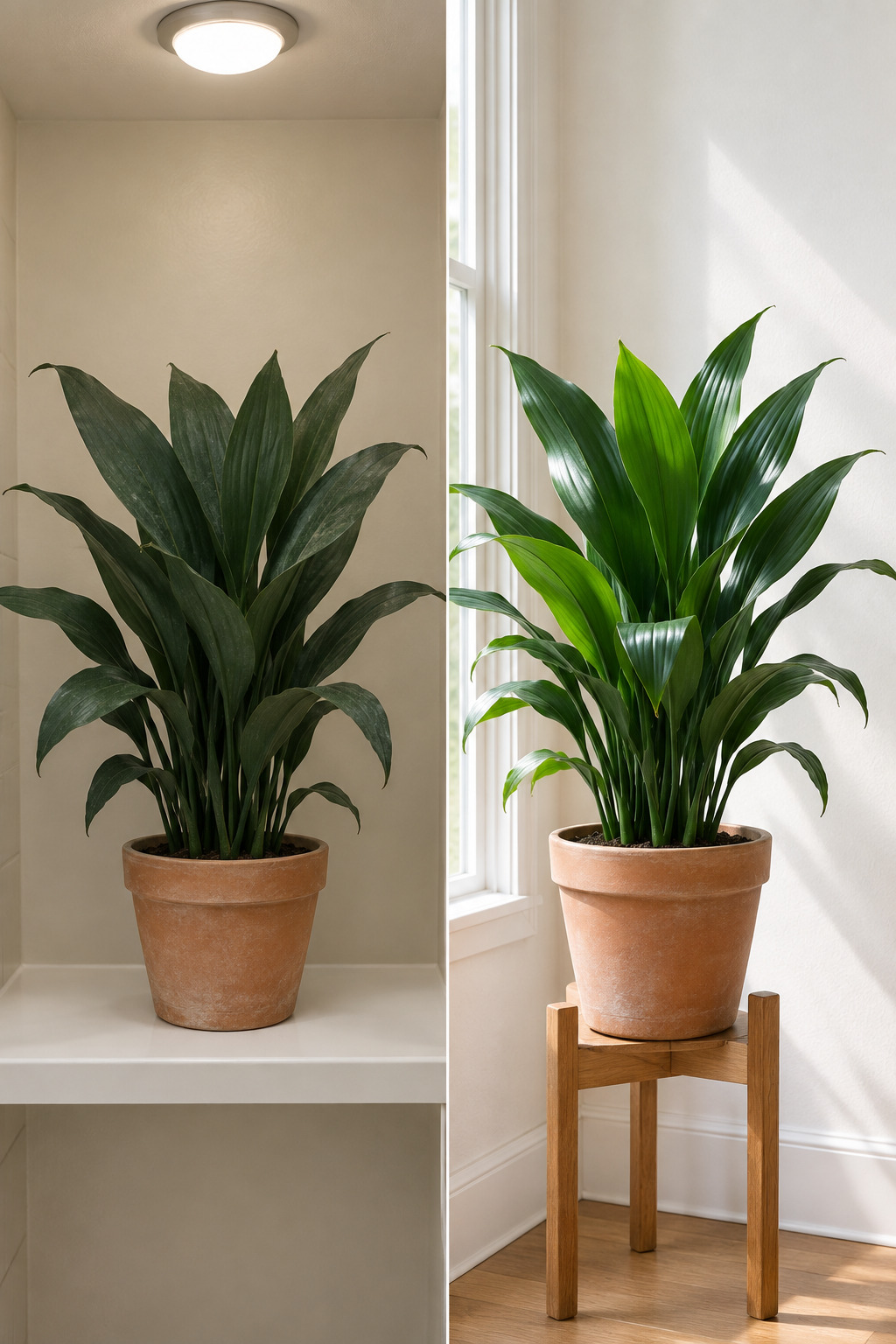
An interior hallway is usually the hardest room in the house. It has every problem the windowless bathroom has and none of the humidity.
- Often no outlet. Without a socket, the rotation method is the only honest option, so plan for two plants.
- The driest air in the home. A heated hallway in winter has nothing to offer a fern.
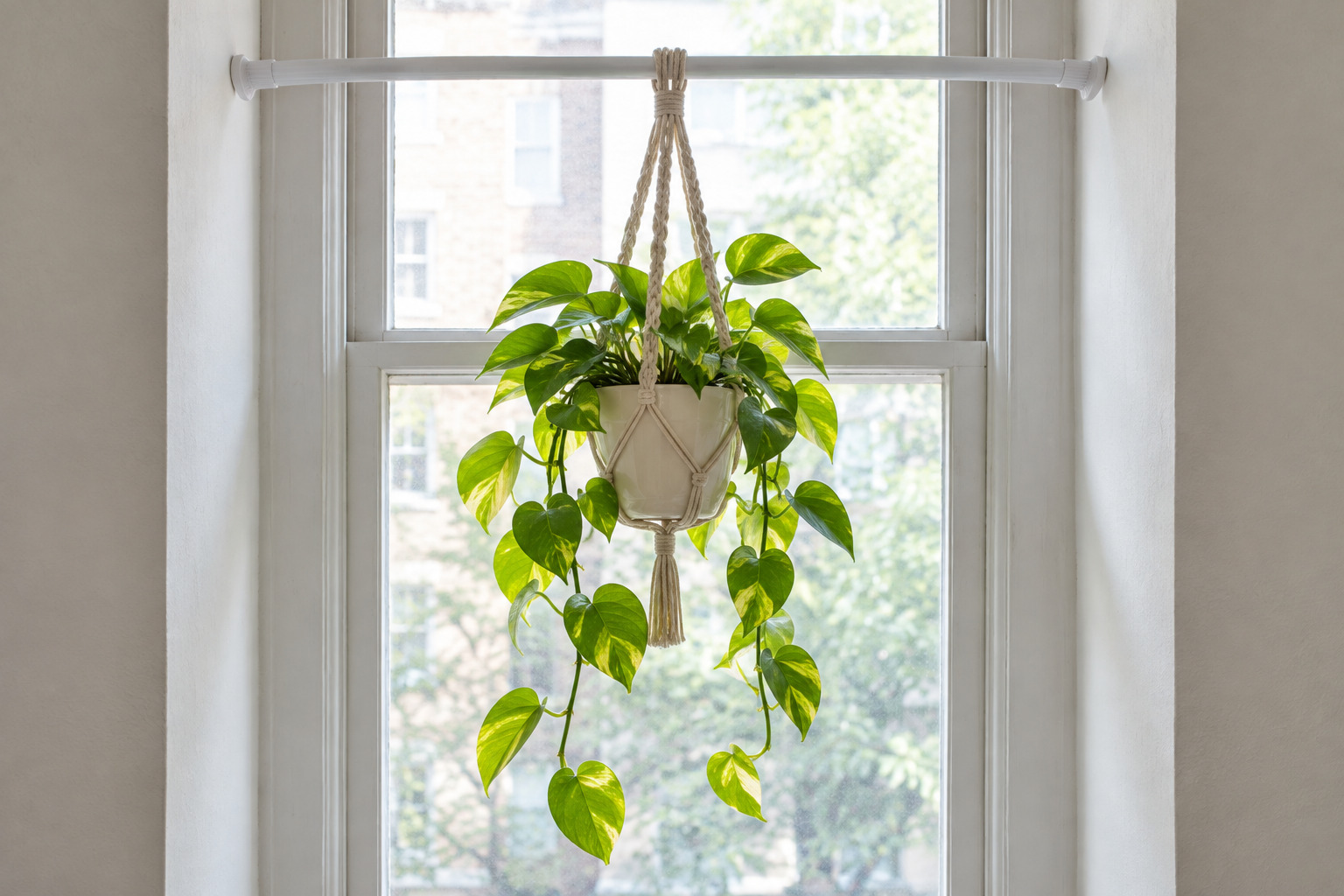
- Foot traffic. Clemson says to keep ferns out of high-traffic areas, because fronds handle rough contact badly. A trailing plant at shoulder height in a corridor is a jacket magnet.
- Doors and drafts. An entry hallway takes the outdoor temperature every time the door opens.
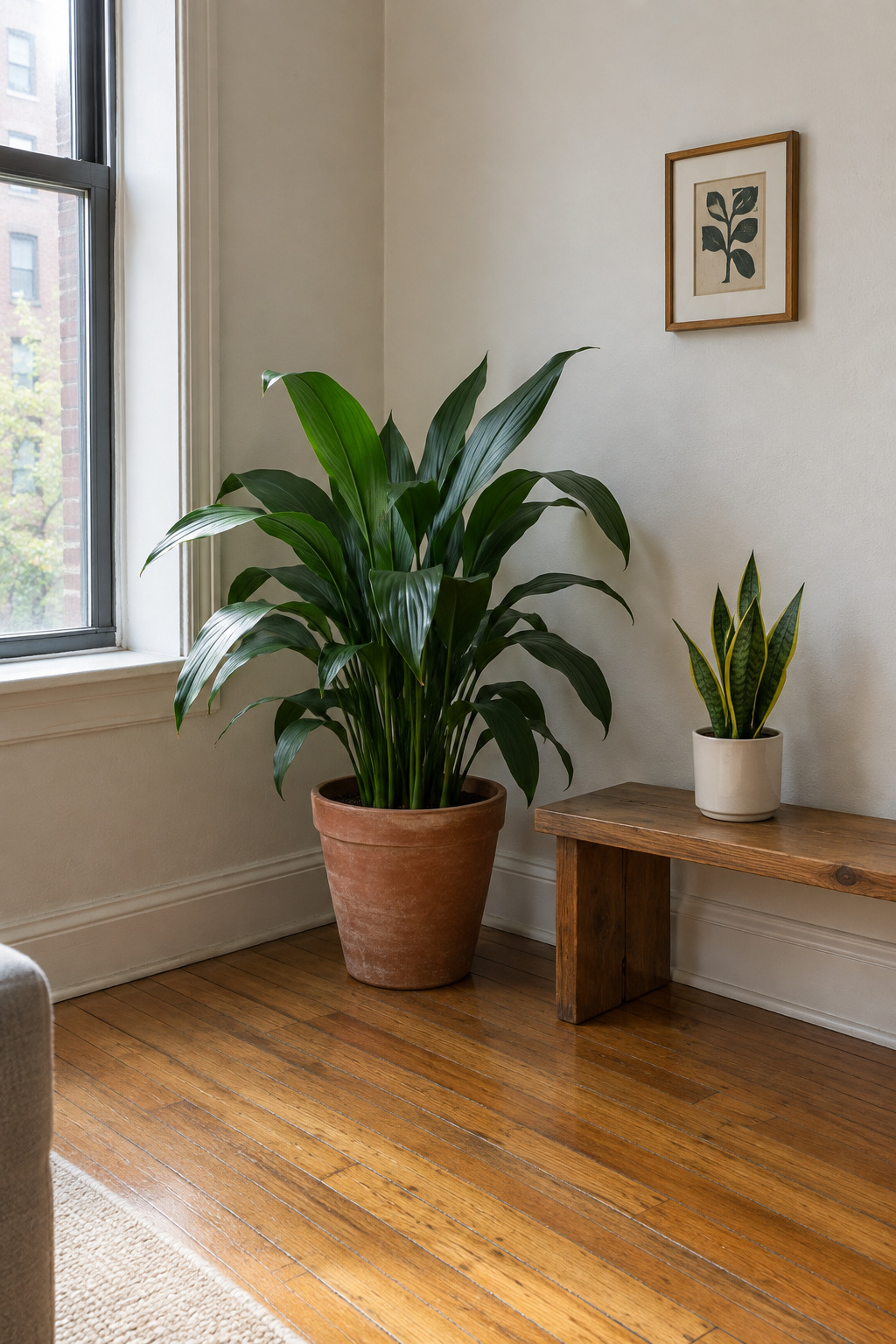
What survives is something narrow and upright, or something hung above head height. A snake plant in a slim pot takes inches of floor. Anchor the pot, keep the walkway clear, and run one small light on a timer if there is an outlet. The narrow plant stands for apartment corners guide covers the rest, since the hallway problem is usually floor space rather than light.
Mistakes That Kill a Plant in a Dark Room
Low light rarely kills a houseplant on its own. Low light plus a habit from a brighter room does.
- Watering on the label’s schedule. A plant in a dark room uses far less water, and the mix stays wet for days longer.
- Feeding a plant that cannot use the food. Below Clemson’s 200 foot-candle line, a foliage plant gets no benefit from feeding, and salt buildup can damage roots.
- Leaving the light on all night. Iowa State’s ceiling is 16 hours and the target is 14.
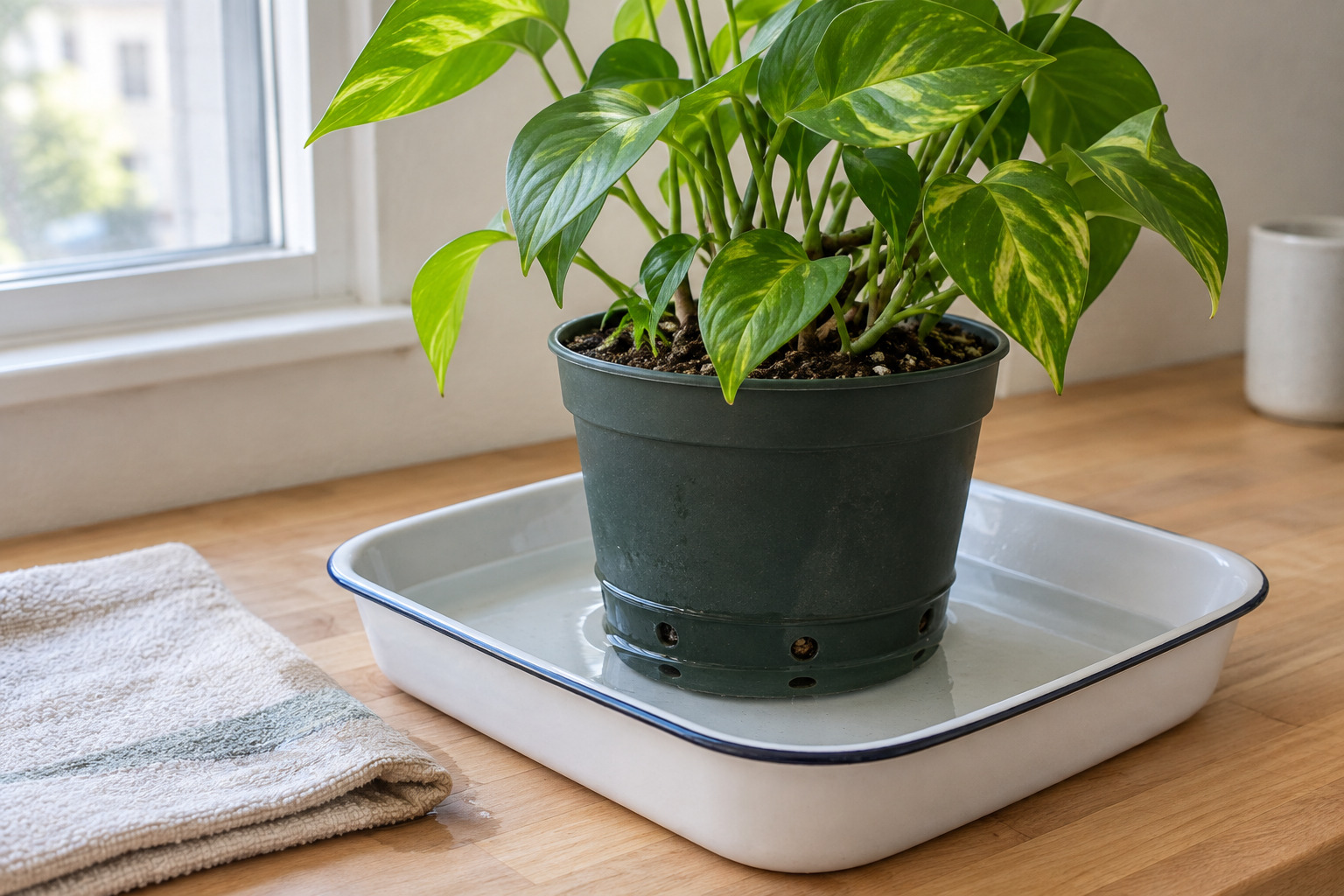
- A cachepot with no drainage. In a humid room this is the fastest route to root rot.
Do Houseplants Absorb Moisture or Remove Mold?
Two questions keep attaching themselves to this topic, and both rest on a belief that does not hold. One asks whether a plant absorbs moisture in a bathroom. The other is a number that circulates with English ivy attached to it, claiming a large share of airborne mold removed. The air purifying plants article traced that number to a 2005 conference presentation that put ivy in a sealed container next to moldy bread, with no room-scale replication since.
A plant moves water from its pot into the air. That is what transpiration is, and it is why Clemson recommends double potting to raise the humidity around a fern. A shelf of ferns is evidence that plants want humidity, not that they take it out of a room.
Mold is a moisture problem. The EPA’s guide to mold, moisture and your home says the key to mold control is moisture control, and that if mold is a problem you clean it up and fix the water. It puts indoor humidity below 60 percent, ideally between 30 and 50.
Keep the fern. Put it in the bathroom because the humidity suits it. Just do not buy it as a dehumidifier. The fan is the dehumidifier, and it was already installed.
Questions People Actually Ask
What plants thrive in dark bathrooms?
None of them thrive. The species that hold their looks longest on a rotation are the ZZ plant, cast iron plant, snake plant, golden pothos, Chinese evergreen and parlor palm.
What is the best plant for a bathroom without a window?
Two plants, not one. Buy a pair of cast iron plants if a pet shares the room, since the ASPCA lists it as non-toxic, or a pair of ZZ plants if no pet does.
What plants can stay in the dark?
About two weeks. Nothing stays longer, so the rotation window is what “stay” means here.
What happens when you put a plant in a dark room?
It stretches toward whatever light it can find, stops growing, then drops its lower leaves. Yellowing lower leaves are the early warning, and they are easy to mistake for underwatering.
Can any plant survive in a windowless room?
Not on the room’s own light, which is the honest answer for a bathroom with no natural light too. A plant survives on a timer light set to Iowa State’s 14 hours, or on a rotation out of the room every two weeks.
What plants work in a low-light bedroom?
A bedroom with one window is a normal low light room rather than a windowless one, so the list is much longer. The low light indoor plants guide covers which species tolerate the dim end.
What plants reduce mold in bathrooms?
None of them, at any rate that matters. Mold needs moisture, so the fix is ventilation and drying rather than foliage. Run the exhaust fan and clean the grout.
Sources
- Clemson HGIC: Indoor plants, cleaning, fertilizing, containers and light requirements : foot-candle bands, the 100 and 200 foot-candle thresholds, and why incandescent light makes plants leggy.
- Clemson HGIC: Indoor ferns : bathroom humidity suiting fine ferns, the day and night temperature range, and high-traffic placement.
- Iowa State University Extension: How to set up supplemental lights for indoor plants : daily light duration, fixture-to-foliage distances, and the shop-fixture recipe.
- EPA: A brief guide to mold, moisture and your home : moisture control as the key to mold, and bathroom ventilation.
- ASPCA: Toxic and non-toxic plants : plant-by-plant pet safety. The list is not all-inclusive, which is why two plants here read as unverified.
What to Read Next
- Low light indoor plants for the longer list that applies once a spot has daylight rather than none.
- Grow lights that look good in a living room for a fixture you can stand to look at.
- Air purifying plants and what they really do for the full history of the mold number.
- Plants that make an apartment feel less sterile when the real goal is a room that feels alive.
- Indoor house plants without the clutter for keeping two plants from turning into a collection.