Most stocking advice assumes a mantel. Plenty of homes do not have one. Some have no fireplace at all, and plenty of the ones that do have a builder-grade surround with no shelf on it. So the question is not decorative. It is structural: where in this house is there a horizontal thing strong enough to carry four filled stockings for five weeks?
There are more of them than you think. A stair rail, a curtain rod, the edge of a bookcase, a peg rail, a tension rod jammed into a window reveal, the back of a dining chair. Twenty six of them are below, ordered from the ones that involve a drill down to the ones that attach to nothing at all, so you can start reading at whichever end matches your lease.
But first the part every list skips, which is weight. A stocking is not light once it is full, and almost every failure comes down to somebody matching a 1 pound hook to a 4 pound stocking in a cold room.
Weigh One Filled Stocking Before You Buy a Single Hook
Put a stocking on a kitchen scale and load it the way you actually intend to.
An empty knit stocking runs about 4 to 8 ounces. Add an orange, a paperback, a bar of chocolate, a pair of socks and two small boxes and most land between 2 and 4 pounds. A generous one with a hardback book or a bottle in it clears 5. That is the number your fixing has to carry, not the weight of the empty stocking you hung on December 1st.
Then multiply by how many you are hanging off the same object. Four stockings at 3 pounds each is 12 pounds pulling down on one curtain rod, one dowel, or one strip of adhesive. Rods and rails fail as a set, not one stocking at a time.
Two habits fix most of this before it starts:
- One fixing per stocking, spaced out, rather than four sharing a single bar or a single bracket. Spread load is the whole game.
- Hang them empty and fill them on Christmas Eve. Then the real weight is on the wall for one night instead of thirty five days of slow creep in a heated room. This is the single most useful sentence on this page and it costs nothing.
What Each Fixing Actually Holds
Ratings are for a load hanging straight down against the wall. Angle a hook outward, or hang something that swings, and the real capacity drops. Every number below is what the package promises, so read your own package rather than trusting mine.
| Fixing | Typical rating | Good for |
|---|---|---|
| Small adhesive hook | 1 lb | Nothing you will actually fill |
| Medium adhesive hook | 3 lb | One modest stocking, filled Christmas Eve |
| Large adhesive utility hook | 5 lb | One full stocking with room to spare |
| Medium picture hanging strips, per pair | 10 lb | Mounting a flat board or cleat to the wall |
| Large picture hanging strips, per pair | 15 lb | The same, heavier |
| X-large picture hanging strips, per pair | 20 lb | A peg rail or dowel cleat, no holes |
| Plastic expansion anchor in 1/2 in drywall | usually 10 to 20 lb | One hook, light duty |
| Self-drilling threaded nylon anchor | usually 25 to 50 lb | A hook you trust with a full stocking |
| Toggle bolt in 1/2 in drywall | 50 lb and up | A rod or rail carrying several |
| #8 screw into a wall stud | far more than you need | Anything permanent |
The strip tiers come off the packaging on 3M’s own Command picture hanging strips, which are sold by rated pair: 10 pound medium, 15 pound large, 20 pound extra large. Their hooks run on a separate scale of 1, 3, 5 and 8 pounds.
A stud is still the best answer for anything you want to keep. Framing in most American houses runs 16 inches on center, sometimes 24 in newer construction, so tap along the wall or run a magnet over it and find the line of drywall screws. Two screws into two studs will hold a peg rail for the next decade and you will use it for coats in February.
Anchors are the compromise, and the ratings above assume half inch drywall. In plaster and lath, in a 1930s apartment, none of those numbers apply and a toggle behaves unpredictably. Test with something you do not mind losing.
Where Adhesive Hooks Quietly Fail
Adhesive is the renter’s default and it is genuinely good, right up until it meets one of four things. All four are in 3M’s own instructions for Command products and all four get skipped.
Temperature. Command products are specified for application between 50 and 105 degrees Fahrenheit. A wall in an unheated entry, a garage, a three season porch or an outside-facing stairwell in December is often below that, and the strip never bonds properly. Warm the wall and the strip to room temperature before you stick anything, and put your hooks up in November while the house is still warm.
Cure time. Press for 30 seconds, then wait one hour before you hang any weight. Not ten minutes. The overnight failures are almost all people who loaded a hook straight away.
Fresh paint. New paint keeps outgassing for days. 3M’s guidance is to wait seven days after painting before applying adhesive, and a wall painted last weekend for the holidays is exactly the wall that will let go.
Texture. Adhesive works by continuous contact. Brick, rough stone, knockdown or orange peel texture, wallpaper, vinyl and bare unfinished wood do not offer it, so the strip touches only the high points. On brick it is not a weak bond, it is no bond. Nothing on this page will make adhesive work on brick, so if that is your wall, skip to the freestanding options at the end.
When it does come off, pull the tab straight down and stretch it slowly, up to about 15 inches. Pulling out from the wall at an angle is what takes the paint with it.
We covered the adhesive weight tiers in more general terms in the renter friendly Christmas decor guide, so this is the stocking-specific version. And if you do have a mantel and just want to stop wrecking it, that is a different problem with its own answer in Christmas mantel decor. If the fireplace under that mantel is unused and you want a flame in it, the electric fireplace inserts that fit an existing opening are a separate buying decision from where the stockings hang.
How to Hang the Row So It Sits Straight and Stays Out of Reach
A row of stockings looks wrong for one of two reasons. Either they touch, or they hang where someone can reach into them.
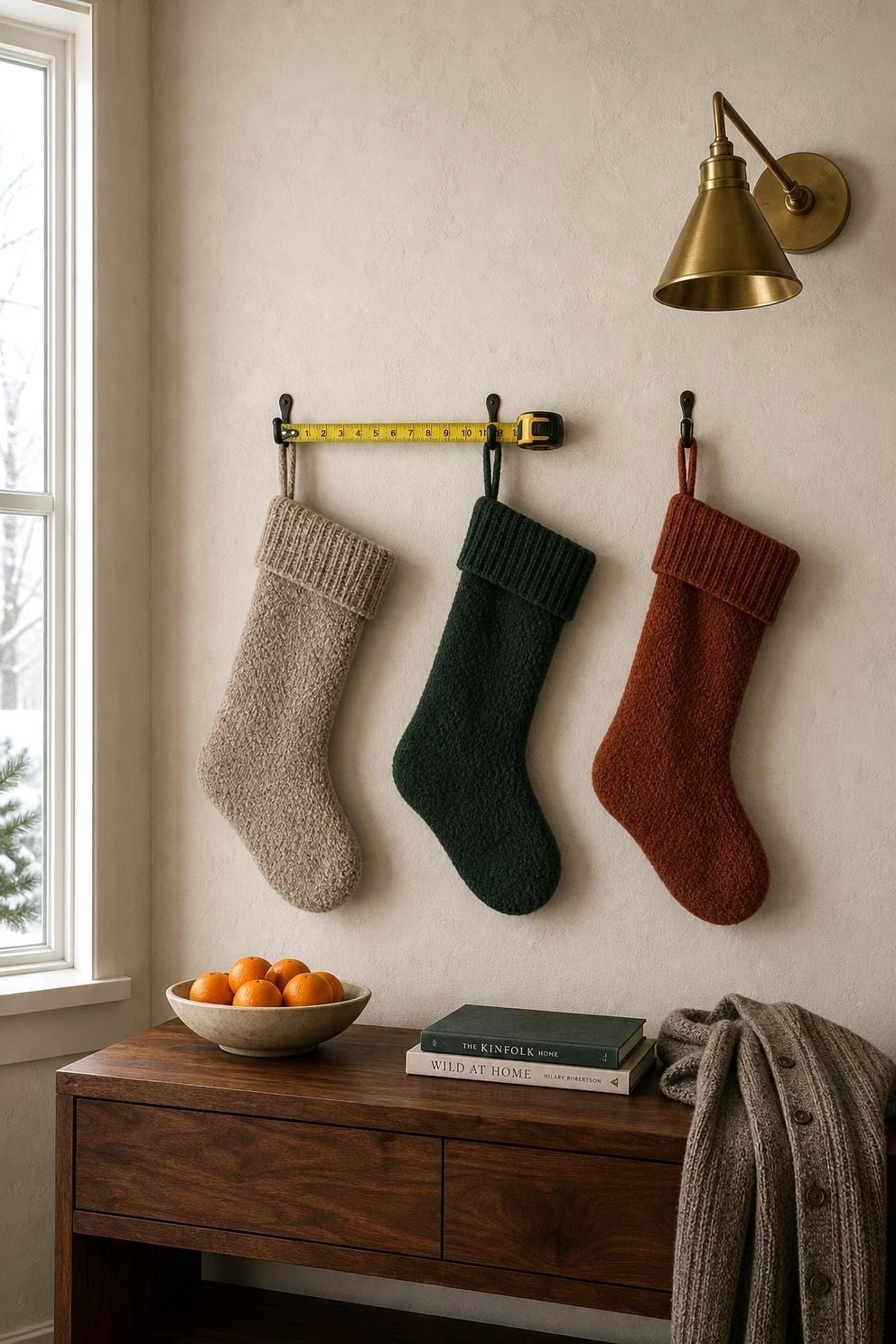
Spacing. A standard stocking is 18 to 20 inches long and 7 to 9 inches across the cuff. Set your hooks 12 inches on center and you get roughly a 4 inch gap between neighbors, which reads as a row rather than a pile. Wide cuff or fur-topped stockings want 14 to 16. Four stockings at 12 inches on center needs about 44 inches of wall or rail, so measure before you commit to a spot.
Height. For a wall row, a cuff at 54 inches off the floor puts the toe around 34 to 36 inches, which is exactly toddler height. Do this instead: stand the smallest person in the house against the wall, have them reach straight up, mark the fingertips, add 4 inches, and hang the toe above that line. For a dog, put its front paws on the wall and measure the same way. The reason is not tidiness. Chocolate is toxic to dogs, and the ASPCA’s list of people foods to avoid feeding pets also flags xylitol, the sweetener in a lot of sugar-free gum and candy, which it says can cause low blood sugar and liver damage.
Once you have both numbers, the row goes up in five steps:
- Mark the cuff line in pencil at the height you just worked out. Every other measurement comes off that one line.
- Run a strip of low-tack painter’s tape along the line and mark the hook positions on the tape at 12 inches on center. The marks stay off the paint and the row stays level.
- Check the tape with a level, or measure down from the ceiling at both ends. A ceiling line is more reliable than your eye, and a row that is 1/4 inch out reads as crooked from across a room.
- Fix the hooks. If they are adhesive, press 30 seconds and leave them bare for the full hour, then pull the tape off after that hour rather than before.
- Hang the stockings empty and step back ten feet before you touch anything else. Adjust now, while nothing is loaded, because a hook you move later takes paint with it.
If the honest answer is that nothing in your house is high enough, you are back to the same fix: hang them empty, fill them Christmas Eve, and go to bed.
26 Places to Hang Stockings, Most Permanent First
Start at whichever heading matches what you are allowed to do to the walls.
It goes in the wall and it stays there
1. A peg rail. The best answer in the whole article if you own the place. A 36 inch Shaker peg rail screwed into two studs carries stockings in December, coats in January and tote bags forever. Mount it at 60 to 66 inches so the toes clear small hands. This is the one that stops being Christmas decor and becomes furniture.
2. A dowel or a branch on two wall brackets. Two closet flange brackets, 36 to 48 inches apart, and a 1 3/8 inch wooden closet dowel across them. Swap the dowel for a straight birch or oak branch about 2 inches thick and it stops looking like hardware. Screw the brackets into studs and the whole span will carry 15 pounds without complaint.
3. Wall hooks in a row. Four cast iron or brass hooks, 12 inches on center, into anchors or studs. Permanent, but a row of good hooks at 60 inches never looks like leftover Christmas in March.
4. A curtain rod above the window. Already there, already horizontal, already at the right height. Check what the brackets are screwed into before you load it, because a rod carrying sheers is doing almost no work and four filled stockings is a real change. Two stockings on a standard bracketed rod is safe. Six is a gamble.
5. Coat hooks inside the entry. If there is already a rail by the door, it is a stocking rail for five weeks. Take the coats off it or the whole thing reads as clutter.
Already part of the house, nothing new goes in the wall
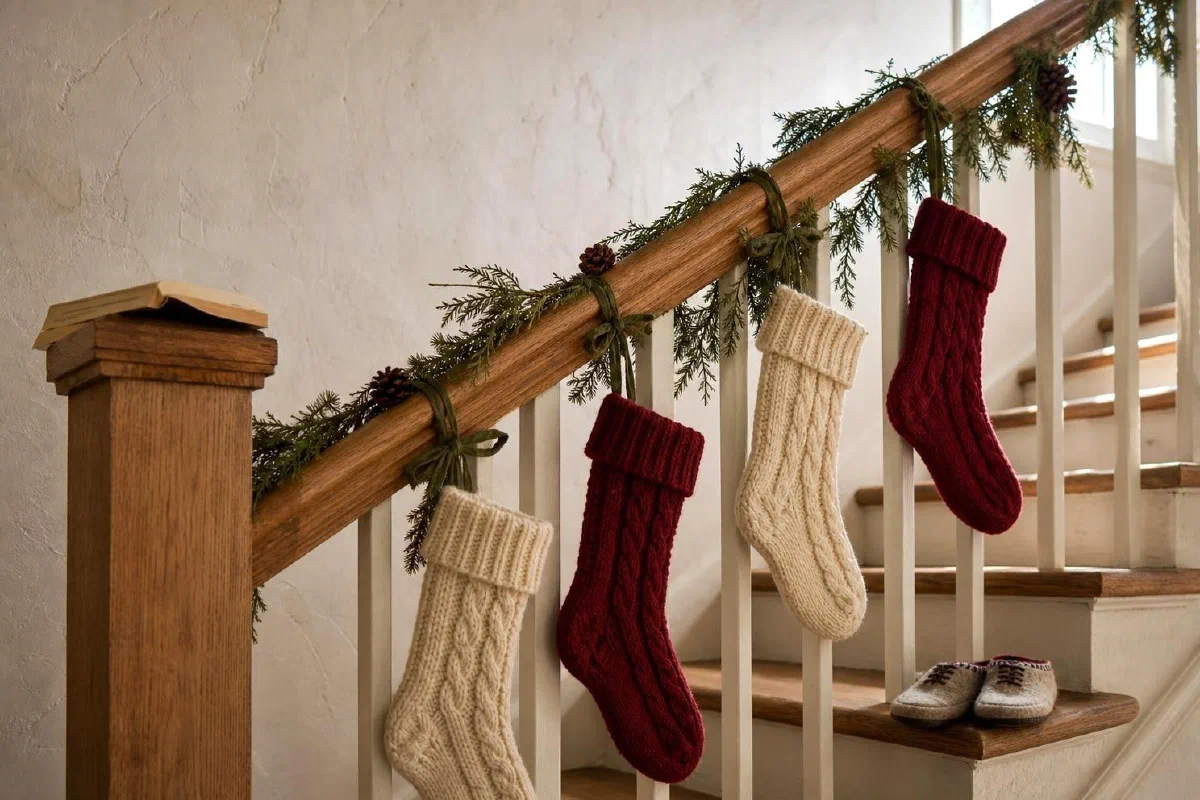
6. The stair rail. The most common answer and the best looking one. Tie each stocking to the rail with ribbon or a wired tie rather than hooking it, so nothing slides. Haute Decor decorative twist ties (opens Amazon in a new tab)As an Amazon Associate, we earn from qualifying purchases. Full disclosure. have a wire core inside a fabric sleeve and hold a knot without cutting into the finish. Space at 12 inches, and keep the handrail itself clear enough to grip, because that rail is a safety device before it is decor.
7. The newel post. The fat post at the bottom of the stairs. One or two stockings only, tied at the top, plus a small garland ring. It is a focal point rather than a row.
8. The bannister spindles. Tie each stocking to its own spindle instead of the top rail. This is the version that leaves the handrail completely clear, which matters if anyone in the house uses it to get down the stairs in the dark.
9. A tension rod inside the window reveal. A deep window opening will take a spring tension rod wedged across it at the top. No holes at all. Most cafe-weight tension rods are rated in the 10 to 20 pound range depending on span, and a long one sags, so keep to a reveal under about 36 inches and hang two or three stockings, not six.
10. A tension rod inside a doorframe. Same trick in an interior doorway you never close. Works well in an archway between two rooms where there is no furniture to hang from.
11. Over the top of a door. Over-the-door hooks carry stockings on the inside face of a door with no hardware anywhere. Only on a door that stays shut, because the stockings swing and thump every time it moves.
12. The doorframe trim. Over-frame hooks that hang on the casing lip, or small adhesive hooks on the flat face of the trim, which is often the smoothest and best-cured paint in the room.
13. A radiator cover. The flat lip on top of a radiator cover is a shelf, and clamp-style holders grip it exactly like a mantel. One caution that is not optional: only on a cover with a top that stays cool to the touch, and never with anything hanging down over the grille where hot air comes out.
14. A garland strung wall to wall. Two anchored hooks at either end of a wall, a heavy cord or a faux garland between them, stockings clipped along it. This is how you get six stockings up when there is no single object long enough. Anchor both ends properly, because the whole load hangs on two points and the sag pulls outward on them.
15. Adhesive hooks in a row on the wall. The straightforward version. Use one large hook per stocking, not one hook for two. Command large utility hooks, seven hooks with twelve strips (opens Amazon in a new tab)As an Amazon Associate, we earn from qualifying purchases. Full disclosure. are rated at 5 pounds each, which covers a full stocking honestly. Re-read the temperature and texture rules above before you buy them.
16. A board or cleat mounted with picture hanging strips. The workaround for renters who want the peg rail look with no holes. A 1 by 4 board, painted, with hooks screwed into it, held to the wall with 20 pound X-large picture hanging strips (opens Amazon in a new tab)As an Amazon Associate, we earn from qualifying purchases. Full disclosure.. Four pairs across a 36 inch board spreads the load properly. It comes down in April and the wall is untouched.
Furniture you already own carries the load
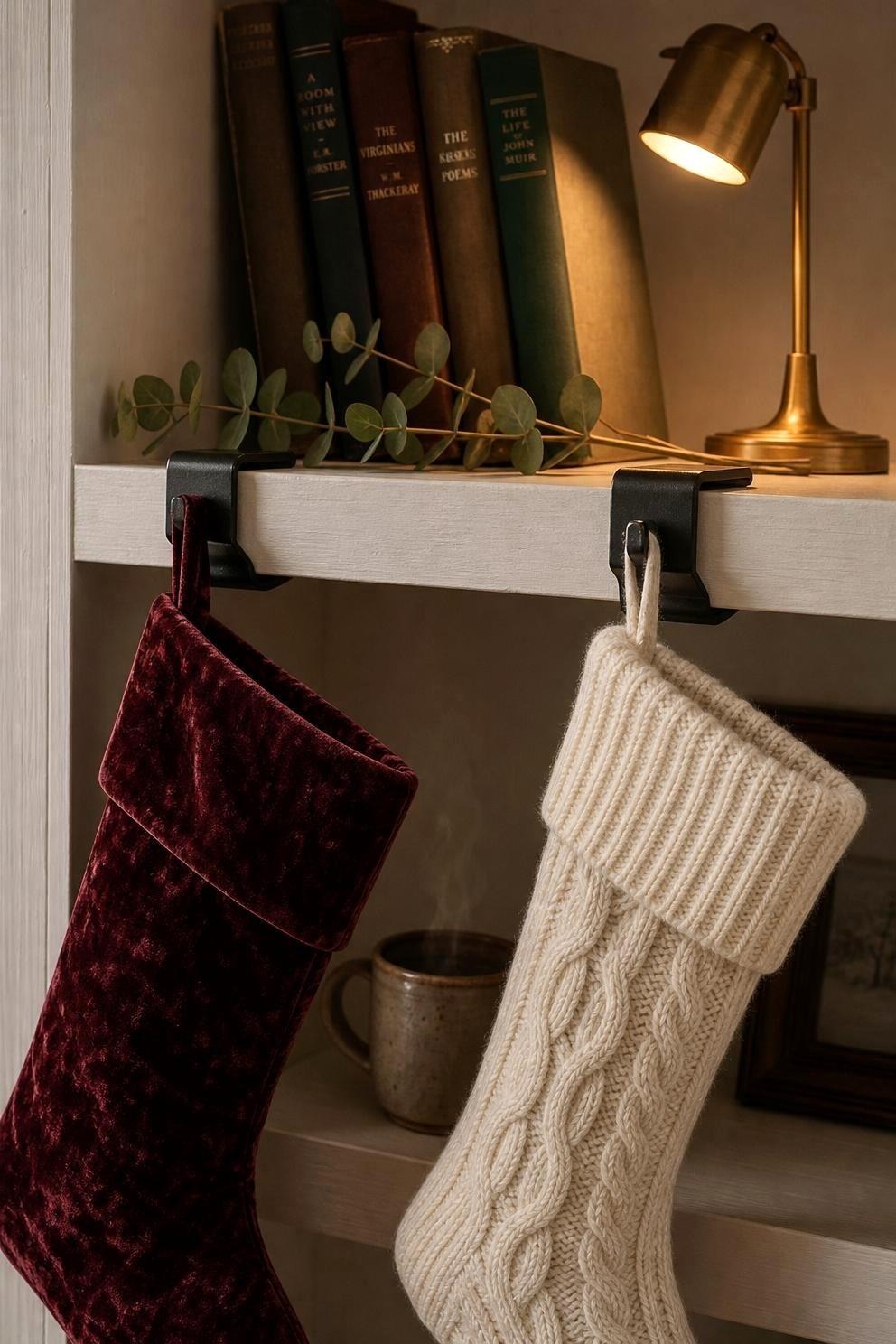
17. The edge of a bookshelf. The best mantel substitute in most houses. A clamp-style holder grips the shelf board the way a mantel clip grips a mantel, and the shelf below hides the mechanics. The Haute Decor MantleClip, four pack (opens Amazon in a new tab)As an Amazon Associate, we earn from qualifying purchases. Full disclosure. fits anything up to 3 inches thick, which covers most shelf boards. Clear the books from that shelf first or the stockings read as an accident.
18. The side of a bookcase. The vertical outer panel of a tall bookcase is a free wall nobody uses. Adhesive hooks on the flat finished side, stockings hanging down the outside. Works especially well where a bookcase stands beside a doorway.
19. A console table edge. Adjustable 2-in-1 stocking and garland holders that need no drilling (opens Amazon in a new tab)As an Amazon Associate, we earn from qualifying purchases. Full disclosure. clamp onto a table top up to 3.5 inches thick, which is thicker than nearly every console made. Garland along the top, mirror or art above, stockings hanging off the front edge. That is a mantel in everything but name, and the full version of that idea lives in Christmas mantel ideas with no fireplace.
20. The TV console. Same clamp, and the television above it does the job the mirror does. The MSHALADE lightweight adjustable holders, set of four (opens Amazon in a new tab)As an Amazon Associate, we earn from qualifying purchases. Full disclosure. are the light-duty option here, which is the right call on a thin MDF top.
21. A headboard. A slatted or spindle headboard takes ribbon ties beautifully, and a kid’s room with two stockings on the bed end is the version children actually remember. Take them down before bedtime on the 24th, obviously.
22. A dresser or sideboard edge. Clamp holders again on any top with an overhang. A sideboard in a dining room is often the widest uninterrupted horizontal surface in a small house.
23. The back of a dining chair. One stocking per chair, tied to the top rail, one per person. This is the best answer for Christmas morning specifically, because everyone sits down to breakfast in front of their own. It needs no hardware whatsoever.
24. A kitchen island or bar counter overhang. Weighted or clamp holders along a counter overhang. Homjoy metal stocking holders, six pack (opens Amazon in a new tab)As an Amazon Associate, we earn from qualifying purchases. Full disclosure. are the set to reach for when there are five or six stockings and one long surface.
Nothing attaches to anything
25. Weighted holders on a windowsill or shelf top. The purest renter answer: cast iron holders that sit on a flat surface and hold the stocking by their own mass. The HMASYO weighted cast iron holders, set of two (opens Amazon in a new tab)As an Amazon Associate, we earn from qualifying purchases. Full disclosure.. They need a surface deep enough to sit stably, so measure the sill before you order.
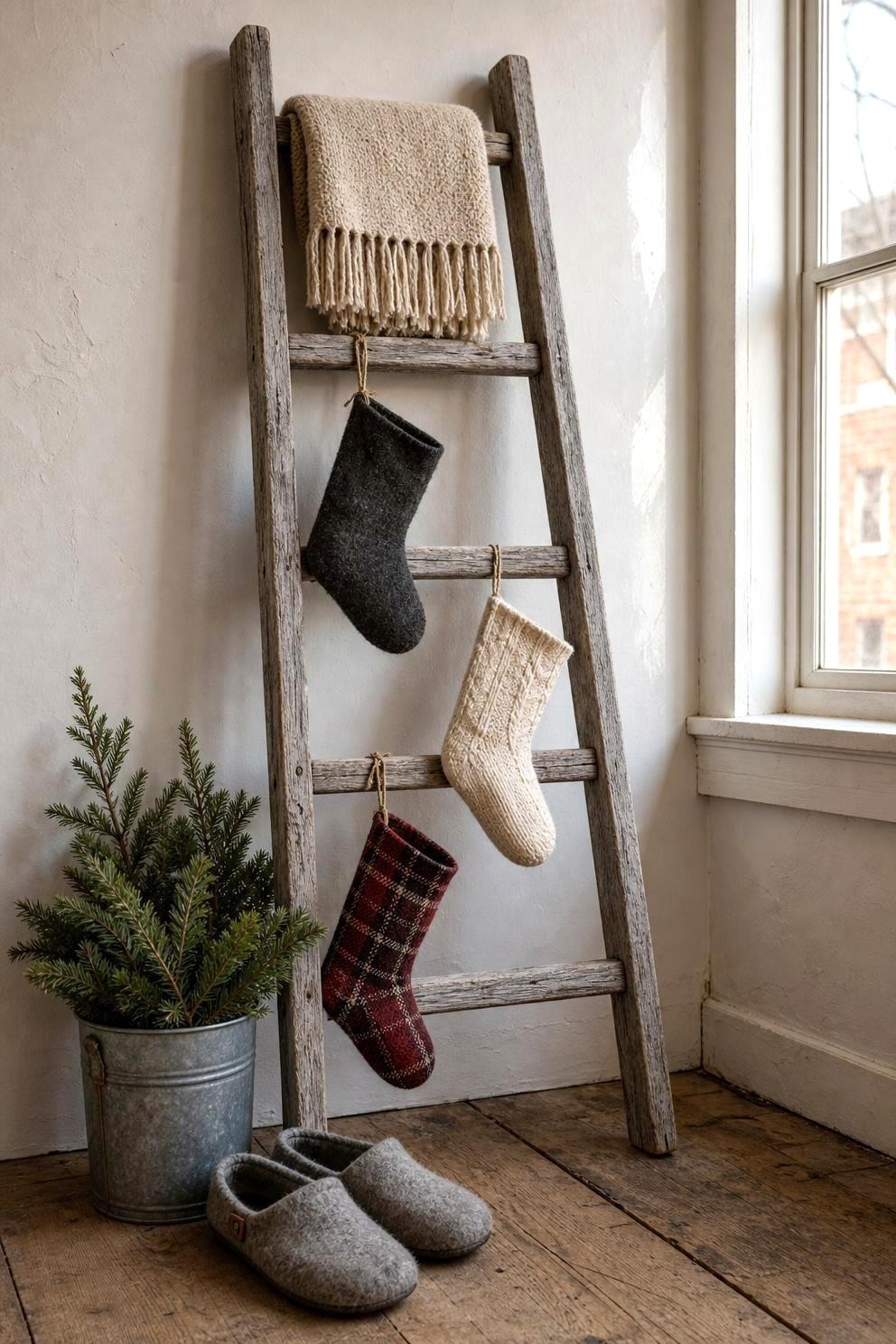
26. A leaned ladder, a coat rack, a stand, or a basket. Four objects, one idea: bring in a horizontal or a vertical thing rather than using the house. A wooden ladder leaned against a wall at a shallow angle gives you four rungs at four heights. A hall tree or freestanding coat rack takes stockings from its arms. A freestanding stocking stand is a purpose-built version of the same thought. And on Christmas Eve, a basket or a wooden crate on the floor by the tree with everyone’s stocking folded into it is what half the houses in the country actually do, and nobody has ever complained.
When You Only Have One Usable Wall
Studio apartments, narrow rentals and rooms where every wall carries a window, a door or a sofa back. This is the constraint that makes the list above collapse to about three options.
- Go vertical instead of horizontal. Two stockings stacked at different heights on one narrow strip of wall beside a door reads as deliberate. A row of four does not fit and should not be forced.
- Use the back of the door, which is a whole wall nobody counts. Over-the-door hooks, one stocking, plus a small wreath above it.
- Borrow the tree. Stockings hung from the lower branches of a tree, or from the trunk itself on a wired tie, are a real and old solution. On a slim tree keep them to the back third so they do not crush the shape.
- Use the window reveal. Tension rod, two stockings, and the light behind them does the styling for you.
- Buy the freestanding stand and accept that it takes up 12 inches of floor. Floor space is usually cheaper than wall space in a small rental, which is the same trade that runs through cozy apartment ideas that make a rental feel like home.
One more thing worth saying out loud: four stockings is not a rule. Two well hung stockings on a narrow wall look better than five crammed onto a curtain rod, and the crammed version is what makes a small room feel smaller.
Questions People Actually Ask
What do you do with stockings if you don’t have a fireplace?
You find the next best horizontal line in the house and use that. In practice the shortlist is short: a stair rail, the edge of a bookshelf, a console or sideboard front, a curtain rod, or a peg rail you mount yourself. If none of those exist, you bring the horizontal line in with you as a leaned ladder, a coat rack or a freestanding stand. The single decision that matters is not which spot looks best in a photograph. It is which spot is strong enough to carry two to four pounds per stocking for five weeks, which is why the weighing step at the top of this page comes before the ideas.
How to display Christmas stockings without a mantle?
Copy the shape a mantel makes rather than the mantel itself. A mantel is a horizontal line at roughly chest height with something anchoring above it and stockings hanging below. A console table with a leaning mirror, a bookshelf with a cleared shelf, or a peg rail under a piece of art all produce that same shape. Then get the spacing right, because that is what separates a deliberate display from a few stockings on a wall: 12 inches on center, cuffs level with each other, one fixing per stocking. Add greenery along the horizontal line last, once you can see how much space the stockings actually left.
Should you hang stockings on your fireplace?
If it is decorative, yes, and it is the easiest surface in the house. If you actually light it, be careful about two separate things. Fabric hanging near an open firebox is combustible material in the wrong place, and the U.S. Fire Administration’s home heating fire guidance puts a real number on it: keep anything that can burn at least 3 feet from a fireplace, wood stove, radiator, space heater or candle. A stocking on the mantel is nowhere near 3 feet. Beyond that, do not light a fire with stockings hanging, take them off the mantel before you do, and remember that a warm mantel above a working fire is also the worst place in the house for adhesive. The clearance figures and the surface-by-surface fixing table are in Christmas mantel decor.
What are some alternatives to stocking holders?
Ribbon and a wired twist tie replace a holder entirely on any rail, spindle, chair back or headboard, and they hold better than a hook because they cannot slide. Small S-hooks work on a rod. Adhesive hooks work on a wall within the temperature and texture limits above. A shower curtain ring on a rod is quietly perfect, because it slides where you want it and locks shut. And for a shelf edge, a spring clamp with a bit of felt tape is the hardware store version of a purpose-made clip for a fraction of the fuss. Weighted cast iron holders are the alternative that attaches to nothing at all.
How to display a lot of Christmas stockings?
Six or more stockings will not fit any single mantel-sized object, so stop trying to make one line work. Two options actually scale. Run a heavy cord or a faux garland wall to wall, anchored at both ends, and clip stockings along it, which gives you as much span as the room is wide. Or split them across two locations, four on the stair rail and two on the newel post, or a row along a bookshelf and a pair on the console. Split beats crammed every time. If they are all going on one run, keep 12 inches on center and buy holders in a matching set of six rather than mixing two sets of four, because the mismatch is what the eye catches.
What I’d Actually Buy
Product details can change; check the listing before you buy.
Notice how many of these are labeled for mantels. That is a search-term problem, not a product problem: a clamp that grips a 3 inch mantel board grips a 3 inch bookshelf edge, console top or radiator cover exactly the same way. Measure the thickness of your surface and buy to that number.
- Haute Decor MantleClip stocking holders, 4 pack (opens Amazon in a new tab)As an Amazon Associate, we earn from qualifying purchases. Full disclosure.. Fits surfaces up to 3 inches thick, which covers most shelf boards and console tops.
- Adjustable 2-in-1 stocking and garland holders, 4 pack, no drilling (opens Amazon in a new tab)As an Amazon Associate, we earn from qualifying purchases. Full disclosure.. The 3.5 inch jaw is the widest here, so this is the one for a thick console or a radiator cover lip.
- HMASYO weighted cast iron stocking holders, set of 2 (opens Amazon in a new tab)As an Amazon Associate, we earn from qualifying purchases. Full disclosure.. These attach to nothing. If you rent, or your only surface is a windowsill, this is the honest answer.
- Homjoy metal stocking holders, 6 pack (opens Amazon in a new tab)As an Amazon Associate, we earn from qualifying purchases. Full disclosure.. Buy the six pack rather than two fours if you have five or six stockings, for the reason in the last question above.
- MSHALADE lightweight adjustable stocking holders, set of 4 (opens Amazon in a new tab)As an Amazon Associate, we earn from qualifying purchases. Full disclosure.. The light-duty pick, and the right one for a thin MDF console or TV unit where a heavy cast iron holder is the wrong load.
- Command large utility hooks, 7 hooks and 12 strips (opens Amazon in a new tab)As an Amazon Associate, we earn from qualifying purchases. Full disclosure., rated at 5 pounds each. One hook per stocking, on a smooth cured wall, applied above 50 degrees.
- Command 20 lb X-large picture hanging strips, 16 pairs (opens Amazon in a new tab)As an Amazon Associate, we earn from qualifying purchases. Full disclosure.. These are for mounting a board or a light peg rail flat to the wall, which is the no-holes route to a permanent-looking row.
- Haute Decor decorative twist ties, 6 pack, 16 inches (opens Amazon in a new tab)As an Amazon Associate, we earn from qualifying purchases. Full disclosure.. Wire core in a fabric sleeve, for tying stockings to a stair rail, a spindle, a chair back or a headboard.
No link for a freestanding stocking stand. I could not find a listing I would stand behind, so I would rather name the category and let you look.
What to Read Next
- Christmas mantel decor is the version for a mantel you actually have, with the clearance numbers and a surface-by-surface fixing table.
- Renter friendly Christmas decor with no nails covers what adhesive strips hold across the whole apartment, plus what the fire code really says about a tree indoors.
- Cozy apartment ideas to make a rental feel like home is the no-holes thinking applied to the other eleven months.
- Small home Christmas decor storage plan is where the holders and hooks go on December 27th so you can find them next year.
- Christmas front door decor picks up at the entry, which is usually the wall right next to wherever the stockings ended up.