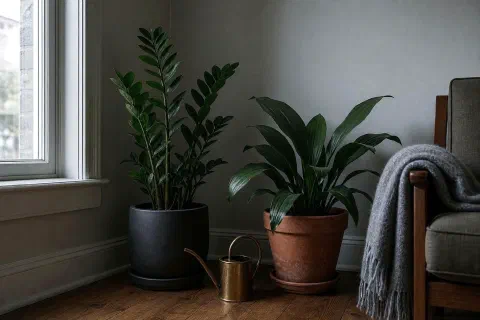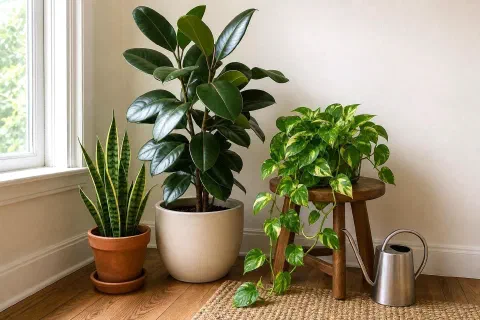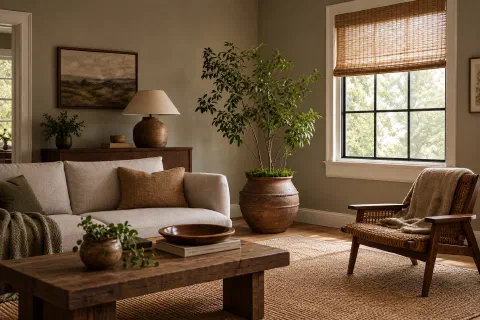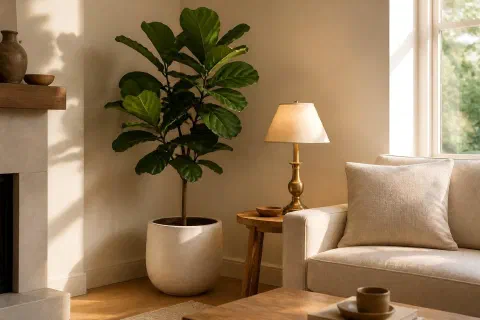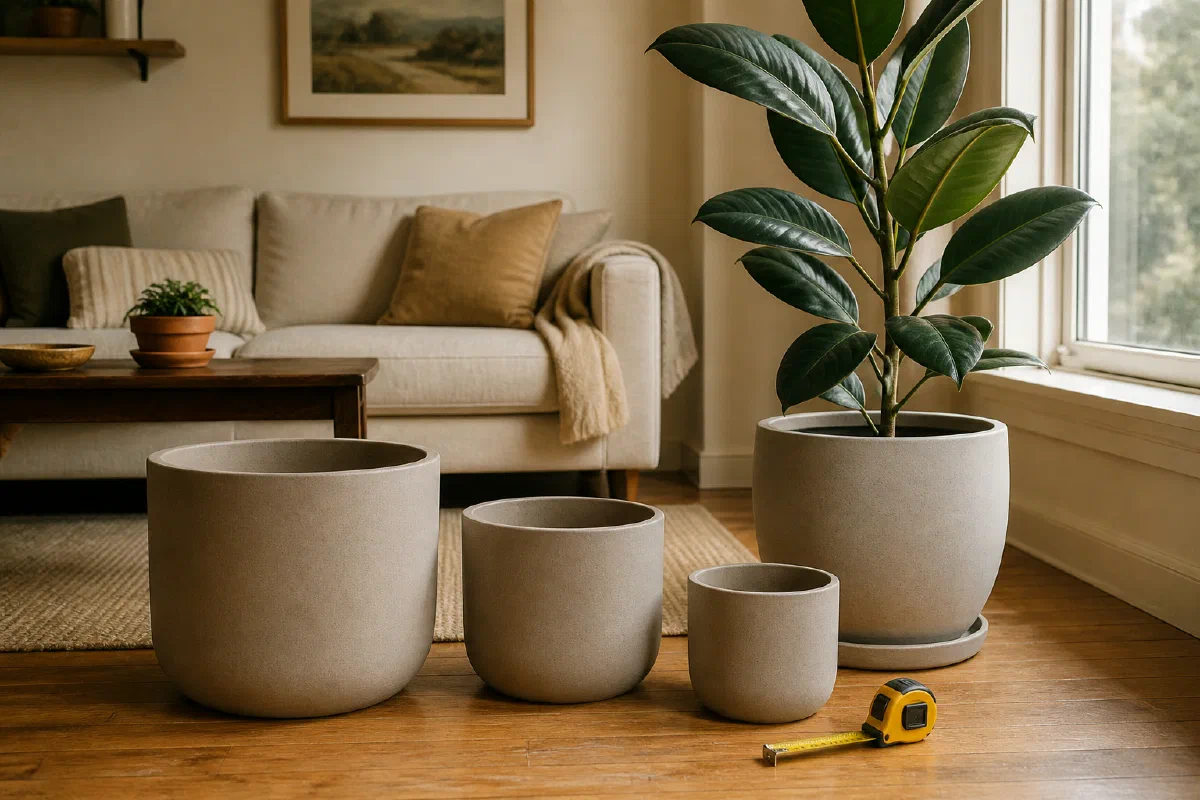
A tall indoor plant does not need a giant planter because its leaves reach the ceiling. The growing pot should fit the root ball, drain freely, and give the plant a steady base. The decorative planter solves the room’s visual problem; it does not need to become a huge volume of wet soil.
That distinction helps a small apartment, too. A large cachepot can make a rubber plant look settled without forcing you to disturb healthy roots. Start with the pot and root ball, then choose the outer planter around them.
The short answer: go one pot size up
When the roots have filled the current container, choose a new growing pot about 2 inches wider than the current pot. For a large plant already in a pot 14 inches or wider, a 2- to 3-inch increase is a sensible upper range. The University of Minnesota Extension recommends no more than a 2- to 3-inch increase because excess mix can stay wet around a smaller root system.
| Current pot diameter | Next growing pot | Useful outer opening | Typical situation |
|---|---|---|---|
| 6 inches | 8 inches | 8.5 to 9 inches | Young snake plant or dracaena |
| 8 inches | 10 inches | 10.5 to 11 inches | Tabletop plant moving toward floor size |
| 10 inches | 12 inches | 12.5 to 13 inches | Medium monstera or rubber plant |
| 12 inches | 14 inches | 14.5 to 15 inches | Established tall plant with a full root ball |
| 14 inches | 16 to 17 inches | 17 to 18 inches | Large floor plant with a filled pot |
| 16 inches | 18 to 19 inches | 19 to 20 inches | Mature specimen that is hard to lift |
The outer-opening column is a shopping starting point, not a promise that every cachepot fits. Product listings may measure a rim, lip, or outside taper. Measure the inside opening and the base before ordering.
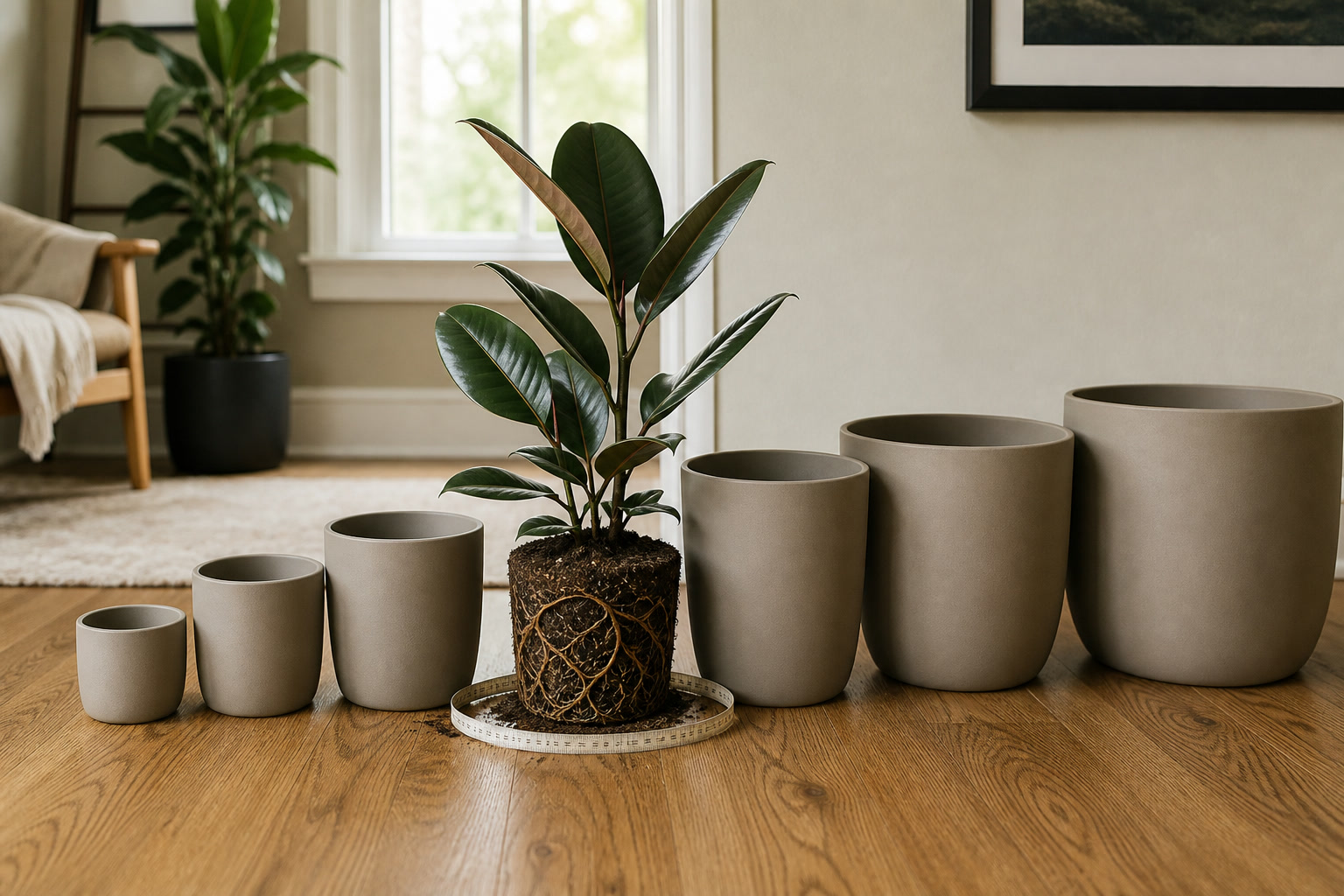
Measure the root ball and pot diameter before repotting
Height is not a repotting signal on its own. A plant can look top-heavy because it is leaning toward a window, standing on a soft rug, or sitting in a light basket. Check the roots before buying a larger growing pot.
Look for one or more of these signs:
- roots circle tightly around the outside of the root ball
- roots push through the drainage hole
- water runs through almost immediately because roots have displaced much of the mix
- the plant needs water far more often than it used to
- the root ball lifts out as one hard mass
If the roots still have room and the mix holds moisture for a normal interval, keep the current growing pot. A heavier outer planter may solve the wobble without repotting. If the plant is bending toward the window, grow lights that look good in a living room may solve the underlying light problem better than extra soil.
If the plant slides out safely, measure the root ball at its widest point. Do not tease apart healthy roots just to get a measurement. For a nursery pot, measure straight across the top rim. For a tapered container, measure the inside width where the root mass actually sits, not the widest outside lip.
Choose a drainage hole, cachepot and saucer that do different jobs
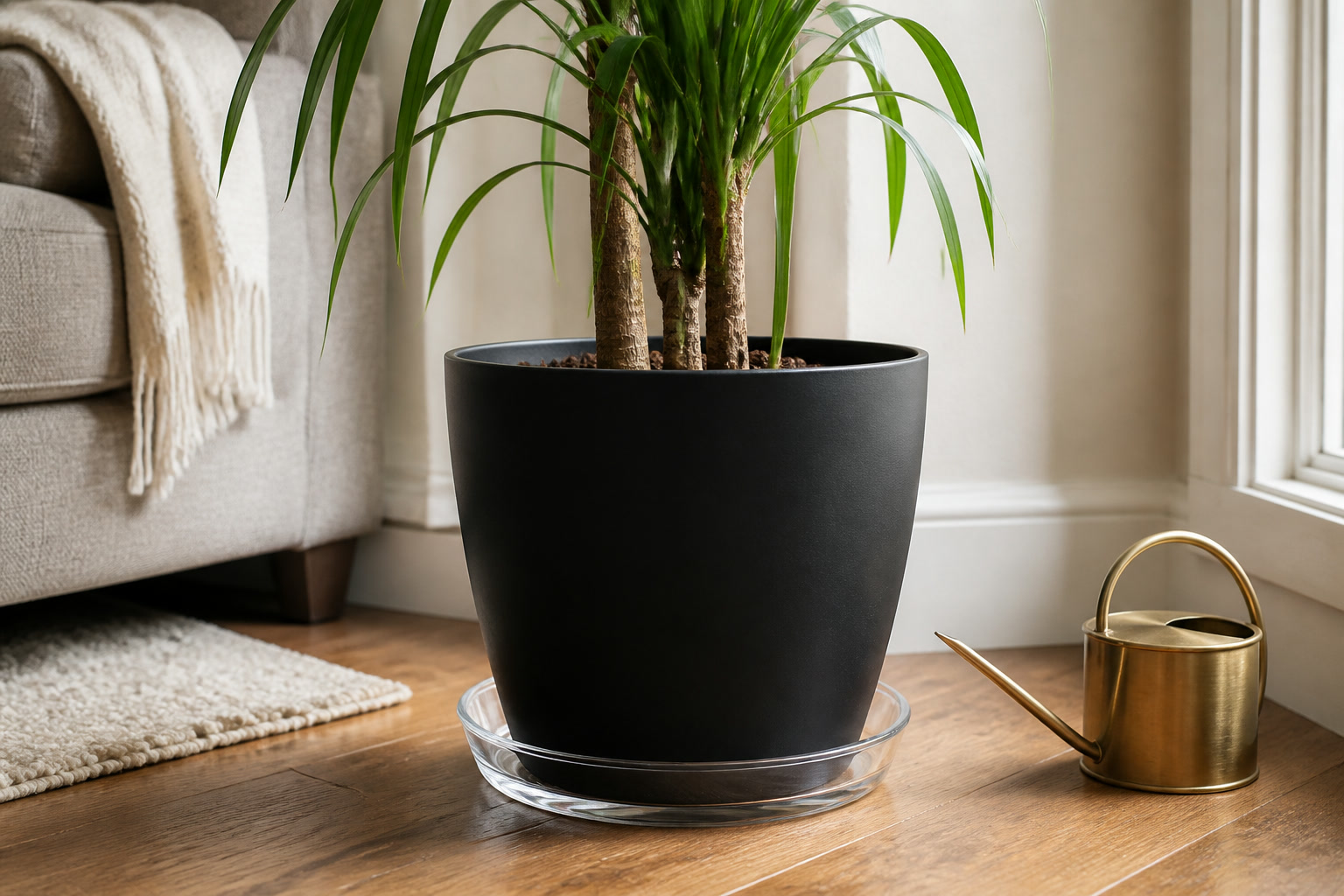
A growing pot holds the roots and needs an open drainage hole. A cachepot hides that pot and provides visual weight. A saucer catches water that exits below. Treating the three as interchangeable is how a pretty planter becomes a wet floor or a waterlogged root zone.
The easiest indoor arrangement is usually a nursery pot inside a decorative cachepot:
- Check that the nursery pot has open drainage holes and that the cachepot is wide enough for it to sit level.
- Lift the nursery pot out before watering, then water thoroughly in a sink, tub, or shower.
- Let excess water drain fully before returning the plant to the cachepot.
- If the pot must stay in place, use a saucer whose usable inside area extends beyond the planter base and empty standing water promptly.
If you plant directly into the decorative planter, confirm that it has a real opening through which excess water can leave. A raised insert or a molded reservoir is not the same as a free drainage hole. Simple living-room plant choices can help when a lower-maintenance setup matters more than a large specimen.
Use the base to solve a top-heavy plant
For a tall plant, the base matters as much as the rim. A narrow, tapered planter can hold the right root volume and still tip when the canopy leans. A broad cachepot with a flat base adds stability without surrounding the roots with extra mix.
Before you buy, check:
- Base diameter: it should sit flat and leave room for the plant’s center of gravity.
- Wet weight: ceramic, wet mix, and a mature plant can be far heavier than the empty pot.
- Path clearance: the pot should not narrow a route to a sofa, window, or balcony door.
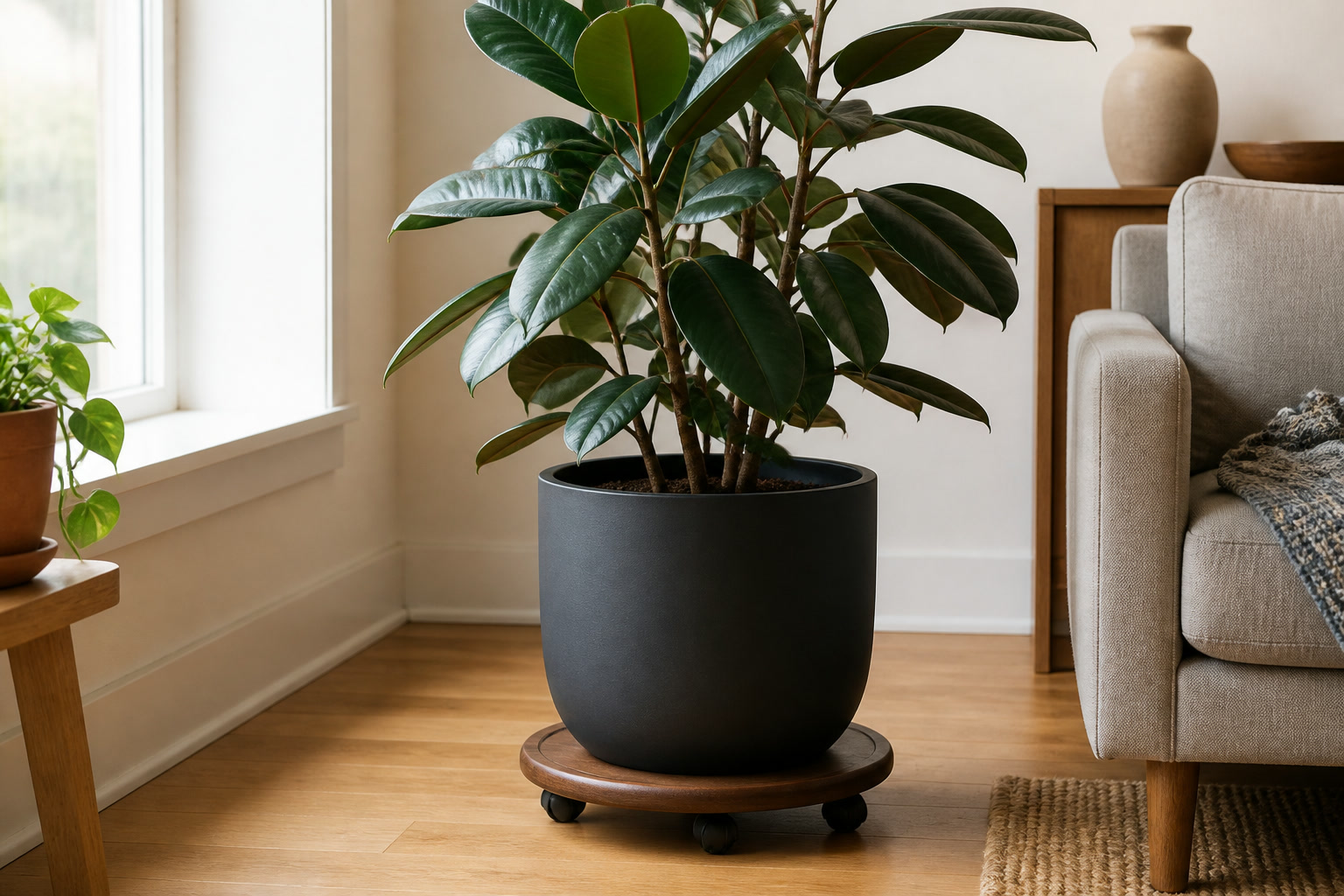
- Moving plan: choose a low rolling caddy before the first watering makes the finished setup too heavy to lift.
If a tall plant wobbles but the roots do not need more room, try these fixes in order:
- Turn the plant a quarter turn every week or two so one-sided window growth does not pull it over.
- Place the nursery pot in a heavier cachepot with a broad base.
- Use a caddy whose platform supports the planter base, not only its rim.
- Give a climbing monstera a support pole instead of using extra soil as ballast.
- Keep the heaviest mass low and centered.
Do not put gravel or rocks in the bottom as a drainage fix. The University of Minnesota Extension’s winter houseplant guidance ties drainage holes to excess-water removal and warns that oversized containers can raise root-rot risk. Its Monstera container guidance also recommends a slightly larger container as the plant grows and a heavier pot when a top-heavy plant needs support.
A shopping checklist for the next planter
Write these measurements down before browsing:
| Measure | Your number |
|---|---|
| Current pot rim diameter | ______ inches |
| Root-ball diameter | ______ inches |
| New pot inside diameter | ______ inches |
| New pot base diameter | ______ inches |
| Saucer inside diameter | ______ inches |
| Caddy platform diameter | ______ inches |
| Clear doorway or walkway | ______ inches |
Then compare the proposed pot with the plant’s actual conditions. The narrow plant stands for apartment corners guide is useful when the real constraint is floor space rather than root volume. If the plant needs more light, solve that before using a larger planter to compensate for a leaning canopy.
How to Move a Tall Plant Into Its Next Pot
Do the move in one sitting, with the new pot already open and the plant still in its old one.
- Water the plant a day or two ahead so the root ball holds together, then let the surface dry enough to handle.
- Tip the pot on its side, support the stems, and slide the root ball out. Never pull a tall plant by the stem.
- Set the root ball in the new pot and check the level. The top of the root ball should sit at about the same height it did before, not buried deeper.
- Fill around the sides with fresh mix, firming it in layers so no large air pockets are left behind.
- Water once, slowly, until it runs out of the drainage hole, then empty whatever the saucer catches.
- Keep the plant out of direct sun and out of drafts for the first week, and skip fertilizer until you see new growth.
If the root ball falls apart on the way out, pot it back into the same size container rather than stepping up. Roots that are struggling to re-establish do not need extra wet soil around them.
FAQ
Does a six-foot plant need a 20-inch pot?
Not automatically. The root ball determines the growing-pot size. A six-foot plant can be healthy in a 12-inch nursery pot if its roots have room and its care matches the container. Use a larger outer planter for proportion, but do not fill the gap with wet soil unless the roots need a larger growing volume.
Should a tall planter be deep or wide?
Match the root shape first. For stability, a broad, flat base is usually more useful than a dramatic tall silhouette. Make sure the pot is stable when the plant is watered and the canopy is fully extended.
How much larger should the saucer be?
Choose a saucer whose usable inside area extends beyond the planter’s bottom by roughly 1 to 2 inches when the shape allows it. Measure the base, not the rim, and empty collected water after watering.
Sources
- University of Minnesota Extension: winter houseplant tips
- University of Minnesota Extension: Monstera deliciosa containers and transplanting
- University of Minnesota Extension: lighting for indoor plants
What to Read Next
- Narrow Plant Stands for Apartment Corners gives you a floor-footprint check before you bring a tall pot home.
- Grow Lights That Look Good in a Living Room helps when a leaning plant needs better light, not a larger pot.
- How to Style Tall Indoor Plants in a Living Room covers furniture and clearance choices after the pot fits.