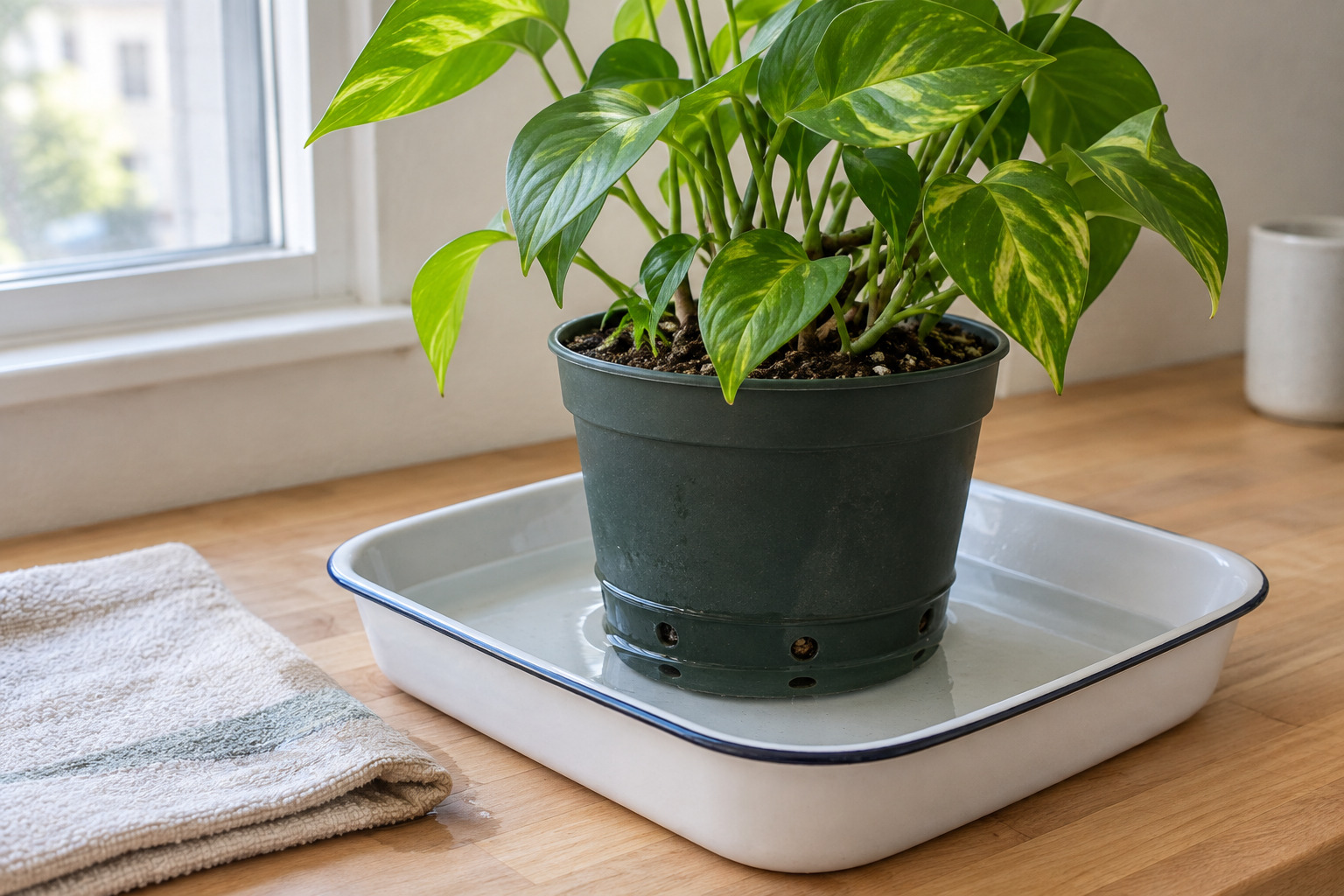
The short answer: how to water houseplants is one habit, not one schedule. Water when the potting mix is dry at the depth the roots live, water until it runs out of the drainage hole, then empty the saucer. Repot only when the roots say so, which is rarely once a year. In dim light and in winter the same pot needs far less water, and that gap is where most houseplants die.
If you have killed a plant by watering it, the watering was rarely the whole problem.
How to Judge When a Houseplant Needs Water
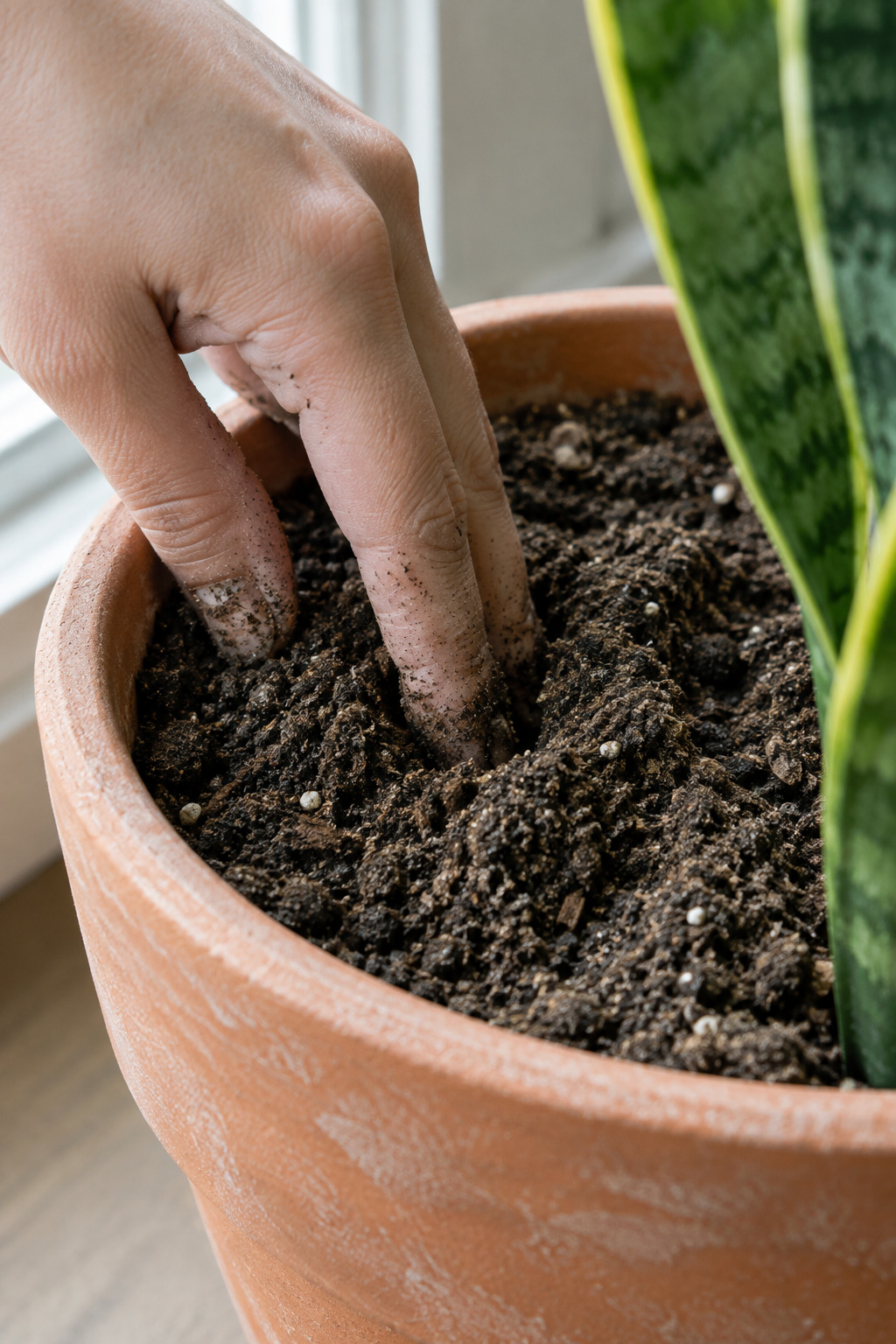
University of Maryland Extension says plants should not be watered on a schedule, but when they need it. Push a finger about two inches into the potting mix, and if it is dry there, the plant probably needs water.
That number was written for an average pot. What you are checking is the depth where the roots are working, and that moves with pot size.
| Pot size | Where to check | Dry there means |
|---|---|---|
| 4 to 6 inches | Most of the depth, since the pot is shallow | Water now |
| 8 to 10 inches | Two inches down, plus a lift of the pot | Water if the pot feels light |
| 12 inches and up | Two inches down is not enough information | Use a lift test or a moisture meter |
Treat those bands as rules of thumb. That last row is where overwatering starts. In a big pot the top two inches can be powder dry while the bottom half is still wet.
Lift the pot before and after watering. University of Maryland Extension notes that dry mix weighs much less than mix still holding water.
Do houseplants need water every day? No, not one of them. Daily watering keeps the mix saturated, and roots need oxygen between drinks.
How often should indoor plants be watered? Often enough that the mix dries at root depth and no more. In a bright June room that might be twice a week, and in January, every ten days.
A wilting plant is not always thirsty. Overwatered roots rot and stop taking up water, so it wilts in a soaked pot, and watering again then finishes it.
How to Water Houseplants So the Whole Pot Gets Wet
- Water slowly over the whole surface, not in one spot.
- Keep going until water runs out of the drainage hole. That is the signal that the whole root ball is wet.
- Let it drain fully.
- Empty the saucer or cachepot, every time.
- Do not water again until the mix is dry at root depth.
Step four is the one people skip. K-State Research and Extension warns that water left in the saucer wicks back into the soil and rots the roots, and Missouri Botanical Garden says the same.
Why a little water often is worse than a lot occasionally. Missouri Botanical Garden describes the failure precisely: pots watered often with small amounts end up with the top sopping wet and the bottom bone dry, and the bottom is where the roots live. Small sips also fail to flush fertilizer salts, which concentrate in the mix and show up later as brown leaf tips. University of Maryland Extension recommends leaching the soil with clear water every four to six months.
Which Pot Material Dries Fastest
Clemson HGIC explains why a clay pot dries faster than a plastic one. Clay is porous and lets air move through the sides, so the soil dries and oxygen reaches the roots. Non-porous glazed ceramic and plastic hold water longer, which is why terracotta suits succulents and plastic suits plants that want to stay moist.
Drainage Rules: Holes, Saucers, and Cachepots
A drainage hole is not a style choice. Penn State Extension calls it necessary so excess water leaves the pot instead of sitting in the mix and causing disease.
- Cover the hole, do not block it. Penn State suggests a square of screen, University of Maryland Extension a pot shard, and Kentucky Cooperative Extension a coffee filter. All three hold the mix in and let water out.
- Set it on a saucer, and empty the saucer after the pot stops dripping.
- Keep the pot off the floor. Clemson HGIC warns that moisture damages carpet, wood, and furniture under a pot.
- Use a cachepot as a cover. Penn State notes cachepots usually have no drainage hole. Slip the potted plant inside, and empty whatever collects below it.
What is the best drainage for indoor plants? A pot with an open hole, a saucer under it, and a mix that drains freely.
Bottom Watering Plants: How Long to Soak a Pot
Everything above is prevention. When prevention has already failed and the leaves are telling you something, the symptom diagnosis table reads the plant back to you one row at a time.
Bottom watering means standing the pot in a tray of water and letting the dry mix pull water up through the drainage hole.
K-State Research and Extension describes it this way: apply enough water, let the plant sit in it for up to an hour, then remove the excess. Busy people forget the last part.
How long should plants sit in water when bottom watering? Up to about an hour is the ceiling in US extension guidance, and a small pot in a light mix is done well before that. A large pot with a dense mix takes longer. Singapore’s national parks gardening resource puts it at twenty minutes to an hour depending on pot size and soil type, so treat the hour as your limit and the surface feel as your signal.
Should you water houseplants from top or bottom? Both. Top watering flushes salt out of the mix, so it is worth doing most of the time. Bottom watering helps when the mix has dried hard.
Can you overwater with bottom watering? Yes. Dry soil keeps pulling water until it is saturated, so a pot left standing in the tray ends up as wet as one you drowned from the top.
Three honest limits:
- It does not fix hydrophobic soil. Mix that dries out completely can pull away from the pot, and water then runs down the gap and out the hole. Missouri Botanical Garden’s test: if water flows out immediately, tip the plant out, and if the soil is dry, soak the whole pot in a bucket.
- It does not suit succulents and cacti. University of Maryland Extension notes they need far less water than most houseplants, and a soak from below makes it easy to hand them more than they want.
If your soil dries hard and fast between waterings, the fix is usually the mix, and what to do when container soil keeps drying out too fast works through that.
The Low Light and Winter Shift
A plant in dim light uses far less water than the same plant by a window, because it grows more slowly. The routine that kept a pothos happy on a bright sill will rot it in a hallway.
Clemson HGIC puts a number on the light side: the interior of a well-lighted home is often under 100 foot-candles, and low-light plants want 75 to 200. A north corner or a spot several feet back from any window sits at the bottom of that band, and low light indoor plants walks through the tests.
Winter adds a second shift. Illinois Extension says to water less often and keep the mix on the dry side while never letting a plant wilt, and it notes that pots in south or west windows dry out before pots in east or north windows.
- Expect longer gaps, not shorter ones. Less light, slower growth, less water used.
- Stop feeding. Clemson HGIC says plants in a winter rest period should not be fertilized.
The first frost checklist for pots and window boxes covers the outdoor end of that move.
If a plant is headed for a dim corner, the ZZ plant, cast iron plant, and snake plant handle it best. On pets: the ASPCA lists cast iron plant, Boston fern, and African violet as non-toxic to cats and dogs, and snake plant and peace lily as toxic. The ZZ plant is not in that database, so treat it as unverified rather than safe.
How to Repot a Houseplant
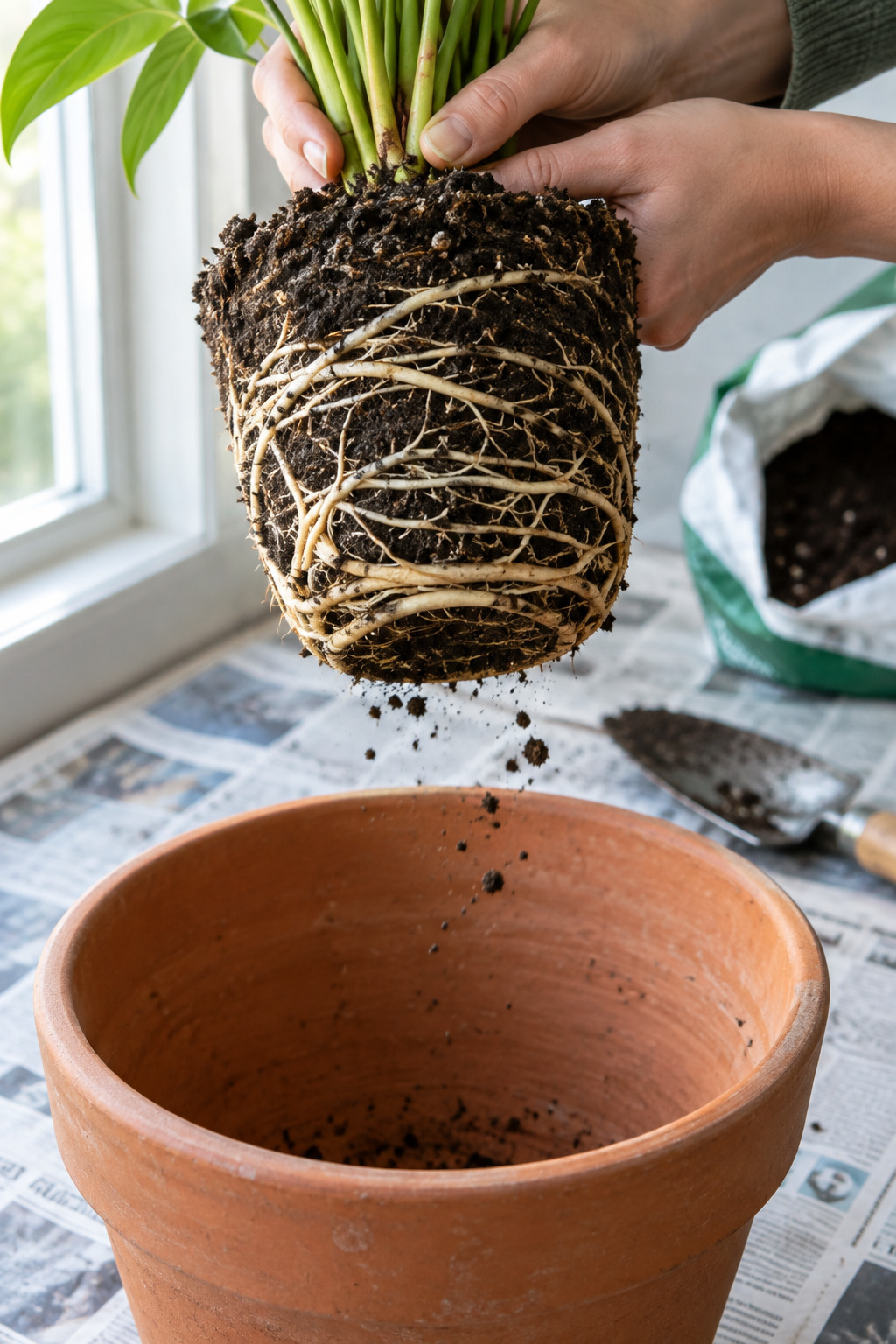
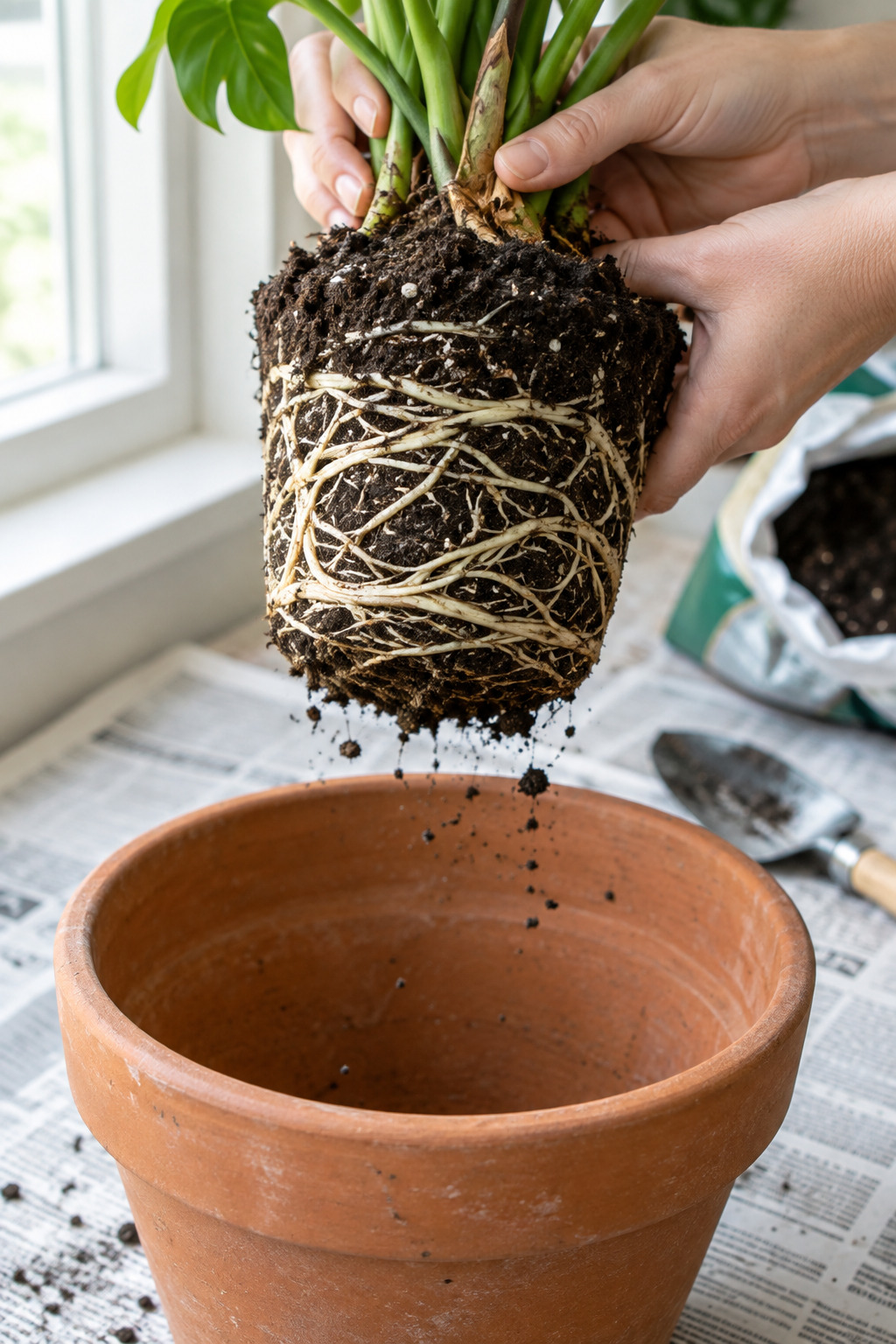
Repotting is not an annual chore. It responds to a plant that has run out of room. Penn State Extension lists the signals: the mix dries out very quickly even in cool weather, roots grow through the drainage holes, and growth slows despite regular feeding. University of Minnesota Extension adds that water runs straight through a pot with more root than soil, and Colorado State University Extension says the fastest check is to tip the plant out and look for a white mass of roots circling the container.
What time of year should you repot houseplants? Spring, as active growth starts, is the usual recommendation, because the roots grow into the new mix. University of Minnesota says any time of year works when a plant needs it.
What not to do when repotting plants:
- Do not jump pot sizes. Colorado State says one to two inches wider in diameter, and Missouri Botanical Garden says one size, usually two inches wider, which leaves about an inch of fresh soil around the root ball. A pot too big leaves the plant in wet mix it cannot drink.
- Do not use garden soil or bury the crown deeper. Garden soil is dense and carries weed seeds and pathogens, so Penn State and University of Maryland Extension point to soilless mixes. Both Colorado State and Penn State set the top of the root ball about an inch below the rim.
- Do not start with a bone-dry or soggy plant. Penn State waters the plant in its old pot and lets it rest an hour first.
Then the sequence:
- Water the plant in its old pot an hour ahead so the root ball holds together.
- Support the stems, tip the pot, and slide it out. Never pull a plant by the stem.
- Trim anything black and mushy, and tease loose any roots circling the ball.
- Set the root ball on fresh, pre-moistened mix so its top sits an inch below the rim, fill around the sides, and leave that headroom for water. Then water thoroughly and empty the saucer.
Should you water houseplants right after repotting? Yes. Penn State, Colorado State, and University of Maryland Extension all finish with a thorough watering, then wait until the surface of the mix dries.
Do you remove old soil when repotting? Some. Shake off what falls away easily and remove mix crusted with salt, but do not strip the roots bare, because the mix clinging to them holds fine roots you cannot see. Missouri Botanical Garden suggests replacing the mix every one to three years.
How long does transplant shock last? None of the repotting guides checked here commits to a number of days, and they describe recovery as new growth instead. Keep the plant out of direct sun and drafts, and hold off on fertilizer until it grows again.
Repotting Mistakes: Rocks, Styrofoam, and Old Soil
What can I put in the bottom of my indoor planter for drainage? Nothing. No gravel, no rocks, no styrofoam peanuts, no broken pottery.
Penn State Extension’s myth page addresses the drainage layer directly. Coarse material at the bottom of a container does not improve drainage and can make it worse, because water movement through the potting mix is hindered rather than helped when it hits that layer. Kentucky Cooperative Extension explains it as a perched water table: water moving down through fine mix hits the coarse layer, spreads sideways, and saturates the soil just above it. It names sand, water bottles, styrofoam, and broken flower pots. University of Maryland Extension puts the rule in one line: don’t fill the bottom of your pot with gravel.
So what does help?
- A screen, shard, coffee filter, or newspaper over the hole keeps the mix in and lets water out.
- A false bottom handles the other real problem, a big pot that would swallow a bag of mix. Kentucky Cooperative Extension suggests plywood cut to fit inside the pot at the depth you want to plant, with its own drainage holes.
- Rocks in the saucer, not the pot. Missouri Botanical Garden notes a one- to two-inch layer of rocks in the saucer of a large pot gives drained water somewhere to sit below the pot.
One honest caveat: Clemson HGIC does recommend coarse gravel in the bottom of a decorative container with no drainage hole. There it is a spacer holding the inner pot out of the standing water, not a drainage layer.
Rescuing an Overwatered Houseplant
Done it already? The plant can sometimes still be saved.
- Get the pot out of standing water. Empty the saucer or cachepot now.
- Dry it down. Move it somewhere warm with moving air and good light, not direct sun. Do not fertilize, and do not repot immediately, because disturbed roots rot faster.
- Check the roots. If the mix is still soaked days later, if the leaves yellow, or if the base feels soft, tip it out. Black, mushy roots smell and fall apart, and healthy ones are white and firm.
When roots are rotting, fresh mix in a clean pot is the only fix. Trim the dead roots, then pot into the smallest container the remaining roots fit, because a large pot of wet soil is what caused this.
What to Buy Only If You Need It
No brands and no product links, because most of this is already in your kitchen.
- A pot with an open drainage hole. Everything else on this page depends on it.
- A saucer that fits under the pot, with a lip wide enough to catch a hurried watering.
- A moisture meter, as a second opinion. A tiebreaker for a big pot your finger cannot reach, not an instruction.
If the plant is already failing rather than just thirsty, yellow leaves and brown tips included, the companion page walks through the diagnosis: what is actually wrong with your houseplant .
Sources
- University of Maryland Extension: Watering Indoor Plants : the two-inch finger test, the lift test, top and bottom watering, emptying saucers, and the four- to six-month leaching schedule.
- University of Maryland Extension: Potting and Repotting Indoor Plants : the instruction not to fill the bottom of a pot with gravel, and finishing a repot with a thorough watering.
- Penn State Extension: Repotting Houseplants : pot-bound signals, spring timing, pot material behavior, cachepot setup, and the repotting sequence.
- Penn State Extension: Debunking Garden Myths : why coarse material in the bottom of a container is counterproductive.
- Clemson HGIC: Indoor Plants, Cleaning, Fertilizing, Containers and Light Requirements : porous versus non-porous pots, gravel in drainless containers, foot-candle bands, and winter fertilizing.
- Kentucky Cooperative Extension Service, Mercer County: Rocks in Pots? : the perched water table explanation and the materials that cause it, styrofoam included.
- Colorado State University Extension, PlantTalk 1316: Houseplants, Repotting : root inspection, the one- to two-inch pot increase, and setting the root ball at its old soil level.
- K-State Research and Extension: Tips for Houseplants : the soak of up to an hour and the warning that water wicks back out of the saucer.
- Missouri Botanical Garden: Environmental Problems of Indoor Plants : small sips versus a thorough soak, hydrophobic soil and the bucket soak, rocks in the saucer, and soil replacement every one to three years.
- University of Minnesota Extension: Winter houseplant tips : the repotting signal that water runs straight through a pot with more root than soil, and repotting at any time of year when a plant needs it.
- Illinois Extension: Houseplants, winter watering, and humidity : winter watering frequency, window orientation, and keeping soil dry without letting plants wilt.
- NParks GardeningSG: Bottom watering : the twenty-minute to one-hour range by pot size and soil type. Singapore’s national parks horticulture resource, listed because US extension guidance gives only the one-hour ceiling.
- ASPCA: Toxic and Non-Toxic Plants : pet status for the plants named here. The list is not all-inclusive, which is why the ZZ plant reads as unverified.
What to Read Next
- What size planter does a tall indoor plant need gives you the root-ball measurement that keeps the next pot size step small.
- What to do when container soil keeps drying out too fast helps when you are watering every other day and the mix or the pot is the problem.
- Low light indoor plants shows how to measure a dim corner and which plants hold up there without rotting.
- First frost checklist for pots and window boxes covers the outdoor half of the seasonal move before the cold sets in.