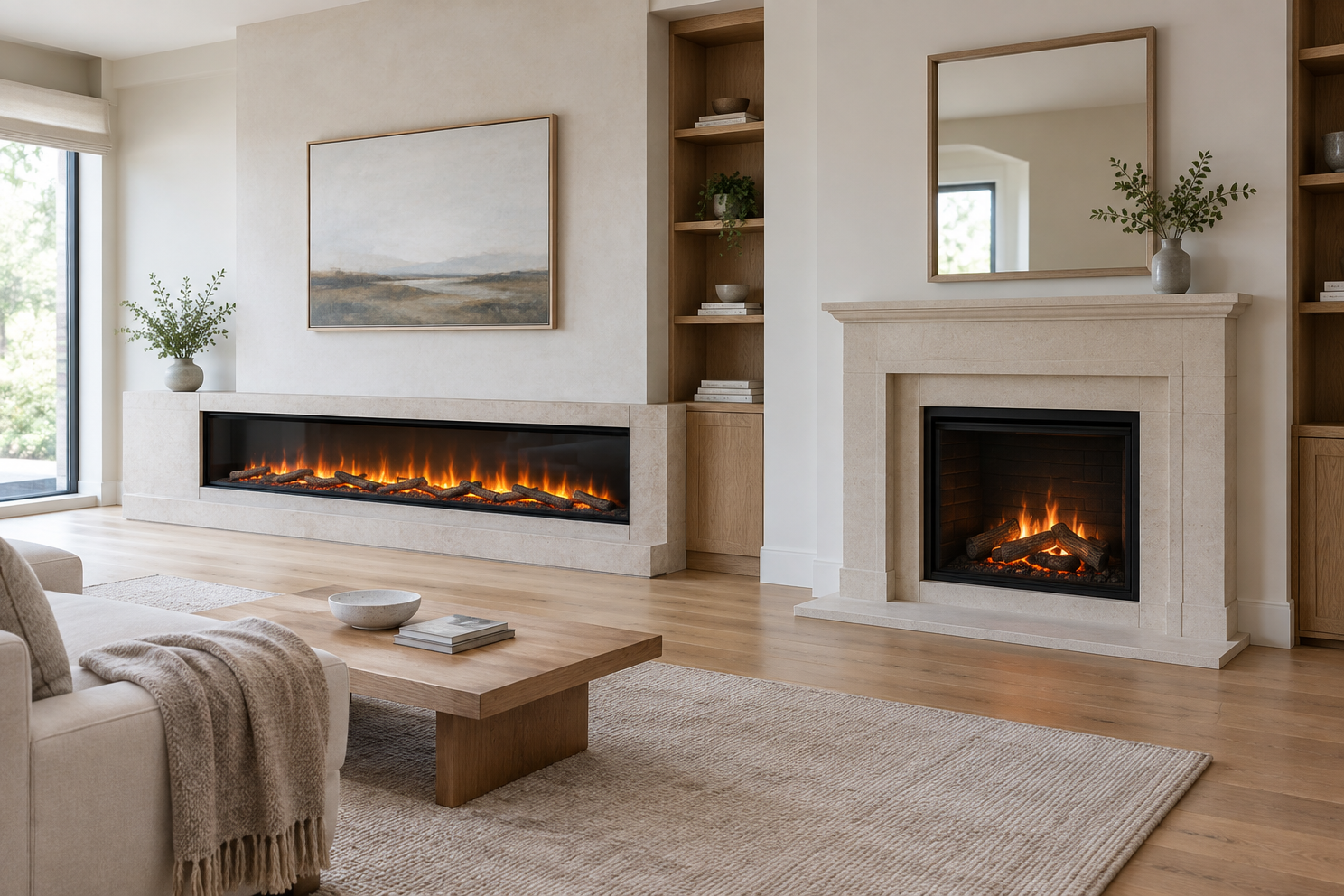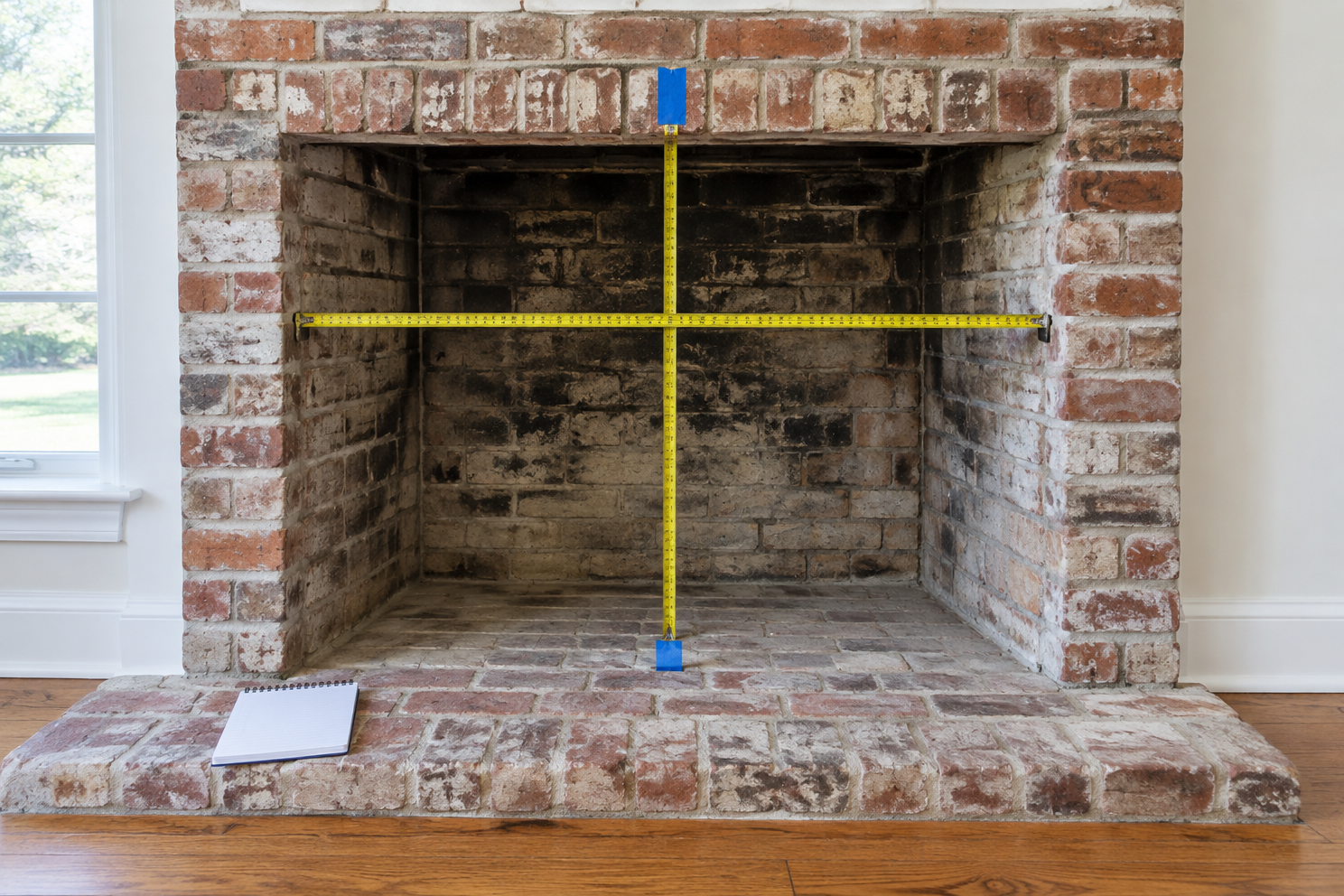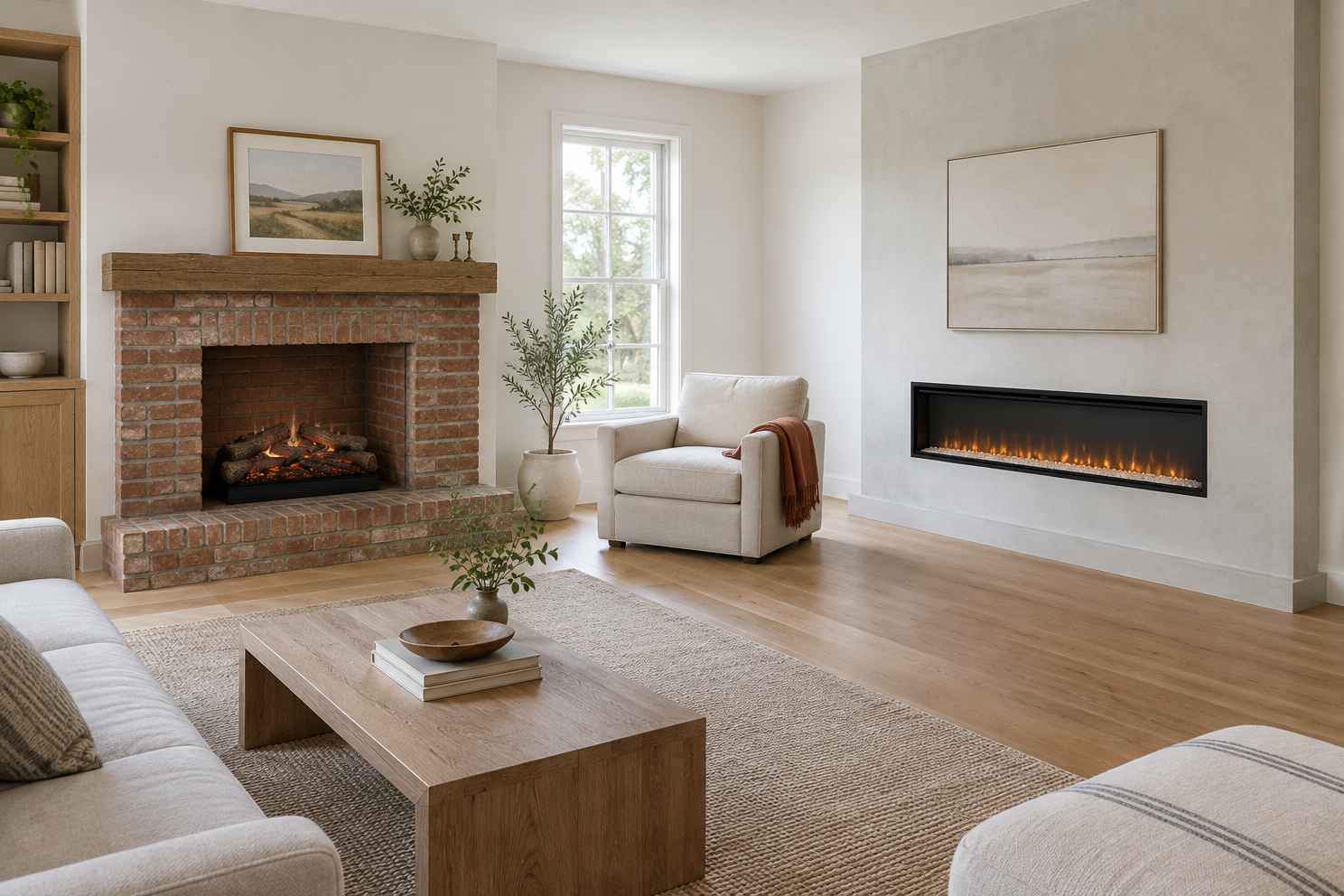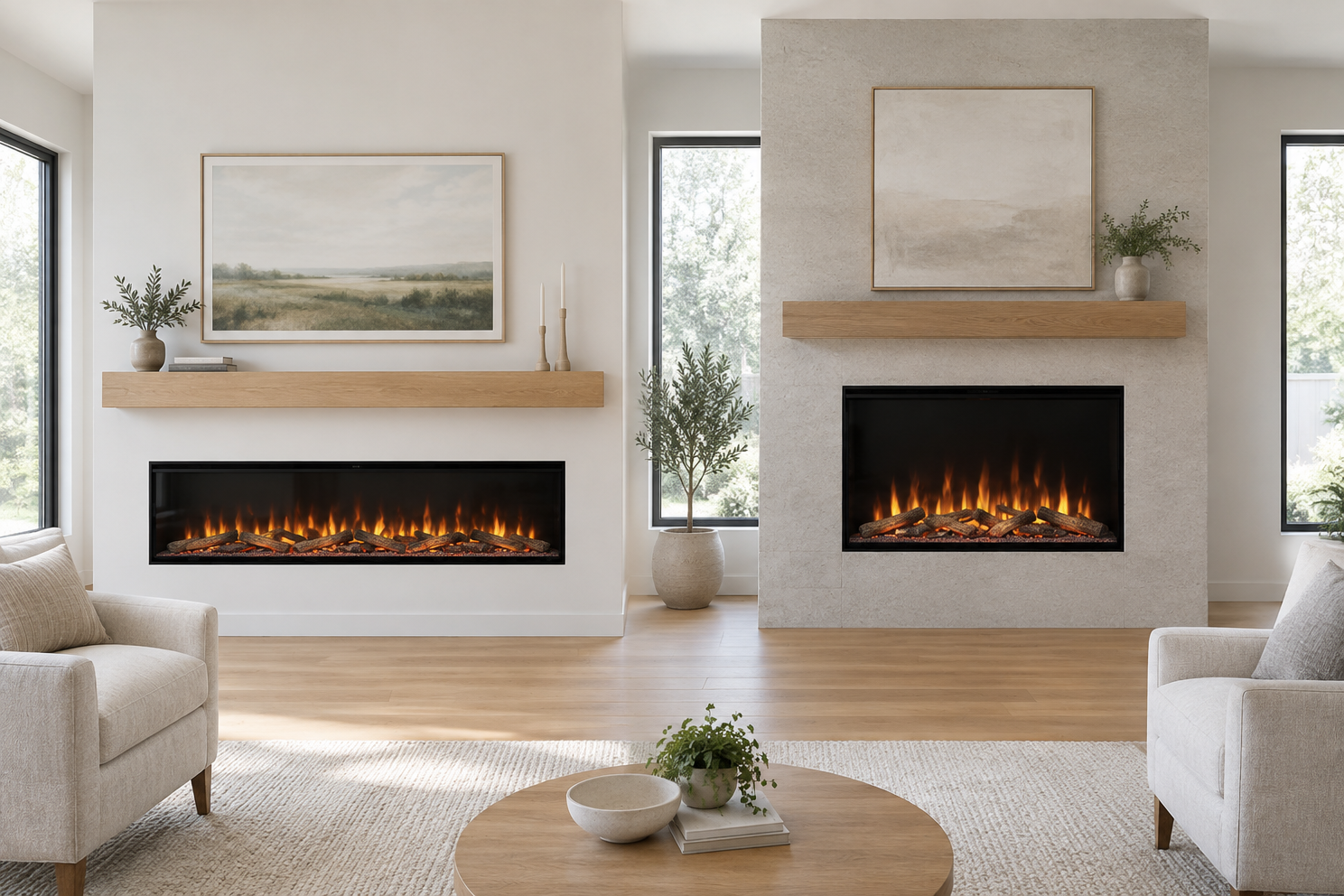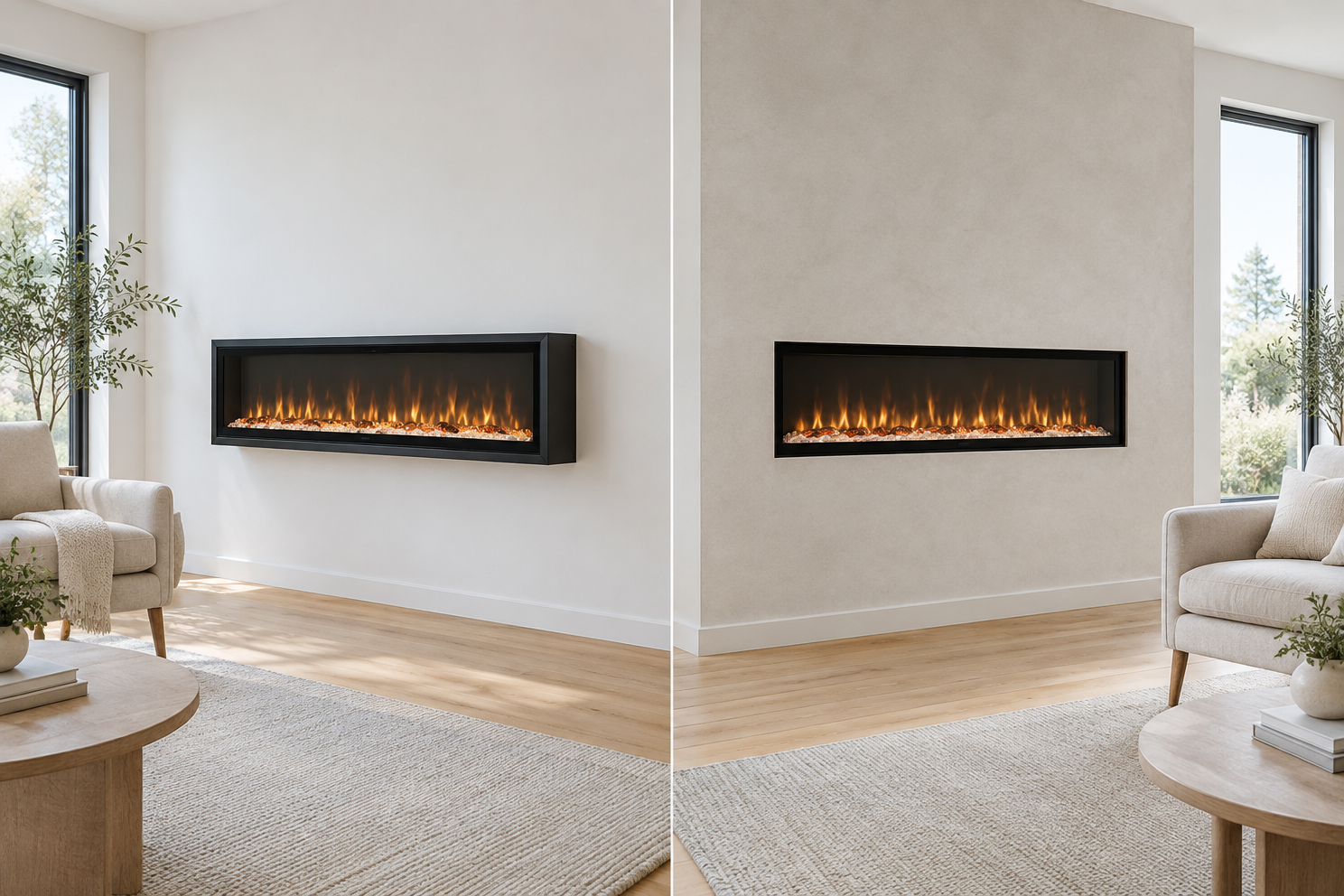
Choose a wall-mounted electric fireplace when you want a lower-cost installation, need to preserve the existing wall, or may remove the unit later. Choose a recessed electric fireplace when you are already framing or remodeling and want the face to sit nearly flush.
The most important difference is not appearance. It is whether the wall has enough usable depth, a safe electrical plan, front-facing heat, and service access. A recessed fireplace can look cleaner, but it can also turn a value-priced appliance into a multi-trade wall project.
Quick Decision Table
| Question | Wall-mounted | Recessed |
|---|---|---|
| Wall demolition | Usually none | Opening or new framing required |
| Finished projection | Appliance depth stays visible | Face sits close to flush |
| Typical labor | Mounting and electrical check | Framing, drywall, finish work, and often electrical |
| Best for renters | Only with written permission | Usually no |
| Easy to remove | Yes, with holes to patch | No |
| Service access | Usually simpler | Must be planned into the build |
| Main risk | Heavy unit or top vent too close to decor | Wrong cavity depth, blocked vent, inaccessible wiring |
The Wall-Depth Test Comes First
A nominal 2x4 wall has a 3.5-inch stud cavity before drywall. A 2x6 wall has a 5.5-inch stud cavity. Those numbers explain why many linear fireplaces cannot fully recess in an untouched 2x4 wall.
The Touchstone Sideline 50 is about 5.5 inches deep. It can be surface-mounted or recessed, but a true flush result generally needs a wall deep enough for the body plus the installation details in its manual. The Dimplex IgniteXL 50 is 5.88 inches deep and Modern Blaze says it fully recesses in 2x6 construction or partially recesses in a 2x4 wall with an optional trim kit.
Modern Flames makes the distinction especially clear. Its Landscape Pro Slim is 5.5 inches deep and built for 2x6 framing. Its shallower Spectrum Slimline is listed at 4.75 inches and designed for 2x4 installation. One inch changes the wall plan.
Before comparing flame colors, identify the studs, plumbing, ductwork, wiring, and load-bearing conditions behind the proposed opening.
What Wall Mounting Actually Looks Like
A wall-mounted fireplace hangs from a bracket like a heavy television. The entire body remains in front of the drywall. That projection can look deliberate when it is centered on a wall, balanced with a low console, and given breathing room. It looks accidental when it is squeezed between trim, a TV, and a mantel shelf.
Wall mounting works well when:
- You are not rebuilding the wall.
- The unit’s weight and bracket can be secured to the required framing.
- The cord can reach a direct wall outlet without an extension cord.
- The heat outlet remains clear.
- The visible side profile does not intrude into a narrow walkway.
It works poorly when the unit is six inches deep in a tight room or when a cord must snake down the wall. A paintable cord cover can tidy a plug-in setup, but it should not hide an overloaded outlet or cross a heat path.
What Recessing Adds
Recessing moves the visual weight into the wall. You see glass and trim instead of a box. That can be worth it on a purpose-built living-room wall, especially when cabinetry, stone, or a mantel is already part of the project.
It adds decisions too:
- Exact rough opening and finished opening dimensions
- Header and stud layout
- Combustible-clearance rules from the manual
- Plug versus hardwire location
- Access for future service or replacement
- Drywall, tile, stone, or panel edges around the face
- TV and mantel clearances
Don’t tile or stone around a fireplace until the appliance has been test-fitted and the removable parts can still come off. A flush face is not useful if a technician has to break the surround to reach the unit.
Product Example: One Fireplace That Can Do Both
The Touchstone Sideline 50 can be recessed or mounted on the wall. It sat in the lower-midrange price band when checked, with a front heat vent, plug-or-hardwire installation, smart controls, and about 5,000 BTU of supplemental heat.
That makes it a useful comparison model because the flame and heater stay the same. The choice is the room:
- Surface mount it when the wall is staying intact and a 5.5-inch projection is acceptable.
- Recess it when you are already building a feature wall and can meet the framing and service requirements.
- Skip both approaches when the wall is narrow, the circuit is crowded, or the traffic path cannot spare the projection.
See the current Touchstone Sideline 50 details
Cost: Appliance Price Is Only the First Line
| Cost item | Wall-mounted | Recessed |
|---|---|---|
| Fireplace | Same if the model supports both | Same |
| Mounting hardware | Often included; wall fasteners may differ | Framing materials and fasteners |
| Electrical | Outlet check or new outlet | New outlet or hardwire, often dedicated circuit |
| Finish work | Cord cover and paint touch-up | Drywall, trim, tile, stone, paint, or cabinetry |
| Removal later | Patch mounting holes | Rebuild an appliance-sized opening |
A recessed installation is not automatically expensive if it is included in a planned renovation. It becomes poor value when a finished wall is opened only to hide a modestly priced appliance.
Price the full wall, not only the firebox. Include electrician, framing, finish material, paint, disposal, and the cost of making the unit removable.
Heat, TVs, and Mantels
Front heat is generally easier to manage in a recessed opening because it sends warm air into the room instead of into the cavity. Even then, every model has its own clearance rules.
Modern Blaze says the Touchstone Sideline 50 needs at least 12 inches between the top of the fireplace and the bottom of a wall-mounted television. Other models differ. A mantel may deflect heat, but it does not cancel the manual.
Before placing a TV above either installation:
- Read the fireplace’s TV and mantel clearance diagram.
- Read the TV’s operating-temperature limits.
- Check where warmed air travels during a full-hour test.
- Leave access to the fireplace and TV cables.
- Consider putting the TV on another wall if the screen would be too high.
The most comfortable television height often conflicts with the prettiest fireplace elevation. Do not solve that conflict by ignoring one manufacturer.
Renters and Temporary Rooms
Wall-mounted is the less permanent option, not a no-permission option. A 50-inch fireplace is heavy and needs secure anchoring. Ask the landlord in writing before mounting it or adding an outlet.
If the answer is no, use a freestanding electric stove or an approved insert in an existing fireplace opening. A compact freestanding model can still give the room a warm focal point without cutting drywall.
Our electric fireplace apartment guide covers lease language, outlet checks, placement, and portable alternatives.
Installation Safety
The Consumer Product Safety Commission says electric heaters should plug directly into a wall outlet, not an extension cord or power strip. Built-in models may require hardwiring or a dedicated circuit. Follow the exact manual and use a qualified electrician when required.
Keep furnishings and anything combustible outside the manufacturer’s clearances. Do not block intake or outlet vents with trim, a soundbar, a floating shelf, or holiday garland.
Frequently Asked Questions
Is a recessed electric fireplace better than wall-mounted?
It looks more integrated but is not automatically better. Recessed installation makes sense in a planned feature wall with adequate depth and electrical access. Wall mounting is usually better for lower cost, faster installation, and future removal.
Can any wall-mounted fireplace be recessed?
No. Only recess a model whose manual explicitly allows it. The heat-vent position, body construction, and clearance rules determine whether a unit can sit inside a cavity.
Can an electric fireplace fit in a 2x4 wall?
Some shallow models can; many cannot fully recess. A 2x4 cavity is about 3.5 inches deep before drywall. Compare that with the exact body depth and framing instructions, not the product’s trim depth.
Does a recessed fireplace need ventilation?
It does not need a chimney, but its intake and heated-air outlet must remain clear. “Ventless” means no combustion flue, not no airflow.
Which option is cheaper?
Wall mounting is usually cheaper because it avoids framing and finish work. If a new wall is already being built, the incremental cost of recessing may be smaller.
Bottom Line
Wall mount for reversibility and a simpler bill. Recess for a built-in look when the wall, circuit, budget, and service plan already support it. If the choice requires hiding a cord unsafely, blocking a vent, or raising the TV beyond comfortable viewing, choose neither. A freestanding stove or a different wall will serve the room better.