
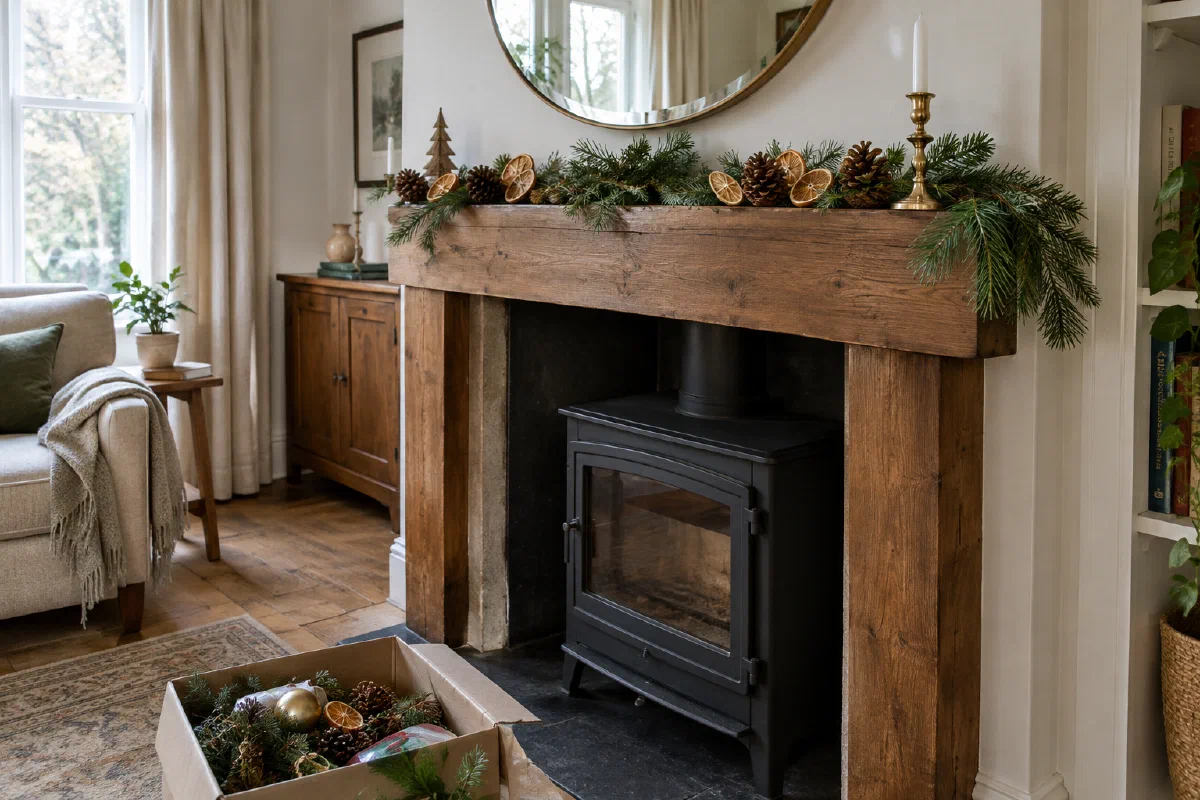
The gap between the two holidays is about four weeks. Most of what is already on your mantel, porch and front door can stay where it is. The evergreen base of a Thanksgiving house is also the evergreen base of a Christmas house, because the materials do not care which holiday you are celebrating.
What changes is the accents inside the room. Do the swaps in the right sequence and the house is never half stripped, with a bare shelf sitting there for three days while you find the box.
This plan assumes you already have a warm fall base from the transition in Fall Decor That Works Through Thanksgiving .
Keep the greenery and the evergreen garland, swap the accents
Separate the room into two layers. The base layer is greenery, warm white light, wood, brass, glass and neutral textiles. The accent layer is anything that names a specific holiday.
The base layer carries through from late November into January. A cedar or fir branch line on the mantel reads as late autumn in November and as Christmas in December with nothing done to it.
Here is what happens to each layer.
| Layer | Keep it as is | Swap in place | Back in the bin |
|---|---|---|---|
| Greenery | Cedar and fir branches, small potted evergreens | Bare branch line becomes an evergreen garland | Dried wheat, rust leaves, orange berry sprigs |
| Lights | Warm white battery lights, amber glass | Lanterns move from the porch to the mantel | Orange novelty bulbs |
| Textiles | Cream and rust throw, wool blanket | Pillow covers swap to red, plaid or green | Turkey and pumpkin covers, fall tea towels |
| Wood and metal | Wood bowls, trays, brass candlesticks | Brass candlesticks onto the table | Painted wood signs |
| Fresh produce | Pears, apples, citrus | Pomegranates and cranberries | Pumpkins, gourds, jack o’ lanterns |
| Candles | Flameless candles in glass holders | Candle cluster moves to the coffee table | Scented fall jar candles |
Nothing on the right column needs replacing. It needs a lid on the bin and a spot on a shelf.
The swap that does the most work for the least effort is the greenery. Leave every hook and branch line exactly where it is and change the material on it. One trip outside with pruners replaces an entire decor purchase.
Which pieces to swap in place, and which to restage
Swapping in place means the support stays and only the item on it changes. Restaging means the whole arrangement gets rebuilt.
Choose the swap when the shape of the arrangement is already right. A tray holding pumpkins becomes a tray holding pomegranates. A wooden bowl of pears becomes a wooden bowl of clementines. A basket of dried stems becomes a basket of evergreen sprigs. Each of those takes about a minute, and a half-done swap still looks finished.
Choose the restage only for the spots the eye lands on when someone walks in: the front door, the mantel, and the dining table. Those are worth clearing completely and starting again.
Swapping wins everywhere else, because it is reversible and a half-done swap still looks like a room rather than a project.
Do the Christmas swap in this order, starting at the front door and the mantel
Work outside in, and from the tallest element to the smallest. Light strands and greenery overlap the things underneath them, so moving a lamp after the garland is up means taking the garland down again.
- Tree placement first, before anything else comes out. Test the spot with a chair or a stack of bins. You want it at least three feet from a heat vent, radiator, fireplace or space heater, and clear of every doorway and exit. Moving a decorated tree later is a miserable hour, and this step is as much about safety as looks.
- Front door and entry next, while the weather is still mild. A front door wreath and two planters take twenty minutes in bare hands. Do it after a hard freeze and you are wiring greenery with numb fingers.
- Mantel and shelf greenery after that. Hang the garland first, then the lights, then the objects in front of it. The garland is the support for everything else on that shelf.
- Table last. The table is the piece you still need for dinner between now and Christmas, so leave it usable longest. A runner, two brass candlesticks and a low bowl take five minutes.
- Release the fall pieces as you go. Every time you clear a surface, walk the displaced items to the storage bin rather than stacking them on the stairs, where they will still be sitting in January.
Keep the fresh greenery alive through both holidays
A cut conifer indoors is a plant on a clock, and the clock is about water. Clemson Cooperative Extension’s Christmas tree safety guidance notes that a fresh tree can take up more than a gallon of water a day, which is why the stand gets checked daily rather than topped up on weekends. Cut branches follow the same rule: the material lasts in proportion to the water it can still pull.
If you are swapping from Thanksgiving into Christmas and want one more round out of the same branches, here is what actually helps.
- Recut the stem ends at an angle with sharp pruners before they go back in water. A dried cut seals over and stops taking water up.
- Keep arrangements away from heat vents, radiators and the fireplace. Warm dry air pulls the moisture out of cut greenery faster than anything else in the room.
- Check the water every day and top it up. A cut tree or branch line drinks the most in the first week.
- Test the material before you trust it near a light strand. Bend a needle. If it springs back, the branch still has moisture in it. If it snaps, the branch is done and belongs outside.
- Pull battery packs out of strands you are storing. Corroded contacts are the reason a strand fails on the one evening you needed it.
On the safety side, the numbers are worth knowing. NIST’s Fire Research Division reports that U.S. fire departments respond to an estimated 210 home fires involving Christmas trees each year, with an average of 6 deaths, 16 injuries and about $16.2 million in property damage. NIST ran the experiment side by side: the watered tree did not catch when exposed to the ignition source, and the dry one did. Keeping the stand full is the whole intervention.
The Consumer Product Safety Commission’s holiday decoration guidance covers the other heat source in the room: keep candles away from decorations, evergreens and anything else that burns, and never leave a lit candle unattended. If your mantel garland and your candles share a shelf, move one of them. That is the argument for flameless candles in greenery, and it is stronger than looks.
Mistakes to avoid during the swap
- Buying a second set of greenery for Christmas when the November greenery is already the right material.
- Hanging the lights before the garland.
- Decorating the tree in a spot you have not tested, then finding it blocks the front door.
- Leaving fall scented candles out next to Christmas greenery. The scent fights the tree.
- Restaging every surface in the house instead of the front door, the mantel and the table.
- Keeping a cut tree, or a live balled and burlapped one, up well into January. Clemson’s living Christmas tree factsheet puts a balled and burlapped tree at seven to ten days indoors, so that is a short window, not a month.
If you want the entry to do more than a wreath and two planters, the layout advice in Christmas Entryway Decor for a Narrow Entry is the place to look, because a narrow hall fails differently than a wide one.
When to make the switch
The cleanest window is the weekend after Thanksgiving, before the first December social event. Two reasons. The tree needs water and attention daily, so the earlier it goes up, the more days you get out of it. And the outdoor work is easier while the ground is not frozen and your hands still work without gloves.
If you host Thanksgiving, do nothing but the tree spot that weekend and give yourself the next Saturday for the rest. A house with a tree up and a fall centerpiece still on the table looks intentional for a week or two.
Fresh greens do not have to be replaced to read as Christmas. That is the part most transition advice skips. It walks you through storing every autumn item and buying a parallel set of Christmas items, which turns a seasonal change into a second shopping trip. The palette is what you change.
Warm white lights, bare branches, brass and cream wool all read as winter in December and January. The red and green can live in the pillow covers, the ribbons and the fruit bowl.
What to Read Next
- Fall Decor That Works Through Thanksgiving is the first half of this pair, and it builds the warm base this article converts.
- Christmas Mantel Decor picks up where the mantel step leaves off, with layering heights that keep the mirror visible.
- Christmas Garland Ideas for a Small Home covers garland runs in tight rooms, including the doorway and stairrail spots this plan skips.
- Christmas Front Door Decor handles the whole door rather than the wreath alone, useful if your entry faces the street.
- Christmas Entryway Decor for a Narrow Entry solves the tight hall version of the entry step above.