
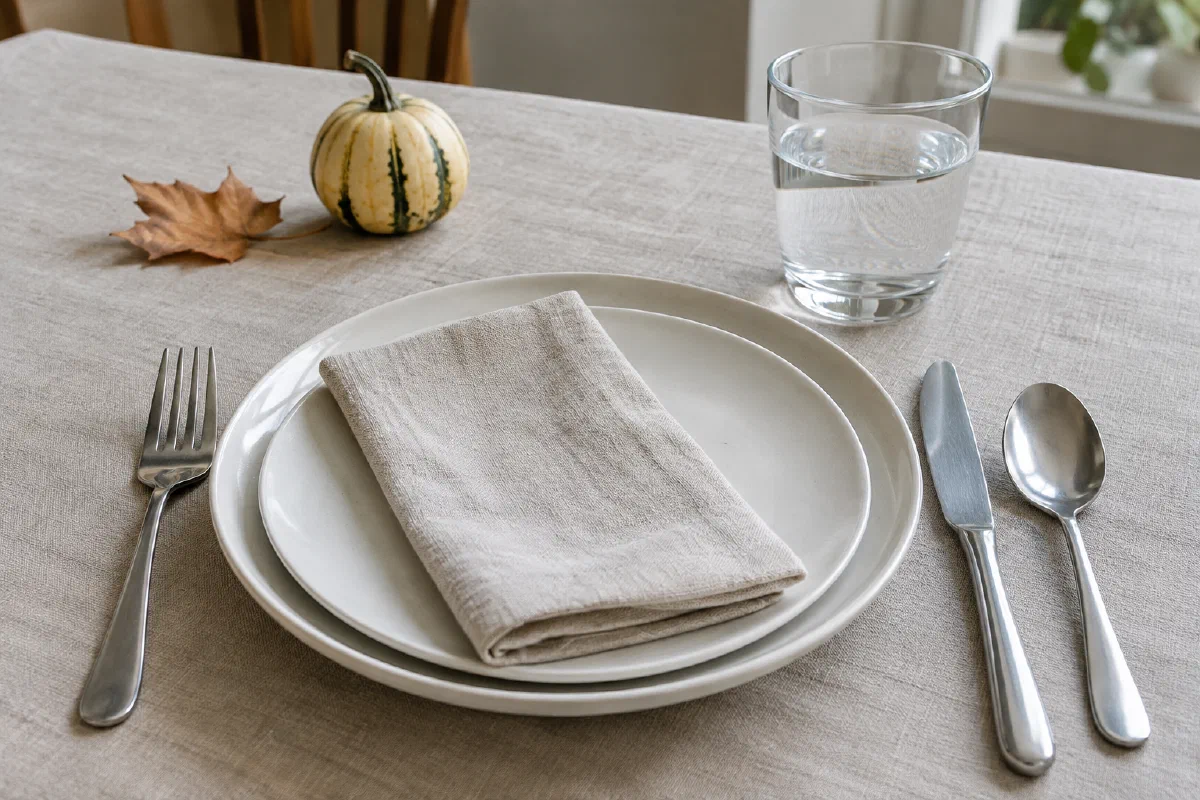
Nobody notices that your plates do not match. They notice when the forks are on the wrong side, when there is nowhere to put a drink, and when they cannot reach the butter without asking a neighbor to pass it. Thanksgiving table settings are a layout, not a shopping list, and the layout is free.
Here is the whole thing in one line. Plate in the middle, about an inch from the table edge. Forks to the left. Knife and spoons to the right, blade facing the plate. Water glass above the knife tip. Napkin left of the forks or flat on the plate. That is it.
Everything else in this article is either a detail on those five items or a thing you can leave in the cupboard.
The Dinner Plate Is the Only Anchor You Need
Reposition one setting and the others inherit the mistake, so build one cover completely before you repeat it. Nebraska Extension calls a single setting a cover, and its guidance is that each cover is set exactly the same.
- Put the dinner plate in the middle of the space, about one inch from the table edge.
- Place mats, if you use them, sit one to two inches from the edge.
- If you are setting more than two forks, the ones used first sit furthest from the plate. You work inward as the meal goes.
- Allow at least twenty inches of table edge per person. This is the number that quietly decides whether your table seats ten or twelve.
Where the guidance splits is the space each person needs, and it is worth knowing before you squeeze in two more chairs. Nebraska Extension sets twenty inches as the minimum for one person’s dishes. K-State Research and Extension gives no number but describes the same left-to-right arrangement, and practical hosting advice pushes it to twenty-four inches. The extension figure is about fitting the dishes. The wider figure is about fitting the people.
Which Forks Get Used First, and Where the Salad Fork Goes
The rule that sorts out every confusing diagram is that you eat from the outside in. Nebraska Extension states it directly: determine which piece will be used first and place it outside the other one. K-State Research and Extension says the same thing, and adds the part most people never hear. Only set the table with utensils you will use.
Here is where two sources openly disagree, and which one applies depends on your menu.
| Item | Placed where | Why it sits there |
|---|---|---|
| Dinner fork | Left of the plate, nearest the plate | It is the main fork, used last of the forks |
| Salad fork | Left of the dinner fork, on the outside | Salad comes before the main course |
| Dinner knife | Right of the plate, blade toward the plate | Blade faces in, toward the plate, always |
| Soup spoon | Right of the knife, on the outside | Soup comes before the main course |
| Water glass | Above the tip of the knife | Not beside it. Above it |
| Napkin | Left of the forks, or on the plate | Either is correct in every guide |
University of Wisconsin-Madison Division of Extension sets the salad fork on the left of the dinner fork in its casual setting, then notes that formal guides reverse it so the dinner fork is used first. So the placement is not a fact about forks. It is a fact about your menu. If salad is plated and waiting when people sit down, the small fork goes on the outside. If salad arrives after the turkey, the small fork goes next to the plate.
For most Thanksgiving tables the salad fork belongs on the outside, because the salad is already on the table. If you are not sure, the honest answer is that you can leave the salad fork off entirely and hand it out with the salad. Nobody is scoring your table.
The mistake almost everyone makes is the glass. Beside the knife feels right and looks wrong: the water glass goes above the tip of the knife. Put it beside the knife and it eats the width you need for the plate to sit comfortably, which is how a setting starts to feel cramped before the food even arrives.
How to Set One Cover in Six Steps
Set a single place completely, stand back, then repeat it. Six steps, in order.
- Wipe and cover. Cloth or runner down, place mat one to two inches from the edge.
- Plate down. Center of the space, about an inch from the edge.
- Forks left. Dinner fork nearest the plate. Salad fork outside it if salad comes first.
- Knife and spoon right. Knife closest to the plate with the blade turned in, spoon to the right of the knife.
- Glass above the knife tip. One inch above it, not beside it.
- Napkin left or on the plate. Fold edge to the left so it opens like a book.
Then do the thing that actually catches errors. Sit in each chair at the finished table and look across. Check that you can reach your own glass without leaning into your neighbor’s plate, and that you can see the face opposite you. If you cannot, the problem is above the table, not on it.
What You Can Skip Without Anyone Noticing
Here is the part the china-and-charger guides leave out. Most of what gets called a proper Thanksgiving table setting is optional, and the extensions say so. K-State Research and Extension calls the bread and butter knife optional outright, and notes that if salad is served with the meal you can skip the salad plate and serve it straight onto the dinner plate.
Ranked by whether anyone will ever notice:
- The charger or service plate. Skip it. It is an underplate with no job at a single-course family dinner.
- The soup spoon. Skip it unless soup is being served. K-State’s rule covers this: no soup, no soup spoon.
- The third fork. Skip it. Two forks is the practical maximum for a Thanksgiving plate.
- The bread and butter plate. Keep this one if you are serving rolls. It gives butter and jam somewhere to go that is not your tablecloth.
That gives you the honest answer to whether you need china: no. What you need is a plate, a fork, a knife, a glass, and a napkin per person, plus somewhere for the bread.
Choose Everyday Dishes That Read as a Place Setting
The trick with non-matching dishes is consistency of scale, not pattern. A heavy stoneware dinner plate next to a thin teacup saucer looks like an accident. Four stoneware plates of similar weight read as a choice. The University of Wisconsin-Madison Division of Extension sets out both the casual and the formal version of a cover, and the casual one is what fits a home table.
| If you do not have | Use instead | What makes it work |
|---|---|---|
| Matching dinner plates | Your everyday plates, all the same size if possible | Same diameter is what the eye reads as a set |
| A bread and butter plate | Small side plates or saucers | Give it one clear job: bread and butter only |
| Water goblets | Everyday tumblers or mason jars | Set them above the knife tip so height stays clear of the plate |
| Cloth napkins | Paper napkins, folded flat | Fold edge left, same as cloth. Placement is what registers |
| A gravy boat | A mug or small jug on a saucer | A serving spoon rests on the saucer instead of the cloth |
Two additions are worth more than a full set of anything. A stack of plain white side plates, because they double as bread plates and dessert plates, and one large serving spoon, because the spoon that comes with your cutlery set is a teaspoon and it will not move stuffing. That is the whole list.
If you do buy one thing, buy the serving spoon. It is the only item here that guests will notice the absence of, because they will be holding it.
Clean and Reuse What You Already Have
No special care routine is needed for everyday dishes, which is the point of using them. Wash and dry the night before so the morning is not a dish race. If you are pulling out the good cloth napkins, press them flat and fold them while still slightly damp. The fold holds without starch.
For the napkins specifically: paper is fine, and a flat fold reads better than a fan. Nebraska Extension notes the fold of an oblong napkin should be to the left so it opens like a book. That one detail does more for the table than any pattern on the plate.
Then, when the meal is over, stack the dishes by type before anything else happens. It takes two minutes and saves a trip.
What to Read Next
- Thanksgiving table ideas for a small space works out the inches each seat needs and where the food goes once the table is full, which is the next problem after the setting is right.
- Simple Thanksgiving centerpiece ideas covers the middle of the table and the height limit that keeps the setting visible.
- Thanksgiving hosting checklist for a small gathering turns all of this into a timed list for the day itself.
- Fall to Thanksgiving decor transition shows how to move pumpkins and leaves into a Thanksgiving table without starting over.
- Fall table centerpiece ideas has more options for the center if you want the table to carry the season on its own.