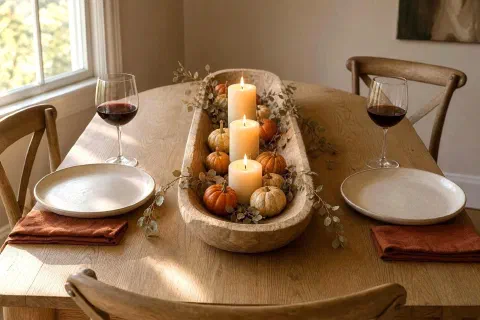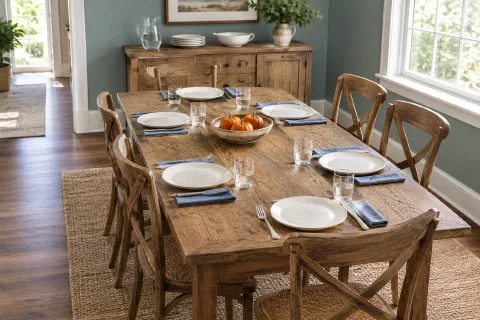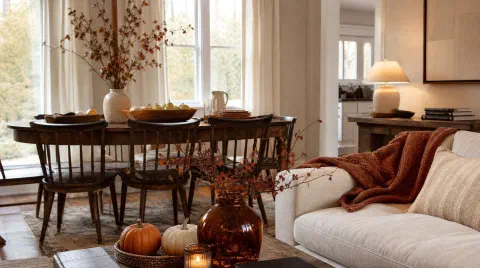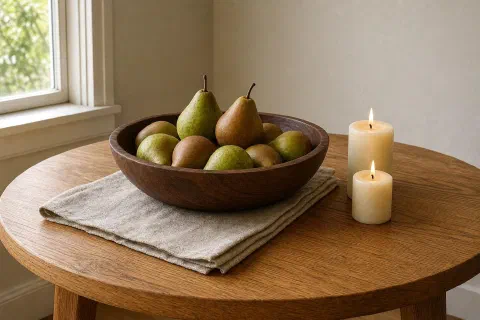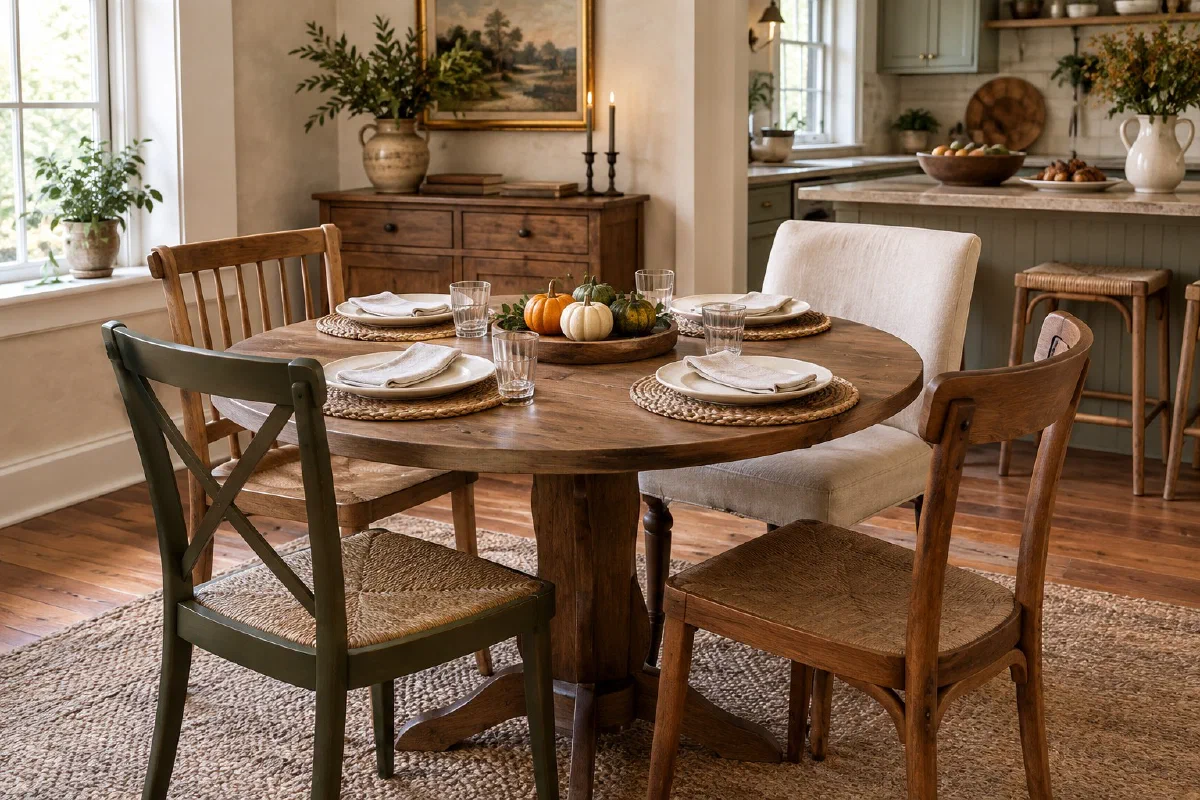
Almost every Thanksgiving table you have saved was photographed on a table wider than yours.
That is not a criticism of the photos. It is the reason the ideas do not transfer. A styled runner with a foot of clear table on either side needs a surface about 60 inches wide. A round kitchen table is often 36. So the advice arrives sounding like decorating and lands as a math problem you did not know you had.
This starts with the math, because once you know the two numbers that govern a small table, the decorating gets short and cheap. Menu, timing and cleanup live in a Thanksgiving hosting checklist for a small gathering. This page is only the table.
For a simple Thanksgiving table, keep the surface to five working parts: one place setting per guest, water glasses, napkins, a low centerpiece, and enough empty room for arms. Put serving dishes on a counter or cart when the table is narrow. The measurements below tell you how many people and how much decor the table can hold before it becomes uncomfortable.
The One Measurement That Decides Everything
Not square feet. Not how many chairs you own. Inches of table edge per person.
Dimensions.com puts a minimum place setting at 24 inches wide by 21 inches deep, split into a 16 inch setting zone and a 5 inch shared zone. The comfortable version is 30 by 27 inches, with an 18 inch setting and a 9 inch shared zone.
So 24 inches is the floor. Below it people slide their chairs back hunting elbow room, which on a small floor plan is the thing you cannot spare. Take the usable edge of your table, divide by 24, and that is your honest seat count. It usually lands one lower than the number of chairs you were planning to fit around it.
For a round table, usable edge is the circumference, the diameter times 3.14:
| Round table | Edge available | Seats at 24 in | Seats at 30 in |
|---|---|---|---|
| 36 in | 113 in | 4 | 3 |
| 42 in | 132 in | 5 | 4 |
| 48 in | 151 in | 6 | 5 |
| 54 in | 170 in | 7 | 5 |
| 60 in | 188 in | 7 | 6 |
For a rectangle, do each side separately and throw the corners away, because nobody can eat sitting at a corner:
| Rectangular table | Long sides | Ends | Realistic total |
|---|---|---|---|
| 34 x 34 in card table | 1 each | 1 each | 4 |
| 48 x 30 in | 2 each | tight | 4, or 6 squeezed |
| 60 x 36 in | 2 each | 1 each | 6 |
| 72 x 30 in folding | 3 each | 1 each | 6 comfortably, 8 at a push |
Then check the floor. The furniture trade works to 36 inches of clearance from the table edge to the nearest wall, with 42 to 48 inches as the comfortable version, because a pulled out dining chair sits 16 to 18 inches back and somebody still has to walk behind it. If one side falls short, seat nobody there and you have solved it.
A Table Narrower Than 36 Inches Has No Middle
This is the number nobody publishes, and it explains most of the frustration.
Two people sitting opposite each other each take 16 inches of table depth for their setting. That is 32 inches gone before anything decorative exists. So the strip left down the center is your table width minus 32:
- 30 inch wide table: minus 2 inches. No center strip at all. Plates from opposite sides nearly touch.
- 36 inch wide table: 4 inches. Tealights in a line and nothing else.
- 40 inch wide table: 8 inches. A narrow runner works, flat.
- 42 inch wide table: 10 inches. A runner plus low objects sitting on it.
- 48 inch wide table: 16 inches. The width the magazine photos assume.
Round tables behave the same way. Subtract 16 inches from each side of the diameter and what is left is the circle in the middle. A 36 inch round leaves a 4 inch dot, a 48 inch round leaves 16 inches, a 60 inch round leaves 28.
Under about 8 inches of center strip, stop looking for a centerpiece and start looking for things that live between the plates: small gourds, votives, a few stems laid flat. Above 10 inches, a runner earns its place.
Ten Ways to Seat More People Than You Have Chairs
Guest count is the part that moves after the table is already planned. Ordered from least disruptive to most.
- Seat the smallest people at the ends. End seats get the least depth and the most chair leg interference. That is a kid seat, and at that age it is not a demotion.
- Swap two chairs for one bench. A 48 inch bench along one long side takes three adults at 16 inches each, because no arms or chair backs are stealing width. It also slides fully under the table when nobody is on it, which chairs never do.
- Put the under tens at the coffee table on cushions. A coffee table sits about 16 to 18 inches high, right for a child on the floor and painful for anyone over about twelve.
- Bring in the desk chair and the reading chair. Mismatched chairs read as a full house, not a shortage. Match the napkins instead and nobody registers the chairs.
- Add stools at the counter for the appetizer hour, so the seated table only has to work for the meal. A kitchen counter runs 34 to 36 inches, taking a counter stool with a 24 to 26 inch seat. A raised bar top runs 41 to 43 inches and takes a 29 to 30 inch seat. Leave 10 to 12 inches between seat and underside or knees hit.
- Count the island as table edge. A 72 inch island edge is three stools at 24 inches apiece.
- Serve one course standing. Appetizers on the counter, everyone on their feet, then sit down to eat. It buys an hour without a single extra chair.
- Borrow chairs before you buy chairs. Four folding chairs live in somebody’s closet for a decade and get used once a year. Ask.
- Set a second small table and make it the good one. More on that below.
- Cap the guest list at what the table takes. Twenty four inches per person is the width of a person holding a fork. It is not a number you can decide to ignore.
Making the Surface Bigger Without Buying a Table
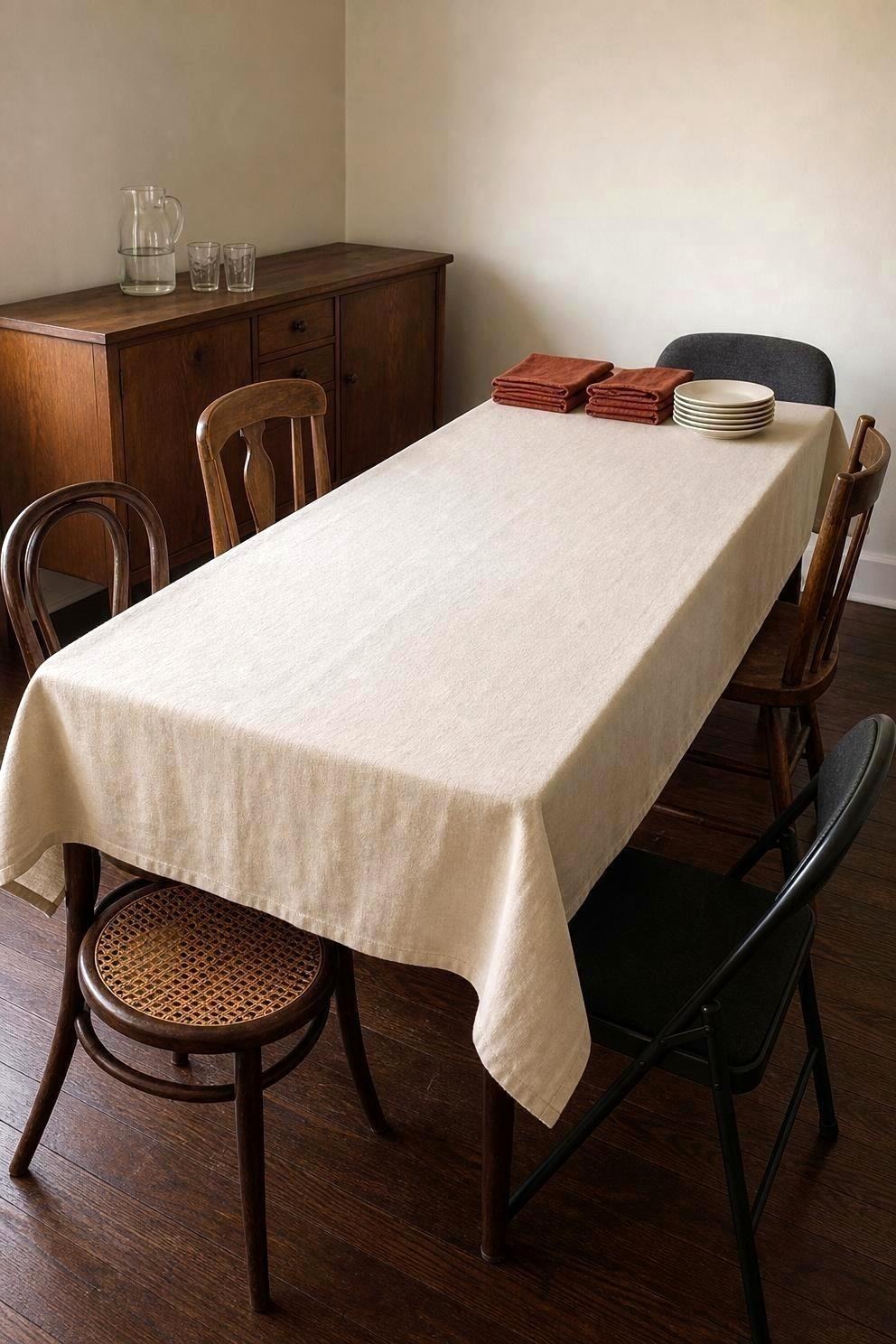
- Butt a folding table onto the end of the dining table. A standard 6 foot folding table is 72 by 30 inches and stands 29 to 30 inches tall. Dining tables run 28 to 30, most commonly 30. So the two usually line up within an inch, and one long tablecloth over both makes the seam disappear. This move alone takes a 6 seat table to 10 or 12.
- Shim the shorter one. If the folding table sits an inch low, folded cardboard or furniture pads under its feet fix it in a minute. Do it before the cloth goes on.
- Lay a half sheet of plywood over a small round. A 4 by 4 foot piece of three quarter inch plywood turns a 36 inch round seating four into a 48 inch square seating eight. A full 4 by 8 sheet averages about 61 pounds, so your half is around 30. Two person lift, cloth over the top, felt pad underneath.
- Open the drop leaves you have been ignoring. Drop leaf is the most common small dining table sold, and the leaves stay down all year because they block a walkway. Thanksgiving is the day to move the table two feet into the room and open both.
- Push a console or a narrow desk against the short end. Heights rarely match exactly, so this works better as a serving extension than as seating.
- Two tables, side by side, dressed identically. A card table beside the dining table looks like an afterthought. A card table wearing the same cloth, napkins and candles looks deliberate. Put an adult at each one so neither is the exile table.
The Low Centerpiece Rule and the 12 Inch Fire Line
- Keep it under 12 inches tall, or over 24. Anything between those heights sits at the eye level of a seated adult, so the people across from each other spend dinner talking around a floral arrangement. Under 12 you see over it. Over 24 you see under it. On a small table, over 24 is not happening, so under 12 is the rule.
- Contain it on a tray. A round wooden tray about 11 inches across gives the centerpiece a boundary, keeps wax off the table, and lifts away in one movement when the food arrives. The Hanobe 11.2 inch round wooden candle tray (opens Amazon in a new tab)As an Amazon Associate, we earn from qualifying purchases. Full disclosure. does this job and then lives on a coffee table the rest of the year.
- Take flame seriously on a narrow table. The US Fire Administration, citing NFPA data, says to keep candles at least 12 inches from anything that can burn, and that about 20 home candle fires are reported every day. On a 36 inch wide table with a 4 inch center strip, no arrangement puts a lit taper 12 inches from a paper napkin. That is arithmetic, not a scare line.
- Flameless tapers solve it without looking like a compromise. GenSwin flameless taper candles (opens Amazon in a new tab)As an Amazon Associate, we earn from qualifying purchases. Full disclosure. measure 9.64 inches, so even in a one inch holder the tip lands under the 12 inch eye line. Real wax, a remote and a timer, so they come on while you are still in the kitchen.
- Scatter instead of stacking when the middle is thin. A dozen small velvet pumpkins (opens Amazon in a new tab)As an Amazon Associate, we earn from qualifying purchases. Full disclosure. set between the plates gives you the fall table without needing a center strip to put it in.
- Light that lies flat. A battery maple leaf garland, 20 feet with 40 LEDs (opens Amazon in a new tab)As an Amazon Associate, we earn from qualifying purchases. Full disclosure. runs along the cloth with no height at all, the one lighting move that costs zero inches of headroom.
The centerpiece itself, with picks and a build order, is in five fall table centerpiece ideas that last past Thanksgiving.
The Runner and Candles Plan
The cheapest table that still looks like somebody tried. Three things, in order.
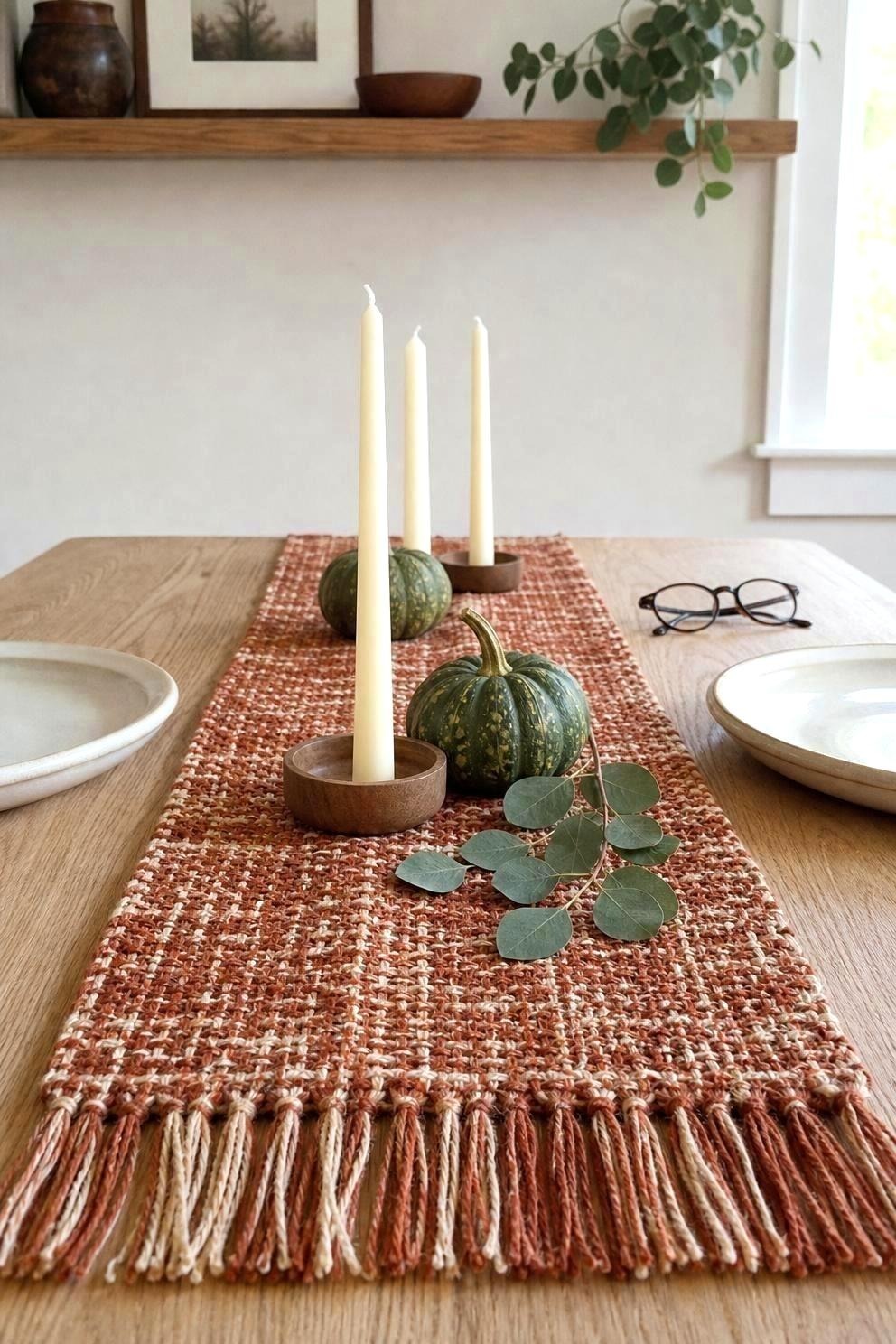
- Runner first, sized to the table. Standard runners are 12 to 14 inches wide, so on a 36 or 40 inch table the runner sits under the edges of the plates. That is how it is meant to look. Length is what people get wrong. A 12 by 72 inch boho runner with tassels (opens Amazon in a new tab)As an Amazon Associate, we earn from qualifying purchases. Full disclosure. leaves a 6 inch overhang at each end of a 60 inch table, which is right, and a 12 inch overhang on a 48 inch table, which drags into laps. On a short table, run it across the width instead.
- Or use cheesecloth, which has no wrong length. A sage green cheesecloth runner, 120 inches (opens Amazon in a new tab)As an Amazon Associate, we earn from qualifying purchases. Full disclosure. is meant to be bunched and twisted rather than laid flat, so 10 feet of it works on a 40 inch table and a 6 foot one equally well. It washes and comes out again in December. To state the season more plainly, the 13 by 72 inch maple leaf lace runner (opens Amazon in a new tab)As an Amazon Associate, we earn from qualifying purchases. Full disclosure. does that instead.
- Then three candles, evenly spaced, all the same height. Three matching reads calmer than five mismatched. Under 12 inches, per the rule above.
- Then stop. The most common failure on a small table is one more thing. Three elements looks styled. Six looks like a shelf.
Napkins do more work here than anything else you can add. Cloth napkins in one color pull a mismatched set of plates together.
Keep the Food Off the Table
A full table has room for plates and glasses and nothing else. So the food goes somewhere else, and that decision is what keeps a small Thanksgiving calm.
- Plate in the kitchen and carry out. Restaurant service. It costs nothing, removes every serving dish from the table, and on a 30 inch wide table it may be the only thing that works.
- Buffet along the kitchen counter. A 6 foot counter run holds a turkey platter, three sides and a stack of plates. Plates at the start of the line, cutlery at the end, so nobody carries a fork through the queue.
- Use the top of a dresser or a bookshelf. Any flat surface at roughly counter height, with a folded blanket or heat pad under anything hot.
- A rolling cart is the small kitchen answer. It parks beside the table during the meal and rolls out of the room before dessert, resetting the space in one push.
- Drinks go somewhere else entirely. Whatever surface sits farthest from the table gets them. That moves the standing crowd out of the walking path between the kitchen and the chairs.
- Dessert stays in the kitchen until dessert. Nothing sits on the table waiting.
- Chargers do a real job on the overflow table. A stack of 10 inch bamboo plate holders (opens Amazon in a new tab)As an Amazon Associate, we earn from qualifying purchases. Full disclosure. keeps a paper plate flat and rigid, so nobody balances a bending plate on a knee. Their rating is not brilliant, and they are still the only reusable charger in this price range that is not a plastic disc.
- Reusable and unbreakable beats disposable if you host twice a year. A 24 piece set of scalloped ivory plates for 12 guests (opens Amazon in a new tab)As an Amazon Associate, we earn from qualifying purchases. Full disclosure. is dishwasher safe and stores in about the space a real stack of 12 would take.
- Disposable makes sense for a genuinely big crowd. A 60 piece white plate set covering 30 guests (opens Amazon in a new tab)As an Amazon Associate, we earn from qualifying purchases. Full disclosure. gives 30 dinner plates at 10.25 inches and 30 dessert plates at 7.5 inches. Check that diameter against your setting math first: a 10.25 inch plate inside a 16 inch setting zone leaves under 3 inches each side for a glass and cutlery, which is tight but workable. An 11 inch plate is not.
Setting the Place So Elbows Do Not Collide
The etiquette is simpler than it looks, and every rule in it saves room.
- Place mats sit one to two inches from the table edge, per Emily Post. That inch stops a plate overhanging a lap.
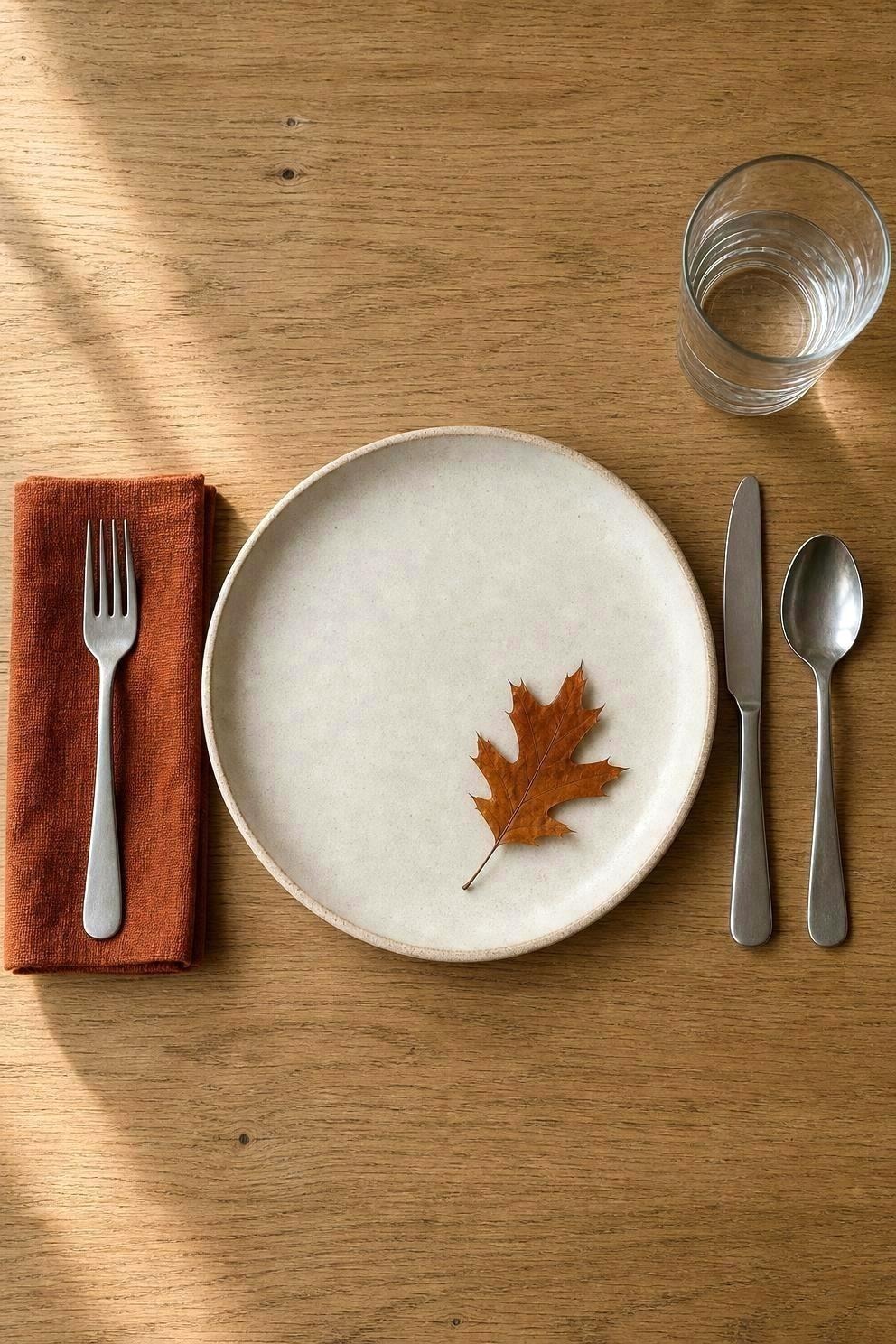
- Fork on the left, knife on the right with the blade turned in toward the plate, spoon to the right of the knife. Utensils are used outside in, so anything you do not need should not be on the table at all. A salad fork you are not serving salad with is stolen width.
- The water glass goes above the knife, or at a 45 degree angle to the right of it. Above rather than beside is the small table version.
- Napkin to the left of the plate, or on the plate. Not in the glass, which needs height you do not have.
- A tablecloth drops an average of 12 to 18 inches, per the same source. On a card table with 29 inches of leg, an 18 inch drop reaches a child’s knees. Use the shorter drop.
The Whole Table, Step by Step
An afternoon, in this sequence so nothing has to be undone.
- Measure the usable edge and divide by 24. That is your seat count.
- Measure the width and subtract 32. That is your center strip: runner, or scattered objects.
- Check floor clearance on the sides people will use. Aim for 36 inches.
- Decide the surface before the decor. Leaves open, folding table butted on, plywood topper, or a second table.
- Cloth or runner, then let it settle. Creases fall out over hours, not in ten minutes.
- Set the places. Plate, fork left, knife and spoon right, glass above the knife, napkin left.
- Centerpiece last, and low. Under 12 inches, on a tray, three elements at most.
- Sit in every chair before anyone arrives. If you cannot see the face opposite, the centerpiece is too tall, and this is the only way to find that out in time.
Questions People Actually Ask
What type of dining table is best in a small space?
A round or oval one, and if it has to be rectangular, one that folds or drops. Round wins for a reason you can calculate: no corners, so all of its edge is usable. A 42 inch round gives 132 inches of usable edge and seats five. A 42 inch square gives four seats and four dead corners. If the table has to disappear between meals, shop a drop leaf by its everyday footprint with both leaves down, never by the extended number. A 36 inch round is the smallest table that seats four adults at the 24 inch minimum.
How to set a simple Thanksgiving table?
Work in four passes and stop. One, the surface: a cloth or runner, laid early enough for the creases to relax. Two, the places: dinner plate centered on each seat, fork on the left, knife and spoon on the right with the blade turned inward, napkin to the left, water glass above the knife. Three, one low centerpiece under 12 inches tall, on a tray so it lifts off in a single movement. Four, one thing per person that marks the date: a name card, a small gourd, or a sprig of eucalyptus laid across the plate. Four passes is a complete table. The fifth is where small tables go wrong.
What are some simple Thanksgiving centerpiece ideas?
Low, and sized to the center strip you measured. With 4 to 8 inches of middle: a line of tealights in glass, small gourds set between the plates, or a flat battery garland lying on the cloth. With 10 inches or more: a runner with three matching candles evenly spaced, a shallow bowl of apples and pears you can eat afterward, or dried stems cut short in a low tray. Free at any width: citrus slices, pine cones, walnuts in their shells, and cuttings from whatever is still alive outside. A branch of oak leaves laid flat along the runner reads as more considered than a bought arrangement.
What are some Thanksgiving table setting etiquette rules?
The ones that matter on a small table are the ones that save room, and they are set out in full further up this page. The two nobody lists: guests wait for the host to sit, so say “please start” once at the beginning and it is settled for the whole meal. And phones off the table, which here is a space rule as much as a manners one.
What not to forget when hosting Thanksgiving?
The table version is short: enough chairs at 24 inches apiece, somewhere for the food that is not the table, a trivet for anything hot, water already out so you are not fetching it mid meal, and a plan for dirty plates that does not involve stacking them on the counter you are also serving from. The wider version, covering menu, timing, food safety and leftovers, is in the Thanksgiving hosting checklist for a small gathering. The most forgotten item on both lists is containers for people to take food home in, which in a small kitchen is also how you get your fridge back.
What I’d Actually Buy
Product details can change; check the listing before you buy.
- Sage green cheesecloth table runner, 120 inches (opens Amazon in a new tab)As an Amazon Associate, we earn from qualifying purchases. Full disclosure.. Bunched rather than laid flat, so length never has to be right.
- FEXIA boho table runner with tassels, 12 by 72 inches (opens Amazon in a new tab)As an Amazon Associate, we earn from qualifying purchases. Full disclosure.. Check your table length against 72 inches first.
- Maple leaf lace fall table runner, 13 by 72 inches (opens Amazon in a new tab)As an Amazon Associate, we earn from qualifying purchases. Full disclosure., if you want the season stated rather than implied.
- Hanobe round wooden candle tray, 11.2 inches (opens Amazon in a new tab)As an Amazon Associate, we earn from qualifying purchases. Full disclosure.. It turns three separate candles into one centerpiece you can lift off in a second.
- GenSwin flameless taper candles, 6 pack with remote and timer (opens Amazon in a new tab)As an Amazon Associate, we earn from qualifying purchases. Full disclosure.. At 9.64 inches they stay under the eye line and answer the 12 inch clearance problem a narrow table cannot answer any other way.
- Fall garland with lights, 20 feet and 40 LEDs, 2 pack (opens Amazon in a new tab)As an Amazon Associate, we earn from qualifying purchases. Full disclosure.. Battery operated, so no cord crosses the floor.
- Velvet pumpkins, 12 pieces (opens Amazon in a new tab)As an Amazon Associate, we earn from qualifying purchases. Full disclosure.. Twelve small objects beat one arrangement on a thin center strip.
- Scalloped ivory reusable plates, 24 pieces for 12 guests (opens Amazon in a new tab)As an Amazon Associate, we earn from qualifying purchases. Full disclosure.. Dishwasher safe, which is what makes it the honest pick over disposable.
- White plate set, 60 pieces for 30 guests (opens Amazon in a new tab)As an Amazon Associate, we earn from qualifying purchases. Full disclosure.. The 10.25 inch dinner plate is the number to check against your 16 inch setting zone.
- Bamboo plate holders, 4 count (opens Amazon in a new tab)As an Amazon Associate, we earn from qualifying purchases. Full disclosure.. Included because it is the only reusable charger in the category that is not a plastic disc.
One category with no honest pick: a small dining table. Everything the search surfaced was a drop leaf under 36 inches wide, the exact width that creates the problem this article opens with.
What to Read Next
- A Thanksgiving hosting checklist for a calmer small gathering picks up where this stops: menu, timing, food safety and leftovers.
- Five fall table centerpiece ideas that last past Thanksgiving goes deeper on the centerpiece and what to buy for it.
- Hurricane lantern fall decor ideas covers the taller lantern lane for the sideboard and the floor, where the height rule does not apply.
- A backyard dinner party checklist for hosting without stress applies the same seating and serving thinking outdoors.
- Fall kitchen decor ideas helps if your counter is doubling as the buffet.