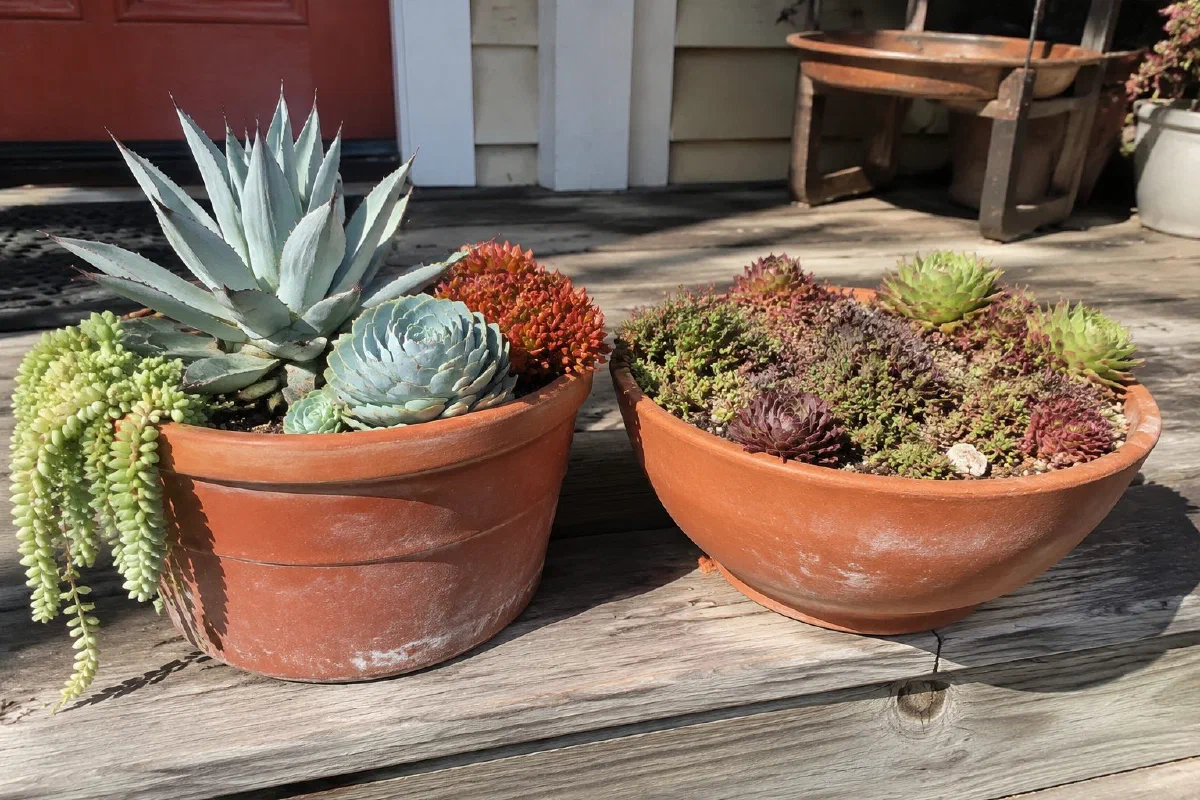
The succulent container that fails in July almost always has the wrong soil, the wrong pot, or the wrong plant for the spot.
Outdoor succulents in containers are some of the most forgiving plants in the garden when they’re set up right. Six hours of sun, well-drained soil, deep infrequent watering, and the right pot will keep a container looking better in August than it did in June. Get any one of those wrong and the same plants rot or burn within weeks.
These nine combinations use plants reliably available at garden centers from spring through summer. Each combo follows the “thriller, filler, spiller” rule (one upright statement plant, two or three filler succulents, one trailing plant) and is sized for a 14-inch container.
Here is the whole list in one place, so you can match the combo to your porch before you read the planting notes.
| Combo | Palette | Light it wants | The plant doing the work |
|---|---|---|---|
| 1. Sun-Baked Classic | Silver-blue, chartreuse, burgundy | Full sun, 6+ hours | Agave parryi |
| 2. Coastal Look | Soft blue and green | Full sun, 6+ hours | Senecio mandraliscae |
| 3. Sunset Palette | Orange, amber, and gold | Full sun, 6+ hours | Sedum nussbaumerianum |
| 4. Monochrome Green | Green on green | Full sun, afternoon shade in zone 8+ | Aeonium ‘Sunburst’ |
| 5. Black-and-Blush | Burgundy and soft pink | Morning sun, afternoon shade in zone 8+ | Aeonium ‘Zwartkop’ |
| 6. Edible Hybrid | Green with lavender and rosemary | Full sun, 6+ hours | Aloe vera |
| 7. Beginner-Proof | Mixed green | Tolerates hot sun and missed watering | Sansevieria trifasciata |
| 8. Pollinator Combo | Blue-grey foliage with pink blooms | Full sun, 6+ hours | Sedum ‘Autumn Joy’ |
| 9. Container Cactus Garden | Desert grey and green | Full sun, 6+ hours | Golden barrel cactus |
The Setup Every Succulent Container Needs
Before any plant choices:
- Pot: Terracotta or unglazed ceramic, 14 inches or larger, with at least one large drainage hole. Smaller pots dry too fast and bake the roots. Glazed pots without drainage are a death sentence outdoors.
- Soil: Cactus and succulent potting mix from any garden center. Or amend regular potting mix 50/50 with perlite or pumice for fast drainage.
- Sun: 6+ hours of direct sun for most succulents. Some (Echeveria, Sedum) prefer morning sun and afternoon shade in zone 8+ summers.
- Water: Deep watering when the soil is fully dry, usually every 7-14 days outdoors in summer, less often in spring and fall.
- Drainage saucer: If using one, empty it after every watering. Standing water in the saucer rots the roots.
These five rules cover 90% of why outdoor succulent containers succeed or fail.
How to Plant a Succulent Container in Six Steps
- Set a screen over the drainage hole. A scrap of window screen, a coffee filter, or a single flat shard keeps the mix in and still lets water run. Skip the gravel layer at the bottom, which does not raise the water table the way people expect.
- Fill about a third of the pot with cactus and succulent mix, and firm it lightly. Leave room to set the root balls without burying the stems.
- Place the thriller first. Set the agave, aeonium, or snake plant slightly off center rather than dead center. An off-center anchor looks planted, not displayed.
- Add the fillers in odd numbers. Three or five filler plants read as a group. Two or four read as a row.
- Tuck the spiller at the rim so the trailing stems start at the edge and fall over it, not out of the middle.
- Fill around the roots, press the mix down, then water once until it runs out the bottom. After that first watering, leave the pot alone until the soil is dry.
Combo 1: The Sun-Baked Classic
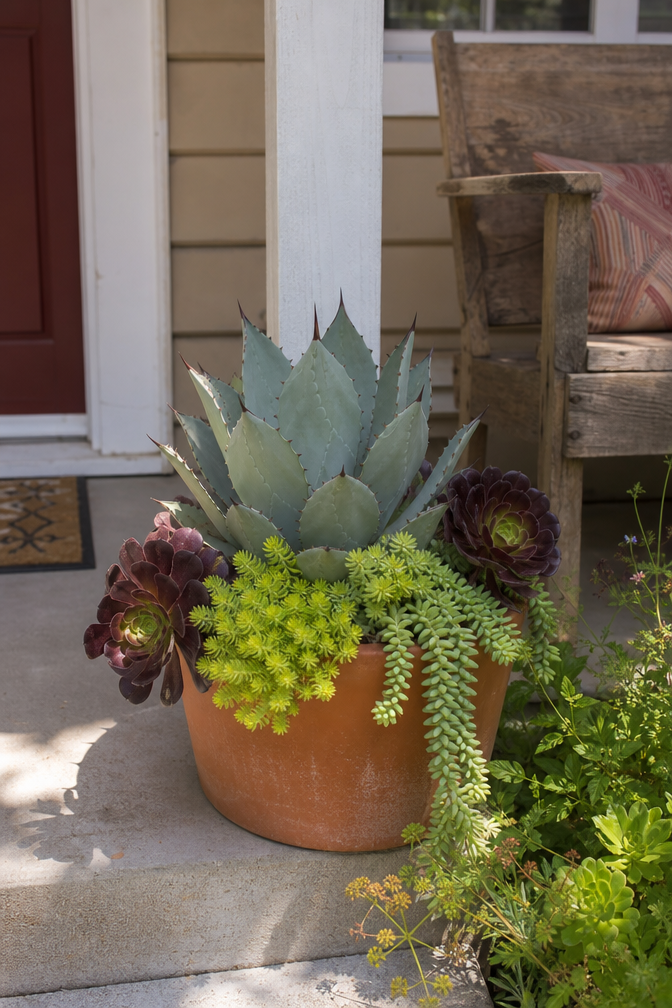
For a south-facing porch that bakes from morning to evening.
- Thriller: Agave parryi (artichoke agave), silver-blue rosette, dramatic
- Fillers: 3 Sedum ‘Angelina’ (chartreuse) + 2 Echeveria ‘Black Prince’ (deep burgundy)
- Spiller: Sedum morganianum (burro’s tail) trailing over the edge
The agave anchors visually; the chartreuse and burgundy sedums and echeverias contrast against the blue-silver agave; the burro’s tail trails 18-24 inches over the pot rim.
Watering: every 10-14 days in summer. Loves heat.
Combo 2: The Coastal Look
Soft blues and greens, salt-tolerant, beach-house feel.
- Thriller: Senecio mandraliscae (blue chalk sticks), vertical blue spears
- Fillers: 3 Echeveria elegans (Mexican snowball, pale blue) + 2 Crassula ‘Calico Kitten’ (pink-green)
- Spiller: Senecio rowleyanus (string of pearls) cascading
This combo holds up beside the ocean and in salty air better than most. The pale blues read coastal without being on the nose.
Combo 3: The Sunset Palette
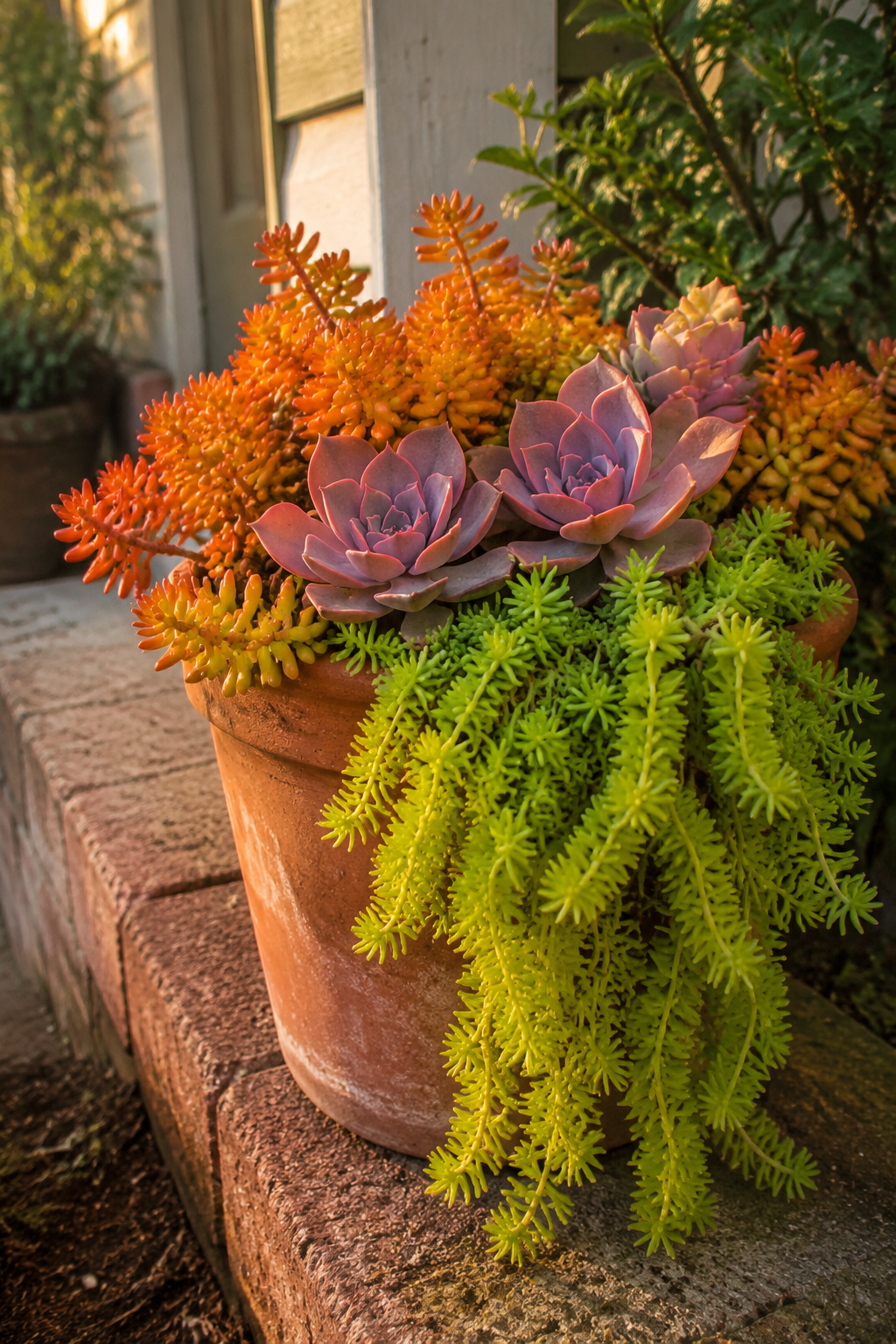
Warm oranges, reds, and golds for a fall-anticipating look from June onward.
- Thriller: Aloe ‘Christmas Carol’ (red-tipped green), bright winter color too
- Fillers: 3 Sedum nussbaumerianum (coppertone sedum, orange-amber) + 2 Echeveria ‘Afterglow’ (pink-purple rosette)
- Spiller: Sedum rupestre ‘Angelina’ (chartreuse-gold)
The coppertone sedum is the secret weapon, it turns vivid orange in full sun and reads like a sunset all summer.
Combo 4: The Monochrome Green
For a porch where green-on-green looks more sophisticated than mixed color.
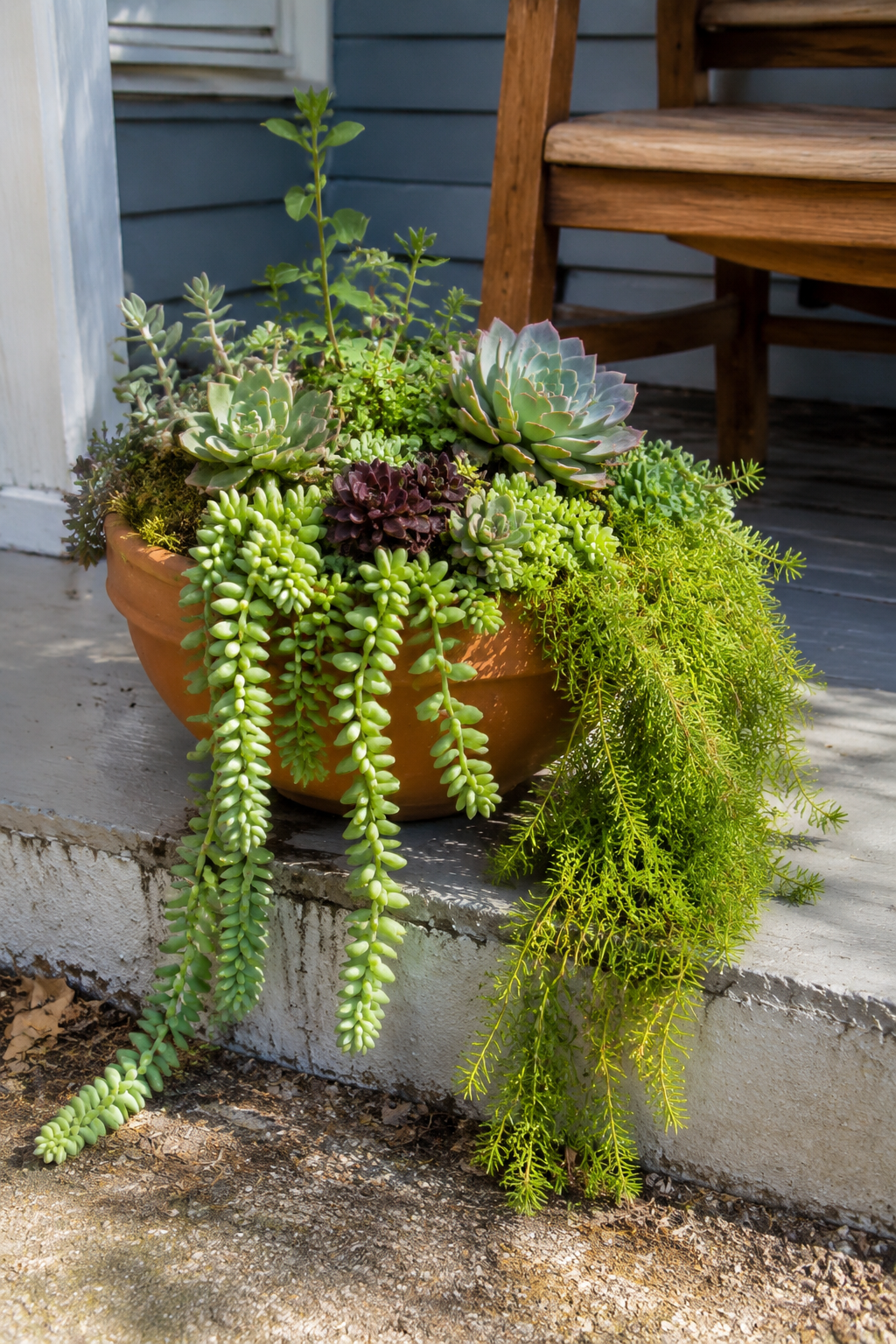
- Thriller: Aeonium ‘Sunburst’ (variegated yellow-green rosette)
- Fillers: 4 Echeveria elegans + 2 Haworthia fasciata (zebra plant)
- Spiller: Senecio radicans (string of bananas)
The variegated aeonium adds visual interest without breaking the green palette. Reads calm and uncluttered.
Combo 5: The Black-and-Blush
Dark burgundy succulents paired with soft pink, dramatic and modern.
- Thriller: Aeonium ‘Zwartkop’ (black tree aeonium), dramatic dark rosettes on stems
- Fillers: 3 Echeveria ‘Perle von Nurnberg’ (pink-purple rosette) + 2 Crassula ovata ‘Gollum’ (jade variant)
- Spiller: Echeveria ‘Topsy Turvy’ or trailing Crassula
The black aeonium creates the contrast. This combo wants morning sun and afternoon shade in zones 8+ to keep the colors saturated.
Combo 6: The Edible Hybrid
For a porch container that’s part decorative, part herb pot.
- Thriller: Aloe vera, medicinal and sculptural
- Fillers: 2 Echeveria ‘Topsy Turvy’ + 1 lavender plant (Lavandula ‘Munstead’)
- Spiller: Trailing rosemary or creeping thyme
The lavender and rosemary aren’t true succulents but tolerate the same low-water, full-sun conditions. The result is a container with herb cuttings for cooking and aloe for kitchen burns.
One caution if a cat or dog shares the porch: the ASPCA lists Aloe vera as toxic to dogs, cats, and horses , with vomiting and lethargy as the usual signs after chewing.
Combo 7: The Beginner-Proof
For the gardener who’s killed plants before and wants near-bulletproof.
- Thriller: Sansevieria trifasciata (snake plant), indestructible
- Fillers: 4 Sedum ‘Coral Carpet’ + 2 Kalanchoe blossfeldiana (any color)
- Spiller: Sedum rupestre ‘Angelina’ trailing
Every plant here tolerates underwatering, hot sun, and benign neglect. The snake plant adds the dramatic upright element most pots lack.
The snake plant is the one to lift out of a puppy’s reach. The ASPCA lists Sansevieria trifasciata as toxic to dogs and cats , with saponins causing nausea, vomiting, and diarrhea.
Combo 8: The Pollinator Combo
Succulents plus a pollinator-friendly bloom for a working garden container. If it is the flower you want rather than the foliage, huernia is the odd little succulent people stop and ask about .
- Thriller: Agave ‘Blue Glow’ or small Yucca
- Fillers: 3 Sedum ‘Autumn Joy’ (blooms pink in late summer, bee magnet) + 2 Echeveria
- Spiller: Sedum spurium ‘Dragon’s Blood’ (red-bronze, blooms pink)
The sedum ‘Autumn Joy’ in particular brings bees and small butterflies to the container all August. This combo earns its place beside a vegetable garden.
Combo 9: The Container Cactus Garden
Cacti are succulents too. For the gardener who wants the desert look.
- Thriller: Golden barrel cactus or small saguaro
- Fillers: 3 small prickly pear pads + 2 hens-and-chicks (Sempervivum)
- Spiller: Sedum acre or trailing portulaca
Add a top dressing of pea gravel or decomposed granite for the desert finish. Water sparingly, cacti want even less water than soft succulents.
The Watering Rule
The most-killed succulent isn’t underwatered. It’s overwatered.
The right cadence:
| Season | How often | What to check first |
|---|---|---|
| Summer, full sun, hot | Every 7-10 days | Soil dry 1-2 inches down |
| Spring or fall, cooler | Every 2-3 weeks | Soil dry most of the way down |
| Indoors for winter, cold zones | Every 4-6 weeks at most | Soil fully dry, pot light to lift |
“Deep watering” means until water runs out the drainage hole. Then don’t water again until the soil is fully dry. Light frequent watering is what rots roots.
Common Mistakes
- Pots without drainage. Even decorative pots without holes can be used as cachepots, slip the actual planted pot inside, lift out to water, drain, return.
- Standard potting mix without amendment. Holds too much water. Always add 50% perlite or use cactus mix.
- Watering on a schedule, not by checking soil. The schedule changes with weather; the check doesn’t lie.
- Planting echeveria in pure afternoon sun in zone 9+. Burns the leaves. Morning sun, afternoon shade for echeveria south of zone 8.
- Leaving outdoor containers out in zone 5-6 winters. Most succulents don’t survive freezing. Bring containers into garage or basement when temps drop below 30°F.
Care for the Move Indoors
The last weeks of September decide whether the same container comes back out in May.
- Cut the water before you cut the light. Start stretching the interval in early fall, while the pots are still outside. A plant going into dormancy on wet soil is the one that rots in the garage.
- Clear the saucers for good. Once the pots are inside, a saucer under a dormant succulent is a rot risk with no upside.
- Move them before the first frost, not after. In zones 6 and colder, watch the forecast rather than the calendar, since an early frost does more damage than a cold December.
- Give them light but not heat. A bright garage, basement, or enclosed porch keeps them dormant. A warm living room pushes pale, stretched growth that never recovers its shape.
- Check once a month. Lift a pot. If it feels heavy, it does not need water yet.
FAQ
What’s the easiest outdoor succulent for a beginner?
Sedum ‘Angelina’ (chartreuse trailing) and snake plant. Both tolerate full sun, drought, and missed watering for months.
Can outdoor succulents stay outside in winter?
In zones 9-11, yes, most succulents are hardy. In zones 7-8, hardy succulents like Sempervivum (hens and chicks) and some Sedum stay out; tender succulents come in. In zones 6 and colder, bring all succulent containers indoors before first frost.
How do I keep a succulent container from getting leggy?
Leggy growth (stretched stems, sparse leaves) means not enough sun. Move the container to a spot with 6+ hours of direct sun and the plants will tighten up over 4-6 weeks.
What to Read Next
- Container vegetable garden ideas for small spaces if you want the same pot count to feed you as well as decorate.
- Container vegetable garden layout for spacing rules that work in the same 14-inch footprint.
- What to do when container soil keeps drying out too fast because a baking porch dries succulents faster than the schedule above.
- Container garden ideas for small patios that still feel full when you want more pots without losing the walkway.
- Flower container combinations that bloom all season if you would rather have flowers than foliage on the same porch.