
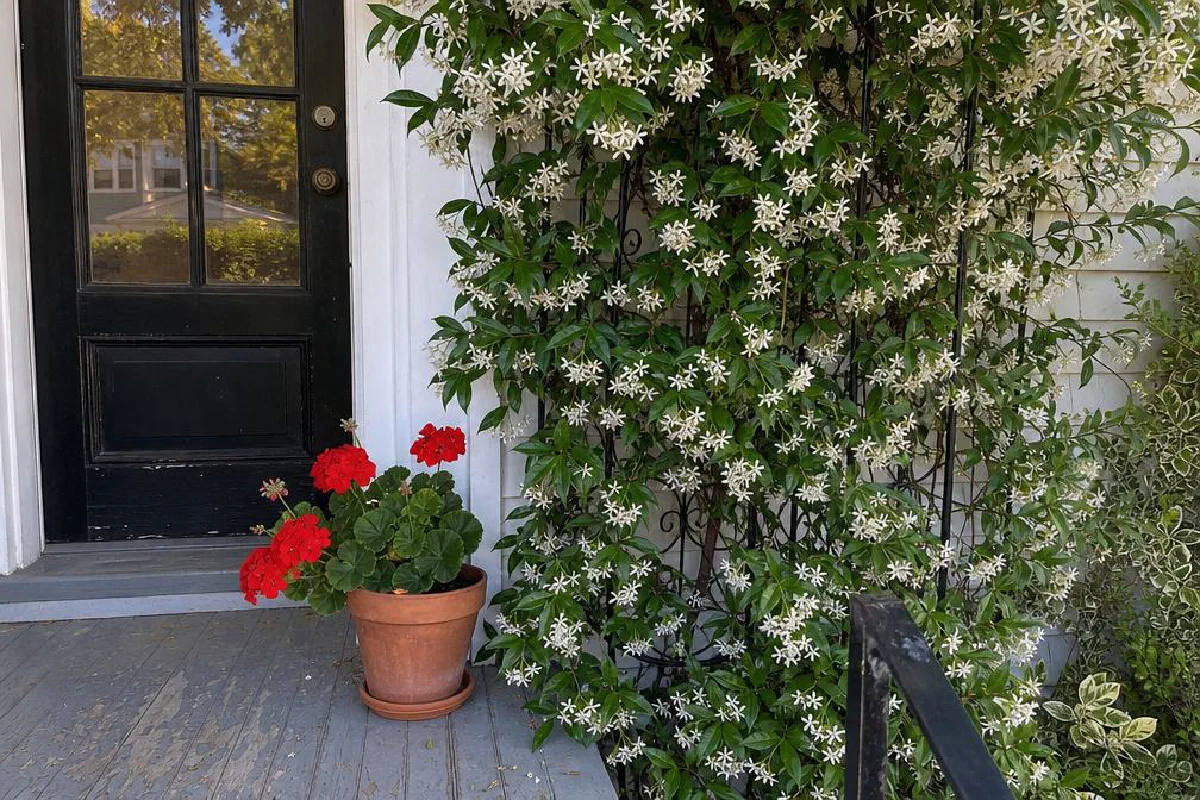
The single best place to plant star jasmine is right beside the front door.
The scent of star jasmine in bloom is heavy enough that one mature plant perfumes a 15-foot radius, the entire porch, the path to the driveway, and the space inside the door for the first ten seconds after it opens. Plant it anywhere else in the yard and you get a corner of fragrance. Plant it by the door and the smell becomes part of the daily rhythm of coming home.
Star jasmine (Trachelospermum jasminoides) isn’t a true jasmine, it’s in the dogbane family, but it’s the plant most gardeners mean when they say “I want jasmine by the door.” It’s evergreen, blooms heavily in late spring and early summer, takes part shade or full sun, and grows in a container in cold climates so even zone-5 gardeners can have it on a porch.
The Plant Itself
Star jasmine is an evergreen woody vine native to East Asia, hardy outdoors in USDA zones 8-10. If you are not sure which zone your entry sits in, the USDA Plant Hardiness Zone Map takes a ZIP code and returns it, and it is the same map the zone numbers on a nursery tag are written against.
Glossy dark green leaves year-round. Small white star-shaped flowers in dense clusters in May and June, with a few sporadic blooms through the summer in warm climates. Mature plants reach 10-20 feet long if given vertical support; in containers they typically grow to 6-8 feet.
The scent is intense but not cloying. Most people who’ve smelled it once want one within ten minutes of arriving home. It’s not a subtle plant.
The “Madison” cultivar is the most cold-hardy (to zone 7 with protection), making it the right choice for borderline climates. “Asiaticum” (Asian jasmine) is the lower-growing groundcover cousin if you want jasmine without the climber.
Where Star Jasmine Wants to Live
Sun and well-drained soil. Star jasmine is forgiving but it has preferences:
- Sun: 4-6 hours of direct sun is ideal, which Penn State Extension classes as part sun . Tolerates more in cooler climates, less in hot climates. Full afternoon sun in Texas is too much; full afternoon sun in Connecticut is fine.
- Soil: Well-drained, slightly acidic to neutral. Doesn’t tolerate wet feet. Heavy clay needs amending with compost.
- Water: Average. Once established, drought-tolerant. New plants need consistent moisture for the first growing season.
- Wind: Protected sites preferred. Strong wind dries out the leaves and damages bloom.
- Cold: Hardy to about 15°F at maturity. In zone 7, plant against a south-facing wall and mulch heavily in winter. In zone 6 and colder, grow in a container that can move to a garage or basement over winter.
This article contains affiliate links. If you buy through them, Etheric Echoes may earn a commission at no extra cost to you. As an Amazon Associate I earn from qualifying purchases. Read the full disclosure.
The Trellis or Support
Star jasmine climbs by twining stems, not by tendrils or aerial roots. It needs a support to wrap around, it won’t stick to a flat wall or wood fence on its own.
| Support | Best for | Watch out for |
|---|---|---|
| Iron trellis on standoffs | A doorway, because the 4 to 6 inch gap keeps the wall dry behind the foliage | Needs solid mounting points, and it costs more than lattice |
| Wooden lattice panel | A container by the step that may move indoors for winter | Wood holds moisture if it sits flat against siding |
| Wire grid between hooks | The most invisible option, since the vine covers the wire completely | Wire alone will not carry a heavy mature vine without a frame behind it |
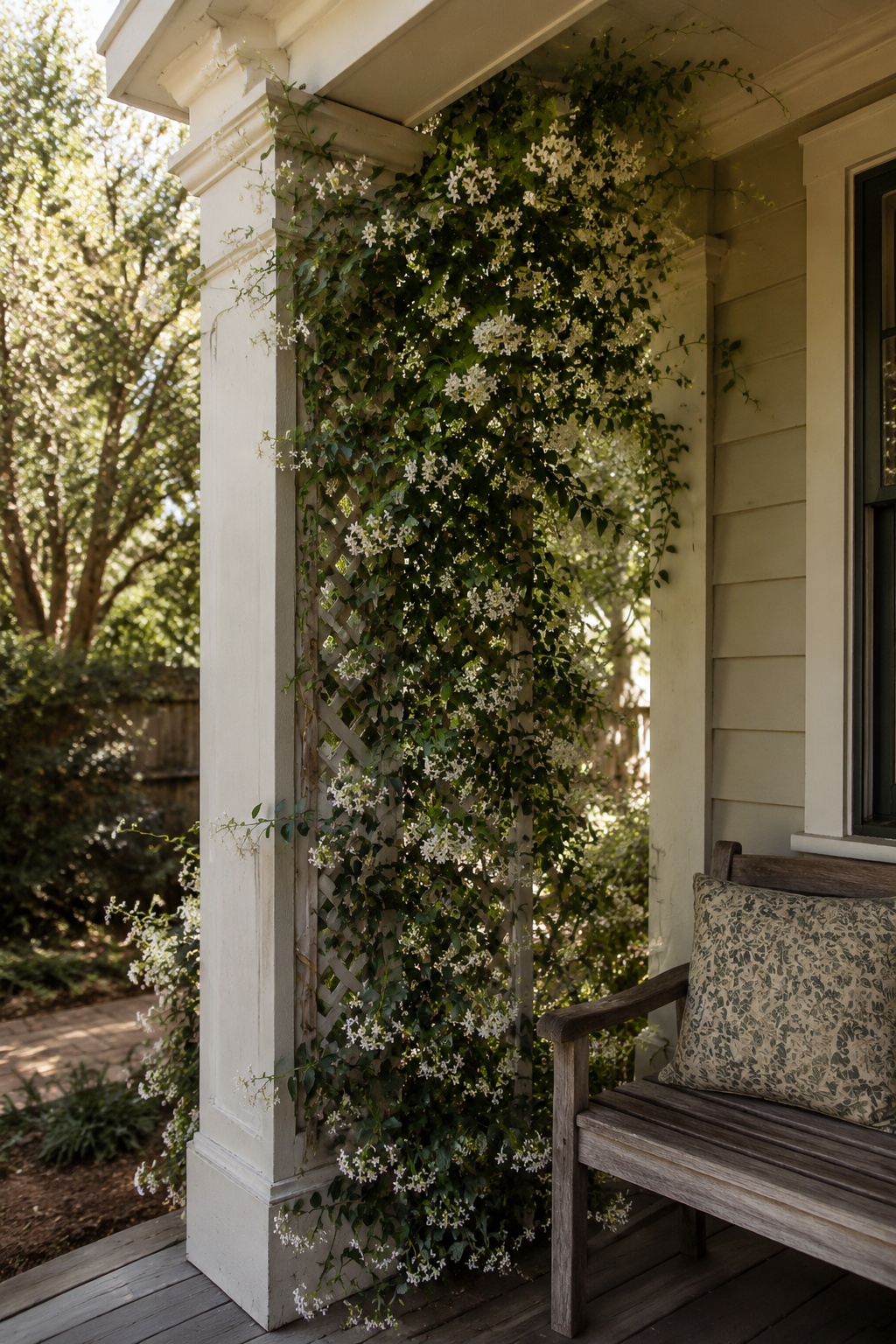
| Arbor or pergola post | A porch column, the classic look | Has to be in place before the vine starts twining |
The best supports:
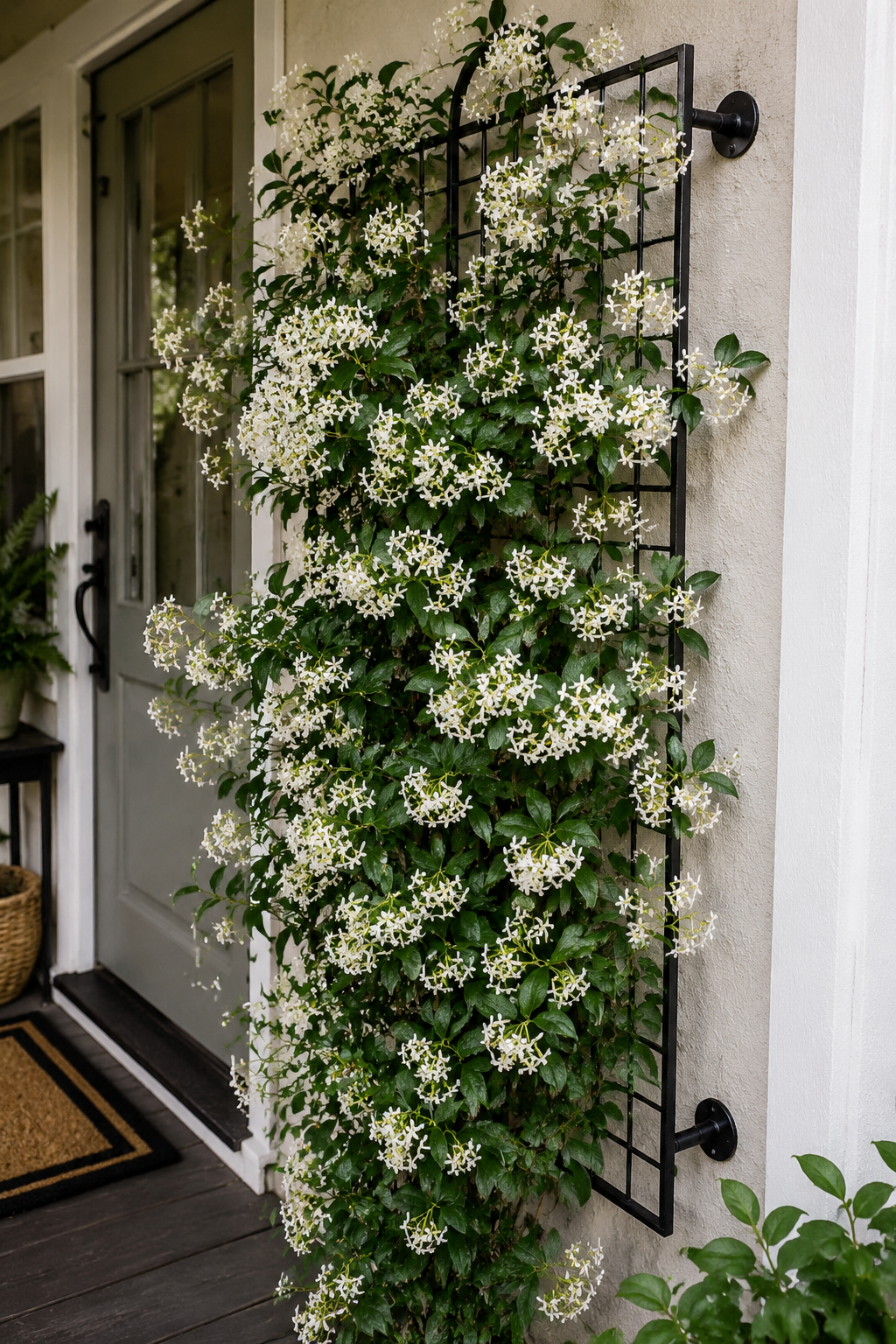
- An iron trellis mounted 4-6 inches off the wall. The gap lets the plant breathe and prevents the wall from staying damp behind the foliage. A black-coated metal trellis around 70 inches tall (opens Amazon in a new tab) (4.6 stars, 306 reviews) is the size that suits a doorway; the two-pack matters because jasmine will fill one panel faster than you expect.
- A wooden lattice panel in a planter, free-standing or anchored to the porch. An expandable wooden lattice (opens Amazon in a new tab) (4.4 stars, 446 reviews) suits a container by the step, since you can widen it as the plant grows.
- Wire grid stretched between hooks on a wall or fence, the most invisible support, since the plant covers the wire completely once mature.
- A wooden arbor or pergola post. A mature jasmine on a porch column is the classic look.
Avoid: solid wood walls (no airflow, traps moisture), vinyl siding (rots from contact), and shutters (jasmine pulls them off).
How to Plant It and Set Up the Support
- Put the support in place before the plant. A vine that spends its first month reaching for nothing is harder to train later.
- Mount an iron trellis 4 to 6 inches off the wall so air still moves behind the foliage.
- Dig the hole the same depth as the nursery pot and about twice as wide.
- Set the vine so the top of the root ball sits level with the surrounding soil, then backfill and firm it in.
- Water deeply, then mulch a few inches out from the stem without piling mulch against it.
- Tie the leading stems loosely to the support for the first season, then let the twining stems take over.
- In zone 7 and colder, decide the winter plan now: a south-facing wall with heavy mulch, or a container that can move into a garage.
When It Blooms and How Strong the Scent Gets
Peak bloom is May into June in most of zone 7-9. The scent peaks in the evening and early morning hours, when the cooler air holds the fragrance close to the ground.
A first-year plant produces a modest few clusters. A three-year-old established plant produces hundreds of clusters and perfumes an entire porch. The scent reaches its full intensity at year three or four, then stays at that level indefinitely if the plant is healthy.
That timeline is worth knowing before you plant one for screening. Star jasmine is a slow builder, so if the job is hiding a fence rather than scenting a doorway, look at vines that cover a fence in a single summer instead.
Light winter pruning in February (just shaping, not heavy cuts) helps the plant produce more flower clusters the following spring. Heavy pruning right after bloom removes next year’s flower buds, don’t do it.
Four Other Fragrant Vines to Consider
If star jasmine isn’t the right fit for the climate or the spot:
Confederate Jasmine (Trachelospermum jasminoides ‘Confederate’). Same species as star jasmine, slightly different name in the southeast US. Often more cold-hardy clones available locally.
Honeysuckle ‘Major Wheeler’ (Lonicera sempervirens). Native coral honeysuckle, hardy to zone 4. Less fragrant than jasmine but heavy on hummingbird traffic and continuously blooming May to September.
Sweet Autumn Clematis (Clematis terniflora). Late-summer-blooming clematis with sweet vanilla-honey scent. Hardy to zone 4. Blooms August-September when nothing else fragrant is going. Note: aggressively self-seeding; plant only where you want to manage it.
Climbing Hydrangea (Hydrangea anomala petiolaris). Not as fragrant as jasmine, but the white lacy blooms in early summer and the deciduous leaf color in fall make it a four-season plant. Hardy to zone 4. Slow first three years, then takes off.
For a true Mediterranean-jasmine smell in a cold climate, the only honest answer is “grow star jasmine in a large container and overwinter it indoors.” The substitutes don’t smell the same.
Container Growing for Cold Climates
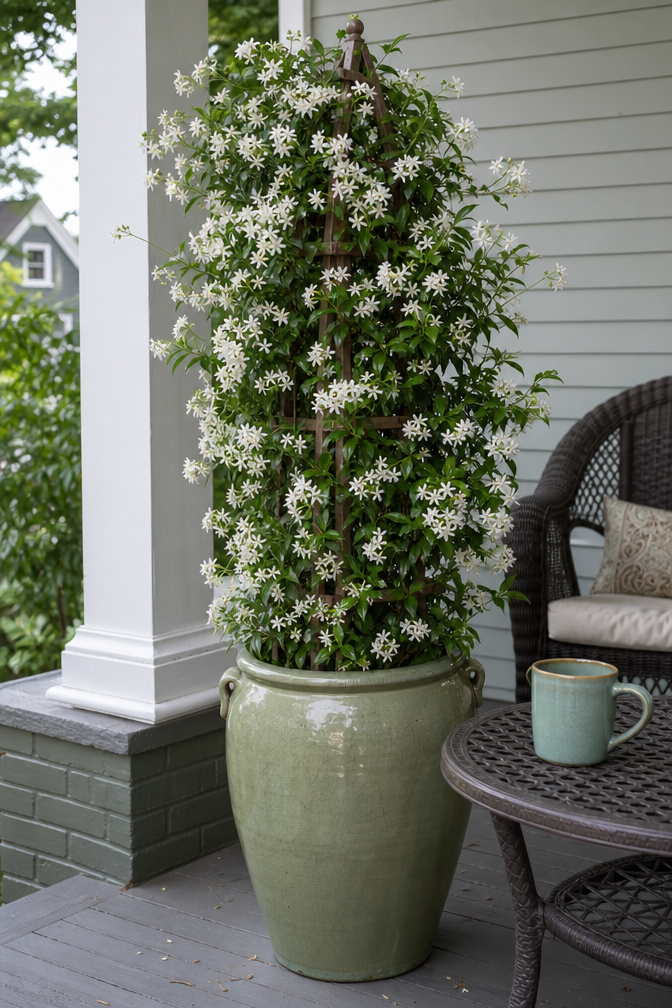
In zones 5-7 (or colder), star jasmine grows beautifully in a large outdoor container that moves indoors for winter.
The setup:
- Container: 18-24 inch diameter, with drainage holes. Glazed ceramic or fiberglass tolerates temperature swings better than plain terracotta.
- Soil: Standard outdoor potting mix amended with 25% perlite or pumice for drainage.
- Support: A 4-foot wooden or iron obelisk planted in the container itself.
- Sun: Place on porch where it gets 4-6 hours of sun.
- Winter move: When nights drop below 30°F, move the container into a cool indoor space, a garage, a sunroom, an unheated basement with a south window. Water sparingly through winter. Move back outside after last frost.
Mature container plants in this setup live for 8-10 years and perfume a porch every spring.
Common Mistakes
- Planting in deep shade. Star jasmine needs at least 4 hours of sun to bloom well. In shade, it grows green and full but produces few flowers.
- Overwatering. Wet feet are the most common cause of star jasmine death in heavy clay soil.
- Pruning right after bloom too aggressively. Next year’s buds form in summer on this year’s growth. Heavy summer pruning kills the next year’s bloom.
- Wrong support. A vine that can’t grip dies on a smooth wall.
- Buying in fall and planting late. Star jasmine needs a full growing season to establish before winter. Plant in spring through early summer for best results.
What I’d Actually Buy
The plant itself comes from a nursery, and a one-gallon pot from a local grower will outrun a mail-order plug. The support is the part worth ordering ahead, because putting it in after the vine is growing means untangling stems that have already twined.
- Black-coated metal trellis, about 70 inches tall (opens Amazon in a new tab) (4.6 stars, 306 reviews). The doorway option. Mount it on standoffs so there is a gap behind it, which is the whole point of iron over lattice.
- Expandable wooden lattice, two panels (opens Amazon in a new tab) (4.4 stars, 446 reviews). Better in a container by the step, and you can widen it as the vine fills in.
Buy the support before the plant. A jasmine that spends its first month reaching for nothing sulks, and you will spend the second month unwinding it.
FAQ
How fast does star jasmine grow?
Slow the first year (1-2 feet), moderate the second (3-4 feet), fast from year three onward (4-6 feet per year). A bare trellis at planting becomes a fully-covered trellis by year three.
Does star jasmine attract bees?
Yes, heavily during bloom. Plant at least 5 feet from heavily-used seating areas if pollinator activity is a concern.
Will star jasmine damage my house?
No, if planted with proper trellis support 4-6 inches off the wall. The plant grips the trellis, not the house. Direct contact with a wood wall over years can trap moisture and damage paint, which is why a stand-off trellis matters.
What to Read Next
- Direct sow flower seeds still worth starting in early summer is the cheapest way to fill the bed at the foot of a new jasmine trellis while the vine is still small.
- Drought tolerant flowers that still bring color suits the same hot, well-drained spot star jasmine wants, once the vine has established.
- Full sun perennials that bloom without asking much is the planting list if the entry gets more than six hours and you want color at ground level.
- Flowers to grow for drying winter arrangements gives the entry something to look at in the months when the jasmine is only green.
- Front yard cottage garden edges that still look tidy from the street is the next job if the vine looks good but the path to the door still does not.