A seven-foot tree can fit a small room. A four-foot tree can make the same room impossible to walk through. Height is not the first number that decides whether a Christmas tree fits. Base diameter is.
Measure from the corner along both walls before shopping. Half the advertised base diameter is roughly how far the tree will project into the room. Mark that distance with painter’s tape, open nearby doors, pull out dining chairs, and walk the route you use every day. Then choose from the seven tree shapes below.
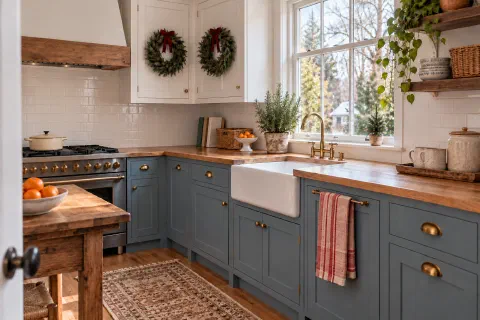
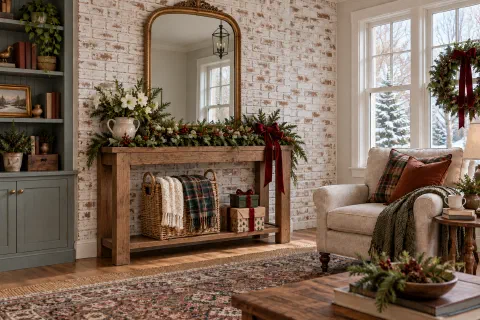
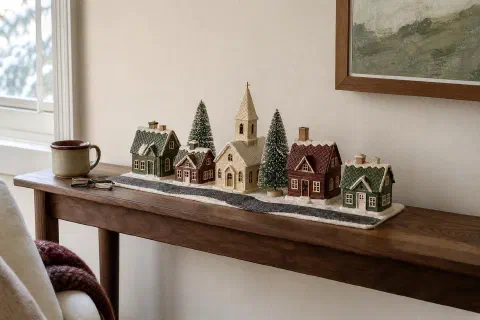
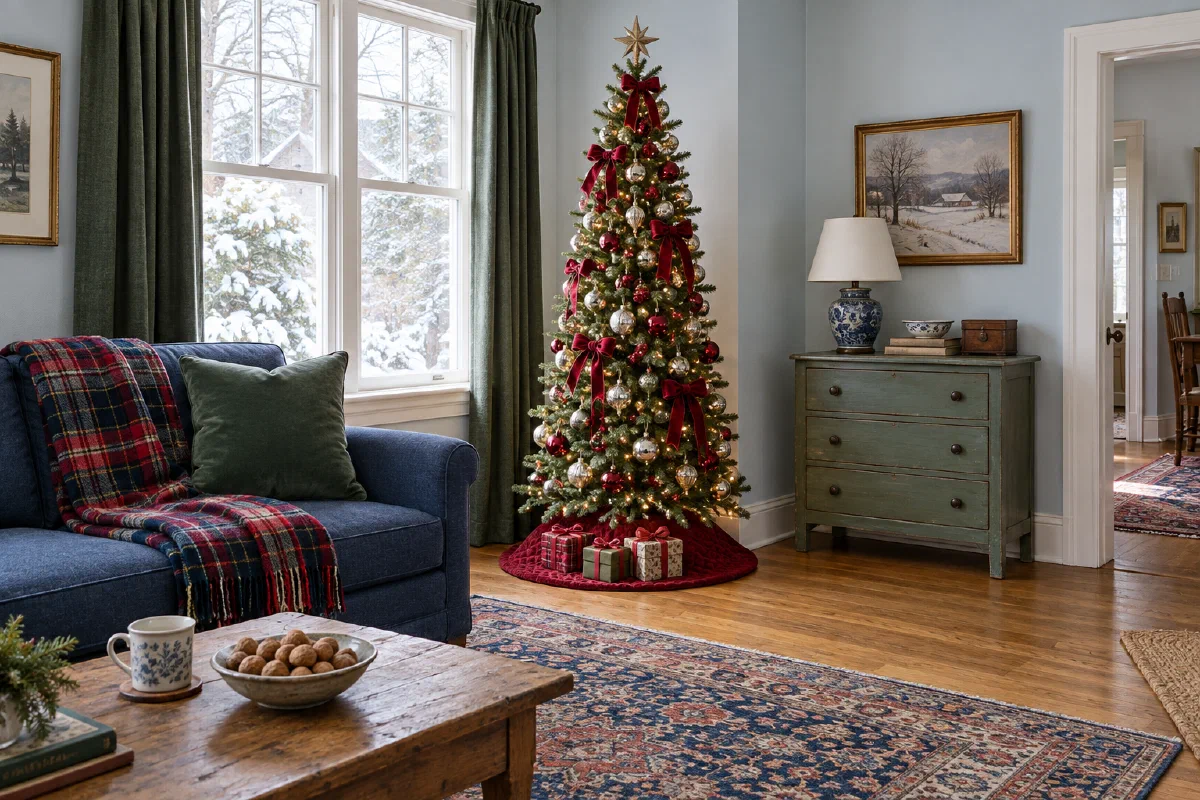
Product details can change; check the listing before you buy. The room photos below illustrate tree sizes and placement, not the exact models sold on Amazon.
Small tree options at a glance
| Tree type | Floor space | Best for | Main tradeoff |
|---|---|---|---|
| Tabletop tree | None beyond existing furniture | Studios and consoles | Needs a stable surface |
| Pencil tree | Small round base | Empty corners | Less room for large ornaments |
| Half tree | Shallow semicircle | Flat wall | One-sided shape |
| Wall tree | Almost none | Very tight rooms | Does not feel like a full tree from the side |
| Potted living tree | Small pot | Plant lovers with outdoor plans | Needs light and careful watering |
| Branch tree | Small weighted vessel | Calm, minimal rooms | Sparse by design |
| Short full tree | Standard round base | Rooms with width but low ceiling | Takes more walking space |
Iowa State University Extension covers living alternatives, including potted conifers and Norfolk Island pine. Whatever shape you choose, the U.S. Fire Administration recommends keeping a tree at least three feet from heat sources and out of exit paths.
1. Measure the corner before choosing a tree

This is the option that prevents the wrong purchase. Measure the corner, radiator, outlet, window treatment, and nearest door swing. A tree should not force anyone to step sideways through the room or reach behind branches to use a switch.
Use this checklist before ordering:
- Can the nearest door open fully?
- Is the tree at least three feet from a fireplace, radiator, or space heater?
- Can you reach the outlet without running a cord across the walkway?
- Will a chair still pull out from the dining table?
- Is there room for a stable stand or weighted basket?
2. Raise a tabletop tree to eye level

A two- to four-foot tree on a console, dresser, or closed cabinet can reach eye level while using furniture already in the room. The Alupssuc 2-foot tree (opens Amazon in a new tab)As an Amazon Associate, we earn from qualifying purchases. Full disclosure. above is the green, prelit tabletop option; its listed width is 11.8 inches. Check the furniture’s stability before adding a tree, lights, and ornaments. Allow room for the cord and keep the tree away from heat.
Keep the tree’s widest branches inside the furniture edge. A branch that reaches beyond a narrow console catches sleeves and bags in an entry or living room.
3. Use a pencil tree in a true corner

Pencil trees are useful when the room has height but little width. The SHareconn 6-foot tree (opens Amazon in a new tab)As an Amazon Associate, we earn from qualifying purchases. Full disclosure. lists a 30.7-inch base; the Hykolity 7.5-foot tree (opens Amazon in a new tab)As an Amazon Associate, we earn from qualifying purchases. Full disclosure. lists a 34-inch base. That extra 3.3 inches matters beside a chair or door. Both take smaller ornaments better than oversized balls, and vertical ribbon helps the narrow shape look deliberate.
Do not hide an unstable stand with a basket and assume the basket fixed it. Weight or brace the stand first, then use the basket as a cover.
4. Put a half tree against a flat wall

A half tree has branches on the front and little or no branch depth at the back. It works where the only available spot is a wall between a sofa and a doorway.
Secure a tall half tree to the wall with the manufacturer’s recommended anti-tip method. The shallow footprint can be easier to tip than a conventional round tree.
5. Make a wall tree when the floor must stay clear

Shape garland, dowels, or lightweight branches into a triangle on the wall. Keep the lowest row above furniture and outside the shoulder line of anyone walking past.
Use attachment hardware rated for the combined weight of greenery, lights, and ornaments. Battery lights avoid a hanging cord when there is no outlet directly below.
6. Choose a living tree only if you can care for it

A small Norfolk Island pine or other container conifer gives a room a real living plant, but it is not disposable decor. It needs species-appropriate light, drainage, water, and indoor temperatures.
The ASPCA lists the Australian pine, commonly sold as Norfolk Island pine, as non-toxic to cats, dogs, and horses. Check the exact species on the plant label rather than assuming every holiday conifer has the same pet-safety status.
7. Build a branch tree in a weighted vessel

Use one strong branch or a small group of branches in a heavy, wide vessel. Add a short warm-light strand and lightweight ornaments. This works especially well in a narrow dining area where a full tree would compete with pulled-out chairs.
Weight the vessel with clean gravel below the visible filler, and keep glass ornaments off any branch that can sway when someone walks past.
A simple setup order for a small room
- Tape the footprint and walk around it for a day.
- Choose the tree shape that protects the path.
- Stabilize the stand, pot, or vessel.
- Place lights before ornaments.
- Decorate the side you actually see instead of forcing equal coverage.
- Store the box where January takedown will not become a second project.
Small-space decorating gets easier when the tree is chosen for the room you have, not the height printed on the box.
Which of the three trees fits your room?
| Best for | Tree | Listed size | What to check first | Exact product |
|---|---|---|---|---|
| A tabletop or dresser | Alupssuc prelit mini tree | 2 ft tall; 11.8 in wide | Stable furniture, cord route, and branch clearance | View Alupssuc on AmazonAs an Amazon Associate, we earn from qualifying purchases. Full disclosure. |
| A smaller floor corner | SHareconn prelit pencil tree | 6 ft tall; 30.7 in wide | Tape a roughly 31-inch circle and test the walkway | View SHareconn on AmazonAs an Amazon Associate, we earn from qualifying purchases. Full disclosure. |
| A tall room with more corner width | Hykolity prelit pencil tree | 7.5 ft tall; 34 in wide | Ceiling and topper clearance, plus the wider base | View Hykolity on AmazonAs an Amazon Associate, we earn from qualifying purchases. Full disclosure. |
I would start with the Alupssuc if the floor has no spare corner. For a full-height tree in a small living room, the SHareconn gives up less floor width than the Hykolity. I would choose the Hykolity only where the ceiling and corner can take its extra height and width. These are comparisons of listed dimensions and owner feedback, not trees we have tested in person.
Related Christmas guides for a small home
- Renter friendly Christmas decor with no nails covers lease, fire-safety, and attachment questions.
- A small-home Christmas decor storage plan makes the January pack-up easier before you buy more.
- Christmas front door decor for the door you have adds a festive first view without using living-room floor space.
- Eight Christmas centerpieces for tables you use keeps the dining surface practical in another tight spot.