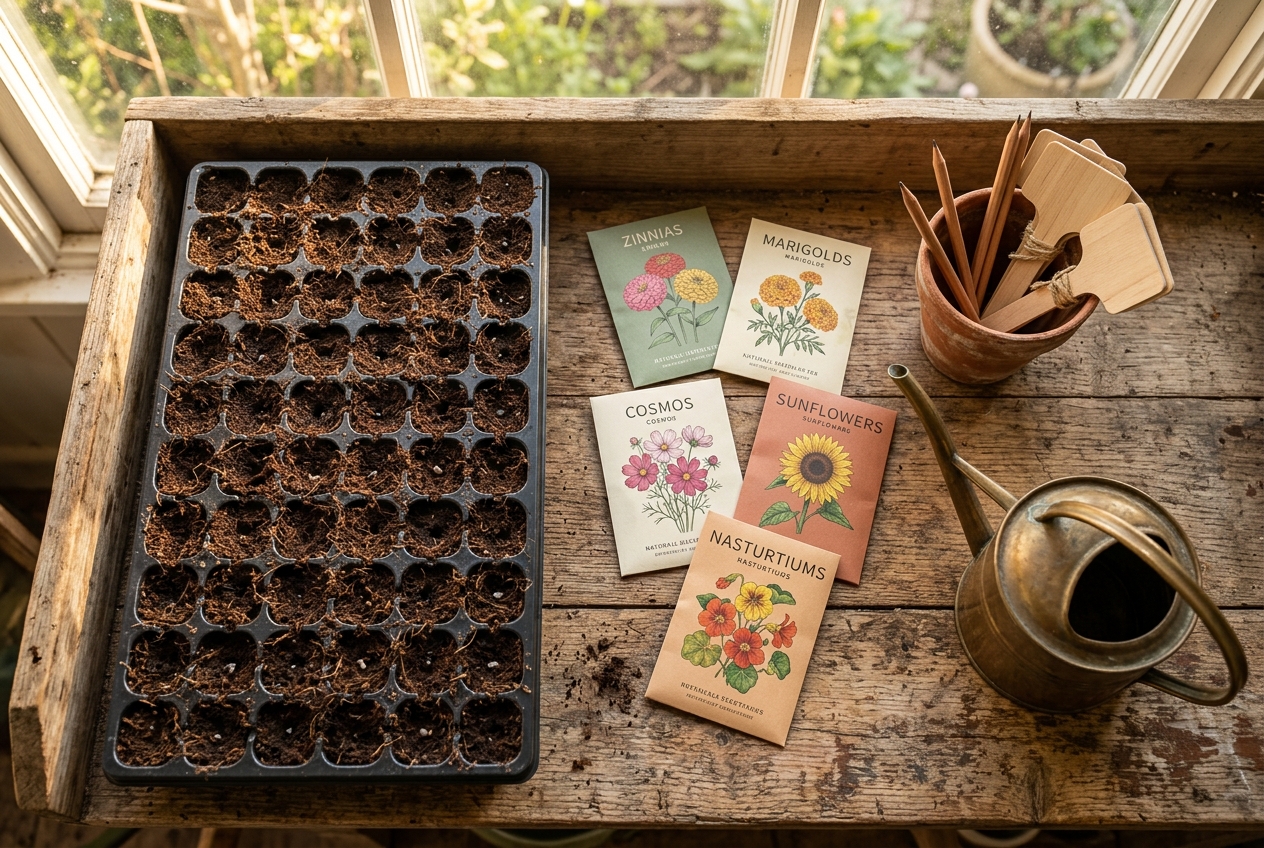
Start these five flowers indoors 4-6 weeks before your last frost date: zinnias, marigolds, cosmos, sunflowers, and nasturtiums. They germinate in 5-10 days, tolerate beginner mistakes, and transplant easily. Total supply cost runs $25-30 for seed trays, soil mix, and a basic grow light.
What You Need
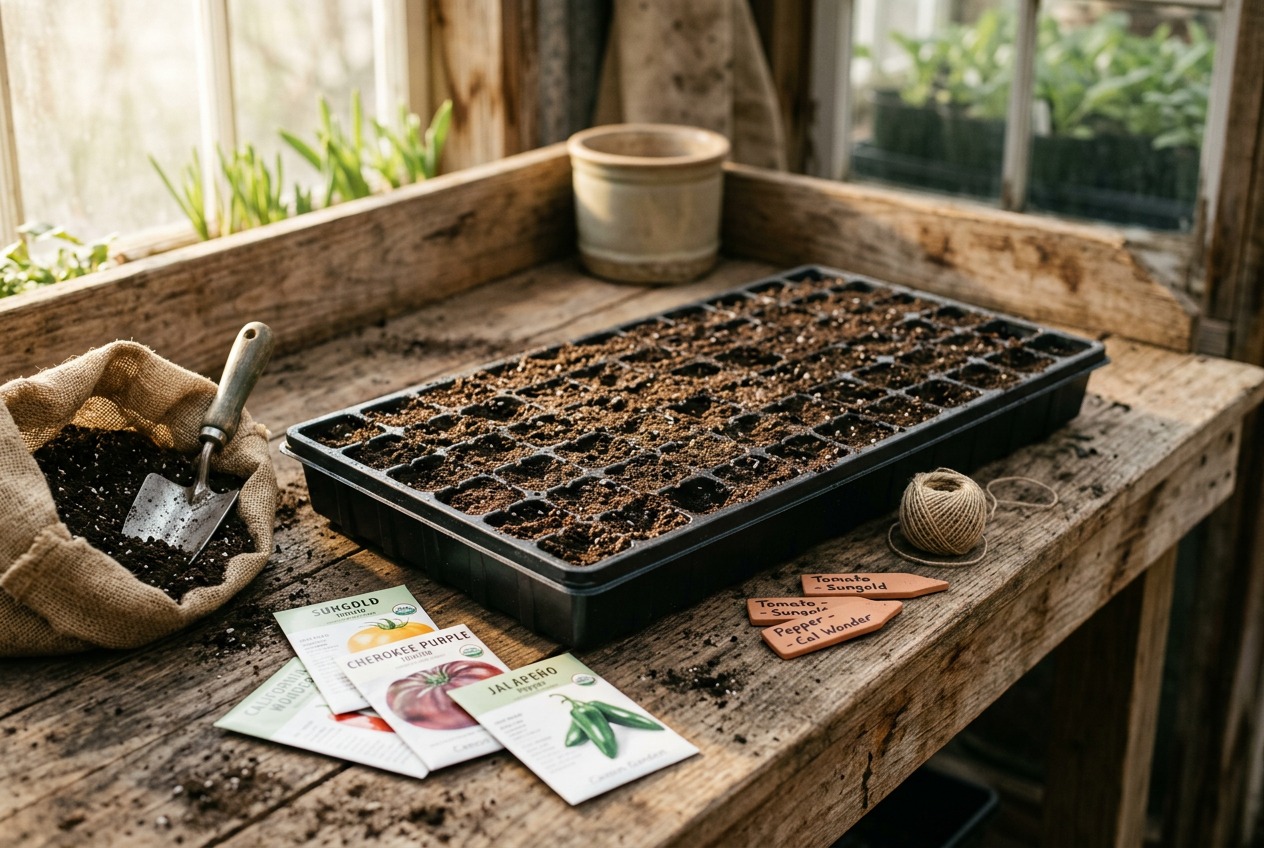
Basic seed starting supplies cost less than buying flats at the garden center. Here’s what works.
| Item | Cost | Notes |
|---|---|---|
| Seed starting mix (8 qt bag) | $6-8 | Sterile blend, not garden soil |
| 72-cell seed tray with dome | $8-12 | Reusable for 3-4 seasons |
| LED grow light (2ft) | $15-20 | 6500K spectrum, hang 3-4" above seedlings |
| Seed packets (5 varieties) | $10-15 | $2-3 per packet, 25-50 seeds each |
| Spray bottle | $3-5 | For gentle watering |
You also need a south-facing window or that grow light. Seedlings stretch and flop without 12-14 hours of strong light daily.
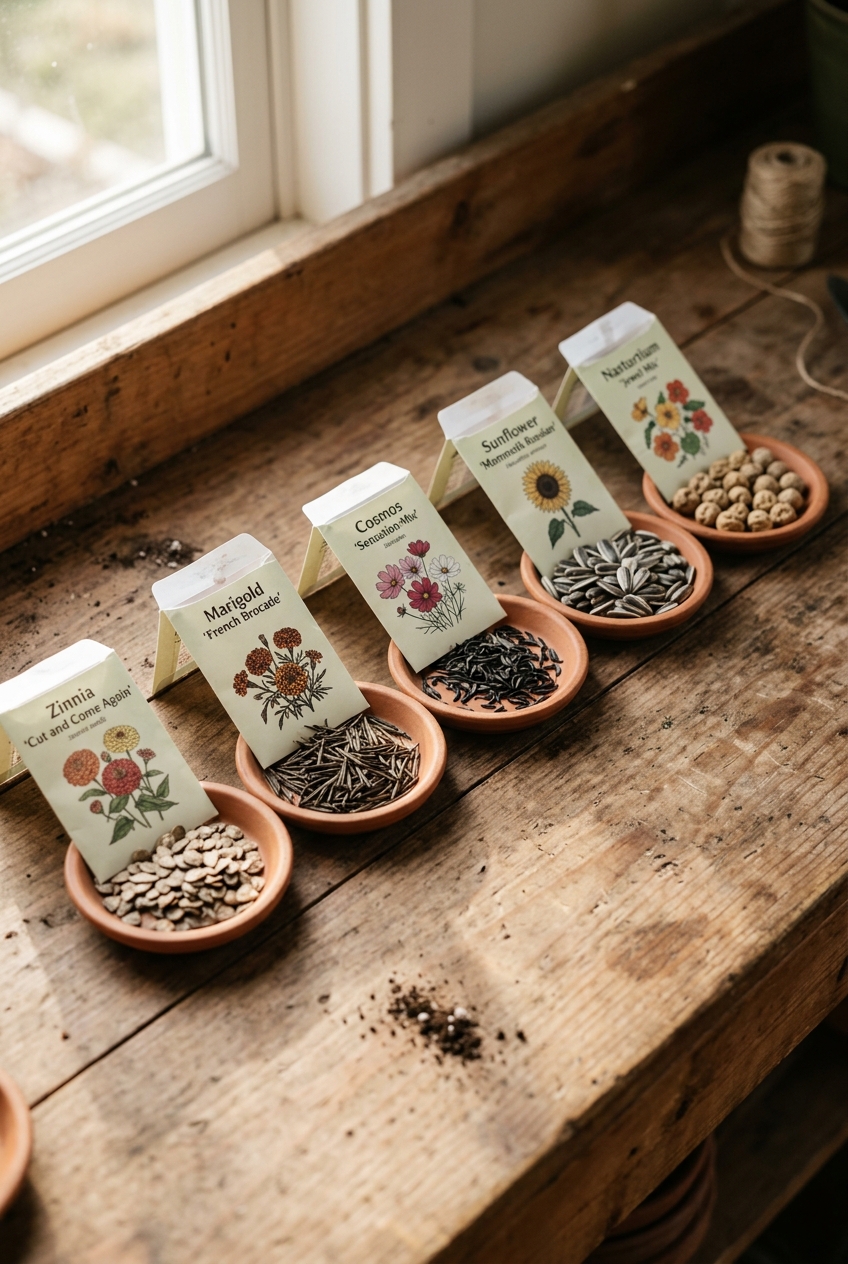
The Five Easiest Flowers
These germinate fast and forgive watering mistakes. All grow in USDA zones 3-9 as annuals.
Zinnias (Zinnia elegans) Germinate in 5-7 days at 70-75°F. Start 4-6 weeks before last frost. Direct sow works too, but indoor starts bloom 3 weeks earlier. Space seedlings 2" apart in trays. Transplant when 3-4" tall.
Marigolds (Tagetes patula) Pop up in 5-7 days. French marigolds handle transplanting better than African types. Start 6 weeks before last frost. They smell strong when you brush them, but that scent deters aphids in the garden later.
Cosmos (Cosmos bipinnatus) Germinate in 7-10 days. Barely cover seeds with soil mix. They need light to sprout. Start 4-5 weeks before last frost. Cosmos transplant easily even when 6" tall, so timing is flexible.
Sunflowers (Helianthus annuus) Sprout in 5-7 days. Use dwarf varieties like ‘Teddy Bear’ or ‘Sunny Smile’ for containers. Start 3-4 weeks before last frost. Sunflowers hate root disturbance, so use individual 3" pots instead of cell trays.
Nasturtiums (Tropaeolum majus) Germinate in 7-10 days. Soak seeds overnight before planting. They speed up by 2-3 days. Start 4-6 weeks before last frost. Nasturtium leaves are edible, peppery, good in salads.
Quick Tip: Label trays immediately with variety name and sowing date. Seedlings look identical for the first week. Use a permanent marker on popsicle sticks.
How to Do It
Fill cells to 1/4" from the top with moistened seed starting mix. The mix should clump when squeezed but not drip.
Step 1: Sow seeds Plant 2 seeds per cell at the depth listed on the packet. Most of these flowers need 1/4" depth. Cosmos barely gets covered. Pat soil gently. Don’t compress it.
Step 2: Water and cover Mist with spray bottle until surface is uniformly dark. Place humidity dome on tray. Set in a warm spot (70-75°F). Bottom of refrigerator or top of water heater works.
Step 3: Check daily Germination happens fast. Remove dome as soon as you see green. Usually 5-7 days for zinnias and marigolds, 7-10 for the others.
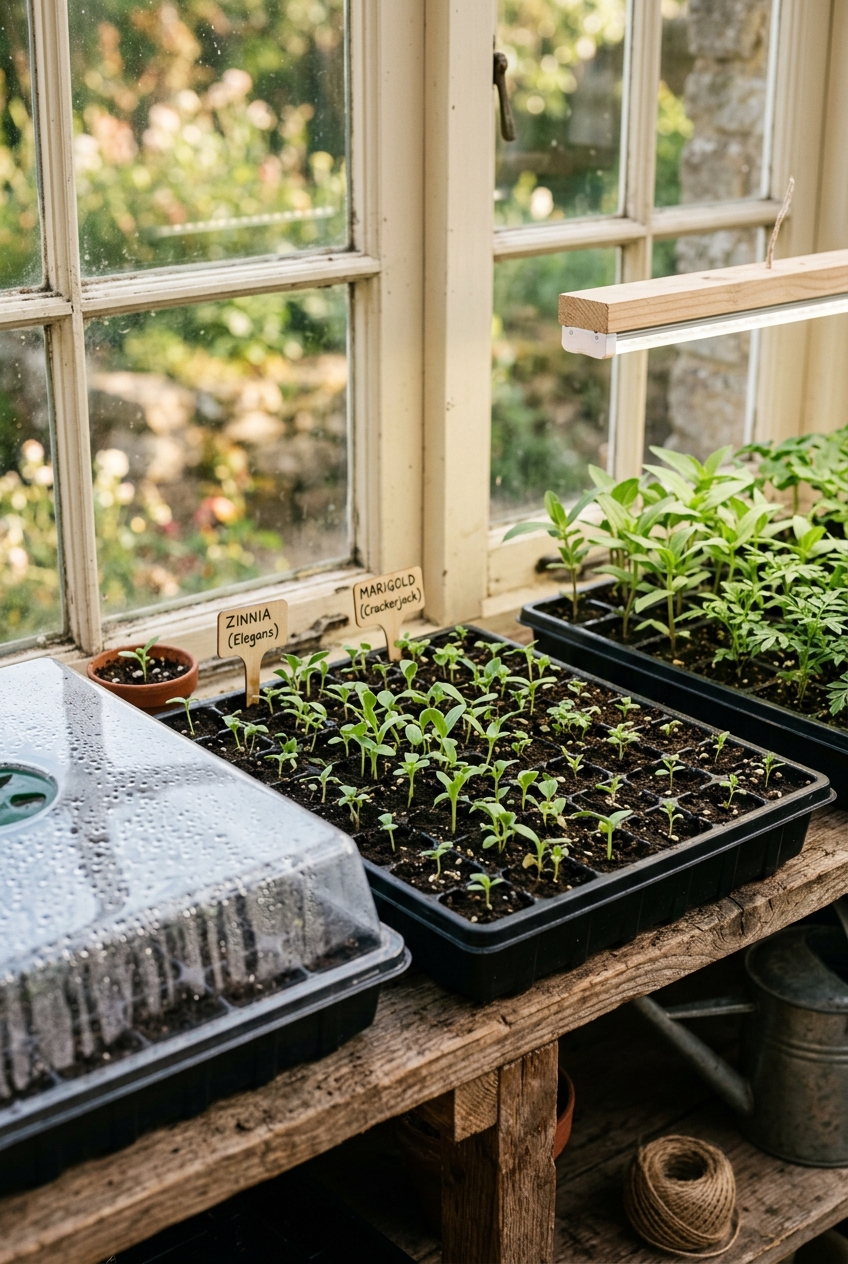
Step 4: Add light Move tray under grow light or to sunny window immediately after germination. Keep light 3-4" above seedlings. Raise it as they grow. Run light 12-14 hours daily.
Step 5: Water from below Pour water into the tray base, not on seedlings. They drink from the bottom. Soil surface should dry slightly between waterings. Overwatering causes damping off (seedling stems rot at soil line).
Step 6: Thin seedlings When seedlings have 2 sets of true leaves (the second set that appears), snip the weaker one at soil level with scissors. Leave the strongest seedling per cell.
Timing by Zone
Last frost dates vary by 6-8 weeks across the country. Here’s when to start seeds indoors.
| USDA Zone | Last Frost Date | Start Seeds Indoors |
|---|---|---|
| 3-4 | May 15-31 | April 1-15 |
| 5-6 | April 15-30 | March 1-15 |
| 7-8 | March 15-April 15 | February 1-March 1 |
| 9-10 | February 1-28 | January 1-15 |
Find your exact last frost date at your county extension office website. It’s more accurate than zone maps.
From my experience: I started zinnias March 10 in zone 6b three years running. Transplanted May 1. They bloomed by June 15 every time. The year I direct sowed on May 1, blooms didn’t start until July 10. Indoor starting gets you 3-4 weeks of extra flowers.
Hardening Off
Seedlings grown indoors are soft. Direct sun and wind damage them. Hardening off toughens them up over 7-10 days before transplanting.
Day 1-2: Set trays outside in full shade for 2 hours. Day 3-4: Move to dappled shade for 3-4 hours. Day 5-6: Morning sun (before 10am) for 2 hours, then shade. Day 7-8: Morning sun for 4 hours. Day 9-10: Full sun all day.
Bring trays in if temperature drops below 45°F at night. These are all frost-tender annuals.
What to Watch For
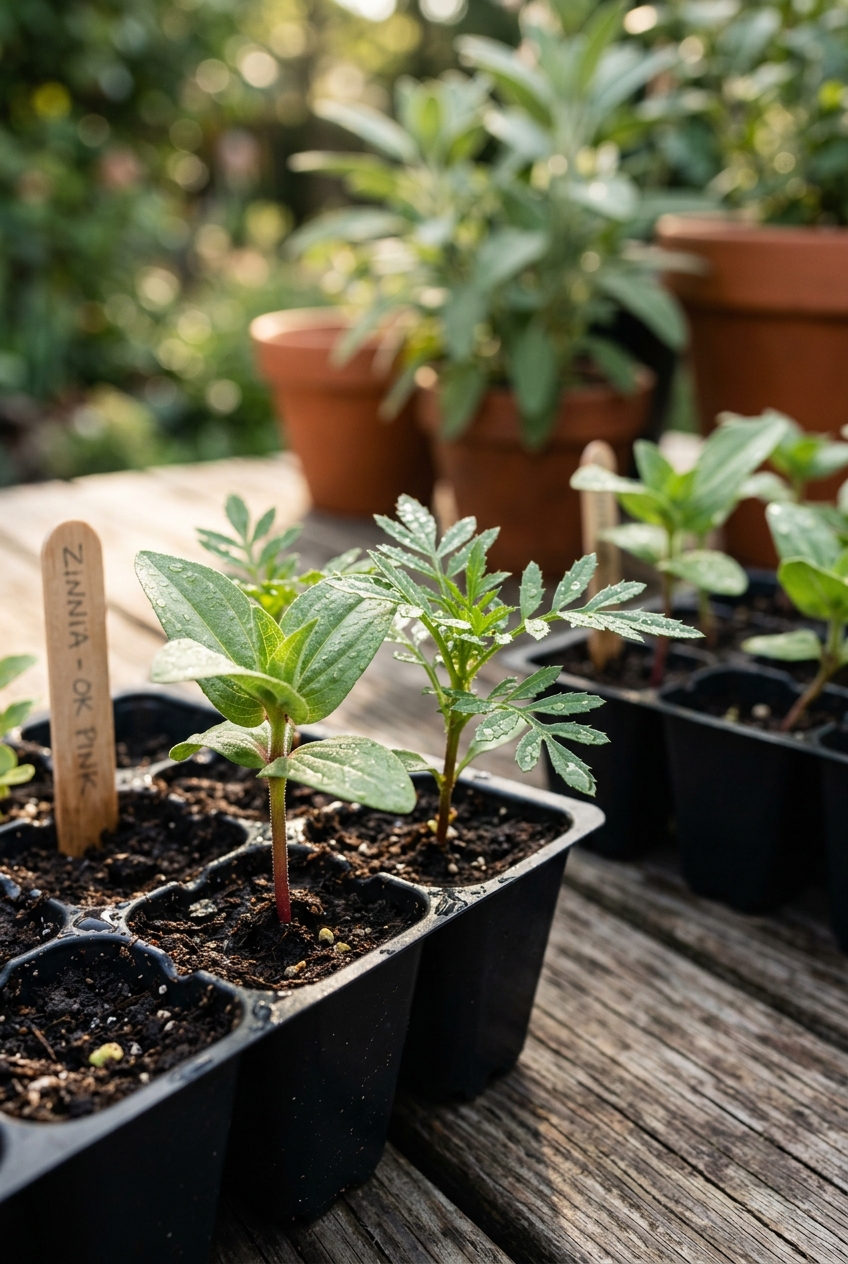
Leggy seedlings: Stems stretch thin and flop over. Caused by insufficient light or keeping seedlings too warm. Lower temperature to 65-68°F after germination. Move light closer (2-3" above leaves).
Damping off: Seedlings collapse at soil line overnight. Fungal disease from overwatering or non-sterile soil. No cure once it starts. Remove affected seedlings immediately. Increase air circulation. Water less frequently.
Yellow leaves: Lower leaves turn pale yellow. Usually nitrogen deficiency after 3-4 weeks in seed starting mix (which has minimal nutrients). Feed with half-strength liquid fertilizer (5-5-5 ratio) weekly after first true leaves appear.
Make It Your Own
These five flowers work in containers or garden beds. Scale your seed starting to your space.
For containers: Start 12-18 cells per variety. That fills three 12" pots or two window boxes. Dwarf zinnias (‘Thumbelina’), compact marigolds (‘Bonanza’), and bush nasturtiums stay under 12" tall.
For cutting gardens: Start 36-48 cells per variety. Tall zinnias (‘Benary’s Giant’), large-flowered cosmos (‘Sensation Mix’), and branching sunflowers (‘ProCut’) produce more stems per plant.
For zone 8-10: Start cool-season flowers like snapdragons, stock, and larkspur in January for spring bloom. These five warm-season flowers go in the ground March-April in hot climates, then bolt by July. Replace with heat-lovers like celosia and gomphrena.
For zone 3-4: Add 1-2 weeks to indoor growing time. Seedlings can get larger before transplant since last frost is late May. Use 4" pots instead of cell trays if starting before April 1.
Before You Start
Budget 8-10 weeks total time from sowing to blooming plants. That’s 4-6 weeks indoors, 1-2 weeks hardening off, then 2-3 weeks after transplanting for first flowers.
Check your last frost date before buying seeds. Starting too early creates leggy, root-bound seedlings that struggle after transplant. Starting too late means buying plants at the nursery would’ve been faster.
Seed starting mix is not potting soil. Garden soil, potting soil, and seed starting mix are different products. Seed starting mix is sterile, fine-textured, and drains fast. Potting soil is too heavy and holds too much water for germination. Garden soil carries diseases that kill seedlings.
FAQ
How long do seed packets stay viable?
Zinnias, marigolds, and cosmos stay viable 3-4 years if stored cool and dry. Sunflowers and nasturtiums drop to 50% germination after 2 years. Store opened packets in a jar with silica gel packets in a cool closet. Germination rate drops 10-20% per year after the packed date.
Can I use regular potting soil instead of seed starting mix?
No. Potting soil stays too wet and compacts in small cells. Seedlings rot or grow slowly. Seed starting mix is sterile (prevents damping off), drains fast, and has a fine texture that new roots penetrate easily. An 8-quart bag costs $6-8 and starts 200+ seedlings.
What if I don’t have a grow light?
A south-facing window works if you rotate trays 180 degrees daily so seedlings don’t lean. They still stretch more than under a light. Expect stems 30-40% taller and thinner. Harden off carefully since window-grown seedlings are more fragile. A basic 2-foot LED grow light costs $15-20 and eliminates stretching completely.