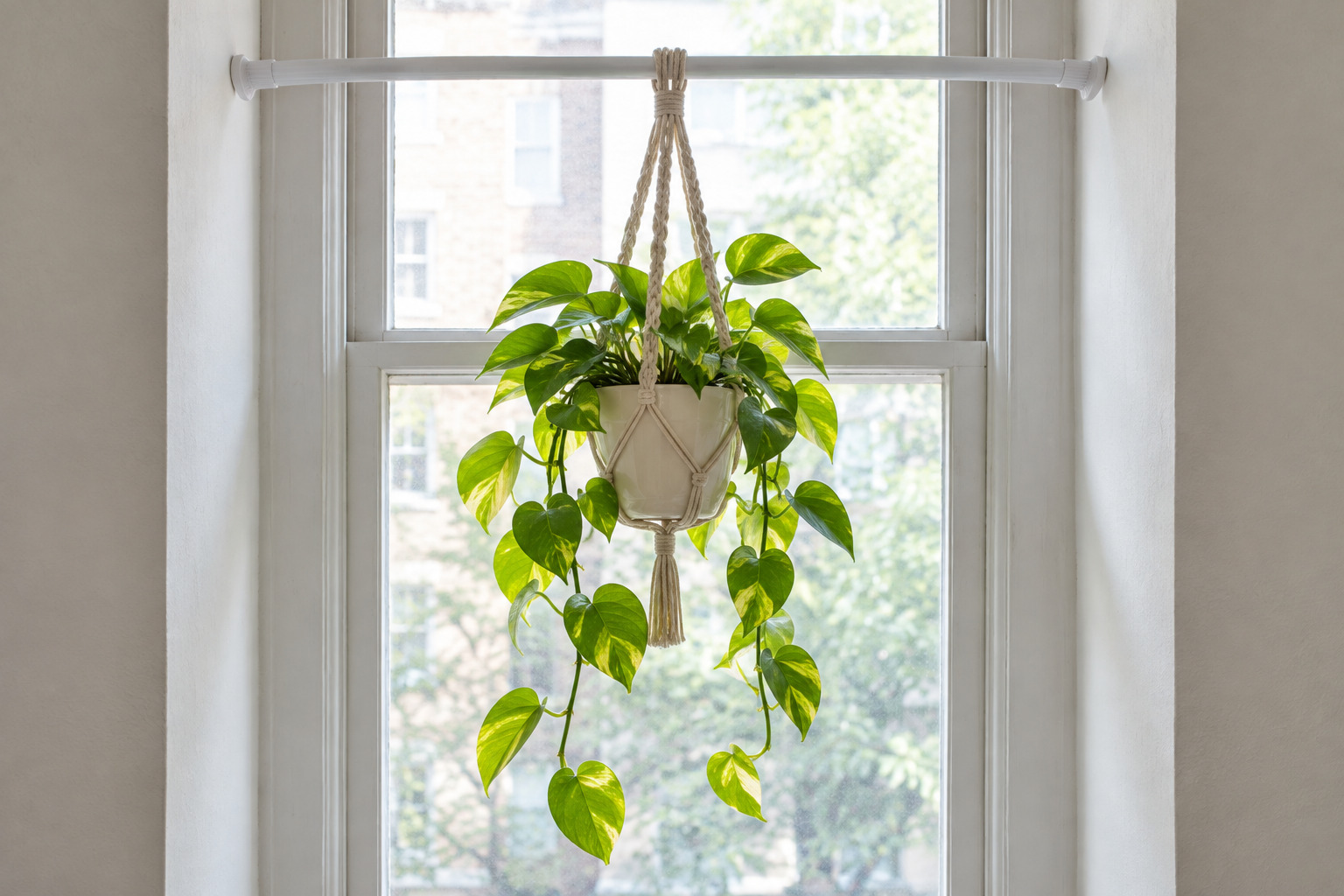
The problem with hanging plants in a rental is never the plant. It is the hardware, and the deposit.
A tension rod plant hanger is the option most renters have not considered. The rod grips the two side walls of a window recess by pushing outward, and the plant hangs from the rod.
Fast answer: hang plants without drilling using a tension rod plant hanger in a window recess, an over-the-door hook, a wall shelf on removable adhesive strips, a freestanding plant stand, or the top of a bookcase. Ranked by weight, a stand or a shelf top takes the most because nothing is stuck to anything, a tension rod and an over-the-door hook take a light to moderate load set by their own rating, and adhesive takes the least. Ranked by reversibility, the stand is first and adhesive is last, because adhesive can still lift paint. A wet pot weighs far more than a dry one, so check the stated limit on the package.
Options, Compared by Weight and Reversibility
| Method | What it needs | Weight it takes | Wall damage | What it will not hold |
|---|---|---|---|---|
| Tension rod plant hanger | A window recess with two flat, parallel sides, plus a rod rated above the wet pot | Light to moderate, less as you extend it | None, though it can mark a painted surface under pressure | Anything heavy, or a textured surface |
| Over-the-door hook | A door that closes with room above it, and a bracket that clears your door’s thickness | Light to moderate, set by the hook’s rating | None | A door too thick for the bracket |
| Ceiling hook, where a lease allows picture hooks | A drill, an anchor, and spackle at move-out | The heaviest of the hanging methods, set by the anchor | Two holes to patch and paint | A plaster ceiling that crumbles |
| Wall shelf on removable adhesive strips | A smooth, clean, painted surface plus the strips’ stated limit | Small pots only | None on a clean release, paint damage if it fails | Anything above the strips’ rating |
| Freestanding or leaning plant stand | Floor space and a level spot | The most of anything here, set by the stand | None | Nothing, if the heaviest pot stays low |
| Curtain-rod retrofit | The existing bracket and a rod that can take the load | Whatever the bracket was installed to hold | None | A plant heavier than the bracket, and never a spring-tension rod inside a window |
| Bookshelf or cabinet top | A sturdy top and a cachepot | As much as the shelf holds | None | Nothing, though vines will reach what sits below |
Two of these need a sentence more than a table cell. A curtain rod is often already screwed into the wall, which is why it tempts people, but the bracket was installed for fabric, and fabric is light. If you use it, hang the plant near a bracket rather than from the middle of a long span that flexes.
A bookshelf top is not hanging at all, and it is the honest answer for a lot of renters. Put the pot up top in a cachepot and let the vines fall past the shelf edge.
Weight and Removable Adhesive Strips: Work Out Your Own Number
Potting mix is mostly pore space. Dry, those pores hold air. Watered, they hold water, and water is heavy. That is why a hook that held the plant on install day can let go a month later.
The estimate for a 6-inch pot, the size most small trailing plants come in:
- A stock 6-inch nursery pot is about 6 inches across at the rim and 6 inches deep.
- Treated as a tapered cylinder, that holds a little over 150 cubic inches of medium, roughly 2.5 dry quarts. A straight cylinder of the same height would hold about 170, so 150 to 170 is a fair band.
- Water is about 62.4 pounds per cubic foot, or 0.036 pounds per cubic inch. If every pore filled with water, the water alone would weigh 5 to 6 pounds, and the medium and the pot sit on top of that.
- So a 6-inch pot of damp soil, before the hanger, lands in the 5 to 9 pound range. A glazed ceramic or concrete container adds several pounds more than the plastic nursery pot it replaces.
That is an estimate, not a specification. Pot shape, medium, and container material all move it.
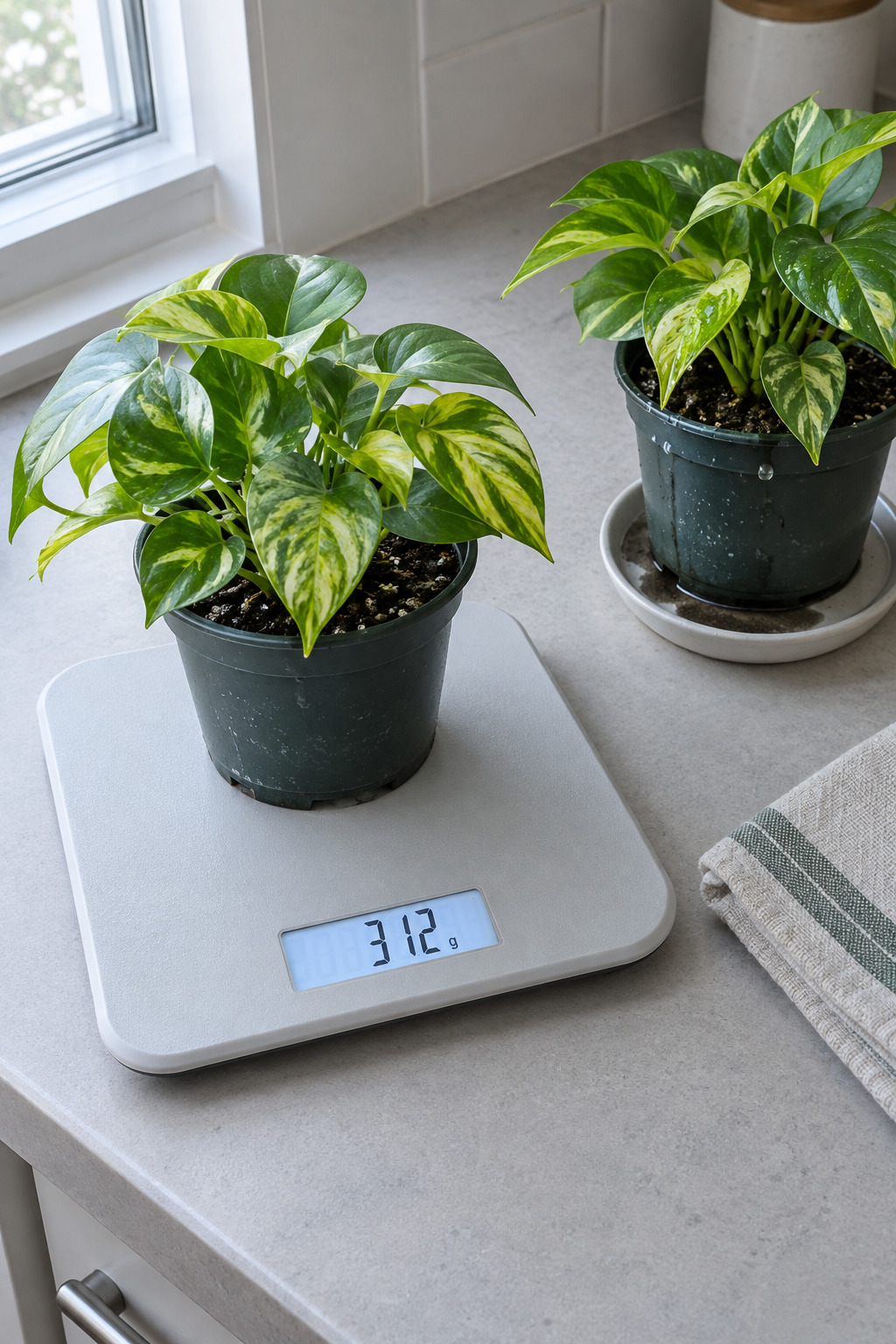
Do this instead of trusting any number, mine included. Weigh the planted pot dry. Water it until it drains, let it stop dripping, and weigh it again. That second number is the load your hardware has to hold. Check the package before you buy, because a hook sold for a “light plant” is describing a dry one. Find the stated weight limit and the surface it requires, and treat the rating as the ceiling for a perfect installation.
Getting a Tension Rod Plant Hanger to Stay Up
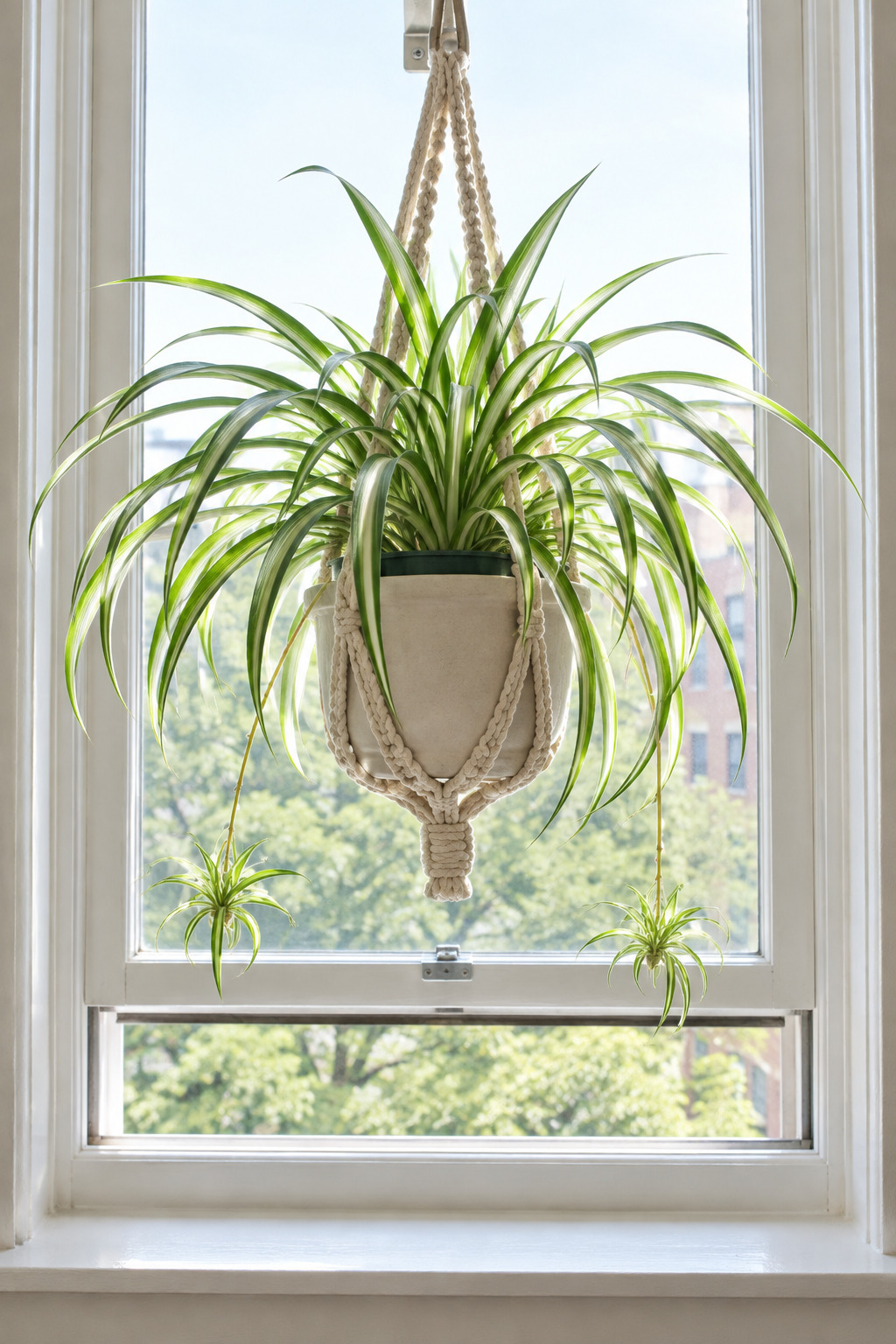
A tension rod holds by pushing outward against two surfaces, and that one fact explains every way it fails.
- Use the shortest extension that reaches. A rod extended near its maximum has less spring left to push with.
- Clean both surfaces and let them dry. Dust, grease, and cleaning spray are what let the ends creep.
- Tighten until the ends are firm to a push. If the rod slides when you press it, it will slide under a wet pot.
- Hang the plant near one end, not the middle, where a long span bows.
- Keep it clear of a door or a window you open. Bumping is cumulative.
- Skip it on a textured or soft surface. The ends need full contact.
Ceilings and Walls That Are Off Limits
Some surfaces rule a method out before weight enters the conversation.
- Popcorn ceilings. Adhesive never gets full contact on that texture, and a hook cannot sit flush.
- Textured walls of any kind. Adhesive touches the peaks and none of the valleys.
- Painted-over wallpaper. The worst case, because the strip can take the paint and the paper underneath in one sheet.
- Plaster. Old plaster fails unpredictably. Sometimes it holds, sometimes the skim coat comes away with the adhesive.
- Drop ceilings. A suspended ceiling tile is not structure, and it is rated to hold nothing but itself.
Then the part the packages do not say plainly. Removable adhesive can still pull paint. “Removable” describes the hook, not your drywall. On a smooth, clean, fully cured painted surface, a strip rated for a small pot may hold a 6-inch pot of damp soil, if you check the rating. On an uncertain surface, assume it will not.
The honest renter move, when the surface is uncertain or the deposit matters more than the look, is a freestanding solution. A narrow corner plant stand or a pot on top of a bookcase gives you the height and the trailing vines with no bond to fail.
The Watering Problem Nobody Mentions
A hanging plant drips. Four ways to handle it, easiest first:
- Water it in the sink or the tub. Take the pot down in its nursery pot, water until it drains, let it sit a few minutes, then hang it back. Fewest problems, most missed waterings.
- Put a cachepot inside the hanger. Water into the cachepot, then pour off what collects in the bottom after ten minutes. You lift nothing, and water left standing in the cachepot turns the root zone into a swamp.
- Drain in place over a tray. Works on a stand or a shelf top with a saucer under the pot, not on a hanger, where there is nothing for a saucer to sit on.
- Lift the pot out and set it on a saucer at height. Keeps the pot where it is and still gives the water somewhere to go.
What a drip does. On a sealed wood floor, standing water gets under the finish at the seams and leaves a dark ring or a raised edge, and a slow drip in one spot for months is worse than one spill. On a windowsill, water sits against the paint and the caulk line, and the mineral residue dries into a chalky ring that does not wipe away. On rental carpet, a drip that dries is a stain you get asked about.
Two placement rules come out of that. Keep the hanger away from outlets and power strips. If you water in place, put a waterproof mat on the floor directly below the pot, where the drip lands.
Care: Pothos, Spider Plant, and Other Trailing Plants
Trailing habit and low light tolerance rarely come in the same plant, which is the part the photographs hide.
| Plant | Why it hangs well | Light it wants | Cats and dogs |
|---|---|---|---|
| Golden pothos (Epipremnum aureum) | Long cascading vines, roots easily in water | Bright indirect light, survives long spells in low light | Toxic, calcium oxalates |
| Heartleaf philodendron (Philodendron hederaceum) | Glossy heart-shaped leaves on cascading stems | Medium light, tolerates very low light | Toxic, calcium oxalate crystals |
| Spider plant (Chlorophytum comosum) | Arching striped leaves with plantlets on runners | Medium light, tolerates deep shade, not direct sun | Safe, non-toxic to cats and dogs |
| English ivy (Hedera helix) | Dense growth that fills a hanger fast | Bright indirect light | Toxic, triterpenoid saponins |
| Bird’s nest fern (Asplenium nidus) | An upright rosette, so it suits a shelf top | Low to medium light with humidity | Unverified |
Toxic is the ASPCA’s finding for that exact species. Safe means the ASPCA lists it as non-toxic. Unverified means the plant is not in the ASPCA database at all, which is a gap in the list rather than a clean result. The bird’s nest fern is absent from it, and so is the ZZ plant.
Which leaves the awkward part. The two plants that hang best in a dim rental, pothos and heartleaf philodendron, are both toxic to cats and dogs. The one confirmed non-toxic here, spider plant, wants more light than a dark hallway corner offers. If your spot is dim, a green-leaved pothos keeps its color better than a variegated one, and NC State Extension notes spider plant does particularly well in a hanging basket. If a cat can reach the vines, check the animal first and the aesthetic second.
How High to Hang It
If the arithmetic already says the pot is too heavy to hang, the narrow plant stand comparison gets you the same height with nothing bonded to the building.
A plant you cannot reach without a stepladder is a plant you will not water. That is a reach limit, not a character flaw, and it causes most of the dead hanging plants I have seen in apartments. Set the height from your own body, not from the ceiling.
- Stand where you will water from and raise your arm as high as is comfortable, not stretched. Measure floor to fingertips.
- Subtract the distance from the top of the hanger to the bottom of the pot, plus an inch or two.
- That is your maximum height for a pot you plan to lift down. In a standard 8 foot apartment it works out near 6 feet to the hanger, putting the pot at chest height and the vines at eye level.
- Want it higher? Use a cachepot and a long-spout can, and accept that you are lifting a full can above your head.
Questions People Actually Ask
Can a tension rod hold hanging plants?
Yes, for a light plant, on two flat and parallel surfaces, with a rod rated above the wet pot’s weight. The load it takes falls as you extend the rod further, so a short rod over a small recess holds better than a long one.
How much weight can you hang on a tension rod, or from a plant hanger?
There is no single number, and anyone who gives you one without naming the product is guessing. Each rod, hook, and anchor is rated by its manufacturer for a specific surface and installation. Read the package rating, then compare it against the wet weight of your pot on a scale.
Are adhesive hooks strong enough for plants?
For a small pot, sometimes. For a 6-inch pot of damp soil, often not, and the failure is slow rather than sudden, which is what makes it dangerous to a floor and a deposit. Adhesive also needs a smooth, clean, fully cured painted surface. On textured walls, painted-over wallpaper, and plaster, it can bring the surface with it.
What can I use instead of a ceiling hook?
A tension rod across a window recess, an over-the-door hook, a wall shelf on removable strips, a freestanding plant stand, a curtain rod bracket installed to hold real weight, or the top of a bookcase. The stand and the shelf top hold the most, because nothing is bonded to the building.
How do I hang plants in a rental apartment without losing the deposit?
A hanging pot also changes how you water, because you cannot see a saucer and you cannot feel the weight of a pot up in the air. The bottom watering method solves both at once.
Choose the method that leaves no trace and prove it to yourself before the plant goes up. A tension rod comes out in seconds. An over-the-door hook lifts off. Freestanding furniture leaves nothing at all. Anything adhesive is a judgment call about your specific wall.
Sources
- ASPCA: Toxic and Non-Toxic Plants : the pet-safety column, including the bird’s nest fern gap.
- NC State Extension Gardener Plant Toolbox: Epipremnum aureum : pothos light range, hanging habit, and variegation loss.
- NC State Extension Gardener Plant Toolbox: Chlorophytum comosum : spider plant light range and hanging baskets.
- NC State Extension Gardener Plant Toolbox: Philodendron hederaceum : heartleaf philodendron low-light tolerance.
- Illinois Extension: Small-space containers big with new gardeners : published container volumes, used to check the weight estimate.
- University of Missouri Extension: Lighting indoor houseplants : the low-light range behind the light column.
What to Read Next
- Low light indoor plants that survive a dark room : check the light in the corner before you hang a plant there.
- Narrow plant stands for apartment corners : the freestanding option that needs no hardware.
- Indoor house plants without the clutter : keep a vertical plant collection from taking over the room.
- How to style tall indoor plants in a living room : balance a hanging plant against the floor plants around it.
- What size planter a tall indoor plant needs : the pot weight question from the other direction.