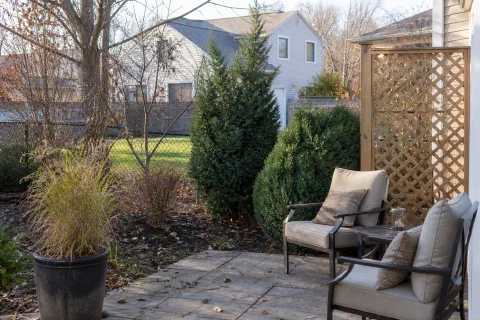
Privacy vines for a fence need a support they can climb and a growing season that suits the plant. Annual climbers can add seasonal cover; perennial vines need time to establish. No vine guarantees a solid screen in its first summer. If you need privacy immediately or through winter, plan a suitable structure as well as planting.
Privacy Vines for a Fence: 9 Plants to Compare
Last updated:
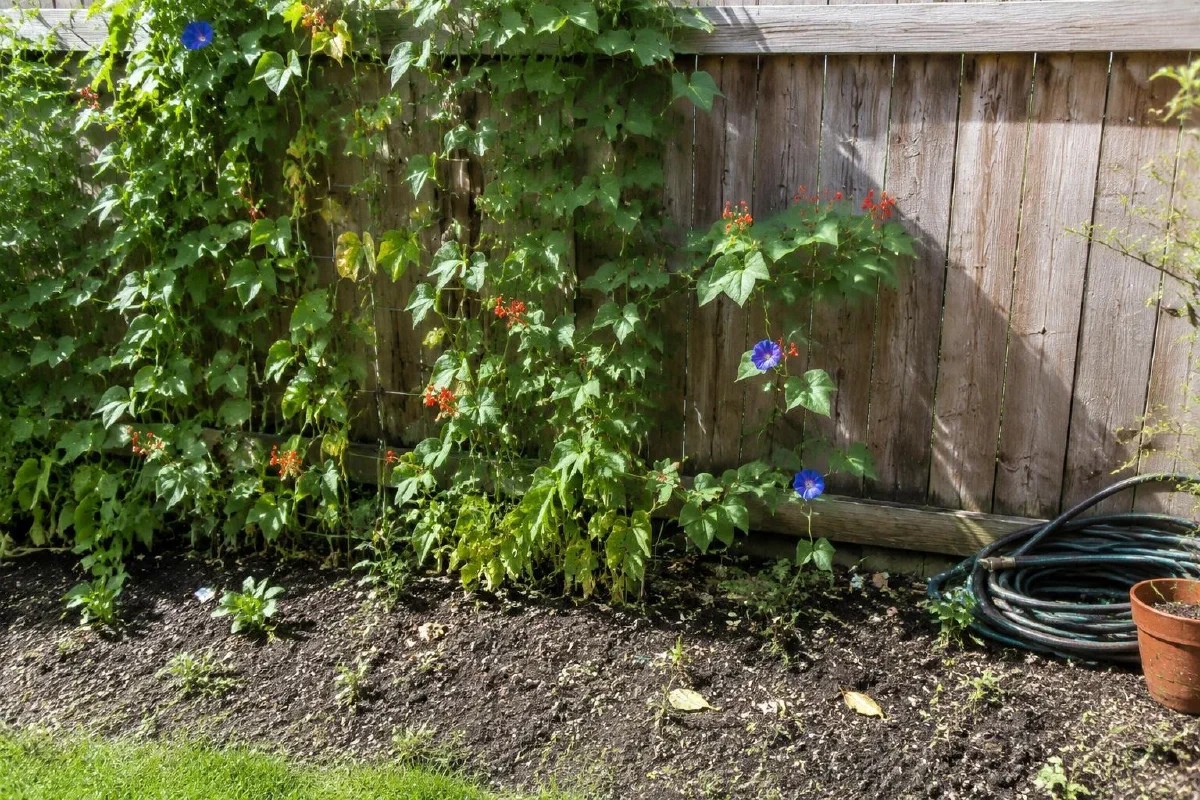
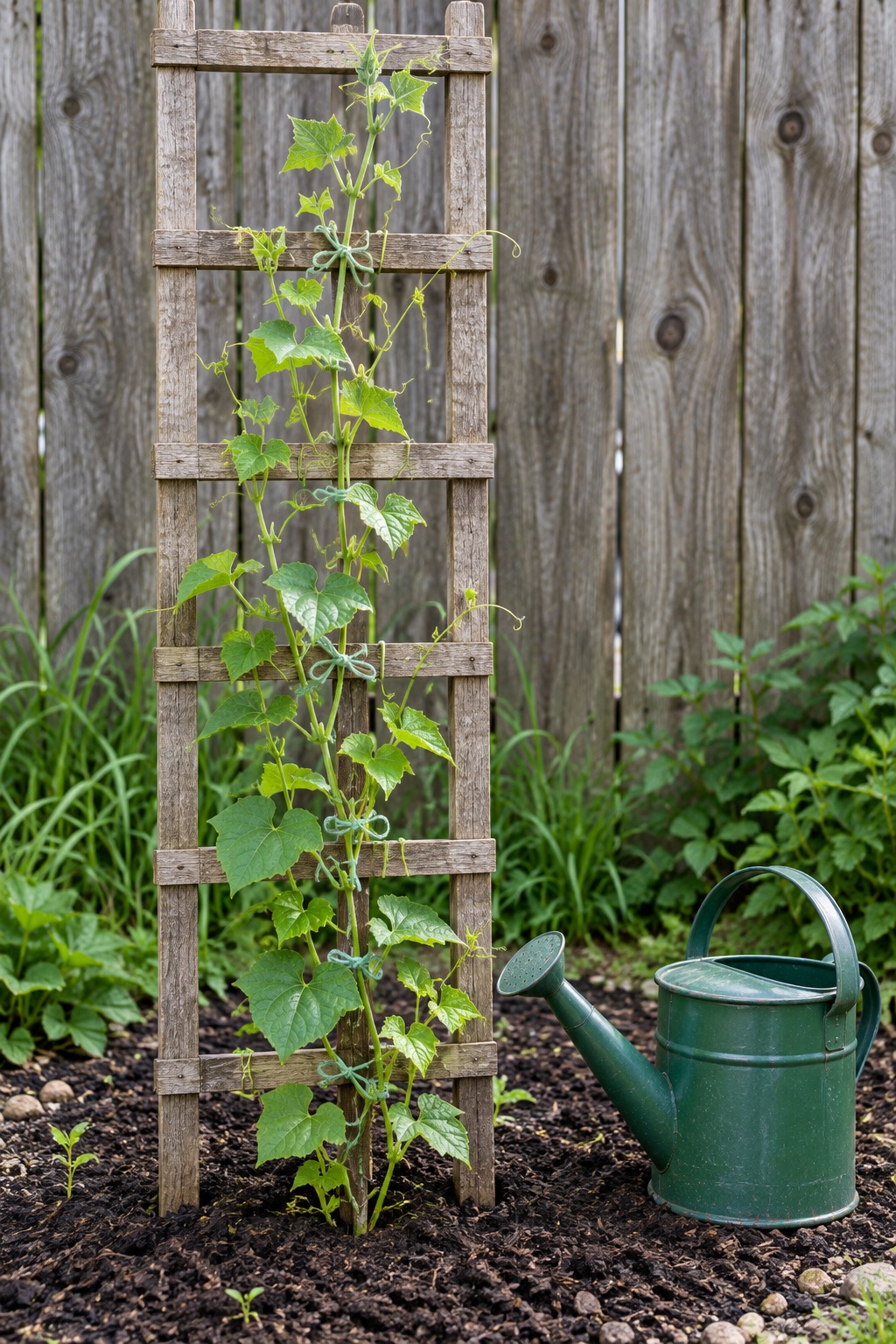
Illustrative scene, not a photograph of the linked products.
Look at the sightline from the chair or window you want to screen. A short screen near that spot may be more useful than planting the entire boundary. Check ownership, height limits and attachment permission before changing a fence.
Match the vine to its support
| Climbing habit | What it uses | What to check |
|---|---|---|
| Twining stems | A lattice, grid or other members the stems can wrap around | Thin enough supports and room to guide growth |
| Tendrils | Narrow supports for the tendrils to grip | Suitable netting, string or wire within an adequate frame |
| Clinging roots or pads | A surface the plant attaches to | Surface damage, removal and the structure’s condition |
A flat fence board does not give every climber something to hold. Use a separate support when the plant needs it, and choose an attachment system for the actual load. Do not assume any masonry, wood or vinyl fence can carry a dense mature vine.
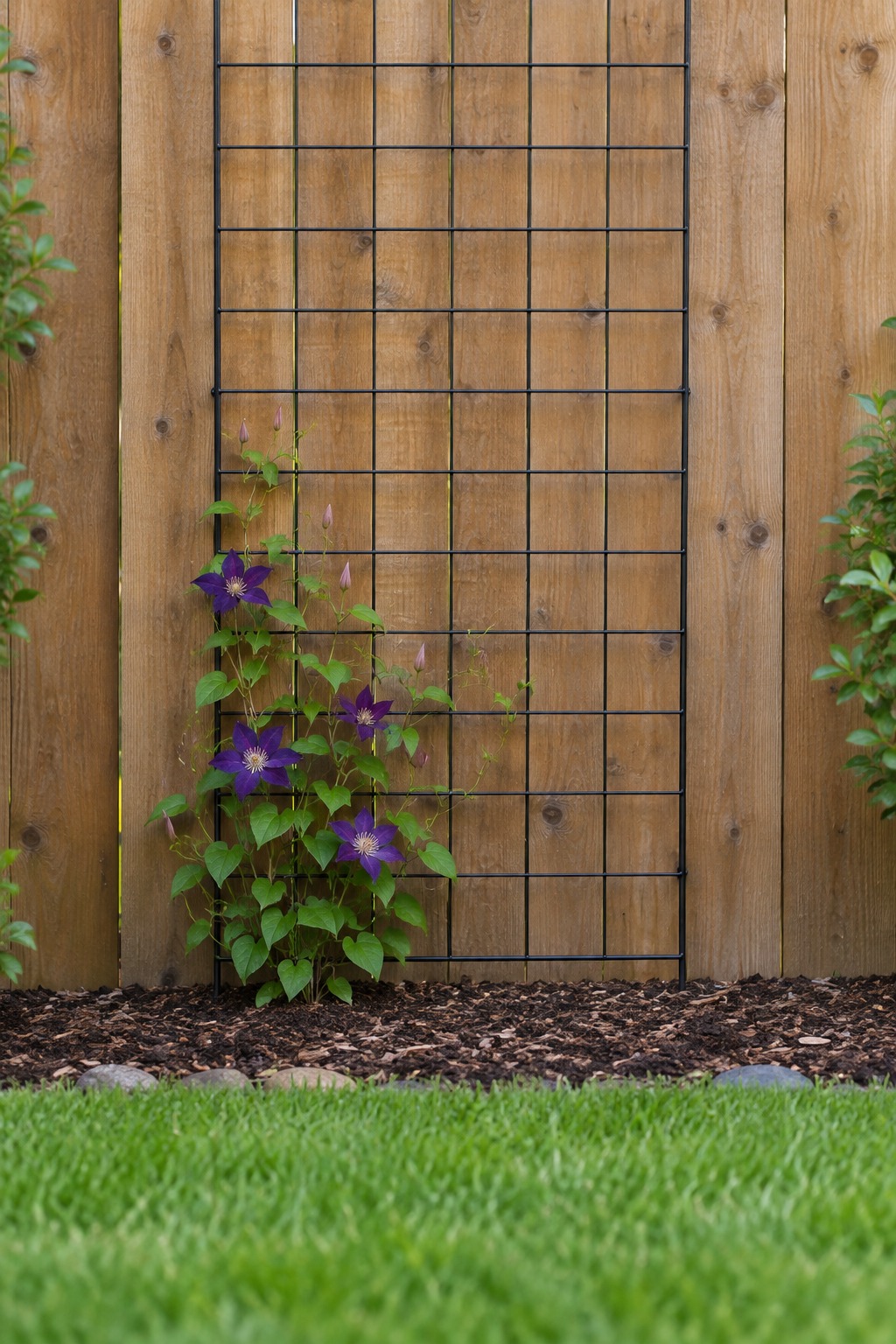
Leave access to inspect, stain or repair the fence. A gap behind a support may help maintenance, but a fixed one-inch spacer is not a universal solution. For a rental, choose a freestanding arrangement only if its base and anchoring suit the vine and wind exposure.
Nine vines to compare
These are choices to investigate for your site, not a ranking by guaranteed feet of growth. The linked NC State Extension profiles describe the plants and their requirements.
| Vine | Useful role | Limitation before buying |
|---|---|---|
| Hyacinth bean, Lablab purpureus | A sun-loving twining annual with purple stems and ornamental pods | Needs a sturdy trellis; treat pods and seeds as ornamental rather than offering casual eating advice |
| Morning glory, Ipomoea tricolor | Seasonal flowers and twining growth in full sun | It self-seeds and may be noxious locally; check restrictions and pet suitability |
| Scarlet runner bean, Phaseolus coccineus | Red flowers on a supported sunny planting | Frost-tender; warm-season growth and bean production vary |
| Black-eyed Susan vine, Thunbergia alata | A smaller twining vine with yellow or orange flowers | Tender, commonly grown as an annual; can become weedy in frost-free places |
| Cup-and-saucer vine, Cobaea scandens | Tendrils and bell-shaped flowers on a suitable support | A tender vine needing enough season and space; local conditions affect flowering |
| Annual sweet pea, Lathyrus odoratus | Fragrant flowers in a cool growing season | Hot humid summers can be difficult; this ornamental pea is poisonous and should not be confused with edible peas |
| Climbing nasturtium, Tropaeolum majus | Seasonal foliage and flowers on a modest screen | Buy a climbing variety, not a dwarf bush type; self-seeding can spread it |
| Star jasmine, Trachelospermum jasminoides | An evergreen twining vine for a suitable mild-winter site | NC State lists zones 8a to 10b; it needs establishment and maintenance |
| Coral honeysuckle, Lonicera sempervirens | A longer-term twining vine native to the eastern US | Flowers attract hummingbirds but are non-fragrant; check local suitability and mature size |
Choose one that fits the climate and season rather than the fastest name on the list. Annual sweet pea is not an interchangeable hot-summer substitute for runner bean. An evergreen star jasmine is not an interchangeable cold-climate substitute for a seasonal annual.
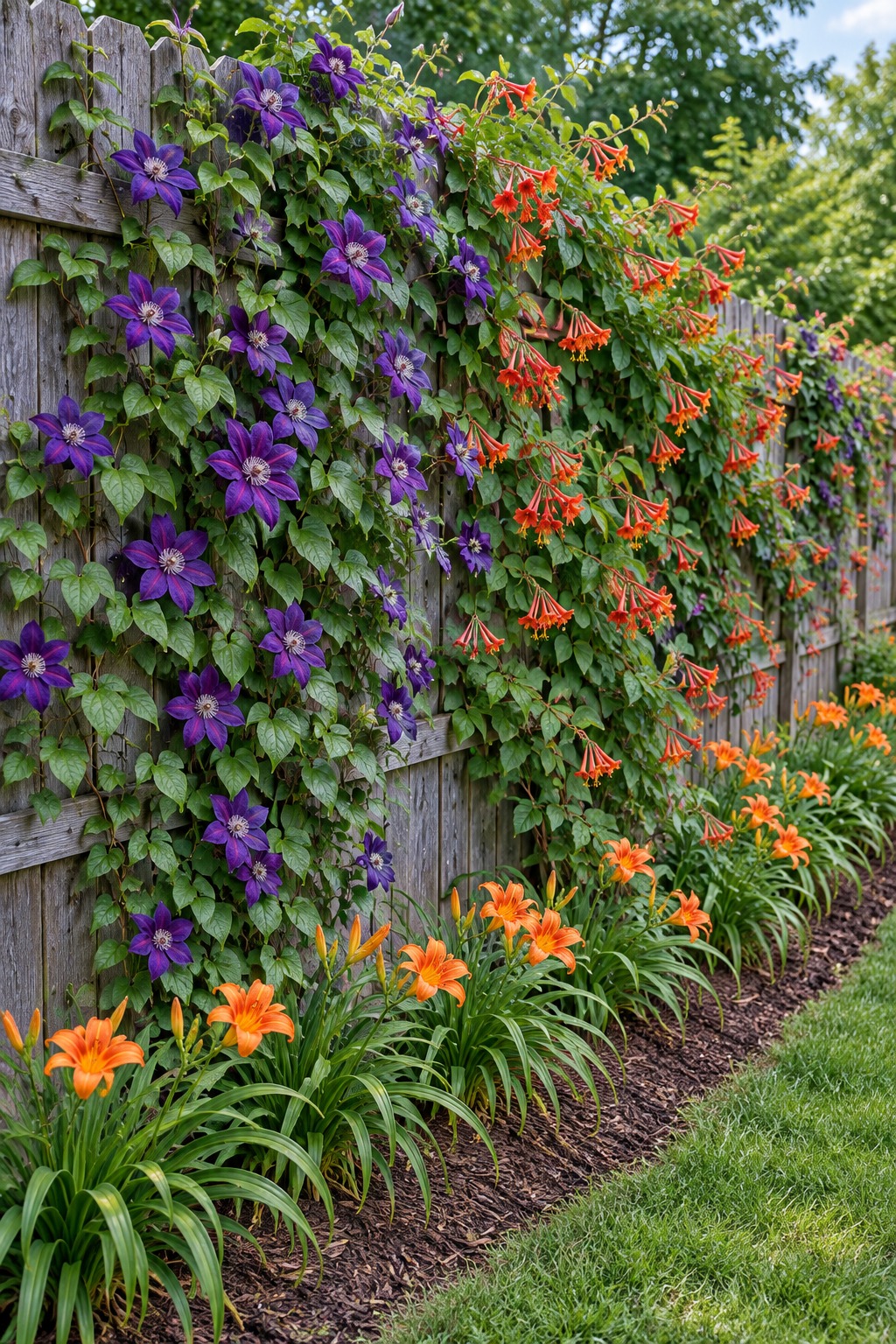
How much will it cover this summer?
Read the mature size and planting directions for the exact seed or nursery plant. Mature height is not first-season coverage. A vine can climb tall while leaving gaps at sitting height, and a late planting has less time than an early one.
Use the packet or local nursery’s spacing guidance. The same 8-to-12-inch spacing does not suit all nine plants. Estimate how many plants fit the actual planting strip, with root space and maintenance access.
If the fence must block a view now, use an approved screen that works without foliage. Let the vine add a seasonal layer rather than making it responsible for immediate privacy. For a balcony that needs privacy right away, balcony privacy ideas that do not look cheap are worth a look.
Check vigorous and invasive plants locally
Fast growth can also mean difficult removal. Check the exact scientific name against your state or regional invasive-plant guidance before planting. A vine sold online is not proof that it is appropriate where you live.
Do the same check for plants labeled annual: some reseed readily, and others behave differently in frost-free climates. Avoid casual substitutions between native coral honeysuckle and Japanese honeysuckle. Their growth and regional impacts are different.
For a pet’s yard, read the relevant plant profile and a reliable toxicity reference. A plant missing from one database is not automatically safe. Keep ornamental seeds and pods away from places where children or pets may eat them.
Three supplies to compare
| Exact listing | Job | Check before using |
|---|---|---|
| Macteyia metal trellis, 70.8 by 19.7 inches, pair (opens Amazon in a new tab)As an Amazon Associate, we earn from qualifying purchases. Full disclosure. | A narrow support for a small planting area | Anchorage, exposure and mature vine load |
| CJGQ expandable wooden lattice, pair (opens Amazon in a new tab)As an Amazon Associate, we earn from qualifying purchases. Full disclosure. | A grid whose width can be adjusted | Installed dimensions and a suitable mounting system |
| Giftsfaloy two-gallon watering can (opens Amazon in a new tab)As an Amazon Associate, we earn from qualifying purchases. Full disclosure. | Watering a reachable planting strip | Full weight and access; follow soil moisture rather than a fixed weekly schedule |
All were in stock on October 11, 2026. The can is a supply rather than a third trellis tier.
Establish and maintain the planting
Install the support before stems become tangled. Plant at the time and depth recommended for the exact vine. Check soil moisture during establishment, guide new growth and inspect ties as stems enlarge.
Pruning is plant-specific. Keep the nursery name and care instructions, especially for perennial vines whose flowering depends on pruning timing. Remove unwanted seedlings and keep stems out of gutters, building fittings and neighboring planting.
For winter screening, see backyard privacy after the leaves fall. Star jasmine by the door covers a single perennial near an entry in more detail.