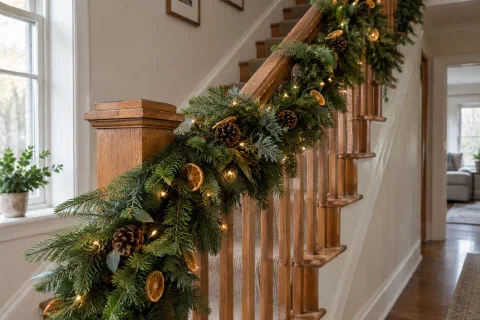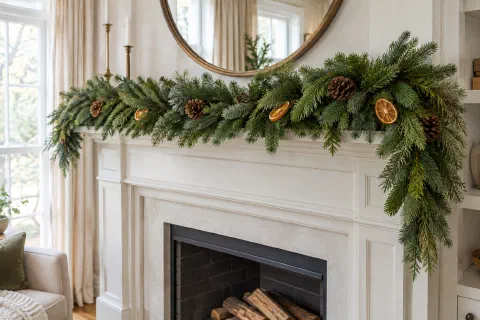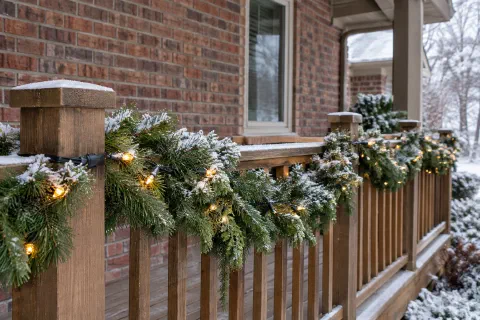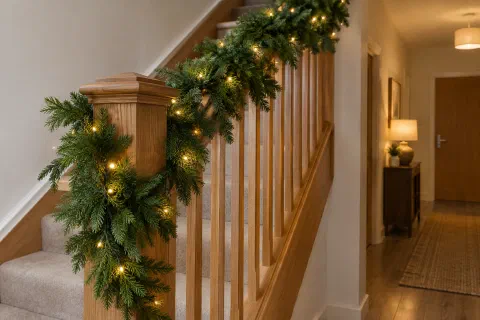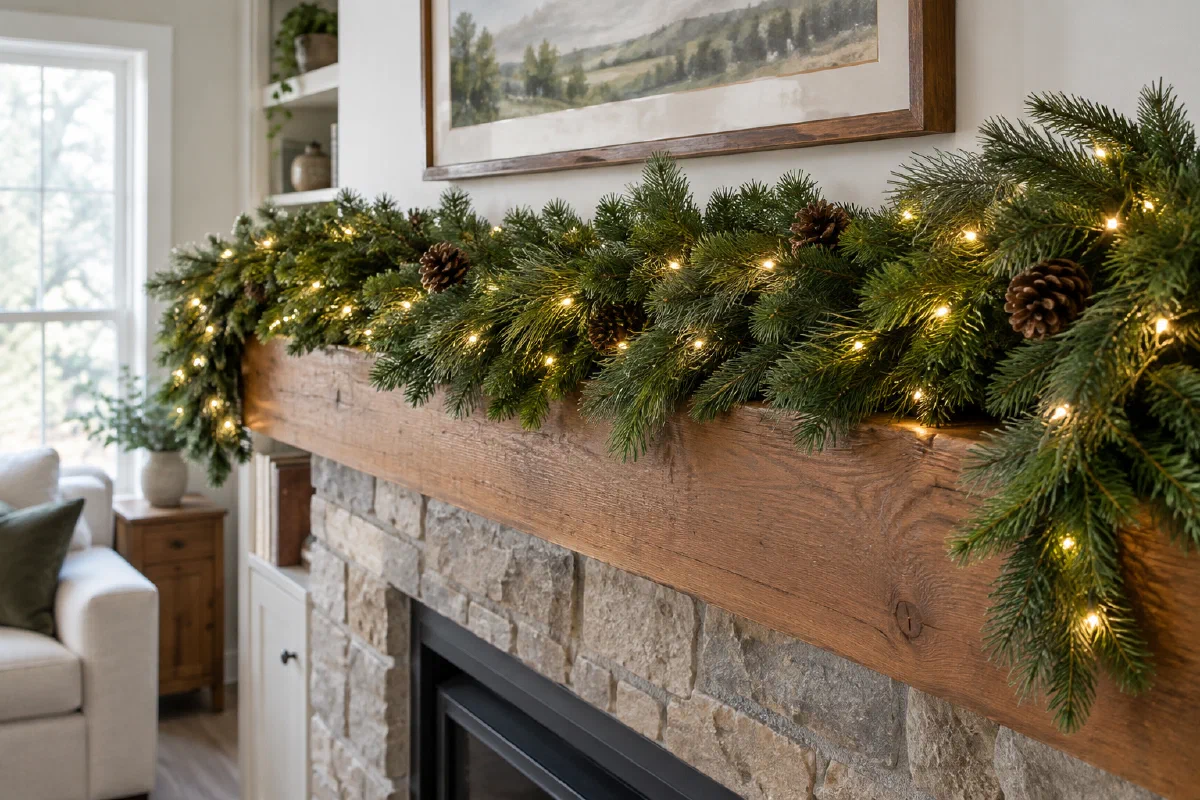
Most pre-lit garland fails the same way. It lights up, and it still looks like a dotted line.
The bulb count on the box is not the problem. Bulb spacing is. A strand with 100 lights spread down 9 feet reads as beads on a wire. The same 100 lights packed into 6 feet reads as greenery glowing from the inside. How to make faux garland look real up close is a separate piece. This is the spec sheet.
What to Check on the Box Before You Buy
- Replaceable bulbs, or sealed? If the box says they cannot be replaced, one dead bulb can end the strand.
- End-to-end connectors. A strand that connects end to end chains into one long run on one plug. A strand with a plug at one end only cannot.
- Outdoor rating. Anything past the door needs an outdoor rating. An indoor-only strand on a porch rail is a cord in weather.
- Stated light count and stated length. Both, because you are going to divide one by the other.
- Wire color. Green vanishes against dark garland and pops against pale wood. Brown does the opposite. This is the most common regret after hanging.
- Timer or remote. Nice to have. Not a reason to pay more.
Divide the light count by the length in feet. That number, not the light count alone, decides whether the garland looks lit or looks dotted.
Bulb Spacing: The Number That Decides How It Reads
Bulb spacing is rarely printed on the box. Lights per foot almost always is, once you divide. These bands are my own read from handling the stuff, not a manufacturer spec.
| Lights per foot | How it reads | Where it works |
|---|---|---|
| Under 6 | Dotted, with bare wire between bulbs | Nowhere you plan to photograph |
| 8 to 12 | A lit line, with visible structure | The sweet spot: banister, mantel, door frame |
| 14 to 20 | Dense and nearly continuous | Dark rooms, dark green garland, porch rails |
| Over 20 | Bright to the point of glare | Short runs, and check the heat |
A 9-foot strand with 50 lights gives about 5.5 per foot and lands in the dotted band. With 100 it gives about 11 and looks good. With 150 it gives about 17 and reads as a solid glow. Aim for that middle band, and weave the strand into the greenery instead of laying it on top.
Warm White, Cool White, or Multicolor: Which to Buy
The label is marketing. The number is the spec. Warm white, soft white, and daylight mean whatever the brand wants them to mean, so find the kelvin rating.
Roughly: warm white sits around 2,200 to 2,700K and reads amber. Soft white runs to about 3,000K. Cool white starts near 4,000K. Daylight is 5,000K and beyond, and on a garland it reads blue.
That blue is a real problem, not just taste. UF/IFAS Extension Sarasota County recommends warm or amber outdoor lighting over cool white or blue, because cool light disrupts the circadian rhythm of humans and wildlife.
Warm white is the safe default near the front door, the mantel, or a window seen from inside. Multicolor reads better on a tree than on a staircase, because a banister is one long line, and a long line of mixed color looks busy.
Buy every strand in the same color temperature in the same trip. Two warm whites from two brands can sit 300K apart, and three feet from each other you will see it.
Garland Length: Measure the Run, Then Add for the Dip
Measure the path, not the object. Along the handrail, not along the staircase. Up one side of the door frame, across the top, and down the other. Then add for the dip, because garland is not hung taut like a cable. It sags between attachment points, and the sag eats length.
| Where it goes | What to measure | Add for dip and fullness |
|---|---|---|
| Stair banister | Along the handrail | 1.5 times, 2 times for a thick run |
| Mantel | The shelf edge | 1.5 times, more if it drapes down both sides |
| Door frame | Up, across, down | 1.5 times for one line, 2 times for two |
| Porch rail | The rail itself | 1.5 times, more on a windy corner |
A banister with a 12-foot handrail wants roughly 18 feet for one generous line, or 24 feet if you are doubling it. The most common pre-lit size sold is 9 feet, and 9 feet is short for most staircases. It is a mantel length being sold as a staircase length. A standard front door at 36 inches wide and 80 inches tall has a frame run of about 16 feet, which wants roughly 24 feet for one line.
But pre-lit has a wrinkle unlit garland does not: extending it later is hard, because you have to match the connector, wire color, and light color. Buy the long one first.
How to Test a Pre-Lit Garland Before You Hang It
Test on the floor, in daylight, before anything goes on a hook.
- Unbox it and plug it in flat, so you can see every foot.
- Walk the run and mark the dark patches. With replaceable bulbs, push each one to seat it. With sealed strands, a dark section usually means the strand is done.
- Look at the last foot at each end. Cheap pre-lit garland is often all wire at the ends. Know how much bare tail you’re hiding.
- Check the fuse in the plug. If the whole strand is dead and the bulbs are fine, that fuse is the first thing to check.
- Chain the whole run and test it as one, on the floor. This is where mismatched connectors show up.
- Run it 20 minutes in the outlet you will actually use, then feel the bulbs. LEDs run cool. Incandescent strands do not, and warm bulbs next to dried greenery start fires.
Four Pre-Lit Problems to Avoid
A dead section in the middle. Usually one failed bulb or a broken wire in the twist. Replaceable bulbs turn a dead strand into a two-minute fix.
Bare wire at the ends. A garland can be full in the middle and thin at both tails. Buy longer than the run and let a loop cover the thin part.
Green wire on a pale wood banister. Green on oak or pine is a visible green line beside your garland. Match the wire to what sits behind it.
Pushing the electrical side past its limits. The Consumer Product Safety Commission’s holiday decorating guidance is blunt: never string together more than three sets of incandescent lights, and never overload an outlet. UF/IFAS Extension puts LEDs at roughly 80 to 90 percent less power than incandescent bulbs.
Battery or Plug-In: The Honest Trade-Off
Plug-in is the better garland. Brighter, and it never needs batteries. Its only weakness is needing an outlet, which is why the question comes up.
Battery is for the places a cord cannot reach: an apartment door with no exterior outlet, a mantel far from a socket. The honest cost is batteries. A three-AA pack on 50 to 100 LEDs runs a few evenings, not a season, and cold shortens that. Rechargeables and a timer on the pack both help. If there is an outlet within reach, take the plug-in.
Pre-Lit or Add Your Own Lights: An Honest Comparison
| Pre-lit garland | Unlit garland plus your lights | |
|---|---|---|
| Setup time | Out of the box and up | An extra hour per long run |
| Light count and spacing | Whatever the factory chose | Entirely yours |
| Color temperature | Locked to the strand | You pick the kelvin |
| Repair | Often the whole strand | Swap lights, keep the garland |
| Extending later | Hard, matching is fiddly | Easy, any lights will do |
Buy pre-lit if the same garland goes in the same place every year, the run is long, and you want it up in one afternoon. Weaving 200 lights evenly through 18 feet by hand is an hour you will repeat next December.
Buy unlit and add your own lights if you want density no factory strand offers, you already own a box of lights, or you change color year to year.
The line I would draw: pre-lit over 10 feet, unlit under it.
Care and Storage: Making Pre-Lit Garland Last
Pre-lit garland survives years if you store it like electrical equipment.
- Test it before you put it away, not before you put it up. You want the failure to show in January, while the return window still exists.
- Coil it loosely around something round. Sharp bends in the wire kill a strand between seasons.
- Keep it out of a hot attic if you can. Heat and temperature swings are hard on wire insulation.
- Keep garland clear of heat sources while it is up. Illinois Extension’s guidance on decorating with greens is direct: fresh evergreens dry out in the heat of a home and become very flammable. A pre-lit garland above a working fireplace is the worst spot for it.
What to Read Next
- Christmas garland ideas for a small home for the measurement math behind a staircase, mantel or door.
- Christmas front door decor because the door frame is the run most people get wrong.
- Christmas mantel decor for building the mantel in layers once your lit garland is up.
- Indoor Christmas greenery that lasts if you are mixing real greens with your lit garland.
- Fall garland ideas for the same measurement math applied to an autumn run.