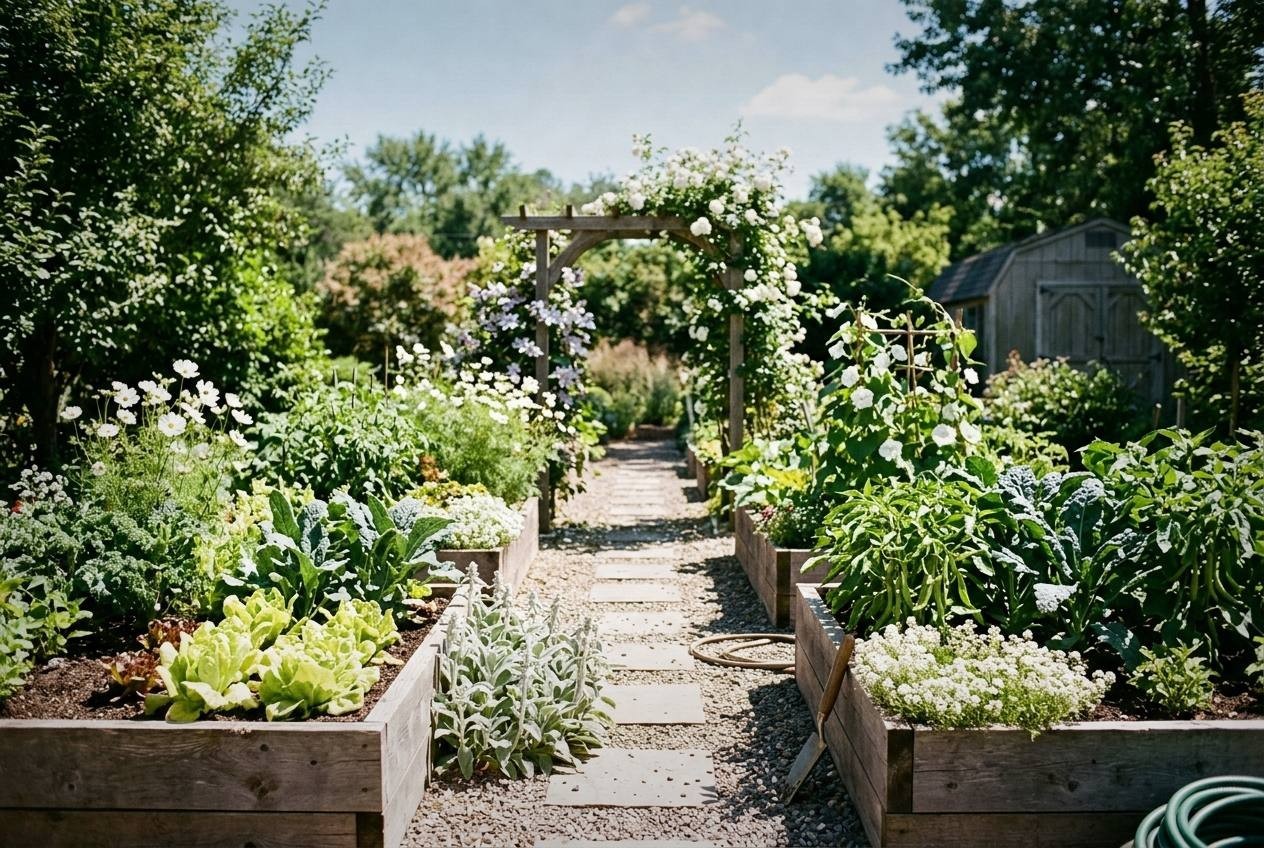
I planted my first moon garden by accident. I’d tucked some white petunias near the back door because they were on clearance, and one evening in late June, I stepped outside after dinner and stopped cold. The flowers were glowing. Not actually glowing, but catching the last blue light of dusk in a way that made them look lit from within. I stood there for ten minutes, just watching them fade up as the sky went dark.
That was four years ago. Now I have a dedicated moon garden along the fence line, and it’s become my favorite part of the yard. Not during the day (it looks pretty unremarkable then, honestly), but from about 8 PM until I go to bed. That’s when the white flowers and silver leaves turn luminous, when the night-blooming jasmine opens up, when the whole space shifts into something different.
Moon gardens aren’t complicated. You’re just choosing plants that show up in low light and arranging them where you’ll actually see them after dark. But there are some tricks to making it work. Some plants perform way better than others. Here’s what I’ve learned.
Why White and Silver Actually Glow
This isn’t magic, it’s physics. White petals and silver foliage reflect whatever light is available. Moonlight, starlight, the ambient glow from porch lights or windows. In full sun, white flowers can look washed out or harsh. But in twilight and darkness, they catch and bounce back every bit of available light.
Your eyes adjust differently at night too. You shift from cone cells (which see color) to rod cells (which see contrast and movement). White stands out. Deep purple or red flowers that look stunning at noon basically disappear after sunset. I learned this the hard way with a whole bed of ‘Black Velvet’ petunias that I couldn’t see at all once the sun went down.
Best Plants for Actual Nighttime Glow
I’ve tested a lot of plants over four summers. Here’s what actually works:
Annuals (replant each year):
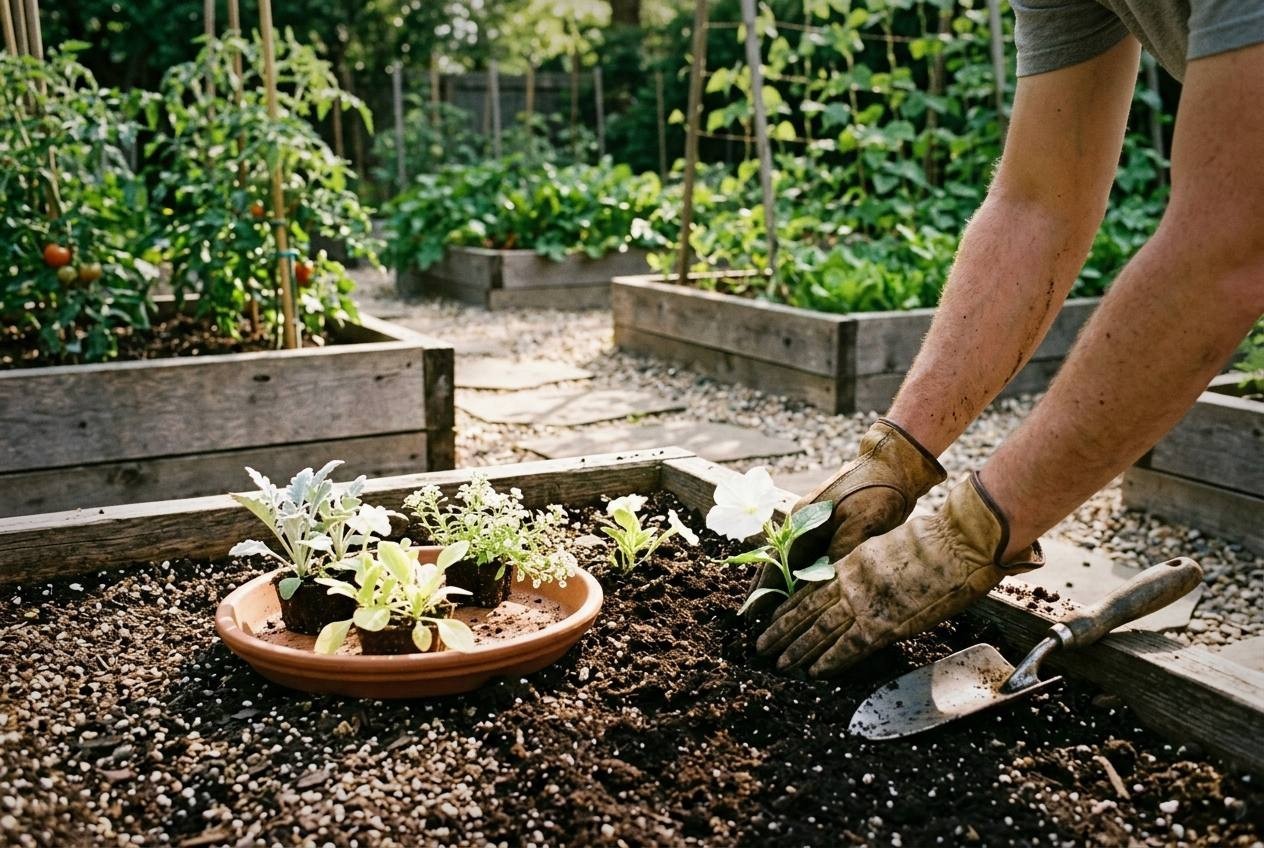
- White petunias: Reliable, cheap ($3-4 per 4-inch pot), bloom constantly. ‘Supertunia White’ is worth the extra dollar.
- Moonflower vine (Ipomoea alba): Opens at dusk, closes by mid-morning. One plant covers 10 feet of fence. Seeds are $4 for 25.
- White nicotiana: Tall (2-3 feet), fragrant at night, reseeds itself. $5 per six-pack.
- Sweet alyssum: Low edging plant, honey scent, $3 per flat.
Perennials (come back each year):
- ‘Honorine Jobert’ Japanese anemone: Blooms late summer into fall, 3-4 feet tall, $15 per plant. Zone 5-8.
- White coneflower (Echinacea purpurea ‘White Swan’): Daisy-like, attracts moths at night, $12 per plant.
- ‘Casa Blanca’ Oriental lily: Huge fragrant blooms in July, $8 per bulb, plant in fall.
- Shasta daisy: Tough, spreads, blooms June through August, $10 per plant.
Silver Foliage (the secret weapon):
- Lamb’s ear (Stachys byzantina): Fuzzy silver leaves, glows like crazy, $6 per plant, spreads fast.
- Artemisia ‘Powis Castle’: Feathery silver mound, 2 feet tall, $12 per plant.
- Dusty miller: Annual, $4 per six-pack, use as edging.
- Russian sage: Purple flowers (which disappear at night) but silver stems catch light, $14 per plant.
The silver foliage plants are what make a moon garden work during the dark of the moon or on cloudy nights when there’s barely any light. They glow even when flowers don’t.
Layout: Where to Put Things So You’ll Actually See Them
Don’t plant your moon garden out in the middle of the yard where you never go after dark. Put it where you’ll see it from inside the house or along a path you actually use at night.
My moon garden runs along the fence between the back door and the garage. I walk that path every evening to take out compost, and I can see it from the kitchen window while doing dishes. That’s 20-30 minutes of viewing time every single night.
Layout principles that work:
Place taller white flowers (nicotiana, lilies, coneflowers) at the back. They catch light from above and create a glowing backdrop. Put silver foliage in the middle layer. The fuzzy or feathery textures diffuse light and create depth. Edge with low white annuals (petunias, alyssum) that spill over onto paths.
If you have a fence or wall, paint it dark. I painted mine a charcoal gray two summers ago ($35 for a gallon of exterior paint), and it made the white flowers pop twice as bright. White flowers against a white fence don’t read well at night.

Fragrance Layering for Night
This is where moon gardens get really good. A lot of white flowers are fragrant, and many of them release scent specifically at night to attract moth pollinators. You can layer fragrances so something is always perfuming the air from dusk until midnight.
Early evening (7-9 PM):
- Four o’clocks (Mirabilis jalapa): Open late afternoon, sweet scent, reseed aggressively. Free after the first year.
- Flowering tobacco (Nicotiana sylvestris): Strong, sweet, almost too much up close.
Full dark (9-11 PM):
- Night-blooming jasmine (Cestrum nocturnum): Not actually a jasmine, but the scent is incredible. Tender perennial, bring inside in winter. $20 per plant.
- ‘Casa Blanca’ lilies: Peak fragrance around 10 PM in my yard.
- Moonflower: Light, sweet, not overpowering.
Late night (11 PM-dawn):
- Night phlox (Zaluzianskya ovata): Tiny flowers, huge fragrance, smells like vanilla and honey. Hard to find but worth it. $8 per plant.
I keep a small table and two chairs in my moon garden now. Some nights in July and August, my partner and I sit out there after the kids are in bed, just breathing in the jasmine and watching the moths work the flowers. Better than any date night restaurant.
Real Costs and Timeline
Here’s what I spent on my 12-foot by 4-foot moon garden, planted over two years:
Year One (Spring 2022):
- 6 white petunias: $24
- 3 moonflower plants (started from seed): $0
- 1 flat sweet alyssum: $3
- 3 lamb’s ear plants: $18
- 2 artemisia: $24
- 1 night-blooming jasmine: $20
- Soil amendments (compost): $15
- Total: $104
Year Two (Spring 2023, filling gaps):
- 3 ‘Casa Blanca’ lily bulbs: $24
- 2 Japanese anemones: $30
- 4 white coneflowers: $48
- More petunias and alyssum: $20
- Total: $122
Grand total over two years: $226
The annuals need replacing each spring ($25-30), but the perennials come back bigger each year. The lamb’s ear has spread so much I’ve divided it twice and given away plants.
Planting and Care Timeline
Late April/Early May:
- Plant perennials (anemones, coneflowers, lilies) as soon as soil is workable.
- Start moonflower seeds indoors in peat pots. They hate transplanting.
Mid-May (after last frost):
- Plant annuals (petunias, nicotiana, alyssum).
- Transplant moonflower seedlings carefully, don’t disturb roots.
- Mulch everything with 2 inches of shredded bark ($6 per bag, I used 3 bags).
June-August:
- Deadhead petunias weekly to keep them blooming.
- Water deeply twice a week if no rain. Moon gardens need consistent moisture.
- Cut back lamb’s ear flower stalks (they’re ugly and flop over).
September:
- Let nicotiana and four o’clocks go to seed if you want them back next year.
- Plant spring bulbs (white tulips, daffodils) for early season glow.
October:
- Cut back perennials after first hard frost.
- Bring night-blooming jasmine inside before frost.
- Mulch perennials with 4 inches of leaves or straw.
The only real maintenance is deadheading annuals and watering. Less work than a vegetable garden and way less work than a lawn.
What Doesn’t Work (Things I Wasted Money On)
White roses: They’re beautiful, but the blooms face down and you can’t see them at night. Also, blackspot. Save yourself the trouble.
White hydrangeas: The flowers are too dense and heavy. They don’t catch light well and just look like gray blobs after dark.
White impatiens: They need too much shade. In shade, there’s not enough light for them to glow.
Solar lights: I thought I’d need them. I don’t. They’re too bright and wash out the natural glow of the flowers. If you need path lighting, use warm-toned low-voltage lights placed at ground level, not pointing at the plants.

Why This Space Matters
Most of us design our yards for daytime. We plant what looks good at 2 PM on a Saturday when we’re outside working. But some of the best moments in a yard happen after the sun goes down. When the air cools and the day’s noise settles and you can actually hear yourself think.
A moon garden gives you a reason to step outside at 9 PM on a Tuesday. It makes the dark hours of your yard useful and beautiful instead of just empty. And there’s something about being outside at night, surrounded by glowing flowers and night-blooming fragrance, that shifts your nervous system into a different gear.
I’m not saying it’s meditation or therapy or any of that. It’s just nice. A pocket of intentional peace that costs about the same as two months of a streaming service and lasts all summer long.
The moths appreciate it too. On a good night in July, I’ll count a dozen sphinx moths working the moonflowers, plus countless smaller moths on the nicotiana and jasmine. They’re part of the show, hovering and dipping in the half-light. My kids call them fairy hummingbirds.
Plant a moon garden this spring. Put it somewhere you’ll see it from inside or walk past it every night. Choose plants that actually glow, not just plants that are white. Layer fragrances so there’s always something blooming and perfuming the air.