Perennials in window boxes sound easier than they are.
The promise is simple: plant once, get flowers again next year. The problem is that a window box is not a garden bed. It has shallow soil, exposed roots, fast-drying edges, and winter cold coming from every side. Some perennials come back beautifully. Others survive in the ground but fail in a box.
That does not mean annuals are the only answer. It means you have to pick perennials that make sense for shallow roots and tight quarters.
For a broader flower-box starter guide, see window box flowers that make a plain house look finished. This article is the narrower question: what can come back in a window box without making the box look tired?
The Window Box Rule For Perennials
A perennial has to pass three tests before I would put it in a window box.
First, it needs a compact root system. Deep-rooted plants struggle in shallow boxes. Second, it needs to tolerate container exposure. Roots in a box get colder in winter and hotter in summer than roots in the ground. Third, it needs to look decent for more than two weeks. A plant that blooms once and disappears can leave the box bare.
The three tests, in one line: compact roots, tolerance for exposed roots, and more than two weeks of good looks. A plant that fails any one of them belongs in a bed, not a box.
The best window box perennials usually have one of these jobs:
- low edging
- trailing texture
- compact foliage
- small flowers
- repeat color
- evergreen or semi-evergreen structure
Think of them as the base of the box. Annuals can still handle the loud seasonal color.
Best Perennials For Sunny Window Boxes
Sunny window boxes dry out fast. The plants need to handle heat, reflected light, and uneven watering.
Good sunny perennial choices:
- Creeping thyme
- Sedum
- Dianthus
- Lavender, in a deeper box with excellent drainage
- Creeping phlox
- Snow-in-summer
- Compact coreopsis
- Ice plant in warmer zones
- Chives, if an herb look fits the window
- Oregano or trailing rosemary in mild climates
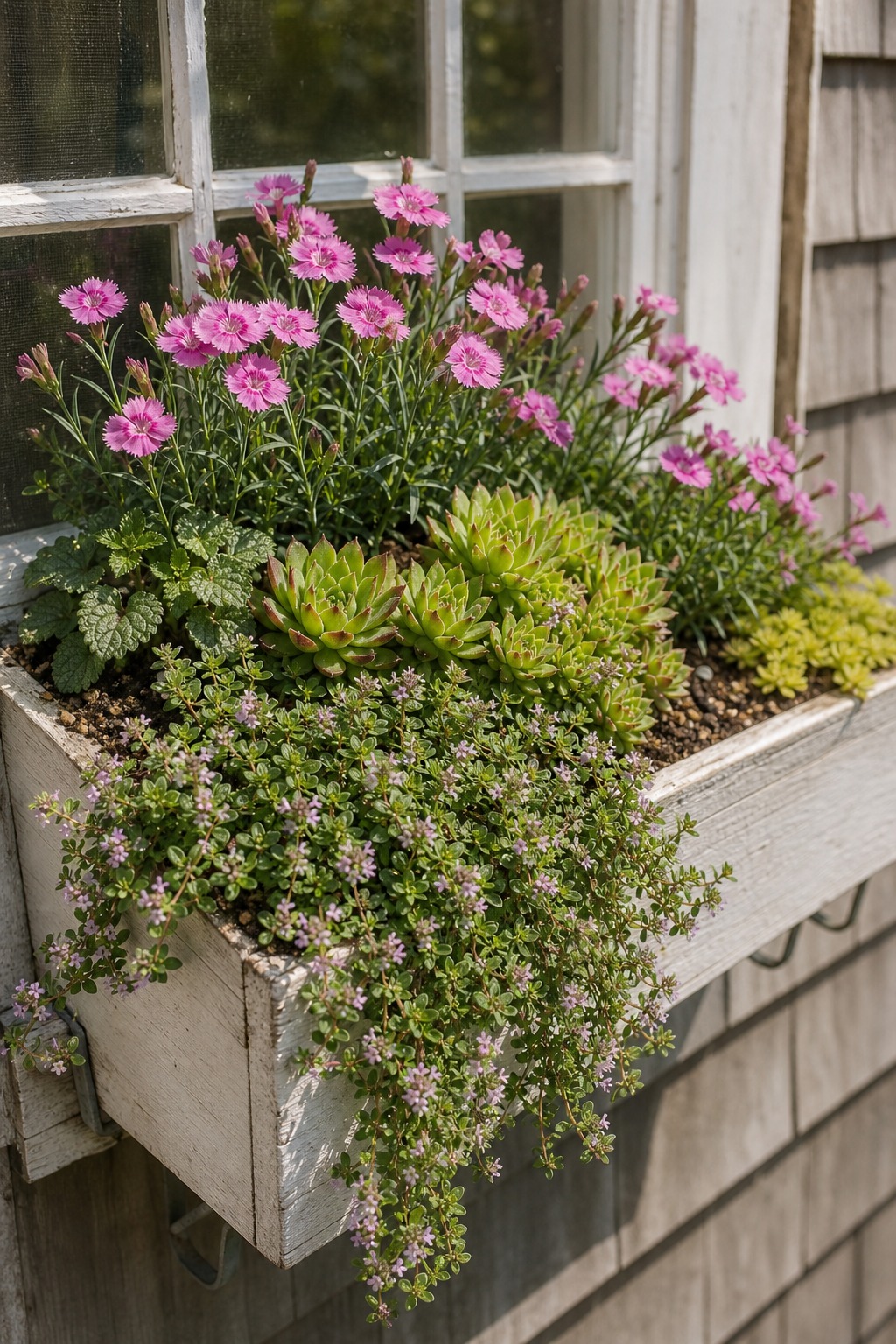
The safest sunny combination is one compact bloomer, one trailing herb or groundcover, and one small foliage plant. For example: dianthus in the middle, creeping thyme over the edge, and sedum tucked near the ends.
Do not overfill the box. Perennials need root room if they are expected to return.
Best Perennials For Shade Window Boxes
Shade boxes can stay prettier longer because they do not dry out as violently. The tradeoff is fewer flowers.
Good shade or part-shade perennial choices:
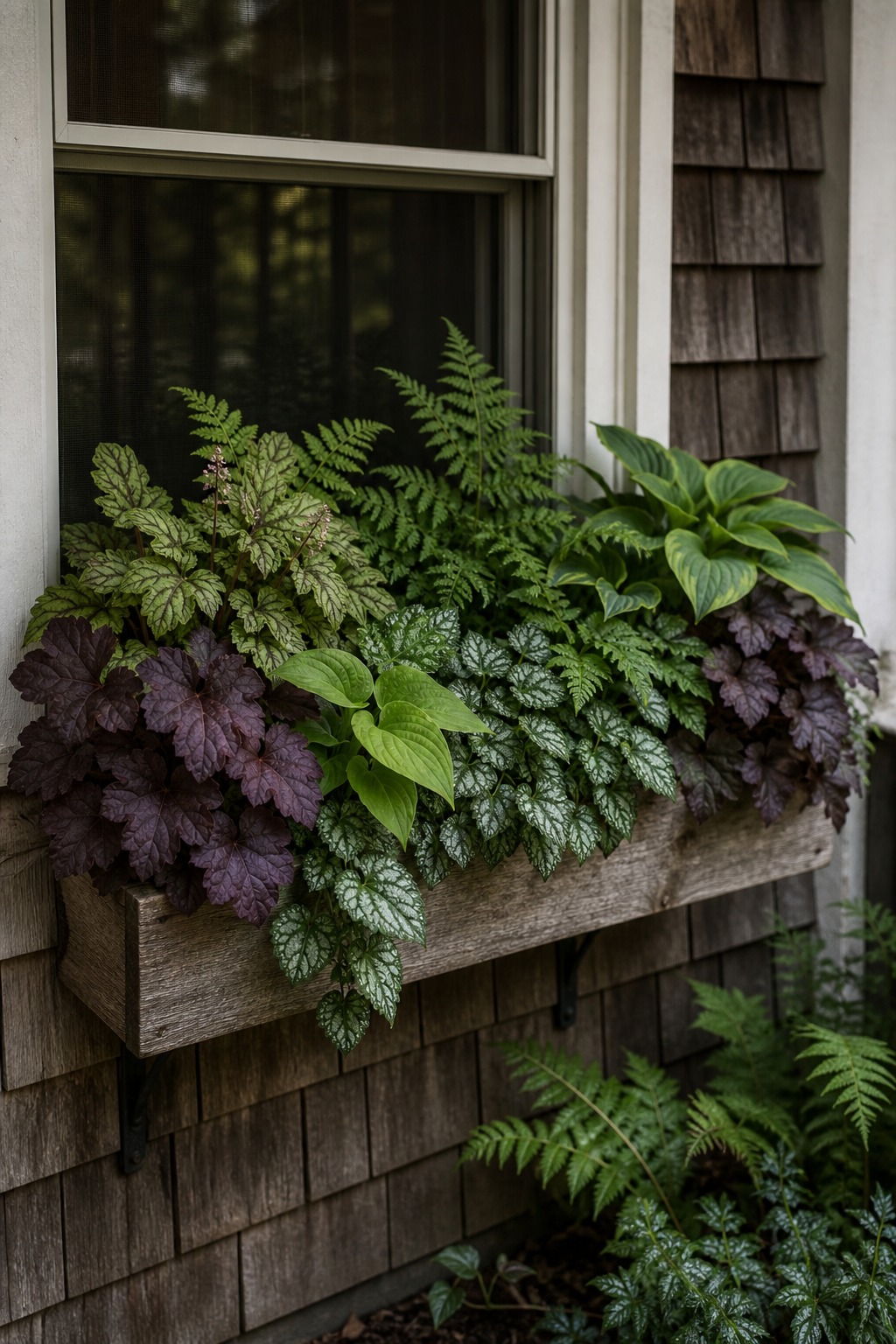
- Heuchera
- Small hostas
- Ajuga
- Ferns in moist shade
- Lamium
- Sweet woodruff, where it is not invasive
- Miniature astilbe in deeper boxes
- Vinca minor where it is appropriate and contained
- Creeping Jenny, if you can keep it controlled
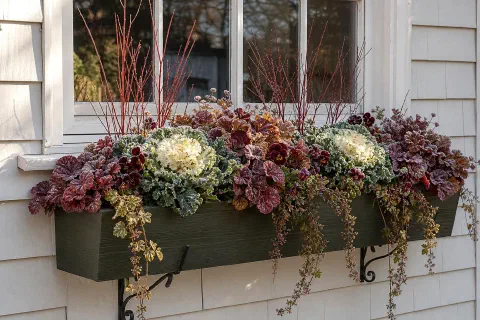
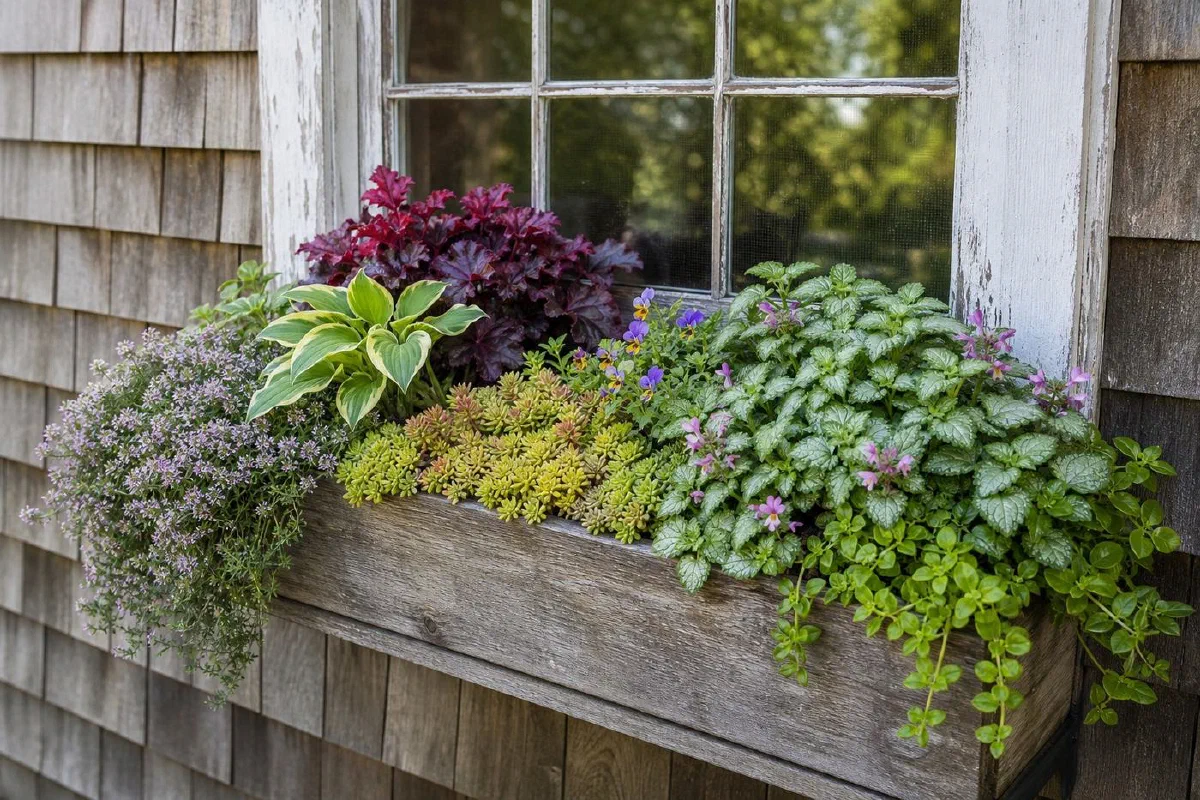
Shade boxes often look best when you stop trying to force constant bloom. Use foliage color instead: burgundy heuchera, blue-green hosta, silver lamium, dark ajuga, soft fern texture.
If you want flowers in shade, tuck in annual begonias or impatiens between the perennials. Let the perennials carry the structure and the annuals carry the color.
Use Annuals With Perennials, Not Instead Of Them
A perennial-only window box can look quiet. Sometimes too quiet.
The better setup is usually a perennial base with annual color added seasonally. The perennials come back and keep the box from feeling empty. The annuals give you the full summer flower show.
Try these pairings:
| Your box | Perennials that return | Annual for color | Why it works |
|---|---|---|---|
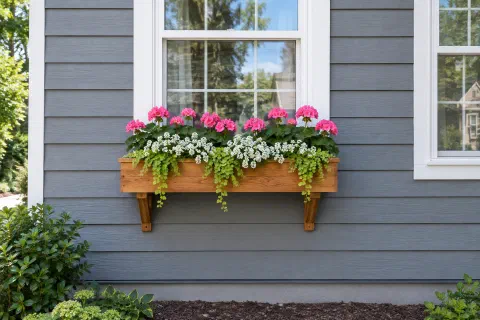
| Sunny box | Dianthus, creeping thyme | White calibrachoa | The dianthus and thyme come back, the calibrachoa brings the spill and bloom |
| Hot dry box | Sedum, thyme | Portulaca | Built for a box that bakes against siding or brick |
| Part-shade box | Heuchera, lamium | Begonias | The foliage holds the shape, the begonias add soft color |
| Shade box | Small hosta, fern | Impatiens | Best where the box stays moist and sheltered |
If the annuals fail, the box still has something alive in it. That is the whole point.
Choose A Deeper Box If You Want Them To Return
Depth matters.
A six-inch-deep box can hold seasonal annuals, but it is harder on perennials. An eight-to-ten-inch-deep box gives roots more insulation, more moisture, and more room to survive winter.
Drainage matters just as much. A window box without drainage holes is not a window box. It is a rot trap. Clemson HGIC’s container guidance is plain about the fix: the container should have a drainage hole and a tray, and you shouldn’t let the excess water sit around the roots. Use a light potting mix rather than garden soil, and check that the bottom of the box actually drains before anything goes in.
If the box is mounted under a roof overhang, remember that rain may not reach it. A shaded box can still dry out if the roof blocks water.
What Not To Plant In A Shallow Window Box
Some perennials are better left in the ground.
Be careful with:
- Peonies
- Large daylilies
- Tall garden phlox
- Big ornamental grasses
- Large salvias
- Bee balm
- Large hostas
- Black-eyed Susans in shallow boxes
- Anything with a deep taproot
These plants are not bad. They are just wrong for a narrow container under a window. If the plant wants space, give it a bed or a large pot, not a small box bolted to the house.
How To Help Window Box Perennials Survive Winter
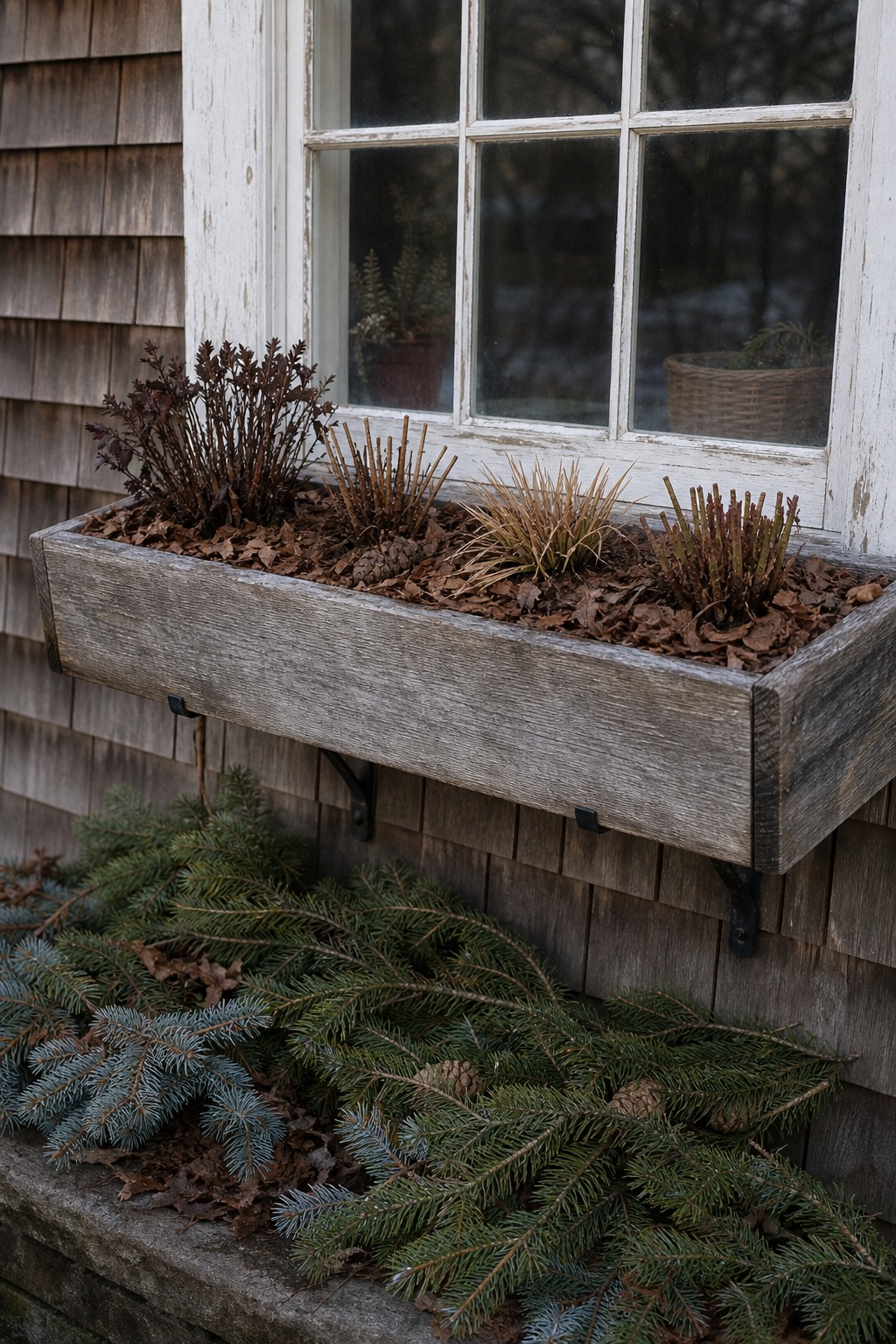
Perennials in containers are more exposed than perennials in the ground. A plant hardy to your zone in a garden bed may not survive the same winter in a window box.
To improve the odds:
- Choose plants hardy at least one zone colder than your area
- Use a deeper box when possible
- Do not let the box dry out completely before a hard freeze
- Add a light mulch layer after the soil cools
- Trim dead annuals out before winter
- Move removable boxes to a sheltered spot if your winters are severe
One thing settles the question before any of that: whether the box itself can take a freeze. Iowa State Extension’s container guidance is blunt about it, saying that containers which are not frost proof should be emptied and stored over winter so freezing soil does not crack them. If your box is not frost proof, no perennial in it is coming back, and the fix is a new box rather than more mulch.
If the box is fixed to the house, plant tougher than you think you need. The roots do not have the same protection they would have in the ground.
A Simple Perennial Window Box Formula
For most people, I would not make the whole box perennial.
I would use:
- One compact perennial for structure
- One trailing perennial or herb near the edge
- One seasonal annual for color
- One quiet foliage plant if there is room
For sun: dianthus, thyme, sedum, and a small annual like calibrachoa.
For shade: heuchera, lamium, fern, and begonias.
That gives the box a chance to come back without expecting every plant to do every job.
Perennials can work in window boxes. They just need the right role. Let them be the base, not the whole performance.
What to Read Next
- First Frost Checklist for Pots, Window Boxes, and Small Gardens: the fall shutdown list for containers, if winter is the part that worries you.
- Shade Plants for Containers: a longer list for the north-facing boxes that never get sun.
- What to Do When Container Soil Keeps Drying Out Too Fast: why a shallow box dries twice as fast as a pot, and what to do about it.
- Fall Window Box Ideas After First Frost: what to put in the box once the perennials have gone quiet for the year.