You bring two mums home in September. They are round, dense, completely covered in bud and color. Two weeks later the middle has gone brown, the flowers feel like paper, and half the plant is crisp.
You did not kill them. They arrived already set up to fail, and almost nobody tells you that at the register.
Mums in planters last two to three weeks when you buy them in full bloom and leave them in the nursery pot. They last five to six weeks when you buy them in tight bud, move them into a 10 to 12 inch pot with drainage, and water at the soil line every single day instead of over the top of the flowers.
That is the whole article in three sentences. The rest is why, and what to actually buy.
This article contains affiliate links. If you buy through them, Etheric Echoes may earn a commission at no extra cost to you. As an Amazon Associate I earn from qualifying purchases. Read the full disclosure.
Mums in Planters: Start by Getting Them Out of the Nursery Pot
The pot a garden center mum comes in is sized for shipping, not for living. It is usually 6 to 8 inches across, and by the time it reaches the display the roots have already circled the wall and filled every bit of space. There is more root than soil in there.
A root-bound pot that small holds maybe a day of water in September sun. Miss one afternoon and the plant browns from the middle out, which is the exact pattern people describe when they say their mums died overnight.
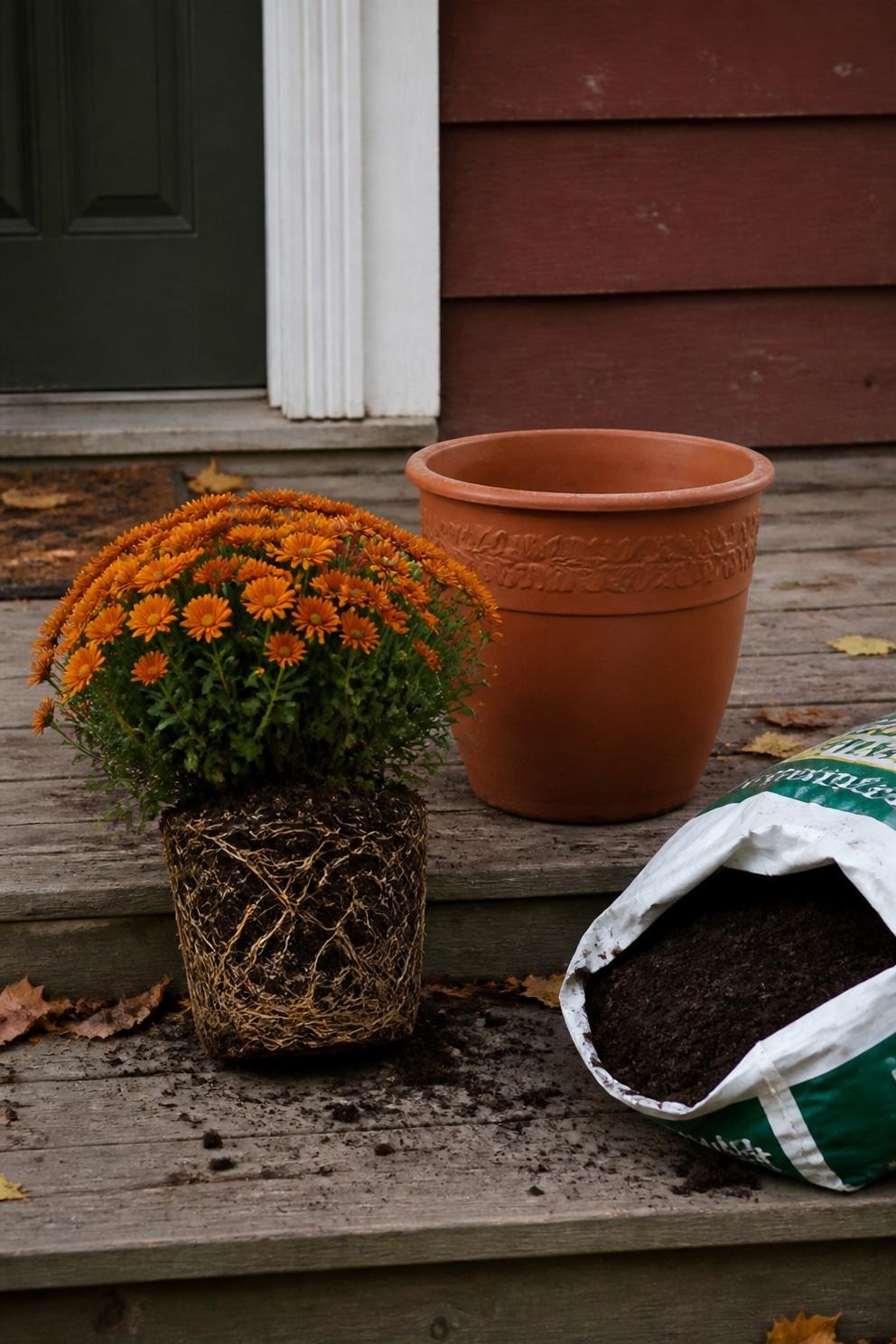
Move it into something 10 to 12 inches across the day you bring it home. Loosen the outside of the root ball with your thumbs before it goes in, because roots that have been circling will keep circling in the new pot if you do not interrupt them. Fill around it with fresh mix, not garden dirt, and leave an inch of space below the rim so water has somewhere to sit while it soaks in.
Two 10 inch whiskey barrel planters (opens Amazon in a new tab) are the straightforward version of this. Drainage holes, a saucer, and the right diameter, at a size that still looks proportional on a step. If you are flanking a front door, 22 inch tall planters (opens Amazon in a new tab) hold enough soil volume that the pot is not fighting you by noon.
The mix matters more here than it usually does. A moisture control potting mix (opens Amazon in a new tab) is worth the few extra dollars on this one plant, because retention is the entire problem you are solving.
How to Water Mums in Pots
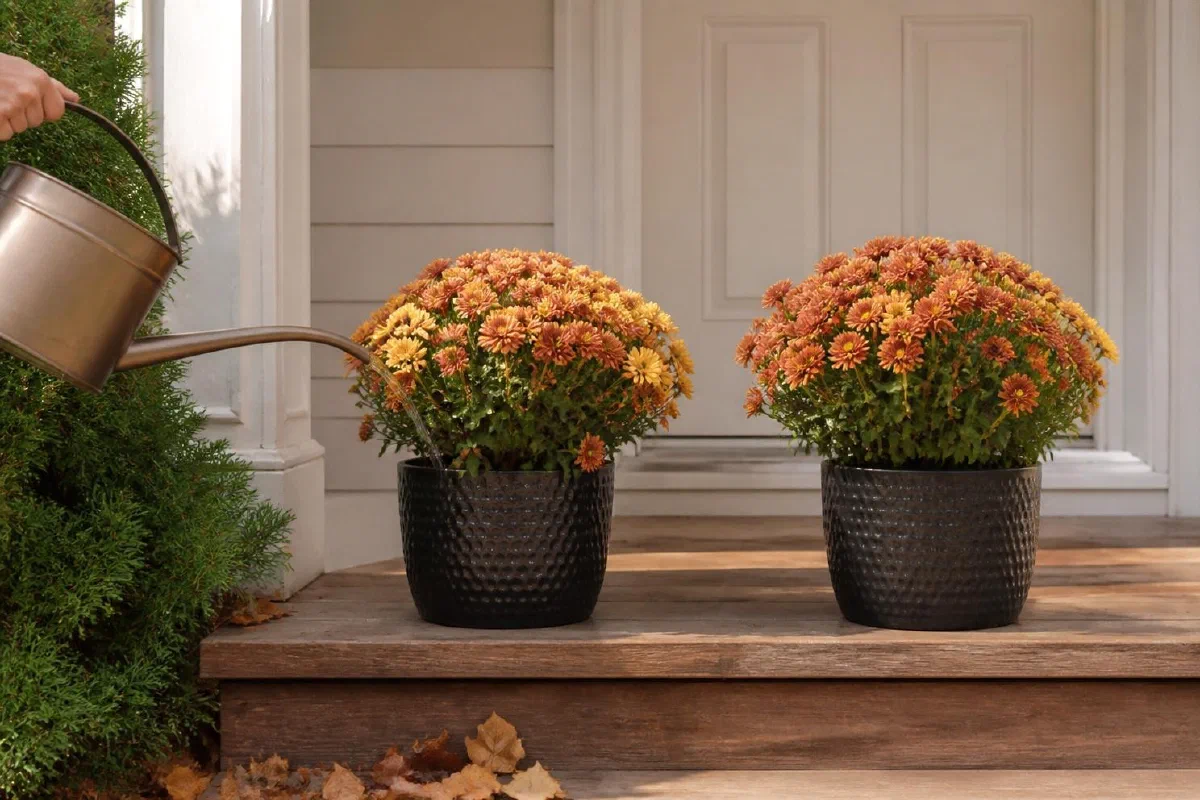
Water at the soil, under the leaves, until it runs out the bottom. Not over the top of the canopy.
This is the habit that changes the outcome, and it is the one people get wrong because watering the flowers looks like caring for the flowers. A mum’s canopy is dense enough that overhead water mostly lands on petals and sits there. Wet petals in a tight dome go brown and mushy, and in a warm week you get botrytis, the gray fuzz on spent blooms that then spreads into the healthy ones.
The canopy also sheds. Pour water over the top of a mum and a good share of it rolls off the outside of the dome and lands on the porch, never reaching the root ball at all. You can water a mum for thirty seconds and have the soil two inches down stay dry.
A long spout watering can (opens Amazon in a new tab) exists for exactly this. The spout reaches under the foliage to the soil line without you having to crouch and hold the leaves back with one hand.
Check daily. In the first hot weeks of September a 10 inch pot on a south-facing step can need water twice. The test is your finger, an inch down, not the look of the surface. Surface soil dries and lightens hours before the root ball does, and going by color alone is how people end up both overwatering and underwatering the same plant in the same week.
How to Care for Mums in Pots
Once it is potted and you have the watering rhythm, the routine is short:
- Water at the base daily, twice on hot days, until it drains from the bottom.
- Deadhead spent blooms by pinching the stem just below the dead flower. This keeps the plant putting energy into the buds that have not opened yet.
- Six hours of sun. Mums set and hold bud in full sun. In deep shade the stems stretch, the color comes in weak, and the whole dome opens up and flops.
- Skip the fertilizer. A mum bought in bud has already been fed everything it needs for this bloom cycle. Feeding it now pushes leaf growth at the expense of the flowers you bought it for. This is about the plant you just carried home, not about mums in general: a garden mum you grow on through the summer is a heavy feeder and wants feeding, while the one in the pot has already had its meal.
- Pull it under cover for a hard freeze, not for a light one. More on that below.
That is genuinely the list. Potted mums are not fussy plants, they are thirsty ones.
Do Mums Need Sun or Shade
Sun. Six hours minimum, eight is better, and it should be direct rather than filtered through a screen or a tree.
Mums are sold as fall decor, so people put them where fall decor looks good, which is often a shaded north-facing step or a covered porch corner that never sees a direct ray. The plant does not care where it looks good. In less than six hours the stems stretch reaching for light, the dome opens up and flops outward, and the color on the buds that do open comes in washed out.
There is a tradeoff worth knowing about. More sun means more water, not a little more. The same 10 inch pot that needs one drink on a shaded step can need two on a south-facing one in early September. If your only full-sun spot is a hot concrete stoop, plan on checking it twice a day for the first few weeks and consider going up a pot size.
One thing almost nobody mentions: mums set bud in response to lengthening nights, not to temperature. A pot sitting directly under a porch light that burns until midnight, or beside a bright street lamp, can get a confused signal and hold off on setting bud. This does not matter for a plant that arrived from the grower already covered in bud, since that work is done. It matters if you are growing a hardy mum on through the summer for its own fall show. Give that one honest darkness at night.
How to Deadhead Mums in Pots
Follow the stem down from the dead flower to the first set of healthy leaves or the first side bud, and cut or pinch there. Take the whole spent head and its little stem, not just the browned petals.
Soft green stems come off cleanly between thumb and finger. Anything woody enough to tear should get small snips instead, because a torn stem stays open longer and gives rot an entry point.
A few things that make the difference:
- Do it every few days, not every few weeks. On a mum in full flower this is a two minute job standing there with your coffee. Let it go a fortnight and you are pulling out handfuls of brown mush and knocking healthy buds off while you do it.
- Never shear the dome flat. Running scissors across the top is fast and it takes off every unopened bud along with the spent ones. Work by hand, from the top down, one head at a time.
- Get the dead heads off before rain. A spent bloom left sitting in the canopy holds water for days, and that wet brown flower is exactly where botrytis starts before it spreads into the good ones.
- Know what it does and does not do. Deadheading keeps the plant tidy and pushes energy toward buds that have not opened. On a mum you bought in full bloom, with no buds left in reserve, it will not buy you extra weeks. That is decided at the register.
If it is a hardy mum you intend to overwinter, stop there and leave the stems standing once the last flush finishes. More on that below.
How to Keep Mums Alive Past Two Weeks
Three things, in order of how much they matter:
Buy in bud. A mum that is 80 percent tight green bud with a little color showing will give you five or six weeks. Clemson’s selection advice says the same thing: the plant with the fewest open flowers now has a showy display for much longer. A mum in full open bloom is already partway through its cycle, and you are buying the back half of it. The full one looks better in the cart and worse in October. This single choice is worth more than everything else on this page.
Get it out of the nursery pot. Covered above. Small root-bound pot, one missed afternoon, browning from the center.
Water under the canopy. Also covered above. It is the difference between petals that fade and petals that rot.
If you do only those three, you have solved most of what goes wrong. Everything else is refinement.
Why Are My Mums Dying
Match the symptom to the cause:
Brown and crisp from the middle out. It dried out, probably more than once. The center of the dome is the most crowded part and gets the least water when you pour from above. Move to a bigger pot, water at the base.
Brown, soft, mushy petals with gray fuzz. Botrytis from wet flowers. Deadhead the affected blooms, get the water off the canopy, improve air movement by not crowding pots together.
Yellowing lower leaves, soil stays wet for days. No drainage. Check that the pot actually has open holes and is not sitting inside a decorative sleeve or a saucer full of standing water.
Stems stretched, plant flopping open. Not enough sun. Move it to a spot with six hours.
Looked perfect at the store, declined immediately at home. It was in full bloom when you bought it. Nothing is wrong. You bought the end of the cycle.
How Long Do Mums Last
In a pot, with good care, the numbers are honest and narrow:
| Bought as | Realistic bloom window |
|---|---|
| Full open bloom | 2 to 3 weeks |
| Half open | 3 to 4 weeks |
| Tight bud, color just showing | 5 to 6 weeks |
Cooler weather extends all three. A stretch of 60 degree days will hold a mum noticeably longer than a warm September, because heat speeds the whole bloom cycle up.
When to Buy and Plant Mums in Pots
Mid to late September, in bud, is the sweet spot for most of the country.
Buy in August and you are asking the plant to hold through the hottest weeks still on the calendar, which shortens the bloom window no matter how well you water. Buy in mid October and the good ones are picked over and what is left has been sitting on a hot asphalt lot with irregular watering for weeks.
Look at the plant, not the sign. You want tight buds with a little color breaking, dense foliage all the way to the soil line, and no brown in the center of the dome. Lift it. A pot that feels light for its size has been dry recently, and probably more than once.
As for when to plant it, that is the day you bring it home, whatever the date on the calendar. There is no settling-in period and nothing gained by leaving it in the shipping pot while you decide where it goes. The pot is the problem, so fix the pot first.
Planting a hardy mum in the ground is a different question with a different answer, and the answer is spring. Failing that, get it in at least six weeks before your ground freezes so the roots have time to grab hold.
Are Mums Better in Pots or in the Ground?
It depends entirely on whether you want fall color or a plant.
Pots win for the fall porch. You can put a mum exactly where it does the most good, flanking a door or sitting on a step, and move it out of a freeze in thirty seconds. You control the soil, so drainage is never a guess. When the blooms finish, the plant comes out and something evergreen goes in. That flexibility is the whole point, and it is why almost every mum sold in September is sold in a pot.
The ground wins for a mum that comes back. Soil holds moisture and insulates roots in a way that no container does. A mum in the ground might need water twice a week in September. The same plant in a 10 inch pot needs it daily, sometimes twice. Come January, roots in the ground sit at a temperature the plant was bred for, and roots in a pot on a windy step sit at whatever the air is doing.
So the honest split is this. If you are buying mums in September for the porch, buy them for the porch and let them be seasonal. If you want mums as a perennial in the bed, buy hardy garden mums in spring, plant them in the ground, and let them root all summer before they bloom.
Trying to have it both ways, buying a fall mum in a pot and hoping it becomes a perennial, is where most of the frustration comes from.
Hardy Mums vs Florist Mums
This is the distinction that explains most of the disappointment, and garden center tags are not always clear about it.
Hardy mums, also sold as garden mums, are bred to survive winter and come back. Reliably perennial in USDA Zones 5 through 9, with some cultivars holding in Zone 4 with protection. Clemson’s garden mum guide lists garden mums as hardy across Zones 5a to 9b, and notes that many people still treat them as short-season, fall-planted annuals. They put energy into roots as well as flowers.
Florist mums are bred for one spectacular bloom in a greenhouse. Shallow-rooted, no real winter hardiness, treated as an annual almost everywhere. Most of what sits outside a grocery store in September is this.
| Hardy garden mum | Florist mum | |
|---|---|---|
| Sold as | “garden mum”, often tagged with a zone | “mum”, usually no zone on the tag |
| Where you see it | Garden centers and independent nurseries | Grocery stores, big box seasonal aisles, roadside stands |
| Roots | Deeper, spreading, built to hold a plant over | Shallow, packed into the shipping pot |
| Winter hardiness | Typically Zones 5 to 9, a few cultivars to Zone 4 with protection | None worth planning around |
| Comes back next year | Sometimes, if planted in spring | No |
| Best use | Spring planting in a bed | Fall color, then compost |
The catch: even a genuinely hardy mum bought in September usually does not come back. Not because the plant is wrong, but because a fall-planted mum spends its energy on the flowers you bought it for instead of on roots, and goes into winter without an established root system. Hardy mums that perennialize are almost always ones planted in spring.
So buy fall mums as seasonal color and enjoy them as that. If you want mums that return, plant them in spring, pinch the growing tips back every few weeks until mid-July so they branch instead of stretching, and let them bloom in place that fall.
Potted Mums Care Through the First Frost
Mums handle a light frost. A night in the high 20s will not kill a healthy plant, and cool nights actually deepen the color on a lot of cultivars.
A hard freeze, meaning mid-20s or lower for several hours, will finish the open blooms. If a hard freeze is forecast and the plant still has weeks of bud left, move the pots into a garage or under a covered porch for that night and put them back out in the morning. A pot you can lift with one hand is a pot you will actually bother to move, which is another quiet argument for not going bigger than 12 inches on a step.
Once the blooms are done, the pot is done for the season. For most fall mums that means composting the plant, keeping the planter, and putting an evergreen or a branch arrangement in it for the rest of the year. If you bought a genuinely hardy garden mum and want to try holding it, read the next section before you throw anything out.
Mums in Pots Over Winter: What Actually Works
The honest answer first. Most mums sold in the fall are florist mums, and a florist mum is an annual. It is not going to overwinter in a pot, in the ground, in a garage, or anywhere else, and no amount of care changes that. If the tag says nothing about a zone, assume this.
If you have a hardy garden mum, it is possible, and the odds are still not great. Two reasons. First, a plant that spent September pushing flowers went into winter without building roots, which is the same reason fall-planted hardy mums so often fail to return. Second, roots in a container sit at roughly the temperature of the air around the pot, with none of the buffering that a foot of soil provides. The working rule is that a plant needs to be hardy about two zones colder than yours to reliably survive a winter in a pot left outside. In Zone 6 that means a mum rated to Zone 4.
Two methods are worth the effort:
Move it somewhere cold but sheltered. After the first hard freeze has browned the top growth, cut the stems back to roughly four to six inches. Move the pot into an unheated garage, shed, or crawlspace, somewhere that stays cold enough to keep the plant dormant but out of wind and deep freeze. Water it lightly about once a month, just enough that the root ball never goes bone dry. Bring it back out in spring once hard freezes are finished.
Put it in the ground. Dig a hole in a spot with real drainage and plant the mum out, or sink the whole pot to its rim. Water it in well. Then wait for the ground to freeze before you mulch, not the other way around. Mulching a warm bed keeps the soil warm and invites voles into the crown, which is a worse outcome than the cold. Leave the old stems standing through winter; they trap leaves and insulate the crown better than bare soil does.
Either way, wait until spring to cut anything back hard. Green shoots appearing at the base by mid spring means it made it. Nothing by late May means it did not, and you can plant something else there without guilt.
The mums that come back year after year are almost always spring-planted, pinched back every few weeks until mid-July so they branch instead of stretching, and left in place. Trying to convert a September porch mum into a perennial is the long way around.
Fall Planter Ideas That Are Not Just a Mum
A mum on its own reads like a grocery store impulse buy. A mum with two companions reads like you meant it, and the companions almost always outlast the mum.
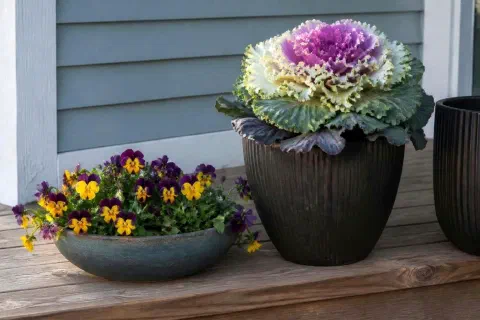
- Mum, ornamental kale, trailing ivy. The kale gets better as it gets colder and holds long after the mum is spent.
- Mum, dwarf fountain grass, creeping jenny. Height, movement, and something spilling over the rim.
- Two mums in different sizes plus a small pumpkin resting on the soil. The cheapest version and it still looks composed.
- Mum, heuchera, dusty miller. The heuchera is a true perennial, so the pot has something in it next spring.
Plant them at the same depth they came at and water the whole pot at the base, same as before.
Fall Planters for a Front Porch
Scale is what separates a porch that looks styled from one that looks like it has pots on it.
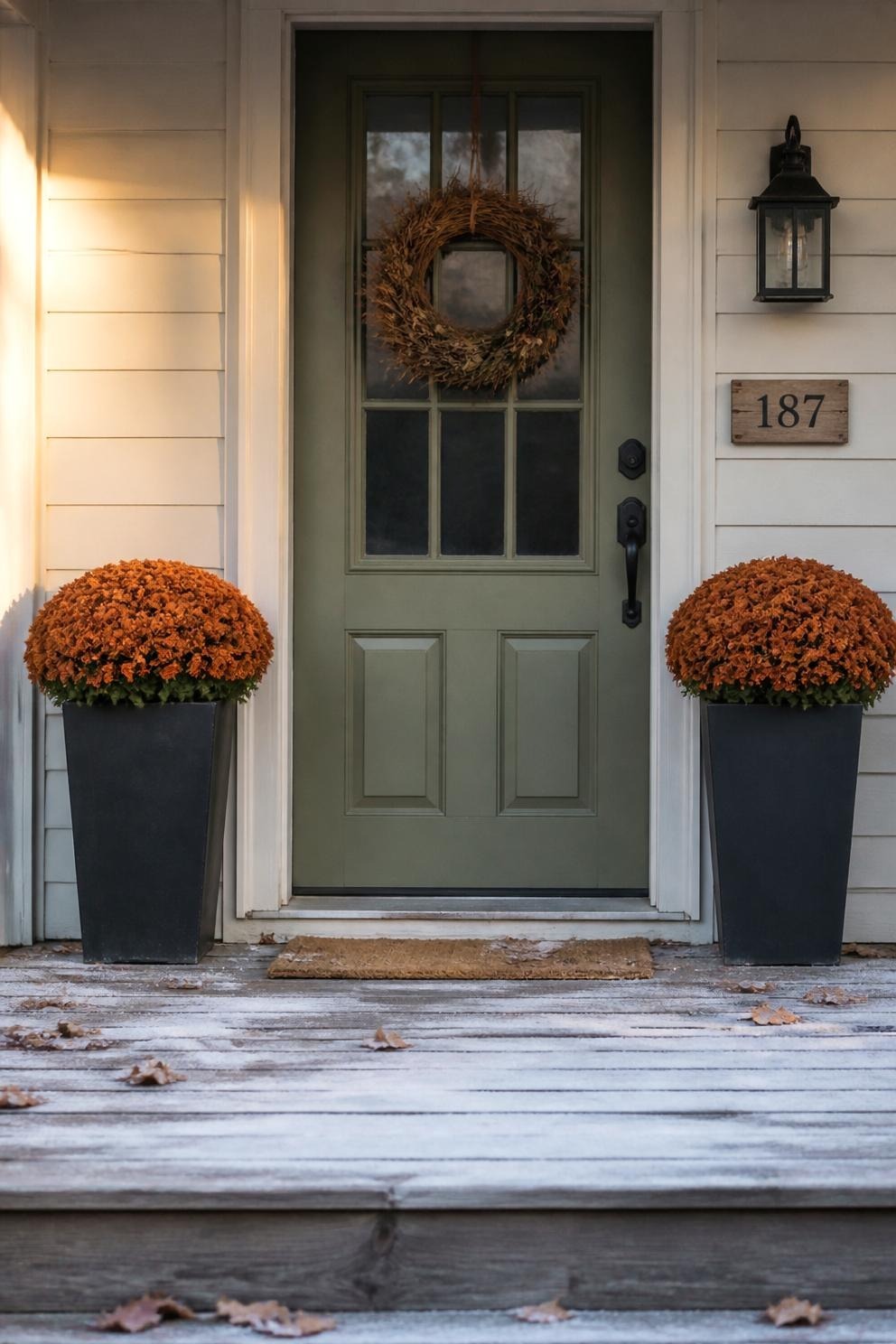
Match the pot to the door, not to the plant. A standard 36 inch entry door carries planters roughly 16 to 22 inches tall on either side. Anything shorter reads as clutter around the base of the door rather than as a frame for it.
Pairs work. Odd numbers work. Four pots of four different sizes and materials do not, and that is the most common way a porch ends up feeling busy instead of full.
Keep the palette to two or three colors across the whole porch. Rust and cream. Deep gold and green. The mums will bring plenty of saturation on their own, and every extra color you add competes with them.
If the porch gets full afternoon sun, weight matters as much as looks. Tall planters catch wind. Put a few inches of gravel in the bottom before the soil goes in, which adds ballast and helps with drainage at the same time.
Mums Care: The Short Version
Pin this part:
- Buy in tight bud in mid to late September, never in full bloom.
- Repot into 10 to 12 inches with drainage the day you bring it home.
- Loosen the root ball before it goes in.
- Water at the soil line daily, twice when it is hot, until it drains.
- Deadhead spent blooms.
- Six hours of sun.
- No fertilizer.
- Cover it for a hard freeze, not a light one.
What I’d Actually Buy
Everything below came off Amazon’s Best Sellers sort, not a sponsored row, and the picks are chosen for the failure this article is about.
- Quarut 10 inch whiskey barrel planters, 3 pack (opens Amazon in a new tab) (4.6 stars, 1K+ bought in the past month). The right diameter for a garden center mum, with drainage holes and a saucer already there. This is the one thing on the list that fixes the most.
- Miracle-Gro Moisture Control potting mix, 8 qt 2-pack (opens Amazon in a new tab) (4.7 stars). Retention is the entire problem with potted mums, so this is the one place the upgrade is worth it.
- 2 gallon watering can with a removable long spout (opens Amazon in a new tab) (4.4 stars). Reaches under the canopy to the soil. Two gallons does a pair of porch pots without a refill trip.
- Self-watering pots, 8/10/12 inch with reservoir and water level indicator (opens Amazon in a new tab) (4.6 stars, 2K+ bought in the past month). If you travel, or you know daily watering is not going to happen, the reservoir buys the margin a blooming mum does not otherwise have.
- 22 inch tall planters, set of 2 (opens Amazon in a new tab) (4.6 stars, 700+ bought in the past month). For flanking a front door. Enough soil volume that the pot is not dry by lunch.
The pot and the mix are the two that change whether the plant is alive in October. The rest is comfort.
What to Read Next
- Container Soil Drying Out Too Fast? Fix This Before Buying More Plants goes deeper on the watering problem that finishes most potted mums.
- First Frost Checklist for Pots and Small Gardens is the night-before routine when a freeze is in the forecast.
- Fall Planter Ideas for Cool-Weather Flowers has the alternatives if you want color once the mums are done.
- Front Porch Planter Ideas That Look Full Without Constant Replanting covers the arrangement, so a pair of pots reads as designed rather than parked.