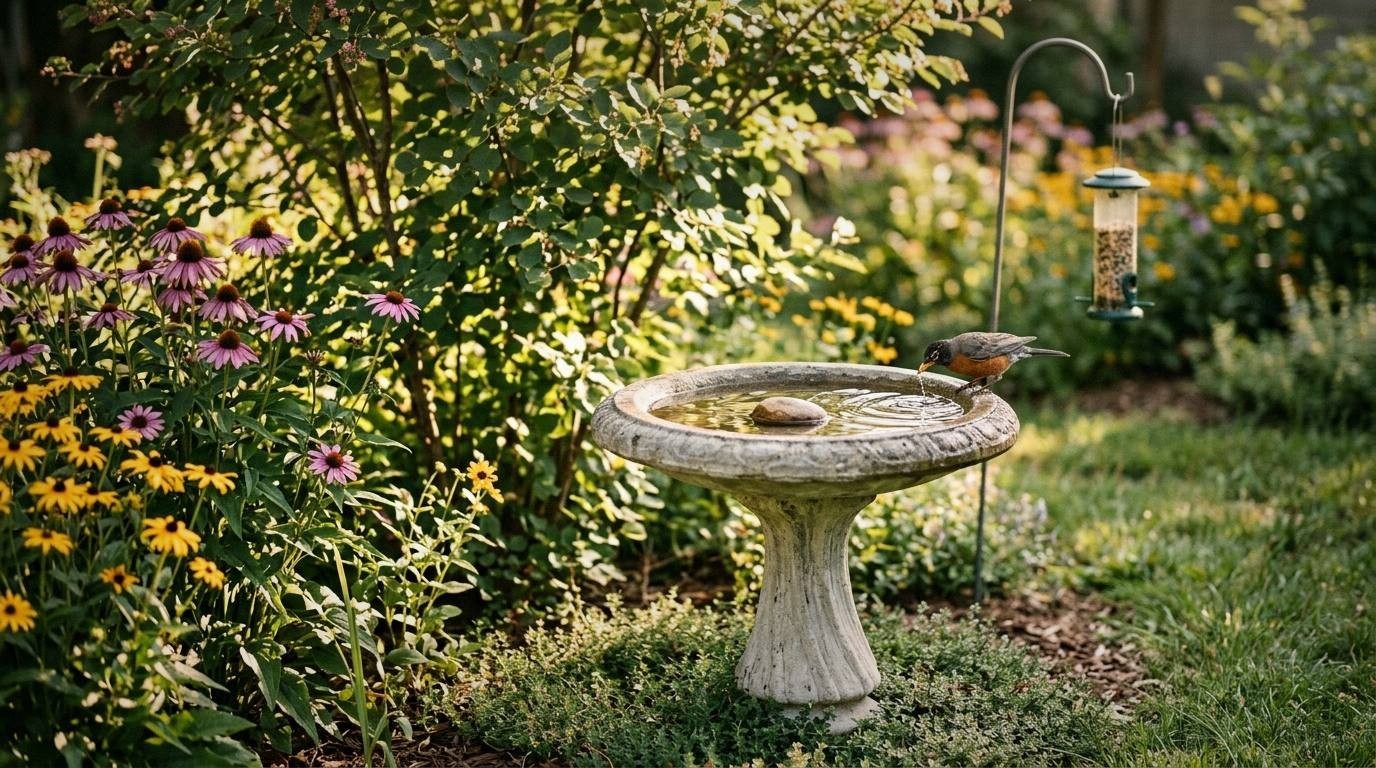
The bird bath was already here when we moved in. Concrete, about two feet tall, with a wide shallow bowl that collects leaves and mosquitoes if you don’t keep it filled with fresh water. The previous owners had it tucked next to the porch steps where nobody could see it. It was half buried in overgrown liriope and had a green film on the inside of the basin.
I almost hauled it to the curb.
Instead, I scrubbed it out with a stiff brush and baking soda, moved it to the back corner of the yard where I could see it from the kitchen window, and filled it with the hose. Then I forgot about it for a week.
The birds didn’t forget. A robin showed up on day three. By the end of the first week, I was watching chickadees take turns splashing from the kitchen while I waited for the coffee to brew.
That was three years ago. The bird bath and I have a routine now.

The Routine
I wake up at 6:15 most mornings. Before I check my phone, before I look at email, before I do anything that involves a screen, I go outside.
I fill the bird bath first. It takes about thirty seconds with the hose. In summer I dump and refill it because the water gets warm and stale overnight. In cooler months I just top it off. The birds seem to prefer it full to the brim, about two inches of water in the basin.
Then I make coffee. Nothing complicated. Regular drip coffee, black. I carry it outside and sit in the canvas camp chair I keep next to the back door. From that chair I can see the bird bath, the garden beds, the fence line, and a strip of sky above the neighbor’s maple.
I sit there for twenty minutes. Sometimes I finish the coffee. Sometimes it goes cold.
That’s the whole routine. Fill the bird bath. Make coffee. Sit. Watch. Go inside when the mug is empty or when twenty minutes have passed, whichever comes first.
What Shows Up
The regulars come in a predictable order. Robins are first, usually by 6:30. They’re ground birds, so they hop around the base of the bath before jumping up to the rim. They like to wade in and flick water over their backs with a full-body shake. Robins bathe like they mean it.
Chickadees arrive next, in pairs or small groups. They perch on the rim and dip their heads quickly, almost nervous about it. In and out. They prefer the bird bath when it’s quiet, so they wait for the robin to leave.
House finches come mid-morning, usually after I’ve gone inside. I see them from the kitchen window. The males are red-headed and loud about it. The females are brown and streaky and do most of the actual bathing.
Cardinals show up on their own schedule. Sometimes early, sometimes not at all for three or four days. Then a male will land on the rim and sit there for a full minute without moving, just looking around, before taking two precise dips and flying to the holly bush to dry off. Cardinals are careful about everything.
In spring, I get warblers passing through during migration. Small, bright, fast. They use the bird bath like a rest stop and are gone in a day or two. I’ve seen yellow warblers, a black-and-white warbler once, and something orange that I still haven’t identified.

The Seasons From One Chair
Sitting in the same spot every morning for three years teaches you things about your own yard that nothing else does.
In March, the light comes from low in the east and hits the bird bath directly. Everything is sharp and gold. The yard is brown and bare and honest. By April, the shadows get shorter and the first green shows up along the fence where the hostas push their rolled-up leaves through the mulch.
Summer mornings are the best. The air is already warm by 6:30. The garden is loud with insects and birdsong. The bird bath gets heavy traffic. Some mornings I count six or seven species in twenty minutes. The coffee gets cold because I keep watching.
Fall is quieter. The robins leave by October. The chickadees stay. Leaves pile up in the bird bath basin and I scoop them out by hand. The morning light shifts south and the chair ends up in shade earlier and earlier until I have to move it two feet to stay in the sun.
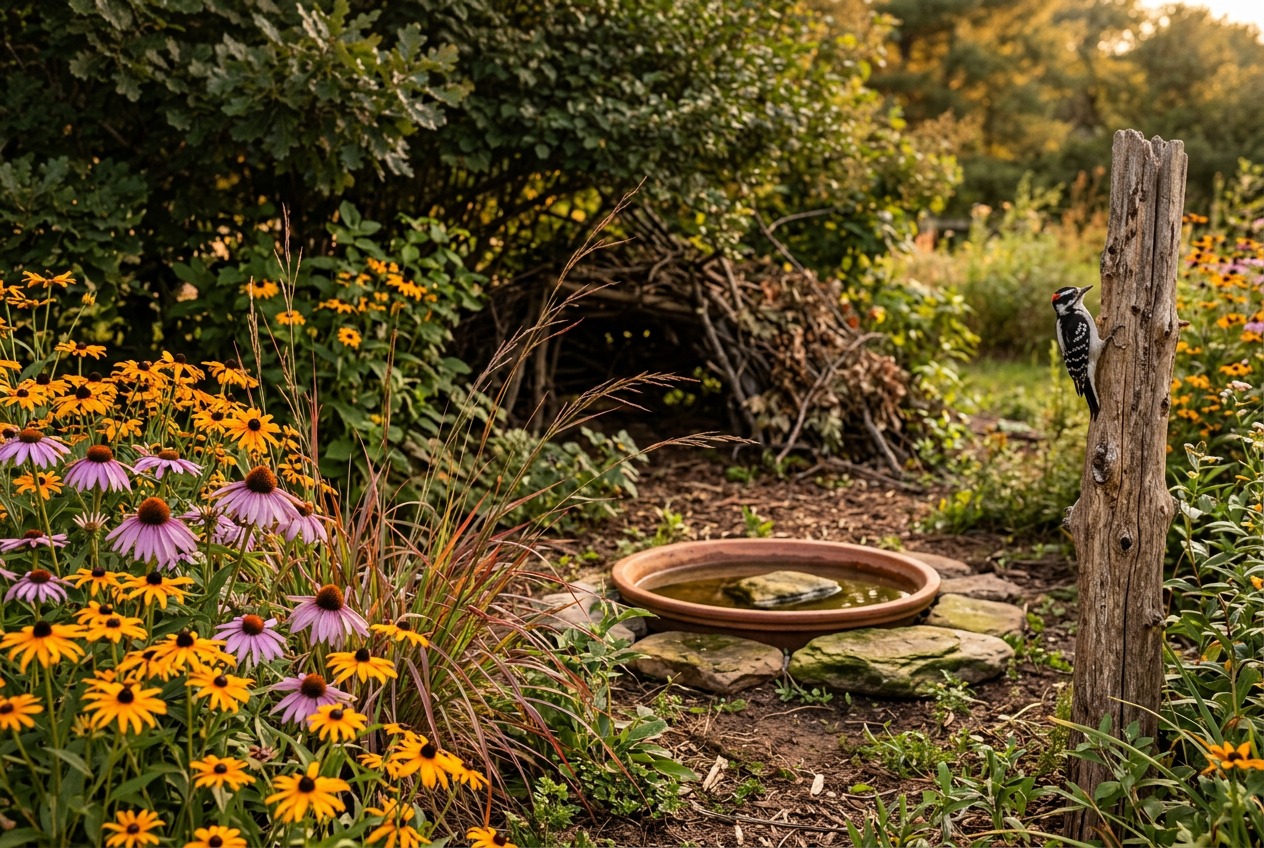
Winter is the hardest season for the routine. Below freezing, the bird bath ices over. I carry a kettle of warm water out to melt it, which feels like a lot at 6:15 in January. But the birds still come. Chickadees, juncos, a downy woodpecker that perches on the rim and hammers at the ice if I’m late.
I bundle up and sit for ten minutes instead of twenty. The coffee steams. The yard is bare and grey and still. It’s a different kind of beautiful than summer, but it’s still worth getting out of bed for.
The Bird Bath Itself
People ask me what kind of bird bath I use, like there’s a secret. There isn’t. It’s a concrete pedestal bird bath, the basic kind you see at garden centers for $30 to $50. No fountain, no pump, no solar attachment. Just a bowl on a post.
Concrete works because it has texture. The inside of the basin is slightly rough, which gives birds something to grip. Smooth ceramic or glass bird baths look pretty but birds slip on them. They won’t come back to a bath where they don’t feel stable.
The basin is about 18 inches across and 2 inches deep at the center, shallower at the edges. That depth matters. Small birds like chickadees and warblers want half an inch to an inch of water. Robins will wade into two inches. Deeper than that and you’ll only get starlings.
I keep a flat stone in the center of the basin, about the size of my fist, poking up above the waterline. Butterflies land on it to drink. Small birds perch on it to test the water before committing. It cost nothing and made the bird bath twice as useful.
I change the water every two to three days in summer, once a week in cooler months. Stagnant water breeds mosquitoes and algae. Fresh water attracts birds. It’s that simple.

Why Twenty Minutes of Nothing Matters
I didn’t start this as a mindfulness practice. I didn’t read an article about morning routines or digital detoxes or being present. I started because the bird bath was there and the coffee was ready and the chair was by the back door.
But three years in, I can tell you what it does. The days I skip the morning sit, the ones where I grab my phone first or go straight to the computer, feel different. Tighter. More reactive. Like the day is already running and I’m behind before it starts.
The days I sit outside first feel like they have a cushion at the front. Twenty minutes of nothing before the first demand shows up. Twenty minutes of watching birds do bird things and letting the coffee work. The day starts when I decide to go inside, not when the phone buzzes.
I protect those twenty minutes the way I protect nothing else on my schedule. If I have an early meeting, I get up earlier. If it’s raining, I sit under the porch overhang with the chair pulled close to the wall. If it’s 20 degrees, I bundle up and make it ten minutes instead of twenty.
The bird bath cost nothing because it came with the house. The camp chair was $15 at a sporting goods store five years ago. The coffee is whatever was on sale. The birds are free.
There’s no app for what this does. No optimization. No life hack. It’s just a person, a chair, a bird bath, and enough time to drink a cup of coffee before the world starts asking for things.
That’s enough. Most mornings, it’s more than enough.