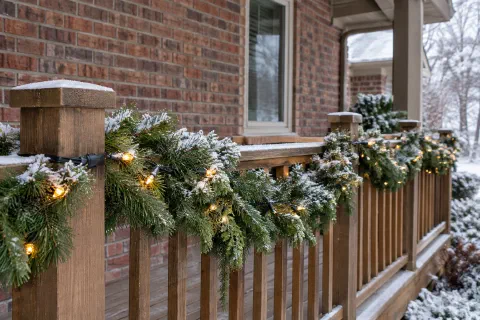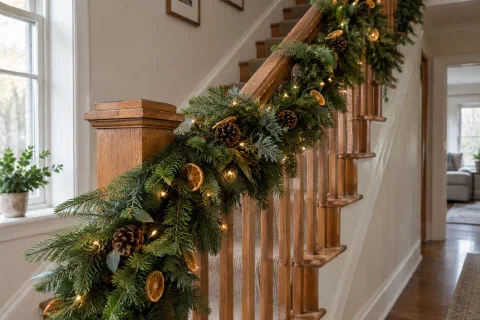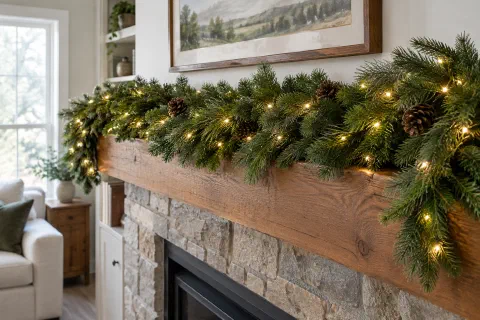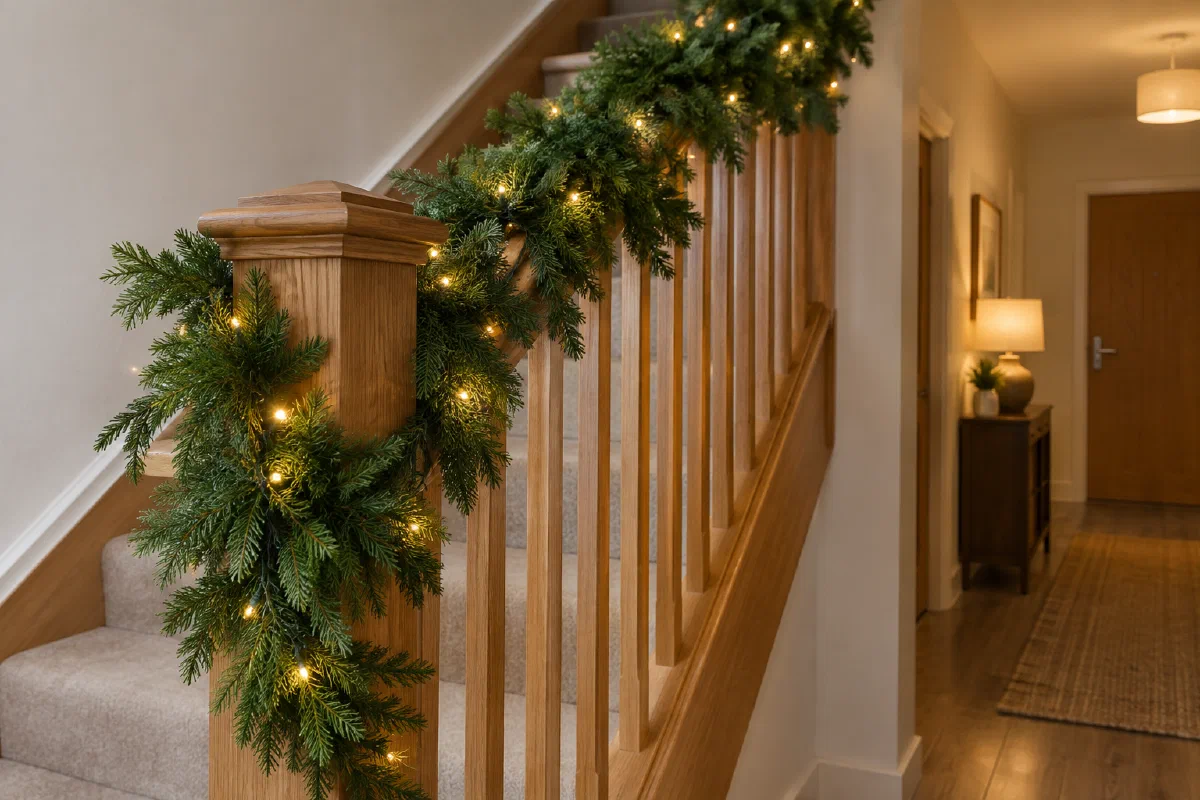
The stair rail in my last apartment had no outlet within thirty feet of it. The bathroom was closer than the nearest plug, and I still wanted garland down that rail every December.
That’s the real problem with lighted Christmas garland. The garland is easy. The power decides where it gets to go. If you rent, you’re not paying an electrician, and you’re not stapling a cord along a baseboard you hand back in May.
So this is the no-outlet version: a stair rail, a headboard, a mirror, a window, a balcony rail. Five spots, four ways to power them, and an honest answer about which holds up in January.
Which Power Option Fits Your Spot
Four ways to light garland with no outlet nearby, each with a catch worth knowing before you spend anything.
| Power source | What it runs | Best spot | The honest catch |
|---|---|---|---|
| AA battery pack | Most pre-lit garland, three or four AAs | Stair rail, mirror, bookcase | Cold drains alkalines, and you will swap them mid-December |
| Rechargeable AA batteries | The same garland, same pack | Spots you light every single night | 1.2 volts instead of 1.5, so the bulbs run a little softer |
| USB power bank | USB garland and fairy lights | Balcony rail, window, headboard | Something else to charge, and it has to come inside to charge |
| Extension cord | Anything, including a strand you already own | A porch or entry with an outlet on the other side of the door | The run has to stay out of every walking path and doorway |
Most battery garland runs on a pack of three or four AAs. Treat the run time on the box as the best case: fresh alkalines, room temperature, no wind. In a cold hallway or on a balcony at night you’ll get less. That’s chemistry, not a bad garland. Alkalines slow down as they chill, so the lights dim for a couple of evenings before they quit.
Rechargeables are worth it if you light the same garland every night. They cost more and run slightly dimmer, but a charged spare set in the drawer means the strand never goes dark while you hunt for batteries. Alkalines left in a cold pack can leak, and a leak ruins the pack.
A USB power bank is the quiet winner for a balcony rail or a window. A garland draws so little that a bank lasts several evenings on one charge. The catch is that the bank has to come inside to charge, so you’re either unhooking the garland or leaving a cable where weather can reach it.
How Long Should the Garland Be? Measure the Run
Measure garland length before you buy, then add for the dip. It sags between hooks and needs slack at both ends to sit flat against the rail.
Take the length of the rail and multiply by about one and a half. A 12-foot handrail wants roughly 18 feet of lighted garland for one generous line. Wrap it instead of draping it and you need closer to three times the length.
This is where battery garland shopping falls apart. A 6-foot or 9-foot strand covers a mantel, not a staircase, and joining two strands means two packs and two timers that drift apart.
- Mantel, shelf, or single window: 9 to 12 feet, one strand, one pack
- Stair rail, draped: about 1.5 times the rail length
- Stair rail, wrapped: about 3 times the rail length
- Balcony rail: 1.5 times the rail, plus a second pack past 15 feet
Past 20 feet, that’s a cord problem, not a battery problem.
Step by Step: A Safe Extension Cord Run
Sometimes there is an outlet. It’s just on the wrong side of the room, or inside the door while the garland is outside it. A cord fixes that if you route it like you mean it.
- Look at what’s already plugged in. A garland draws little, but a space heater doesn’t. The USU Extension holiday lighting guide says it plainly: a maze of cords and plugs from one outlet is where the hazard starts.
- Pick a cord rated for the worst place it goes. If any part of the run is outside, use an outdoor-rated cord with a three-prong plug. Don’t run an indoor cord outdoors, and don’t cut off the third prong.
- Use the shortest cord that reaches. More length means more resistance and more cord to coil up and hide.
- Plug into a grounded outlet protected by a ground fault circuit interrupter. If that outlet isn’t protected, a portable GFCI adapter covers the whole run.
- Keep connections off the ground, out of snow, and out of standing water. Point sockets down so moisture can’t sit inside them.
- Tape down anything that crosses a walkway, and don’t run a cord under a rug or a doormat. The CPSC names that one directly : rugs trap the heat a cord gives off.
- Never pinch a cord in a door or a window frame. Doors crush the insulation, and that’s how a cord becomes a fire.
A cord across a doorway or a walking path is a trip hazard, not a decorating choice. If no route keeps it out of the way, that spot doesn’t get a cord.
Safety Rules Before You Touch a Hook
If you rent, the question isn’t which hook is strongest. It’s which one comes off in May with the paint still on the wall.
- Adhesive hooks with pull-tab strips work, but they want a clean, dry, room-temperature surface. A cold window frame or a metal balcony rail in December is the opposite of that.
- Clamp-on rail hooks suit a balcony railing or a stair rail with a lip you can grip. Nothing touches the paint, and the garland comes down in one motion.
- Over-the-door hooks and zip ties are removable and strong. Zip ties have to be cut, so buy a bag of them.
- Nails, screws, and staple guns are out. Past the deposit question, staples cut the insulation on light strings, which is how a strand turns into a shock risk.
- Test every hook twice: once when you hang it, once the next morning. Adhesive that fails usually fails on the first cold night.
The honest trade-off: adhesive is the least visible option and the most likely to let go in the cold. Warm the wall with your hand first, press the full thirty seconds, then wait an hour before hanging anything. If one hook has already failed on that surface, switch to a clamp instead of a bigger strip.
Where to Hide the Battery Pack
A visible battery pack is what makes a battery garland look like a battery garland. Three places hide it well:
- Clip it to the back of the rail or the frame, behind the greenery.
- Drop it into a tin, a basket, or a lidded box on the shelf below, where you can swap batteries without unwinding anything.
- On a balcony, keep it in a lidded container so rain can’t reach it, or tuck it inside a stocking at the end of the run.
Failure modes arrive in the same order every year. The batteries fade, and the lights dim for two evenings before they die. An adhesive hook lets go on a cold wall and takes the garland with it. Then the pack works loose and hangs in plain sight.
Keep It Running All Season
Built-in timers run six hours on, eighteen hours off. That’s the standard cycle, and it’s why the garland is lit when you get home and off while you sleep. Set it once. If your strand has no timer, a plug-in timer does the job on a cord run, and an inline battery timer does it for a pack.
Battery math is simpler than it looks. Count the batteries in the pack, then buy two full sets. One set goes in, one stays in the drawer. Alkalines running six hours a night are good for a few weeks at best once the weather turns, so a mid-December swap is normal.
For the balcony and the front door, cold is the whole story. A garland that looked fine in November looks tired by New Year.
Take the batteries out before you store anything. A pack that sat all winter with alkalines inside it is a pack with corrosion inside it, and that’s how a garland you liked becomes a garland you replace.
Unlit Garland or Pre-Lit Battery Garland?
Buy pre-lit battery garland with a built-in timer when you’re starting from nothing, the run is under about 15 feet, and you want one purchase and one evening of work. That covers most renters and most stair rails.
Go the other way, unlit greenery plus your own battery lights, when you already own garland you like, when the run is long, or when the pre-lit bulbs are too cool for the room. Separate lights let you replace a dead string without replacing the greenery. The trade is one more timer to set and one more pack to hide.
Either way the rule holds. Measure the run, add for the dip, buy the timer, hide the pack. The outlet was never the point.
What to Read Next
- Christmas Garland Ideas for a Small Home has places to hang greenery when every wall is already busy.
- Renter-Friendly Christmas Decor No Nails goes deeper on removable hooks and what comes off clean in January.
- Christmas Window Decorating Ideas for Renters covers the window run, which is the easiest spot to power from inside.
- Christmas Balcony Decor for a Small Apartment handles the outdoor version, including wind and cold.