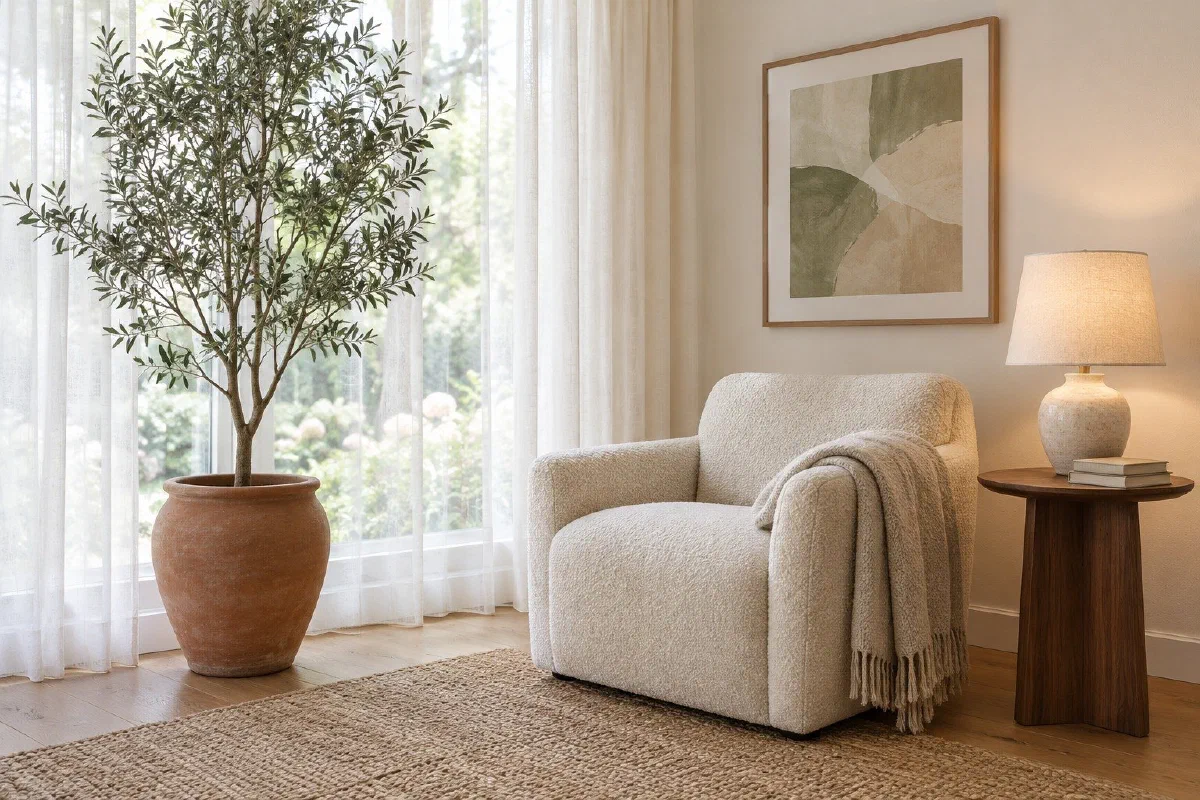
An olive tree is the easiest way to get that tall, soft, gray-green look in a corner, and it works in almost any room as long as you pick the right kind. A real one (Olea europaea) only lives indoors in your sunniest window, the kind that gets at least six hours of direct sun a day, or under a grow light. Anywhere dimmer, buy a good faux olive tree, shape the branches, and nobody on the sofa will know.
Start with the window. The spot and the pot are the fun part, and they come after.
Real or faux olive tree: which one fits your room?
Stand where you want the tree at noon. If the sun lands right on that spot for most of the day, a real tree can work there. If the light is bright but never direct, or the spot is across the room from the window, go faux.
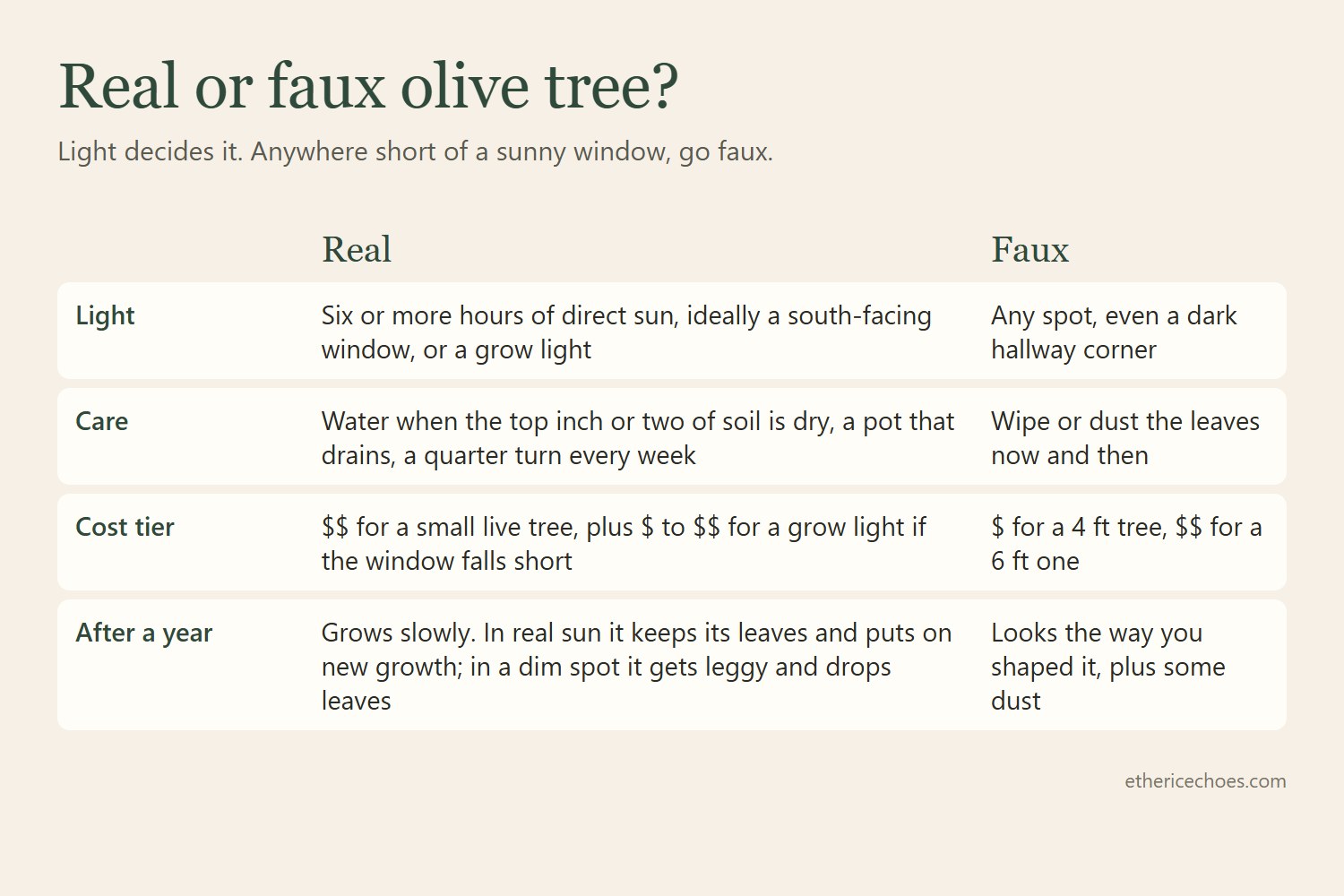
| Real olive tree | Faux olive tree | |
|---|---|---|
| Light | Six or more hours of direct sun, ideally a south-facing window, or a grow light | Any spot, even a dark hallway corner |
| Care | Water when the top inch or two of soil is dry, a pot that drains, a quarter turn every week | Wipe or dust the leaves now and then |
| Cost tier | $$ for a small live tree, plus $ to $$ for a grow light if the window falls short | $ for a 4 ft tree, $$ for a 6 ft one |
| After a year | Grows slowly. In real sun it keeps its leaves and puts on new growth; in a dim spot it gets leggy and drops leaves | Looks the way you shaped it, plus some dust |
The real tree is the better plant and the harder houseplant. Olive trees grow wild on dry, sunny hillsides around the Mediterranean, and a living room is not that. East or west windows can work, but expect slower growth and some leaf drop. When an indoor tree goes thin, too little light is the first thing to suspect.
Dim room? Pick these instead
If the corner you love is dim, skip the real olive tree. Choose a faux one for that spot, or put a real plant there that actually likes it. Our low light indoor plants list ranks the plants that cope with a dim corner, and apartment plants covers what lives in a single window.
Some links below are Amazon affiliate links. If you buy through them, Etheric Echoes earns a small commission at no extra cost to you.
Three olive trees to compare
Choose a faux tree for a dim corner, or a live tree for your sunniest window. The small faux tree needs some branch shaping; the taller one comes in a plain nursery pot. The live tree starts smaller and needs time to grow.
48 inches tall; allow time to shape the branches.
72 inches tall; the trunk comes in pieces to assemble.
A small living tree; check the selected size before ordering.
Want the tree to arrive already potted? The VIVATREES 6 ft faux olive tree comes set in a 9.45 inch white planter. That planter is small next to a 6 ft tree, so you may still want to set it in a wider basket. $$
Olive tree living room ideas: 9 places it looks right
An olive tree is airy. You can see the wall through its branches, so it fills a corner without making the room feel smaller.
1. The olive tree living room corner beside the sofa
The empty corner at one end of the sofa is the classic spot. Pull the pot a few inches off both walls so the branches can spread, and let the canopy rise above the sofa arm. A 6 ft tree suits an 8 ft ceiling; a 4 ft one sits better beside a low sofa or a window. If the corner gets real sun, this is also where a live tree has the best chance. Our guide to tall plants for a living room covers clearance and which tall plants suit which light.
2. Beside an arched mirror
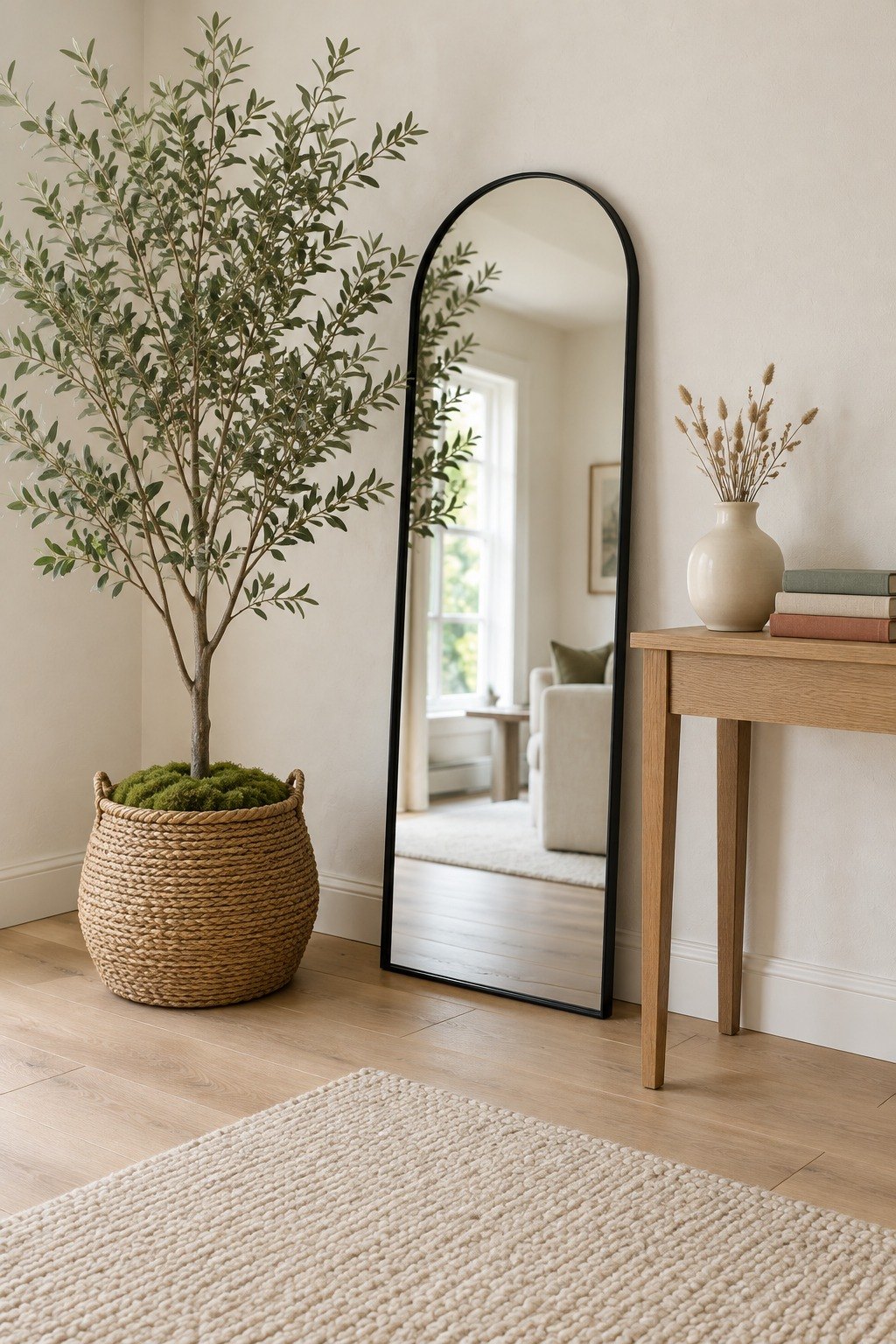
This is the most-saved olive tree Pin we found on Pinterest: a tall arched mirror leaning on the wall, a faux olive tree right beside it in a stone or concrete-look planter, and the cream sofa reflected in the glass. The mirror shows the branches twice, so one tree reads like two. Set the tree to one side of the mirror, not in front of it, so the arch stays visible.
3. Flanking a TV wall or console
Two matching trees, one on each side of a TV wall or a long console, make the wall look planned. Faux is the easy choice here, since most of us keep the TV out of direct sun anyway. Match the pots exactly. A pair of Worth 9 gallon tall planters comes as a set of two in a beige stone look, 14 inches across and 21 inches tall. $$
4. A reading chair corner
Put the tree behind and to one side of an armchair, with a floor lamp on the other side and a small table for a mug. The tree gives the chair a back wall, and the corner starts to feel like a nook. Keep the pot out of the path you walk to sit down.
5. The entry
Most entries are dim, so this is a faux spot. A 4 ft tree fits beside a narrow console or a bench without blocking the door swing. In a tight entry, choose a planter with a small footprint and keep the branches turned toward the wall, not the walkway.
6. A bedroom corner
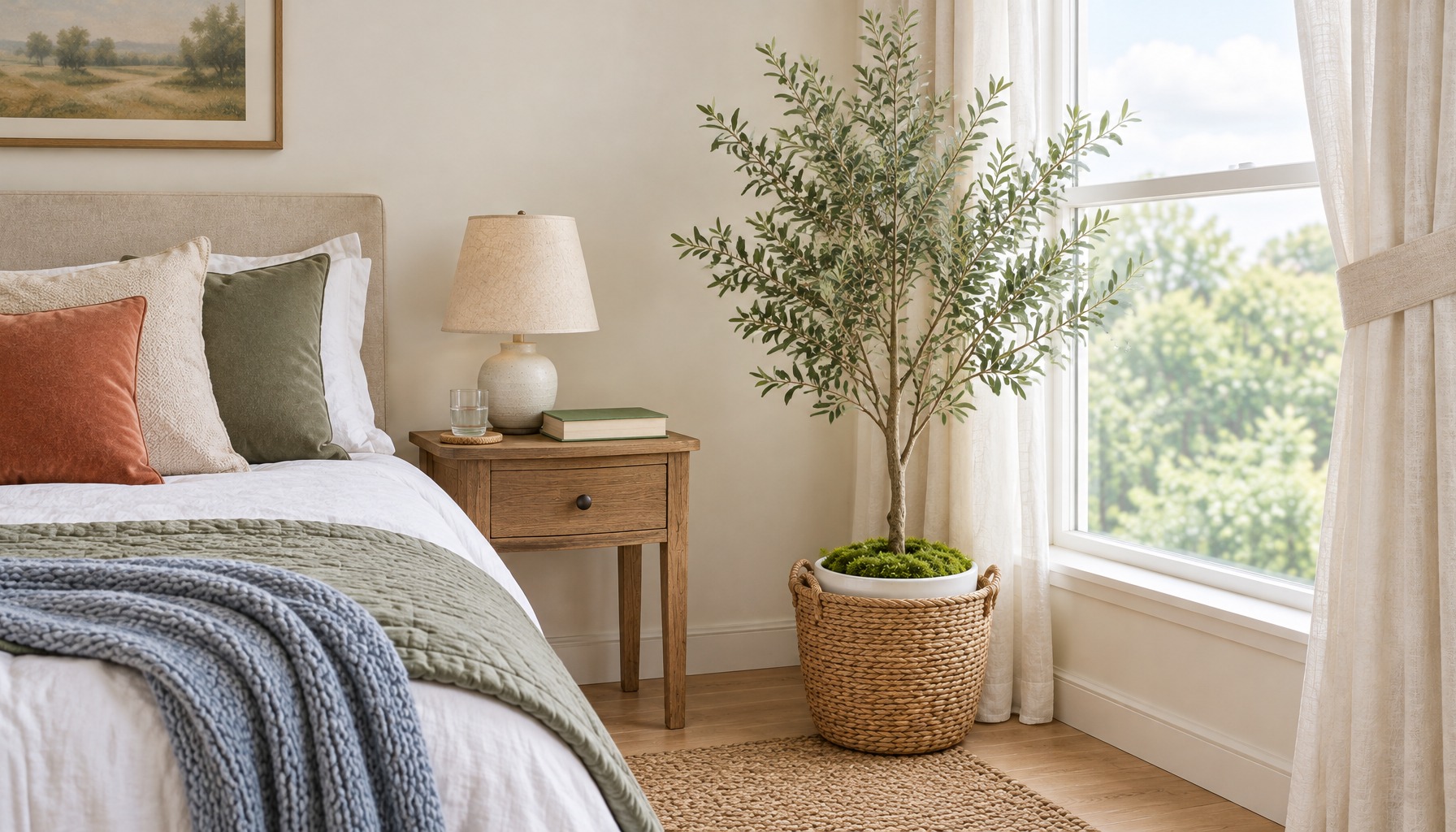
A faux olive tree in a bedroom corner softens a wall of furniture, and nobody has to remember to water it. Set it beside the window, a dresser or a reading chair, never right next to the bed where branches catch on the bedding. Linen curtains in oatmeal or ivory and a wool rug in warm beige pick up the soft color of the leaves.
7. Indoor olive tree pot ideas: terracotta, basket or stone
The pot does half the styling. A terracotta pot looks Mediterranean and warm, a woven seagrass basket looks relaxed and cozy, and a stone or matte ceramic planter looks clean and modern. Keep the tree in its plastic nursery pot and set that inside the decorative one. For a real tree, lift the nursery pot out to water so the roots never sit in a puddle.
Measure the opening before you buy: the nursery pot has to fit through it, even if the basket is wider in the middle. Put a saucer inside a basket under a real tree. A tall planter can give a shorter tree more height. See the planters and baskets with photos below.
Not sure what size to buy? Our guide to what size planter a tall indoor plant needs walks through the measurements.
8. Hide a faux base with moss
Many faux trees, like the 6 ft one above, arrive in a plain black nursery pot. A layer of preserved moss over the top hides the plastic and makes the tree look planted. Tuck it right to the rim so no black plastic shows. On a real tree, keep the moss layer thin and pull it back to feel the soil before you water.
9. Warm lamp light behind it
At night, a warm floor lamp or a small uplight set on the floor behind the pot throws branch shadows up the wall. It is the easiest way to make a corner feel finished after dark. Keep the bulb warm and soft, not bright white. This is for looks only. A lamp will not keep a real tree alive, which is what a grow light is for (more on that below).
How to make a faux olive tree look real
The trick is to undo the factory look. Real olive branches are never straight and evenly spaced.
- Fluff it the day it arrives. Pull every branch out from the trunk.
- Bend some branches. Curve a few, curl the tips of others, and let a couple point down. Too even looks fake.
- Snip off some of the olives. A real tree only carries fruit for a few months, and many faux ones are loaded with it.
- Give a short tree some height with a plant stand, or raise the nursery pot inside a taller planter.
- Wipe the leaves with a damp cloth or run a duster over them every couple of weeks, or they start to look flat and gray.
Indoor olive tree care: keeping a real one alive
A real olive tree is not hard to care for, but it is particular about a few things. Get the light right and most of the rest follows.
How much light does an indoor olive tree need?
At least six hours of direct sunlight a day, ideally more. A south-facing window is the best spot, close to the glass. In winter, when days are short and gray, most homes come up short, and that is when a grow light earns its place.
A floor light with an adjustable stand can tuck behind the canopy. A vertical grow light takes up more room beside the tree but can light it from the side. See the two grow lights with photos below.
Our post on grow lights that look good in a living room shows more ways to hide one.
How often to water an indoor olive tree
Let the top inch or two of soil dry out, then water slowly until it runs out of the drainage hole. Empty the saucer after. In summer that may be about once a week; in winter it can stretch to every two or three weeks. Olive trees handle a little dryness far better than wet roots, so when in doubt, wait a day and check again.
Drainage, soil and the pot
The pot needs a drainage hole. Use a fast-draining potting soil, like a cactus or succulent blend, not a dense mix that stays wet. If you love a basket or a pot without a hole, keep the tree in its nursery pot inside it and never let water pool in the bottom.
Turn it, and keep it out of drafts
Give the pot a quarter turn every week so the tree grows evenly instead of leaning toward the glass. A rolling plant caddy makes a heavy pot easier to turn. Check that your pot base fits the platform.
Keep the tree away from heating vents and cold drafts. If you have a sunny patio, it can summer outside and come back in before nights drop below 40°F.
Pruning is simple. In early spring, as new growth starts, cut back leggy or crossing branches just above a leaf. The tree branches out and stays fuller instead of tall and thin.
Why is my indoor olive tree dropping leaves?
Olive trees are evergreen, so a few old leaves falling now and then is fine. Steady leaf drop means something is off. Check these in order:
- Not enough light. Suspect this first indoors, especially in winter. Move it closer to the sunniest window or add a grow light.
- Too much water. Yellow, limp leaves and soil that never dries out point to wet roots. Check that the drainage hole is not blocked and let it dry more between waterings.
- Too dry. Crisp, curled leaves over bone-dry soil. An underwatered olive tree can drop a lot of leaves at once. Water deeply, then get back to a steady routine.
- A sudden change. A move to a new spot, a cold draft or a quick jump in temperature when the heat comes on can make it shed.
- Pests. Look under the leaves and along the stems for scale and spider mites.
- An outgrown pot. Roots coming out of the drainage hole or a root ball that lifts out as one solid mass means it needs a bigger pot.
If it has dropped almost everything, scratch a tiny bit of bark with your fingernail. Green underneath means the branch is alive and can leaf out again once you fix the cause.
FAQ
Can you keep olive trees indoors?
Yes, if you can give one a very sunny window or a grow light. A compact variety such as ‘Arbequina’ handles pot life best and stays around 4 to 6 ft in a container. ‘Little Ollie’ is another compact choice that does not set fruit. Outdoors, olive trees grow in zones 8 to 10, so in colder places an indoor tree can spend summer on a sunny patio and winter inside.
Will an indoor olive tree grow olives?
Don’t count on it. Olive trees need about two months of cool weather, in the 40s, to flower, and a heated house does not give them that. Indoors you get the silvery leaves and the branching shape, not a harvest.
What size olive tree for a living room?
Match the tree to the room. A 4 ft tree suits a small living room, a spot beside a window or a narrow entry. A 6 ft tree suits a sofa corner under a standard 8 ft ceiling. In a big open room, go taller or use two.
What to buy
Pick the tree by your light, then the pot by your look. These are affiliate links; we may earn a commission at no extra cost to you.
Sources
- NC State Extension Gardener Plant Toolbox: Olea europaea (olive)
- Bloomscape: olive tree care guide
- ELLE Decor: how to grow an olive tree indoors
- Ideal Home: why is my olive tree dropping leaves
- Livingetc: olive tree care indoors
What to read next
- Tall Plants for a Living Room: 9 Indoor Picks by Height if you want other tall plants beside the olive tree.
- What Size Planter Does a Tall Indoor Plant Actually Need? before you buy the pot.
- Indoor Corner Plants for a Living Room, by Light for the corner that does not get sun.
- 10 Low Light Indoor Plants for Dim Rooms for the rooms an olive tree will not like.