
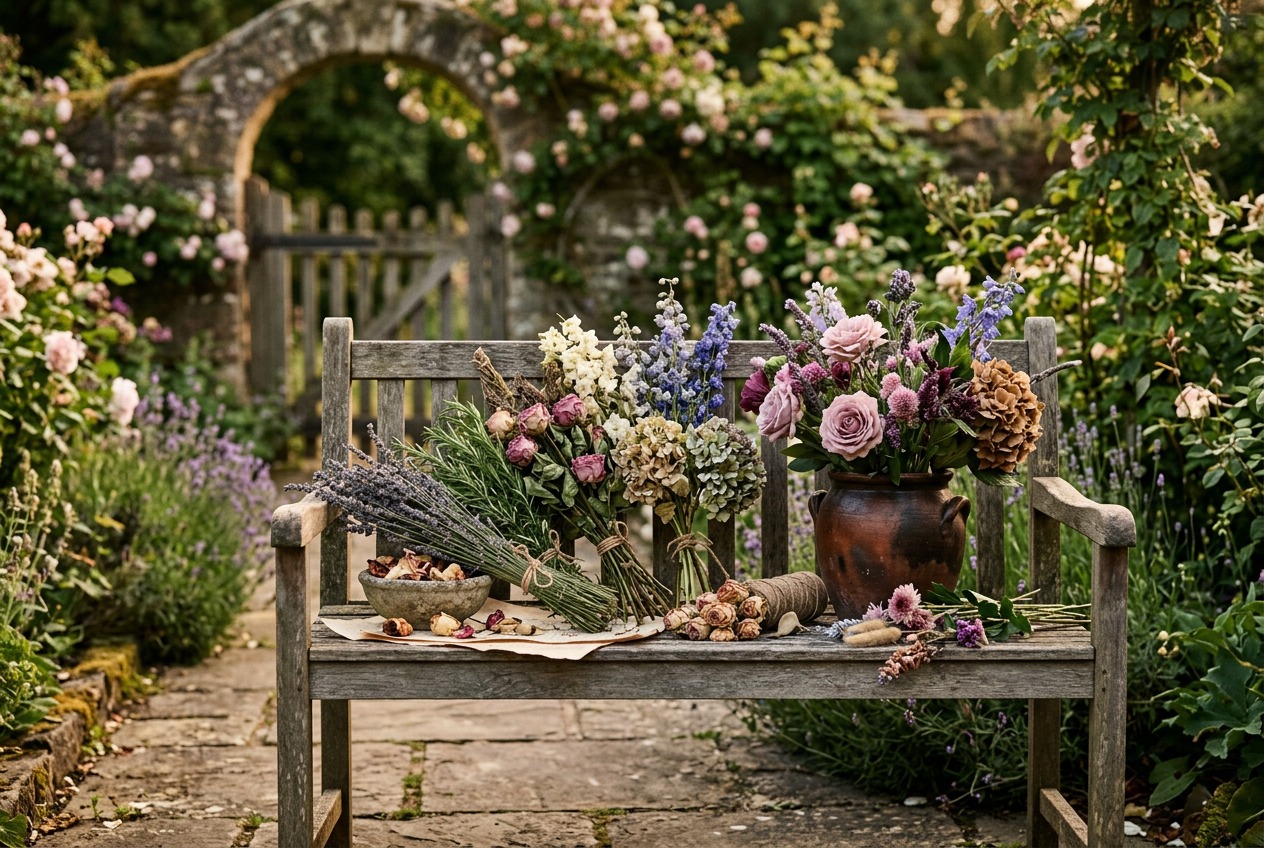
Not every dried flower method works for every bloom. Roses hold up in silica gel but turn brown when air dried in a humid room. Lavender air dries perfectly but crumbles to dust in a microwave. The method you pick matters more than how carefully you do it.
Here are six methods I have tested with specific results for each flower type. Pick the right match and you will get flowers that last 1 to 3 years on a shelf.
When to Harvest for Drying
Cut flowers for drying at the right stage and you solve half the problem before you start.
General rules:
- Harvest mid-morning after dew dries but before afternoon heat
- Cut when blooms are about 75% open. Fully open flowers drop petals during drying.
- Choose stems with no brown spots, insect damage, or wilting
- Cut stems 6 to 12 inches long
- Strip all leaves from the lower two-thirds of the stem immediately
These timing rules apply to all six methods below.
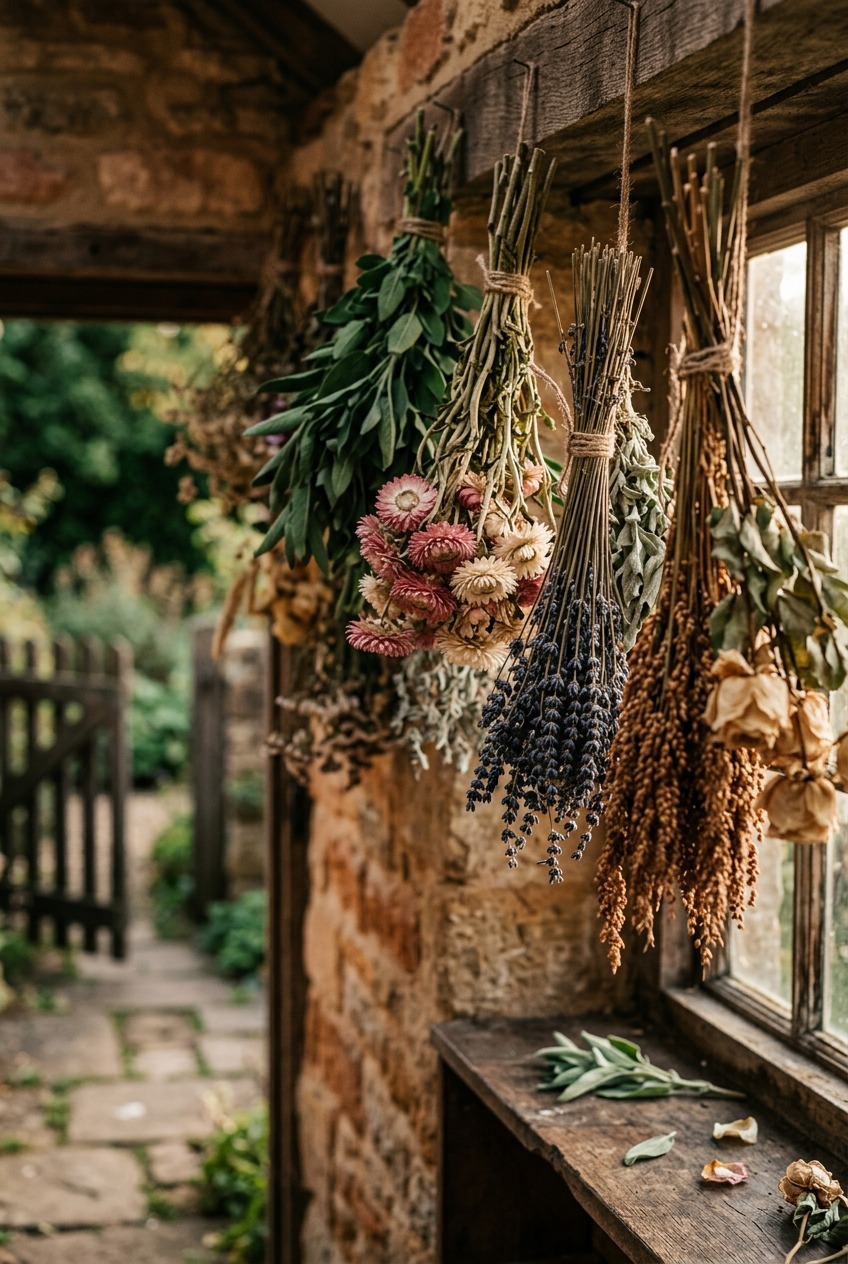
Method 1: Air Drying (Hanging)
The oldest and simplest method. Works best for sturdy flowers with low moisture content.
How to do it:
- Bundle 4 to 6 stems together with a rubber band (not string, because stems shrink as they dry and slip out of knots)
- Hang bundles upside down from a hook, nail, or clothesline
- Space bundles 4 to 6 inches apart for airflow
- Dry in a dark, warm room with good ventilation. A closet, attic, or spare bedroom works well.
- Avoid kitchens and bathrooms. Humidity ruins everything.
Drying time: 2 to 4 weeks depending on flower density and humidity
Best flowers for air drying:
- Lavender (Lavandula angustifolia ‘Hidcote’ or ‘Munstead’). Cut when the bottom third of buds are open. Keeps color and scent for 2+ years.
- Strawflower (Xerochrysum bracteatum ‘Bright Bikini Mix’). Already papery when fresh. Dries in 1 week.
- Globe amaranth (Gomphrena globosa). Retains vivid pink, purple, and white for over a year.
- Statice (Limonium sinuatum). Keeps color better than almost any other flower. Dries in 10 days.
- Yarrow (Achillea millefolium ‘Cerise Queen’ or wild white). Flat heads dry evenly. Great for wreaths.
- Celosia (Celosia argentea ‘Chief Mix’). Both crested and plumed types air dry well.
- Baby’s breath (Gypsophila paniculata). Classic filler. Dries in under 2 weeks.
Flowers that fail with air drying: Roses (petals wrinkle and brown in most climates), dahlias (too dense, they mold before drying), peonies (too many petals, same mold problem).
Method 2: Silica Gel
The best method for preserving flower shape and color. Silica gel absorbs moisture fast enough that petals keep their form instead of shriveling.
What you need:
- 5 lbs of silica gel crystals (about $15 on Amazon or at craft stores like Hobby Lobby)
- An airtight plastic container deep enough to bury your flowers
- A soft paintbrush
How to do it:
- Pour 1.5 inches of silica gel into the container
- Trim flower stems to 1 inch
- Place flowers face up on the silica gel, spaced so they do not touch
- Gently spoon silica gel around and between each petal. Use the paintbrush to nudge crystals into tight spots.
- Bury flowers completely under 1 inch of gel
- Seal the container. Do not open it for 3 to 7 days.
- After drying, gently pour off the gel and lift flowers out. Brush off remaining crystals with the paintbrush.
Drying time: 3 to 5 days for most flowers. Dense blooms like peonies need 6 to 7 days.
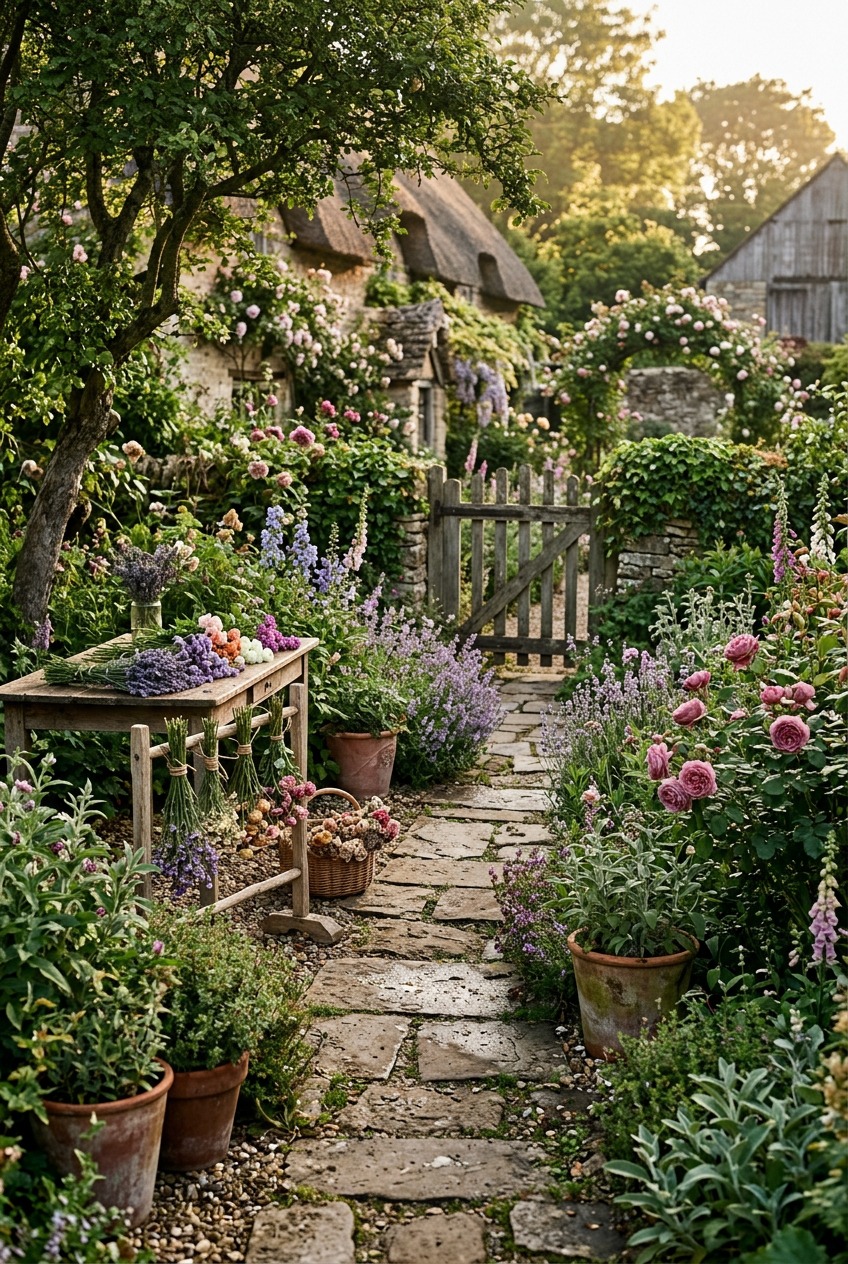
Best flowers for silica gel:
- Roses (Rosa ‘Mr. Lincoln’, ‘Double Delight’, any hybrid tea). This is THE method for roses. They keep shape and color beautifully.
- Peonies (Paeonia lactiflora ‘Sarah Bernhardt’ or ‘Bowl of Beauty’). Dense petals that would mold with air drying. Silica preserves them perfectly.
- Dahlias (Dahlia ‘Café au Lait’ or ‘Dinner Plate’ types). Complex petal structure stays intact.
- Zinnias (Zinnia elegans ‘Benary’s Giant’). Colors stay vivid. Flat shape makes burial easy.
- Ranunculus. Paper-thin petals hold their ruffled form.
- Delphiniums (Delphinium elatum). Individual florets on the spike preserve well.
Pro tip: Silica gel is reusable. Spread used crystals on a baking sheet and dry them in the oven at 250°F for 2 hours. They turn from pink (saturated) back to blue (dry) and work like new.
Method 3: Pressing
Pressing removes all dimension but preserves color and detail for framing, cards, resin art, and bookmarks. The result is a flat, paper-thin botanical specimen.
How to do it:
- Place flowers between two sheets of parchment paper (not wax paper, the wax transfers)
- Set inside a heavy book or a flower press
- Stack 2 to 3 more heavy books on top
- Change the parchment paper after 3 days to prevent moisture from causing mold
- Wait 2 to 4 weeks
Drying time: 2 to 4 weeks
Best flowers for pressing:
- Pansies (Viola x wittrockiana). Flat faces press perfectly and keep their markings.
- Violas (Viola cornuta ‘Sorbet Mix’). Same flat structure, smaller size.
- Ferns. Not a flower, but they press beautifully. Maidenhair fern (Adiantum) is a classic.
- Cosmos (Cosmos bipinnatus). Thin petals go flat without bunching.
- Queen Anne’s lace (Daucus carota). Delicate structure presses into lace-like discs.
- Lobelia. Tiny flowers press flat instantly.
- Single-petal roses. Avoid doubles. Press individual petals for best results.
What does not press well: Anything thick or bulbous. Sunflower centers, dahlia heads, and carnations will mold before they flatten.
Method 4: Glycerin Preservation
Glycerin replaces water in the plant’s cells, keeping stems and leaves flexible and soft. This is the only method that produces flowers you can handle without them crumbling.
What you need:
- Vegetable glycerin (about $8 for 16 oz at a pharmacy or Amazon)
- A tall jar or vase
How to do it:
- Mix 1 part glycerin with 2 parts very hot water. Stir until fully dissolved.
- Cut stems at an angle and split woody stems with a knife
- Place stems in 3 to 4 inches of the glycerin solution
- Set in a cool, dark spot
- Check every few days. Add more solution if the level drops.
- Flowers are done when petals feel smooth and slightly waxy, and leaves turn translucent
Drying time: 2 to 6 weeks
Best plants for glycerin:
- Eucalyptus (Eucalyptus cinerea or silver dollar). Turns a deep olive green. Stays pliable for years.
- Hydrangea (Hydrangea macrophylla ‘Endless Summer’ or ‘Limelight’). Petals become leathery and keep their shape.
- Baby’s breath (Gypsophila). Stays soft and flexible instead of brittle.
- Magnolia leaves. Turn a rich bronze. Classic for wreaths and garlands.
- Beech branches (Fagus). Leaves turn copper and last indefinitely.
- Ivy. Keeps its deep green color and flexibility.
Important note: Glycerin changes colors. White flowers often turn cream or tan. Reds darken. Blues may shift toward green. This is normal and part of the appeal.
Method 5: Microwave Method
Fast and effective for small batches. You can dry flowers in under 3 minutes, which sounds too good to be true, but it works.
What you need:
- Silica gel crystals
- A microwave-safe container (no lid)
- A cup of water
How to do it:
- Pour 1 inch of silica gel into the container
- Place 1 to 3 flowers on top, face up
- Gently cover with more silica gel
- Set an uncovered cup of water in the microwave alongside the container (this prevents scorching)
- Microwave on medium power: 2 minutes for delicate flowers, 3 minutes for dense ones
- Let the container sit undisturbed for 20 to 30 minutes after microwaving
- Gently uncover and remove flowers
Best flowers for microwave drying:
- Roses. 2.5 minutes on medium. Results nearly identical to silica gel alone but in a fraction of the time.
- Zinnias. 2 minutes on medium. Colors stay bright.
- Daisies (Leucanthemum x superbum ‘Becky’). 1.5 minutes. Petals stay white.
- Marigolds (Tagetes erecta ‘Crackerjack Mix’). 2 minutes. Orange and yellow hold well.
- Small sunflowers (Helianthus ‘Teddy Bear’). 3 minutes for the dense centers.
Warning: Timing is everything. Ten seconds too long and petals scorch. Start with less time and add 30-second increments. Every microwave is different.
Method 6: Screen Drying (Flat Drying)
The best method for seed heads, small flowers, and anything you want to dry without hanging. Screens allow air to circulate on all sides.
How to do it:
- Stretch a window screen or mesh fabric across two supports (chairs, boxes, sawhorses)
- Lay flowers in a single layer, not touching
- Place in a dark, ventilated room
- Flip flowers every 2 to 3 days
Drying time: 1 to 3 weeks
Best flowers for screen drying:
- Chamomile (Matricaria chamomilla). Tiny flower heads dry evenly on screens. Also great for tea.
- Rose petals (loose, individual). Spread in a single layer. Dry in 5 to 7 days.
- Lavender buds (stripped from stems). Scatter on screen for sachets and potpourri.
- Nigella seed pods (Nigella damascena). The papery striped pods are the real prize. Dry in 1 week.
- Poppy seed heads (Papaver somniferum). Already partly dry on the plant. Finish on a screen.
- Strawflower heads (removed from stems). Wire stems on later for arrangements.
Screen drying is also the method to use when you need bulk quantities for potpourri, sachets, or wreath-making.
Quick Reference: Which Method for Which Flower
| Flower | Best Method | Drying Time | Color Retention |
|---|---|---|---|
| Roses | Silica gel or microwave | 3-5 days or 3 min | Excellent |
| Lavender | Air drying (hanging) | 2-3 weeks | Very good |
| Hydrangea | Glycerin or air drying | 2-6 weeks | Good |
| Peonies | Silica gel | 6-7 days | Excellent |
| Zinnias | Silica gel or microwave | 3-5 days or 2 min | Excellent |
| Pansies | Pressing | 2-4 weeks | Very good |
| Eucalyptus | Glycerin | 3-4 weeks | Changes color |
| Strawflower | Air drying or screen | 1-2 weeks | Excellent |
| Cosmos | Pressing | 2-3 weeks | Good |
| Chamomile | Screen drying | 1-2 weeks | Good |
Making Dried Flowers Last
Dried flowers fade faster in direct sunlight. Display them away from south-facing windows.
Humidity is the enemy. If you live somewhere consistently above 60% humidity, spray finished arrangements with a light coat of unscented hairspray. This seals petals and prevents reabsorbing moisture from the air.
Handle dried flowers as little as possible. They are brittle (except glycerin-preserved ones). Arrange them once and leave them.
Expect 1 to 3 years of display life depending on the method and environment. Silica gel flowers last longest. Air-dried flowers are the most fragile. Glycerin-preserved stems stay flexible but eventually fade.
When a dried arrangement finally looks tired, compost it and make a new one. That is the advantage of growing your own. The supply is always free.
