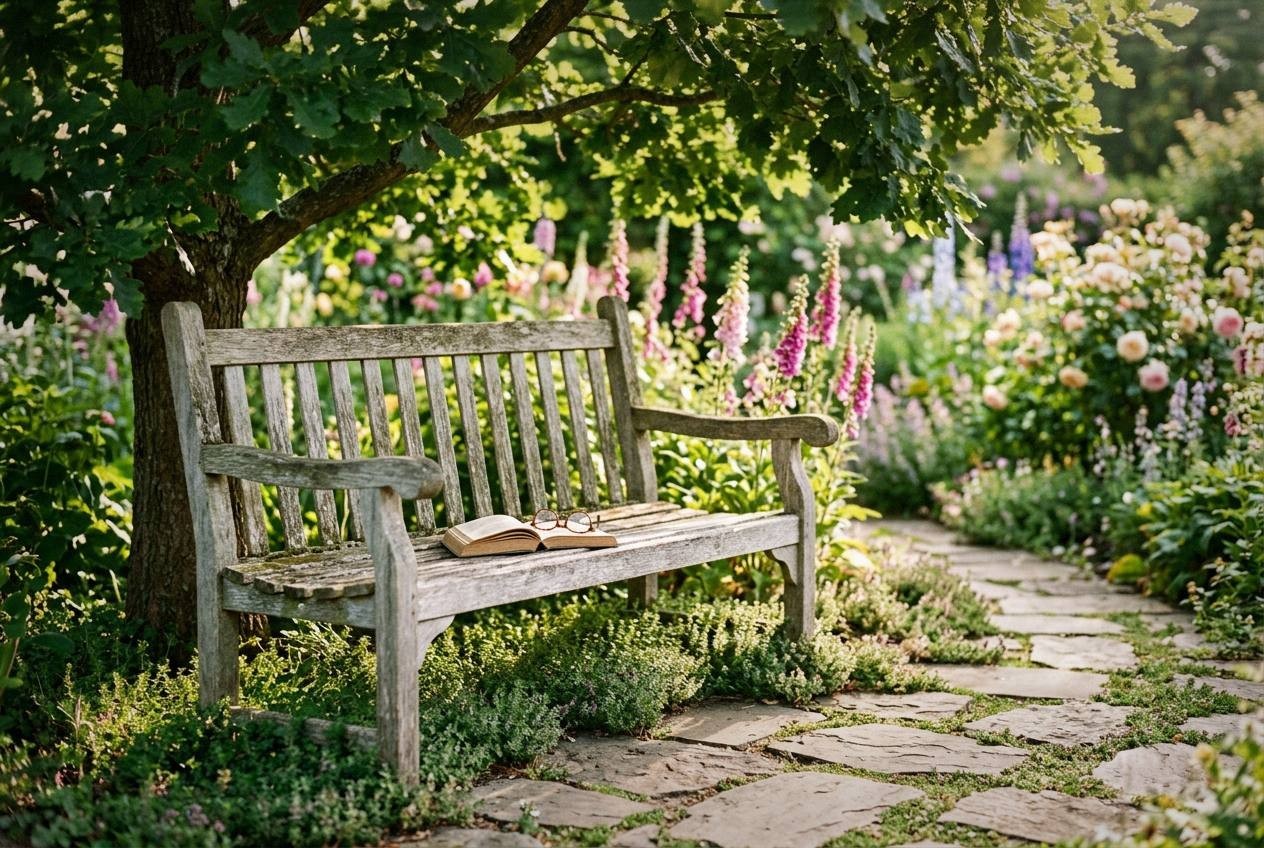
A garden bench under the right tree can feel more like a room than most rooms in your house. No walls, no roof, just the right combination of shade, scent, and a place to set your coffee.
I bought a $40 bench at a garage sale two years ago. It started as an impulse buy. Now it is the most-used seat on my property. This guide covers everything I learned turning that bench into a proper outdoor reading nook, plus the research I wish I had done before I started.
Best Garden Bench Types for an Outdoor Reading Nook
The bench you choose affects comfort, maintenance, and how long your outdoor reading nook lasts. Here is a comparison of the four most common materials for garden benches.
| Material | Cost Range | Weight | Maintenance | Lifespan | Best For |
|---|---|---|---|---|---|
| Hardwood (teak, cedar, acacia) | $150-$600 | Heavy | Oil annually or let silver | 15-25 years | Classic look, ages beautifully |
| Softwood (pine, fir) | $40-$200 | Medium | Stain/seal every 1-2 years | 5-10 years | Budget-friendly starter bench |
| Metal (wrought iron, aluminum, steel) | $100-$500 | Heavy (iron) to light (aluminum) | Rust-proof coating every few years | 20+ years | Modern gardens, low maintenance |
| Stone or concrete | $200-$800 | Very heavy | Almost none | 50+ years | Permanent placement, formal gardens |
| Recycled plastic/composite | $150-$400 | Medium | Wipe clean | 20+ years | Wet climates, zero maintenance |
What to Look for in a Reading Nook Bench
- Wide armrests. You need somewhere to rest a book or a mug. Flat armrests at least 3 inches wide make a huge difference.
- Curved or angled backrest. A straight vertical back gets uncomfortable after 20 minutes. A slight recline (about 5-10 degrees) supports longer reading sessions.
- Seat depth of 16-18 inches. Shallow benches feel perched. Too deep and your feet dangle.
- Solid joints. Grab the armrest and push sideways. If it wobbles in the store, it will collapse in the yard.
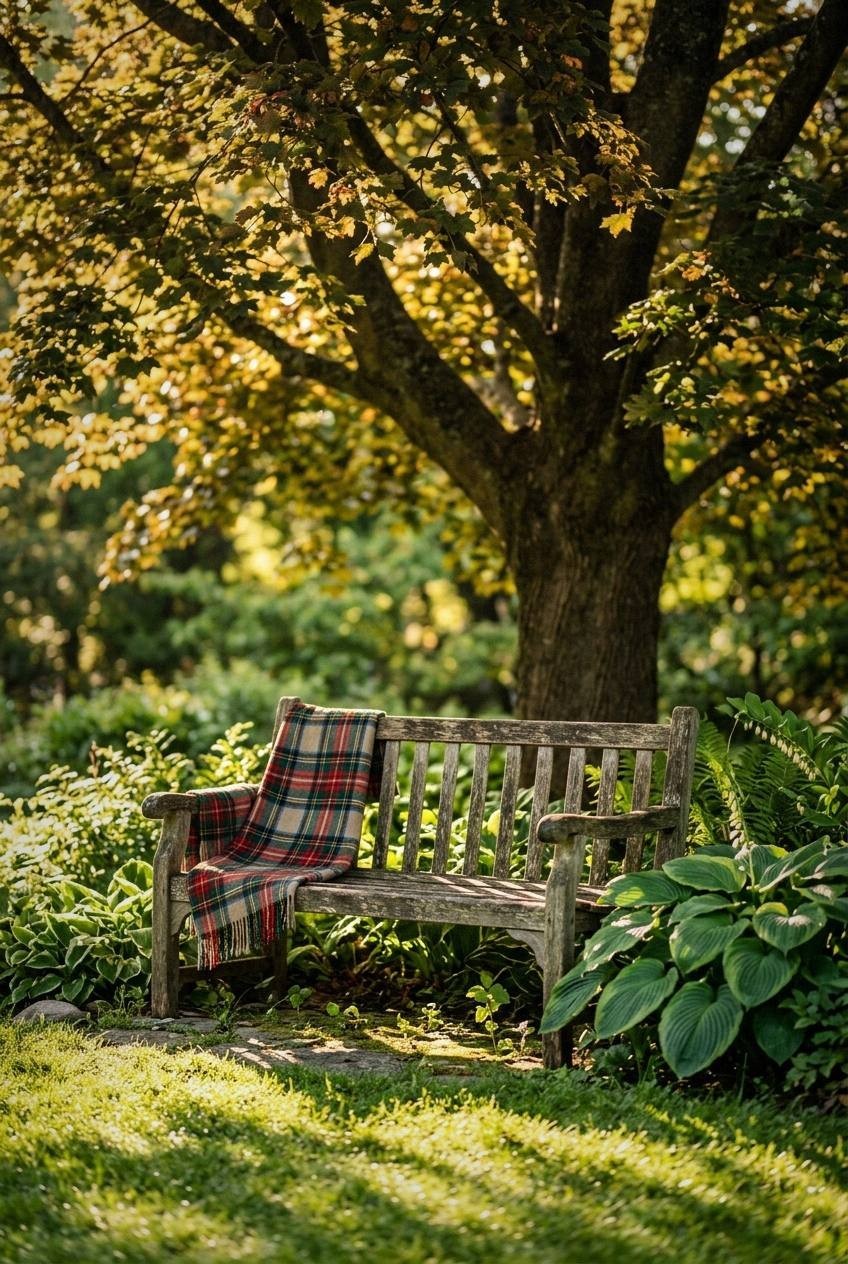
My garage sale bench was pine with a curved back and wide armrests. Two years later the paint is gone, the wood has turned silver-grey, and one armrest has a permanent coffee ring. It looks better now than the day I bought it.
How to Choose the Right Spot for a Garden Bench
Location matters more than the bench itself. A $500 teak bench in the wrong spot gets ignored. A $40 pine bench in the right spot becomes your favorite place on the property.
The Four Factors for Bench Placement
1. Shade coverage
An outdoor reading nook under a tree is the single most popular garden bench setup on Pinterest for good reason. Deciduous trees (maple, oak, birch) provide summer shade and let winter sun through. You want the bench under the canopy’s drip line, not directly against the trunk.
If you do not have a mature tree, alternatives include:
- A shade sail or pergola with climbing vines
- The north side of a garage or shed
- Under an arbor with wisteria, grape vine, or climbing hydrangea
2. Wind protection
At least one side should be blocked. A fence, hedge, building wall, or dense shrub planting all work. Wind turns a pleasant reading session into an annoying one fast.
3. Facing direction
| Direction | Best For | Light Quality |
|---|---|---|
| East-facing | Morning readers | Soft golden light, cool by afternoon |
| West-facing | Evening readers | Warm sunset glow, hot in afternoon |
| North-facing | Hot climates | Consistent shade, cool all day |
| South-facing | Cold climates | Maximum sun exposure, warm in winter |
4. Distance from the house
This one is counterintuitive. Do not put the bench on the patio. The patio already has chairs. Place your reading nook 20-40 feet from the back door, in a part of the yard you normally ignore. The short walk creates a mental break between indoors and your reading spot.

Ground Cover Plants for Around a Garden Bench
Bare dirt around a bench looks unfinished and turns to mud when it rains. Ground cover plants solve both problems while adding scent and texture underfoot.
| Plant | Zones | Height | Foot Traffic | Fragrance | Bloom Color | Sun Needs |
|---|---|---|---|---|---|---|
| Woolly thyme (Thymus pseudolanuginosus) | 5-8 | 1-3 in | Excellent | Warm herbal when stepped on | Pink-purple | Full sun to part shade |
| Creeping thyme (Thymus serpyllum) | 4-9 | 2-4 in | Good | Herbal, mild | Purple, pink, white | Full sun |
| White clover (Trifolium repens) | 3-10 | 4-8 in | Excellent | Mild, sweet | White | Full sun to part shade |
| Creeping Jenny (Lysimachia nummularia) | 3-9 | 1-2 in | Moderate | None | Yellow | Part shade to shade |
| Blue star creeper (Isotoma fluviatilis) | 5-9 | 1-3 in | Good | None | Blue | Part shade |
| Corsican mint (Mentha requienii) | 6-9 | 0.5 in | Light | Strong mint | Lavender | Part shade |
How to Plant Ground Cover Around a Bench
- Clear a 4-foot radius around the bench legs of existing weeds and grass.
- Lay flat fieldstones or flagstones as footers under the bench legs (prevents sinking).
- Amend soil with compost if it is compacted clay.
- Plant starts 6-8 inches apart in a rough circle around the bench area.
- Water consistently for the first 3-4 weeks, then taper off.
- Expect full coverage in one growing season for thyme, two seasons for clover.
I planted woolly thyme starts around my bench in a $15 flat. By August it had filled in so completely that the whole area looked planned from the start. When you walk through it or brush it with your ankle, it releases a warm herbal scent that makes the whole nook smell alive.
Solar Lighting Ideas for an Outdoor Reading Nook
Good lighting extends your reading nook into the evening hours without running electrical lines. Solar-powered options charge during the day and turn on automatically at dusk.
Best Lighting Options Ranked
| Light Type | Cost | Brightness | Best Placement | Reading Friendly? |
|---|---|---|---|---|
| Solar lantern (jar style) | $8-$25 | Low-medium | Hung from branch, 7 ft up | Yes, for casual reading |
| Solar string lights (warm white) | $15-$30 | Low, ambient | Branch to fence post | No, atmosphere only |
| Solar pathway lights | $20-$40 (set) | Medium | Along walking path to bench | No, wayfinding only |
| Solar LED clip light | $10-$20 | Medium-high | Clipped to bench back or branch | Yes, direct task light |
| Solar post lantern | $30-$80 | Medium | On a shepherd’s hook beside bench | Depends on distance |
Tips for Reading Nook Lighting
- Hang your primary light source 6-7 feet above the seat, slightly in front of you (not behind, which creates glare on pages).
- Warm white (2700K-3000K) is easier on the eyes than cool white for evening reading.
- A single solar lantern on a branch hook provides enough light to read by after sunset. I screwed a small iron hook into a low branch and hung a glass jar lantern that cost $8. It charges all day while I am at work.
- String lights add atmosphere but are not bright enough to read by alone. Use them as secondary lighting strung from the lantern branch to a nearby fence post or tree.
Fragrant Plants for Near a Garden Bench Seating Area
The right plants within 3-5 feet of your bench add scent without crowding the seat. Choose species that release fragrance passively (from foliage or blooms) rather than only when crushed.
Best Fragrant Plants for Seating Areas
- Lavender (Lavandula angustifolia): Zones 5-9. Plant 3 feet from the bench on the sunny side. Blooms June through August with a calming floral scent. Attracts pollinators.
- Catmint (Nepeta faassenii): Zones 3-8. Extremely low maintenance. Blue-purple flower spikes from late spring through fall. Mild minty fragrance. Deer resistant.
- Sweet woodruff (Galium odoratum): Zones 4-8. Thrives in shade under trees. White star-shaped flowers in spring. Vanilla-like scent from dried leaves.
- Russian sage (Salvia yangii): Zones 4-9. Tall, airy, lavender-blue flowers. Aromatic silvery foliage. Needs full sun.
- Scented geranium (Pelargonium): Zones 10-11, or grow as annual. Comes in rose, lemon, mint, and chocolate scents. Place in a pot beside the bench.
- Night-blooming jasmine (Cestrum nocturnum): Zones 8-11. Releases intense sweet fragrance after sunset. Perfect for evening reading nooks.
Plant fragrant species on the upwind side of your bench so the breeze carries the scent toward you. I put catmint on one side and sweet woodruff on the other, both about 3 feet back. On a calm evening with both in bloom, the bench smells like a garden shop.
How to Make a Garden Bench Area Feel Like a Room
The best outdoor reading nooks feel enclosed without feeling boxed in. You are creating the sensation of walls and a ceiling using plants, structures, and vertical elements.
The Three Boundaries
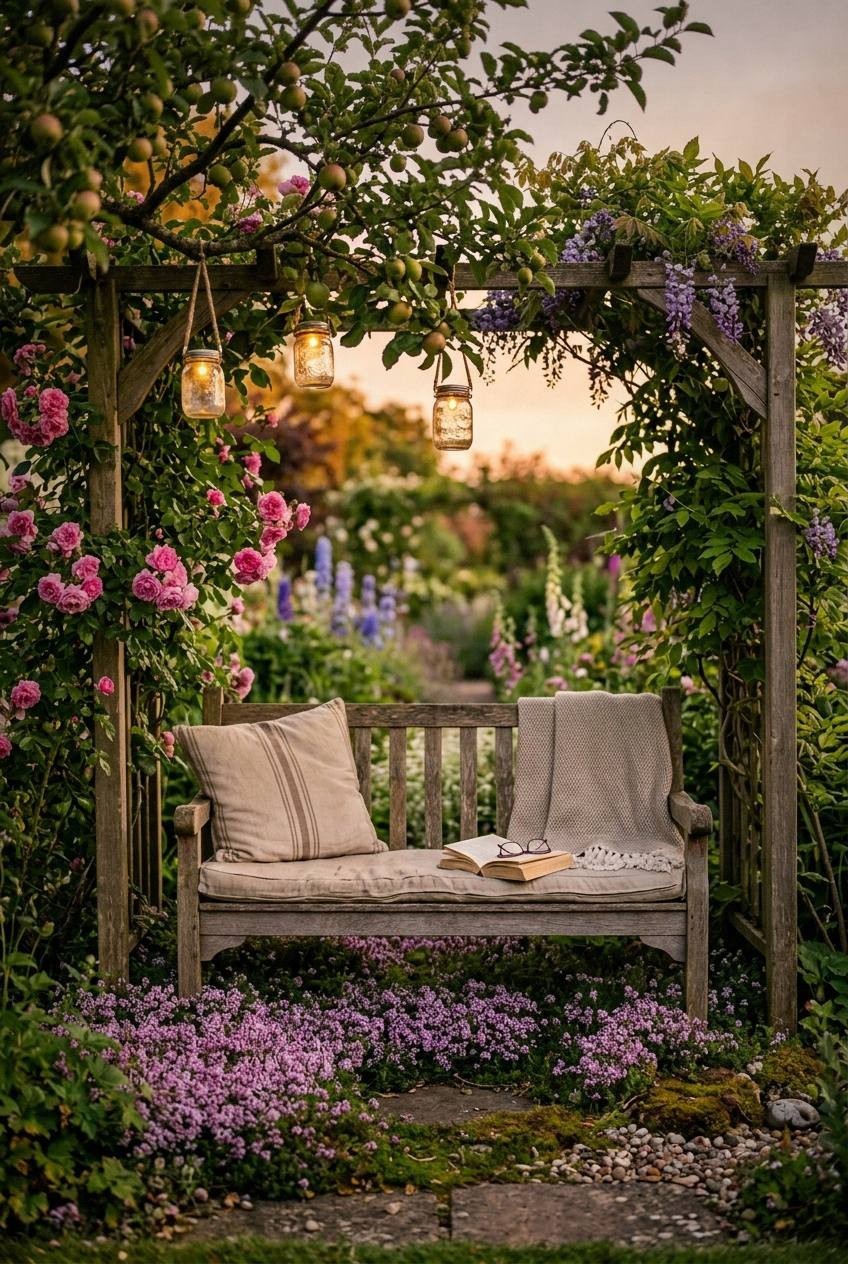
Overhead canopy (the ceiling) A tree canopy is ideal. If you lack a mature tree, use a shade sail, pergola, or even a large patio umbrella anchored beside the bench. The key is something above you that defines the space and filters light.
Side boundaries (the walls) You need screening on at least two sides. Options by budget:
| Method | Cost | Privacy Level | Time to Establish |
|---|---|---|---|
| Existing fence or wall | $0 | Full | Immediate |
| Tall ornamental grasses (miscanthus, Karl Foerster) | $30-$60 | Medium | 1 season |
| Boxwood or privet hedge | $50-$150 | Full | 2-3 years |
| Bamboo screen (clumping varieties only) | $40-$100 | Full | 1-2 years |
| Lattice panel with climbing rose or clematis | $30-$80 | Medium-full | 1-2 seasons |
| Tall potted plants (moved seasonally) | $40-$100 | Medium | Immediate |
Open front (the view) Leave the front of your reading nook open. You want to see part of the garden, sky, or yard. A completely enclosed space feels claustrophobic. The goal is “room with a view,” not “room with four walls.”
Quick Wins for a Cozy Garden Nook
- Add a weatherproof outdoor cushion or folded blanket on the bench seat.
- Place a flat stone or small stump beside the bench as a side table.
- Keep a book on the armrest permanently. It signals “this is a reading spot” and you will use it more often.
- Lay a stepping stone path from the house to the bench. It makes the nook feel intentional and keeps your shoes clean.
DIY Outdoor Reading Nook on a Budget
You do not need to spend hundreds of dollars. Here is a realistic budget breakdown for a complete garden bench reading nook.
| Item | Budget Option | Cost |
|---|---|---|
| Bench | Secondhand (garage sale, Facebook Marketplace, thrift store) | $20-$60 |
| Footers | Flat fieldstones (4 pieces) | $0-$15 |
| Ground cover | One flat of creeping thyme starts | $12-$20 |
| Lighting | Solar jar lantern + branch hook | $8-$15 |
| String lights | Solar warm white strand, 20 ft | $15 |
| Fragrant plant | One catmint or lavender from the nursery | $8-$12 |
| Side screening | Lattice panel from hardware store | $15-$30 |
| Path | 5-6 stepping stones | $10-$20 |
| Total | $88-$187 |
Steps to Build It in a Weekend
- Saturday morning: Scout your spot using the four factors above (shade, wind, direction, distance). Place the bench and sit in it for 15 minutes before committing.
- Saturday afternoon: Level the ground, set fieldstone footers, position the bench permanently. Clear ground cover area and plant starts.
- Sunday morning: Install the lantern hook and hang your solar light. Set up string lights if using.
- Sunday afternoon: Plant one fragrant perennial on each side. Lay stepping stones from the house. Place a book on the armrest.
The total investment for my outdoor reading nook was about $63. Two years later it is the most-used seat on the property, and every member of the family has claimed it as their own at different times of day.
Outdoor Reading Nook Under a Tree: Best Tree Species
If you are planting a new tree specifically to shade a future reading nook, choose one that provides dense summer canopy, interesting bark, and minimal mess on the bench.
Top Trees for Garden Bench Shade
- Japanese maple (Acer palmatum): Zones 5-9. Elegant form, dappled shade, spectacular fall color. Slow growing but worth the wait.
- Sugar maple (Acer saccharum): Zones 3-8. Dense canopy, classic shade tree. Large at maturity, so plan for a big space.
- River birch (Betula nigra): Zones 4-9. Light, filtered shade. Peeling bark adds winter interest near the bench.
- Eastern redbud (Cercis canadensis): Zones 4-9. Smaller canopy (25-30 ft), spring flowers, heart-shaped leaves. Good for compact yards.
- White oak (Quercus alba): Zones 3-9. Massive long-term shade. Acorn drop can be messy near seating, so place the bench just outside the drip line.
Avoid trees with aggressive surface roots (silver maple, willow) that will buckle the ground under your bench within a few years.
Frequently Asked Questions
What is the best material for an outdoor reading nook bench?
Teak and cedar are the top choices for a long-lasting garden bench. Both resist rot and insects naturally without chemical treatment. Teak weathers to a silver-grey patina if left unfinished. Cedar is lighter and more affordable. For zero maintenance, recycled plastic composite benches hold up in all climates and never need sealing.
How do I keep a garden bench from sinking into the ground?
Place flat fieldstones, concrete pavers, or brick pads under each bench leg. This distributes weight across a wider surface and lifts the legs off direct soil contact, which also slows wood rot. For heavy stone benches, pour a small gravel pad (4 inches deep, 6 inches wider than the bench footprint) to prevent settling.
What ground cover survives foot traffic around a bench?
Woolly thyme and creeping thyme are the most foot-traffic-tolerant ground covers for garden seating areas. White clover is another strong option that handles heavy use and fixes nitrogen in the soil. All three stay low (under 4 inches), spread to fill gaps, and recover quickly from being stepped on.
Can I create an outdoor reading nook without a tree?
Yes. Use a shade sail, pergola, or large patio umbrella to create overhead coverage. A north-facing spot against a building wall provides natural shade without any structure. You can also grow a fast-growing vine (hops, hyacinth bean, morning glory) on an arch or trellis to create a living canopy in a single season.
How do I make my garden bench comfortable for long reading sessions?
Add a 2-3 inch thick outdoor cushion rated for weather resistance (Sunbrella fabric is the standard). A lumbar pillow against the backrest helps for sessions over 30 minutes. If your bench has a straight vertical back, angle it slightly by shimming the rear legs with thin wood wedges, or look for a replacement bench with a 5-10 degree recline built in.
What is the cheapest way to create a garden reading nook?
A secondhand bench ($20-$60), four flat stones as footers ($0-$15), and a solar jar lantern ($8) gives you a functional outdoor reading nook for under $80. Add a flat of creeping thyme ($15) for ground cover and one potted lavender ($8) for fragrance, and the total stays under $105.