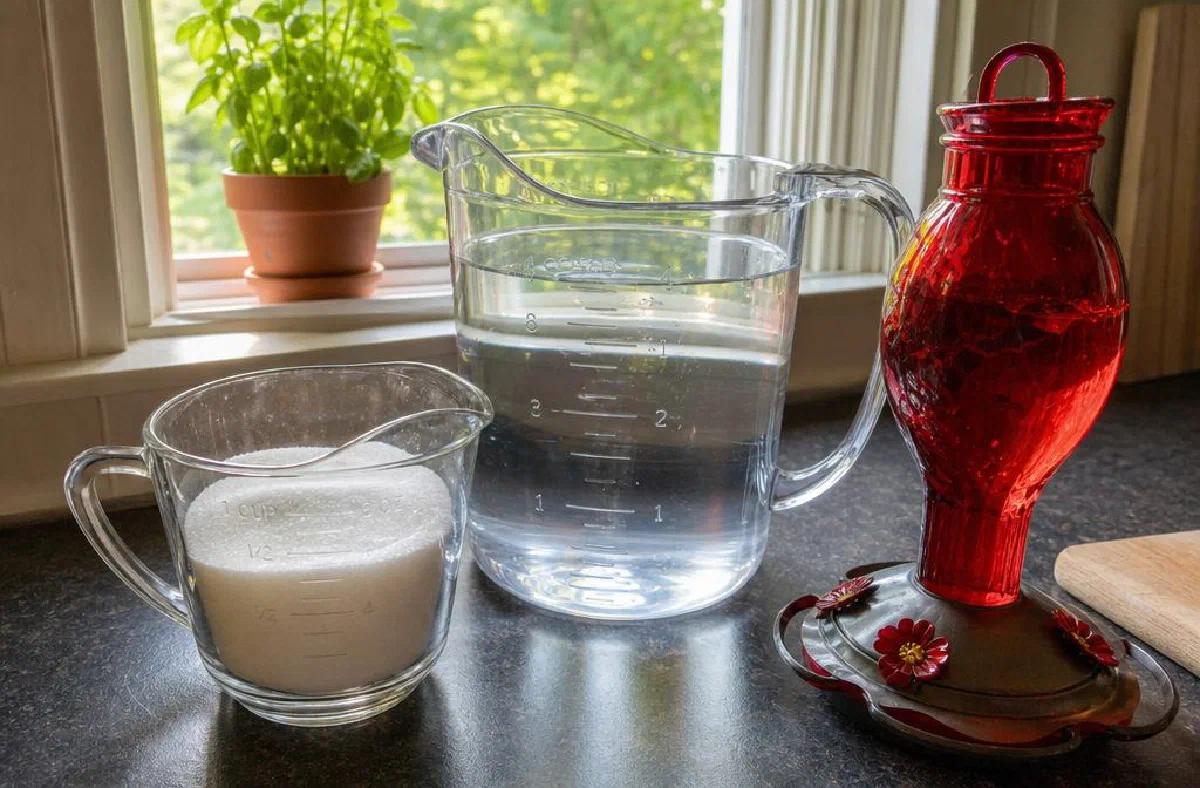
The hummingbird nectar recipe is simple: four parts water, one part white sugar. That’s the entire recipe.
The complications that hurt hummingbirds come from what people add to it, red dye, honey, brown sugar, organic sugar, vitamins. None of those belong in a feeder. The 4:1 white-sugar-and-water mix matches the natural nectar composition of the flowers hummingbirds evolved drinking. Anything else risks the bird’s health.
This is the recipe, the cleaning schedule, the common mistakes, and the small details that determine whether a feeder helps hummingbirds or hurts them.
The Recipe
Ingredients:
- 1 cup white granulated sugar
- 4 cups water
Steps:
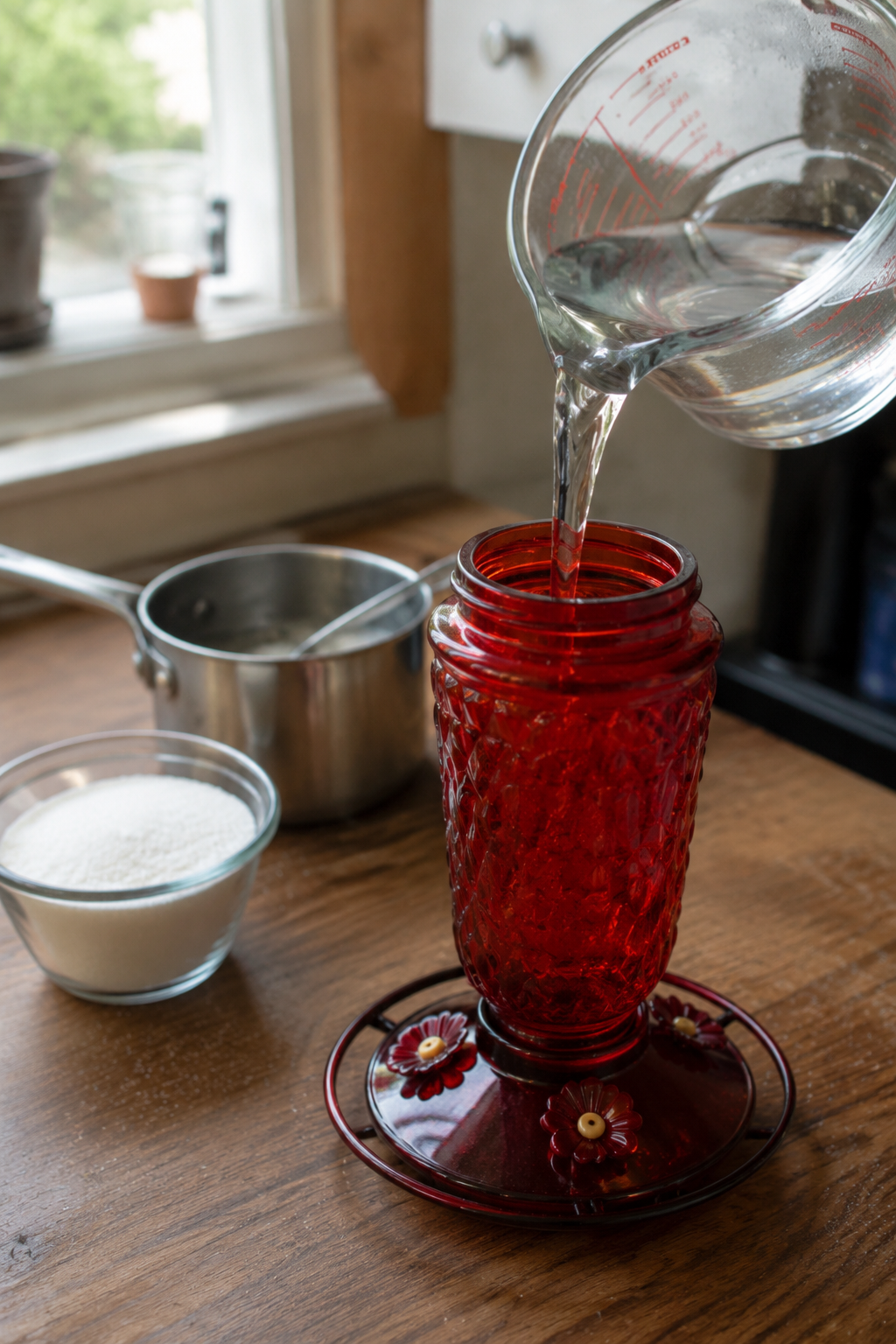
- Bring the water to a simmer in a saucepan. Don’t fully boil, a simmer is enough to dissolve sugar cleanly.
- Remove from heat. Stir in the sugar until completely dissolved.
- Let the nectar cool to room temperature before filling the feeder.
- Pour into a clean feeder. Refrigerate any leftover for up to one week.
That’s the entire recipe. Two ingredients. Two minutes of active work.
The 4:1 ratio is the one Project FeederWatch, the Cornell Lab’s feeder-monitoring program , publishes: one part sugar to four parts boiling water, stirred, then cooled before it fills the feeder. It also lands close to the average sugar concentration of the wildflower nectars hummingbirds evolved on (about 20-25% sugar). Stronger ratios (1:3 or 1:2) can dehydrate the birds. Weaker ratios (1:5 or 1:6) under-fuel them, especially during spring migration and fall stockpiling.
Why No Red Dye
Red dye 40, the common food coloring added to commercial hummingbird nectars, does not belong in a feeder. Project FeederWatch’s guidance on the subject is short and unambiguous: do not add red food coloring, because it is harmful to birds.
Hummingbirds find feeders by the color of the feeder itself, not the color of the nectar. The red glass or red plastic at the top of the feeder is the visual signal. FeederWatch puts it plainly: red feeding ports, or even a red ribbon tied on top, attract the birds just as well. A clear nectar with a red feeder works just as well as a red nectar with a clear feeder, and is safer.
Any commercial nectar mix sold with red dye should be skipped. The 4:1 sugar water you make at home is safer, cheaper, and works better.
Why White Sugar Only
White granulated cane sugar is the only sugar that should go into hummingbird nectar.
Honey ferments quickly and harbors fungi that infect hummingbird tongues. Brown sugar contains molasses, which contains iron, toxic to hummingbirds at higher doses. Organic sugar, raw sugar, and turbinado all contain trace minerals (especially iron and molasses) that the birds’ systems can’t process well. Artificial sweeteners offer no calories, a hummingbird drinking diet nectar starves while feeling full.
Plain white granulated sugar. That’s the only acceptable sugar source.
How to Choose Your Nectar, Your Ratio, and Your Batch Size
Most of the decisions here have one right answer, so this stays short.
| The decision | What to do | Why |
|---|---|---|
| Make it or buy it | Make it | Two ingredients, about two minutes of work, and it costs less than a mix |
| A commercial mix | Only one with no dye | Red dye 40 is harmful to birds, and FeederWatch says not to add any |
| Stronger or weaker than 4:1 | Stay at 4:1 | 1:3 or 1:2 can dehydrate a bird; 1:5 or 1:6 under-fuels it, especially during migration |
| How much to mix | One cup of sugar to four cups of water | One batch fills a feeder with some left over for the fridge |
That is the whole decision. Everything after this is the reasoning behind it.
How Often Should You Clean and Refill a Hummingbird Feeder?
Change the nectar every one to two days in hot weather, every three to four days in warm weather, and every five to seven days in cool weather. Heat sets the clock, not how full the feeder looks.
| Weather | Change the nectar | Clean the feeder |
|---|---|---|
| Under 70°F | Every 5-7 days | Weekly |
| 70-85°F | Every 3-4 days | Every 4-5 days |
| Over 85°F | Every 1-2 days | Every 2-3 days |
Nectar ferments in heat. Fermented nectar can develop black mold and yeast that infect the bird’s tongue and throat. A feeder that’s left full for two weeks in July becomes a death trap. Project FeederWatch’s feeding guidance is blunt about the warm-weather case: clean hummingbird feeders every couple of days, more often during heavy use or warm weather, and ideally every time you refill them. If the liquid looks cloudy or you see black mold, dump it and clean the feeder right away.
How to clean:
- Empty any remaining nectar
- Disassemble the feeder
- Wash with hot water and a bottle brush
- If mold has taken hold, disassemble the feeder and soak the parts in one part liquid chlorine bleach to nine parts warm water for two to three minutes, the ratio Utah State University Extension gives for disinfecting feeders. Rinse until you can’t smell bleach, then let every part air dry completely.
- Air dry completely before refilling
Project FeederWatch’s own guidance is warm water and dish soap followed by a thorough rinse, so what causes the problem is leftover residue rather than soap itself. Utah State Extension puts the stronger option in the disinfecting column: it names diluted chlorine bleach as the feeder disinfectant. FeederWatch lists diluted vinegar as the bleach alternative if you would rather not use bleach. Whichever you use, rinse and dry the feeder before it goes back out.
How Many Feeders Does Your Yard Need?
One feeder attracts a few hummingbirds, but dominant males defend it aggressively, chasing off others.
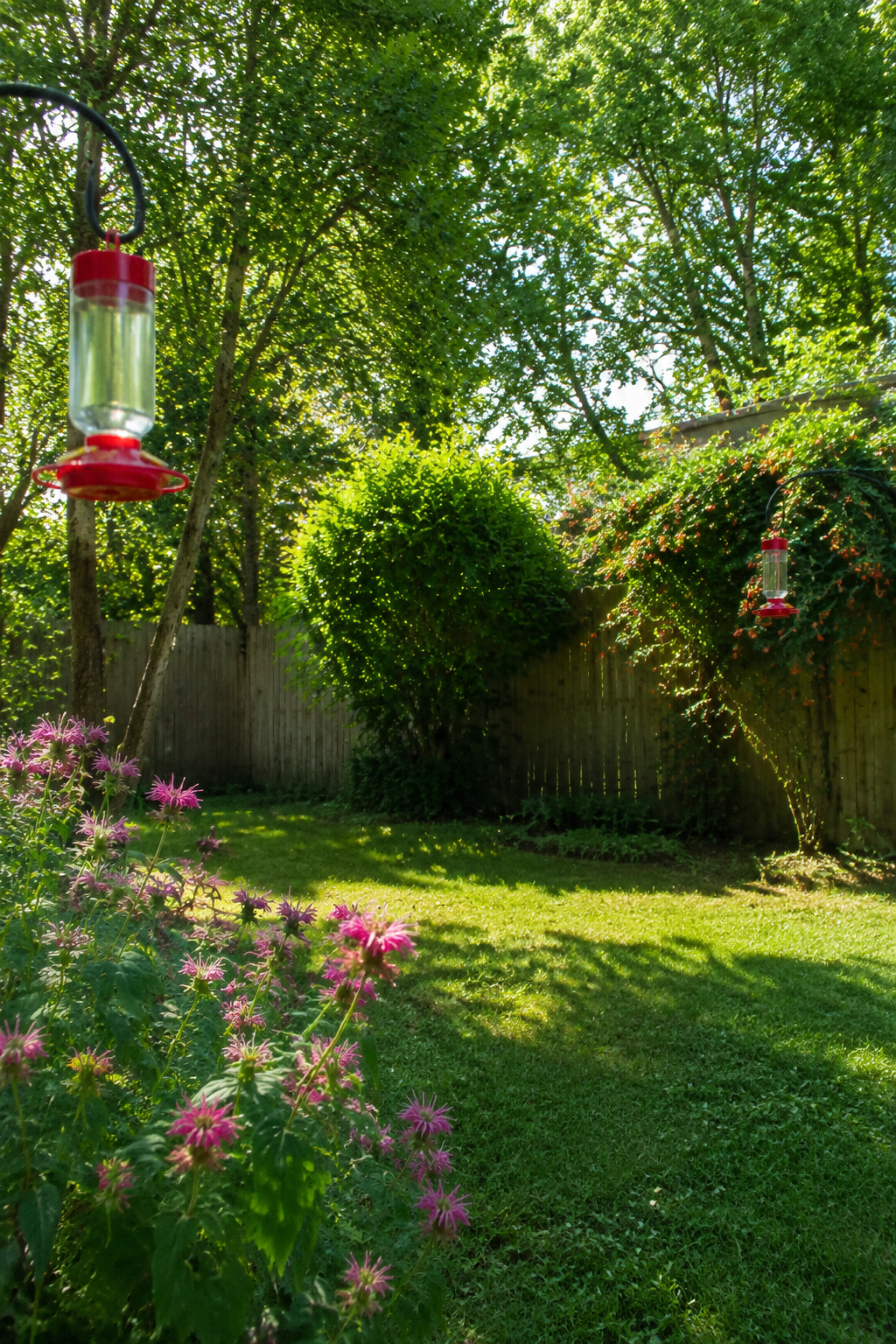
Two or more feeders, placed at least 15 feet apart, allow multiple hummingbirds to feed at once. The dominant male can only guard one feeder at a time, so a second feeder gives other birds access.
For a small yard, two feeders is the sweet spot. For a larger yard with established hummingbird traffic, four to six feeders spread across the property hosts a real summer colony.
Where to Place a Feeder
A hummingbird feeder needs to be:
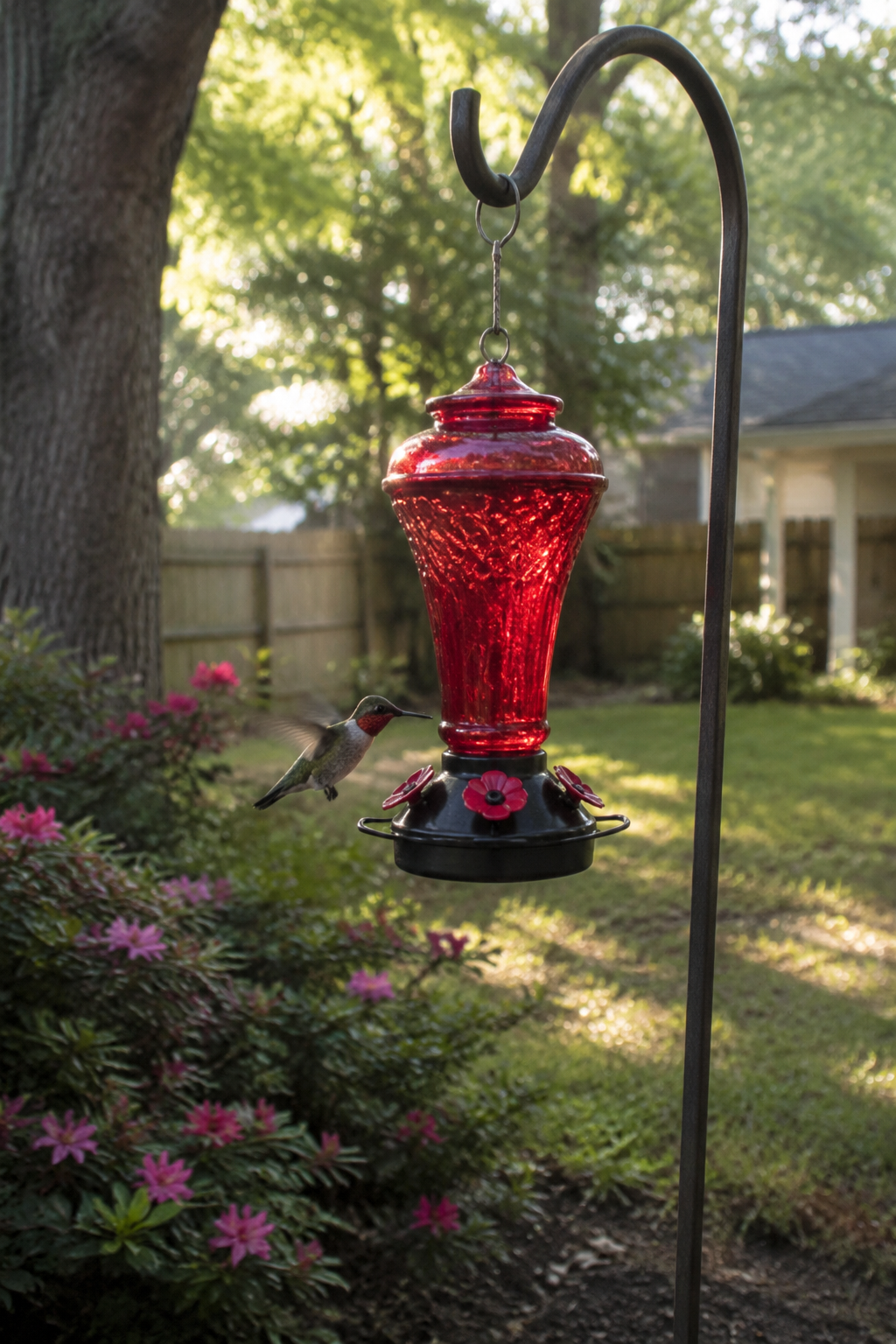
- Visible from the air. Hummingbirds hunt from elevated perches and scan for color. A feeder buried under a porch overhang is harder to find than one hung from a tree branch or a shepherd’s hook in an open spot.
- In partial shade. Direct full sun heats the nectar and accelerates fermentation. Morning sun with afternoon shade is ideal.
- Within 10-15 feet of cover. Hummingbirds need shrubs, trees, or vines nearby for rest perches between feeding visits. A feeder in a completely open lawn gets less traffic than one near a flowering shrub.
- Away from windows where possible. Hummingbirds can collide with windows during territorial chases. If a feeder must go near a window, place it within 3 feet of the glass (slow impact) or more than 30 feet away (clear flight path).
Common Mistakes That Hurt Hummingbirds
A short list of feeder mistakes documented as causing real harm:
- Red dye in the nectar. Skip it.
- Honey or brown sugar instead of white sugar. Both cause health problems.
- Soap residue from washing. Use vinegar and water only.
- Old, fermented nectar. Change on schedule even when the feeder still looks fine.
- Feeders hung in full sun all day. The nectar spoils in hours.
- Feeders too close together. Causes territorial fighting and injuries.
A clean feeder with fresh 4:1 nectar, hung in the right spot, refreshed on schedule, is a small but real act of wildlife support. A neglected feeder is worse than no feeder.
FAQ
Can I store hummingbird nectar in the refrigerator?
Yes. Made nectar keeps for up to one week refrigerated. Bring to room temperature before refilling the feeder.
Do I need to boil the water for hummingbird nectar?
A simmer is enough, it dissolves the sugar cleanly and kills any bacteria in the tap water. Full boiling is fine but unnecessary. Some sources recommend boiling for tap water with chlorine; the chlorine actually evaporates at much lower temperatures, so a simmer is sufficient.
When should I take down hummingbird feeders in fall?
Leave them up two weeks past your last sighting in fall. The myth that feeders keep hummingbirds from migrating is false; migration is triggered by day length, not food availability. Leaving a feeder up helps late migrants and stragglers who need the calorie boost.
What to Read Next
- Plants Hummingbirds Visit Every Day : nine flowers that do the work a feeder can only supplement.
- Bird Bath Placement Mistakes : where to put water so hummingbirds actually use it.
- Native Plants for Wildlife Habitat : regional natives if you would rather the nectar came from the garden than the kitchen.
- Backyard Wildlife Habitat Ideas : perches, cover, and shelter for the birds using the feeder.