Walk out to the street at nine at night and turn around. That view is the only one that counts, because nobody sees a front yard in daylight in late October.
Most halloween yard decor fails that test for one reason. Every piece stands on the same plane, lit flat by one bright bulb or by nothing at all, and flat light on a flat arrangement gives the eye no depth to read. The yard collapses into a dark smudge with a porch light floating above it.
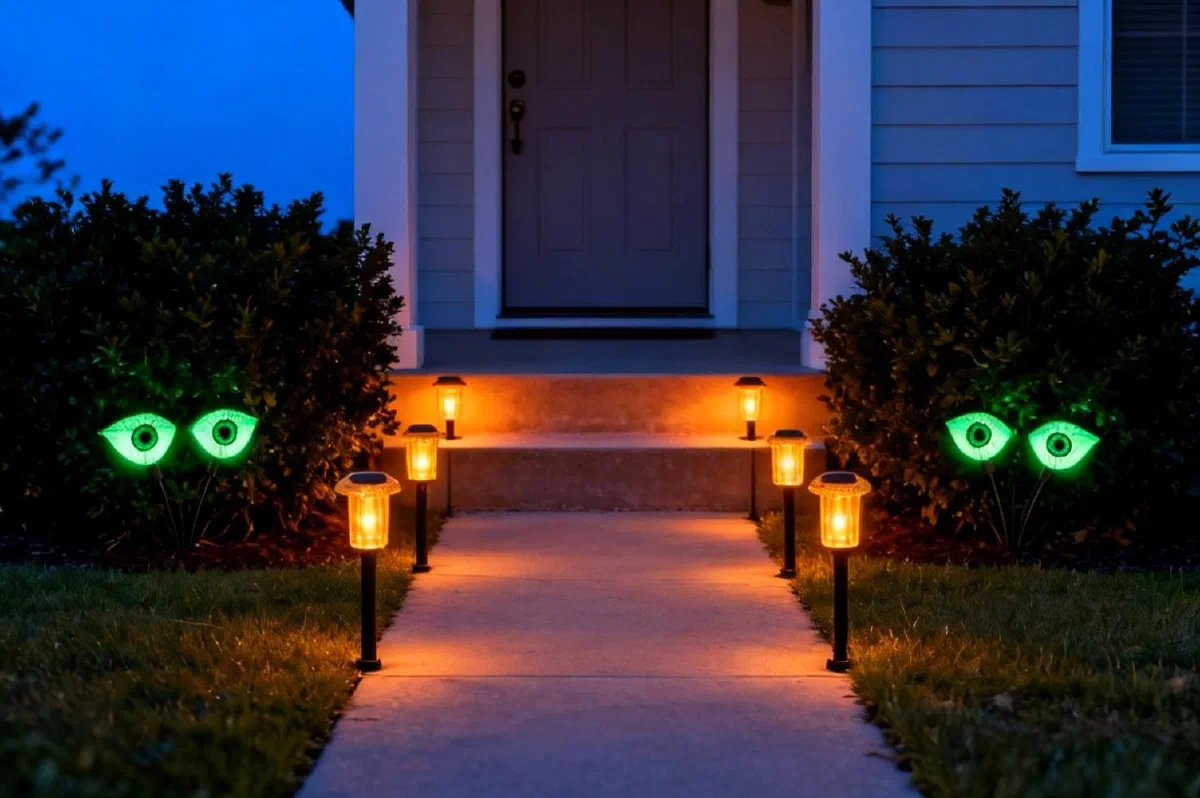
The fix is not more decorations. It is light at three distances from the sidewalk, with a warm base layer underneath and exactly one cold color used as an accent.
What a yard is actually competing with at night
Your yard is not competing with other decorations. It is competing with the streetlight, the neighbor’s porch fixture, and headlights sweeping past.
Against that, one bright floodlight does nothing. It blows out whatever it hits and leaves everything outside its cone black, so the eye reads one bright patch and moves on. Depth is what stops the eye, and depth comes from separation. A light at ten feet, a glow at twenty-five, and a shape at forty give the brain three points to place in space.
Full dark also arrives earlier every week in October, and you can look up sunset and the end of civil twilight for your own address with the U.S. Naval Observatory rise and set table . NIST notes that in 2026, daylight saving time runs to November 1, so Halloween is the last evening on daylight time and trick-or-treat hours start in twilight. Twilight is the harder condition, because there is still enough ambient light to wash out anything weak.
The three distances, and how to choose what goes where
| Distance from the sidewalk | What goes there | The job it does | Light color |
|---|---|---|---|
| Near, roughly 6 to 15 feet | Path lighting at ankle height along the walk and steps | Draws the eye in and makes the ground legible | Warm, always |
| Middle, roughly 20 to 30 feet | Glowing eyes at eye level in the shrubs and hedge | The one cold accent, and the piece people point at | Green, only here |
| Far, roughly 35 feet and back | One silhouette against a lit wall, fence, or garage | Gives the yard a back edge and a sense of scale | Unlit, backlit only |
Read that last column carefully. Cold colored light is one of the three things that make a display read as cheap, which is the argument in Cheap Halloween Decor That Doesn’t Look Cheap . That article permits exactly one exception, and the wording matters: if you love the purple, use exactly one colored bulb as an accent, in a single window or inside one lantern. One is a choice. Fifteen is a color cast over the whole porch.
The glowing eyes are that one accent. They spend the whole colored-light budget for the yard, and the path, the porch, and the uplight on the silhouette all stay warm. A yard washed in purple or green from the curb to the door is the exact failure that rule exists to prevent.
Warm is not only taste. The Department of Energy’s guidance on buying energy-efficient light bulbs describes correlated color temperature as the color appearance of a lamp’s light, lists 2,700 K as warm and reading “friendly, personal,” and puts 4,100 K at the cool end reading “neat, clean, efficient.” Warm white is why brick still looks like brick. Narrow-band colored light has nothing to give back, so it turns every surface gray.
This article contains affiliate links. If you buy through them, Etheric Echoes may earn a commission at no extra cost to you. As an Amazon Associate I earn from qualifying purchases. Read the full disclosure.
Distance one: path lighting along the walk
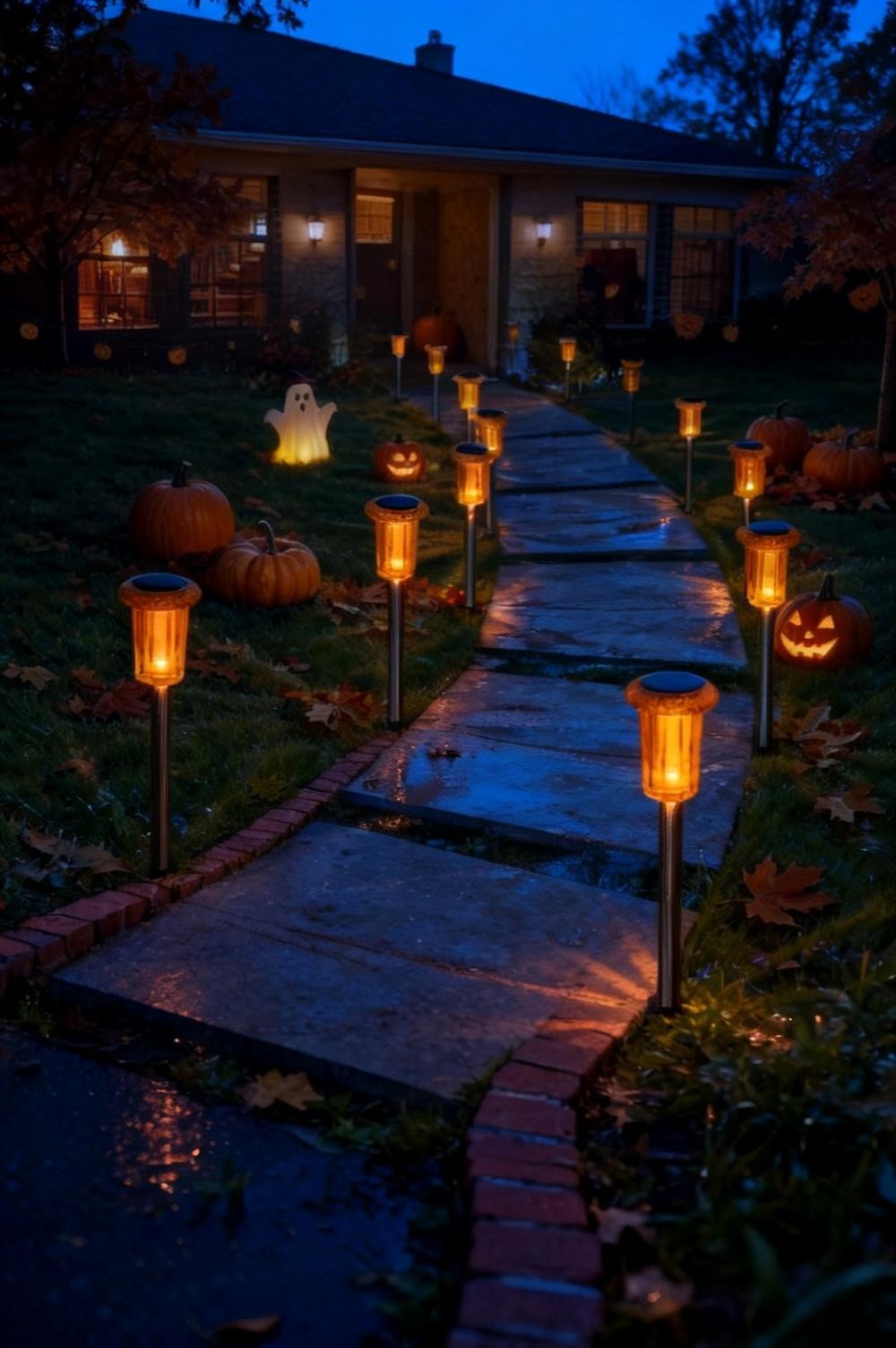
This is the layer people skip, and it does the most work. Light on the ground gives the eye a starting point and a direction. Keep it low, keep it warm, and space it wider than feels right. Every two feet reads as a runway. Every six to eight feet reads as a path.
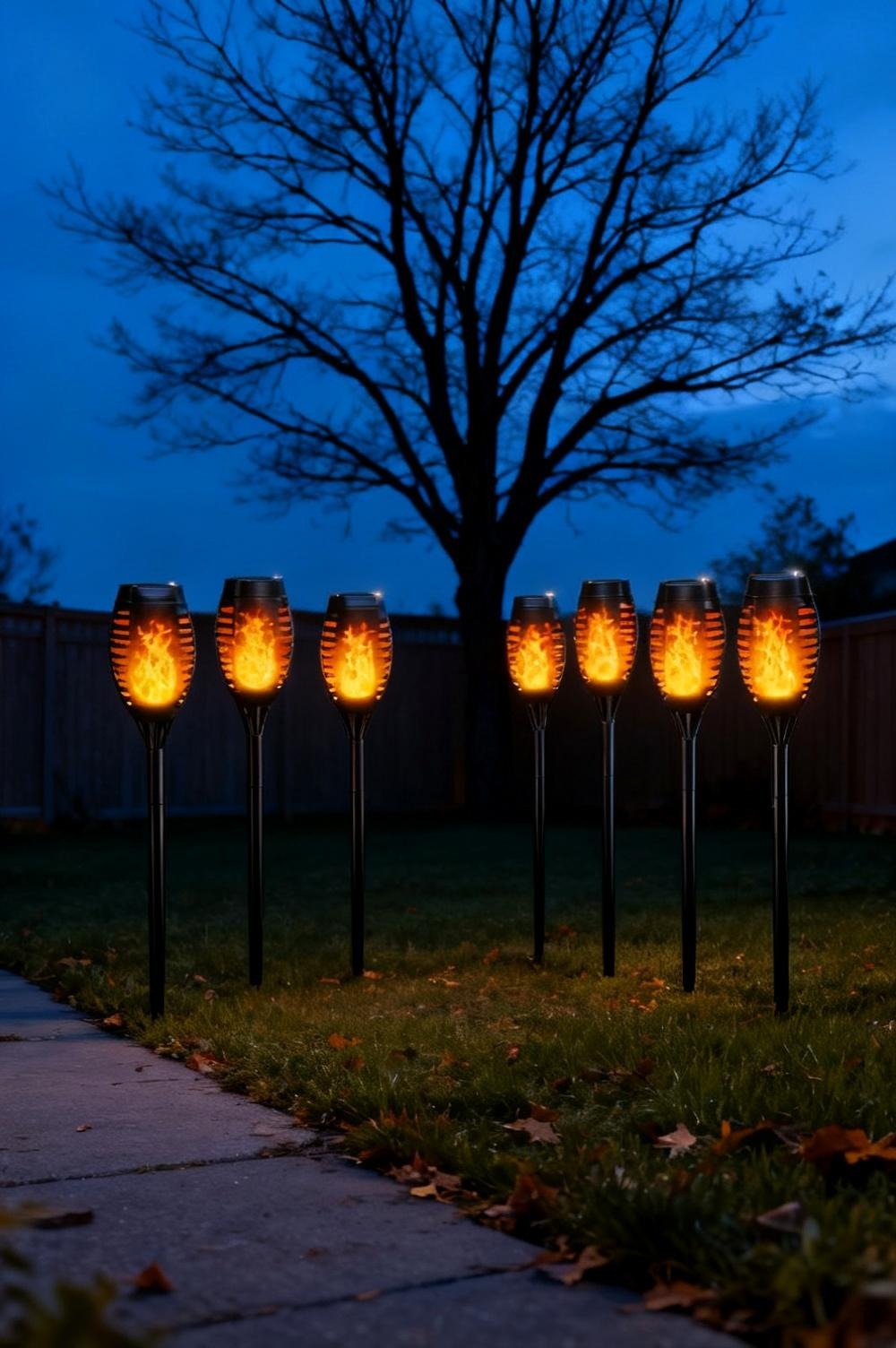
For the warm base, IkeeRuic’s flickering flame torch lights (opens Amazon in a new tab) are a Best Seller at 4.3 stars across roughly 10,100 reviews. The flicker does something specific: moving amber light reads as fire rather than as a fixture, and movement is what the eye catches from a passing car.
Solar stake lights are the other half of the near layer, and the color you pick matters more than the fixture does. DenicMic’s 10-pack solar stake lights (opens Amazon in a new tab) carry an Amazon’s Choice badge at 4.5 stars across about 9,400 reviews, with auto on and off and a waterproof rating on the listing.
Orange is the deliberate choice here, not a default. The same stake sells in purple, green, and a 6000K cool white, and all three do to a walkway exactly what a colored bulb does to a porch: they strip the warmth out of everything the light touches. Amber keeps the brick brick and the grass green. The eyes at the middle distance are already spending your one colored accent, so the path stays warm.
If a lit pumpkin is going on the steps, run it flameless. The U.S. Fire Administration’s candle safety guidance says to keep candles at least 12 inches from anything that burns and suggests battery-operated flameless candles instead. Dry cornstalks, a straw bale, and a nylon costume at knee height all burn.
Distance two: glowing eyes at eye level in the shrubs
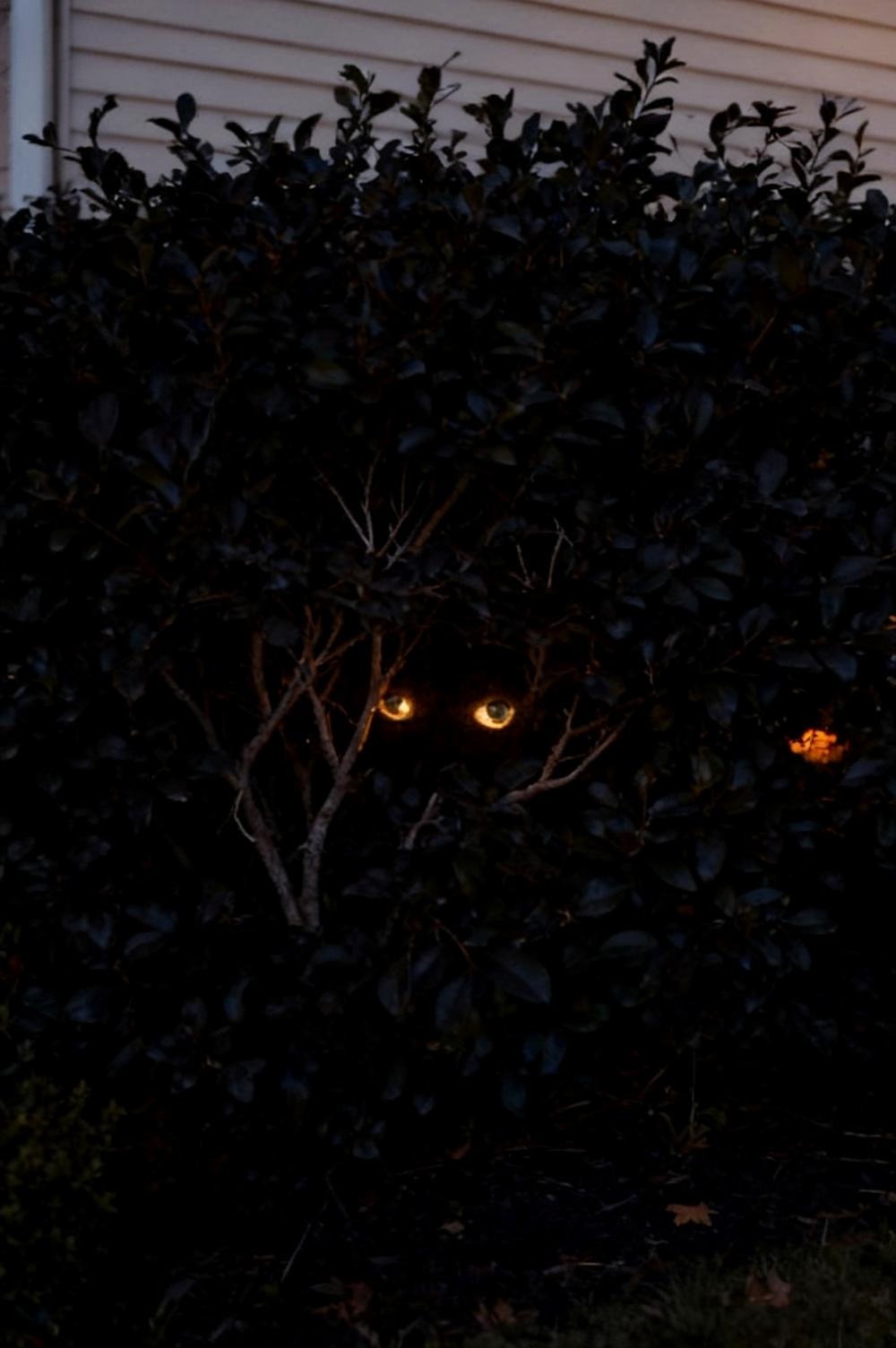
This piece works because of where it sits, not what it is. Eyes at ground level read as landscape lighting. Above head height they read as a mistake. At roughly four to five and a half feet, tucked into a hedge or foundation shrub so the housing disappears, they read as something looking back.
ASMAD’s solar scary eyeball lights (opens Amazon in a new tab) come four to a pack with 32 LEDs, at 4.5 stars across roughly 8,900 reviews. They sway, which matters: a fixed green dot reads as an electronic device, and one drifting in the wind reads as alive.
The vignuto eyeball lights (opens Amazon in a new tab) are the same idea at a higher rating, 4.6 stars across about 3,400 reviews, also four packs of 32 LEDs, with an IP65 rating on the listing. Confirm the power source before committing a shaded spot to them.
Four pairs is enough: two low in the shrubs on one side of the walk, two set deeper on the other. Twenty pairs along the whole hedge is a green wash.
For a spot with no sun, the Peep n’ Peepers flashing eye light (opens Amazon in a new tab) is the old reliable at 4.4 stars across roughly 1,100 reviews. It is a single set of flashing eyes rather than a stake, so it goes where a solar unit cannot: an unlit window, a crawlspace vent, the gap under a porch.
Distance three: one silhouette further back
The third distance is not a light. It is a shape, and it works by blocking light rather than making it. A silhouette needs something lit behind or beneath it: a garage door, a pale wall, a fence panel, a window with a lamp on inside. Aim one warm torch or path light at that surface and hang the shape in front of it. The surface glows, the shape goes black, and the yard gains a back edge. Without it, everything you set out reads as one shallow band along the sidewalk.
Scale sells it. Small pieces at forty feet disappear, which is why a bin of decor spread across a lawn reads as nothing from the street. A mature tree solves that for free, and hanging the pieces up in the branches puts them at a height the street can actually see.
OCATO’s 200 inch spider web with a 59 inch giant spider (opens Amazon in a new tab) is the easiest version, at 4.5 stars across about 5,600 reviews. The web is triangular, so it stretches into a corner: a porch corner, the angle between a garage and a wall, the gap between two trees. Pull it tight and set the spider off center and high, near the apex. A spider centered in a saggy web reads as a decoration.
One silhouette per yard. Three cancel out.
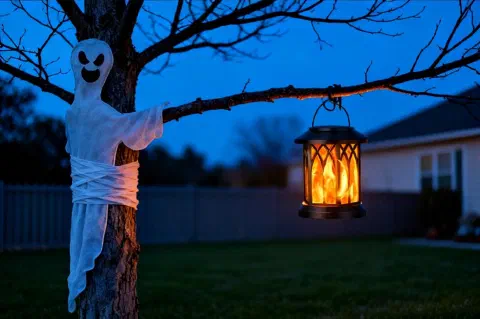
A hanging shape does the same job from a branch instead of a wall. Cheesecloth ghosts stiffened and hung outside drift whenever the wind picks up, which is the one thing a flat silhouette cannot do.
The setup, in the order that works
- Walk to the sidewalk at night before you buy anything. Note where the streetlight falls, which parts are already black, and which wall faces the street squarely. That wall is your silhouette surface.
- Set the near layer first, six to eight feet apart along the walk and up the steps, warm only.
- Turn everything else off and check the ground reads. If you cannot see the edge of the walk from the sidewalk, the near layer is too dim or too spread out. Fix it before anything else goes down.
- Add the eyes at the middle distance, pushed deep enough that the housing is invisible in daylight, at chest to head height, staggered in depth rather than in a line.
- Add the one silhouette last, with a single warm light aimed at the surface behind it, never at the shape itself.
- Stand on the sidewalk for a minute, then walk the yard both directions. Anything that reads from only one angle needs to move. Check again at twilight, not just at full dark.
Solar honesty: what to check before late October
Solar lights need real sun on the panel, and listings are quiet about it.
- A panel in shade does not charge, however bright the day. Under a porch roof, beneath a dense shrub, or under a tree still holding its leaves, a solar unit runs briefly at dusk and quits.
- Runtime drops as October goes on. Shorter days, a lower sun, and overcast weather all cut charge, so the light that ran all evening in early September may not last through trick-or-treating on the 31st. Nobody can give you an honest hour figure, because it depends on your sky and your panel placement.
- Wipe the panels. Dust, pollen, or one fallen leaf across a small panel costs real charge time.
- Keep a non-solar option for the dark spots. That is what the Peep n’ Peepers unit is for.
For the deeper version, see The Walmart Solar Lights I’d Use for a Softer Garden Path .
Weather and Electrical Checks Before Halloween Night
- Use only light strands and extension cords marked for outdoor use, and plug outdoor electric decorations into a GFCI-protected circuit.
- Inspect lights and cords for damage, keep cords out of standing water and the clear walkway, and secure lights to firm supports without pinching the insulation.
- Follow the product’s weather rating. Bring lightweight webbing, paper, and unsealed props inside before strong wind or heavy rain instead of leaving them to fail in place.
- Turn off outdoor electrical decorations before bed or when nobody is home.
NFPA’s decorating guidance covers the cord, support, and shutoff checks. The U.S. Consumer Product Safety Commission’s Halloween guidance also recommends safety-tested decorative light strands and warns against overloading extension cords. These checks protect the visibility plan, because a darkened path or damaged cord is not a design problem to solve after sunset.
Keeping it running through the last week of October
- Charge new solar units in full sun for two or three days before placing them. Most ship with the switch off, and a first evening on a half charge is disappointing enough to make people return a fine product.
- Stake everything deeper than feels necessary, then push it again after the first hard rain. Soft ground and a windy night is how stake lights end up flat by morning. Pull the spider web in ahead of a real storm.
- Check the eyes from the sidewalk once a week. Shrubs settle, and a unit placed perfectly in early October can end up swallowed by foliage.
The mistakes that make a yard vanish at night
- Everything on one plane. The most common one, and the reason for this whole article.
- One bright floodlight. It blows out what it hits and blackens everything else.
- Colored light everywhere instead of in one place. Purple across the porch and green across the hedge is a color cast, not a scene.
- Lighting the silhouette instead of the surface behind it. Aim a light at a black plastic spider and you get a shiny gray plastic spider.
- Judging the whole thing from your own front door. You are the only person who ever sees it from there.
What I’d Actually Buy
Buy the near layer first. Warm light along the walk fixes more of the problem than any object does, and it stays useful into December.
- IkeeRuic solar torch lights with flickering flame (opens Amazon in a new tab) (Best Seller, 4.3 stars, about 10,100 reviews). The warm base layer, and the piece that reads as fire from a moving car.
- DenicMic 10-pack solar stake lights, waterproof (opens Amazon in a new tab) (Amazon’s Choice, 4.5 stars, about 9,400 reviews). Ten stakes covers a typical front walk. Take the orange, not the purple or green versions of the same stake.
- ASMAD solar scary eyeball lights, 4 pack, 32 LEDs (opens Amazon in a new tab) (4.5 stars, about 8,900 reviews). The middle distance. The sway is why these read as alive instead of electronic.
- vignuto scary eyeball lights, 4 packs, 32 LEDs, IP65 (opens Amazon in a new tab) (4.6 stars, about 3,400 reviews). Same idea, higher rating. Confirm the power source first.
- Peep n’ Peepers flashing eye light (opens Amazon in a new tab) (4.4 stars, about 1,100 reviews). For a spot with no sun: a deep porch corner, an unlit window, the gap under the steps.
- OCATO 200 inch spider web with 59 inch giant spider (opens Amazon in a new tab) (4.5 stars, about 5,600 reviews). The far silhouette, large enough to read from the street.
Check each listing for pack counts, colors, and power source before ordering, and give any solar unit a few days of sun before judging it.
Related
- Cheap Halloween Decor That Doesn’t Look Cheap is the indoor half of the same argument, and where the one-colored-accent rule comes from.
- Halloween Front Porch Decor: The Lit Ghost Look covers the porch itself once the yard around it is lit.
- 5 Walmart Lighting Finds for a Warm, Welcoming Front Porch has the warm porch fixtures that stay up long after October.
- A Small Entryway Ready for Trick-or-Treat Night picks up at the door, with a clear path and visible steps.