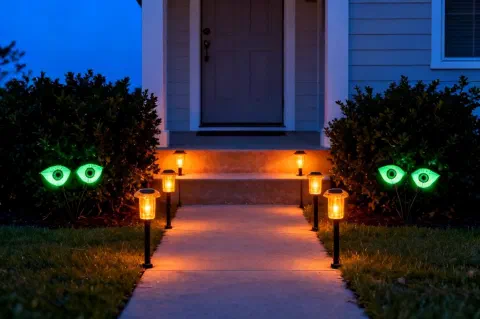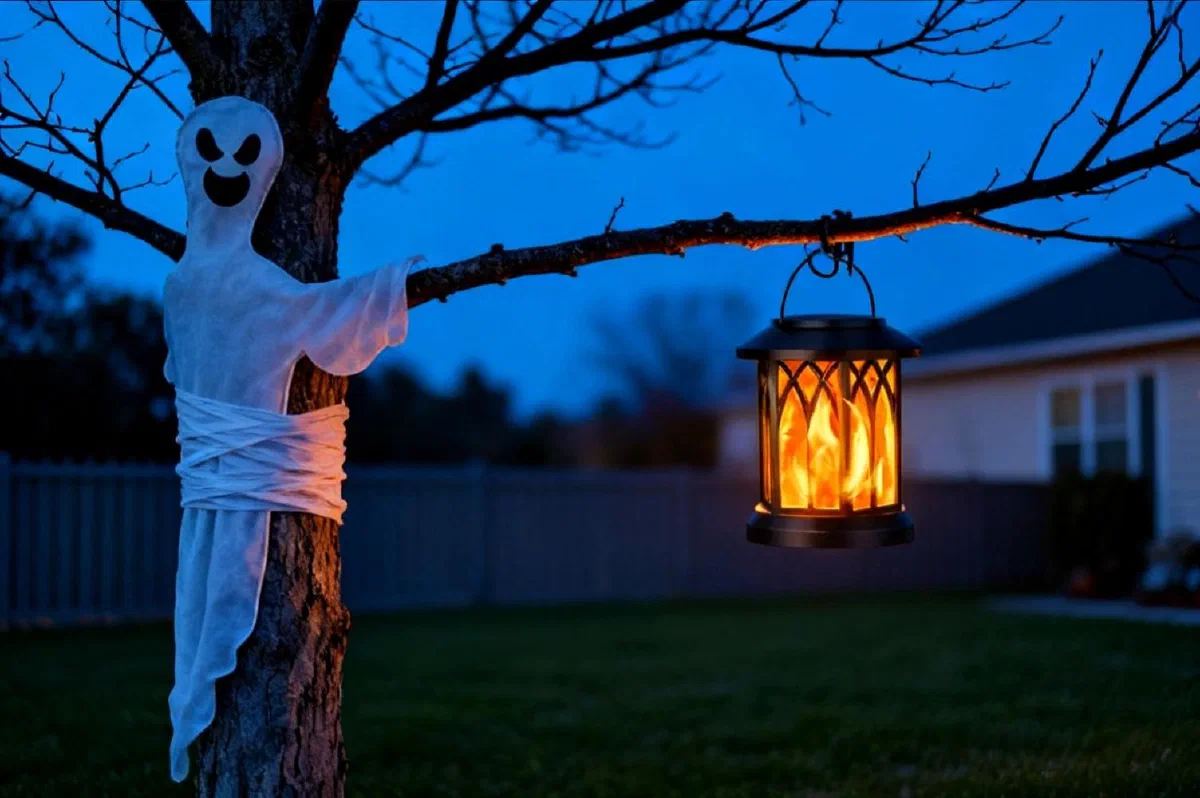
Stand at the curb on Halloween night and most front yards read the same way. A row of small shapes on the grass, every one at knee height, every one lit from the front, and not one of them moving.
The tree in that same yard is doing nothing. It is fifteen or twenty feet of vertical space that clears the parked cars, the fence, and the neighbor’s hedge, and in most yards it is the only thing tall enough to be seen from three houses down.
Outdoor Halloween tree decorations fix the two things ground props cannot: height, so the display registers before anyone reaches your walk, and movement, because a figure hung from a branch swings and turns on its own.
The silhouette is a bonus. A shape hung against open sky reads with almost no light of its own, which objects sitting on dark grass never do.
| What you hang | Where it goes on the tree | The job it does |
|---|---|---|
| Warm hanging lanterns | Low inner limbs, close to the trunk | Gives the tree an inside, so it reads as depth instead of a dark mass |
| One lit figure | The main sightline limb, above head height | The anchor, and the piece people see first from the street |
| Light free-hanging figures | Outer limbs, wherever the wind reaches | The movement, and the reason the tree looks alive |
| Heavier silhouettes | Strong inner limbs, hung lower | Scale and weight, so the tree is not all flutter |
| A trunk wrap | The trunk itself, near eye level | The fallback when nothing overhead is reachable |
A real yard tree or a light-up Halloween tree?
Search results mix two different projects under the same name. Decide which one you mean before you buy anything.
| Type | What it is | Best use | Main limit |
|---|---|---|---|
| Decorated yard tree | An existing tree with removable lights and hanging pieces | A layered display visible from the street | Needs reachable, healthy branches and a wind plan |
| Artificial light-up tree | A freestanding seasonal decoration with built-in lights | A porch, covered entry, or bare spot without a usable tree | Storage, anchoring, cord routing, and weather rating |
| Trunk wrap or tree face | A decoration strapped around the trunk | A young tree or a tree with no safe overhead reach | Reads at eye level but does not add movement above the yard |
This guide is for decorating a living yard tree. If the only usable tree has damaged limbs, touches utility lines, or requires a ladder you cannot place safely, use a freestanding piece on the ground instead.
Which tree to choose: branch height, the streetlight, and what the neighbors see
Most yards have more than one candidate, and the wrong one wastes the effort.
Start with reachable branch height. You want the lowest sturdy limb between about seven and twelve feet. Below seven, everything hangs in grabbing range on the one night when a lot of small hands walk past. Above twelve, you need a ladder for every adjustment, and adjustments are most of this job.
Look at where the streetlight falls. A tree in full glare goes flat, because the light hits the front of everything and kills the shadow. A tree in total blackness gives you nothing to hang shapes against. Take the one at the edge of that pool of light.
Check the sightline both directions. Cars park where they park, and a tree that reads beautifully from the north can be blocked from the south.
Open beats dense. A maple, an oak, a crape myrtle, anything with space between the limbs lets figures swing freely and light through from behind. A dense conifer swallows whatever you put in it.
One tree done properly beats three trees with a piece each. That reads as clutter from the curb.
Hanging without girdling the bark
This is the part worth getting right, because the tree outlives the decorations by decades.
The University of Minnesota Extension’s guidance on staking and guying trees states the principle most clearly. Any material connected to the stem should have a broad and smooth surface, and it names wide canvas strapping, burlap, strips of old carpeting, and bicycle inner tubes. It warns specifically against threading rope or wire through a section of garden hose and wrapping that around the trunk, because abrasion and compression follow quickly, and it notes that supports left on too long can girdle a tree.
That was written about staking, where material stays on for a season or more, so girdling is not the realistic risk across six weeks of October. Abrasion is. A thin cord under tension saws at bark every time the wind moves the piece.
- Nothing thin, nothing tight. No wire, no fishing line, no zip ties cinched around a limb, no bare twine under tension.
- Use something broad. Wide cloth strap, burlap, an old inner tube, or soft rope with cloth between the rope and the bark.
- Hang over the limb, not around it. A loose loop resting on a branch lets both the branch and the piece move, which is the point. A cinched knot does neither.
- Never a nail, screw, or hook, and stay off the trunk where you can. A limb recovers from a light rub better than a trunk does.
- Take everything down in one pass at the end of the season, straps included, so nothing gets the chance to embed.
The tree is the far layer, not a second porch
This is where most decorated trees go wrong.
Halloween Yard Decor That Works After Dark lays out the scheme this article sits inside: light at three distances from the sidewalk. Warm light low along the walk at the near distance. One cold colored accent at eye level in the shrubs at the middle distance. One shape set back at the far distance, working as a silhouette rather than being lit itself.
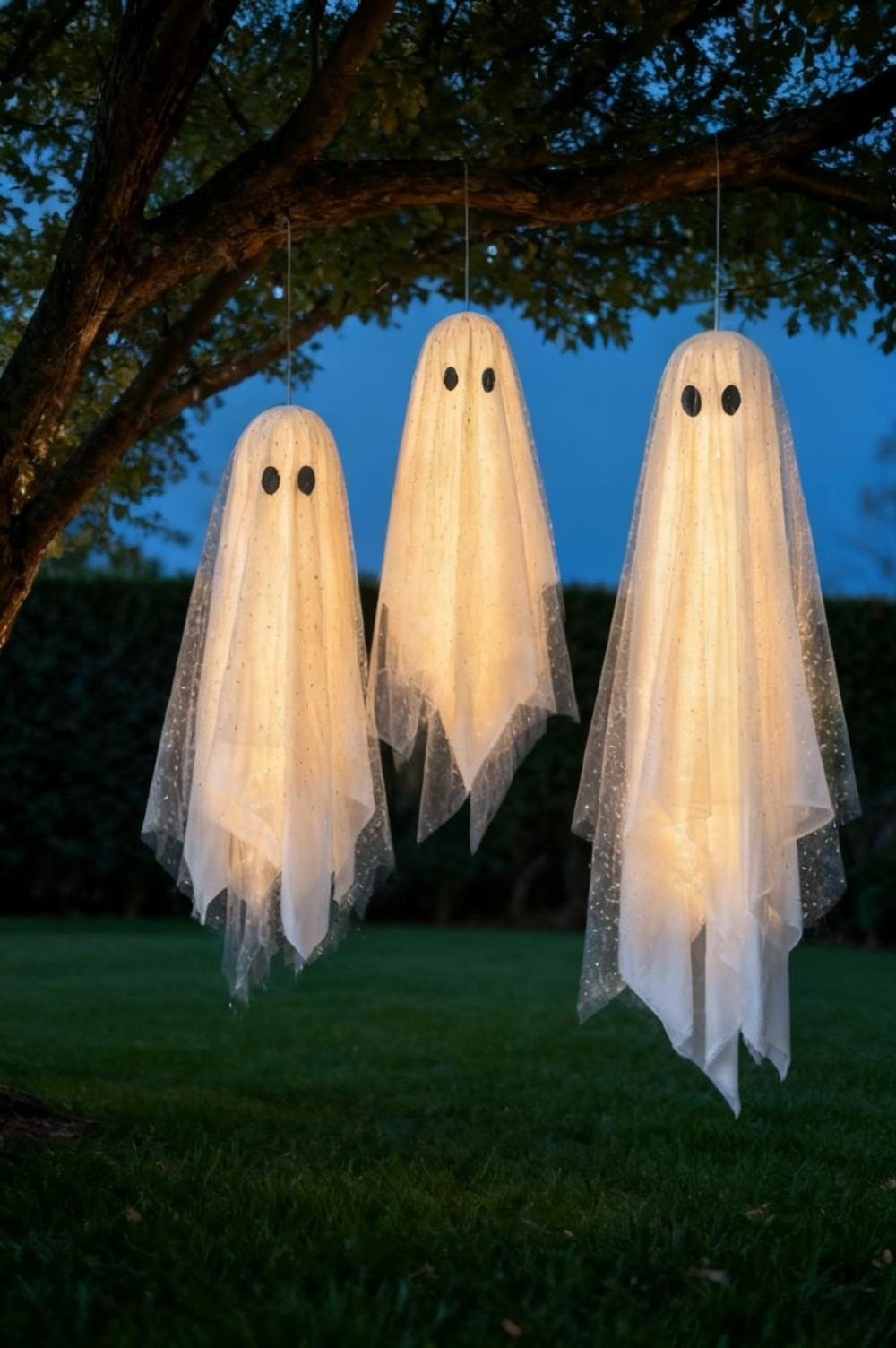
A decorated tree is that far layer. It is the back edge of the yard, the thing that gives the display depth and scale. It is not a second porch competing with the door. Two rules come out of that, and neither is optional.
Do not light the tree in color. Not the canopy, not the trunk, not a colored floodlight at the base. The scheme allows one cold accent per yard, and the glowing eyes at the middle distance already spend it. The rule starts in Cheap Halloween Decor That Doesn’t Look Cheap , and the wording there is worth keeping: one colored bulb is a choice, fifteen is a color cast. A canopy washed in purple or green is the largest surface you own voting for the cast.
Keep the tree’s own light warm and low. The Department of Energy’s guidance on buying energy-efficient light bulbs lists 2,700 K as warm and reading “friendly, personal,” with 4,100 K at the cool end reading “neat, clean, efficient.” Warm light keeps bark looking like bark. Narrow-band color has nothing to give back and turns every surface gray.
What to hang, starting with the light
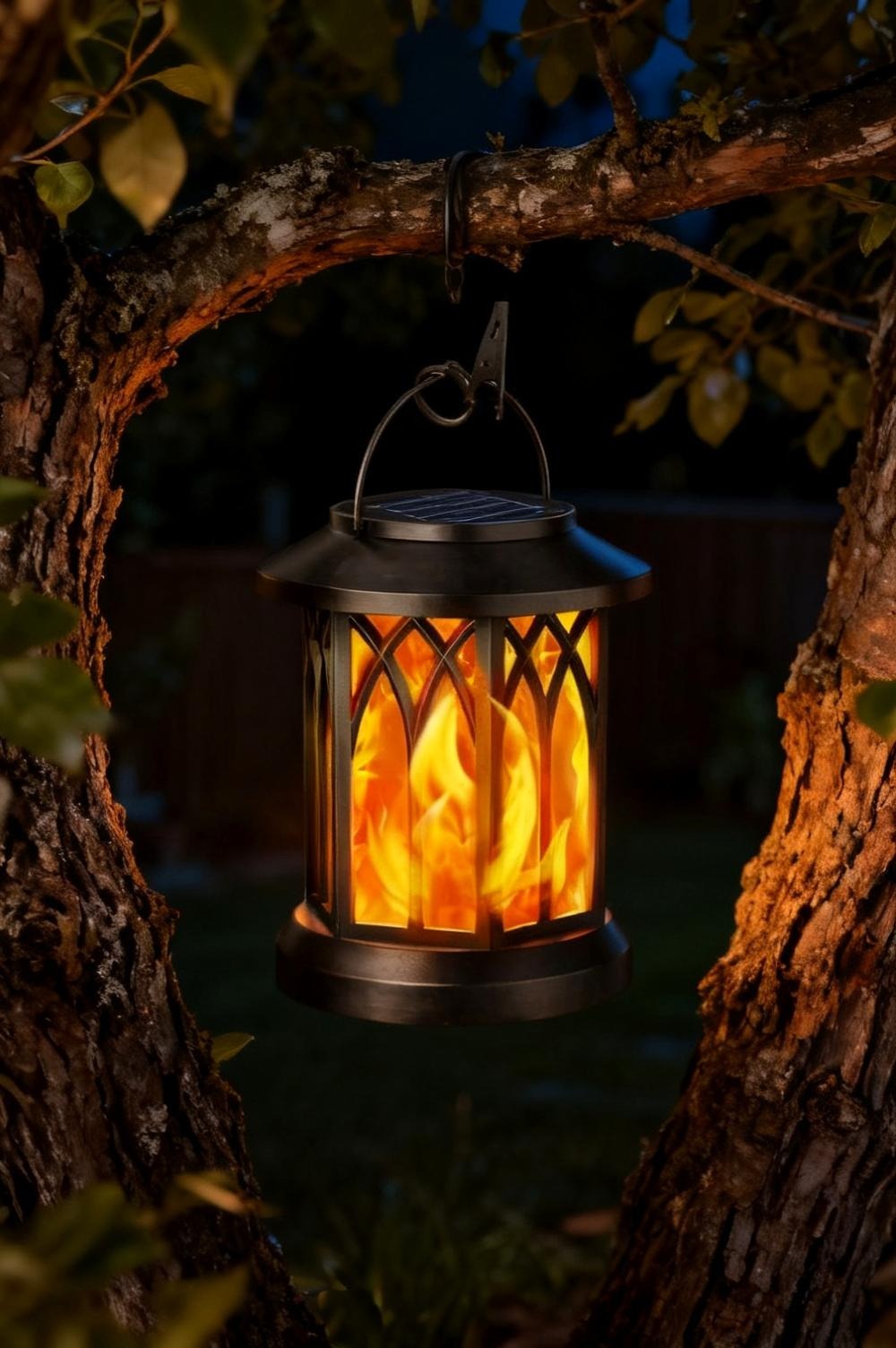
Warm light goes in first, and it hangs low. Lanterns near the trunk light the inside of the tree, so the canopy reads as a space with depth rather than a flat dark mass. KOOPER’s 4 pack of solar lanterns (opens Amazon in a new tab) hold 4.6 stars across roughly 3,200 reviews, the strongest rating in this group, with a flickering flame effect and a waterproof rating on the listing. Moving amber light reads as fire rather than as a fixture. The panel needs real sun, so hang them where the leaf cover is thinnest.
Then one lit figure as the anchor, if you still need one. Look for warm-white light, an outdoor rating, and a timer. I did not find a current lit figure that cleared the same 4.4-star floor as the three picks above, so I would buy this layer locally where you can test the light before it comes home.
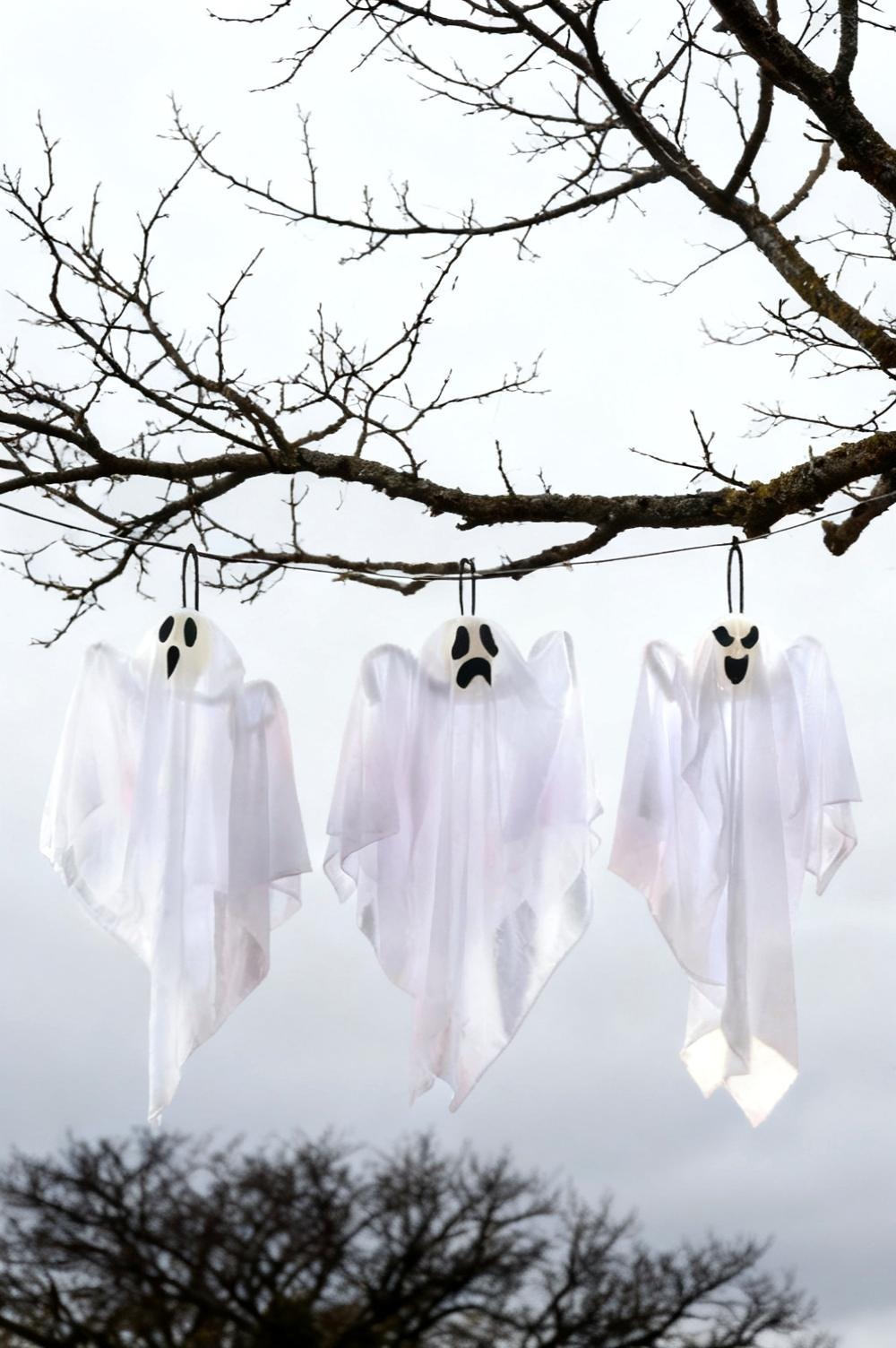
Then the pieces that move. These carry the effect and cost the least. JOYIN’s 3 pack of 27.5 inch hanging ghosts (opens Amazon in a new tab) are 4.4 stars across roughly 1,900 reviews, light enough to turn in air you can barely feel. Hang them on the outer limbs at three different heights, never in a row.
Then weight, so the tree is not all flutter. JOYIN’s 3 pack of hanging skeleton ghosts (opens Amazon in a new tab) are grim reaper figures at 4.4 stars across roughly 2,400 reviews. Hang these lower and on strong inner limbs, where they hold still while the light pieces move around them. A tree where everything flutters at one rate looks like laundry.
And if nothing overhead is reachable, the trunk is the fallback. Use a light fabric figure with broad cloth ties and wrap it loosely rather than tight to the bark. This is another piece I would inspect in person, because the current listing I checked sat below the rating floor used for the three linked picks.
About those ratings, plainly
The three linked picks clear a 4.4-star floor and have roughly 1,900 to 3,200 reviews behind them. I removed the 4.1- and 4.2-star items from the buying list. A badge on a product page is not enough reason to send you toward the weakest-rated piece in the group.
Halloween Front Porch Decor: The Lit Ghost Look found one consistent pattern across the category: lit Halloween decor fails at the light more often than anywhere else. Open every lit piece the week it arrives so a dud is still easy to return.
Wind loading, rain, and what makes it to October 31
Everything you hang in a tree is a sail, and a flat piece of fabric is a very good one. The National Weather Service’s wind safety guidance notes that isolated wind damage is possible when winds are sustained at 40 to 50 mph, and that high winds can blow objects around. You need nothing close to that to lose a decoration, but it sets the scale.
What wind loading means in practice:
- Flat and broad catches the most. A wide sheet-style ghost pulls far harder than an open figure with gaps in it.
- Two attachment points stop the wrap. A large piece on one line eventually winds itself tight around its own cord. Two short lines a foot apart let it swing without twisting.
- Rain makes fabric heavier, and it holds the water for a day or more. Check every attachment after the first real soaking.
- Bring the light pieces in ahead of a storm. They are the cheapest to lose and fastest to rehang. Heavier figures hung low can usually stay.
- Look at where the battery box sits. A waterproof rating describes the figure. Tuck the box under a limb or into a bag.
How to decorate an outdoor tree for Halloween
- Stand on the sidewalk after dark before you hang anything. Note where the streetlight falls, which side of the tree is already black, and which limb sits on the sightline.
- Hang the warm lanterns first, low and close to the trunk, then check from the sidewalk. If the inside of the canopy is not glowing, move them before anything else goes up.
- Add the one lit figure on the sightline limb, above head height.
- Add the moving pieces on the outer limbs, at three clearly different heights, staggered around the tree rather than all on the street-facing side.
- Add the heavy silhouettes low and inside, on limbs that do not flex much.
- Walk both directions, then check again at twilight. Anything that reads from one angle only needs to move, and twilight is when most visitors arrive.
Keeping it up through the last week of October
- Check every attachment weekly and loosen anything that tightened. A strap that started loose can work its way snug after a windy week.
- Untwist whatever wound itself up. A piece wrapped tight around its own line has stopped moving, so it has stopped working.
- Wipe the solar panels. One fallen leaf across a small panel costs real charge time, and October drops leaves onto the surfaces you need clear.
- Expect runtime to fall as the days shorten. A lantern that ran all evening in September may not last through trick-or-treating.
The mistakes that make a decorated tree disappear
- Everything hung at one height. The same failure as a yard on one plane, moved vertically. Three heights minimum.
- Wire, zip ties, or a nail in the trunk. Fast to put up, and the tree carries it for years.
- Lighting the whole tree purple or green. The largest colored surface in the yard, and the one thing this scheme cannot absorb.
- A floodlight aimed up into the canopy. It blows out the near leaves and flattens the depth you hung the lanterns to build.
- One small piece in a big tree. A 12 inch ghost at 20 feet is invisible from the curb.
- Judging it from your own front door. Nobody else ever sees it from there.
What I’d Actually Buy
Buy the warm light first. It gives the tree depth, it is the highest rated thing here, and it stays useful long after the ghosts are boxed up.
- KOOPER 4 pack solar lanterns, flickering flame (opens Amazon in a new tab) (4.6 stars, about 3,200 reviews). The strongest rating here and the piece I would buy first. Low, close to the trunk.
- JOYIN 3 pack hanging skeleton ghosts, grim reapers (opens Amazon in a new tab) (4.4 stars, about 2,400 reviews). The weight layer, hung low on strong inner limbs.
- JOYIN 3 pack 27.5 inch hanging ghosts (opens Amazon in a new tab) (4.4 stars, about 1,900 reviews). The cheapest movement you can buy. Outer limbs, three heights, never in a row.
Check each listing for current sizes, counts, and power source before ordering, and open every lit piece the week it lands so a dud is returnable.
What to Read Next
- Halloween Yard Decor That Works After Dark is the scheme this tree sits inside, with all three distances spelled out.
- Cheap Halloween Decor That Doesn’t Look Cheap is where the warm-light and one-accent rules start, plus the material swaps behind them.
- Halloween Front Porch Decor: The Lit Ghost Look covers the porch under the tree and why lit decor fails at the light.
- Neutral Halloween Decor: 10 Cozy Amazon Finds picks up indoors, with pieces that stay out through November.