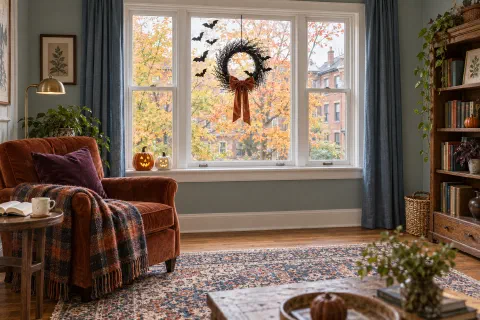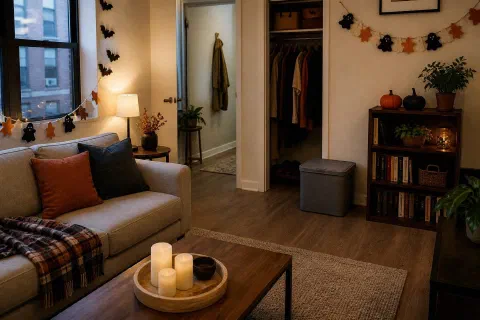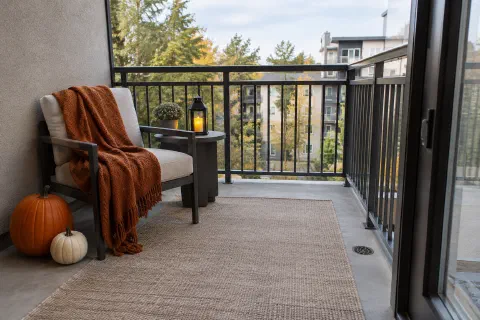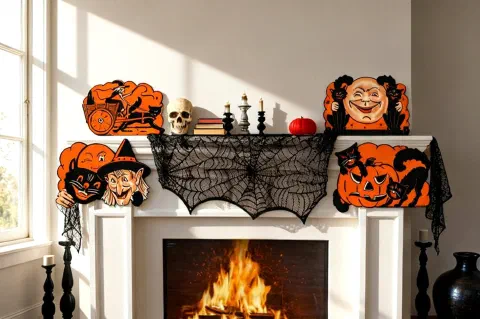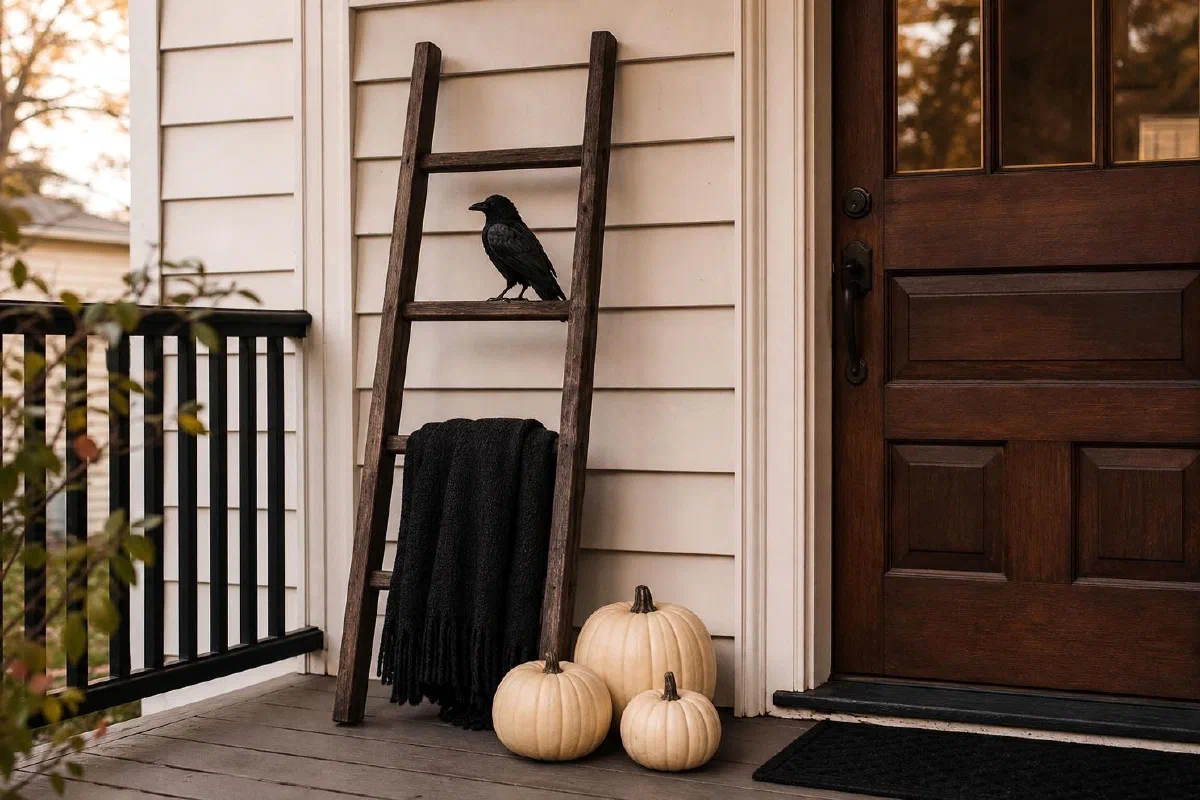
Halloween decor has one recurring problem, which is that almost all of it sits on the ground. Pumpkins on a step, a mat, a couple of things in the grass. The result is a display that reads at six feet away and disappears at twenty, and a porch that looks bare from the street.
A leaning ladder fixes that for less than the cost of one inflatable. It is five feet of vertical in a room or on a porch that has none, it holds a dozen light things at once, it folds flat, and it works indoors or out.
Outdoors it comes with a catch nobody mentions: the moment you hang fabric on it, it is a sail. That part is first, because October is the windy half of autumn and a ladder face down on a wet porch is a bad Saturday.
Blanket Ladder Placement: Indoors or Outdoors
They are not the same purchase, and using an indoor one outside is the most common way people ruin a ladder in one season.
Indoors any decorative blanket ladder (opens Amazon in a new tab)As an Amazon Associate, we earn from qualifying purchases. Full disclosure. works: pine, oak, painted, metal. Finish is a taste question and nothing else.
Outdoors you need one of three things. Either a ladder finished for exterior use, or an untreated one you seal yourself, or one you accept as disposable. Raw pine left on an uncovered porch through October will take on water at the end grain first, grey off, and can spot with mildew in a single wet month. On a covered porch out of direct rain, an indoor ladder is usually fine for six weeks and then wants a wipe down and time to dry before it comes inside.
If you want one ladder for both, buy an untreated pine one and give it two coats of exterior spar urethane or a penetrating exterior oil, paying particular attention to the cut ends of the rails and the feet, which is where water gets in. That is an hour of work and it turns a six week purchase into a several year one.
| Placement | Best choice | Check before decorating | Bring it in when |
|---|---|---|---|
| Living room or hallway | Finished indoor ladder | Level floor, clear doorway, no climbing | Seasonal pieces come down |
| Covered porch | Sealed wood or exterior-rated frame | Roof coverage, wet feet, and top tie | Rain reaches the frame or wind picks up |
| Open porch or deck | Sealed frame with base weight and top tie | Weather rating, stable feet, and clear path | Strong wind or heavy rain is forecast |
This is a decorative display, not a step ladder. The Occupational Safety and Health Administration’s ladder guidance says ladders should be used only for their designed purpose, kept on a stable surface, and secured against displacement. Use those rules as a safety floor even when nobody plans to climb it.
Outdoors, Wind Is the Whole Problem
An empty ladder is mostly air and it barely notices wind. Hang a throw on it and you have created maybe six to eight square feet of solid surface, five feet up, on an object that weighs eight pounds and is resting rather than fixed. That is a sail on a light frame.
You do not need a storm. A gusty autumn afternoon is enough, and the failure is always the same: the base slides out, the lean angle collapses, and it goes over.
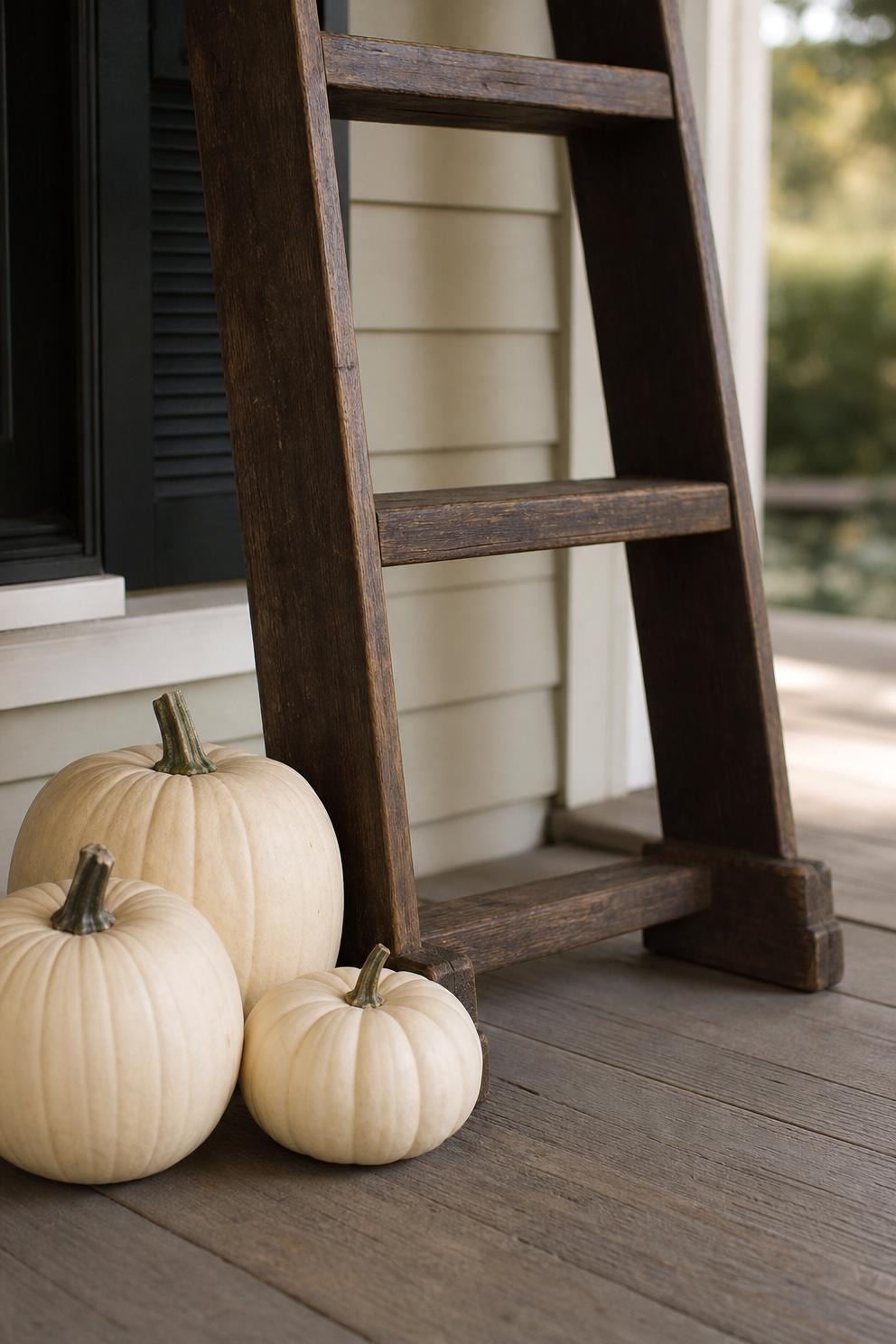
Four things fix it, and on an exposed porch you want at least two of them:
- Weight the base. A sandbag, a filled planter, a bag of play sand in a hessian sack, or two real pumpkins set against the feet. This is the highest value fix and it is also decor, which is why the pumpkins-at-the-base look exists in every good photo of one of these.
- Tie the top to something fixed. A cable tie or a loop of garden wire from the top rung to a porch railing, a downpipe bracket, a post, or a hook. It does not need to carry weight, only to stop the ladder travelling.
- Grip the feet. Rubber furniture pads (opens Amazon in a new tab)As an Amazon Associate, we earn from qualifying purchases. Full disclosure. or a strip of rug pad. Wet painted porch boards are slippery in a way dry ones are not, which is why these often survive three weeks and fail on the first rainy one.
- Cut the sail. If the forecast turns, take the fabric off and leave the frame. An empty ladder with a garland on it rides out weather that a ladder with a blanket on it will not.
Under a solid roof against a house wall, out of the prevailing wind, you can be more relaxed. On an open deck or a balcony, do all four and check it after every windy night.
The Lean and the Tip, Short Version
The stability numbers are the same as any leaning ladder, so here is the summary and the full version with the load table is in Christmas blanket ladder ideas.
- Set the feet out from the wall about one fifth of the ladder height. Eight to fourteen inches for a five foot ladder.
- Keep the heaviest item on a low rung, not a high one.
- Total load under about thirty pounds, and less outdoors.
- A decorative ladder is not a step ladder. Nobody climbs it, and on Halloween night there will be children who would like to try.
Two things specific to Halloween. Keep the ladder out of the walking path, because on the one night of the year strangers walk up to your door in the dark wearing costumes with restricted vision. And keep it clear of the step edge, so nobody puts a foot between the feet of the ladder and the stair nosing.
Three Looks, From Least Spooky to Most
Pick one and commit. Mixing all three is how a ladder ends up looking like a clearance aisle.
1. Harvest neutral
Cream, bone, dried grass tones, dark wood, and a single deep note like burgundy or aubergine. A cream or oatmeal throw, a few berry stems and rose hips woven through the rungs, two or three matte cream pumpkins at the base, and a small dried wreath leaned at the top.
This is the version that carries all the way from late September to Thanksgiving without touching it, and it is the one that will not look like a party supply in photographs. It is the same logic as neutral Halloween decor.
2. Vintage Halloween
Black, cream, and a muted rust or mustard rather than a bright orange. Matte black crows, old-paper style prints clipped to the rungs, a black knit throw, black taper candles in brass holders at the base, and a bat or two in cut metal rather than paper.
The rule that makes this work is desaturation. Vintage Halloween reads as expensive because the colours are dusty rather than bright, and because the black is matte rather than glossy. More on the finishes in vintage Halloween decor that still looks good.
3. Full spooky
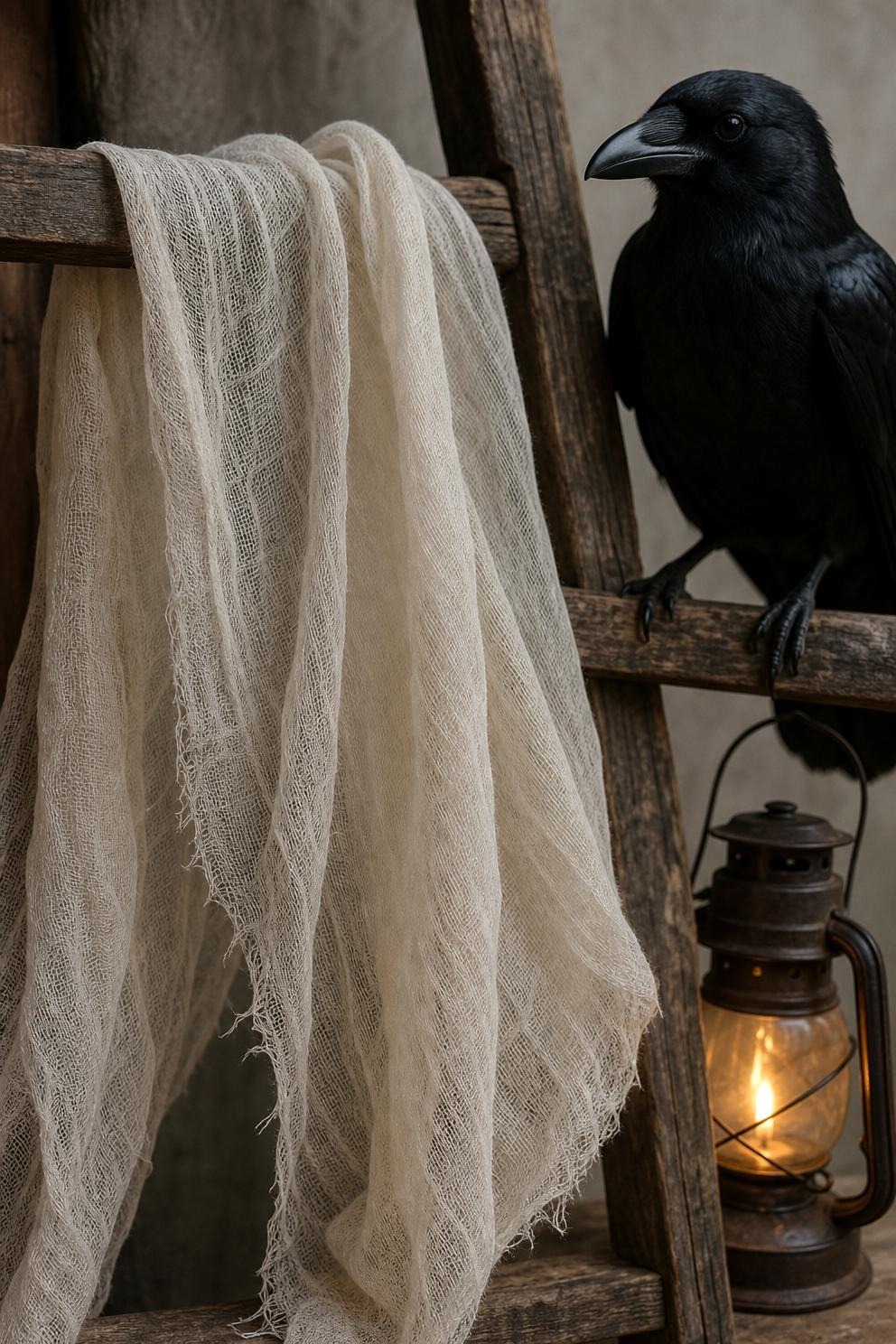
Cheesecloth draped through the rungs, a lantern with a flameless flicker candle, cobweb stretched thin, a skull or a crow, black and deep purple. This one is genuinely fun and it is also the easiest to overdo.
One rule if you go here: thin the cheesecloth (opens Amazon in a new tab)As an Amazon Associate, we earn from qualifying purchases. Full disclosure. until you can see through it. Cheesecloth that still looks like a folded packet of cheesecloth is the single biggest tell. Pull it apart until it is gauze, then drape.
What Actually Goes on the Rungs
Good on a ladder:
- A throw, black, charcoal, cream or rust. One, on a low rung.
- Garland, dried orange and rust leaves, black eucalyptus, or a plain evergreen for the vintage look. Woven diagonally, behind one rung and in front of the next.
- A matte black crow (opens Amazon in a new tab)As an Amazon Associate, we earn from qualifying purchases. Full disclosure. or two. Perched on a rung, facing slightly off-centre rather than straight out. Matte finish, real feathers or a good flocked one. Glossy plastic is the tell.
- A small wreath at the top, leaned rather than hung.
- Lanterns and flameless candles (opens Amazon in a new tab)As an Amazon Associate, we earn from qualifying purchases. Full disclosure. at the base, not on the rungs.
- Faux pumpkins (opens Amazon in a new tab)As an Amazon Associate, we earn from qualifying purchases. Full disclosure. in a basket at the foot, or set on the floor against the rails.
- Cut metal or thick felt bats. Paper ones outdoors last until the first heavy dew.
Bad on a ladder:
- Anything round on a round rung. A pumpkin on a dowel rolls off. If you want one up high it needs a flat surface or a basket.
- Real flame. A ladder is a wooden frame draped in dry fabric. Flameless only, and that is not a fussy rule.
- Heavy ceramics. They fall on a hard floor or a stone porch, and they take the ladder with them.
- Paper anything, outdoors. Rain and dew both.
- A full-size skeleton. The weight is wrong and the proportion fights the ladder. Put it in the yard.
Battery String Lights and Flameless Candles After Dark
A Halloween ladder in daylight is decor. Lit, it is the reason your porch reads from the pavement, and it is the single largest difference between the ones that photograph well and the ones that do not.
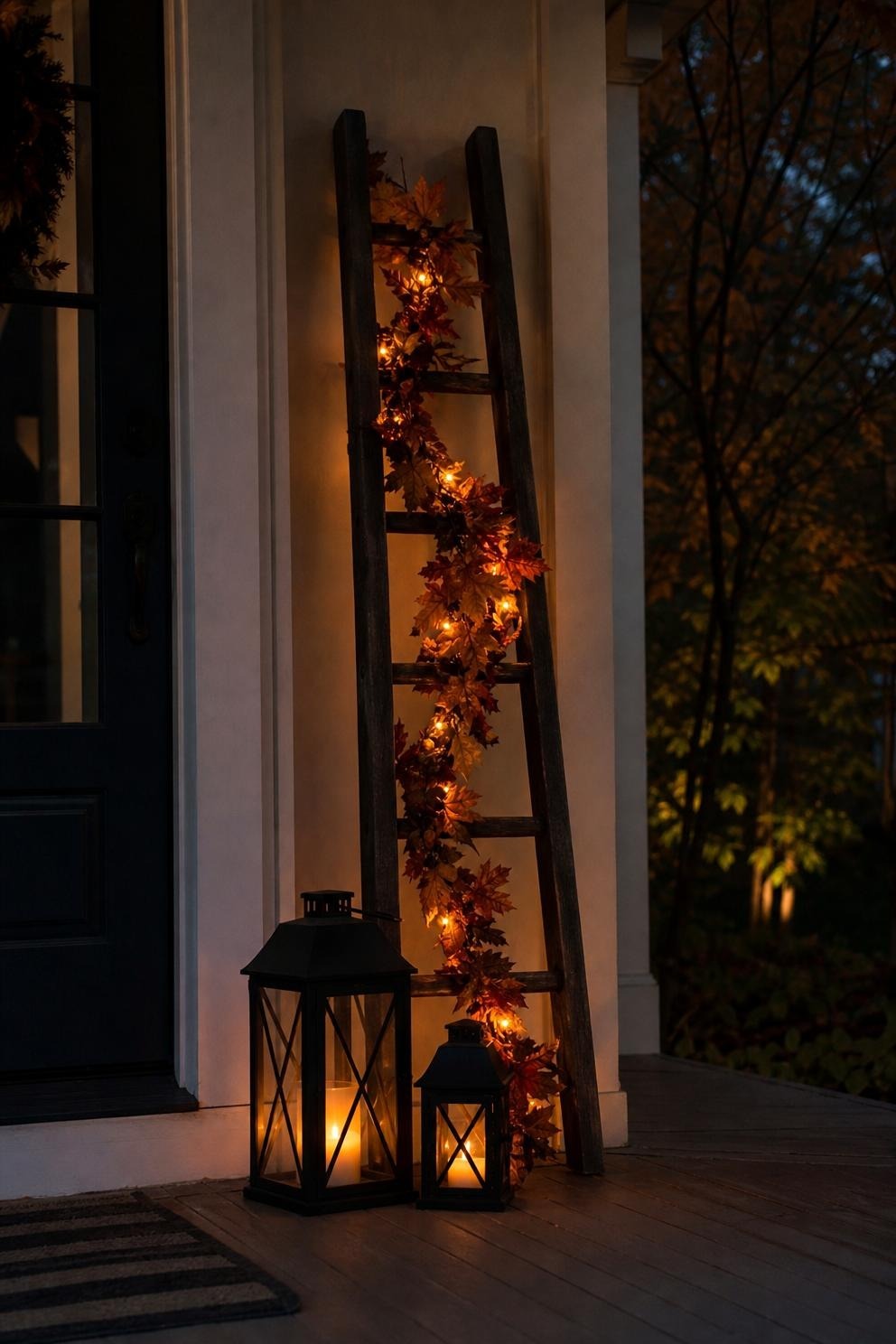
Battery string lights with a timer are the workhorse, and a leaf garland that already has them woven in (opens Amazon in a new tab)As an Amazon Associate, we earn from qualifying purchases. Full disclosure. saves buying both. Warm white for the harvest and vintage looks, and warm white for the spooky one too, because coloured bulbs go novelty fast. A six hour timer means it comes on around dusk and shuts itself off overnight.
Flameless pillars (opens Amazon in a new tab)As an Amazon Associate, we earn from qualifying purchases. Full disclosure. in a lantern at the base do more than lights on the rungs, because they throw light upward across the ladder and put the whole frame in relief. Two lanterns, at different heights, one on the floor and one on an upturned crate or a low stool.
A note on solar. It is tempting outdoors and it is unreliable in late October, because the days are short and the sun is low, so a panel that ran eight hours in August runs two or three by Halloween. If the ladder is under a porch roof, the panel gets even less. Battery with a timer is the honest recommendation for this specific six weeks. The same reasoning is in Halloween yard decor that works after dark.
For any plug-in lights, NFPA’s decorating guidance calls for cords and outlets that are weatherproof or marked for outdoor use, string lights listed by a recognized testing laboratory, clips rather than nails so the cords do not get damaged, and shutoff before sleep or leaving home. Keep cords off the walking path and away from standing water.
Leave Rungs Empty
Same rule as every other ladder and it matters most here, because Halloween decor is cheap and the temptation to add one more crow is real.
Fill about half the rungs. On a five rung ladder that is three items. The empty rungs are what make it read as a display rather than a rack, and they are also what lets each object be seen from across a room or a garden.
One thing per rung. A throw and a crow and a garland swag on the same rung is where it turns to clutter, and it is the exact drift that happens over three weeks of adding.
If you want a test: stand fifteen feet back and see whether you can name three separate things. If it is one busy mass, take something off.
Setup for the DIY Ladder
A Halloween ladder is the ideal first build, because it looks better slightly rough than it does perfect.
Two eight foot 2x2s and five dowels, rails cut to five feet, rungs to eighteen inches, holes at twelve inch centres drilled three quarters through the rails, glued and clamped. Cut the bottom of each rail at about ten degrees so the feet sit flat when it leans.
For the Halloween finish specifically, skip the clean stain. A dark walnut stain wiped on and mostly wiped off, or a black stain thinned with water, gives you a weathered frame in one coat. Then knock the edges back with sandpaper so the wood shows through at the corners. That takes twenty minutes and it does more for the look than any object you hang on it.
If it is going outside, seal it afterwards.
If You Cannot Lean It Anywhere
Some porches have no free wall, and a ladder leaning on a railing rather than a wall is unstable because the railing is not a flat surface.
Two alternatives that give you the same vertical:
- Lay it flat against the railing and cable tie it at four points, then hang everything from the rungs as normal. It becomes a trellis rather than a ladder and it is far more stable in wind.
- Stand it in a large planter. Fill the planter with sand or gravel, stand the ladder in it against a post, and tie the top. The planter is the weight and the ladder is fully upright rather than leaning.
Indoors, the narrow wall beside a doorway, the end of a hallway, or the gap between a window and a corner all work, and the ladder wants no more than about two feet of clear wall.
November 1st, and Then December
The best argument for a ladder is that it converts. On November 1st, take off the black elements and the cheesecloth, leave the ladder, the throw and the garland where they are, and add a few more pumpkins at the base. That is a Thanksgiving display in four minutes.
Then in December the same frame takes a cedar garland, stockings and warm lights, which is the Christmas version.
One ladder, three seasons, and a blanket rail for the rest of the year. That is what makes it worth buying rather than the six week novelty it looks like on a shelf in September.
Storage
The ladder itself does not get stored if you use it for blankets year round, which is the point.
Everything else goes into one bin. Cheesecloth folds to nothing and is worth keeping because pulled-thin cheesecloth is better than new. Faux crows and pumpkins go on top so nothing crushes them, garland gets coiled loosely rather than folded, and battery lights get their batteries taken out, which is the step everybody skips and the reason so many sets are dead the next year.
Label the bin by season rather than by room, because this is one of the few sets of decor that moves around the house.
Questions People Actually Ask
How do you style a decorative ladder?
Use about half the rungs and put one thing on each of them, at different visual weights. A folded throw low, something with structure in the middle, and one small item high reads as deliberate. Go diagonally rather than symmetrically, so the eye travels up the ladder rather than stopping at each rung, and weave any garland behind one rung and in front of the next rather than draping it straight down. Then put two or three objects on the floor at the base to anchor it. The empty rungs are doing as much work as the full ones.
Can you put a blanket ladder outside for Halloween?
On a covered porch, yes, for six weeks, and then bring it in and let it dry properly. In the open weather, only if it is sealed. Untreated pine takes water in at the cut ends of the rails first, greys off, and can mildew in one wet month. Two coats of exterior spar urethane or a penetrating exterior oil, paying attention to the feet and the cut ends, turns an indoor ladder into one you can leave out. Either way, weight the base and tie the top, because outdoors the wind matters more than the rain does.
How do you keep a ladder from blowing over on a porch?
Weight the bottom and tie the top. A sandbag, a filled planter or two real pumpkins set against the feet is the most effective single fix, because a leaning ladder fails by the base sliding out. Then run a cable tie or a loop of wire from the top rung to a railing, a post or a bracket so it cannot travel sideways. Stick rubber pads on the feet for wet boards, and if a real gust is forecast, take the fabric off and leave the frame, since the throw is what turns the ladder into a sail.
What do you hang on a Halloween ladder?
A throw on a low rung, a garland woven diagonally through all of them, one or two matte black crows, a small wreath leaned at the top, and thin cheesecloth if you want the spooky version. Lanterns, flameless candles and faux pumpkins go on the floor at the base rather than on the rungs, because anything round rolls off a dowel. Skip paper decorations outdoors and skip real candles anywhere near it. Three items on the rungs is usually the right number, and the objects at the base are what make it look finished.
How do you make Halloween decor look expensive?
Desaturate it and use fewer things. Bright orange, bright purple and glossy black are what read as cheap, and the same objects in dusty rust, bone, aubergine and matte black read as considered. Matte finishes over glossy in every case, natural materials where you can, and one palette rather than three. Then cut the object count by a third. The single most expensive looking Halloween display on any street is almost always the one with the fewest separate items in it.
Can I use the same ladder for Halloween and Christmas?
That is the best reason to buy one. The frame does not change at all. In October it takes a black or rust throw, a crow and cheesecloth, on November 1st you strip the black elements and add pumpkins for Thanksgiving, and in December it takes a cedar garland, stockings and warm white lights. Between January and September it holds blankets. Buy a five foot ladder with rungs about twelve to fourteen inches apart and it will do all four jobs without compromise.
What I’d Actually Buy
Product details can change; check the listing before you buy.
If you buy one thing from this list, buy the ladder, because it is the only item here that works in October, November, December and the other nine months. Everything else is under the cost of a takeaway.
- HOOBRO 5-tier blanket ladder with removable hooks (opens Amazon in a new tab)As an Amazon Associate, we earn from qualifying purchases. Full disclosure.. Five rungs, which is the right count for using three and leaving two bare. Seal it before it goes outside in the open weather.
- Perfnique black metal lanterns, 15 and 13 inch, set of 2, with 6 hour timer candles (opens Amazon in a new tab)As an Amazon Associate, we earn from qualifying purchases. Full disclosure.. Two lanterns at two heights is exactly the setup in the lighting section, and these arrive with the flameless candles and the timer already in them, which saves buying both separately.
- ATDAWN black feathered crows, 6 pack (opens Amazon in a new tab)As an Amazon Associate, we earn from qualifying purchases. Full disclosure.. Real feathers rather than moulded plastic, which is the difference between considered and costume shop. Use one or two on the ladder and scatter the rest.
- Black creepy cloth, 30 by 72 inch, 5 pieces (opens Amazon in a new tab)As an Amazon Associate, we earn from qualifying purchases. Full disclosure.. Five pieces because you will want to pull it thin, and pulling it thin uses more of it than you expect. Save the offcuts, since pulled cheesecloth is better the second year.
- Winlyn small faux velvet pumpkins, 16 pieces (opens Amazon in a new tab)As an Amazon Associate, we earn from qualifying purchases. Full disclosure.. Matte and muted rather than bright orange, and small enough to group at the ladder feet without swamping it.
- Luditek fall leaf garland with lights, 3 pack, 24.6 ft total, 60 LED (opens Amazon in a new tab)As an Amazon Associate, we earn from qualifying purchases. Full disclosure.. This is the harvest neutral look rather than the spooky one, and the lights are already in it, so it is one purchase instead of two.
- 9 ft black cedar garland, real touch (opens Amazon in a new tab)As an Amazon Associate, we earn from qualifying purchases. Full disclosure.. It is the one garland here that suits the vintage Halloween palette, and the same length works for the Christmas version if you swap it for green.
- Homemory outdoor waterproof flameless candles, 6 by 3 inch, with timer (opens Amazon in a new tab)As an Amazon Associate, we earn from qualifying purchases. Full disclosure.. Waterproof is the word that matters if the ladder is going anywhere near the open side of a porch.
- X-PROTECTOR non slip furniture grippers, 2 inch, 16 pack (opens Amazon in a new tab)As an Amazon Associate, we earn from qualifying purchases. Full disclosure.. Two under the ladder feet. On wet painted porch boards this is the difference between a display and a pile.
No link for a sandbag. A bag of play sand from any hardware store, poured into a hessian sack, is cheaper and looks better at the base of a ladder than anything sold as a decor weight.
What to Read Next
- Christmas blanket ladder ideas for a room with no mantel: use the same frame in December, with the full lean and load numbers.
- Neutral Halloween decor Amazon finds: borrow the muted palette for the harvest-neutral ladder.
- Vintage Halloween decor that still looks good: choose finishes that keep the ladder from reading like a costume-shop display.
- Halloween yard decor that works after dark: extend the after-dark lighting plan from the ladder to the yard.
- Cheap Halloween decor that does not look cheap: decide where to spend if the ladder is the only new piece.